Rebirth (Youkame no semi) 八日目の蝉

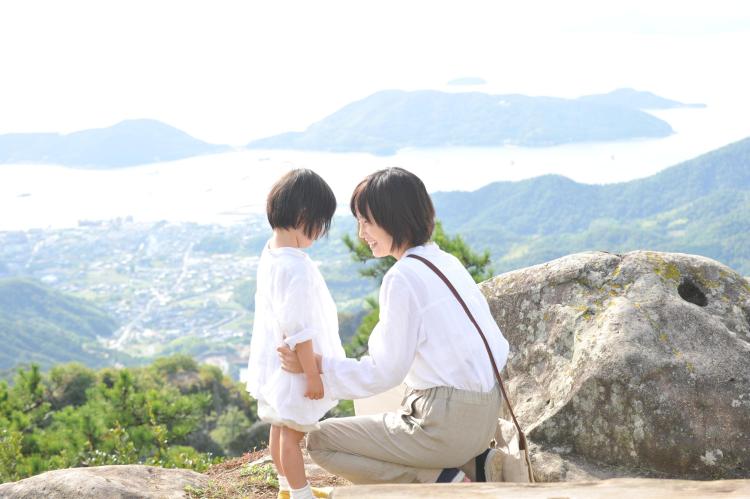
高解像度寒霞渓First of the Japan Foundation Touring Film Programme for this year up on UK-Anime.net. I’m going to do a general round-up later in the week but this was the best of the (impressive) bunch.


Kiwako has been having an affair with a married man who swears he’s going to leave his wife (just not right now) but now things have come to a head as she finds out she’s carrying his child. Despite her being desperately happy and excited about it – planning to call the child Kaoru and designing visions of the a domestic bliss, Kiwako’s married lover is decidedly less enthusiastic and persuades her to opt for a termination. However, complications from the procedure leave her unable to have any more children and she also begins being harassed by her lover’s wife who finally turns up on her doorstep one day, heavily pregnant, to taunt her – going so far as to remark that her ‘barren womb’ is a direct result of her immoral relations with her husband. One day Kiwako just snaps and in an act of madness abducts her lover’s newborn baby and raises the child as her own for four years until she is finally caught.

In the present day, Erina – who was Kaoru, raised by Kiwako for the first four years of her life, has grown up and is in college. She is deeply scarred by the traumatic events of her early childhood and seems to have difficulty with forming relationships with people, not that she seems to want to make any. After being returned to her birth parents she struggled to adapt to her new life and her birth parents struggled to come terms with everything that had happened. Now, as a young woman, Erina finds history begin to repeat itself in more ways than one and she’s forced to consider who she really is and what she wants out of life. In order to do that, she’ll finally have to confront her traumatic past and all of the complex questions and emotions that will inevitably arise.

In a Chalk Circle-esque way, Rebirth wants to ask a lot of questions about motherhood. Who is the mother of this child really? The woman who gave birth to it or the one who has cared for it all its life and who the child regards as its parent? It is obviously a terrible situation for all involved – the birth parents have lost their child, something truly awful, but the child now believes her abductor to be her mother and ‘returning’ her to a pair of ‘strangers’ she has no recollection of is beyond cruel. Being cruelly ripped away from everything she knew would be traumatic enough, let alone being dragged away from her ‘mother’ in a car park late at night and bundled into car by a harsh woman who tells her she’s being taken to her ‘mummy’ when her total understanding of that word is being handcuffed and taken away.

At only four years old you might think she’d be young enough to gradually ease back into her birth family, and you might be right had her natural parents been better equipt themselves to cope with the situation. Erina’s mother is very definitely of the ‘carry on as if nothing happened’ school so any allusion to the first four years of the girl’s life provokes a hysterical fit that only further exacerbates the confusion already ripping apart the poor child’s soul. So jealous is she that she’s effectively projecting all her resentment and bitterness towards Kiwako’s actions onto the child itself – as if she can’t forgive her for the crime of growing older or having spent so much time with the other woman. The child is a reminder of the trauma of its disappearance, of her husband’s infidelity, and subsequently of her own fear of not measuring up as a mother.

Izuru Narushima has crafted an intense and deeply layered character study that neatly sidesteps the risk of becoming as overblown or melodramatic as the plot description might sound. He approaches the subject matter with great sensitivity and with as even a hand as is humanly possible. His camera is incredibly non-judgemental and treats each of the characters with the same level of sympathy and understanding. Surprisingly, it is the birth parents that become the most difficult to sympathise with but even they are presented with a great deal of compassion.

Rebirth is certainly a very complex film that raises all sorts of uncomfortable moral questions from the nature of motherhood to the treatment of the women of society. If I had one criticism it would be that the male characters don’t come out of this well at all – which may be slightly unfair given the deliberate similarity between the two prominent male characters, but certainly the portrait it paints of masculinity is far from flattering. The performances are astounding, particularly those of Mao Inoue (probably still best known for Hana Yori Dango) as the damaged Erina and Hiromi Nagasaku as the desperately maternal Kiwako. Excellently shot and fantastically well conceived Rebirth is one of the best Japanese films of recent times.

I Wish (Kiseki) 奇跡

IMG_0227

Review up over at UK-A for the latest Kore-eda  to fetch up on out shores. Well, actually, I reviewed this at the LFF in 2011 as well but I like to think I’ve come on as a writer since then (maybe not though, oh well, I still have a ways to go). If this is playing anywhere near you I very much urge you to go and see it even if just to show there is still an audience out there for seeing Asian films in the cinema. It’s a great movie though!

Weekly Rundown 21st-27th January 2013

Django Unchained

Mixed thoughts – it is a little long and has a few other problems here and there but I enjoyed it a lot.

Piano 17

Not as good as I’d been led to believe but an OK crime caper with TV production values. The subtitles were pretty awful but it encouraged me to turn them off for better Italian practice 🙂

Lincoln

Would have liked this a lot more if it hadn’t been for the ever present John Williams score. Excellent script, excellent performances and excellent filmmaking but somehow it falls on the slightly trite side for me.

The Blue Angel

Der Blaue Engel

Eureka’s new Blu Ray edition of the first collaboration between Von Sternberg and Dietrich. I’ve only watched the German version so far but this is an excellent transfer and of course the film is essential viewing. Tony Rayns’ commentary track is worth the price of admission alone!

Once Upon a Honeymoon

Being a lover of screwball comedies and not having heard of this one I dutifully went down to the BFI during their screwball comedy season to give this a go. There was a reason I’d never heard of it – IT IS AWFUL. At one point the leads get sent to a concentration camp by mistake which is every bit as funny as it sounds. Accidentally offensive, totally not funny and with the least interesting romance ever committed to celluloid I feel it is my duty to strongly recommend you DO NOT EVER WATCH THIS FILM!


Watch Bringing Up Baby instead. It’s the funniest film ever made – that’s how you make a screwball comedy!

Piccadilly

Another choice offering from Mubi, BFI’s recent restoration of the 1929 silent film. The credits included those for the new score but there was no sound at all when I streamed it so I watched totally silent. Excellent cinematography and an almost proto-noir atmosphere make this a very interesting late silent feature.

Clone

Womb

Weird film about a woman who gives birth to the clone of her recently deceased boyfriend and then continues to feel conflicted about it forever. Weird, just weird. Doesn’t really engage with any of the issues you might expect it to raise so obsessed is it with its own weirdness! It’s quite forgettable as a consequence.

Weekly Rundown 14-20th January 2013

Pickpocket

Xiao Wu 小武

Jia Zhangke 1997

Jia Zhangke’s earliest (feature) film is a hard hitting character study of a petty thief trapped in criminality in a small mainland town. Rough and raw it paints an uncomfortable picture of modern Chinese life.

The House I Live In

A tough documentary which posits that the ‘war on drugs’ is only perpetuated because it’s politically (and finically) expedient even though those in power are aware their actions carry little social good.

Padre Padrone

Story of a small town shepherd boy cruelly ripped away from his education and childhood by an overbearing father who forces him to protect his flock from bandits. A harsh look at a primitive way of life and the relationship between a violent father and his helpless children. Haunting.

Nostalgia for the Light

Another moving documentary which links the astronomers gazing into space in the Chilean desert with the women still gazing down into the sands looking for the remains of loved ones disappeared during turbulent years of revolution and dictatorship. Profound and devastating but ultimately imbued with a sense of hope.

Street Mobster

現代やくざ:人斬り与太  Gendai Yakuza: Hitokiri Yota

Another Fukasaku and the last from Eureka’s first box set. I preferred this one to Yakuza Graveyard.

Dragon Head

Full review here. Much more impressive than you’d think post-apocalyptic adventure with Satoshi Tsumabuki and Takayuki Yamada.

Another Earth

Light sci-fi film that’s more about guilt, responsibility and introspection. Interesting but perhaps little too indie for its own good.

Zero Dark Thirty

Full review coming soon. This film is already attracting a lot of controversy because its politics or at least those some people have inferred from the film. I had a range of complex reactions and I’m not sure I’ve really sorted them out yet.

Flashpoint

Generic martial arts film with Donnie Yen. I actually thought it was much better than its reputation – yes, the plot is paper thin (even for a kung-fu movie) and the characters are poorly drawn and mostly just genre stereotypes but the action’s pretty good and it does what it claims to do fairly well. No masterpiece certainly but watchable.

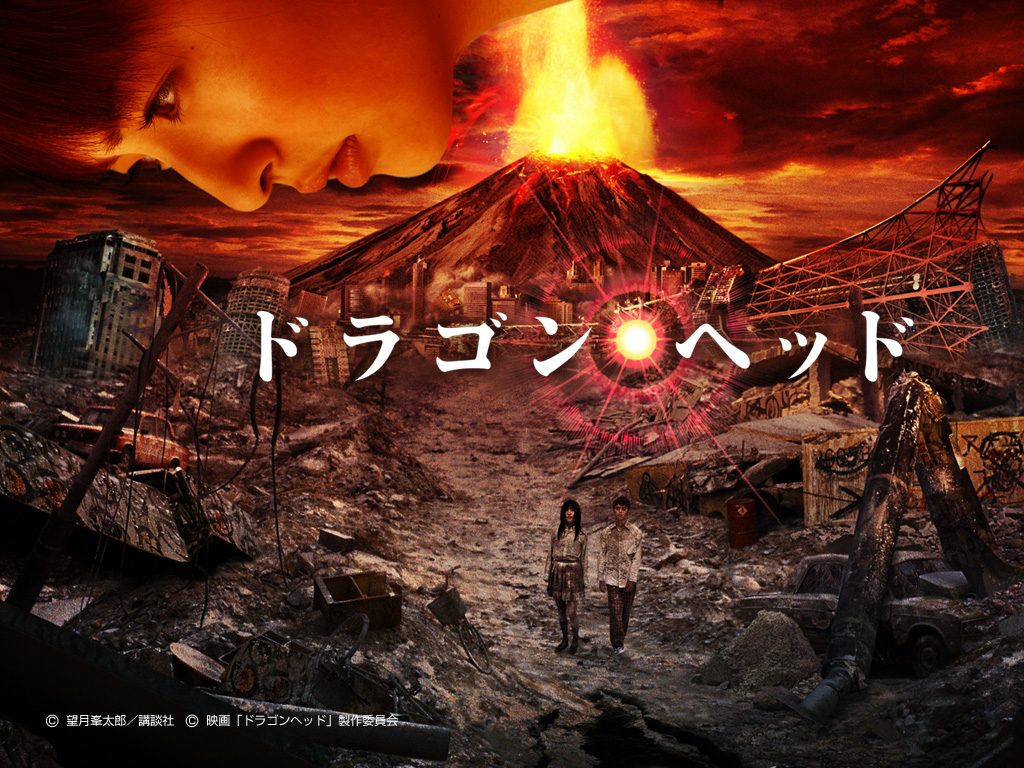
Dragon Head (ドラゴンヘッド, Joji Iida, 2013)

220992

Judging from the scene that surrounds Teru (Satoshi Tsumabuki) as he struggles to open his eyes, he’s either just waking up after the best party ever or something truly awful must have occurred. Where is he? Feeling around it seems like there are a lot of seats – a plane, or a train? Yes, a train. He remembers being on some kind of trip with his school mates – they were all on the train together so where is everyone? Struggling to get up, stumbling against walls he finds them – dead, all dead. Seemingly the only survivor of some kind of accident, Teru tries to get off the train to find out what’s happened and look for other survivors. It seems the train is trapped in a tunnel, both ends blocked by fallen rubble. Beginning to fear he really is all alone he comes across another boy perched in the window of an adjacent carriage. Small relief however as Nobuo (Takayuki Yamada) seems to be acting very strangely and muttering on about red lights and embracing the darkness. Evading him leads Teru further along the train where he finds another survivor, a girl – Ako, desperately hiding from Nobuo after witnessing him completely losing control whilst looking for survivors.

You might think this is where our three plucky teenagers club together to figure out how to escape the train wreck and get home, but no this is not that type of film. Quicker than you can say Lord of the Flies, Nobuo has gone completely crazy – painting a strange grin on his face with some lipstick he found and dotting his his chest with it too, he even makes a makeshift spear go with with new tribal outfit as a sort of dedicatory effort to his new red light god. He’s very much of the opinion that this stretch of tunnel is the only safe space left on earth and its three inhabitants have inherited a new eden, if they’d just learn to accept it. Teru and Ako though, clearly terrified by Nobuo’s transformation, do little other than wait for help to arrive. When serious tremors start to shake the tunnel and they no longer have any choice but to act they finally manage to climb out through a supply tunnel. What they find on the other side though is a vast desert of ash – all visible signs of human civilisation have been destroyed and they seem to be alone in the world.

Dragon Head is a bleak, seventies style post-apocolyptic drama in which our ‘heroes’ discover that the threads that hold society together are incredibly weak and snap the moment the slightest pressure is placed upon them. Without spoiling too much, we never find out exactly what it is that has happened, only that whatever it was caused people to turn on each other in a terrible fashion and those few who have survived only want to forget. During in their travels our, frankly unbelievably clueless and incredibly lucky, duo come across a town full of men who’ve decided not to go on and don’t want anyone else to either; mercenary soldiers with dubious motivations; a pair of strange brothers who’ve been surgically altered to remove all trace of fear and sadness and myriad other examples of humanity’s darkest places.

In facing the successive crises, it has to be said that Teru and Ako are not exactly survival buffs. They react to each new situation in what might be termed a realistic fashion as far as two teenagers faced with seemingly impossible odds would do. Largely this means there is a fair amount of panic, crying, blind stumbling and a the recurrent idea of simply giving up. This realistic portrayal of ordinary people caught up in an extreme situation is quite refreshing and a direct contrast to the super smart, seemingly indestructible, level headed teens you often find in such movies. However, the vulnerability of the central couple may also be turn off those viewers who find them simply too whiny and wonder why they don’t get on with trying to find a better way to survive.

For what was seemingly quite a low budget picture shot on early digital, Dragon Head features some very impressive visuals. Making use of old school techniques like matte paintings alongside CG effects, the post apocalyptic landscape is rendered in an extremely convincing way and this is certainly one of those films that has made the best of what it had. In fact it benefits greatly from not relying on CGI to the extent other films of its era often did and so appears much less dated in comparison. Its real world effects and attention to detail mark it well above the some of the big budget disaster epics that began to appear around the turn of the century and help it become much more engaging as a result.

Dragon Head is not without its faults – it’s based on a manga which lends it an episodic structure which isn’t always conducive to good cinematic story storytelling. It’s also possible that some of the overarching mythology which isn’t really explored during the course of the film is more fully explained in the manga (not to mention the Seventies style ending) but really these are small problems. Dragon Head turns out to be much more impressive than you’d originally think it would be and offers a refreshing dose of bleakness that’s been absent from our screens for much too long.

Reviewed on R2 Japanese DVD release

Les Misérables

les-mis

Tom Hooper’s starry adaptation of the long running Boublil & Shönberg musical (itself of course adapted from Victor Hugo’s novel) arrives, with curious serendipity, just in time for awards season. Although the RSC’s original stage production was not universally well received, even if its notices were not necessarily as damning as common perception would have it, Les Misérables went on to become one of the most popular musical productions of all time and at the point of writing still regularly sells out in London’s West End more than twenty-five years later. During that time it has gathered a rather fanatical fan base and become a phenomenon in its own right. As might be expected then, interest in a big screen outing has been high for much of the show’s lifetime but for one reason or another plans have never quite come together – until now. Riding on the coattails of the success of the (vastly overpraised) The King’s Speech, Les Misérables: the movie is now a reality.

The big selling point of this adaptation seems to be the decision to allow the actors to sing live, rather than lip-synch to a pre-recorded vocal track as was usual in the classic Hollywood musicals, and it is, frankly, the correct one. Singing live allows the actors to fully inhabit their roles and give a truer, more rounded performance than they would otherwise be able to do. However, it does have its downsides as in the vocals are necessarily rougher, obviously not as polished as they might be sung in a booth free from the real world set constraints and helped along in post by talented sound technicians. Whether one prefers a stronger acting performance or a totally flawless vocal one (leaving aside the ideal of having them both) is perhaps a personal preference and very much open to debate but singing live certainly eliminates the old stuffiness and forced emotion that often characterised the classic musical. Now that the technology exists to make this much easier to accomplish, the practice of live singing could be what finally wakes the movie musical from its long slumber.

Unfortunately, not many of Hooper’s other decisions are as helpful and where Les Misérables falls down it is by his own hand. Largely the directorial problems that plague the film are similar to those of The King’s Speech but here are vastly magnified by the epic nature of the material which, it seems clear, is simply too unwieldy for this style to handle. Broadly speaking, despite its large scale, Les Misérables is guilty of the sin most British cinema is accused of (often unjustly, but not in this case) – it is effectively a big TV movie rather than something which looks authentically cinematic. Much of the film is shot in extreme close up and even with the actors singing directly into the camera like an awkward soliloquy in a televised Shakespearean production. You might think that giving us such supreme access to the actor’s face, something which can never happen in a theatre of course, would allow us ever deeper into the actor’s performance but what it really ends up doing is forcing us into contemplating their performance rather than the drama. That Hooper uses this same technique so often lends the film an odd sort of formulaic monotony which actively works against the audience’s ability to engage.

Further to that the film as a whole is totally monotone, everything only comes in one variety of ‘loud’. Trevor Nunn, the musical’s original stage director is often criticised for his tendency to produce needlessly long productions Hooper’s film version by contrast moves at an extremely fast pace. However, where the stage version has its various moments of introspection or levity everything in Hooper’s construction is quite literally in your face. There’s very little difference in tone between Valjean’s soliloquy and the bombast of One Day More or Do You Hear The People Sing. The comedy numbers, Master of the House & Beggars at the Feast, even in a much compressed format fall completely flat and only serve to hold up the action – the added santa jokes also aren’t in any way humorous and are, if anything, cringeworthy.  Similarly, cutting Dog Eat Dog and relegating the Thérnadiers to comic relief only eliminates the darkness of their characters and paints them as slightly ridiculous Dickensian like rogues rather than the ruthless, selfish, cruel characters they actually are (though it is to be acknowledged that their primary role in the stage musical is that of comic relief).

Hooper also employs several seemingly random canted angles and odd compositions which do nothing except distract. This is further exacerbated by some extremely misguided editing decisions such as in the ensemble number One Day More in which the fast cutting between extreme close-ups makes it near impossible to follow the action or engage with the emotion of the song. Everything just seems to move from one thing to the next with very little connecting it and in the end it feels like a series of music videos connected only by a vague theme.

The saving grace is the high quality of the performances the actors contribute to the film. Anne Hathaway’s Fantine is rightly gaining high praise everywhere for her extraordinary rendition of I Dreamed a Dream with all the pain and bitterness of a woman seduced, betrayed and degraded by life. Eddie Redmayne however, who seems to be getting far less attention, is something of a revelation in the often thankless role of Marius with his impassioned innocence and sweetly powerful singing voice. Jackman in fact turns out to be something of a disappointment, especially when it comes to Valjean’s stand out song Bring Him Home which doesn’t suit him vocally and never quite ignites (in part due to Hooper’s direction). Russel Crowe’s performance as the righteous Javert is an odd one, even if not as bad as some reviews have made out – his singing is not exactly bad but perhaps incongruous with those around him. He also fails to integrate his performance sufficiently and there’s a curious disconnect in his performance when singing. Both Jackman and Crowe come more alive during the confrontation scene, however, the effect of this is somewhat lost through unfortunate sound mixing. Aaron Tveit also gives a very strong performance as the doomed leader Enjolras but it’s a shame that he seems to be so low on the sound mix that we often cannot hear him. As a bonus for those followers of the London theatre scene there are also many cameos from the cream of the West End ranging from background support to featured lesser roles and it maybe that this film has the highest Olivier award count ever seen on the big screen.

It is perhaps a fault in the musical, though the stage has more mitigating factors, but given there have been so many films with a revolutionary bent recently it’s odd that the uprising itself should come across as merely plot point and there’s very little time given over to the plight of the poor other than a few throw away lines about having had a failed revolution already and wound up with another king on the throne and everything worse than before. The student uprising lacks any sort of wider context and one might be forgiven for thinking that it really is ‘a game for rich young boys to play’ and that the people do not join them is not altogether unexpected. In short, despite the commitment of the actors, it lacks passion and comes across as a soulless exercise that fails to rouse the audience let alone the people of post-revolutionary Paris.

Where Les Misérables succeeds it does so because it is ‘Les Mis’ rather than any particular aspect of the filming and in fact often succeeds in spite of itself. It is certainly not the disaster that it might have been and the sung live approach helps ground it in a reality where it may have become even more overblown with non-sync singing but Tom Hooper’s Les Misérables fails on a cinematic level. It doesn’t manage to provoke the instant standing ovation that the closing music is engineered to – where the theatre audience is thrown to its feet the cinema one is wondering where it parked the car. As a film it’s pleasant enough for the most part but will leave you hungry for something more fulfilling later on.

2012 in Review – An Extremely Subjective Top Ten!

I kind of hate trying to come up with a top ten list for a huge variety of reasons: 1) I have an extraordinarily loose grip on time – I can never remember what I saw when or what was this year or last year or a decade ago so trying to even list ten films I definitely watched within a specific period of time is not something my brain is set up for 2) I change my mind all the time 3) I’ve almost certainly left something out due to point 1 4) I’m over sensitive and will probably burst into tears when the inevitable trolling begins OMG I CAN’T BELIEVE YOU THINK AI TO MAKOTO IS BETTER FILM THAN AMOUR, WHAT KIND OF IDIOT ARE YOU OH I SEE YOU ALSO LIKE SEVEN PSYCHOPATHS YOU EVIDENTLY HAVE NO EYES OR EARS, I PITY YOU – GOOD EVENING  5)I feel bad making a list when I didn’t see every film released this year, I don’t even think that would be possible but still it feels wrong from a scientific point of view 6)What does ‘best’ mean anyway? Closest to perfect? could we ever agree on the criteria for this? 7) as usual I’ve totally over thought the whole thing and wasted a whole 200 words on neurotic waffle. Oh well, neurotic waffle is what I do ‘best’, after all….

Ahem, all that in mind, I have come up with an extremely subjective, somewhat arbitrary, list of films I quite liked over the last year. As I say it’s a list of the films I liked the most, I’m not going to try and argue the artistic merits (or otherwise) of all the films on the list or debate the positioning – it’s a simply a list of the films that I either enjoyed the most, was most affected by, or impressed me in the most significant way. Are you all wearing your party hats? Right then, trumpets please


1 Himizu

I reviewed this over at Uk-anime back in June and was completely blown away by it – raw and tender it’s the story of two damaged children trying to find their way in world that’s all sorts of broken. Devastating yet oddly uplifting.

2 Tabu

A tale of longing, loss and the cinema Miguel Gomes’ Tabu is a beautifully made homage to silent cinema. Memory, the passage of time and the relationship between past and present come together to create one of the best European films from the last year.

3 The Master

To say The Master received a divisive reception is to understate the state of affairs. I don’t claim to have understood all of it, but on a first viewing found it utterly overwhelming.

4 Ai to Makoto

Fun, great ridiculous unrepentant FUN.

5 Holy Motors

Strange and extraordinary – the accordion scene might even make it into my top scenes in cinema history list!

6 Amour

An extremely powerful, and usually warm, film from Michael Haneke about the true nature of love. Undoubtedly difficult to watch but rewarding.

7 Berberian Sound Studio

An homage to Giallo with a strong performance from Toby Jones as the bewildered Gilderoy – an Englishman lost in the foreign world of slasher movies. Does extraordinary things with sound.

8 Dredd

A supreme effort that perfectly captures a genre and a place and time. Gritty, spare and punkish this is my favourite action movie for a very long time. Also excellent use of 3D.

9 Kotoko

A harrowing film about a woman who can no longer distinguish reality from imagined fears and her battle to protect her son. A horrifying experience in which we’re just as unsure as Kotoko is whether or not what we’re watching is actually happening. Truly impressive performance from leading actress Cocco.

10 Seven Psychopaths

Again, just a lot of entertaining meta fun as brilliantly dark and witty as the best of McDonagh’s stage work. Those expecting another In Bruges might be disappointed as this is altogether a lighter exercise but no less entertaining for it.

Life of Pi 3D

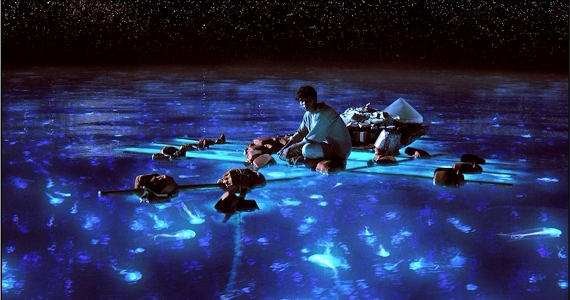
LOP-068    Pi Patel takes in the bioluminescent wonders of the sea.

Ever since Yann Martel’s Life of Pi won the Booker prize in 2003 there has been intense interest in translating it to the screen. Considered by many to be unfilmable, it seeks to tell the story of one boy’s journey from an idyllic childhood as the son of a zoo keeper in French India to his present life in Montreal by way of a terrible, life altering ordeal – becoming the victim and only survivor of a shipwreck. Only human survivor that is, the boy, Pi, is alone for his 227 day odyssey across the Pacific save for a Bengal tiger with the incongruous name of Richard Parker that managed to escape the wreck and climb aboard his life boat.

Rafe Spall’s Martel stand in, having  thrown out a recently completed novel, has come to hear Pi’s story after being told that it could ‘make him believe in God’. A bold claim indeed, it seems younger Pi was something of a spiritual enthusiast – collecting religions the way other boys collect heroes, and attempting to practice them all at the same time! It’s mostly down to this pan-spirtituality that Pi attributes his miraculous survival, that and of course the tiger. Having to fend off Richard Parker and find ways the two of them could co-exist together kept his mind focused and prevented him on dwelling on his greater fears or the earthly loneliness that comes from being the only one of your kind for hundreds of miles.

That said, for all the film’s constant talk about gods and the universe some of its philosophising can’t help but feel a little trite. As for the tale’s claim that it will make you ‘believe in God’, it’s difficult to see how this could be the case. Yes, the boy’s survival is, literally, incredible – miraculous even, as is the way the universe functions as a whole but this story isn’t necessarily any deeper than any other meditations of a wandering soul about why the world is as it is, or indeed how one chooses to view it. Ultimately the film suffers from never being as quite profound as it would like to be and perhaps feels it is.

The real strength of this film is in its visuals which are extremely impressive. There’s no arguing that what Lee has created is revelatory, a series of beautiful, digital vistas more akin to a moving work of art than we are used to seeing from mainstream cinema. The use of 3D might well be the first that justifies its use as a valid artistic tool that is part and parcel of a film’s artistic vision rather than something that can be tacked onto a movie’s name in order to add a few pounds onto the ticket price.

This artistic vision is what makes Life of Pi such an interesting film. Though many will find its storytelling banal or unconvincing, its technical and artistic proficiency cannot be denied. The weaknesses of the central narrative and its slightly saccharine tone mean that Life of Pi may not stand up to repeated viewings, however resisting a first viewing on these grounds would be a mistake as it represents a true evolution in the art of filmmaking.

Weekly rundown 17-23 December 2012

Goodness, I’m late already and this is only the second time I’ve done this! Must do better! Oh well, not so many films this week what with Christmas fast approaching – not sure how many I’ll get to see over the festive period as I’m staying with family so it’ll probably be mostly old favourites. My family don’t really share my taste in films so much but I’ve bought my mother some Scandinavian thrillers which she really likes at the moment (unfortunately we seem to have exhausted the available French policiers which are her favourite!) so hopefully we’ll be able to fit some of those in.

Yakuza Graveyard

Yakuza no hakaba: Kuchinashi no hana

やくざの墓場 くちなしの花

Eureka DVD

The second film in Eureka’s first Fukasaku box set, now OOP, and another genre classic from the prolific director. Police Corruption and Yakuza honour play out as mirror images as a complicated policeman ends up caught between two worlds.

Smuggler

HK Blu Ray

Slightly disappointing film from Katsuhito Ishii, director of The Taste of Tea, which sees Satoshi Tsumabuki’s failed actor being unwittingly forced into the criminal underworld. Unfortunately this is a film that might have benefitted from being more absurd as the darkness of the story and the humour of the script/direction never really gel. Still, the action scenes are entertaining and the performances are universally good it’s just a shame it never quite comes together.

The Silent War

Ting feng zhe 聽風者

HK Blu Ray

Chinese late ’40s war film about radio telephonists and code breaking – lacking in tension and high on propaganda it’s never quite as exciting as it promises to be.

Joyeux Noel

Film4

Maudlin film about the 1914 Christmas truce. Excellent performances from the international (and often multi-lingual) cast can’t quite enliven the uneven, unsubtle scripting.

Babycall

Soda Pictures DVD

Odd Norwegian psychological thriller with Noomi Rapace where a brutalised woman trying to protect her son becomes increasingly paranoid and believes she overhears a murder on her baby monitor. The ‘twist’ can be seen a mile off but at the same time nothing is actually explained adequately at the end making this quite a frustrating experience despite Rapace’s excellent performance.

Third Window Announce 2013 Acquisitions

Ladies and Gentlemen, take a moment to prepare yourselves for I am about to tell you the best news you will ever hear. What’s that you say, they’ve finally finished The Grandmasters? No, unfortunately not but an even more exciting development has come to pass. Third Window announced via Twitch today that they will be releasing …..*drumroll please*…. AI TO MAKOTO on Blu Ray and DVD on 29th of April 2013. As you might remember I, and a few others of us here, were greatly impressed when this was screened at the LFF and it’s safe to say this is indeed very welcome, if totally unexpected, news!

If that wasn’t enough they’ll also be following up their recent Tetsuo release with another Tsukamoto double bill of Bullet Ballet and Tokyo Fist. Bullet Ballet is probably my favourite Tsukamoto film and I can’t wait to see it in HD!

They’ll also be releasing their ‘film of the year’ The Story of Yonosuke and the upcoming See you Tomorrow alongside the already announced Woodsman in the Rain, Vulgaria and the long over due Eyes of the Spider/Serpents Path from Kiyoshi Kurosawa! All in all these are a fantastic set of upcoming releases and Third Window continues to go from strength to strength!