Secret Cinema – 3rd June 2012. Prometheus

This Secret Cinema seemed a bit different, in that it seemed fairly obvious all along what the film was going to be. Secret Cinema evidently had quite a big budget with this one – full page ads in The Guardian, multiple websites and promo videos so there was less in the way of clues and intrigue but perhaps more in terms of content. After I had signed up to their website and bought ‘shares’ in Brave New Ventures – apparently some sort of R&D company – I was instructed to choose my career path from the website. I chose to be a ‘Data Scientist’ as it seemed to fit me best (I guess in the end it was more along the lines of a social archaeologist  or anthropologist). Uniforms could be obtained from BNV Stores and I would need a blue jump suit. Dutifully I went down to the store but being on the shorter side my new employers were unable to accommodate me; I bought a badge and found alternative arrangements for the coveralls.

As the day approached there wasn’t as much input from SC as there had been previously but nevertheless it was very exciting. I arrived at the meeting point at Euston Station a bit before my appointed time of 12pm and waited for other people in jumpsuits to arrive. While I was waiting I met Professor Edwards, who didn’t seem know anything about our mission either. Eventually there were quite a few of us there and we were marched up the road to the right and into where the BNV stores had previously been. After an ID check (read: ticket check) and currency exchange (I guess I effectively bought a tiny bit of orange perspex for £10 but it is quite cool), we had to queue up for decontamination (being sprayed with something in the car wash) before lining up at out appointed embarkation gate by order of profession.

Once the gate finally opened I, and the other data scientists, were led off to our section HQ by our leader (Holloway!) where we were briefed about out mission – finding out the origins of man etc. Looking round the room afterwards I was very excited to find a picture marked ‘The Ripley Scroll’.  After that there was some free roaming, I tried going up one set of steps but an alarm went off so I stopped. Going down some other steps I ended up in the cargo bay and got a mission to take a box to the infirmary, which I did so I roamed round there and eventually into the mess hall, crew areas etc. After a while there was a countdown to external shutdown and I was shuffled back to my original gate. I was told to hold onto the flowers while we launched. After that it was into the hypersleep pods! We lay there for about a minute listening to Radiohead’s Everything In Its Right Place.

After waking we were told to go to the mess hall but on my way David gave me a flower to take for analysis which I did, it was analysed by Dr Boden but she didn’t find anything and gave me a curt note for Holloway. On my way to find him however I was given ANOTHER FLOWER so I had to do the whole thing over again but Doctor Boden said she’d take me to the infirmary to make sure I was OK after the hypersleep.

However when we got to the cargo bay there was a mission just about to go down to the surface so I joined that. I had to put on green overall over my jumpsuit and a helmet (and eat some bread, which was very nice). The planet surface was pitch black so I mostly kept close to the people in front of me and followed the guides, we saw some of those geyser type things, alien markings and some kind of miraculous projection.

I wasn’t really sure what to do after that but just then people started getting ‘sick’, I tried wandering around but more and more areas were closed off because of ‘contamination’ and eventually I found myself herded back into a lift and  back at the cargo bay. Some people were on the floor convulsing and others were tying to help them. I stood on the side as more and more people became ‘sick’ and the BNV staff were obviously upset. Many of them were shouting things like ‘someone tell me what’s going on’ and ‘what’s happening’, ‘we need a containment officer over here’. After awhile of total chaos someone just started shouting to come this way so we followed and were led to the ‘escape pod’ (or screening room) to watch the film – Prometheus!

As a huge fan of Alien(s) this was absolutely fantastic to me, really loved being in the world and and interacting with Weyland-Yutani.The whole experience was just amazing, could not fault it!

Secret Cinema: The Third Man (11th December 2011)

My second visit to Secret Cinema (proper that is, excluding last summer’s The Lost Boys) was every bit as impressive as the first. This time I was in on the ground floor so to speak so I felt much more involved the run up to the event itself. So what were the clues – a pan European Post-War setting, smuggling, spy drama, involvement of The British Consulate?! I was pretty sure I’d figured it out but then they kept throwing the occasional curve ball like the simultaneous screening in Afghanistan that made me doubt myself. In the end though what else could it have been other than Carol Reed’s seminal film The Third Man.

Upon receiving my instructions from ‘The Provost’ it seemed I’d been put into the British military police group (Guardians) and was to be attending a funeral so I needed to wear a black armband or scarf and bring a single flower to lay at the grave. After traveling somewhat nervously to what turned out to be a disused warehouse near The Barbican I identified my meeting point and began to wait there despite being quite early. However, I was soon approached by The Provost who greeted me warmly but warned me that I might be in for a bit of a surprise.

He was not misleading me, though I had been assigned as a guardian I was ordered into a different alleyway by a Russian soldier along with people from all the various groups. We were then led a bit further down where we were passed on to the criminal element who informed us that we were now all part of his gang – we were smugglers and bootleggers and were to avoid the police and particularly the Russians at all costs. He then led us a further on again and we witnessed the funeral of ‘a very important man in Vienna’ (Harry Lime of course) from the public side of the railings outside the churchyard. We then heard some strange noises and were instructed to run the next part of the journey to evade capture by the police! Our ‘boss’ (who himself had a heavy limp) then deposited us at the entrance gate which was staffed by some very scary Russians!

Once we’d gotten through the check point we were lined up the courtyard and escorted into a ‘secret’ entrance which involved some very difficult terrain. Bypassing the main entrance we were lead across some planking and into a narrow corridor leading to a basement which was almost pitch black – it was incredibly difficult just to see the person in front of me so I could follow them and I nearly tripped a few times because I couldn’t see if there were steps. We climbed over beams and squeezed through dark and narrow passageways into what was the brewing/distilling area for the bootlegged alcohol until we eventually found the stairway into the main area.

Once inside were free to roam around and engage whichever tasks took our fancy. I wandered around exploring and taking photos looking for where the action was and it wasn’t long before I tracked down ‘Holly’ and ‘Lena’.  After that I tried to keep following them but I lost them a few times. Some highlights: The French police raiding the old lady’s apartment, meeting Dr Winkel and his ‘friend’, the children’s hospital (some lucky man was getting some attention from a nurse one time when I went by), the ‘lab’ right at the top of building which I later helped the British/Russian military police raid (this was very exciting!), being pushed into a room and taught drill and right at the very end I ended up stood right in front of ‘Lena’ as they brought ‘Harry’s body’ out of the sewers and had to tell her who it was! I didn’t know what to say at first, whether I was supposed to play along or not but I just answered honestly and it was a bit sad, I felt quite bad about it. After the big showdown we were all led into the various areas for the screening. I ended up in Cecil’s seminar room so he introduced the film which was preceded by a really funny noiresque short about a trio of people who were really bad at trying to murder each other.

I think I probably enjoyed Battle of Algiers a bit more because it felt like such a big experience, I was quite moved/overwhelmed as I left that screening streaming past the actors in posed in white gowns and attitudes of peace. The Third Man, despite being one of my favourites, obviously doesn’t quite have that sort of resonance so even though I really enjoyed it perhaps it didn’t quite impact me in the same way. As always though it was extremely well done and the only thing I really hope for next time is some more comfortable chairs for watching the film (and for it not to be freezing cold!).

Pastoral Hide and Seek

Terayama’s Pastoral Hide and Seek is a post modern meditation on the nature of truth and memory. Totally surreal, a man’s childhood populated by bizarre circus troupe, nuns with eye patches, strange fascinations with clocks. Then the director gets fed up with the deceptiveness of his own vision, so then he tuns up inside his own childhood and tries to mess about with it. Odd but oddly affecting

Pandemonium (Shura)

Matsumoto once said that if Funeral Parade of Roses was filmed in white, this was filmed in black. It’s certainly a very bleak and unsettling film with its dreamlike horror and sense of inevitability. The film begins with a sort of vision sequence where the protagonist comes home to find a tangled mess of body parts, followed by bodies, followed by the lifeless corpse of the woman he loves and a man hanging from the ceiling. Later he is visited by a former servant who’s arrived with the news that 47 of his fellow samurai (yep, THAT 47) plan to rise against their cruel master and that his former serfs and peasant folk have clubbed together and raised the money for him to take his rightful place alongside them.

Overcome with joy and relief Gengobe takes the money and pledges to go to the town the next morning and join his comrades. However, he’s also gotten himself mixed up with a courtesan who has other ideas and urges Gengobe to spend this money on her freedom so that they might marry. At first Gengobe sticks to his duty but fearing for the courtesan’s life he gives in and squanders the money on her. Of course, as it turns out there’s more to this woman and her, er pimp?, than first thought. Gengobe has been conned out of the money so many people made big sacrifices to get him and now there’s no way he’ll be able to fulfill his samurai duties. Hurt, humiliated, ruined, Gengobe has nothing left to live for and this pushes him into a dangerous mania for revenge that trails behind him a wake of scattered corpses.

Chilling. Somehow the atmosphere of this film is so completely unsettling you feel the cold rising through your bones just sitting in the cinema seats. There’s no other word for the world of this film than hell. It’s not a horror film, it’s not the violence or the blood that’s upsetting, it’s the sheer oppressive atmosphere of despair. A claustrophobia of fate. It’s this that stays with you, an odd feeling of inevitable doom.

Not a pleasant a film to watch then, but a very impressive one.

A Man Vanishes


Imamura’s A Man Vanishes starts out as a documentary surrounding the disappearance of a plastics salesman but eventually becomes a discourse on truth, reality and cinema. We begin in documentary fashion by paying a visit to the police station and having the details of the missing man related to us. We then hear from the man’s fiancée who it seems is very keen to find him, and his family who are worried but also hurt and disappointed. It transpires that Oshima, the absent centre of the film, had many secrets those closest to him did not know. He had previously been suspended from his place of work for embezzlement, though the money had been repaid and the matter settled. He was also a drinker and according to his friends had been expressing doubts about his planned marriage, either because he did not want to marry or because he disapproved of his future sister-in-law’s supposedly ‘immoral’ lifestyle. There is also a rumour he’d been having an affair with a waitress which resulted in a pregnancy.

All this information uncovered and still no real clue as to Oshima’s whereabouts, Imamura takes the bold step of deciding to put the fiancée on television. After this things start to change, the fiancee seems to have lost her zeal to find her intended and, as it turns out, has developed feelings for the interviewer on the documentary (who is actually an actor). Shortly after this they visit a kind of spirit medium who claims the future sister-in-law has poisoned Oshima and disposed of the body because she too was in love with him and did not wish to share.

This ultimately leads to a showdown in a tea house in which the fiancée confronts her sister with the evidence so far and seems unwilling to believe her denials. Except at the climactic moment Imamura orders the set to come down around them and we see they’re just in a pretend tea house room in the middle of a soundstage. This ‘reality’ was fabricated, and other filmmakers will come here to make their fictional truths or untruthful realities. We thought we were watching fact, but it was a construction.

The final scene of the film then follows this up further, Imamura announces what we’re watching is a reconstruction, a fiction, as a man swears he saw Oshima going up the stairs with the sister, which she flatly denies. Another witness then shows up and reaffirms his testimony about having seen Oshima and the sister, and the debate continues with some of the participants becoming quite irate. Can we believe anything we’re seeing here, what or how much of this is truth? What is truth anyway, what is reality?

Was there a man who vanished, are these the people in the his life? If they are, are they themselves or have they begun to play versions of themselves more suited to film? Imamura later said this film might more rightly have been called ‘When a Woman Becomes an Actress’, and it is true that you can see a definite change in the fiancée after her television appearance. Or can you, is it just the way Imamura presents it or has the change really taken places since the woman became a ‘character’ watched by the TV audience? Just as we’ve been unable to reconstruct a accurate picture of Oshima through the descriptions of those who knew him, our vision of the major players, the fiancée and her sister is also clouded by Imamura’s presence.

Imamura’s assertions that objective documentary making is pointless and that greater truth can be displayed through fictional film making are carried right the way through the film. What you largely have are ideas which are then reconstructed by the film maker in the editing suite. It’s a document of real people and real lives but only from one perspective. Fictional film making, in Imamura’s view, is better able to articulate human truths than this patching together of material which cannot be a fully accurate representation.

A Man Vanishes is one of Imamura’s most intriguing films but nevertheless has been unavailable with English subtitles for a long time. Thankfully Masters of Cinema will be releasing a new version on DVD in a couple of months the viewing of which will, hopefully, help to clear things up a little (but then again, maybe not).

Funeral Parade of Roses


An inverted retelling of Sophocle’ Oedipus, Funeral Parade of Roses has become a landmark in Gay Japanese Cinema. Eddie (geddit?), a transvestite living in Tokyo makes her money at a gay bar and has begun an affair with this boss. This has created an awkward situation with the boss’s ‘wife’ who runs the club and has become increasingly jealous and antagonistic towards Eddie.  Something from Eddie’s past is also haunting her and will turn out to have major repercussions for herself and others.

Funeral Parade of Roses is notable for its explicit detailing of 1960s gay life in Tokyo. Eddie and her friends have wild parties where they take drugs and discuss avant-garde films from America whilst watching distorted pictures of the student riots on the TV. The films even breaks with its narrative to interview various people, including a couple of the the actors, about gay life.

This is just one of many of the post-modern techniques that Matsumoto employs, often breaking up the narrative with vox pop sessions, inserted signs etc. He often repeats scenes or sections of scenes and sometimes breaks them off only to return at exactly that point later on. The overall timeline of the plot only becomes clear near the end when you’re able to piece these scenes together into a coherent narrative. An important and influential film, Funeral Parade of Roses is a must for fans of Japanese Cinema.

Human Bullet

Human Bullet (Nikudan) is a powerfully absurd antiwar satire. Set in the very last days of the second world war, when most can see the writing on the wall but don’t want to admit  that their situation is hopeless, the film attempts to capture the bewilderment and confusion as people start to comprehend the situation. An unnamed soldier of about twenty years old is training to be an officer and is repeatedly subjected to ridiculous tasks and ideas sent from high command.

Whilst in charge of the food store, it’s discovered that three packets of biscuits have gone missing. Whilst being question about this the soldier remarks that himself and the other men have become cows, that is they’ve learnt to ruminate – a skill which he then demonstrates to the non plussed superior officer. They stole the biscuits because their rations are pitiful and they lack the strength for their training. Pointing out the obvious that this warehouse is full of food whilst the men are collapsing from malnutrition,  the superior angrily tells him the food is for the final battle. Pointing out that there won’t be a final battle if they’ve all died of starvation further annoys the officer and our hero is reprimanded for his defeatist attitude by being forbidden to wear any clothing until further notice.

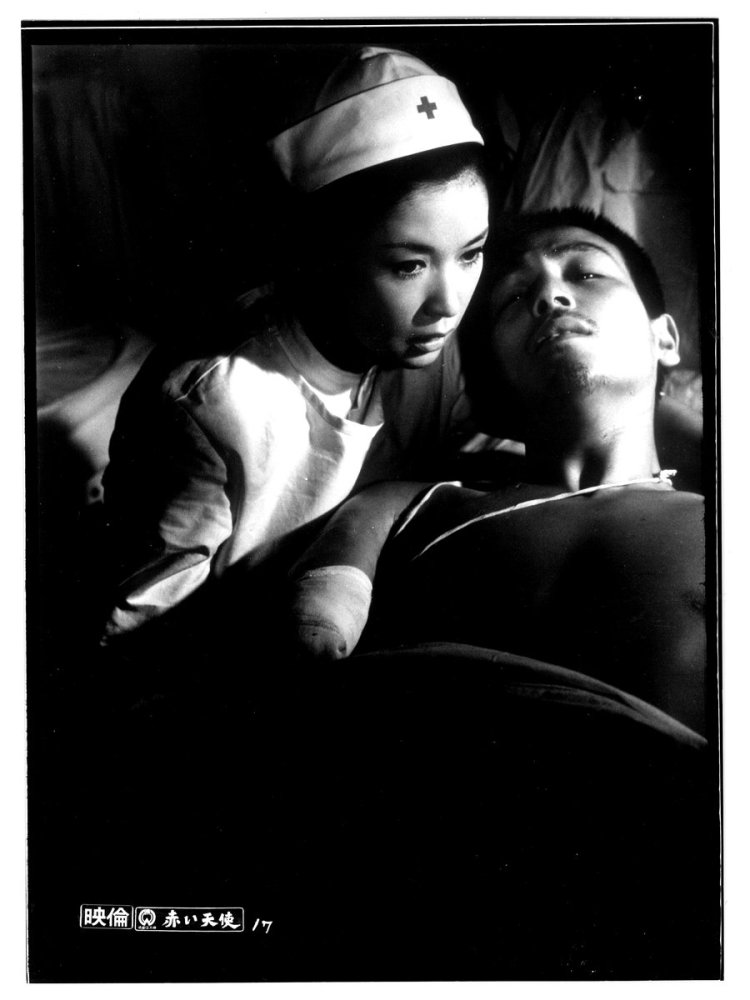
This further notice only comes when the squad is abruptly designated an anti-tank suicide squad, they will basically run into tanks whilst carrying explosives. Given one day of freedom before being expected to make the ultimate  sacrifice, the soldier finds love after a few wrong turns and a strange meeting with an armless bookseller (a noticeably odd late performance from Chisu Ryu). He also develops a strange friendship with some orphaned children and ‘saves’ a suicidal woman.

Alas his orders are abruptly changed again and having failed to meet up with his unit he ends up, in the most absurd image of the film, a man in a barrel strapped to a torpedo. When you hear about lost Japanese soldiers years later not knowing the war is over and you wonder how that can happen, well it’s because of things like this. Aimlessly drifting and bemoaning the ridiculousness of his situation, his feelings of helplessness and bewilderment perfectly sum up the events of the summer of 1945.

Okamoto’s trademark dark humour prevent this from being as bleak as the subject matter might suggest, although the finality of its ending is still incredibly powerful. Like Catch-22 or Dr Strangelove the film beautifully sends up the absurdity of war, and especially of an authoritarian win at all costs philosophy. It’s a shame this film isn’t currently available on DVD anywhere with English subtitles as it’s a very unusual film even by the standards of the Japanese Wave. Human Bullet is unforgettable and really deserves to be better known in the West.

Silence Has No Wings

Silence Has No Wings follows the journey of a butterfly from it’s larval phase in Nagasaki to it’s eventual fate in a small boy’s butterfly net on Hokkaido. Well, it’s much more complicated than that. The butterfly is also deeply associated with a female atomic bomb survivor whilst at the same time becoming the centre of a yakuza/triad disagreement. The film also mixes several styles and genres, at one moment a documentary – stock footage/taped interview of bomb survivors, another time a surreal gangster comedy or a social comment and even romantic melodrama. It’s truly a film that defies explanation and deserves to be seen

Sansho the Bailiff

Kenji Mizoguchi’s Sansho the Bailiff is one of those films that has many times been cited as among the greatest ever made. Based on an ancient folktale, Mizoguchi places the action during the Heian era where a feudal lord is being stripped of his position for daring to speak out about brutal treatment of the peasants. The lord will be exiled but his wife and children will travel to stay with relatives until sent for. Parting from his children he entrusts to them a statue of the goddess Kanon (goddess of Mercy) and instructs them to remember to show mercy, be kind even if it causes you personal pain.

Some time later the mother and her two children set out to join the father with only one servant and no resources to help them get there. Having failed to find lodging in the town (taking in travelers has been banned because of the bandit/slaver problem) they prepare to make camp in the woods. An old lady priestess offers them food and lodging for the night and apparently knows a quicker way to their destination if they’re prepared to travel by sea. Of course, it turns out that the old lady’s motives were far from altruistic and the family are quickly separated, the mother and female servant in one boat and the children dragged away elsewhere. The slavers have great difficulty finding a buyer for these wealthy children, being so small they won’t be as productive, especially considering their background makes them unused to physical labour. Eventually the children are sold to the notorious Sansho, who shows no mercy or consideration for the children’s youth and is determined to get his money’s worth.

As time moves on the children struggle to adapt to their new conditions, the girl clinging to memories of the past and the boy wishing to forget. He casts aside his father’s teachings and seeks to become closer to Sansho until the illness of another prisoner, coupled with the echo of his mother’s voice, reminds him of his better nature and sets him off on his path to redemption.

Sansho the Bailiff is a morality tale about the importance of compassion and of standing up for what is right over what is expected. Cruel men like Sansho, who can regard people as objects and are without the ability to understand the point of view of those who might raise questions, are much in favour with the feudal lords who see nothing except their profits. The profit of the lords must be maintained, those who make suggestions that might interfere with those are removed. Sansho is valued because his turnover is so high, more humane procedures would necessarily reduce this and so are out of the question. Who cares about a bunch of lowborn ‘cattle’? they aren’t like us, they are not us, so we need not concern ourselves with their lives, their feelings or their souls.

When Zushio has committed himself to the path of mercy, vowing to bring down this economy of exploitation, he again finds himself effectively powerless. Although he has achieved the necessary status, the will of the other lords will always win out. Taking drastic action wins him a small victory in the immediate area, but it’s not clear how long this will last or if any permanent change will occur. He’s no better off as a lord than he was with Sansho, he’s still a slave just in a nicer cage. So abandoning his position he sets off in search of his mother.

Finally mother and son are reunited, but the reunion is bittersweet. Zushio exclaims that he could have come here as a fine, important man and taken her away back to the life she once knew, but instead he kept to his father’s teachings and has nothing. She replies that she’s sure that if he had not obeyed they would never have met again. In the end their only victory is to have survived and found each other, but it’s the victory of the pure soul.

Poetry


Last year’s winner of the Cannes award for screenwriting, Lee Chang-dong’s Poetry is the story of one women’s yearning to see the beauty of life and finding that often it’s only to be found in its blackest tragedies. Mija (Yun Jung-Hee), a sixty-five year old woman, is caring for her grandson in a tiny apartment of the edges of a city when simple aches and pains lead to the discovery of a serious health problem. Having seen a poster for a local adult education class in poetry writing, and recalling a teacher once predicted she’d one day become a poet she decides to enroll. In the midst of this she also discovers that her grandson has done something unthinkable, and that the reactions of others to these events ranges from the nonchalant to the wildly self interested. Bewildered by the conspiracy of these conflicting crises, Mija must reach an understanding of what must happen now and learn to see the beauty of life in all its ugliness so that she can finally write her own poem.

Although it has a gentle melancholy, Poetry is not quite as depressing as it sounds and is in the end deeply beautiful. Yun Jung-Hee’s performance is breathtaking, never straying too far into melodrama she keeps a film that might have become overwrought firmly rooted whilst allowing the audience to totally empathise with her character. It’s no wonder that this won the screen writing prize at Cannes last year as it’s incredibly well written and hugely literate.

Poetry is a beautiful film that everyone would benefit from seeing. It’s a real shame that this is the first of Lee Chang-Dong’s films to be released in the UK, hopefully it won’t be the last!