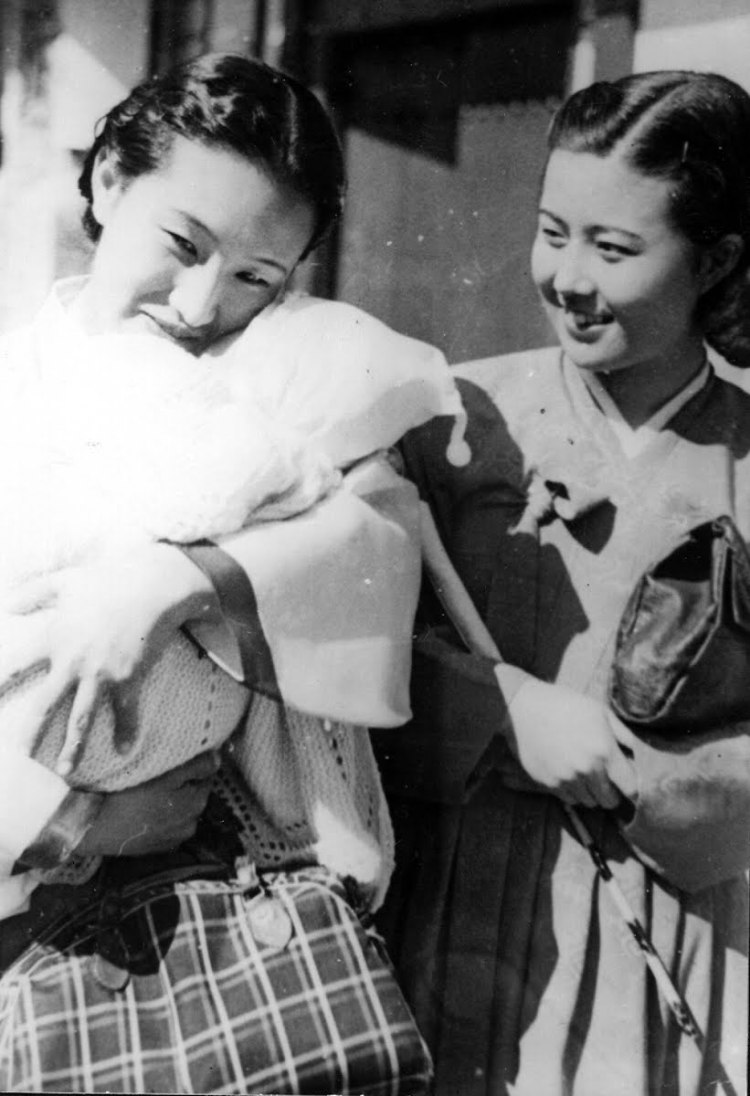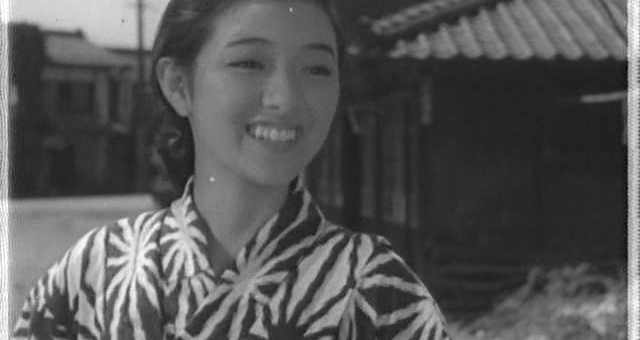
Hideko, the Bus Conductor (秀子の車掌さん, Mikio Naruse, 1941)

vlcsnap-2019-12-28-21h47m57s539It’s true enough that we might not have enough extant material from the pre-war and wartime eras to be as selective as some might accuse of us of being on realising that the directors we tend to remember are the ones we see as resisting. Though there were a fair few who managed simply to steer clear of the prevailing ideology, most skirted their way around the demands of the censors board by embracing the kinds of themes they could would work with. In Hideko, the Bus Conductor (秀子の車掌さん, Hideko no Shasho-san) Naruse pushes in a slightly different direction, retreating almost entirely from the troubles of the contemporary era into an idyllic vision of pastoral Japan.

Echoing Mr. Thank You, he opens with a POV shot of bus travelling a rural road accompanied by jaunty music. Neatly undercutting the cheerful atmosphere with ironic absurdity, we then cut to bus conductress Okoma (Hideko Takamine) announcing the next stop to an entirely empty bus. The problem is, the bus Okoma and the driver, Sonoda (Kamatari Fujiwara), operate is old, slow, and dirty. A new company, Kaihatsu, recently launched with shiny new buses that are cleaner and faster, if a little more expensive. Unsurprisingly, most people prefer to travel with Kaihatsu, meaning the only passengers waiting for Okoma’s bus are the kind that don’t have much money or are looking for different kinds of service – e.g. transporting live chickens or unusually large amounts of bags.

A radio programme recommended by her landlady gives Okoma an idea to boost business – performing as a kind of tour guide reading out interesting facts about the local area to entertain the passengers. Unfortunately, no one can quite think of any interesting facts or local landmarks in this tiny rural backwater. Nevertheless, Okoma and Sonoda are determined to give it a go, eventually obtaining permission from the decidedly laissez-faire boss who spends most of his days guzzling ramune and eating kakegori. To make sure the service is professional, they enlist the services of a local writer, Ikawa (Daijiro Natsukawa), whose notebook Okoma once returned when he left it on the bus. Weirdly, he doesn’t even want paying because he enjoys writing this kind of thing, and even coaches Okoma on how to get the cutest accent to really attract those customers with adorable local charm (even though Okoma is very proud to be thought of as nicely spoken young lady with nary an accent at all).

Of course, in true Naruse style, it’s not quite as idyllic as it seems. Most of the people we meet are poor and struggling, that’s why they’re taking this bus and not Kaihatsu’s. Even so, they’re all pleasant and polite, not even minding when Okoma asks the driver to stop by her house so she can chat with her mother, giving her a kimono she’s bought as a present (that her mum tells her off for spending her money on) and swapping her worn out cloth shoes for a classic pair of geta in which she seems to be more comfortable. At one stage, a chicken escapes from the bus and they stop to catch it, timetable be damned. Mind you, there don’t even really seem to be specific stops on this strangely occasional service. In need of passengers, Okoma and Sonoda seem content to stop and pick up random passersby who might be in search of a lift, taking them to wherever they might want to to go.

That might be one reason explaining why Okoma’s landlady is keen to warn her that she’s heard the bus company is no good, it’s just a front for some kind of unspecified shadiness. The truth, however, is more that the boss seems to be the feckless sort who enjoys being bossy but has no idea how to run a business. Distracted by Okoma’s monologue, Sonoda starts forgetting to stop and pick people up and eventually has to slam on the brakes when a child runs out into the street. While they’re checking on the kid, the bus rolls back over the verge, injuring Okoma and landing in farmland. Reassured that no-one has been “seriously” hurt (he’s not getting sued), the boss is then more worried about the insurance, seeing as it doesn’t cover him if the engine was running while they were stopped. Even though Sonoda explains that there’s no damage except maybe a scratch on the side, the boss suggests he scupper the engine and smash the windows so they can claim. They need a better bus, otherwise the company will have to close.

Earlier on, Sonoda and Okoma had joked about a popular slogan “When a country gets confused, loyal subjects appear”. Sonoda rolls his eyes a little and calls it “bombast”. They might not object to adding a bit about birds singing for the emperor’s long reign to their monologue, but it’s plain they aren’t going to go along with something they think is wrong because the boss says it’s a good idea. Sonoda is a little conflicted to begin with, talking it over with Ikawa who acts as the slightly patronising voice of city sophistication, he realises that if he follows the boss’ orders and lies he’ll not only be cheating the rest of society but himself too in doing something he knows to be immoral. Both he and Okoma vow they’ll quit rather than be forced into dishonesty, after all, says Okoma, there are plenty of other jobs (or perhaps not, in real terms, but still there is a choice). Suddenly, they feel quite cheerful, buoyed by their sense of moral righteousness.

An intervention from Ikawa saves their jobs, but this is still a Naruse film in which the world will always betray us, and so Okoma and Sonoda cheerfully continue their tour guiding business little knowing that the boss has gone bust and sold the bus. It might be going too far to say that Naruse envisages a fiery crash, a rude awakening for Okoma and Sonoda who will be left with only the cold comfort that they stood up against authoritarianism when it all goes to hell, but the subtle allegory is all but unmissable. Absurdly cheerful, and just a little bit depressing if you stop to think about it, Hideko the Bus Conductor is a charming jaunt through rural ‘40s Japan filled with salt of the earth types just trying to muddle through while the big bosses put their feet up and pop ramune marbles all day long without a care in the world.
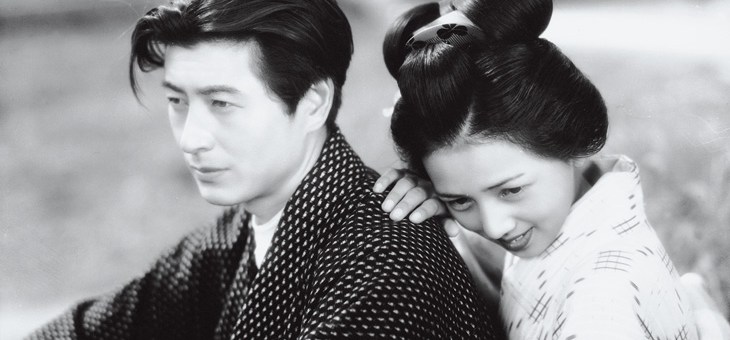
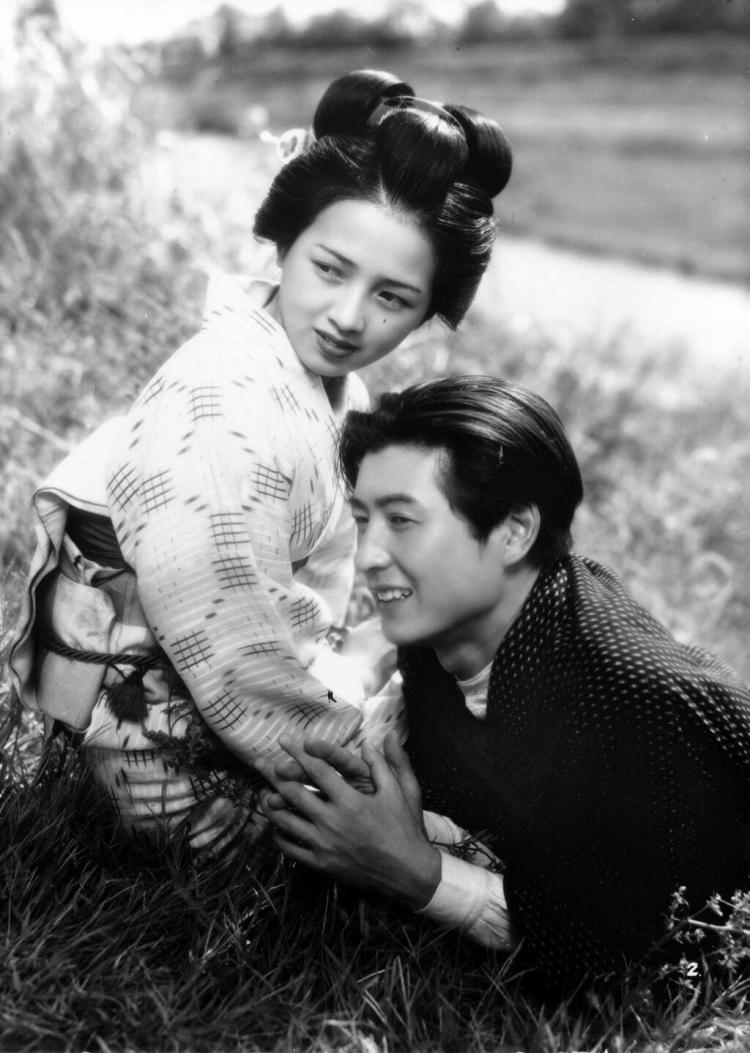
Apostasy (破戒, Keisuke Kinoshita, 1948)

Hakai still 1For all his good hearted humanism and intense belief in the simple power of human goodness, the films of Keisuke Kinoshita can also be surprisingly conservative, most particularly in their attachment to the old, pre-war Japan which they often see as unsullied by the corruption and ugliness of the militarist era. A new constitution film, Kinoshita’s adaptation of the Toson Shimazaki novel The Broken Commandment, The Apostasy (破戒, Hakai), opens with a series of bold titles proclaiming “Freedom and equality”, and “respect for human rights” before breaking into an attack on the persistent feudalism which has managed to survive into the new era along with prejudice and contempt. Zooming back to the missed opportunity of Meiji-era liberation, Kinoshita too remains somewhat ambivalent about the the decline of a social order in a Chekhovian lament for the rise of the petty middleman and the fall of noble aristocracy.

In Meiji 35 (1902), despite the advent of the Meiji Restoration and abolishment of the class system, prejudice against the “burakumin” – untouchable “outcasts” who lived in isolated settlements and (historically) made their living in occupations connected with death, was still very much in existence. This is all too apparent to Segawa (Ryo Ikebe). A bright young man, Segawa’s father sent him out of their village to make something of himself with the solemn promise that he must never reveal his burakumin origins to anyone. The world being as it is, however, Segawa is conflicted especially as he has fallen in love with his mentor’s daughter Oshiho (Yoko Katsuragi) and wonders if it would be fair to marry a non-burakumin woman without telling her truth and live with the threat of discovery forever over their heads.

The Broken Commandment would later be adapted again by Kon Ichikawa whose focus is, perhaps quite surprisingly, very different to that of Kinoshita who, uncharacteristically, chooses to prioritise class concerns over the right to live freely and honestly in a compassionate society. Ichikawa’s adaptation deliberately widens the implications of Segawa’s dilemma, making it plain that he is talking not just about burakumin rights but directly to all oppressed peoples and most particularly to those who feel obliged to keep their true natures a secret in an oppressive and conformist society. Strangely, Kinoshita chooses not to engage with this theme which might otherwise seem tailor made for his persistent concerns if perhaps a little close to home, preferring to focus not on Segawa’s gradual shift into accepting his own identity and hearing the call to activism but on the reactions of the changing world around him which seems to be imploding while besuited upstarts enact their petty revenge on the chastened nobility.

This is most clearly seen in the unfair treatment of Segawa’s mentor and landlord, Kazama (Ichiro Sugai) – a former samurai and until recently the local school teacher. Mere months away from his retirement, Kazama has been instructed to resign so that the school will not need to pay his pension while his position has been taken by a pushy local man with limited education whose sole claim to the job is being of the people. Kazama is understandably resentful but stoic. Segawa’s liberal colleague, Tsuchiya (Jukichi Uno), takes the school board to task for its unreasonableness and underhanded attempt to save money by forcing an old man out of his position with no thought for his 30 years of service. Though Tsuchiya might be broadly in agreement with the changes taking place in Meiji-era society, he too worries about the greedy upstarts usurping privilege rather than seeking to eradicate it.

Stepping back for second, Apostasy is a post-war film designed to echo the egalitarian philosophies of the new constitution drawn up under the American occupation. It is then somewhat subversive that our villains are the Westernised lower middle classes of Meiji-era society who seem to have embraced “modernity” by dressing in suits but refuse to abandon ridiculous ancient prejudices such as that towards burakumin, doubtless because those prejudices largely work out in their favour. It would be tempting to read these prejudices as foreign imports, but that against the burakumin is wholly Japanese and truth be told somewhat backward in contrast to (the kimono’d) Tsuchiya’s forward looking socialist beliefs which superficially at least seem more in keeping with the age.

Yet it is in some senses Segawa himself who struggles to emerge from the feudal yoke. His promise to his father is a sacred vow underlined by loss and sacrifice. He feels it is his duty to live as his father wished, as a “normal” Japanese citizen in success and comfort, but also begins to become acutely aware that to do so may be cowardly and selfish. If he chooses to keep his promise to his father and never reveal himself as a burakumin, he will be complicit with the systems which oppress him and thereby ensure those like him will always be oppressed. His awakening comes, in a sense, from a second father – Inoko (Osamu Takizawa), a burakumin who has come out of the closet and loudly fought for burakumin rights along with the general liberty of all oppressed people. Caught between two fathers and his growing love for Oshiho, Segawa remains lost while one of the suited proto-militarists threatens to out him leaving him floundering in the face of intense social stigma and the possibility that those he loves may turn against him.

Segawa has to free himself or risk becoming like Kazama – a man haunted by the feudal past, as Tsuchiya puts it. Kazama himself is painted in broadly sympathetic terms, forced to endure the melancholy fate of being eclipsed by a Lopakhin-esque member of the insurgent middle-classes, but his prejudice is later exposed despite his original support of Segawa when he notices one of the suits smirking at him and instantly feels humiliated, turning his impotent rage back on the outcast as if his presence further dishonours him as a samurai. Segawa’s aim as a teacher had been to teach his children the power of individual thought, which would seem to be the best weapon against prejudice but his message has been cut off at source thanks to the self-interested school board who have been all to quick to claim the benefits of modernity with none of the responsibility. Resolved to fight for a freer future, Segawa finally accepts his responsibility as a burakumin spokesman in the knowledge that his calling is to educate and that only through education can anything ever change. The lessons of Meiji may have gone unheeded, but the opportunity presents itself again to abandon the feudal past in favour of an egalitarian modernity built on fairness and compassion rather than obligation and oppression.


Titles/opening (no subtitles)

The Girl I Loved (わが恋せし乙女, Keisuke Kinoshita, 1946)

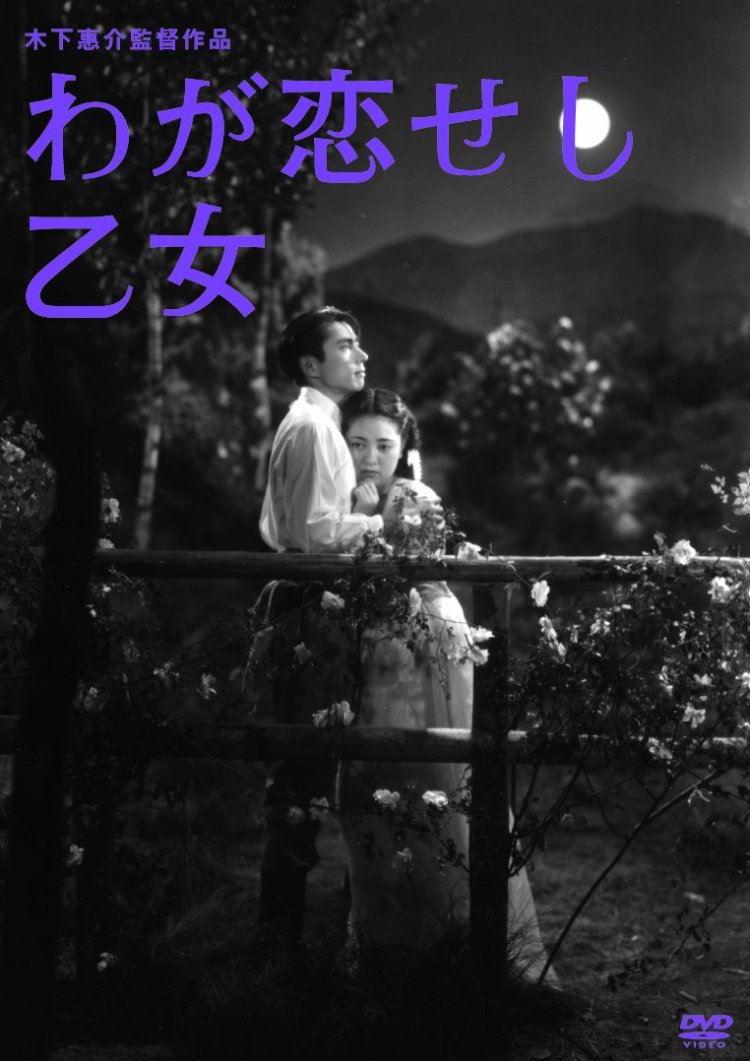
The Girl I loved DVD coverThe post-war era, as confusing and chaotic as it was, offered several choices, among them that to change to course, choose to create a better, kinder world than the one which had led to so much suffering. As always, however, the human temptation is to choose the opposite and allow anger and resentment to make everything even worse than it had been before. Occasionally censured for his sentimentality, Keisuke Kinoshita was perhaps among the more defiantly positive of the post-war humanists whose fierce love human goodness knew no bounds. In The Girl I Loved (わが恋せし乙女, Waga Koiseshi Otome) he puts his ideas to the ultimate test as a young man recently returned from the war must learn to cope with various kinds of disappointment but eventually resolves to take solace in other people’s happiness even at the cost of his own.

The tale begins some years earlier when a baby girl is abandoned in front of the Asama Ranch, her mother apparently having taken her own life by jumping from a nearby cliff. The Asamas are good people and moved by the letter they find with the baby so decide to take her in. Yoshiko (Kuniko Igawa) is raised alongside older brother Jingo (Yasumi Hara) as an adopted sister always aware of her origins but very much a full member of the family.

Flash forward to the present day and Yoshiko has become a beautiful young woman. Jingo has returned from five years of war in perfect physical health, keen to resume his idyllic farm life in the beautiful Japanese countryside. The fact is that Jingo has long been in love with Yoshiko, though the situation is understandably complicated seeing as they were raised as siblings even if there is no blood relation between them. Somehow it seems a perfectly natural idea that the pair will marry and many assume this will be the case. Jingo, however, remains somewhat reticent and afraid to voice his feelings. It seems Yoshiko has something to tell him too and so he dares to hope as they both agree to share their respective secrets after the harvest festival.

At the festival, however, Jingo gets a shock. He sees the way Yoshiko looks at another man and realises that what she wanted to tell him was probably that she had fallen in love with someone else. Shaken and confused, Jingo bites his tongue. He knows to say anything now would only create more pain and suffering for everyone while he alone will suffer if he decides to stay quiet.

Nevertheless the temptation is there. Mr. Noda (Junji Soneda), Yoshiko’s intended, is a quiet man, an intellectual who returned from the war early thanks to injury and still walks with a cane. Yoshiko has been fearful that her family may object to the marriage on the grounds of Noda’s disability – something he has also been aware of and warned her about in explaining the potential hardship she may have to endure as his wife seeing as he is also merely a poor schoolteacher. Jingo could try to refuse her permission to marry, try to force her to marry him instead, or refuse to give his blessing for her to marry anyone at all, but if he did that all he’d be doing is condemning both of them to eternal misery. It would be understandable if he began to resent Noda and most particularly his disability which brought him home from the war early and enabled him to be here to fall in love with Yoshiko while Jingo was away and dreaming of home, but then it could so easily have been the other way around.

In the end, Jingo’s love is selfless and good. What he wants is for Yoshiko to be happy and if being with Noda is what that means then Jingo will not stand in her way no matter how much it may hurt him to stand aside. After all, as Noda says, aren’t they both lucky to be alive in this beautiful place? Having suffered so much, the two men understand how precious life is and know it’s far too short for pettiness or resentment. A quiet, gentle tale The Girl I Loved is a sad story of youthful disappointment in love, but it’s also a kind of melancholy manifesto for the new post-war world built on compassion and understanding as a young man decides to take the noble path in accepting that the girl he loved loves someone else and that’s sad but it’s also happy and if you can learn to rejoice in someone else’s happiness even in the midst of your own pain then perhaps everything will be alright after all.


Titles and opening scene (no subtitles)

Woman (女, Keisuke Kinoshita, 1948)

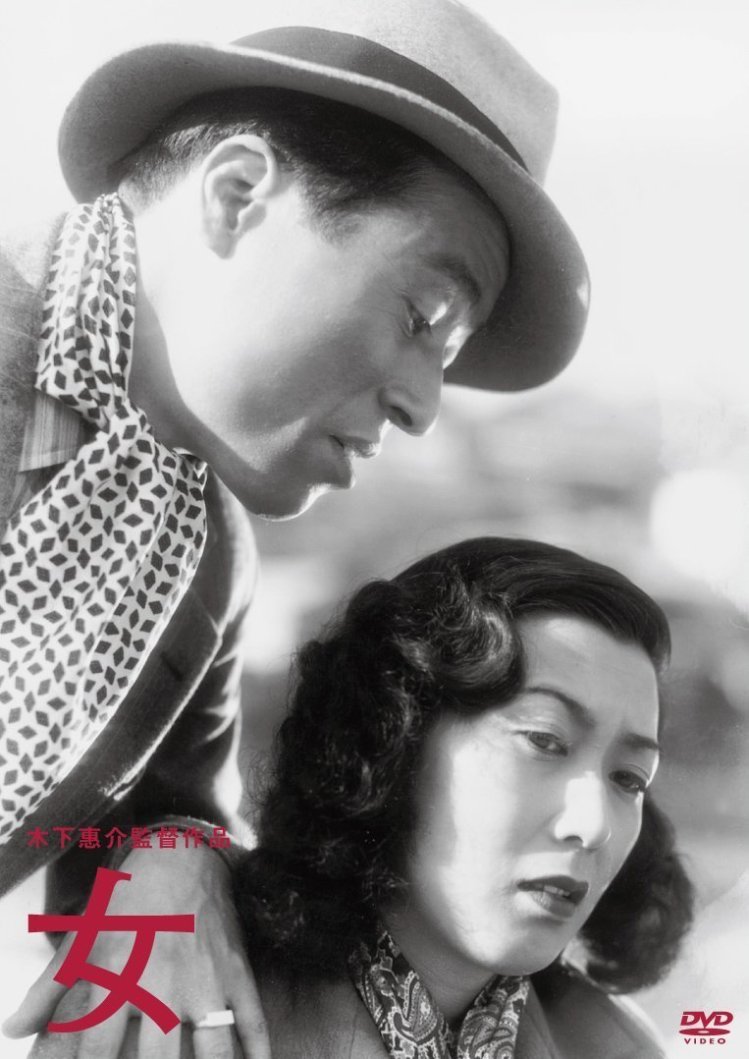
Kinoshita Woman dvd cover“You must remember there are many kind people in the world” the heroine of Keisuke Kinoshita’s Woman (女, Onna) instructs her recalcitrant boyfriend in his 1948 noir infused drama. It might as well be a mission statement for the famously humanist director, but in contrast to many of his later explorations of the power of goodness, Woman asks if a stubborn belief in the possibility of redemption for a selfish man might only be an act of mutual destruction which in itself enables the continuing decline of humanity.

Our heroine is Toshiko (Mitsuko Mito), a young woman we first meet preparing to take to the stage in her job as a chorus girl in a musical review. Toshiko’s evening is disrupted when her no good boyfriend, Tadashi (Eitaro Ozawa), turns up unexpectedly and instructs her to run away with him. Though reluctant, Toshiko does indeed find herself pulled along only to discover that Tadashi is responsible for a heinous crime for which he appears to be entirely unrepentant.

In a double irony, Tadashi’s name literally means “correct”, not just in the sense of being the indisputably right answer to a question, but also of being “just” and imbued with moral goodness. Tadashi is, however, an immensely corrupted figure. Toshiko has her doubts about him. She objects to his criminality and desperately wants him to find a way to live “honestly”, but for some reason finds it impossible to simply break with him and somewhere deep down seems to believe that he is worth saving and that she can in a sense restore him to his natural condition.

During her unwilling flight the possibility of being able to do so dwindles before Toshiko’s eyes. Tadashi’s chosen method of entertainment for the journey is reading the newspaper clippings he’s collected detailing his crimes which include burgling a middle-class home, tying up the family and their maids, and stabbing a policeman who tried to intervene. Not only is Tadashi unafraid, he seems to be proud of his actions, grinning broadly as he reads and shows off his glorious deeds to the stunned Toshiko.

As Toshiko tries to run from him, she wanders into a nearby village filled with the cheerful sound of children playing as if to throw their natural innocence in stark contrast to Tadashi’s growing corruption. Cornered he tries to convince Toshiko by softly crying as he hears the children sing the gentle folksong Akatombo, remembering that he was once an innocent child like them but that his childhood was ruined by poverty that left him responsible for supporting his siblings two of whom eventually ran away never to be seen again. This he claims caused him to despise the world and vow revenge against a society that had abandoned him. Deceived into fighting a pointless war to return to a land in ruins in which there was no work for men like him, he decided to embrace his dark side and turned to a life of crime.

If it had been just desperation, perhaps Toshiko could have understood but as she points out, if everyone thought like Tadashi the world would be in an even worse state than it already is. Times are hard for everyone, but there are still many kind people who haven’t given in to their baser instincts and continue to live honest lives helping each other as they go. Tadashi tries to convince her that he will change, that he loves her and that she is the only good thing in his life, but though there may be a grain of truth in it, his words are all calculation as his wry smirk proves when Toshiko consents to take the bento he offers her in order to suggest that he actually cares about her wellbeing.

Toshiko vacillates. The further she goes the more convinced she becomes that Tadashi is no good and cannot be redeemed. Still, she finds it hard to abandon him. She too has been deceived, corrupted by male pride. An innocent shopgirl seduced by Tadashi’s false promises she fell into the seedy underbelly of the post-war world as he forced her into bar work and then to extort her clients. The chorus girl job is perhaps a step-up, but the reason she doesn’t want to leave it is not so much a career and chance for escape as her essential character in that unlike Tadashi she is not selfish or irresponsible and does not wish to inconvenience her employers by making a sudden disappearance.

Tadashi meanwhile attempts to undermine her sense of self, snapping that “anyone could fill in” for her at the theatre while roughly grabbing her each time she attempts to move away from him. Kinoshita shoots Toshiko’s flight from claustrophobic, film noir-esque 45 degree angles. Only in brief moments of calm during her fractious conversations with Tadashi is her world restored to a natural plane, as if he is her only anchor in this decidedly off kilter world which might explain why she finds it so difficult to cut him loose. Eventually the pair end up in a pleasant resort town that apparently holds happy memories for them as a couple, but Tadashi’s childish joy as he joins in with some cheerful street musicians reminds her only of his psychopathic cruelty as he loudly sings along as if he has forgotten that he is a wanted man with blood on his hands. She remembers him throwing stones at starving children – a boy and a girl who could easily have been the brother and sister who ran away from his unhappy home, while greedily guzzling his bento without even considering that he might have shared and alleviated their suffering.

The chaos of the post-war world is made manifest by fire in the town which brings the citizens into the square and sends debris flying from windows and rooftops into the streets below. Toshiko is eventually made to realise that there is no good left in Tadashi, and, as she tells a fellow dancer in the closing scenes, even if his feelings for her are genuine she owes him nothing because them. This final declaration may be a mild misstep as it paints Toshiko and women in general as enablers of male corruption, placing the blame of societal decline on women who continue to love problematic men despite their badness in the mistaken belief that love alone can redeem them. Nevertheless, it is also a kind of defiant advocation for a new post-war world in which greed and selfishness will not be tolerated and a woman’s right to make her own decisions both in terms of her romantic future and the direction of her life in general are never in question. Toshiko has made her choice and chosen not to live in the world of men like Tadashi but in a better, kinder one free of his constraint and finally on her own terms.


Akatombo

My Love Has Been Burning (わが恋は燃えぬ, Kenji Mizoguchi, 1949)

My love has been burning posterAmong the many parallels that could be drawn between the Meiji Restoration and the immediate post-war period, the most obvious is that each provided a clear opportunity for social change along with a moment of frozen introspection and internal debate about what the new promised future ought to look like. Following Victory of Women and The Love of the Actress Sumako, Kenji Mizoguchi completed a loose trilogy of films dealing with the theme of female emancipation with My Love Has Been Burning (わが恋は燃えぬ, Waga Koi wa Moenu), returning once again to the broken promises of Meiji as its heroine discovers that old ideas don’t change so quickly and even those who claim to be better will often disappoint.

The film opens in the early 1880s as a teenage Eiko Hirayama (Kinuyo Tanaka) attends a rally to celebrate the arrival of noted feminist Toshiko Kishida (Kuniko Miyake). Eiko, a committed social liberal from a conservative middle-class family, went to see her idol in the company of a childhood friend, Hayase (Eitaro Ozawa), who is shortly going to Tokyo to study and join the democratic revolution. He halfheartedly asks Eiko to come with him, but knows that she won’t because her parents will refuse permission and she will not disobey them. Soon after, Eiko’s loyalty to her family is weakened when the family’s maid, Chiyo (Mitsuko Mito), is sold to a brothel by her father. Devastated, Eiko asks her parents for the money to buy her back but they refuse, regarding Chiyo’s sacrifice as noble and in line with filial tradition. If Chiyo had refused (not that she had the right or power to refuse), her parents would starve. Eiko rushes back to the docks, but she is too late, Chiyo and Hayase have both departed for the capital and extremely different fates.

After her family situation declines still further and Eiko decides it is impossible for her to remain under her father’s roof, she makes her own way to the city but finds it not quite so welcoming as she’d assumed it to be. Hayase is not overjoyed to see her. He merely asks if she has finally decided to marry him and becomes petulant when she reaffirms her intention to study even if she implies that she intends to marry him at a later date. During his time apart from her, Hayase has been working for the fledgling Liberal Party agitating for wider democratic rights and the expansion of the franchise, though he is irritated still further when his mentor, Omoi (Ichiro Sugai) – the leader of the socialists, is supportive of Eiko’s ambitions and agrees to find a job for her working on the party paper.

Eiko’s early disappointment in Hayase is frequently mirrored in all of her subsequent dealings with men. Hayase put on a performance of believing in her cause of women’s liberation and more widely the equality of all peoples ending centuries of feudal oppression, but really just wanted to possess her body and is unwilling to accept her decision to reject him or to choose someone else. Later visiting her after she has been imprisoned on a somewhat trumped up charge, Hayase tells her that a woman is only a woman when loved by a man, and that a woman’s fulfilment is achieved through home, family, and motherhood. He tells her that he admires her for her education and talent, but that she has “forgotten” that she is a woman. He will help her remember by getting her out of prison if only she consent to marry him even though he has previously attempted to rape her and is now working for the rightwing government having betrayed the socialist cause.

Meanwhile, Omoi looks an awful lot better. He is, ostensibly, entirely committed to socialist aims, energetically engaged in promoting the Liberal Party, and trying to ensure true democracy takes root in the new Japan, lifting the common man above his subjugated position in the still prevalent feudal hierarchy. Nevertheless, he too eventually falls in love with Eiko and like Hayase is ultimately more interested in her body than their shared cause for liberal freedom. He appears to support her desire for women’s rights as an integral part of his desire to end feudal oppressions but his belief in female equality is later exposed as superficial. Eiko, reuniting with Chiyo in prison, takes her into the household she now shares with Omoi (though they are obviously not legally married) as her maid which is perhaps not entirely egalitarian but still a well intentioned attempt to free her from the life her father condemned her to.

Omoi disappoints, bedding Chiyo while Eiko is working hard at the campaign office. Confronted, he rolls his eyes and offers a boys will be boys justification before affirming that it was just a matter of sexual satisfaction and that his feelings for her haven’t changed, mildly reproving Eiko for allowing her emotional jealously to cloud her judgement in restricting his sexual freedom. If it were indeed a matter of free love, perhaps Eiko could have understood, but Omoi damns himself when looks askance at Chiyo and remarks that it doesn’t really matter because she is nothing but a servant and a concubine. All at once, Eiko sees – despite his fine talk, Omoi may have abandoned feudal ways of thinking when it comes to working men but still sees women in terms of things. If he thinks female “servants” are not worthy of respect or agency, then what is it that he has been fighting for in his supposed mission to end oppression in Japan?

Attempting to comfort a distraught Chiyo who has been so thoroughly brainwashed that she never quite expected anything “better” than being a concubine and has truly fallen for all Omoi’s pretty words about wanting to make her happy, Eiko reminds her that as long as men continue to think as Omoi does women will never be free. Freedom and equality are what will enable female happiness, and long as men refuse to recognise women not as domestic tools but as fellow human beings there can be no freedom in Japan. Mizoguchi reinforces the idea that while one is oppressed none of us is free, neatly celebrating the success of the disappointing Omoi while lamenting that his intentions for reform will not go far enough. Eiko cannot free the women of Japan on her own, but her solution is warm and committed – she will teach them to free themselves by starting a school, educating the next generation to be better than the last. Chiyo, notably, whom she never blames or rejects, will become her first pupil neatly subverting Hayase’s cruel words when she asks Eiko to teach her how to be a woman.

Unusually brutal, My Love Has Been Burning does not shy away from the violence, often sexual violence, which both women suffer both at the hands of men and of the state as they attempt to do nothing more than live freely as full human beings. It also makes plain that even those with supposedly high ideals can disappoint as they nevertheless motion towards real social good without fully committing to its entireties. A committed pro-democratic, intensely feminist statement, Mizoguchi’s lasting message lies in an affirmation of female solidarity as, unlike the self-serving Omoi, Eiko lifts her pupil up onto her own level and draws her shawl around them both committed to proceeding forward together into a fairer future.


The Love of the Actress Sumako (女優須磨子の恋, Kenji Mizoguchi, 1947)

vlcsnap-2019-03-27-01h39m45s435The Taisho era was, like that of the post-war, a time both of confusion and possibility in which the young, in particular, looked for new paths and new freedoms as the world got wider and ideas flowed in from every corner of the globe. In The Love of the Actress Sumako (女優須磨子の恋, Joyu Sumako no koi), the second of a loose trilogy films about female emancipation, Kenji Mizoguchi took the real life story of a pioneering actress of Western theatre and used it to explore the progress of lack there of in terms of social freedoms not only for women but for artists and for society as a whole.

We begin in late Meiji as theatre director Shimamura (So Yamamura) fights to establish a foothold of Western-style “art theatre”, moving away from the theatricality of kabuki for something more immediate and naturalistic. He has, however, a problem in that as women were not allowed to take to the kabuki stage all of his students are male and casting a man to play a woman’s role would run counter to his desires to create a truly representative theatre. It is therefore lucky that he runs into Sumako Matsui (Kinuyo Tanaka) – a feisty, determined young woman who had divorced her first husband for infidelity and then left the second when he complained about her desire to pursue a career on the stage. In Sumako, Shimamura finds a muse and the ideal woman to portray the extremely controversial figure of Nora in his dream production of Ibsen’s incendiary A Doll’s House.

Shimamura casts Sumako because he sees in her some of Nora’s defiance and eventual desire to be free from illusionary social constraints, but it is in fact he who ends up embodying her spirit in real life. Somewhat feminised, Shimamura is in a difficult position in having married into his wife’s family, leaving him without real agency inside his own home as evidenced by his mild opposition to his daughter’s arranged marriage. While he wishes that his daughter be happy and if possible marry for love, Shimamura’s wife is very much of the old school and wants to make the best possible match in terms of financial gain and social status, viewing emotional compatibility as a low priority (the daughter herself as relatively little say). Unwisely falling in love with Sumako, it is he who eventually decides to follow Nora’s example by walking out not only on his family but also on the theatre company. He does this not quite because the scales have been lifted from his eyes – he was never under any illusion that his arranged marriage was “real” and there is of course an accepted degree of performance involved in all such unions, but because he finally sees possibility enough in his love for Sumako and the viability of emotionally honest Western art to allow him to break free of outdated feudal ideas of familial obligation.

Nevertheless, making a career as an artist is a difficult prospect in any age and Shimamura’s emotional freedom quickly becomes tied up with that of his art. Sumako’s Nora proves a hit (in the last year of Meiji), but he is ahead of his times both in terms of his liberal, left-wing philosophy and his determination to embrace modern drama in a still traditional society. The roles we see Sumako perform, including that in Tolstoy’s Resurrection which was another of those that helped to make her name, are all from proto-feminist plays which revolve around women who, like herself, had chosen to challenge the patriarchal status quo in pursuit of their own freedom and agency. Shimamura’s wife makes no secret of her outrage to her husband’s desire to stage A Doll’s House, viewing Nora’s decision as “selfish” and perhaps of a subversion of every notion she associates with idealised femininity. Though not so far apart in age, Sumako is a woman of Taisho who left not one but two unfulfilling marriages and is determined to forge her own path even if that path eventually leads her to subsume her own desires within those of her lover as the pair attempt to put their social revolution on the stage.

The revolution, however, does not quite take off. Despite good early notices, Shimamura’s Art Theatre company quickly runs into trouble. Faced with financial ruin, he does what any sensible theatre producer would do – he begins to prioritise bums on seats and acknowledges that if he’s to keep his company afloat and facilitate his dream of making Western theatre a success in Japan he’ll have to compromise his artistic aims  by putting on some populist plays. Of course, this sudden concession to commercial demands does not go down well with all and some of his hardline actors begin to leave in protest not just of his selling out but of his twinned desire to make Sumako his star.

Tellingly, the pair are eventually forced out of Japan entirely to tour the beginnings of empire from Korea to China and on to Taiwan. Their ideas are too radical and their society not quite ready for their messages even if not initially as hostile as it would later become. Shimamura works himself to the bone trying to keep his dream alive, eventually damaging his health. Sumako remains somewhat petulant about being forced into an itinerant lifestyle while her onstage personas come increasingly to influence her offstage life until it is said of her that her performance is “no longer an interpretation but an extension of reality”. In this, Sumako has, in a sense, achieved Shimamura’s dreams of a truly naturalistic theatre, but it comes at a cost, as perhaps all art does, and, Mizoguchi seems to suggest, becomes a kind of sacrifice laid down to a society still too rigid and unforgiving to appreciate its sincerity. Nevertheless, their boldness, as fruitless as it was, has started a flame which others intend to keep burning, eventually becoming a beacon for another new world looking to rebuild itself better and freer than before.


Short clip featuring Sumako’s performance as Carmen.

Victory of Women (女性の勝利, Kenji Mizoguchi, 1946)

Victory of Women cap 1Female suffering in an oppressive society had always been at the forefront of Mizoguchi’s filmmaking even if he, like many of his contemporaries, found his aims frustrated by the increasingly censorious militarist regime. In some senses, the early days of occupation may not have been much better as one form of propaganda was essentially substituted for another if one that most would find more palatable. The first of his “women’s liberation trilogy”, Victory of Women (女性の勝利, Josei no Shori) was released in 1946 and expressly embraced the democratic philosophy espoused by the American authorities which necessarily included a motion towards female emancipation.
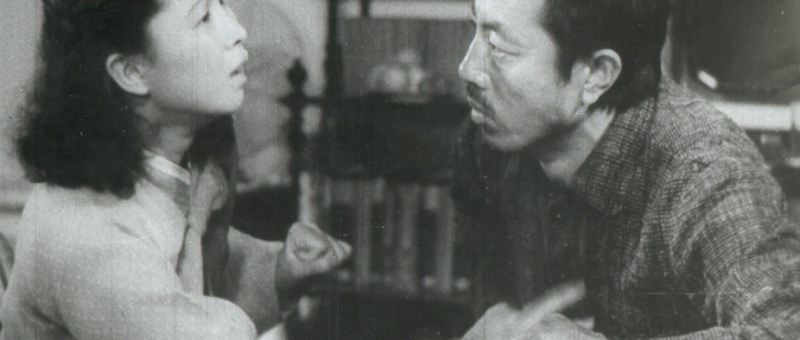
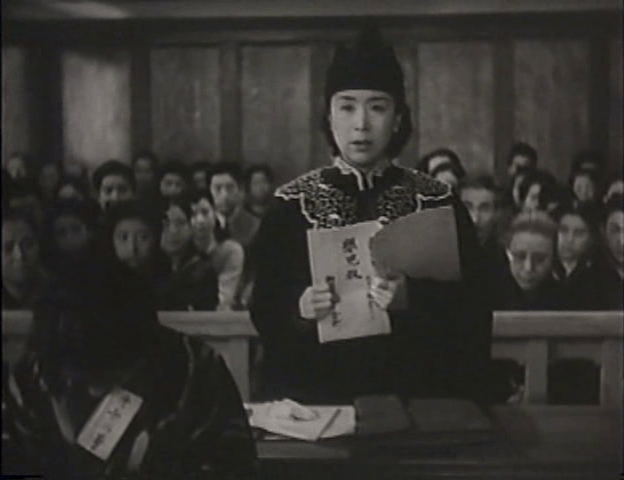
Played by Mizoguchi’s muse Kinuyo Tanaka, our heroine is Hiroko – a young woman working as a lawyer defending women against the cold and hard face of the law. Her family situation is, however, complicated. Her father having passed away, Hiroko’s sister Michiko (Michiko Kuwano who sadly passed away during shooting after collapsing on set) married the prosecutor Kono (Kappei Matsumoto) who financially supported Hiroko so that she might become the lawyer she is today. Meanwhile, Kono is also responsible for the arrest and incarceration of Hiroko’s fiancé Yamaoka (Shin Tokudaiji), a liberal intellectual. The political situation having changed, Yamaoka is to be released from prison after five years but is now in extremely poor health. Hiroko intends to return to him, resume their former relationship and marry once his health recovers. This is anathema to Kono who still objects to his liberalist views and views himself as having a hold over Hiroko’s future as the head of her family and in having supported her financially.

Financial support is a cornerstone if not the full foundation of Kono’s position of entitled superiority over Hiroko and her family. Despite the melodramatic underpinning of the case at hand, the real questions are the ones defining the direction of the post-war world in pitting the feudal values of “duty” and “womanliness” against a modernising liberality that prizes freedom and equality above hierarchy and obligation.

Kono, perhaps to his credit, does not appear object to the idea of female lawyers and has indeed facilitated Hiroko’s rise to just such as position but otherwise affirms that “a woman’s duty is easy. All that is required of her is self-sacrifice”. The idea of “self-sacrifice” is one which is brought up in the closing speeches of the trial in which Hiroko makes an impassioned plea in the case of a mother, Moto (Mitsuko Miura), who, mad with grief, held her baby too closely and may have suffocated it. Kono’s argument is that Moto’s transgression is against nature and the social order, that she has “failed” as a woman in rejecting her maternity by murdering her child. He rejects the “extenuating circumstances” of her grief and desperation by painting her “crime” as a selfish one in choosing to save her own life rather than sacrifice herself on her child’s behalf. Insisting that she has “disgraced the morals of women”, Kono requests she be punished severely as an example to the others.

In refuting Kono’s argument, Hiroko not only restates the extenuating circumstances of the intense strain on Moto’s mental health but attacks his entire way of thinking in positioning “motherhood” as the primary female “duty”. She does not deny that there have been many wonderful stories of women who valiantly sacrificed their own lives for their families, but reminds the court that these stories have often been misused as a kind of propaganda in service of female oppression, that under the feudal system which militarists prized so highly women were little more than slaves to men with no rights or agency. Further more, she points to the corruption of the hierarchical society which has left Moto in such a difficult position following her husband’s early death as a result of an accident at the factory for which the factory paid but only until the end of the war at which time he was cruelly cast away like so many of his generation who had perhaps been similarly exploited to serve a similar idea of “duty” only this time to the state. Kono blames Moto, insisting that her “crime” occurred because her character is “weak”. Hiroko does not blame Moto at all but the society which placed her in such an impossible position and has all but broken her spirit.

The argument is between a fair and just society in which the law exists for the protection of the people, and an austere and cruel one in which the law exists to oppress and tyrannise. Kono, an arch and unreconstructed militarist, believes in the primacy of the law. He is rigid and uncompromising, branding Hiroko’s summation as “sentimental” and “romantic”, dismissing an “irrational” woman’s logic from his elevated position on the podium. As others point out to him, his way of thinking is outdated and his tendency towards an entitled assumption that it will eventually prevail through being the proper order of things is extremely misguided yet he clings fiercely to feudalistic values which have ensured power remains in the hands of people like him since time immemorial, uncompromising to the last.

Rather than focus on Moto and her trial, Mizoguchi and his scriptwriters Kogo Noda and Kaneto Shindo, return to the realms of melodrama in shifting into the domestic as Hiroko’s older sister Michiko struggles between the feudal duty to her husband (however much she appears to dislike him) and her love for her sister whose modern liberal way of thinking still strikes her as immoral. Michiko, it seems, was forced to sacrifice herself for her family in marrying Kono for financial support. The sisters’ mother, now committed to Hiroko’s way of thinking, willingly married her daughter off telling her never to return believing it to be the proper way of things. Having suffered so long in service of an ideal no longer current, Michiko gradually comes to the realisation that she now has a choice – she does not have to stay with a husband who she does not love and does not love her, she is free to leave him and live as a full and independent woman if that is her individual will.

Nevertheless, the slightly awkward framing perhaps casts the choices of Hiroko and her sister as being defined by their respective men – Hiroko swept along by Yamaoka’s socialist politics and Michiko by her husband’s conservatism. Both men are in different senses problematic – Yamaoka vindictive and unsympathetic to Michiko’s attempts to make peace, no more forgiving than Kono while also patronising in his last impassioned speech which places such great responsibility in Hiroko’s “tiny hands”. Nevertheless, Hiroko’s clearsighted fight not only for her own freedom but for a fairer, more compassionate society founded on the idea of a literal social justice in which the law exists in service of its people rather than to oppress them is remarkably forward thinking, moving beyond “propaganda” for the new regime to the better world so often envisaged by the post-war humanists.


Hurrah! For Freedom (自由万歲 / 자유만세, Choi In-kyu, 1946)

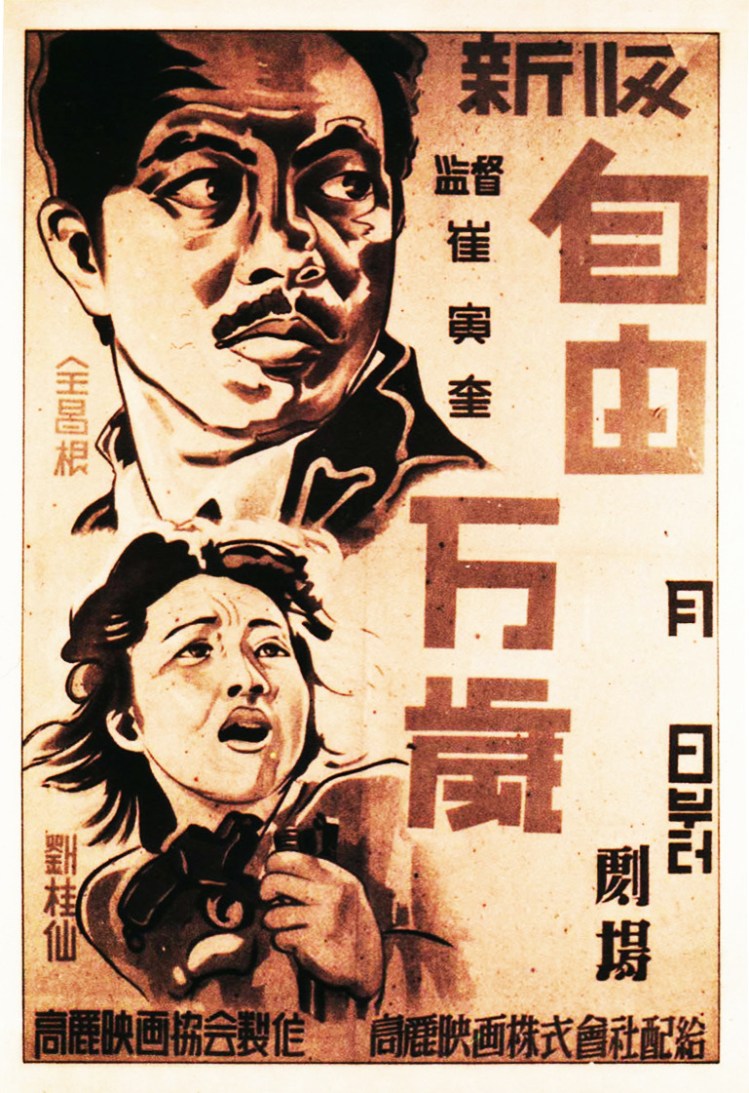
hurrah for freedom posterAttempts to foster a Korean film industry had often been frustrated during the colonial era throughout which aspiring filmmakers found themselves dependent on the Japanese film industry for financial and technological assistance while forced to produce increasingly overt Imperial propaganda under the ever tightening grip of the militarist colonial government. Hurrah! For Freedom (自由万歲 / 자유만세, Jayu Manse), the first film produced after the liberation, was then an aptly titled chance to start anew, create a new film language for a new young nation finally free of what some saw as decades of brutal oppression which made successive attempts to erase a national character.

Sadly, we cannot quite know exactly what director Choi In-kyu intended to create with this the first truly “Korean” film because so little of it survives intact, not because like much colonial cinema it was simply lost but because it bears witness to the next chapter in Korea’s unhappy 20th century history in undergoing severe editing during the oppressive era of Park Chung-hee’s military government who decided to remove scenes featuring popular pre-war actor Dok Eun-gi who, like many in his position, eventually defected to the North after the Korean war. As for Choi himself, he perhaps felt he had some atonement to do for having remained complicit with the Imperial machine. Following the completion of 1941’s Angels on the Street, he’d vowed to never to direct another pro-Japanese film but was eventually persuaded to return by the right-wing Han Hyung-mo (also the cinematographer on this film) and made a further three propaganda movies the last of them in 1945.

Nevertheless, Hurrah! For Freedom opens with a tribute to those brave Resistance fighters who gave their lives for liberty. Our hero is cell leader Choi Han-joong (Jeon Chang-geun – also the film’s scriptwriter) whose friend is killed while fleeing from Japanese police after being denounced by collaborator Nam-bu (Dok Eun-gi). Forced into hiding, Han-joong is lodged with a friendly nurse, Hye-ja (Hwang Ryuh-hee), who seems to have become fond of him though he remains distracted by his Resistance activities even if he does eventually notice the flowers that she bought him as a token of affection. While saving another comrade from the police and rescuing some explosives in the process, Han-joong ends up taking refuge in the flat of none other than Nam-bu’s main squeeze Mi-hyang (Yoo Kye-sun) who also develops a crush on him.

Though Nam-bu, an obvious bad guy antagonist, is sidelined by the demands of ‘70s censorship, the main thrust of the drama is conveyed by the melancholy figure of Mi-hyang who eventually becomes a symbol of betrayed, thwarted ambition and the relative impossibility of redemption for those who made “weak” choices during the colonial era (as you could perhaps accuse Choi himself along with the entire film industry of having done). Mi-hyang, having fallen for Han-joong’s passionate intensity, decides to betray Nam-bu by giving valuable information she has obtained from him to the Resistance, little knowing she has been weaponised in a plot laid by her vindictive former lover.

Nevertheless, her true love confession is rejected by Han-joong whose only lover is the revolution. Han-joong, reminding her that he is a man who could be killed at any moment flits between talking of his bright future and his dark end. He reassures Mi-hyang that, despite her past, she like everyone else has the right to start again but coldly insists that she does not have what it takes to join the cause and should return to her hometown and safety. Denied the right to be by his side in life, Mi-hyang affirms that she will be the one to tend Han-joong’s grave, suddenly returning this talk of new beginnings to the nihilistic struggle which seems to define Han-joong’s existence.

Nevertheless, in contrast with the defeated figure of Mi-hyang who must pay not only for her “weakness” in complicity with the colonial regime but also for her sexual transgression with an “enemy”, the saintly Hye-ja remains pure and brave – a brighter mirror for the gloomy Han-joong who seems surely destined to be her romantic hero as the pair of them fight earnestly for a freer future. Sadly, this is where we leave them – in media res as the film cuts out just at its most climactic moment as if affirming that this is a revolution very much in progress. Choi, shifting away from the realism that defined his earlier work, seems to be reaching for a new cinematic language with which to begin a new era free of colonial constraints. History, however, would defeat them all as this short period of hard won liberty would lead eventually to another conflict and another oppressive dictatorship. Choi himself went missing during the Korean War, presumably either killed or fled to the North. Nevertheless, what we can discern from the extant lessons of Hurrah! For Freedom is that there was perhaps more appetite for nuance than might have been expected even if sympathy for the collaborator does not quite extend to forgiveness.


Hurrah! For Freedom was screened as part of the Early Korean Cinema: Lost Films from the Japanese Colonial Period season currently running at BFI Southbank. Also available to stream online via the Korean Film Archive’s YouTube Channel.

Marriage (結婚, Keisuke Kinoshita, 1947)

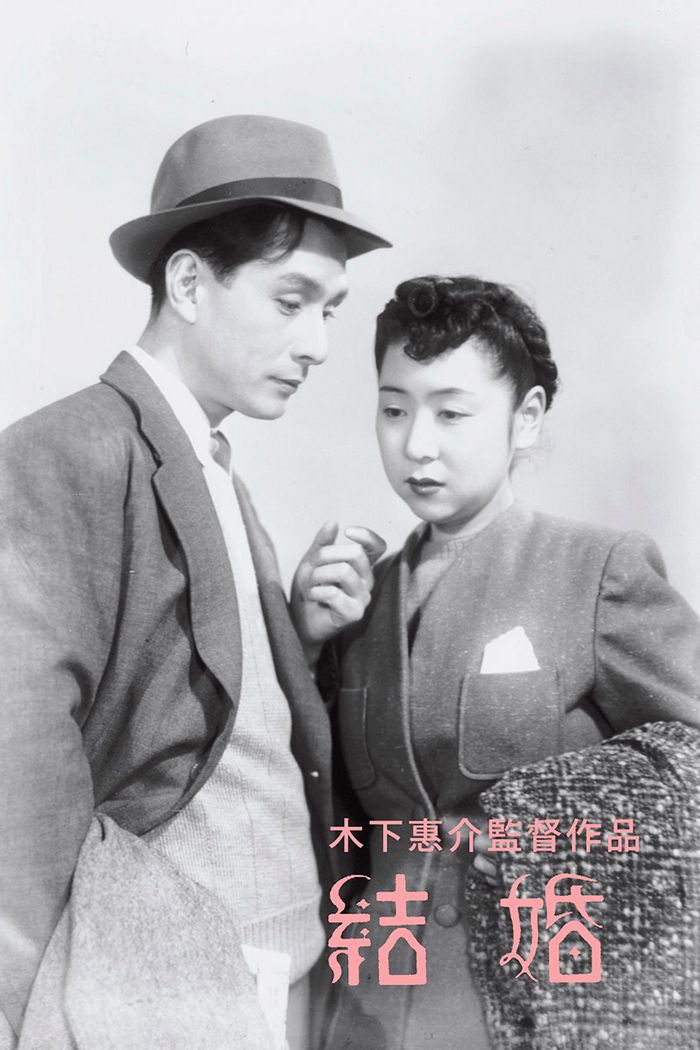
Marriage DVD coverGenerally speaking, the heroes in the world of Keisuke Kinoshita are those who stick steadfastly to their principles and refuse to become corrupted by the world around them. This is all very well but perhaps somewhat idealistic given the pressures of the post-war world. 1947’s Marriage (結婚, Kekkon) finds the director working with scriptwriter Kaneto Shindo whose view of humanity was perhaps a little more pragmatic than Kinoshita’s and therefore recasts his heroes as essentially good people who eventually come to the conclusion that their moral rigidity is causing more unhappiness than compromise might and that an acceptance of complicity may in fact be the only possible way forward.

Fumie (Kinuyo Tanaka) became engaged to Sugawara (Ken Uehara) before he went away to war and the couple have been waiting to marry ever since. Though Sugawara returned promptly, unharmed, and seems to be in regular employment, they have been unable to formalise their union because Fumie and her sister are the only members of her family currently working which means that they cannot do without her paycheck. Things begin to look up when Fumie’s father Kohei (Eijiro Tono), formerly an accountant who lost his job when his previous employer went bust, runs into an acquaintance who’s now the owner of a successful restaurant. Shimamoto (Eitaro Ozawa) promises him a job which has the family overjoyed, not least Fumie who may now finally be able to marry, but their happiness is to be short lived. Kohei realises that Shimamoto’s business is built on underhanded practices intertwined with black market profiteering and wants no part of it. The two men argue. Kohei refuses the job and storms out. Fumie is back to square one.

Though Sugawara reiterates that he understands the demands of the situation they find themselves in and will wait as long as is necessary, he too is under pressure from his family to bring the matter to a suitable conclusion. Sugawara’s mother is in poor health and wants to see him settled before she goes. She understands that he has someone in mind, but would rather he marry as soon as possible even if that means marrying someone else entirely – for example, a lovely girl from the village whose omiai photo his aunt has helpfully delivered. Sugawara bears all of this with good grace, but stands firm in insisting he will wait for Fumie even if that means he never marries at all.

The dilemmas are two fold and occur across two generations. Fumie finds herself torn between a duty to her family who are now almost entirely dependent on her as a breadwinner, and her romantic desire to become Sugawara’s wife – a promise made before the war which the post-war world conspires to make impossible. Despite their dire circumstances, the Matsukawas are a happy family doing their best to muddle through though there is obvious tension between teenage son Kei (Shozo Suzuki) and his father over Kohei’s rigid refusal to compromise himself as the times seem to demand. Kinoshita captures the atmosphere of a precarious household with easy confidence, an icy silence descending as Kohei returns with a face like thunder making plain that his job opportunity has not worked out as planned. Everyone is upset and disappointed, but no one has the energy for an argument and so silence is all there is.

Fumie becomes ever more conflicted, especially after a strained meeting with Sugawara’s aunt who seems nice enough but drops a few hints about the girl waiting in the country and Sugawara’s sickly mother. She begins to wonder if her romantic dreams are selfish in a world so wracked with ruin that it seems unlikely that she will ever be in a position to marry. Perhaps it would be more responsible, or just less painful, to end things with Sugawara for good so that he at least can move on. As things stand, the couple only have their Sundays which are endlessly prolonged with additional activities to put off the time that they must part as long as possible. The destabilising visit from the aunt is followed by an awkward, almost celebratory dinner in which sake pushes difficult emotions to the fore. Fumie vacillates, unable to dance she eventually decides to give things a go, affirming that she will simply hold onto and follow Sugawara – seemingly unaware of the wider implications of her statement. During the dance, however, in which she is literally swept off her feet, she changes her mind again, shamed by her brief moment of joy into feeling selfish and self involved as if all those around her suffer in service of her eventual romantic fulfilment.

Where Kinoshita might have introduced a deus ex machina in which the Matsukawas would be the beneficiaries of divine reward for their selfless goodness, Shindo makes way for a more realistic (though perhaps equally melodramatic) solution in which Kohei reassumes his role of the head of the family and chooses his daughter’s happiness over his principles. As such he recognises that he must make the sacrifice that will save them all in abandoning moral righteousness and becoming complicit with the murkiness of the world in which he lives. Pragmatism, this time, wins out but only as a lesser evil in which a compromise is made in the favour of happiness which might, in a round about way, produce a greater change in an already unhappy world.


Titles and opening (no subtitles)

Straits of Chosun (朝鮮海峽 / 조선해협, Park Gi-chae, 1943)

Straits of Chosun still 1Following a period of increasing censorship, the Colonial Government banned Korean language cinema altogether in 1942. Nevertheless, cinema was still a major propaganda tool even if much of the audience was not quite ready to receive its messages offered only in a language they may already have felt hostile towards. 1943’s Straits of Chosun (朝鮮海峽 / 조선해협, Joseonhaehyeob) was shot entirely in Japanese and is fully committed to the “one nation” ideals which had marked Korean Cinema in the colonial period but it also faces a somewhat interesting battle in paradoxically arguing for a kind of liberal modernity in which “love” overcomes centuries of tradition and becomes the driving force enabling the continuing forward propulsion of the Japanese empire by means of war.

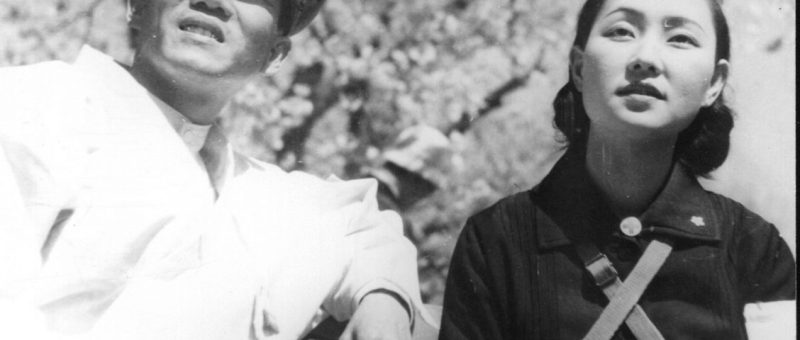
The film opens with its hero, Seki (Nam Seung-min), making a melancholy offering at the altar of his older brother recently fallen in war. For reasons of which we are not yet aware, Seki is thrown out of his familial home and seems to be at odds with his father who insists he has shamed them. It turns out that Seki’s crime is not of the kind one might expect, but only of having selfishly married a woman of his own choosing without his family’s consent. Kinshuku (Moon Ye-bong), his wife, is now pregnant and the couple seemingly have no money. In order to impress his father, Seki enlists in the army leaving his pregnant wife behind, alone, and with no real idea where he is or whether he’s ever coming back.

Whichever way you look at it, Seki’s abrupt enlistment is an extremely selfish and irresponsible action seeing as Kinshuku appears to have no family and will have to find a way support herself financially even when the baby’s born – though Seki refers to her as his “wife”, their exact legal connection is not quite clear and it does not seem she is getting any of his military pay (or, perhaps he just chooses not to send it to her). Nevertheless, his primary goal in enlistment seems to be proving himself a man worthy of respect by honouring his father’s wishes in the hope that he will eventually relent and give his blessing to their marriage. Strangely, while he does this he cuts off contact with Kinshuku while she adopts the role of the patient wife offering spiritual support from afar and serving the nation by working in a factory (later resolving to raise her son to become a fine soldier like his dad).

In fact, Straits of Chosun is extremely reminiscent of the earlier Japanese film So Goes My Love save for complicating matters with the addition of a baby and a war. Released in 1938, So Goes My Love is a mildly anti-militarist melodrama in which a spoilt son of a wealthy household has defied his family to marry a young woman of humble means and been disowned in the process. As in Straits of Chosun, it is the anxious sister (Kim Sin-jae) who eventually becomes the bridge bringing the traditionally minded parents and earnest daughter-in-law together. In both cases, the sister is the voice of reason speaking for the rights of youth to determine its own destiny – a desire which would become more prominent in the post-war world but was already growing even in the ‘30s.

The Colonial Government had realised that the major stumbling block to increasing recruitment was the reluctance of noble families to risk the end of their family line in sending their childless sons off to war. What they needed to break was centuries of patriarchal traditions which placed familial authority solely in the hands of the father when they needed that authority to belong to the nation. Thus Seki’s compromise, like that of the son in So Goes My Love, requires some give on the part of the parental generation who must cede some of their authority to their son, who will then transfer it not to his own family or his own will but to the forces of empire. Seki goes to war to bring glory to his father’s name, but his father must then accept the choice that he has made to defy his authority by marrying a woman of his own choosing without seeking permission. Of course, having a guaranteed heir in the form of a new, legitimised grandson is an ideal bridge to just such a compromise in neatly unifying Seki’s twin obligations.

Compromised as it is, Straits of Chosun does its best to push the one nation idea in insisting that each and every Korean must do their bit in order for Japan to secure peace in Asia. Thus Kinshuku works herself into nervous collapse in service of her nation just as Seki is injured on the battlefield, neatly symbolising their continuing spiritual connection. Kinshuku’s selfless love is, in a sense, the force which serves to underpin the expansion of imperialism, as uncomfortable as that idea eventually seems to be. Nevertheless, despite its propaganda aims and naive defence of imperialist goals, Straits of Chosun accidentally makes an argument for liberal modernity in which men and women are equal partners in their shared endeavour, the class system has collapsed, and the individual has the right to determine their own destiny free of familial obligation.


Straits of Chosun was screened at the Korean Cultural Centre in conjunction with the Early Korean Cinema: Lost Films from the Japanese Colonial Period season currently running at the BFI Southbank. It is also available on DVD as part of the Korean Film Archive’s The Past Unearthed box set (currently OOP). Not available to stream online.