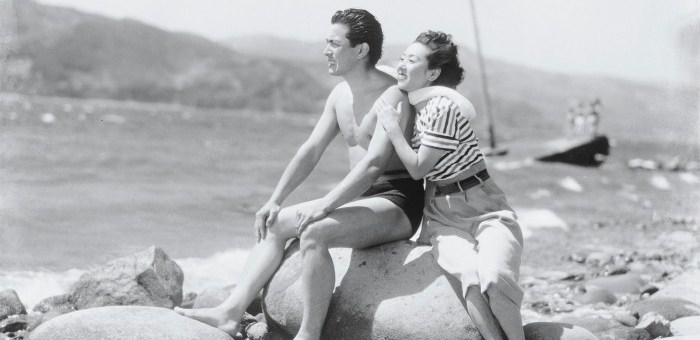
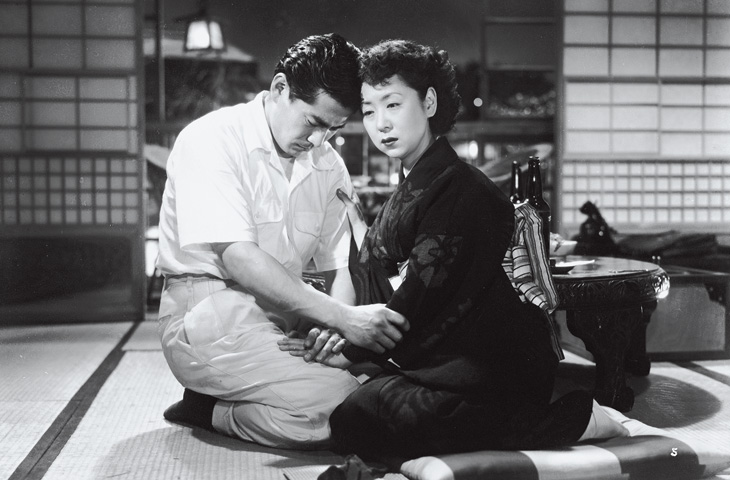
The H-Man (美女と液体人間, Ishiro Honda, 1958)

H-man
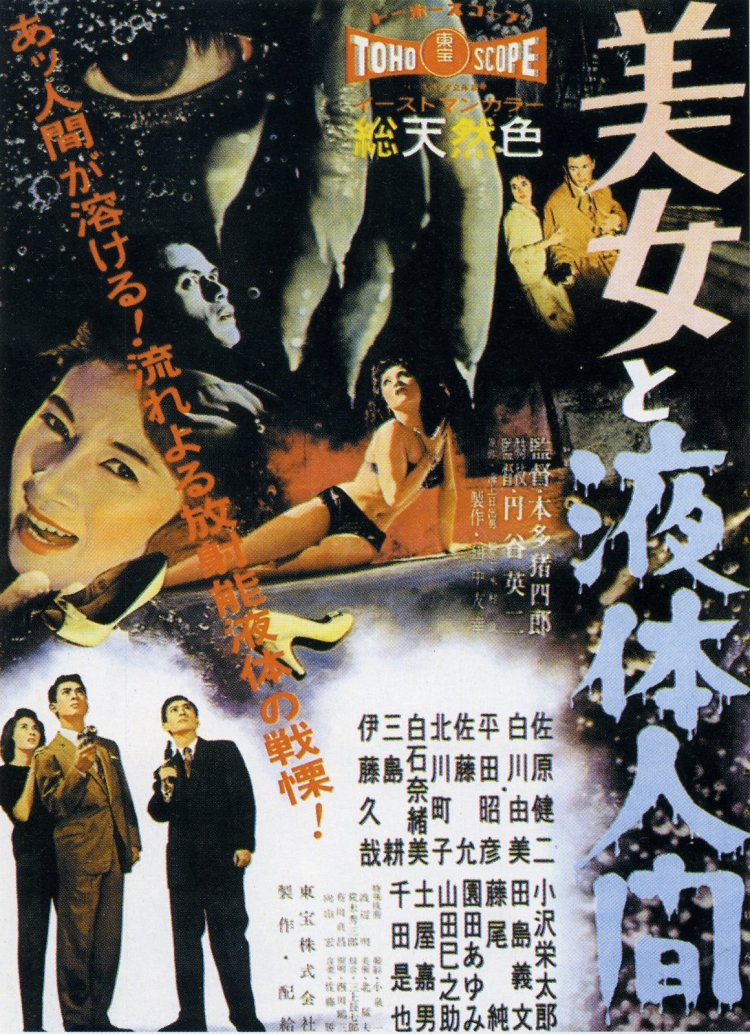
Toho produced a steady stream of science fiction movies in the ‘50s, each with some harsh words directed at irresponsible scientists whose discoveries place the whole world in peril. The H-man (美女と液体人間, Bijo to Ekitainingen), arriving in 1958, finds the genre at something of an interesting juncture but once again casts nuclear technology as the great evil, corrupting and eroding humanity with a barely understood power. Science may have conjured up the child which will one day destroy us, robbing mankind of its place as the dominant species. Still, we’ve never particularly needed science to destroy ourselves and so this particularly creepy mystery takes on a procedural bent infused with classic noir tropes and filled with the seedier elements of city life from gangsters and the drugs trade to put upon show girls with lousy boyfriends who land them in unexpected trouble.

Misaki (Hisaya Itou) is not a man who would likely have been remembered. A petty gangster on the fringes of the criminal underworld, just trying to get by in the gradually improving post-war economy, he’s one of many who might have found himself on the wrong side of a gangland battle and wound up just another name in a file. However, Misaki gets himself noticed by disappearing in the middle of a drugs heist leaving all of his clothes behind. The police immediatetely start hassling his cabaret singer girlfriend, Chikako (Yumi Shirakawa), who knows absolutely nothing but is deeply worried about what may have happened to her no good boyfriend. The police are still working on the assumption Misaki has skipped town, but a rogue professor, Masada (Kenji Sahara), thinks the disappearance may be linked to a strange nuclear incident…..

Perhaps lacking in hard science, the H-Man posits that radiation poisoning can fundamentally change the molecular structure of a living being, rendering it a kind of sentient sludge. This particular hypothesis is effectively demonstrated by doing some very unpleasant looking things to a frog but it seems humans too can be broken down into their component parts to become an all powerful liquid being. The original outbreak is thought to have occurred on a boat out at sea and the scientists still haven’t figured out why the creature has come back to Tokyo though their worst fear is that the H-man, as they’re calling him, retains some of his original memories and has tried to return “home” for whatever reason.

The sludge monster seeps and crawls, working its way in where it isn’t wanted but finally rematerialises in humanoid form to do its deadly business. Once again handled by Eiji Tsuburaya, the effects work is extraordinary as the genuinely creepy slime makes its slow motion assault before fire breaks out on water in an attempt to eradicate the flickering figures of the newly reformed H-men. The scientists think they’ve come up with a way to stop the monstrous threat, but they can’t guarantee there will never be another – think what might happen in a world covered in radioactivity! The H-man may just be another stop in human evolution.

Despite the scientists’ passionate attempts to convince them, the police remain reluctant to consider such an outlandish solution, preferring to work the gangland angle in the hopes of taking out the local drug dealers. The drug lord subplot is just that, but Misaki most definitely inhabited the seamier side of the post-war world with its seedy bars and petty crooks lurking in the shadows, pistols at the ready under their mud splattered macs. Chikako never quite becomes the generic “woman in peril” despite being directly referenced in the Japanese title, though she is eventually kidnapped by very human villains, finding herself at the mercy of violent criminality rather than rogue science. Science wants to save her, Masada has fallen in love, but their relationship is a subtle and mostly one sided one as Chikako remains preoccupied over the fate of the still missing Misaki.

Even amidst the fear and chaos, Honda finds room for a little song and dance with Chikako allowed to sing a few numbers at the bar while the other girls dance around in risqué outfits. The H-man may be another post-war anti-nuke picture from the studio which brought you Godzilla but its target is wider. Nuclear technology is not only dangerous and unpredictable, it has already changed us, corrupting body and soul. The H-men may very well be that which comes after us, but if that is the case it is we ourselves who have sown the seeds of our destruction in allowing our fiery children to break free of our control.


Original trailer (no subtitles)

Night Drum (夜の鼓, Tadashi Imai, 1958)

night-drum

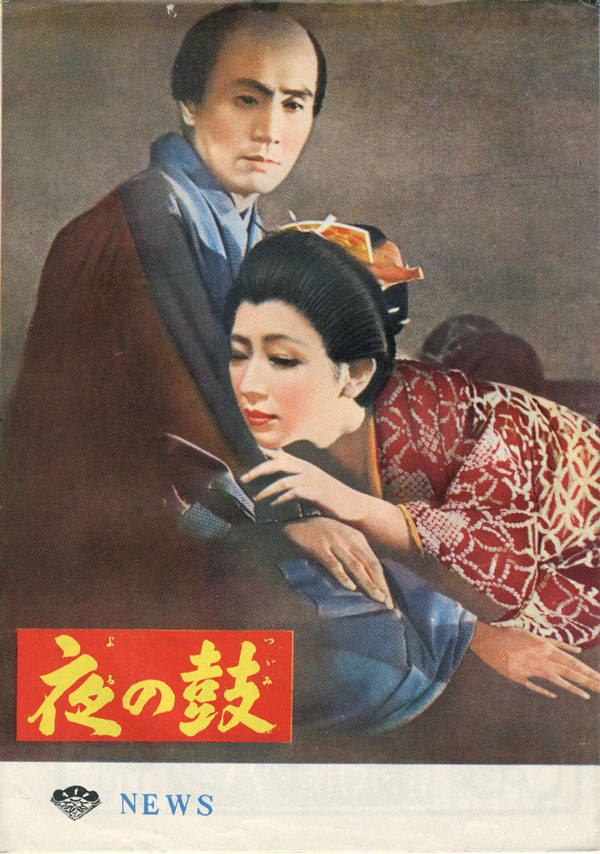
The works of Chikamatsu Monzaemon continue to have a large influence over Japanese drama even if not as frequently and directly adapted as they were in the immediate post-war period. Famous for tales of tragic love suicides and romantic heroes who risk all in the service of deep emotion, Chikamatsu’s works perhaps found even greater resonance in the turbulent years in which individual freedom and adherence to tradition found themselves in even greater conflict than ever before. Tadashi Imai makes the most of Chikamatsu’s melancholy fatalism to take a sword to the samurai order itself with all of its arcane rules and the essential hypocrisy which underlines its cruelty.

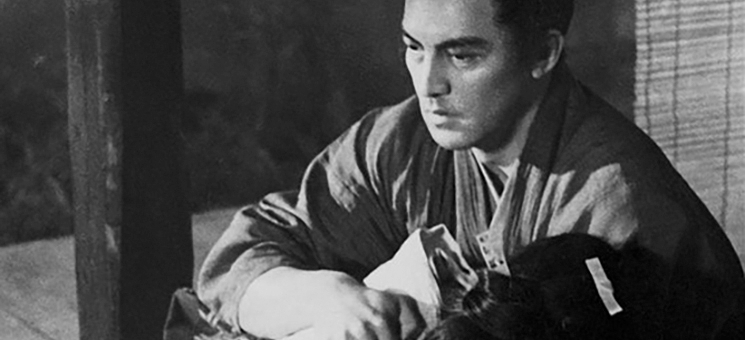
Hikokuro Ogura (Rentaro Mikuni) has been in Edo for a year with the shogun and is now on his way home. Stopping at an inn, he has a low level argument with his brother-in-law who warns him the men are getting restless and need to blow off some steam preferably with some sake. Hikokuro is in charge of the purse strings and knows all of this pageantry costs money the clan do not quite have hence he’s reluctant to fritter it away on alcohol no matter how much the men might resent him for it.

That’s not to say Hikokuro is a particularly officious person, he’s kind and cheerful by nature but also tired and eager to get home after such a long time away. His wife, Otane (Ineko Arima), is very happy to see him but something seems different about her and there’s a tension in the air among some of the other women. It seems, there are rumours about Otane and a travelling musician (Masayuki Mori) who frequented the house during the summer while Hikokuro was away. Rumours are often just that, especially in these petty circles of nobility, but female adultery is punishable by death and so is not something to be gossiped about idly.

Night Drum (夜の鼓, Yoru no Tsuzumi) begins with the ominous sound of the drum itself, beating out the inevitably tragic fate of all concerned with a melancholy fatality. The tale proceeds in a procedural fashion as the authorities become involved, hearing witness testimonies and trying to discover if there could be any truth at all in these unpleasant rumours. Matters are further complicated by the pecuniary difficulties the clan currently finds itself in – the elders are half hoping it is true because it would be a good excuse to expel the Ogura household and thereby save the money which goes on its upkeep. They are aware, however, that they’re talking about the life of a previously unblemished woman as well as the ruin of her extended family.

The life of a retainer is not as easy as it sounds and we’re constantly reminded of just how much money is necessary to keep up appearances. The clan authorities are dismayed when they hear of Otane earning money on the side through needlework though other retainers are quick to confess their wives also help out, they just can’t survive on such meagre stipends. Each lord is required to hire servants as befits their status but they aren’t given the money to do so. Hikokuro is also required to serve the shogun in Edo every other year for at least twelve months meaning Otane is left alone at home with almost nothing other than her needlework to do except wait patiently for her husband’s return.

Given these circumstances, it’s easy to understand how such pernicious rumours might begin. The sole basis of the evidence seems to rest on a tip off that Otane is thought to have been alone in a room with a man who is not her husband. That she may be put to death solely for the crime of sharing the same space as someone of the opposite sex seems extreme, but this is the feudal world where rules and propriety are all. The men can cavort with geishas to their heart’s content, but Caesar’s wife must be above suspicion.

The action unfolds piecemeal as each of the various witnesses offers their testimony of events. Given the gravity of the situation, few are eager to recount their suspicions – especially the other women who fear the rumour may be true but are also unwilling to believe it. Hikokuro does not want to believe it either but faced with such convincing, if circumstantial, evidence doubt creeps into his mind and finds an anchor in Otane’s guilt ridden behaviour. Ironically, this entire situation developed only because of Otane’s attempts to avoid it – remaining at an inn rather than travelling with a man on the road only for one of her husband’s friends to attempt to rape and blackmail her. Having had far too much to drink in an attempt to steel her nerves and cover up the embarrassing assault, Otane finds herself at the mercy of man who should have known better than to take advantage of another man’s wife in such a moment of weakness.

One stupid mistake born of alcohol, loneliness, and a series of male betrayals is enough to bring down the social order all on its own. Rentaro Mikuni plays the part of the previously affable wounded spouse with an exceptional level of nuance as he accepts his part in his wife’s downfall thanks to the the circumstances of their lives which have kept them apart and left her at the mercy of untrustworthy lords. There is anger here, and shame, but there is still love too which only makes the inevitable outcome all the more painful for everyone concerned. Hikokuro plays the part he’s expected to play, but it pains him and you can’t wipe a slate clean with blood. Imai has his eyes firmly on the civilised society with all of its rigid yet often cruel and unfair rules for living. Shot with a kind of hypnotic dreaminess in which each of our unfortunate players is swept along by events they are powerless to influence, Night Drum beats out the death knell of those who allow their individual desires to overwhelm their “civilised” conformity but it does so with a rhythm that is filled with anger rather than sorrow, for those who are forced to leave half their lives unlived in maintenance of the very system which oppresses them.


A Mother’s Love (母情, Hiroshi Shimizu, 1950)

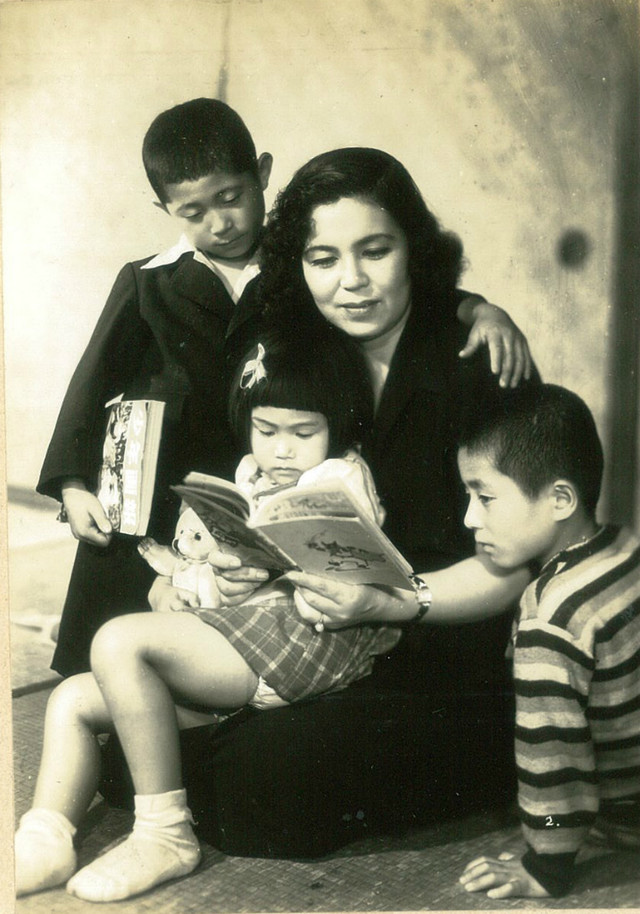
mothers-loveShimizu’s depression era work was not lacking in down on their luck single mothers forced into difficult positions as they fiercely fought for their children’s future, but 1950’s A Mother’s Love (母情, Bojo) takes an entirely different approach to the problem. Once again Shimizu displays his customary sympathy for all but this particular mother, Toshiko, does not immediately seem to be the self sacrificing embodiment of maternal virtues that the genre usually favours.

Tellingly, when we first meet Toshiko she’s asleep on a bus as her three children badger a friendly artist who’s entertaining them by drawing a picture of their pretty mother. The boys are quick correct themselves when talking about the woman they’re with – she’s their “aunt” not their mother, but the artist sees through the ruse. Toshiko is heading to visit her brother in the country in the hope that he will look after her children for awhile offering the explanation that she wants to get married again. Her brother is sympathetic to her problems, but has six children of his own already (and perhaps a seventh on the way) so taking in three extra mouths to feed is not really an option. Agreeing to look after the youngest girl, they suggest trying an elderly uncle but remind her that he has a rather conservative mindset and may ask all sorts of questions about Toshiko’s recent past which she might not want to answer.

Not to worry, the uncle seems to have mellowed with age though he can’t take in two growing boys either and suggests asking a friend of his who’s been trying for a baby for years but has been unable to have one. When that doesn’t work out Toshiko deposits her second son at the uncle’s and travels on with just her oldest boy, Fusao, but as time goes on Toshiko begins to rethink her decision to have her children fostered out and wonders if just being together might be worth more than a stable economic life founded on the pain of abandonment.

The protagonists of “hahamono” which praise the idea of the noble, self sacrificing mother are not universally saintly but the one thing they never do is consider leaving their children. In this regard Toshiko is not immediately sympathetic. Rejecting the name “mother” for “aunt” in the hope of hooking a prospective husband, Toshiko has already marked herself as falling outside of the idealised mother standards and her rather cool, snappy way of addressing the children does not go in her favour either. Her brother greets her warmly (even if he seems to suspect that she’s probably come because she wants something) and has no desire to drag up the past but points out that other people might not be so charitable given that all three children have different fathers and Toshiko has never revealed how she supported herself towards the end of the war and in its immediate aftermath. Nevertheless, Shimizu refuses to judge her. Her life has been a hard one and she herself was fostered out herself as a child. Toshiko’s decision may not be one everyone would agree with but that doesn’t mean it was an easy one for her to make, or that she feels nothing in giving up her children.

The biggest tragedy is that the kids will be separated. Apparently often left to fend for themselves at home whilst Toshiko works, the children are a mini band of three and it seems even more cruel that they will be deprived not only of a mother but of their siblings too. Though the youngest girl tries to run after her mother and brothers, and the second son cries so much that his brother goes back to give him one of his comic books to cheer him up, Fusao is even more upset and anxious as the last remaining child. Constantly wetting the bed which costs him his place at a few prospective new homes, Fusao is plagued by the idea that his mother is about to abandon him and finally pleads with her that he can take care of his siblings by himself if only they can all stay together.

Fusao’s pleas eventually soften his mother’s heart though she begins to think again after coming across a band of itinerant performers, one of whom is nursing an infant despite her poverty and the harshness of her life. The young woman seems devoted to her child and is determined to take care of it even though she has no husband to help her. The child’s grandmother urged her daughter to give the baby up to someone with more resources to raise it but the girl refused, no matter how hard it may turn out to be. Moved, and feeling even more guilty in witnessing the hardships another mother is bearing for her child, Toshiko’s resolve begins to weaken.

When Toshiko is taken ill at an inn and her friend from the city, Mitsuko, comes to visit her it is revealed that Toshiko’s plan is not another marriage but that the two women are in the process of opening a bar – hence why she needs to farm out her children. Mitsuko has also sent her daughter to a relative so that she can plow all her time and money into the enterprise though no one knows how long it will take until the place is successful enough to support the full families of both women. It may be, therefore, that Toshiko’s desire to run her own business is for the ultimate benefit of her children who will finally have a degree of economic security. On thinking again, she wonders if it isn’t selfish vanity and that she’s sacrificing her children to fulfil her own desires.

Shimizu takes a more conservative viewpoint than that found in his other work by encouraging Toshiko to reject the prospect of being her own boss to embrace the traditional values of her natural maternity. The old nurse Toshiko visits in the hope that she will take in Fusao (which she almost certainly would have done) remarks that a full belly isn’t everything and being together might be enough, but that doesn’t quite explain what the obviously desperate Toshiko is going to do to survive from here on in. One can only hope that she somehow finds a way to make the bar work (even if it takes a little longer) rather than be left with nothing all over again. Focusing less on the children than on the maternal conflict as Toshiko becomes torn by the traditional values as seen in her rural hometown and the less forgiving modernism of the city, Shimizu retains an understanding tone but also eschews the concessions to pragmatism which so often went hand in hand with his forward looking idealism, for a reassertion of conservative values which fly in the face of his usually compassionate acceptance of the very real difficulties faced by women in a conformist and male dominated society.