Astro Gardener (별의 정원, Won Jong-shik, 2019)

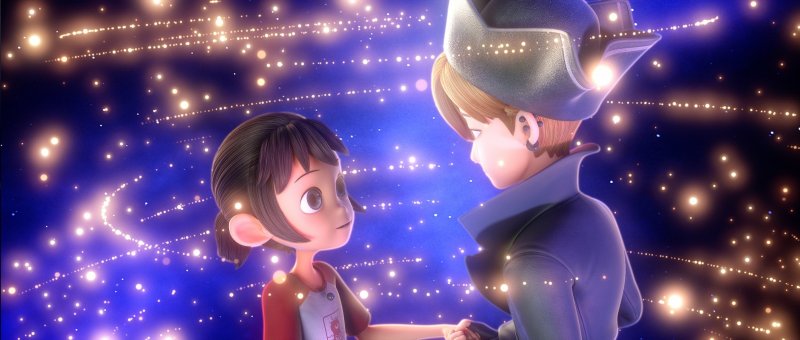
Astro Gardener poster 1Korean cinema is sometimes criticised for its bleakness. Happy endings are indeed something of a rarity, though not entirely absent and, ironically, often rejected for their sentimentality. Cinema for children might be a notable exception with the desire to cushion young viewers from the world’s harshness as a high priority even if it never shies away from the fact that life is sometimes hard and there will be times when you are sad or afraid or lonely. Astro Gardener (별의 정원, byeol-eui jeongwon), a colourful tale of strange creatures making sure the stars still shine, is a film about just those times which makes the very important and always relevant point that there is no light without darkness and that it’s OK to feel sad, or afraid, or alone because your darkness is also a part of you.

12-year-old Suha (Kim Yeon-woo) is excited that her parents are going to leave her alone in the apartment overnight for the first time while they go on a fishing trip. Before he leaves, Suha’s dad gives her a precious necklace which she is not very impressed with because all she wants is a dog. Suha’s dad is broadly in favour of the puppy idea, especially as grandma’s dog is currently pregnant so it would be very easy to adopt one once it’s born. Mum is less convinced, both fearing that she will end up looking after it and worrying that it will be sad when the dog inevitably passes away. While they’re busy discussing all that on the way to the campsite, the car swerves to avoid an oncoming truck and they get into an accident during which Suha’s dad is killed.

A year later, Suha’s mum takes her to stay with grandma during the holidays while she has to get back to work. Suha isn’t very happy about it, but the blow is softened by the fact she’s finally getting a little dog named “Night” who is the last of grandma’s puppies seeing as her own dog passed away shortly after giving birth. Playing on the beach, Suha is drawn to a strange stone and takes it home only for a weird little man with a star on his head to break into her room and steal it. The man, who turns out to be called Om (Jeon Tae-yeol), is an “Astro Gardener” charged with looking after the darkness to ensure that the stars can stay in the sky. It turns out that the planet Pluto (Shin Yong-woo) has gone rogue and left its orbit to become a space pirate hellbent on destroying the darkness to create a universe of light born of the destruction of hundreds of stars.

A universe of light in which there is no more loneliness or pain might sound very attractive, but where there’s no sorrow there can be no joy. Since her father’s death, Suha has been deathly afraid of “the dark”, sleeping with the light on and only venturing out in the middle of the night when her dog chases out after Om, which is how she winds up discovering the Astro Garden. She isn’t terribly invested in the quest to save the darkness but finds herself swept into it when Pluto’s minions show up and kidnap Night’s shadow which means she has to go and get it back or risk loosing him because, as the repeated metaphor points out, you can’t live as light alone. 

Om warns Suha that Pluto is a no-good rebel out to destroy the universe but because she loses a lot of her memory on his ship, Suha is instantly smitten seeing as it just so happens that Pluto looks exactly like the handsome K-pop idol we see on the poster in her bedroom. Realising that the necklace Suha received from her father is the All-Energy capable of controlling all the darkness in the universe (what teenage girl doesn’t think she can do the same?), Pluto sets out to take it but the snag is that the power can only be transmitted to someone you truly love which is the real gift her father was trying to give her.

Learning to remember her father’s love rather than his loss, Suha rediscovers her sense of confidence and is no longer so afraid of “the dark”. Resolving to be kinder to her mother, she can appreciate life’s light and shade but makes sure to keep in touch with her old friends at the Astro Garden to go tend to her darkness to make sure she can still see the stars. A cheerfully animated tale of a little girl figuring out how to live with grief while becoming embroiled in an interstellar battle to save the universe, Astro Gardner is a surprisingly deep meditation on depression and anxiety in which the heroine rediscovers her sense of self while finding the will to fight for others.


Astro Gardener screens on 2nd November as part of the 2019 London Korean Film Festival.

International trailer (English subtitles)
Long Live the King (롱 리브 더 킹: 목포 영웅, Kang Yoon-sung, 2019)

long live the king poster 1Back in the good old days, gangsters used to make a case for themselves that they were standing up for the little guy and protecting those who couldn’t protect themselves. Of course that wasn’t quite the truth, but one can’t deny how closely small town thuggery and political office can resemble one another. Following his breakout hit The Outlaws, Kang Yoon-sung returns with web comic adaptation Long Live the King (롱 리브 더 킹: 목포 영웅, Long Live the King: Mokpo Yeongwoong), another unconventional comedy in which a surprisingly loveable rogue rediscovers his national pride and finds a more positive direction in which to channel his desire to be helpful.

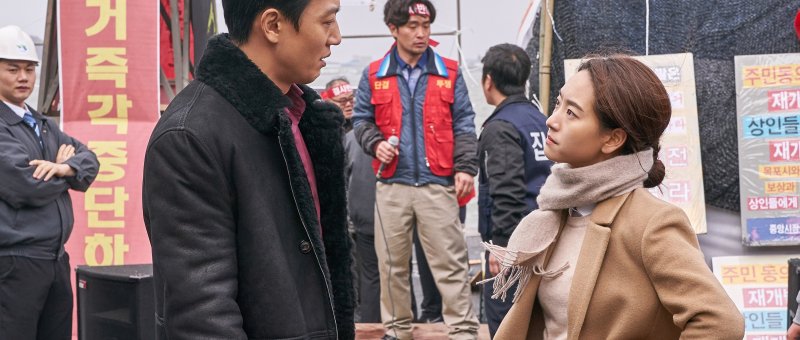
Se-chool (Kim Rae-won) is a notorious thug with a traumatic past currently working with a local gang hired to clear a small protest of stall owners trying to cling on to a traditional market space in working class Mokpo where a developer wants to build a theme park and upscale skyscraper. A feisty young lawyer, So-hyun (Won Jin-a), is working with the protesters on their case and has no problem telling the gangsters where to get off. Impressed, Se-chool is smitten and starts to wonder if he’s on the wrong side but his attempts to get So-hyun’s attention – being strangely nice to the protestors, buying everyone lunch etc, spectacularly backfire. Only when he hears about another man, Hwang-bo (Choi Moo-sung), who used to be a gangster but has now reformed and become a social justice campaigner running a small not-for-profit cafe serving meals to the vulnerable, does he begin to see an opening, vowing to give up the gangster life and commit himself to serving the people of Mokpo.

The irony is that everyone seems to think that Se-chool has a hidden agenda, but his only agenda is the obvious one in that he wants to win So-hyun’s heart even if that means he has to shape up and learn to become a decent person rather than a heartless gangster thug. Known as the king of the nightlife, Se-chool is regarded as a slightly eccentric, good time guy, so his sudden desire to go “legit” is met with bemusement rather than surprise, but old habits are hard to shake and it takes a while for him to realise that trying to help people with his fists is not the best way to go about it. Punching out some punks making trouble in a cafe gets him an earful from the proprietress who explains that she owes a lot of money to the guys’ gang so Se-chool’s chivalry has probably caused her a series of potentially serious problems she assumes he won’t be on hand to help her out with. Nevertheless, he retains his desire to wade in and do his bit, becoming a surprise local hero when he puts himself in danger to ensure the unconscious driver of a crashed bus gets out safely while the other passengers make their escape.

Meanwhile, local politics is starting to heat up. Venal politician Choi Man-su (Choi Gwi-hwa) is up for re-election and running on a platform of making Mokpo great again. It comes as no surprise that Man-su is deep into the corrupt theme park project and outsourcing general thuggery to Se-chool’s arch-enemy which eventually includes taking out potential rivals like Hwang-bo whose approval ratings are soaring while voters are becoming tired of Man-su’s big money tactics and insincere messaging. Soon enough, Se-chool is persuaded to enter the race seeing as his “local hero” persona puts him in good stead to oppose Man-su’s establishment credentials. But, in order to get elected and convince So-hyun he’s really changed, he’ll have to finally face his traumatic gangster past while learning to be open and honest with his feelings.

Kang goes in hard for the business of politics, taking pot-shots not only at corrupt establishment figures in so tight with organised crime that they’re little more than jumped up gangsters, but also at ambitious party hoppers, and misguided mobsters who think they’re onto the big ticket by hooking up with “legitimate” power. Poor Se-chool, meanwhile, actually thought he was doing “proper business” in his persona as a besuited gangster of the new, corporatised school little thinking about the little guy as he unwittingly went about his ultra-capitalist agenda. Heading for broad comedy, Long Live the King misses an opportunity for serious satire but has undeniable heart as the misused hero learns to accept himself in being accepted by others, falling in love not only with a feisty activist lawyer but with community spirit and progressive politics as he vows to fight for a better future for the people of Mokpo while opposing the inherent corruption in the system embodied by men like Man-su who feel themselves entitled to exploit solely by virtue of their own superiority.


Long Live the King was screened as part of the 2019 London East Asia Film Festival.

International trailer (English subtitles)

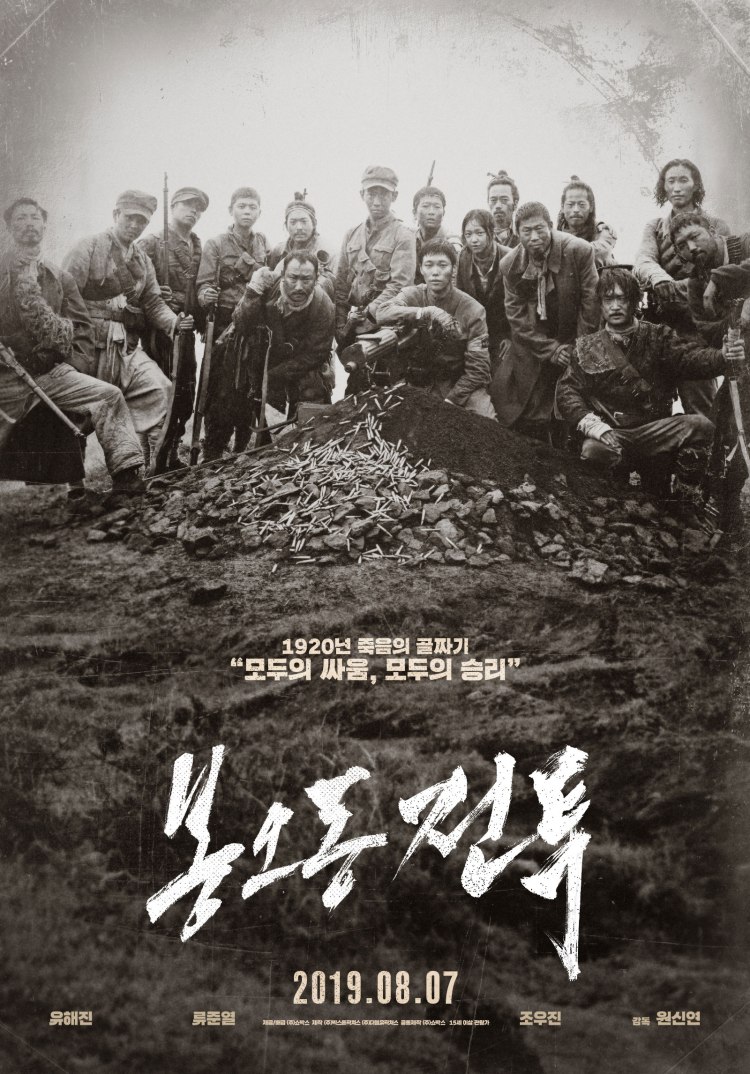
The Battle: Roar to Victory (봉오동 전투, Won Shin-yeon, 2019)

The Battle roar to voctory poster 1Besides seeing the birth of Korean cinema, 1919 was something of a flashpoint in the nation’s 20th century history. Japan had annexed Korea in 1910, thereafter instituting an increasingly brutal colonialist regime. On March 1, 1919 the people rose up in an act of mass protest inspired by the provision for “Self-Determination” included in US president Woodrow Wilson’s 14 Points speech outlining a path towards enduring peace. Though the protest was peaceful, it was quickly suppressed by Japanese troops resulting in thousands of deaths and mass incarcerations.

The Battle: Roar to Victory (봉오동 전투, Bongodong Jeontoo) situates itself a year after the protest as the Independence Movement began to intensify, and is inspired by real life events apparently often absent from the textbooks in which several factions eventually came together to wipe out an “elite’ squad of Japanese troops which had been put together to take down guerrilla Resistance fighters. Our heroes have been charged with collecting money from a fundraiser and conveying it to the Independence Movement in exile in Shanghai but are drawn into a wider battle against Japanese brutality on their way.

The Japanese colonial forces are indeed brutal, if often cowardly. When we first meet crazed commander Yasukawa (Kazuki Kitamura), he’s butchering a tiger in some kind of symbolic act of intense barbarity. To smoke out the Resistance fundraiser, the Japanese military begin razing villages, killing the men and raping the women, even going so far as to shoot small children for sport. When veteran Resistance fighter Hae-cheol (Yoo Hae-jin) raids a command post, he makes a point of taking a hostage who himself seems to be a teenage recruit. Hae-cheol lets the boy live not only out of a sense of compassion, but also because he wants him to take what he’s seen back to Japan, including the aftermath of a Japanese assault on an ordinary Korean village.

Yukio (Kotaro Daigo), as the boy later gives his name, is, unlike his fellow officers, conflicted and confused. Apparently a member of the elite himself, the son of a prominent military figure, Yukio gave up a bright academic future to join the army and find out what it is that Japan does with its advanced weaponry. Asked what he thinks now that he’s seen for himself, he says that he’s ashamed, that his worst fears have been confirmed. According to Yukio, his nation is suffering from an intense inferiority complex which is leading it to commit acts of extreme barbarity in order convince itself it is equal to any other imperial power.

The Japanese officers veer from the crazed, bloodthirsty Yasukawa who views his mission as some kind of hunting expedition, to the merely weak and cowardly. The Independence fighters, however, come from all over Korea speaking many dialects (some less mutually intelligible than others) and with many different motivations but all with the desire to free their country from Japanese oppression. Ace captain Jang-ha (Ryu Jun-yeol) is a born soldier, but those who support him are largely street fighters and “bandits” not always welcomed into the movement by the so-called intellectual “nobles” running the show from a position of social superiority. Then again, as Hae-cheol puts it, no one can be sure how many guerrilla soldiers there are because any farmer is a potential sleeper agent.

In any case, the Resistance fighters pursue their mission selflessly, manipulating the complacent Japanese troops to lure them into a mass ambush while trying to ensure the money still makes its way to Shanghai to preserve the movement. Despite the “Roar to Victory” subtitle, it’s important to note that the Independence Movement was still in a nascent state and would continue opposing Japanese oppression until Korea’s liberation at the end of the war. Covering the legendary battle of Battle of Fengwudong, the film ends with forward motion as the Resistance commander (a late and great cameo from a giant of Korean cinema) points ahead towards the next target, the well known Battle of Cheongsanri, in which the Japanese military reportedly suffered over 1200 casualties at the hands of Independence forces. Overly gory and lacking in subtlety, The Battle: Roar to Victory is unabashedly patriotic but does its best to suggest the costs and compromises of guerrilla warfare as its selfless heroes put aside their differences to fight for a better Korea.


The Battle: Roar to Victory was screened as part of the 2019 London East Asia Film Festival.

Original trailer (English subtitles)

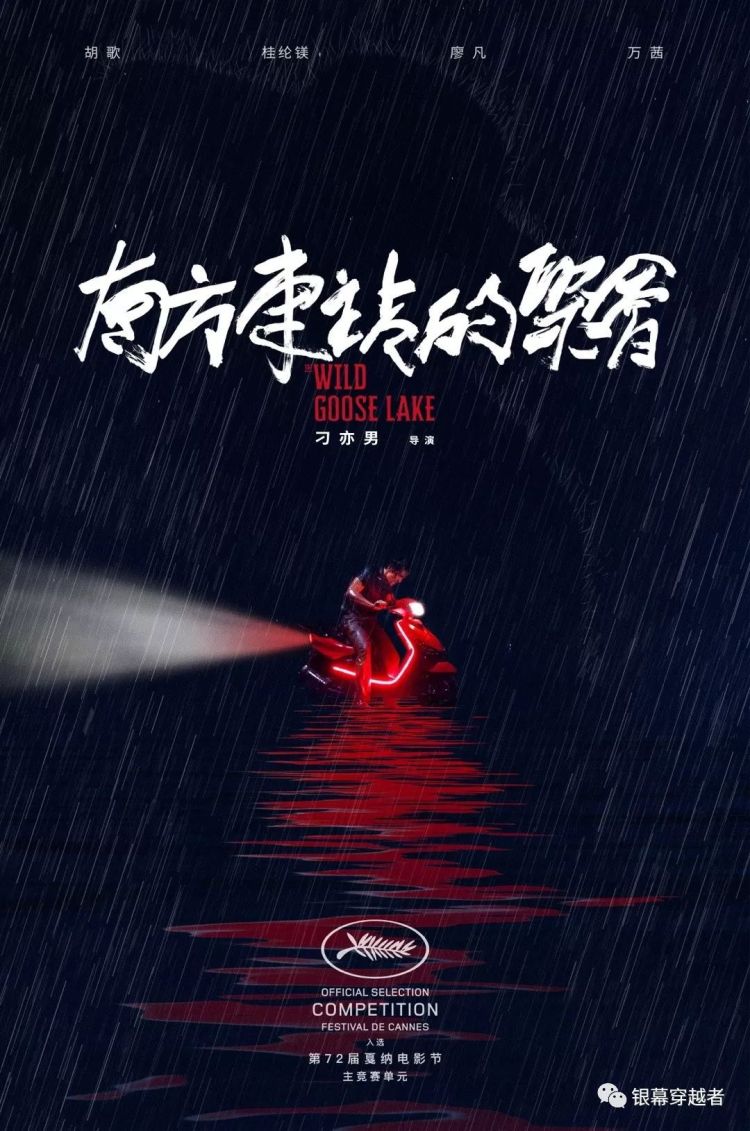
The Wild Goose Lake (南方车站的聚会, Diao Yinan, 2019)

wild goose lake poster 1Chaos and desperation are about as far as it’s possible to get from the image of the modern China the nation’s cinema has been keen to project, but that’s exactly where we find ourselves in the murky world of The Wild Goose Lake (南方车站的聚会, Nánfāng Czhàn de Jùhuì). Diao Yinan’s Black Coal, Thin Ice followup finds the director in much the same territory only this time embracing the absurdity of existential flight as his twin heroes seek impossible escape in the garish neon of a provincial underworld.

Diao opens on the rain-drenched streets as sullen gangster Zhou Zenong (Hu Ge) waits impatiently for a rendezvous with his estranged wife Shujun (Wan Qian), only to be met by a stranger – “bathing beauty” Aiai (Gwei Lun-mei), who explains she won’t be coming. A lengthy flashback reveals that Zenong is currently on the run after getting embroiled in a dispute over turf assignments at some kind of gangster briefing session during in which one of his guys shot one of the Cat brothers’ men in the leg. To settle the matter, the boss proposes a good old-fashioned competition to see who can nick the most bikes in one night with the winner getting the prime spot, but Zenong doesn’t know he’s been set up and mistakenly kills a policeman after being attacked by Cat Eyes. Realising there’s no longer any way out for him, Zenong’s last hope is to keep the police at bay long enough to get back in touch with his wife and convince her to turn him in to the police so that she can claim the reward money.

Like many men of his generation, Zenong couldn’t find the kind of honest work that would allow him to provide for his family and so he left home. Too ashamed to own his no-good gangster ways, he stayed away for five years but all that’s on his mind is family and this is the only chance that he will ever have to provide for them. Shujun isn’t even really sure she wants anything to do with her absentee husband, but is dragged back into his orbit once again harassed by the police every step of the way.

In striking contrast to most Chinese crime dramas, these police are far from a force for order. Describing Wild Goose Lake as a lawless land, they have their very own briefing to formulate a plan to catch Zenong but aren’t averse to underhanded tactics like threatening Shujun and trying to undermine her attachment to her husband through a fabricated story about a pregnant girlfriend. The line between cop and thug isn’t so thick as you’d think it would be, and you can’t trust the police any more than brotherhood or honour amongst thieves.

Devoid of morality, Wild Goose Lake is indeed a chaotic place defined by shifting loyalties and unexpected betrayals. Fights break out without warning, plans change, and there are no safe spaces. Bumbling as they are, the police are everywhere watching everything and trying to blend in. Anyone might be a cop, or secretly working against you. Zenong is on the classic wrong man path, except that he’s the right man and he knows it. He might not have pulled the trigger if he knew it was a policeman he was firing at, but pull the trigger he did and now he’ll have to make peace with it. Trying to outrun the law only so long as to subvert it, he finds himself slipping past checkpoints distracted by pointless officiousness and consistently evading the net.

When Shujun is unable to make it to the rendezvous, Aiai offers to take her place by turning Zenong in and claiming the reward money to pass it on to Zenong’s wife (minus a small fee), meaning they will need to trust each other until the mission is completed. Aiai, a dejected young woman supplementing her income with casual sex work as one of the “bathing beauties” found at the lake, longs to escape her dead end existence, eventually telling the policeman she’d use the reward money to open a small store back in her hometown. Like Shujun, she lives in a fiercely patriarchal, unforgiving society  from which there is little sign of escape or independence. Yet, as afraid of everything Zenong represents as she eventually becomes, Aiai remains steadfast and true, keeping her promise and paving the way towards a brighter future for Shujun and her son away from the haphazard chaos of Wild Goose Lake. An absurdist fable drenched in neon, Diao’s conception of life on the margins of provincial China is as bleak as they come but eventually finds space for positivity on returning to a world more ordinary in which two women walk away from the traumatic past arm in arm and the law has to be content to let them go.


The Wild Goose Lake was screened as part of the 2019 London East Asia Film Festival.

International trailer (English captions)

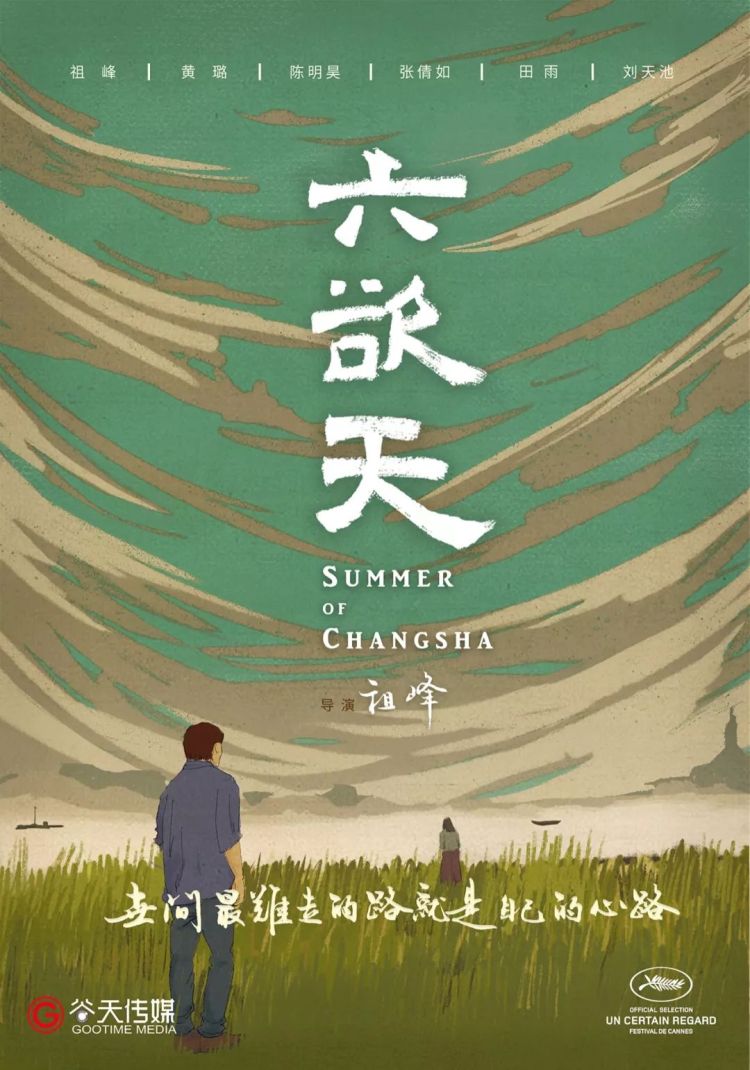
Summer of Changsha (六欲天, Zu Feng, 2019)

Summer of Changsha poster 1Escaping from the traumatic past is fast becoming a favourite theme of Chinese cinema, but Summer of Changsha (Liù Yù Tiān) swerves away from the neon-lit, rain-drenched streets of your average melancholy police procedural for the fetid air of sun-baked provincial China where death haunts the shadows. Each dealing (or failing to deal) with guilt and responsibility, a depressed detective and seemingly emotionless doctor bond through a shared sense of impossibility only to discover that there may be a way out after all only not of the kind they might have assumed.

Detective Bin (Zu Feng) has already handed in his resignation but has no real plans for his post-police life. Consumed by powerlessness and regret over failing to prevent the death by suicide of his girlfriend who had been living with longterm depression, he cannot seem to find a place for himself back in the world. When a severed arm is fished up from a local lake, he gets a new sense of purpose and eventually connects the lonely limb to a missing persons ad found after trawling the internet which mentions a prominent scar on the right hand.

The ad was placed by a doctor, Li Xue (Huang Lu), who emotionlessly confirms to Bin and his earthier partner Lei (Chen Minghao) that she believes the hand to be her brother’s, shocking them by correctly guessing where they might have found it. Xue tells them that her brother Yi appeared to her in a dream and showed her where the rest of his body parts are – something later confirmed to be true when the three drive out to a remote spot and dig up a suitcase buried under a tree.

Strangely, Bin takes the “dream” theory at face value with only Lei seemingly unconvinced. He never quite entertains the obvious conclusion that Xue knows where the body parts are because she put them there, even after discovering that the pair were seen to be arguing recently and that their relationship became strained after a tragic accident during which Xue’s daughter, who was suffering with a heart condition, sadly passed away.

What draws Bin to Xue is a shared sadness, a deepening gulf of introspection which, ironically, convinces them they exist outside of regular society and should not permit themselves genuine human connections. Xue’s animosity towards her brother, it seems, was less because of what happened to her daughter than because of his conversion to Buddhism which had, she felt, allowed him to move on and start to forget about their past. By contrast, Xue condemns herself to a life of suffering as atonement, wilfully carrying on an affair with a married surgeon (Tian Yu) she doesn’t seem to like very much solely because his research area was closely connected to her daughter’s condition and if she’d lived he might have saved her. Bin, meanwhile, criticises his partner Lei for trying to ghost a girlfriend, cute as a button Ting Ting (Zhang Qianru), because he thought she was annoying, but finds himself doing the same thing after he sleeps with her when she approaches him for comfort only for her to become emotionally attached.

Ting Ting wants to help him overcome his emotional pain, but Bin isn’t sure he can. Like Xue, his grief and guilt have made him selfish and self-involved. Reconnecting with his late girlfriend’s family, he has the urge to make some kind of confession in order to ease his burden only for her sister (Liu Tianchi) to rightly round him for the cruelty of what he’s about to do. She was just starting to move on with her life, and now Bin’s sudden chattiness seems primed to stir everything up again. His desire to ease his conscience is entirely for his own benefit whatever he might say about wanting the family to know the truth. Each conflicted by their awkward connection, neither Xue or Bin can see a way out of their suffering because they don’t believe they deserve one.

To stave off the inevitable, they continue investigating the mysteries behind Yi’s death but the answers they find turn out to be depressingly banal. While a mysterious collective of Buddhists release fish back into the rivers (perhaps not as responsible as it first sounds), the pair remain similarly trapped in a solipsistic world of suffering little realising the consequences of their (in)actions on those around them. Yet solving the case in its entirety does at least offer the opportunity of new beginnings, however far they choose to take them. A detached exploration of the entrenched effects of trauma, guilt, and regret, Summer of Changsha is not quite the film it first appears to be but an icy journey from the cold heat of summer into the unexpected warmth of winter snow as its dejected leads learn to look for new directions towards a less uncomfortable future.


Summer of Changsha was screened as part of the 2019 London East Asia Film Festival.

Original trailer (English subtitles)
Cities of Last Things (幸福城市, Ho Wi Ding, 2018)

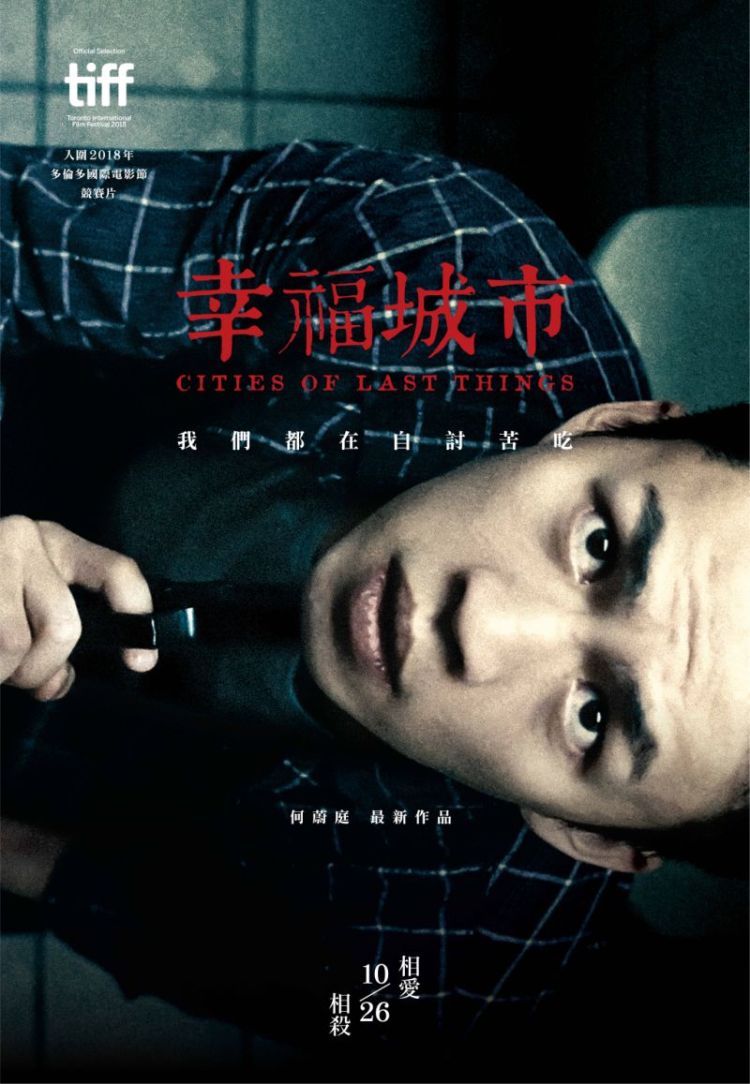
Cities of last things poster 1A sense of finality defines the appropriately titled Cities of Last Things (幸福城市, Xìngfú Chéngshì), even as it works itself backwards from the darkness towards the light. Still more ironic, the Chinese title hints at “Happiness City” (neatly subverting Hou Hsiao-hsien’s “City of Sadness”) but that, it seems, is somewhere its hero has never quite felt himself to be. Embittered by a series of abandonments, betrayals, and impossibilities, he grows resentful of the brave new world in which old age has marooned him. 
Ho opens with a bouncy, retro track advising that one should never be too generous with love only for a body to suddenly rain down from above. As we later discover, the body belongs to 60-something former policeman Dong-ling (Jack Kao) who has grown disillusioned with his futuristic, digital world, stubbornly smoking cigarettes and growing old gracefully while surrounded by vapers and ads for rejuvenating drugs. For reasons we don’t yet understand, he ventures into the red light district to buy a gun, punches his wife’s dance partner, and visits a hard-nosed sex worker who reminds him of a woman he loved and lost thirty years previously.

Love, guns, death and revenge become persistent themes for the older Dong-ling whose only bright spot seems to be a grownup daughter preparing to move abroad with her foreign boyfriend. Thirty years previously Dong-ling (Lee Hong-chi) too dreamed of running overseas. Consumed with rage on discovering his wife’s infidelity, he imagines himself killing her, her lover, and himself but settles only for a petty revenge against a colleague which exposes the entrenched police corruption he had refused to participate in, alienating his fellow officers. Bonding with a French kleptomaniac (Louise Grinberg) on the run from some kind of unresolved conflict with her father, he sees a way out only to have the door cruelly closed on him just as it was so many years before when he was just a teenager picked up for trying to steal a scooter.

In true film noir style, all women are perhaps one woman. Abruptly shifting tone in venturing into the recent past, we are introduced to Big Sister Wang (Ding Ning) – an embittered, disappointed femme fatale running out of road, hemmed in by the choices she has already made. She may already know there’s no way out for her, little needing the policeman’s warning that after her arrest everyone in gangland will assume she talked when they let her go, but she refuses to give in, repeatedly insisting on cigarettes and asserting her dominance while the unsympathetic policemen get on with their grim business.

Cornered, Ara, the shoplifting free spirit, decides to interrogate her interrogator, calling back to the later version of herself in asking why it is that prostitution is illegal. The policeman has no answer for her, save that he does not make the rules only follow them. Dong-ling too wanted to be a force of order, perhaps taking Big Sister Wang’s impassioned pleas to be a good person and not end up like her a little too much to heart. He follows the rules too closely for the comfort of his colleagues but finds himself dangerously exposed by an inability to regulate his feelings, a victim of toxic masculinity humiliated by his wife’s betrayal but unable to stand up to the corrupt superior who so casually closes down the only escape route he has been able to find.

The older Dong-ling is horrified by his daughter’s revelation that she lasered away a birthmark. How else can you recognise someone you lost long ago in the great wide world other than by a mark placed on them when they were born? His daughter rolls her eyes and reminds him that these days everyone is chipped, but there may be something in his rationale that everyone is marked at birth. Dong-ling is surrounded by handcuffs, self-driving vehicles, and locked doors. His fate is sealed, as we know, because we saw him fall, yet like Big Sister Wang he fought back only his resistance was violent and vengeful, abhorrent in its enraged pettiness. His is a tale of fatalistic resentment and of an existence consumed by a sense of hopeless abandonment, coloured only by a longing for lost love. Ho’s decision to end the film with its happiest moment, bright sunshine in place of rain soaked night, is ironic in the extreme but returns us to the grim serenity of the opening as the cheerful retro strains re-echo and Dong-ling catapults himself into a life of misery in the cities of last things where all hope is futile and all love loss. 


Screened as part of the 2019 London East Asia Film Festival, Cities of Last Things is also available to stream online via Netflix.

TIFF trailer (English subtitles)

Liu Wen-cheng – Don’t Be Too Generous About Love

EXIT (엑시트, Lee Sang-geun, 2019)

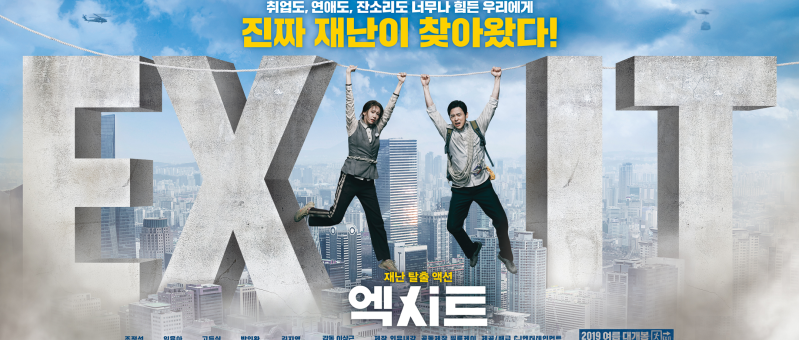
Exit poster 2“Hell Joseon” manifests as “toxic gas” in Lee Sang-geun’s Exit (엑시트). Millennial “slackers” losing out in Korea’s increasingly cutthroat economy find themselves consumed by their own sense of failure while those around them only compound the problem by branding them useless, no-good layabouts, writing off the current generation as lazy rather than acknowledging that the society they have created is often cruel and unforgiving. Yet, oftentimes those “useless” skills learned while having fun are more transferable than one might think and the ability to find innovative solutions to complex problems something not often found in the world of hierarchical corporate drudgery.
30-something Yong-nam (Jo Jung-suk) spends his days in the park surrounded by grannies and has earned the nickname “IBM” – Iron Bar Man, for his athletic pursuits. The local kids have even come up with an origin story for him that his girlfriend must have died after falling off one and so now Yong-nam is some kind of “village idiot” with an overwhelming need to master the monkey bars. The truth is, however, that Yong-nam has nothing much of anything else in his life. His continual failures to find employment are an embarrassment to his family, and even his little nephew (Kim Kang-hoon) is so ashamed of him that he routinely blanks Young-nam in the street. With mum’s (Go Doo-shim) 70th coming up, everyone is very keen that Yong-nam look the part and try not to embarrass them.

Yong-nam is also quite invested in not being an embarrassment because the only reason he booked this fancy restaurant that’s a two hour drive away is that he’s heard his university crush Eui-ju (Im Yoon-ah) works there. Back in uni when they were both members of the rock climbing club, Yong-nam asked Eui-ju out but she was only interested in friendship so he started avoiding her out of embarrassment. Not really any more mature, he lies that he’s a high flying hedge fund manager rather than admit that his life has not been going well. Eui-ju, meanwhile, is the vice-manager of this events centre but shrugs the job off as not much better than part-time when in reality she’s really running the place while her sleazy boss (Kang Ki-young) who’s only in the position because it’s his dad’s company constantly sexually harasses her and shows no signs of taking no for an answer.

When toxic gas floods the city, however, the pair are instantly in their element. They know how to conjure makeshift stretchers from stuff that’s lying around and how to try and draw attention to yourself when you’re in need of rescue, but find their ideas dismissed by Yong-nam’s confused, conventional family members well used to ignoring crazy uncle Yong-nam. To survive they’ll have to trust him and his rock climbing prowess as he shins his way to the top of the building where salvation seems more of a possibility.

Crisis aside, Yong-nam lives in a world of constant anxiety where he’s forever receiving disaster alerts on his phone for things he never thought he’d have to worry about, and his mother spends her evenings diligently copying down ways to prevent cancer from TV documentaries. Yong-nam’s dad (Park In-hwan) would rather chill out with some soap operas, but it seems you can’t drown out existential dread with vicarious drama. Having more or less given up, Young-nam hasn’t even been going to his climbing club. After all, if you can’t get a foot on the ladder, what use is the ability to climb? “Our lives are the disaster” Yong-nam’s similarly troubled friend exclaims, but the sudden threat of toxic gas does at least give the dejected young man motivation to prove himself in demonstrating that his skills are useful, even essential, rather than frivolous or eccentric as his family members previously believed them to be.

Eui-ju, meanwhile, is kept in her place by a combination of sexism and the demands of a hierarchical society which prevent her from fulfilling her true potential by convincing her that she has to be polite to her odious boss. Teaming up with Young-nam, the pair work as equals and support each other as they try to find ways to survive. No damsel in distress, Eui-ju is finally able to take an active role in her own destiny while also making sure to save other people along the way, often at the expense of the pair’s own chance to escape.

In a loose moment, Yong-nam declares that he’s only applying for jobs in one of the shiny skyscrapers from now on because those guys probably got saved first, but in the end it’s their plucky never say die spirit which saves them, in more ways than one, as their exploits go viral with their millennial brethren who eventually motivate the drone squad to try and keep them safe. There may be no exit from Hell Joseon, but as Yong-nam and Eui-ju discover, you don’t have to listen when people tell you there’s no way out because the only way is up and you won’t know unless you go.


EXIT was screened as the opening night gala of the 2019 London East Asia Film Festival.

Original trailer (English subtitles)

The Thousand Faces of Dunjia (奇門遁甲, Yuen Woo-ping, 2017)

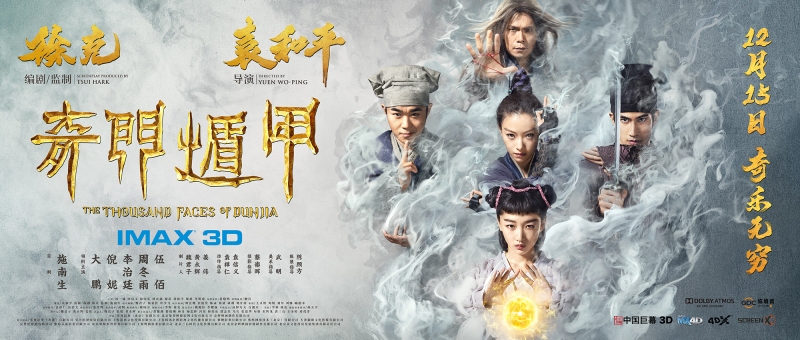
Thousand faces of Dunjia poster 6The Dunjia has a thousand faces. Or maybe not. Yuen Woo-ping teams up with Tsui Hark for a “remake” of Yuen’s 1982 classic The Miracle Fighters retitled The Thousand Faces of Dunjia (奇門遁甲, Qíméndùnjiǎ), only it isn’t much of a remake at all and simply pinches the idea of supernaturally-charged heroes fighting for justice which, it has to be said, is hardly original or at least not enough to justify Tsui’s claim that the two films are linked by a desire to push the boundaries of the wuxia film. Nevertheless, Yuen does his best to craft a tale of brotherhood and rebirth for his noble warriors newly re-energised by a life-giving phoenix, but struggles under the weight of an otherwise incoherent narrative.

So, in fantasy medieval China, the land is beset by a stealth invasion from otherworldly powers. Our heroes, the Wuyin clan, are the last line of defence against the increasingly powerful alien marauders. In order to beat them, they need to unlock the mysterious power of Dunjia, which, according to a prophecy, can only be done by a very specific person. Accordingly, the clan’s “big brother”, Zhuge (Da Peng), has gone out looking. Unfortunately, not everyone is convinced by what he brings back – a young woman he found in some kind of institution who has a childish, ethereal quality and a surprising ability to suddenly morph into a giant colourful phoenix.

Yuen opens with a brief discussion of Qimen and the Dunjia which seems to have something to do with interdimensional co-ordinates but truth to tell it turns out not to be very important. The main thrust is that weird alien beings have been living amongst us for centuries and are quietly waiting for us to die out so that they can inherit the Earth. Only some of them have lost patience. The aliens might be about to get their hands on a world destroying device, something the Wuyin are desperate to prevent but the aliens keep using their abilities against them and their prospects look increasingly hopeless.

With the narrative in disarray, Yuen relies on the camaraderie between the members of the Wuyin to carry the film (which it largely does). There’s history between the de facto leader Dragonfly (Ni Ni) and healer Zhuge despite the Wuyin’s increasingly silly code which forbids affection between comrades and punishes it with mutual slapping. Accordingly the pair spend most of the film bickering while conflicted by the arrival of romantic rivals in the form of the mysterious Circle (Zhou Dongyu) and an earnest young policeman, Dao (Aarif Lee), who keeps stumbling on the activities of the Wuyin but has his memory wiped to prevent the truth getting out. Despite the plot holes and inconsistencies, the Wuyin are an intriguing bunch who do their best to earn our sympathies even whilst shouldered with a series of incomprehensible events.

Incomprehensibility is not necessarily a problem in a wuxia film, in fact it can sometimes be an asset, but the concept is continually let down by over reliance on poor quality CGI and bland production design. Yuen opens with an engaging, if surprisingly cutesy, sequence of Dao and Dragonfly enjoying a (re)meet cute while chasing a giant three-eyed fish through the streets of an ordinary city, but despite the resurgent beauty of Circle’s colourful phoenix the cartoonish battles between soulless alien mecha giants largely fail to convince.

Cartoonish though it may be, there is charm in Dunjia’s lowbrow humour as the gang bicker amongst themselves and engage in a comically romantic tug of war. Yuen breaks the tale into a series of chapters as if mimicking an old fashioned wuxia serial and there is certainly a strain of meandering fairytale nonsense in the film’s refusal to pick a direction and follow it even if it takes things too far with an all too abrupt ending designed only as an inelegant hook for an upcoming sequel. Ironically enough, Dunjia is a film about coming “full circle” and then being reborn anew like a phoenix from the flames but pushes itself too far in threatening to set the wheel turning again just when it ought to be hitting its stride. Flawed but intermittently entertaining, the first adventure fo the Wuyin clan is off to a rocky start but sheer charisma alone may be enough to ensure repeat custom.


Currently available to stream in the UK (and possibly other territories) via Netflix.

Original trailer (English subtitles)

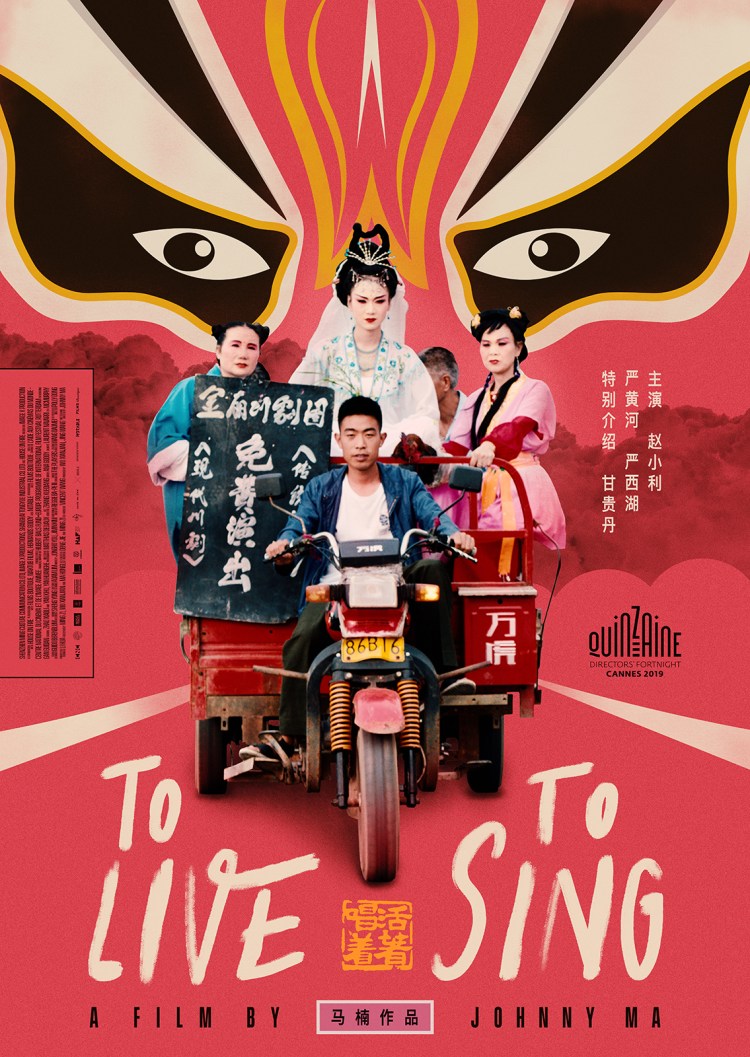
To Live to Sing (活着唱着, Johnny Ma, 2019)

To Sing to Live poster 2“Boundless is the land for all to sing” according to the reverberating strains of a Sichuan Opera troupe practicing their art in the open air, ironically surrounded by the ruins of a decaying land. According to Chinese cinema at least, China is very much “under construction” though there is considerable ambivalence about the costs involved with such rapid “progress”. According to Johnny Ma’s second feature To Live to Sing (活着唱着, Hzhe Chàngzhe), Sichuan Opera maybe one of them though melancholy as it is and performed by real life opera stars, Ma’s film perhaps suggests that art’s transience is an unavoidable consequence of modernity.

We first meet our heroes, the Jinli Sichuan Opera Group, giving a small stage demonstration at a local cultural event straight after a team of high school girls in cheerleader uniforms inexpertly performing a traditional fan dance. Obviously running on a shoestring budget, the troupe gets around by means of a motorbike pickup truck which allows them to advertise on the road. Their main base, however, is a dilapidated theatre in a small corner of a rapidly depleting village.

The theatre, such as it is, is the only holdout surrounded by the rubble of the old town currently being “redeveloped” in keeping with the modern China. The wolf is quite literally at the door as the bulldozers’ claws tear through walls like an all powerful villain in an opera casting a spell of destruction over a disobedient kingdom. Leader of the company, Zhao Li has been ignoring the numerous “for demolition” tags all over the building hoping that something will come up, but now she’s had a letter to tell her that the end is nigh and she has no idea what to do.

Meanwhile, she’s also worrying about the future of the troupe seeing as they are all ageing and, according to her niece Dan Dan, Sichuan Opera isn’t “cool” anymore which why most of their audience members count themselves among the very elderly. Dan Dan, the troupe’s bright hope and leading lady, is conflicted in her role as a potential saviour. Mildly resentful at having been brought up in the trade, she both loves and rejects it, sorry to see it go but sure there is no future for traditional opera in the modern world. In her spare time she dances to K-pop hits alone in her room and, unbeknownst to Zhao Li until she’s guided by to the realisation by the manifestation of a stock Dwarf character, Dan Dan has taken a part-time job singing in a cabaret bar both to express herself and to earn a little extra money.

As the crisis deepens, the opera in Zhou Li’s head intensifies. Entering a dream stage, she finds herself once again in full costume valiantly battling villains only to emerge victorious but alone striking a heroic pose atop a pile of rubble. Worse, her fighting spirit threatens to harm those close to her including her beloved niece Dan Dan who longs to leave the world of opera behind but knows to do so would be to break her aunt’s heart. While her well-meaning husband goes behind her back to try and earn a few extra pennies by selling out the art of opera with a cheap “mask changing” act in a local hotpot restaurant, she makes use of a connection for a last ditch effort to get bureaucracy interested in her case by inviting a local dignitary to a show for which they’ll be pulling out all the stops, but also performing for free to make sure they get the punters in.

Zhao Li’s efforts prove fruitless. You can’t stop progress, after all. But, it’s not just the troupe who feel the sadness of something passing but the audiences too. With no performance scheduled, the old regulars dutifully show up to see the troupe off lamenting that there’s nothing left for them to do in this tiny, crumbling village. Sichuan Opera maybe be “uncool” to some, but it was the only splash of colour in an otherwise dull existence for many of the elderly residents and so it’s sad to say goodbye. At once signalling the tragedy of this moribund world and suggesting it’s time to let it go, Ma closes with a note of poignant, perhaps ironic positivity. “Boundless is the land for all to sing”, the Sichuan Opera troupe reminds us, rendering the ruined building that was its former home irrelevant as they offer their song to the open air for nothing more than the love of it.


To Live to Sing was screened as part of the 2019 BFI London Film Festival.

Clip (English subtitles)

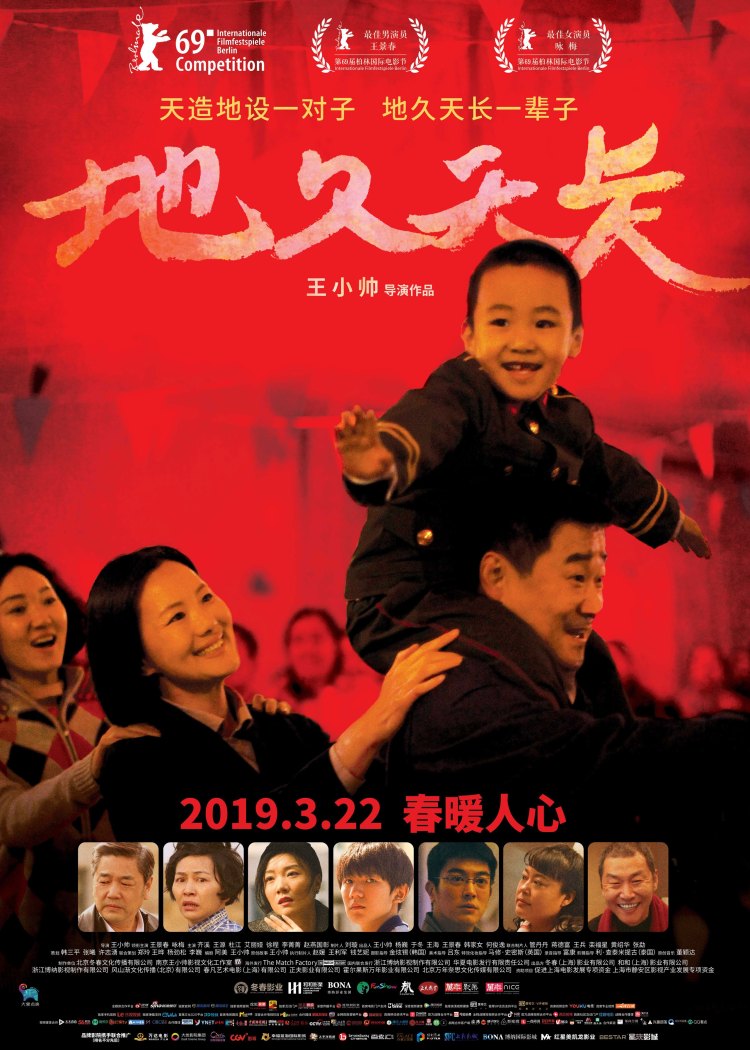
So Long, My Son (地久天长, Wang Xiaoshuai, 2019)

So long my son poster 1“Time stopped moving for us a long time ago” the hero of Wang Xiaoshuai’s So Long, My Son (地久天长, Dì Jiǔ Tiān Cháng) sadly intones, a melancholy relic of another era lightyears away from the gleaming spires of the new China. Following two families over thirty years at the close of the 20th century, Wang’s film, perhaps unlike those of his contemporaries, is not so much quietly angry as filled with tremendous sadness and an unquiet grief for the things which were taken from those who found themselves betrayed by an unforgiving, rigidly oppressive regime.

In the early 1980s, two boys, brothers in all but blood, sit by a river. One is too timid to go in because he cannot swim, while the other, irritated, tries to coax his friend with the promise that they will stay by the shore and he will be there to protect him. Sometime later, we see that a boy has drowned, his parents running fast towards the hospital with the body in their arms but all to no avail. This single event, just one of many ordinary tragedies, is the fracturing point in lives of six previously close friends whose easy, familial relationship is instantly shattered by unspeakable guilt and irresolvable shame.

Liu Yaojun (Wang Jingchun) and his wife Wang Liyun (Yong Mei) have lost their only son, Xingxing, but as someone later points out he needn’t have been their only son if weren’t for the oppressive and needlessly draconian One Child Policy. Haiyan (Ai Liya), the mother of the other boy Haohao and wife of Yaojun’s best friend Yingming (Xu Cheng), rose quickly in the party hierarchy following the end of the Cultural Revolution, becoming ambitious and seduced by her own sense of power. On learning that Liyun had become pregnant with a second child, she marched her friend to the hospital and forced her to undergo an abortion during which Liyun almost died and was left infertile.

The couple lose both their children in the same room, passing underneath the single character for “quiet” that tries to silence even their grief in the face of such cruelty. Silence comes to define their relationships with their former friends who are by turns unsure how to speak to them in the wake of intense tragedy, and fully aware of their complicity. Yaojun and Liyun forgive all. Having lost their own son they only want the best for Haohao, hoping that he is young enough to simply forget the incident and go on with his life, but as the older Haohao later says the guilt became like a tree inside of him that grew as he grew. The silence, more than the guilt or the sorrow, destroys their friendship and makes reconciliation impossible.

Betrayed again, Yaojun and Liyun are two of many laid off from their previously guaranteed government factory jobs following the market reforms of the late ‘80s. To escape their grief they exile themselves to Fujian where they know no one and do not speak the dialect. We discover that they live with a rebellious teenager named Xingxing and wonder if somehow their son survived only to realise later that they have adopted an orphaned boy in a misguided attempt to replace the child they lost. Divided by their grief and frustrated hopes, Yaojun and Liyun grow apart. He drinks to escape his intense resentment towards his powerlessness in an oppressive society, while she yearns to repair their broken family but fears that Yaojun has already moved away from her.

Meanwhile, the modern China leaves them behind. Yingming starts a business and becomes a wealthy man, while Yaojun struggles on with a small repair shop. The couple return to their hometown and the flat they once lived in to find it exactly as it was when they left, improbably surviving while the rest of the factory complex has long been torn down. The statue of Chairman Mao is still there, but now he stands incongruously outside a giant shopping mall offering ironic comment on China’s rapid progress towards rampant capitalist consumerism. Haiyan, filled with shame and remorse, seeks reconciliation near the end of her life, but as others point out no one blames her for doing her job – she was a victim of the system too, if perhaps a willingly complicit one who allowed fear and need for approval to overrule her sense of humanity. Those were dark days in which one might be arrested and perhaps killed just for dancing. Following emotional rather than temporal logic, Wang’s non-linear tale bounces through 30 years of history as its stoic protagonists attempt to endure the cruelty of their times, but eventually lands on a note of hopeful restitution in which the “Everlasting Friendship” is finally restored and the family repaired, the silence broken and time in motion once again.


So Long, My Son was screened as part of the 2019 BFI London Film Festival.

International trailer (English subtitles)