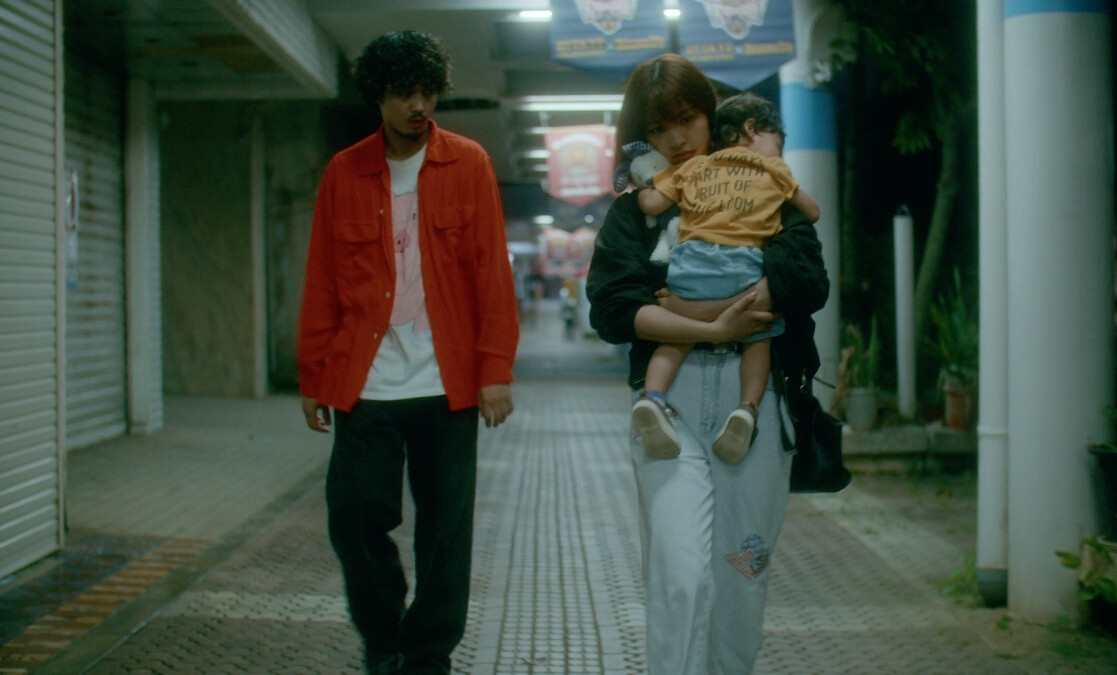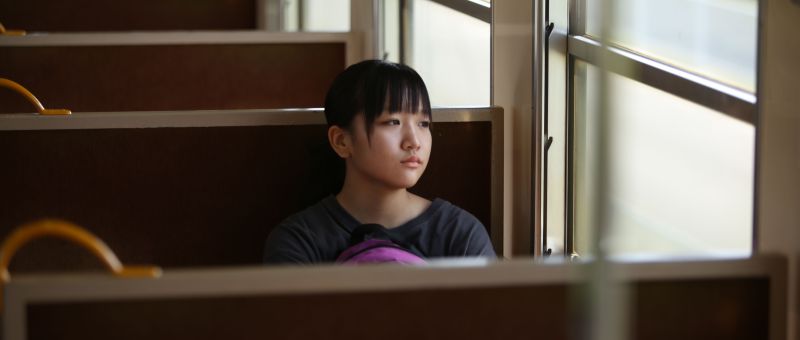
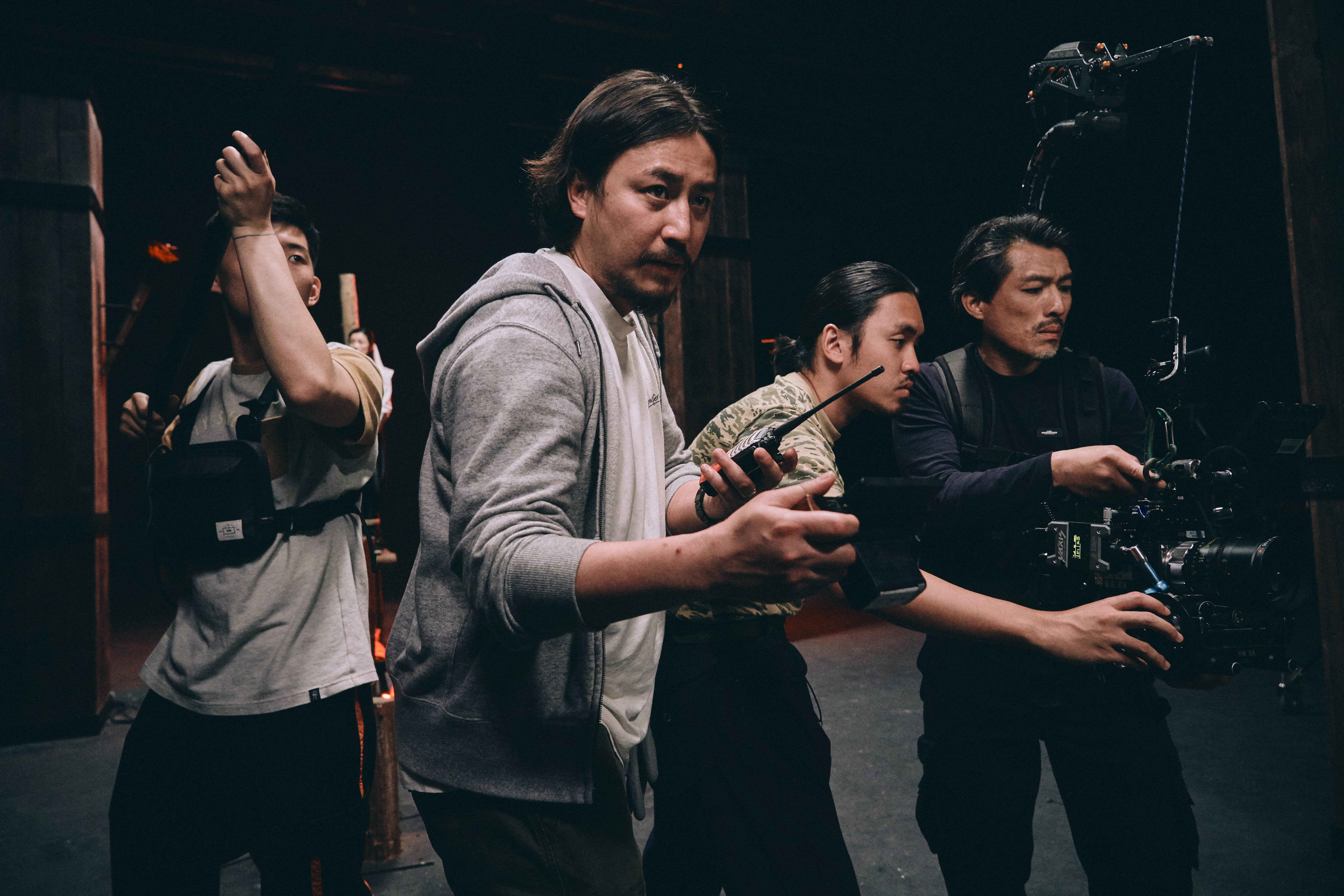
Legendary in Action! (大俠Action!, Justin Cheung & Li Ho, 2022)

An unsuccessful film director looks for new opportunities in gaining closure with the past in Justin Cheung and Li Ho’s behind the scenes comedy, Legendary in Action! (大俠Action!). Echoing classic wuxia, the film finds its heroes searching for themselves while on a quest to revitalise the Hong Kong film scene in which they must battle unscrupulous investors, idol stars with limited acting experience, divided loyalties, the changing nature of the industry, and the ghosts of wuxia’s past. 

40-ish Tiger (Bill “Tiger” Cheung) made a big splash in his earlier career but when his first feature flopped he discovered that second chances are hard to come by in the contemporary film industry. Since then, he’s been making a living shooting sleazy shorts for live streamers while privately dying inside. When a mysterious investor turns up wanting to make a retro wuxia, Tiger is the perfect fit. Shopping an old script he’d written to provide an ending to a serial he loved as a child which was abruptly cancelled, he sets about fulfilling his childhood dream even recruiting the original star to reprise his role but soon finds out that the past is not so easily resurrected. 

This fact is brought home to him by irascible former action star Master Dragon (Chen Kuan-tai) who constantly reminds him that it wasn’t like this in his day usually because they had no health and safety regulations or working rights. Yet Master Dragon is also in a sense in search of himself in that he has begun suffering with dementia and is no longer able to separate fantasy from reality. Far too into his role, he ignores the script and attacks the actors playing bad guys for real but cannot quite recall his signature move while insisting on completing dangerous stunts by himself. He’d also insisted on trying to find the original actress to play the romantic lead, but finally settles for a feisty young woman, Greta (Wiyona Yeung), who is mostly in it for the cash but gradually warms to Master Dragon happy to know that someone cared for her after he waded in on her behalf when she was bullied by lecherous customers at the bar where she was working. 

Tiger meanwhile finds himself failing in his responsibilities as a husband and soon-to-be father, pouring everything into the film while neglecting his long-suffering wife who asks him why he thought now was a good time for his one last chance. When the shoot enters a crisis, he signs up for even more “meaningless” shorts and onerous employment contracts to get the money together to finish while asking his cast and crew to do the same, each of them facing their various issues while coming together as a team squaring off against the vagaries of the independent cinema scene.

Then again, Tiger doesn’t seem to have learned much about work life balance. Nor is Master Dragon a particularly good influence instructing those around him that if film is not their lives’ work, they shouldn’t be doing it. Master Dragon is on his own journey trying to reclaim his former self while dealing with the past just as Tiger is himself trying to bring something full circle in giving his childhood favourite the ending it deserves. In a closing speech, he aligns his struggles with those of the Hong Kong film industry in general positing the wuxia serial as a symbol of faded glory while implying that the contemporary film industry has run out of steam. “At some point we lost faith in Hong Kong Cinema”, he laments, complaining about rubbish films with bad scripts and terrible production values while praising the efforts of the crazy people who give their all to make them. 

“I won’t accept fate” he goes on, like the hero of a classic wuxia fighting for justice in an unjust world while insisting that it is possible to turn things around and restore the glory of Hong Kong film. Then again, as much as his film seems to bring closure and present a place from which to move forward perhaps its unwise to look for new directions in attempting to recreate the past rather than finding new ways to bring it with you into a more positive future. 


Legendary in Action! screens at Lincoln Center 17th July as part of this year’s New York Asian Film Festival.

Original trailer (Traditional Chinese / English subtitles)

Images: © Marigold Project
Chilli Laugh Story (闔家辣, Coba Cheng, 2022)

Family gatherings can sometimes be a little spicy, but channeling some of that passion into a family business eventually becomes too hot to handle for the ambitious hero of Coba Cheng’s New Year comedy Chilli Laugh Story (闔家辣). Set during the pandemic, the film finds its young hero embracing his lifelong dream of becoming an entrepreneur while giving his parents something to do so they won’t be bothering him but eventually discovering that the business world can be cruel and it’s family who will be there for you in the end if it all goes wrong.

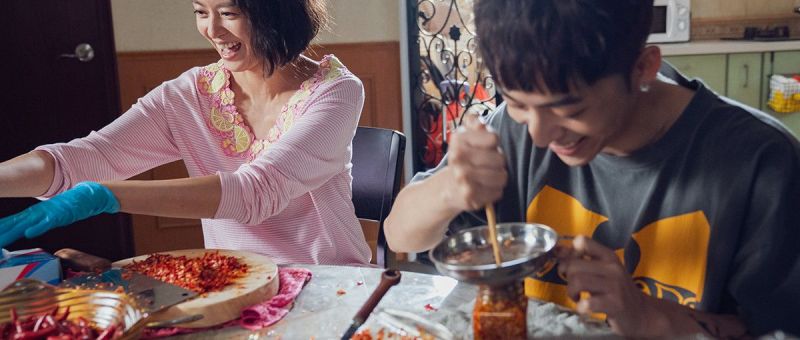
At 24, Coba (Edan Lui) lives with his parents in a rented flat and has a job as a concert promoter which is obviously suffering under the ever changing COVID-19 regulations. Though as a child he’d hated his mother’s hot sauce, he soon realises he’s on to an ideal business opportunity seeing as restaurants are closed and more people are eating at home without easy access to fiery condiments. With his mum Rita (Gigi Leung Wing-Kei) chopping chillies and garlic and his dad Alan (Ronald Cheng Chung-Kei) trying not to get in the way, Coba concentrates on the branding and creates an online sensation with their “Chiu Chiu Chiu” chilli sauce inspired by a local recipe from Rita’s hometown. But while the business begins to take off relationships between the family members suffer under the strain of their differing goals and aspirations. 

Coba’s big thing has been that he doesn’t see the point in owning property and is content with renting, whereas all his mother ever talks about is buying their own place. What she sees as security and freedom, Coba sees as a burden he doesn’t want to be saddled with tied down by a 30-year mortgage. Her plan is to get a loan in Coba’s name to take advantage of a preferential rate for first time buyers, the parents having previously owned a flat they were forced to sell, even if that means applying for one without actually telling him. They are all keeping secrets from each other, Coba choosing not to disclose that he lost his concert gig and is concentrating on the business, while eccentric auntie Wendy (Sandra Ng Kwun-Yu) suffers something similar when her son, who rarely has time to talk, abruptly tells her he’s moving abroad and may not return. Meanwhile, Rita had been using her sister’s restaurant kitchen as a cover to get around licensing regulations but their success puts them at odds with their siblings who resent not being included in the business or its profits. 

Part of Coba’s desire for success to is assert his independence, yet he learns a cruel lesson after being offered an opportunity to collaborate with a weird corporate Guru who speaks only in English and offers pithy maxims while completing a giant all-white jigsaw puzzle in his minimalist all white room. His best friends from school are rich kids who ended up accidental CEOs in the family business, and he desperately wants that kind of approval talking big about being able to buy a flat for his mum with cash to avoid being saddled with the mortgage while hustling in the local food scene trying to talk an old man running a hotdog cafe into collaborating on a chilli dog to expand the brand only for the old man to tell him he’s too old to be jumping on the next new trend. 

Annoyed with his parents for cost cutting behind his back and making his decisions for him by applying for loans in his name, what Coba comes to realise is that having no plan isn’t always a bad thing because it means there are plenty of opportunities while the family strengthen their bonds after a little mutual honesty respecting each other’s wishes and responsibilities in acknowledging they didn’t need to monetise their connection to make it meaningful. Family is after all what New Year comedy is all about. Peppered with references to the pandemic, Cheng’s familial dramedy is full of the anarchic humour the New Year movie is known for from random gags to crazy puns and even throws in a couple of unexpected cameos from major stars in its closing sequences but clearly has its heart in the right place as the family learns to find the sweetness in the spice and Cobo new directions for his future.


Chilli Laugh Story opens in UK cinemas on 15th July courtesy of CineAsia.

UK trailer (Traditional Chinese / English subtitles)

A Far Shore (遠いところ, Masaaki Kudo, 2022)

A young mother struggles to find a way through a legacy of parental abandonment and exploitation in Masaaki Kudo’s Okinawan drama, A Far Shore (遠いところ, Tooi Tokoro). As the title implies, the heroine does indeed long to go somewhere far away but finds herself hemmed in by the nature of the island on which she lives while facing rejection from all sides. She tries to do everything right, working to support herself and her son, but is finally left with no place to turn in a fiercely patriarchal and judgemental society. 

At 17 (Kotone Hanase), Aoi makes her living as a bar hostess leaving her two-year-old son Kengo (Tsuki Hasegawa) with her grandmother. Her husband, Masaya (Yoshiro Sakuma), is a drunken lout who can’t, and doesn’t want to, hold down a job. She hides the money she earns in various stashes around their apartment including in the bathroom bin fearful that Masaya will take it and they’ll be left short on the rent again. Though he refuses to work, Masaya resents being kept by his wife and often turns violent, viciously beating Aoi if he suspects her of hiding money from him or otherwise feels in some way belittled. 

On the one had, she isn’t supposed to be working in the clubs because she’s a minor but realistically they are the only place where she can find the kind of employment that will pay enough to support herself and her son. The clubs know they make more money off underage girls so they are keen to employ them, a gaggle of men from Tokyo obviously taken with the transgressive thrill of buying cocktails for a girl who technically isn’t old enough to drink, but cut them loose when the police come knocking as Aoi discovers when she is picked up by a patrol who take her in for questioning and ask insensitive questions such as how a woman who does what she does can love her son while making her the criminal rather than prosecuting the bar which employed her. In any case when Masaya beats her so badly she is forced to take on even more debt paying for hospital treatment she can no longer do bar work because men won’t want to drink with a woman whose face is bruised. In another irony, it’s the inability to work in bars, which only requires sitting and talking with men, that finally leaves her with little option other than sex work in which her clients are also often violent. 

Her plight in a sense echoes a legacy of abandonment in the Okinawan islands, her own parents having seemingly disowned her with her mother apparently in prison on the mainland and her father remarried with other children. When she asks him for help he just tells her that it’s easy for a woman to find work when men will struggle all their lives in Okinawa’s difficult employment environment, brushing off grandma’s reminder of the lucrative subsidy she assumed he had as a fisherman. Meanwhile Grandma also takes against her, believing she’ll end up wayward like her mother but seemingly accepting little responsibility for either of the women while suggesting that part of her problem lies in not having given enough respect to her local Okinawan heritage neither speaking the language nor obeying the customs. Grandma’s last straw is seeing Aoi take back Masaya after he abandoned her and ran off with all her savings, while he echoes his refusal to work by insisting they move in with his mother who can’t do anything with him either because he’s been indulged by a fiercely patriarchal social culture that encourages him to think he owes women no basic respect or decency. To add insult to injury he ends up landing Aoi with even more debt when he’s arrested after a bar fight and tells the police that his wife will pay the compensation money he owes to the other guy for throwing the first punch.

Eventually Aoi is brought to the attention of social services who do actually seem a little more sympathetic than might be expected but still largely fail to accept that she may be a mother but she’s also a child in need of care. She tries get to a respectable job in a cafe but encounters only further exploitation with extreme low wages, a shift pattern that doesn’t suit a working mother, and a one month probationary period during which she wouldn’t be paid which is obviously impossible for her to manage with no other means to support herself while everywhere she goes people just look down on her. A bleak portrait of life in contemporary Okinawa, Kudo’s icy drama suggests the hope of a distant place is all women like Aoi have to keep them going but in the end it may not be enough. 


A Far Shore made its World Premiere at this year’s Karlovy Vary International Film Festival.

Ode to the Spring (没有一个春天不会来临, Zhou Nan, Zhang Chi, Dong Yue, Tian Yusheng, Rao Xiaozhi, 2022)

There isn’t any denying that the last two years have been extremely difficult for everyone all around the world. Multi-strand “main melody” drama in praise of frontline workers Ode to the Spring (没有一个春天不会来临, méiyǒu yī gè chūntiān bùhuì láilín) may in itself be slightly optimistic in that its perspective is clearly one assuming that the worst is over and the pandemic is largely a thing of the past. Ironically the film’s release, previously scheduled for April, had to be delayed until the early summer because of rising cases in Mainland China. Nevertheless, its messages of hope and the importance of community have lost none of their power while the film’s willingness to admit that some things could have been handled better, even without expressly stating by who, is surprisingly subversive. 

Structured as a multi-strand drama rather than a traditional omnibus movie, the film follows five groups of people mainly in Wuhan at the beginning the outbreak. The first story revolves around a young man, Nanfeng (Yin Fang), whose relationship with local florist Xiaoyu (Zhou Dongyu) had become strained by his decision to move to Shanghai to earn more money for their future. As the New Year Spring Festival approaches, he returns to Wuhan in an attempt to patch things up oblivious of the new disease engulfing the city. Xiaoyu and her mother, who had not approved of him, have each been hospitalised but were separated in the chaos and are now in different hospitals with no way to stay in touch. In a mild rebuke to modern day consumerism, the message that Nanfeng is forced to learn is that he should have been thinking how best to support his community rather than leaving to make more money in Shanghai. Running all around town looking for Xiaoyu’s mother, he eventually wins her approval but is simultaneously warned that he is too impulsive and should think more about what it is others actually want rather than giving them what he thinks they should have. 

Meanwhile a pair of migrant workers struggle to make a living but are given a load of face masks and told to sell them in Wuhan. They too are little aware of how bad things have already become. The older of the drivers is rebuked by his wife because he hasn’t come home in several months and his daughter is beginning to forget him. Though they become increasingly afraid of infection, the truckers maintain their compassion helping an elderly lady and her granddaughter, whose parents are already in a quarantine centre, get to a hospital and then deciding that perhaps they shouldn’t be trying to profit from the pandemic no matter their own desperate circumstances. 

Then again, the film is surprisingly frank about the supply problems in the hospitals which have already run out of high grade medical masks while medics are close to burn out. A doctor is forced to sleep in his car because he’s technically on call. His wife, a nurse, chooses to join him rather than stay in the hotel room they’ve been provided while their son is cared for by his grandparents. He calls a man to tell him his father has passed away and ask for additional documentation to release the body, but the grieving son is himself in a quarantine centre as are all the other family members who have so far survived. The inability to save a fellow doctor who was shortly to become a father almost breaks him, while his wife wonders what’s to become of their son if they should both fall ill. Despite having scolded the boy on the phone about not doing his homework, the doctor has recorded a poignant voice message for his son just in case letting him know that he bought him the toy he wanted for his birthday and has been paying attention even if it didn’t seem like it at the time. 

The themes of parental separation echo through each of the stories, Xiaoyu is separated from her mother, the trucker cannot return to his family because of the lockdowns and his precarious financial position, and the doctor is staying away from his son to treat the sick. In the final strand, a naughty little boy obsessed with legendary child warrior Nezha is separated from his doctor mother (Song Jia) who is despatched to Wuhan to help with the relief effort while his father (Huang Xiaoming), unused to taking care of him, is preoccupied because he unwisely invested in buying a bus he cannot now use because no one is allowed to go anywhere. The boy dreams of visiting a local Buddha statue and getting him to “awaken” from his “quarantine” to show the virus who’s boss only for the Buddha to let him take on Nezha’s form to stamp on those nasty viruses so his mum can come home.

Similarly, the head of a local neighbourhood committee struggles to deal with complaints about a young woman playing piano at all hours while left home alone because her mother is a doctor staying at the hospital. Mr. Wang (Wang Jingchun) becomes something of a local hero, selflessly caring for the residents of a series of apartment blocks ensuring they get food deliveries and dealing with disputes. When he comes down with a fever and has to isolate, the whole block turns out their lights in support waving the torchlight on their phones like tiny stars shining in the distance. It’s here that the film’s real message lies in praising the value of community, not just the doctors and frontline health workers but the civil servants who kept everything running and the ordinary people who did their best to follow the rules and stay at home, while also hinting at some of the failures in the response from the random veg that keeps turning up at the depo to lack of PPE and the total disregard for the migrants stuck far from home in the midst of an economic collapse. Shot by five directors, the strands each have idiosyncratic flare from the chaotic handheld of the hospital scenes to the gentle romance of Nanfeng’s quest and the cheerful adventures of the would-be-Nezha but are otherwise of one voice in the film’s consistent messaging of mutual solidarity and praise for frontline workers. 


Ode to the Spring opens in UK cinemas on 8th July courtesy of CineAsia.

International trailer (English subtitles)

I Go Gaga, Welcome Home Mom (ぼけますから、よろしくお願いします。~おかえりお母さん~, Naoko Nobutomo, 2022)

Naoko Nobutomo’s documentary feature debut I Go Gaga, My Dear proved an unexpected hit on its 2018 release striking a chord with many middle-aged and younger people facing similar issues to the director while preoccupied about how best to care for their ageing relatives. Her 2022 followup I Go Gaga, Welcome Home Mom (ぼけますから、よろしくお願いします。~おかえりお母さん~, Bokemasukara Yoroshiku Onegaishimasu -Okaeri Okasan-) once again follows her parents though this time witnessing her mother’s gradual decline and eventual hospitalisation along with her equally ageing father left alone at home. 

Nobutomo does retread some of the same ground reusing footage from the previous documentary to fill in gaps in her mother’s story giving a brief overview of life and marriage before the first signs of the Alzheimer’s with which she would later be diagnosed would appear. It is however also rawer, including several scenes of Fumiko in extreme distress calling out for a knife in order to end her life in a moment of frightening lucidity or walking around the house asking “what’s wrong with me?” 

The couple had hoped to stay in their home taking care of each other but as Fumiko’s condition declines that becomes increasingly impossible until she finally suffers a stroke and is hospitalised. Naoko frequently talks to her father Yoshinori about returning home to help him care for her but her offer is always refused. They tell her not to worry about them and to do the things she wants to do while she can but Naoko continues to worry. Explaining that her parents had married at a late age by the standards of the time and never expected to have any children, she recounts that she was raised in an extremely loving home and that sense of love and devotion is still very much evident between the elderly couple who continue to love and care for each other deeply. 

But then Yoshinori is also ageing, approaching his 100th birthday, and taking care of his wife takes an obvious physical toll. After Fumiko is hospitalised, he walks for an hour everyday to visit her while even carrying the shopping home from the local store is far from easy. Meanwhile he too undergoes physical therapy hoping to build up his strength for when Fumiko eventually returns home. Though in generally good health, at times he too struggles suffering a nasty fall during heavy rain on his way home from the dentist and later hospitalised with a hernia. His daily visits to Fumiko seem to keep him going, but even these come to an end during the COVID-19 pandemic during which hospital visits are restricted leaving Fumiko, bedridden having suffered a second stroke, all alone with nothing to do. 

The presence of COVD-19 is also reflected in the funeral, an incredibly small affair populated by people wearing masks. Fumiko’s condition caused her to worry about her quality of life while a poignant visit to her home reduces her to tears before she’s transferred to hospital for longterm care. In her voice over Naoko explains that she’s been spending more time in Kure with her father, but evidently does not wish to intrude on his independence as far as she can help it while he becomes an accidental local celebrity given the documentary’s success. Fumiko too had been looking forward to seeing it, a treasured pamphlet lying next to her bed, but was ultimately unable to because of her ill health. 

Like its predecessor, I Go Gaga: Welcome Home, Mom tells a heartwarming study of an elderly couple doing their best to care for each other though later turns in a poignant direction as Naoko and her father begin to process the possibility that Fumiko will not return home something very painful for Yoshinori who is evidently suffering himself extremely worried about the thought of losing his wife. Yet life in a sense goes on, Yoshinori edging his way to his 100th birthday and pledging to live until 120 before heading to a diner for the hamburger steak he’d been craving. He even gets an award from the local mayor in celebration of his centenary. Ending on a poignant note, Nobutomo switches back to older footage of happier days in which her parents go about their ordinary lives filled with precious memories never to return. 


I Go Gaga, Welcome Home Mom streamed as part of this year’s Nippon Connection.

Original trailer (no subtitles)

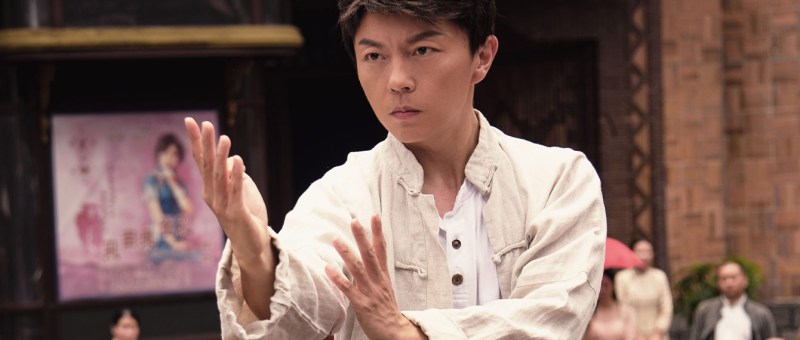
Ip Man: The Awakening (叶问宗师觉醒, Zhang Zhulin & Li Xijie, 2022)

“Someone must stand up to injustice!” according to the young Ip Man (Miu Tse) newly arrived in Hong Kong and witnessing the abuses of colonialism first hand. A kind of origin story, the latest outing for the legendary hero, Ip Man: Awakening (叶问宗师觉醒, Yè Wèn zōngshī juéxǐng), has its degree of political awkwardness but essentially finds the young master coming to an understanding of the purpose of martial arts while realising that sometimes you have to play the long game and not every problem can be solved with Wing Chun alone. 

This is something he discovers after stepping in to protect a young woman and her mother who are being hassled by muggers on a street car. Evidently, the thieves seem to have been emboldened and assume themselves to be under no threat from the passengers, driver, or indeed law enforcement and were not expecting to be challenged. Unfortunately, however, Ip Man’s gallant defence of the two women only brings him a whole mess of trouble in a new city in irritating a local gang who are it seems linked to arch villain Stark. A corrupt British official, Stark has been colluding with local police to run a lucrative people trafficking operation though even they are becoming worried by Stark’s increasing arrogance brazenly snatching young women off the street to sell abroad.  

According to Stark, there are only two kinds of people, cheap and expensive, which bears out his imperialist worldview. Yet, Ip Man himself is perhaps awkwardly positioned as a Mainlander fighting colonial oppression in Hong Kong. According to his apathetic friend Feng perhaps it doesn’t matter who’s in charge because it’s all pretty much the same, but to Ip Man it does seem to matter though given the current situation between the two territories his words cannot help but seem ironic if not directly subversive. He seems to suggest that men like Feng, who later tries to appease Stark who has kidnapped his younger sister Chan, have enabled their own oppression and only by rising up against it can they be free which is it has to be said a series of mixed messages only finally resolved by Ip Man’s reminder that “We are all Chinese” during his final fight battling his way towards Stark.

Nevertheless, the battleground that develops is located firmly within the realms of marital arts with a stand-off between the Chinese Wing Chun and the almost forgotten British fighting style Bartitsu. Not content with subjugating Hong Kong, the British apparently have to prove their superiority even over this sacred territory only they’re as duplicitous and immoral about it as they are over everything else. Even so, Ip Man is able to overcome their blatant attempts to cheat through manipulating Feng and proves that Wing Chun is the best after all while Feng pays a heavy price for his complicity but is later forgiven having learned his lesson. 

What Ip Man learns is that as his teacher points out righteousness requires both wisdom and resources. He can’t expect to solve all the world’s problems by wading in his with his fists and sometimes doing the right thing is going to land him in a world of trouble and complication but even so he has to do it because a “world in which asking for justice is wrong would be truly hopeless”. Perhaps more mixed messages, but leaning in to the Ip Man mythos as a man who stands firm in the face of oppression and fights for the rights of those who cannot fight for themselves. 

Then again, this is a Mainland film and if was surprising that the spectre of police corruption was raised (it’s the British colonial police after all) the conclusion ensures that the authorities will finally get on the case and put a stop to the human trafficking ring once and for all while clearing out the corrupt imperialists. Ip’s sense of righteousness is well and truly awakened in the knowledge that he and his fists can make a real difference even if lasting change requires a little more finesse. With some nifty if occasionally unpolished action sequences Zhang Zhulin and Li Xijie’s take on the classic Ip Man story makes the most of its meagre budget while positioning Hong Kong veteran Tse Miu as the latest incarnation of the ever popular hero.


Ip Man: The Awakening is released in the US on DVD & blu-ray courtesy of Well Go USA on June 21.

Trailer (English subtitles)

One Day, You Will Reach the Sea (やがて海へと届く, Ryutaro Nakagawa, 2022)

“We only see one half of this world” according to the absent heroine of Ryutaro Nakagawa’s moving mediation on loss and the eternally unanswered questions we leave behind when we die, One Day You Will Reach the Sea (やがて海へと届く, Yagate umi e to todoku). Taking its name from a plaintive folk song about a wife waiting for the return of a husband lost at sea, Nakagawa’s indie drama finds its melancholy heroine struggling to move on while plagued by a sense of regret in the absence of an ending. 

Mana (Yukino Kishii) first bonded with Sumire (Minami Hamabe) in the early days of university when she helped her navigate the tricky social rituals of freshers week, eventually moving in to her apartment but then moving out again to live with uni boyfriend Tono (Yosuke Sugino). It’s Tono who in one sense brings the reality of Sumire’s absence back to her more than a decade later as he decides it’s time let go. Letting go is however something Mana struggles to do, not least because Sumire disappeared during the 2011 tsunami and as her body was never found there’s still a part of her that refuses to believe she will never be coming back.  

Tono criticises Mana for wanting to keep Sumire stuck in the same place forever yet it is she who is somehow stuck, still living her admittedly stunning apartment as if afraid to move in case Sumire should return and find her gone. She had once told her that she wanted to work for a furniture company in Kyoto but is currently working as a head waiter at an upscale restaurant where she has developed a paternal relationship with the manager, Mr Narahara (Ken Mitsuishi), only to discover that perhaps she didn’t really know him either or that she only knew the part of him he wished for her to see. Her resentment towards Tono is in part that he knew a different side of Sumire that remained unknown to her, though equally neither of them can be said to have known her entirely. 

The relationship between the two women remains frustratingly ill-defined but what’s clear is that they represented something one to the other as two halves of one whole. They made each other feel at ease, but if romance is what it was it remains unresolved. Despite having claimed that she wanted nothing more than to stay in Mana’s apartment, Sumire eventually leaves explaining to Tono that she cannot say cannot stay with her forever giving him a look that perhaps he should know when he quite reasonably asks why. Then again perhaps she just thinks she’s holding her back, that if it were not for her Mana would long ago have moved on finding new and more fulfilling directions in life. She urges Mana to interact more, hoping that she’ll find someone to tease out the “real” her though she of course already has.

A perspective shift late in the film fills in some of those details from the other half of the world that we don’t get to see, laying bare Sumire’s own distress and vulnerability as it becomes clear that she has something she wants to say to Mana but is always frustrated and finally never does. When someone is gone, you can no longer ask them what they meant or solve the riddles of their life even if you can patch back together a vague picture composed of the memories of those who knew them. “I didn’t want her to be found but I felt I had to find her” Mana explains of her early attempts to look for Sumire after the tsunami wanting answers while simultaneously afraid to get them. Burdened by another sudden and unexpected loss, she takes a road trip to Tohoku and witnesses testimony taped by a local woman from tsunami survivors eventually receiving her own epiphany in an animated dream sequence that links back to those which bookend the film. Watching footage from Sumire’s ever present videocamera fills in a few more details, but what she comes to is less a point of moving on that an accommodation with loss that suggests Sumire has in a sense returned and will always be with her as sure as the sea. What we mourn is not only an unresolved past with all its concurrent regrets, but the other half of the world we’ll never see in all the unlived futures that never got to be. 


One Day, You Will Reach the Sea streamed as part of this year’s Nippon Connection.

Original trailer (English subtitles)

Popran (ポプラン, Shinichiro Ueda, 2022)

“Wieners are stuck to the body, they can’t go flying!” a confused father attempts to convince his toddler son, but as the young boy had said that isn’t quite the case. The hero of Shinichiro Ueda’s Popran (ポプラン) has been, well, to put it bluntly, a bit of a dick to just about everyone in his life but when even his bits seem to have become tired of his schtick it can’t help but provide something of a wakeup call. More surrealist morality drama than scatological comedy, Popran’s heart at least is in the right place as its hero attempts to, literally, piece himself back together to repair his fractured integrity. 

As we first meet 30-ish entrepreneur Tagami (Yoji Minagawa ), he’s being interviewed for a documentary that wants to explore the real lives of well-known people. As might be expected, the opening questions are fawning, pointing out his vast success at such a young age as the developer of app and manga publishing platform but the atmosphere soon changes when they stray into less positive territory. It seems Tagami’s success might have come as a result of betraying his old friend and business partner, while he also abandoned his wife and child to chase success in Tokyo and apparently has become estranged from his parents. His well-meaning PR shuts down the interviewer’s attempts to ask anything remotely challenging, yet it’s obvious that something inside Tagami is dying even as he reads out a cheesy speech he’d written about the importance of following the compass of your heart from a cue card held up by his assistant. 

We can see what kind of man he is or has been when an excited employee approaches him in the corridor about an exciting project but, feigning politeness, he has to ask his assistant who the guy was once he’s gone. At a birthday party for one of their writers, he leers over a woman sitting behind him and offers to introduce her to their editing department when she tells him she’s interested in writing something herself despite his clearly stated policy of not running original material only buying rights to distribute perennially popular series. It’s after taking her to bed with false promises that he discovers his penis is missing. 

More than a symbol of his masculinity, the errant penis is an indictor of his misplaced desires and lack of both moral fibre and impulse control. To achieve success he’s screwed over countless people besides the young woman who seems to have been the last straw for his literally alienated genitalia leaving a trail emotional chaos in his wake. After discovering that he is not the only one to fall victim to the “Popran” phenomenon he is forced to face himself, his moral cowardice, anxieties, and fears, and reckon with his sense of inadequacy and disappointment. Just as in the message he’d delivered to the youngsters watching the documentary, he too needs to take a look at the compass of his heart and realise he’s been reading it wrong chasing down his penis with a butterfly net before realising he knew where it was all along he just needed to go back to where it all started and remember who he really is. 

Then again, there is perhaps something of frustrated masculinity in Tagami’s quest. As his friend point out, he makes all his money exploiting other people’s labour while offering nothing new of his own. In the interview, he’d said he wanted to be a mangaka but felt he wasn’t good enough so decided to become a distributor instead setting up the company with a colleague from the manga cafe where he was working. But they parted ways because his friend wanted to publish original material and with his eye on the bottom line Tagami forced him out. Where his friend is now running a small studio from his apartment and even while not wealthy creatively fulfilled, Tagami has become rich but empty. Obviously that’s not to say there’s no value in the kind of work he does, but he’s begun to appropriate others’ success as his own with no real thought for their well-being. Chasing his dick around is also in its way a desire to regain his creative mojo as symbolised in his re-energised commitment to publishing original material rather than simply raking in royalties from safe and stable classics.  

As is often pointed out to him, his fantastical tale sounds like something out of a manga though Popran is certainly less reflexive than Ueda’s previous efforts telling a story which is much smaller in scale though also in its way heartwarming as the hero is pulled around by the penises of past and present if not future before reaching a moment of emotional maturity that allows him to exercise a more healthy control over his desires knocking his dickish behaviour on the head to wise up and realise being a man’s about treating others with respect and dignity. Some things you can’t just stick back on if they fall off, but you can at least acknowledge that you should have treated them better and resolve to be happy that they have at least found better futures as you might yourself if only you can figure out which compass to follow. 


Popran streams in Germany until 6th June as part of this year’s Nippon Connection.

Original trailer (English subtitles)

Images: Ⓒ ”Popran” Film Partners

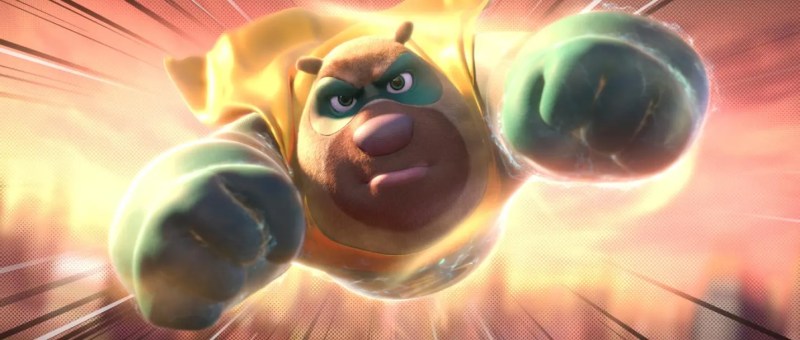
Boonie Bears: Back to Earth (熊出没·重返地球, Lin Huida, 2022)

One of the biggest animation franchises in Mainland China, Boonie Bears began airing as a children’s cartoon show back in 2012 and has produced over 600 episodes across 10 seasons. The latest movie, Boonie Bears: Back to Earth (熊出没·重返地球, xióng chūmò: chóngfǎn dìqiú), is the franchise’s eighth theatrical movie and again proved popular at the box office on its Lunar New Year release. As might be expected for a series revolving around woodland creatures, the first antagonist was a logger who later came round and teamed up with the animals to protect the forest, the franchise has a strong if potentially subversive ecological theme which reverberates throughout Back to Earth. 

In fact, the chief job of unreliable younger brother bear Bramble (Zhang Bingjun) is sorting rubbish into the appropriate bins to keep the forest tidy. Daydreaming he casts himself as superhero battling a giant trash monster symbolising the destructive effects of the buy now pay later philosophy of the modern consumerist society. In any case Bramble’s cheerful days of chasing ice cream and just generally enjoying life in the forest are disrupted when he’s almost wiped out by bits of a falling spaceship and becomes the repository for all of its knowledge. This brings him to the attention of alien space cat Avi who needs his brain to locate his ship but is also being chased by a gang of nefarious criminals led by an amoral entrepreneur who wouldn’t let a little thing like the survival of the Earth interfere with her desires for untold wealth and power. 

As it turns out Avi also has a few lessons to offer as to the costs of irresponsible industrialisation having been born in an ultra-advanced cat society buried deep in the Earth’s core. The over mining of a valuable mineral soon destroyed the environment forcing the cats to flee into space looking for a new home. Avi hopes to return to his home city which lies abandoned as a kind of cat Atlantis accessible only with a valuable necklace which he needs Bramble’s help to retrieve. To begin with, the relationship between the pair is less than harmonious, though they soon bond in their shared quest to stop the evil corporate entities taking over the ancient technology and causing the death of the forest through their insatiable greed. 

Then again as one of the other creatures had put it, “you can’t rely on Bramble”, cross that he never pulls his weight and is always off in a daydream or chasing the next tasty treat. While Avi poses as an adorable kitten trying to convince Bramble to use his brain to help get the spaceship back, the others become even more disappointed in him believing that he’s taken against the cat out of jealously and resentment. Yet the lesson that everyone finally has to learn is that it doesn’t matter if Bramble isn’t the smartest or most hard working because he is strong and kind and has plenty to offer of his own. His gentle bear hug eventually saves the world in healing the villainess’ emotional pain so she no longer has any need to fill the void with cruel and ceaseless acquisition. 

Aside from the gentle messages of the importance of protecting the forest from the ravages of untapped capitalism, after all “this is our only homeland”, the film packs in a series of family-friendly gags including a surprising set piece in which Bramble dresses up as Marilyn Monroe to recreate the famous subway vent moment from The Seven Year Itch, while a pair of eccentric scrap merchants with a taste for rhyme provide additional comic relief. Even in the villains get a lengthy cabaret floorshow to mis-sell their evil mission to the guys from the forest belatedly coming to Bramble’s rescue. In any case, thanks to everyone’s support and encouragement Bramble finally gets to become the hero he always wanted to be proving that he’s not unreliable and even if he doesn’t always succeed is doing his best. Boasting high quality animation, genuinely funny gags, some incredibly catchy tunes and well choreographed musical sequences along with a warmhearted sense of sincerity, Boonie Bears: Back to Earth is another charming adventure for the much loved woodland gang.


Boonie Bears: Back to Earth is in UK cinemas from 27th May courtesy of The Media Pioneers (screening in a family-friendly English dub).

Original trailer (no subtitles)

The Wonder of a Summer Day (幻の蛍, Yuka Ibayashi, 2022)

A solitary teenage girl struggling to come to terms with her parents’ divorce gains a new perspective through a trip to grandma’s in Yuka Ibayashi’s charming indie drama, The Wonder of a Summer Day (幻の蛍, Maboroshi no Hotaru). Somewhat numbed emotionally, Kanata (Konoha Nogishi) is consumed with a sense of emptiness and has no idea what she wants to do in the future or even what her favourite food is while spending almost all of her time alone even going into school during the summer holidays to keep up her cleaning routine or work in the library. 

Part of this as we discover is that she doesn’t have a smartphone because her mother’s (Akiko Kikuchi) business running a small bar is struggling so she can’t join the group chat on phone-based social network LINE, the other girls in any case walking away before she’s fully time to explain even if she were going to. Kanata is certainly a very responsible young woman, often needing to get herself up and out because her mother rises late given the nature of her work, and helping out behind the bar when she gets home from school where she seems to be taking care of all the cleaning needs single handedly simply explaining “we’re supposed to rotate” when questioned by her eccentric science teacher as to why she has to do all of this extensive labour on her own. 

The science teacher is also surprised to learn that Kanata has no plans for the summer vacation planning to continue coming into school to do her various jobs, Kanata sadly wiping the word “summer” off the blackboard and cleaning the eraser afterwards. Then again, the teacher’s idea of fun is sitting in a bowling alley watching people bowl, prompting Kanata to begin wondering what fun might be or if there’s something she might like to do after all. “Life tends to provide us something we enjoy” according to the man at the grocery store, but she struggles to find an answer even refusing an invitation from her father to go to a local festival with her younger sister Sumire (Nonoka Ikeda) when he calls to borrow her old yukata.  

Part of the reason for her loneliness is rooted in the disintegration of the family unit. Not only is she harbouring a degree of resentment towards her father but has also been separated from her sister and feels acutely divided by the traditional social codes which mean that she and her mother have reverted to her maternal family’s name while Sumire and her father have kept theirs the same marking them as no longer family to the extent that she isn’t quite sure why Sumire regrets not having been allowed to attend their grandfather’s funeral. The situation is compounded by the fact that she suspects her father has a new girlfriend, her shock and distress palpable after spotting the three of them driving around looking like a family a pair of sisters excitedly crossing the road ahead of her while she remains frozen on the spot. 

Invited to spend a few days with grandma in the country along with Sumire, Kanata remains sullen and uncommunicative in contrast to her upbeat and cheerful sister who displays an unusual degree of emotional maturity in trying to take the moody teen to task. “You’re not the only person in this world with problems” she eventually fires back fed up with Kanata’s moods and hurt by her most recent barb basically blaming her for their parents’ divorce while insisting that she only makes trouble for those around her. Even so, a trip to find out of season fireflies finally allows the sisters to re-establish their bond with Kanata coming to accept her situation realising that she doesn’t have to cut off contact completely just because they won’t be living together and even if there are many things they may never do again there are plenty more they could do for the first time, like looking for fireflies. “If we keep walking we’ll end up somewhere” Sumire offers encouragingly as they find themselves temporarily lost during their brief summer adventure neatly proposing a metaphor for life and relationships as the sullen heroine begins to repair her fracturing family bonds letting go of her pain and resentment now a little less lonely if only in having shared her loneliness. 


The Wonder of a Summer Day screened as part of Osaka Asian Film Festival 2022