12.12: The Day (서울의 봄, Kim Sung-soo, 2023)

Sometimes, the bad guys win. Kim Sung-soo’s long-awaited return after superb underworld drama Asura, 12.12: The Day (서울의 봄, Seoul-ui Bom) explores one of the darkest hours of recent Korean history as all hopes for democracy and freedom are dashed by a 1979 coup by General Chun Doo-hwan whose reign turned out to be far worse than that of his predecessor, Park Chung-hee who had been assassinated by a member of his own security team some months previously.

Yet Kim is less concerned with the coup itself than why so few people tried to stop it. Though everything appears to be going very badly for Chun (Hwang Jung-min), he eventually succeeds in taking Seoul by force while opposed by a solo general who is the lone guardian of justice and righteousness. Lee Tae-shin (Jung Woo-sung) first turns down a promotion to command the Seoul garrison and accepts it only when it’s explained to him that Jeong (Lee Sung-min), the army chief of staff, hopes to use him as a bulwark against Chun whom he fears is indeed preparing for an insurrection. Sure enough, Jeong is eventually abducted by Chun’s minions, who run the security division, on a trumped up charge of being involved with Park’s murder while Chun desperately needs the duly elected president of a democratising Korea to sign his arrest warrant so his blatant power grab will be legitimised rather than branded a “coup”.

Only the president doesn’t play along. He insists on following proper protocol and getting the approval of the defence minister all of which is vexing for Chun who is left humiliatingly standing in his office while the president holds his ground. The defence minister has, as it turns out, fled to the American embassy in his pyjamas where he finds little sympathy while the film subtly implies that the Americans advise him to return and back Chun who is doubtless considered much more useful to them politically.

Though Tae-shin and another officer at HQ try to warn of a brewing coup, their orders are often overruled by superiors either because they do not take the situation seriously or are actively siding with Chun whose “Hanahoe” faction has taken over a significantly large proportion of the military. Kim zooms in on militarism as the fatal flaw in this botched defence system as it seems no one can act without first receiving an order from above nor are they equipped to make critical decisions on a personal level as to whether or not an order should be obeyed. Tae-shin calls on countless devisions for backup but finds them either actively allying with Chun or refusing to get involved believing it is a hopeless battle. Tae-shin asks what the army is for if it refuses to fight at the crucial moment and abandons its responsibility to protect the interests of its citizens in simply allowing Chun to seize power but receives no real answer. 

Chun has already aroused suspicion for his handling of the investigation into Park’s death, reportedly bringing in countless people with no obvious connection to the case and torturing them. The men who support him want to continue Park’s “glorious revolution” which was in itself a repackaging of Colonial-era Japanese militarism, and fiercely resist the idea of “democracy” advocating totalitarian views that the ordinary person longs for a strong hand at the wheel and to be absolved of the responsibility of choice which ironically fits perfectly with hierarchal structure of the Army. The film paints Chun, slight, small, and bald, as a man with a chip on his shoulder apparently resentful of military elites and the wealthy. He craves power because of his own insecurity and a desire to get one over on righteous men like Tae-shin which might be why his line about Chun being unworthy of the uniform of a Korean solider seems to get to him. 

Using the film language of the 1970s such as heavy grain and split screens, Kim keeps the tension on a knife edge even though the conclusion is all too inevitable. Tae-shin cuts a heroic figure, standing alone on a bridge and forcing back the advancing tanks solely with his imperious righteousness but in the end it’s not enough, there are too few like him and too many like Chun whose maniacal laughter is intercut with scenes of Tae-shin in the torture facility which lies beneath the facade of government. Bleak, but also angry, Kim’s extraordinarily controlled political thriller is damning in its condemnations of a militarising culture and the ever present threat which accompanies it.


International trailer (English subtitles)
Noryang: Deadly Sea (노량: 죽음의 바다, Kim Han-min, 2023)

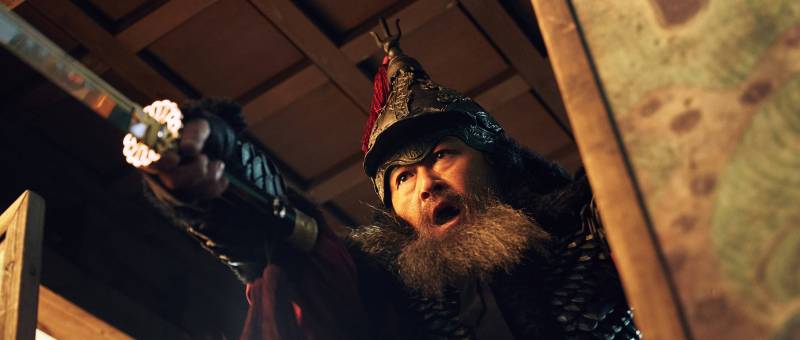
The strange thing about Noryang: The Deadly Sea (노량: 죽음의 바다, Noryang: Jugeumui Bada), the third and final instalment in Kim Han-min’s trilogy about 16th century admiral Yi Sun-sin is that everyone wants to end the war but they all want to end it definitively and so are unable to simply let it run its course. Then again, there is a little more complexity involved in the depiction of Yi in asking whether his desire to repel the Japanese once and for all is really about the national good or personal vengeance for the death of one of his sons at the hands of Japanese raiders.

The opening scenes taking place in 1598 witness the death of Toyotomi Hideyoshi who had launched two invasions of Korea in the previous decade which were in themselves precursors to an invasion of Ming China in an attempt to disrupt the Chinese Tributary System that prevented Japan from trading with China without agreeing to pay them taxes and recognise their political superiority. In the film at least, his deathbed order is to withdraw troops from Korea where they had been unsuccessfully fighting for the previous year. The leader of the Japanese forces, Konishi Yukinaga (Lee Kyu-hyung), is however prevented from leaving by a naval blockade placed by Admiral Yi around their fort on Suncheon Island. With Hideyoshi dead, Yukinaga is keen to return to Japan as quickly as possible in order to defend Hideyoshi’s young son, Hideyori, from Tokugawa Ieyasu who makes a very sinister appearance at Hideyoshi’s deathbed.

One might wonder why Yi does not allow Yukinaga to simply leave and return to Japan now that the war is technically over yet he insists that without a full surrender nothing is guaranteed and the Japanese may simply regroup and return as they had done before. Then again, he’s haunted by nightmares of his son’s death in which he witnesses him cut down by Japanese pirates while unable to intervene dragged back by shadowy figures rising from the water. Yi also later makes clear that his motivation is coloured by a desire for revenge to the extent that he is willing to sacrifice his life for it, which is one thing but it also necessarily means he’s willing to risk the lives of his men over what is partly a personal vendetta. 

Yukinaga, meanwhile, and the Japanese in general are depicted as cruel, ruthless, and cowardly. Shimazu (Baek Yoon-sik), the admiral leading the reinforcements sent to help spring Yukinaga, wilfully fires on his own men in order to cut his way through to the enemy and then threatens to execute sailors who tried to desert. In the end Yukinaga breaks his promise and declines to come to the assistance of Shimazu’s fleet as arranged, turning away and sailing back to Japan (he is subsequently beheaded after being on the losing side of the battle of Sekigahara as he was unable to commit ritual suicide because he was a Christian). They had originally been let down by a Chinese general they’d bribed to assist them but had decided not to turn up given the war was already over, making a secondary agreement with Admiral Chen (Jung Jae-young) who also desires a peaceful end to the disruption but vacillates between each side while not really wanting to get involved before making a fairly disastrous intervention in the final battle. 

There is something a little a uncomfortable in the film’s framing and most particularly in its post-credits scene which reinforces Yi’s conviction that the war isn’t really over without a complete surrender from Japan. In any case, Yi becomes a literal beating heart of the battle banging the drums of war to encourage weary fighters that it isn’t over yet and to keep going to the last man buoyed by the spirits who appear to him of his son and allies who lost their lives fighting similar battles in the previous films. That aside, Deadly Sea is mostly standalone though some knowledge of Japanese and Korean history in the late 16th century is undoubtedly helpful. Kim devotes the second half of the film to a lengthy series of naval battles as Yi tries to lure Shimazu to a vulnerable position, eventually shooting a harrowing long take from the perspective of an ordinary sailor trying to cut his way through after boarding a series of enemy boats. The senseless futility of the violence is the point, but it’s one that’s continually lost on Yi who continues to insist that this war will never really be over until they chase the invaders all the way back to their own islands and into total capitulation even as his quarry sails away towards his own unhappy destiny in an equally turbulent Japan.


International trailer (English subtitles)
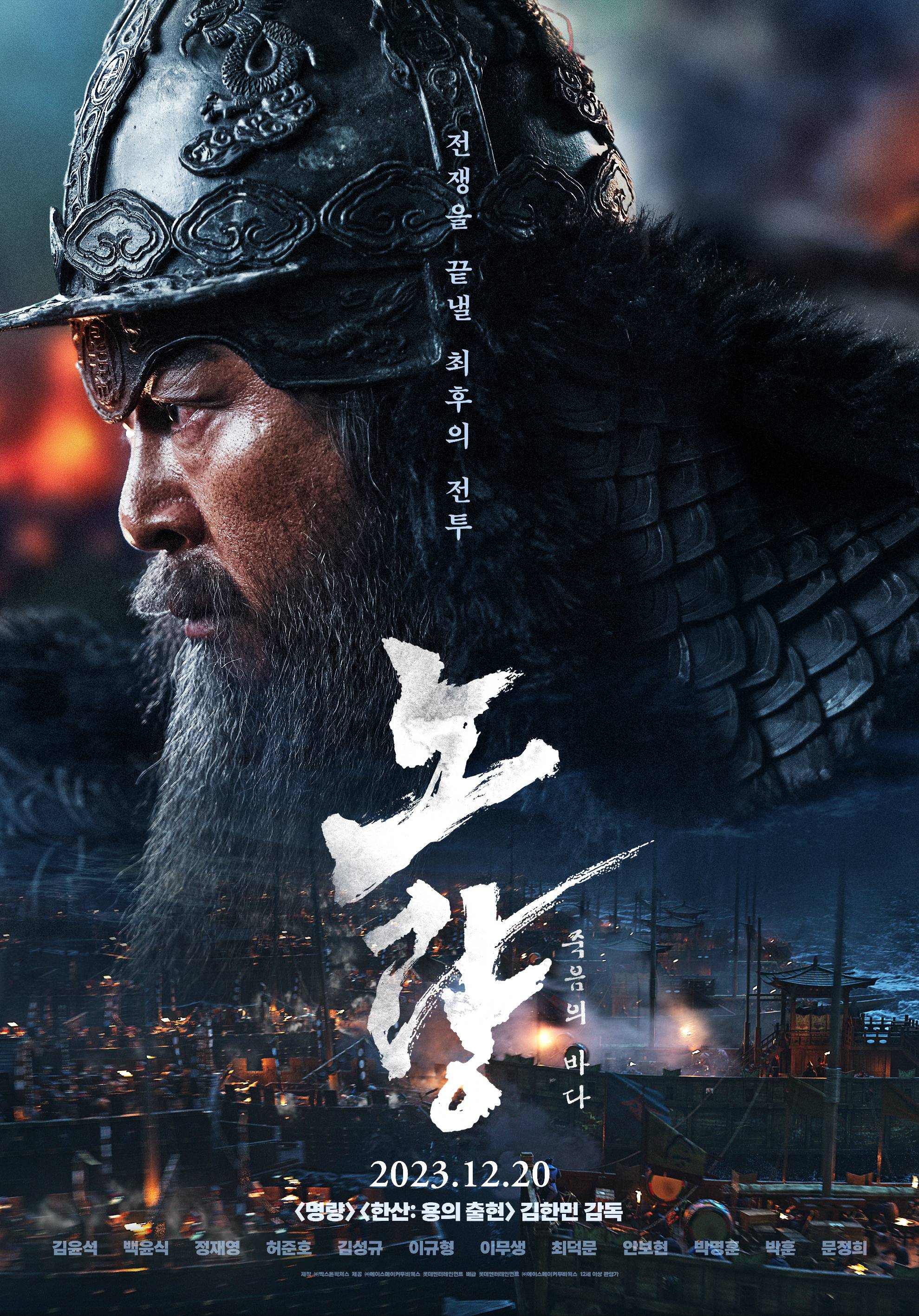
The Roundup: No Way Out (범죄도시 3, Lee Sang-yong, 2023)

Ma Dong-seok has been cultivating an image of himself as an action star for quite some time. The kind of marquee name who generally plays the hero, Ma looks back to the genre’s heyday presenting an uncomplicated vision of righteous masculinity, a bruiser with a heart of gold. The Roundup: No Way Out (범죄도시 3, Beomjoedosi 3) is the third in a series of films that began with The Outlaws and is projected to total at least eight instalments each starring Ma as the maverick detective his superiors hate to love. 

It’s true enough that you can’t get away from the more problematic elements of his unreconstructed good bad cop persona. We often see Seok-do (Ma Dong-seok) beat information out of suspects which the film treats as a cheeky joke in an otherwise tacit endorsement of police brutality that suggests red tape is the reason the guilty often evade justice. Meanwhile, in a step back from other Ma vehicles there are almost no women in the film and none in the police force. The heart of the case is the death of a 28-year-old woman who “fell” from a hotel room window and is later discovered to have died of a heart attack after being drugged in a club and dragged off by a random man who then literally threw her away to distance himself from the crime. The murder which Seok-do is supposed to be investigating is totally forgotten in his all encompassing drive to find out where the drugs are coming from which eventually descends into a battle of wits with a corrupt police officer who’s teamed up with a Korean-Japanese yakuza to skim his boss’ supply of new designer drug Hiper. 

There is a distinctly uncomfortable thread of xenophobia that runs through the series even if in this case the villainy is discovered closer to home in the form of police corruption. This time around, the threat is once again Japan which is apparently where Hiper originated though petty yakuza Tomo (An Se-ho) now manufactures it in Korea where he’s cut a freelance deal with dodgy cop Joo (Lee Joon-hyuk) to distribute it in the local night life scene without the knowledge of his boss back in Japan, Ichijo (Jun Kunimura). Joo has also cut a deal to sell the drugs to a Chinese gang, so it’s quite bad news for him when Ichijo gets wind of the situation and Tomo takes off with a suitcase full of pills for his own protection. Unluckily for him, Ichijo has already sent his most intimidating assassin, Riki (Munetaka Aoki), to find out what’s been going on behind his back. 

Problematic as it may be, Ma’s retro take on the action star is undeniably entertaining with his frequent hero moments and penchant for one liners. The first time he appears, we see him break up a street fight but mostly interested in finding out if the guy on the ground started it the implication being that perhaps if he did it’s none of his business but otherwise he’s going to have to intervene. Then again as he tells his exasperated boss, his personal motto is “punish and serve” and he’s here to get the job done even if that means wading in all fists blazing without much thought for regulations or procedure. At one point Seok-do and his guys stumble on a crime scene and walk around it touching everything in sight without bothering to even put on so much as gloves. 

In any case, Lee makes every punch land and quite literally as the screen seems to vibrate on contact almost as if the camera itself were taking a blow. Ma’s thunderous fists clash with the sound of justice as he all too easily disables hardened gangsters with one well placed slap. At times, his invincibility borders on the ridiculous but he does eventually allow himself be “defeated” if only temporarily as in his miraculous recovery from being run over by a gangster’s car. In many ways, Joo is Seok-do’s mirror, a bad bad cop with crazy eyes who kills without a second thought and behaves with narcissistic recklessness, overconfident in his abilities to sort his problems through his status as a law enforcement officer. Bruiser he may be, but Seok-do likes arresting people and never uses lethal force even when the opportunity is presented to him, symbolically snapping Riki’s katana and then proceeding to slap him seven ways to Sunday leaving the ice cool assassin collapsed amid a display of Japanese parasols. An end credits scene set three years later in 2018 sets up a fourth instalment and the return of a familiar face besides that of Seok-do himself who continues to charm as the world weary bruiser slapping down crime wherever it rears its ugly head. 


The Roundup: No Way Out is in UK cinemas now.

International trailer (English subtitles)

The Bros (부라더, Chang You-jeong, 2017)

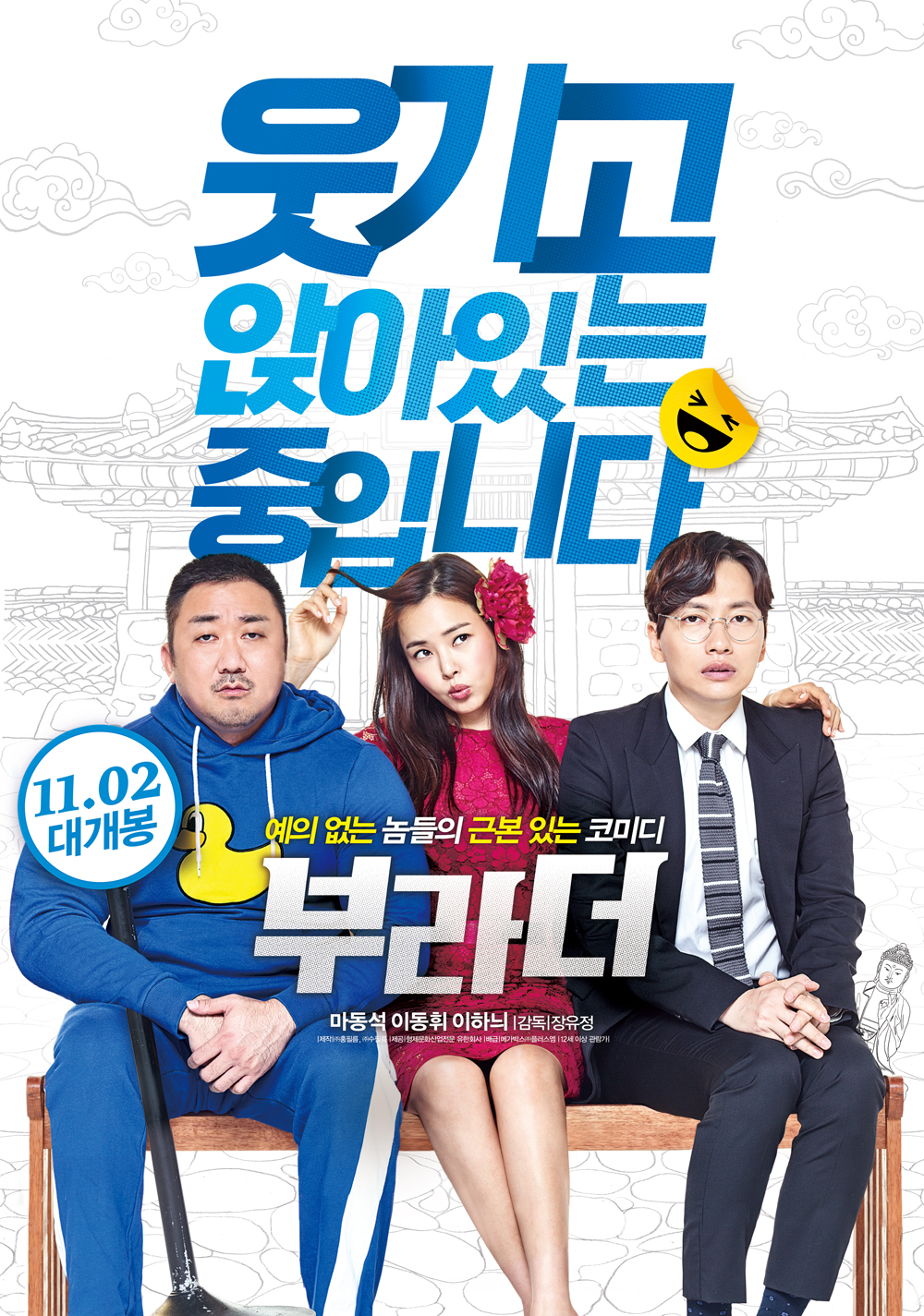
The Bros posterTime passes differently in the country. Two brothers from rural Andong thought they’d escaped the relative restrictions of an oddly feudal upbringing, but something keeps pulling them back. Ghosts literal and figural force them to return home, confront each other and their remaining family, and then attempt to come to some kind of acceptance of their places in the grand scheme of things in light of their newly acquired knowledge. The Bros (부라더, Buladeo) stars unlikely siblings Ma Dong-seok and Lee Dong-hwi and is adapted from the stage musical “The Brothers Were Brave” which was also directed by Chang You-jeong. Set in rural Andong, the film is an affectionate, if not entirely sympathetic, portrayal of the fiercely traditional way of life in tiny country towns in which it really still matters who accedes to be the head of a family and women are expected to know their place.

“Estranged” brothers Seok-bong (Ma Dong-seok) and Joo-bong (Lee Dong-hwi) have each skipped out on their familial responsibilities for lives of modern “freedom” in Seoul. Seok-bong is a “treasure hunter” who gives eccentric lessons on archeological ethics to bored students while overspending on the latest tools to aid him in his (permanently unsuccessful) quests, while Joo-bong is an ambitious salaryman whose career runs into a problem after he is accused of “embezzlement” for ruling out the cheapest route for a new road because (unbeknownst to his bosses) it would cut right past his childhood home. Just as Seok-bong realises he’ll have to pay back the outrageous sum of money he “speculated” on new equipment when a civil war breaks out in his prospective dig site, and Jong-boo frets over his workplace blunder, both sons get an unexpected text informing them that their “estranged” father has died and they’re “welcome” to attend the funeral, if they should wish. As both brothers are in need of a getaway plan (and also an opportunity to ask for some financial assistance), they find themselves finally going “home” only to unexpectedly find each other on the road, start bickering in the car, and then accidentally run over a random young woman (Lee Honey) apparently out walking in this otherwise barren and deserted stretch of land.

On their arrival, the brothers are not exactly embraced by their loving family. Nobody really expected to see them and, as it turns out, their grandfather didn’t even realise they’d been invited. The boys’ rural country home is one of fierce traditionality, seemingly cut out of time and existing in the feudal past where people refer to each other via archaic titles and it really seems to matter who is declared “first son” of the family. Both Seok-bong and Joo-bong left the village because they had no interest in all this feudal nonsense and resented the old fashioned authoritarianism which defined their relationships with the apparently tyrannical patriarch they have both come home to bury, if not perhaps to mourn. Seok-bong, in particular, remains extremely resentful towards his late father for the way he treated their mother who, he assumes, must have been very unhappy all her married life.

Rural Andong, it turns out is not a great place for women. The brothers do have a “friend” in the family complex in the form of Mi-bong (Jo Woo-jin) – a policeman recently married to a very nice but often frustrated young lady who has taken to smoking (still considered scandalous in these parts) in secret in order to relieve the stress of being a married woman suddenly expected to undertake all these arcane social responsibilities, which include being “nice” to her overbearing mother-in-law who seems to delight in scolding her for doing everything wrong. In fact Mi-bong’s wife wants to move to Vietnam to get as far away from the family as possible, but  finds it difficult to abandon the feudal way of thinking in wondering what it would be like to be the wife of a “first son”. Women here are supposed to know their place – stay silent, serve the men. When Joo-bong’s “lady friend” from the city shows up unexpectedly, everyone reacts to her as a “potential daughter-in-law” and sets about giving her the third degree which includes a pop quiz on the three duties of an Andong woman which include obeying a father, then a husband, and then presumably a son. In a running joke, no one can even remember the given name of the boys’ mother because she was always just referred to as “first daughter-in-law”.

All in all, it’s no surprise that Seok-bong and Joo-bong wanted to leave but then again, it turns out there was a lot more going on with the family than they were ever privy to know and they have perhaps judged their father unfairly without knowing all the facts. This being a comedy, the central point is the repair of a broken family – firstly in the brothers repairing their bond as they face the crumbling of their individual quests and are forced to work together, unwittingly uncovering the truth about their family history. Meanwhile, they also have to cope with the strange woman they apparently ran over who seems to have lost her memory but has valuable information to impart to each of them. Haunted by the ghosts of home, neither of the boys finds what they originally came for but gets something (arguably) better in rediscovering their roots and experiencing the upsides of familial connection.

Filled with the strangeness of the village tradition with its mourning suits, wandering monks, shamanic rituals, and uncles who speak only in incomprehensible four character idioms The Bros is an absurd affair but one with its heart in the right place. Chang enlivens the otherwise unremarkable comedic narrative with interesting visual compositions as the mysterious woman seems to drag the brothers away into a pretty fairytale land filled with oversaturated picture book images in which the moon is just a little bit bigger than you’d expect and oddly ‘70s fashions of purple and yellow lend a cheerful and nostalgic air. A comedic tale of family, brotherhood, and the unexpected endurance of feudal tradition, The Bros is a warm and fuzzy tribute to rediscovering one’s roots but also one with unexpected bite in its subtle undercutting of the pervasive misogyny which underpins it.


The Bros is currently available to stream in the UK (and possibly elsewhere) via Netflix.

Original trailer (Korean subtitles only)

Queen of the Night (밤의 여왕, Kim Je-young, 2013)

Queen of the NightThere are only two things which spring to mind on hearing the words “Queen of the Night” – Mozart and…something else. Anyway, Kim Je-yeong’s Queen of the Night (밤의 여왕, Bamui Yeowang) is about neither of these. It’s about a dreadfully self-centred IT guy who finds out something he didn’t previously know about his wife and then decides to go all CIA about it. It’s also about her boss who turns out to have a connection to her hidden past and a taste for date rape. Queen of the Night is a comedy in which in which nothing seems very funny, at least if you don’t happen to be a nerdy IT guy whose dream it is to marry a kind and “frugal” woman who will have just emerged from a nunnery or spent her formative years at a conservatoire where all male contact was expressly prohibited.

Young-soo (Chun Jung-myung) is a lonely, middle-aged computer guy whose continual search for love is often undermined by his money-saving mania which extends to leaving his lunchtime blind date waiting while he runs back to the office to retrieve the discount coupon he’d intend to use to buy her a cheap meal. All he wants is a wife who is “frugal” and kind. One day he ventures into a Subway and lays eyes on the girl of his dreams, Hee-joo (Kim Min-jung), who doesn’t seem to notice him and also seems to be the reason this is store completely packed out with middle-aged salarymen. Finally she sees him, the pair start dating, and eventually get married.

Everything is amazing, Young-soo has never been happier. The pair have bought their own apartment in Seoul and are even about to get rid of Young-soo’s horrible old fridge. Young-soo’s life begins to derail when his good-looking but sleazy boss, Park Chang-joo (Kang Sung-ho), asks him to install a dodgy surveillance app across the office network but it’s a trip to a uni reunion which plants doubts in Young-soo’s mind as to how well he really knows his wife.

Without giving too much away, Queen of the Night’s big secret is not what you think it is. In fact it’s nothing at all. All it amounts to is that Hee-joo was once young and a bit mixed up. She spent some time abroad, didn’t feel like she fit in, came back to Korea and felt even more out-of-place. So she started going to clubs and hanging out with delinquents – how scandalous! Of course, Young-soo wanted a nice, level-headed girl who was careful with money so this information disturbs him. Hee-joo has definitely outgrown her wild years and is exactly the woman he wants her to be, but Young-soo just can’t let it go.

The ironic thing is, spineless Young-soo is conflicted about employing the spy program but does it anyway while planning to write a blocking program to stop it working. Meanwhile he’s basically stalking his wife, googling her on the internet and trying to track down her old friends to find out who she really was before he met her. Simply asking Hee-joo does not occur to him.

The world Hee-joo is forced to live in is extremely misogynistic. Young-soo’s suspicions are first aroused when he is talked into making a rare appearance at a uni reunion after being assured he can take his new wife with him. Young-soo only wants to do this to show off that’s netted himself such a lovely, pretty girl but the reunion itself takes a turn for the strange when the wives (there is only one female computer engineer in the group and she apparently owes her graduation to Young-soo who supposedly ghostwrote her thesis for her, because you know women and computers, right?) are expected to participate in a bizarre talent contest to win white goods by showing off their special skill. Hee-joo ends up winning a kimchi fridge her mother-in-law had been desperate for by showing off her smooth moves on the dance floor, much to Young-soo’s surprise and mild displeasure.

Aside from being thrust into combat with the other wives of engineers, Hee-joo is also forced to contend with the unwanted attentions of Young-soo’s boss, Park. As part of his attempts to defeat the spying app, Young-soo discovers surveillance footage of Park taking women back to his office and spiking their drinks after which he assaults them. Despite seeming outraged, Young-soo does nothing at all about this. When Hee-joo looks set to become his latest victim, Young-soo busts a gut to save her but later descends into a bout of victim blaming, preferring to bring up the small amount of info he’s discovered about Hee-joo’s past to imply this was all her fault. Matters are made worse by Young-soo’s geeky friend (Kim Ki-bang) who spends too much time on the internet and assures him that the reason he and Hee-joo haven’t conceived is because of the anti-sperm antibodies in her system generated by promiscuity. Absolute and total rubbish, but Young-soo falls for it without reservation, largely because he has such low self-worth that he assumes any woman who falls for him must in some way be damaged.

Hee-joo is allowed to get her own back, to a point, by reuniting with some of her delinquent friends to scare the living daylights out of Park before telling Young-soo to get lost. He, of course, tries to win her back but he’ll have to learn to love her past too if he’s to have any chance of regaining his bright and happy future. This is a positive step, in a sense, as Young-soo seems to have acknowledged Hee-joo is a person and not just a personification of his hopes and dreams, but it’s also painted as a kind of forgiveness rather an acknowledgement of his totally inappropriate behaviour. Nothing about this is funny to anyone born after 1780, it is rather profoundly depressing. Queen of the Night may shine a little light on male/female relations in modern-day Korea but the picture it paints is far from inspiring.


Original trailer (English subtitles)

https://www.youtube.com/watch?v=PMPPvhe9ZOU

The Prison (프리즌, Na Hyun, 2017)

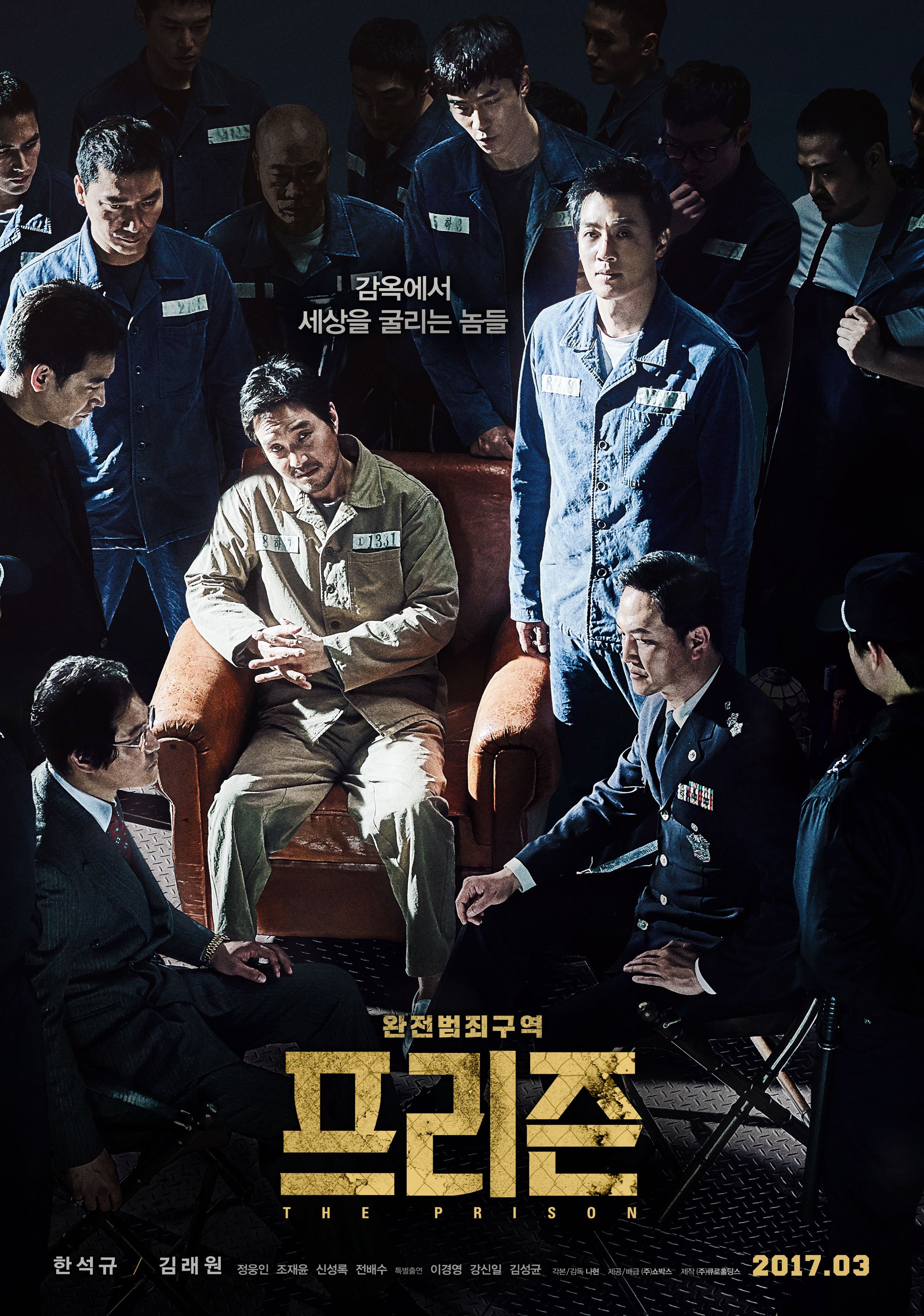
prison poster bigPrison can be a paradise if you’re doing it right, at least if you’re a top gangster in the movies. Na Hyun’s The Prison (프리즌) paints an interesting picture of incarceration and the way it links into his nation’s infinitely corrupt power structures. When investigators wonder why a crime spree suddenly came to an end, one of the frequently offered explanations is that the perpetrator was most likely arrested for another crime but what if you could turn this obviously solid alibi to your advantage and get those already behind bars to do your dirty work for you?

Disgraced policeman Song Yoo-gun (Kim Rae-Won) has wound up imprisoned alongside several of the men he himself helped put away. Like many cops who suddenly find themselves on the other side of the bars, Yoo-gun’s life is not easy. Badly beaten, tortured, and threatened with amputation Yoo-gun eventually starts fighting back and seizes the most likely path to prison survival – allying himself with the inside’s big guy, Jung Ik-ho (Han Suk-Kyu). Ik-ho, a notorious gangster famous for eating the eyeballs of his enemies, is the one who’s really in charge around here, not least because he’s the one running the gang of prison based hitmen trotted out to take care of the bad guys’ hit list.

What starts out as an intriguing idea quickly descends into predictability as Yoo-gun and Ik-ho face off against each other, finding common ground and camaraderie but ultimately existing on the plains of good and evil. Yoo-gun has his own reasons for landing himself in prison but his policeman’s heart still loves truth and justice even if he’s forced to become a prisoner whilst in prison. While he goes along with Ik-ho’s crimes, joining in the violence and intimidation he practices, he also wants to take Ik-ho down even if it means becoming him in the process.

While the interplay between the two men forms the central axis of the film as they develop an odd kind of grudging friendship which may still end on the point of a knife at any moment, Na tries his best to recreate the world of the grim ‘80s action thriller. Technically speaking, The Prison is set in the ‘90s (not that viewers outside of Korea would notice aside from the external lack of mobile phones, computers, internet etc) but wants to be the kind of tough, bruisy, fight heavy action movie they don’t make any more in which a righteous hero defeats a large-scale conspiracy by jump kicking hoodlums. He almost succeeds in this aim, but never quite manages to anchor the ongoing background conspiracy elements with the intense pugilism of the prison environment.

Yoo-gun and Ik-ho are obviously a special case but aside from their efforts, prison life in Korea is not too bad – the guards are OK, the warden is ineffectual, and the inmates are running the show. Nevertheless the prison is the centre of the conspiracy as elite bad guys take advantage of put upon poor ones who’ve found themselves thrown inside thanks to ongoing social inequality, trading cushy conditions to guys who’re never getting out in return for committing state sponsored crimes. Needless to say, someone is trying to expose the conspiracy which would be very bad news for everyone but rubbing them out might prove counter productive in the extreme.

Na lets the in-house shenanigans drag on far too long, pitching fight after fight but failing to make any of his punches land with the satisfaction they seem to expect. Flirting with the interplay between Yoo-gun and Ik-ho in wondering how far Yoo-gun is prepared to go or whether he is destined to become his criminal mentor rather than destroy him, Na never fully engages with the central idea preferring to focus on the action at the expense of character, psychology, or the corruption which underlines the rest of the film. Nevertheless The Prison does have the requisite levels of high-octane fights and impressive set pieces including the fiery if predictable prison riot finale. Life behind bars isn’t all it’s cracked up to be after all, the corrupt elites of Korea will have to actually pay people to off their enemies. Predictable and poorly paced, The Prison is best when it sticks to throwing punches but might be more fun if it placed them a little better.


The Prison was screened at the 19th Udine Far East Film Festival.

International trailer (English subtitles)
One Way Trip (글로리데이, Choi Jeong-yeol, 2016)

one-way-trip-poster

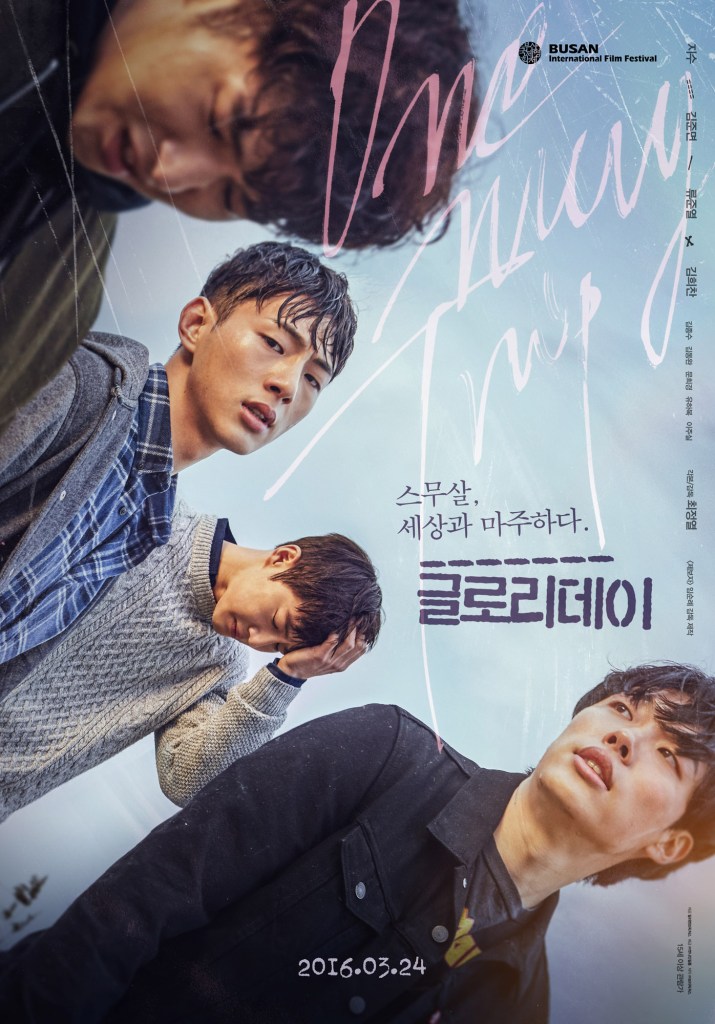
Young men just trying to do the right thing often end up losing out in the long run – so it is for the four best friends at the centre of Choi Jeong-yeol’s One Way Trip (글로리데이, AKA Glory Day). Caught right on the liminal divide between adolescence and adulthood, each of the four has a different path set before him, not entirely of their own choosing. De facto leader Young-bi (Ji Soo) seems the most directionless of the four but as the only one with a driving license he’s found an old banger of a van and got the guys together for one last road trip before Sang-woo (Suho) enlists in the military. Joined by city councilman’s son Ji-gong (Ryoo Joon-Yeol) and Doo-man (Kim Hee-Chan), a reluctant baseball player, the boys take off for the last real trip of their adolescent lives.

Things do not go to plan as the opening sequence features the guys furiously running away from the police, more worried about their parents finding out than any more serious consequences, but tragedy strikes when Sang-woo is knocked over in a hit and run accident. With Sang-woo unconscious in the hospital, the remaining three guys find themselves locked up on assault charges which later graduate to murder. How did their peaceful trip turn out like this?

Told largely through flashbacks explaining both the events of that night and the guys’ lives, One Way Trip examines the effect of a traumatic incident on each of the boys as they find their friendship coming under increasing pressure. Hanging around near the harbour, the guys spot a couple having a domestic dispute in a nearby car before the man drags the woman outside and proceeds to accuse her of having an affair whilst becoming increasingly violent. Headstrong Young-bi decides to intervene but goes too far in picking a fight with the guy while the woman gets herself to safety. When the violent husband falls into a nearby boat, the guys get scared and run off but the battered wife has already called the police who wind up chasing them through the town.

Panicking in the police station, distraught Young-bi gets himself into even more trouble sending their case straight up to the detectives. Though originally sympathetic, the police change their tune when it turns out that the woman involved is a high profile TV news reader. In an attempt to protect her reputation, she refuses to back the boys’ story and implicates them in the murder of her husband. The police, not overly interested in the finer details of the case, want a speedy resolution – a desire which is only echoed from further up where head office is getting pressure from the media.

These are all nice, ordinary kids who’ve never been in any kind of trouble before but suddenly they’re being encouraged to turn on each other and engineer the best possible outcome for themselves as individuals. Ji-gong’s mother (Moon Hee-kyung) is a prim woman most worried about what the neighbours will think, not to mention the impact on her husband’s political career. Doo-man’s father (Yoo Ha-bok) is even more panicked than his son and immediately starts making every conceivable kind of fuss at the police station, including attempted bribery. Young-bi, by contrast, has no one to speak for him as the only responsible adult is his older brother (Kim Dong-wan) – his father is already in jail. To the other parents, the answer is obvious, blame it on the no good delinquent their “nice” kid has been lead astray by and forget about the whole thing.

Though these boys are almost men, they have very little control over their own lives which continue to be dictated by parental expectation. Ji-gong’s overbearing mother locks him in the house to try and force him to study while Doo-man’s father ignores his pleas that he can’t stand playing baseball and is sick of the other players’ resentment because they know he’s only on the team because his father put him there. Young-bi has no firm parental input but his feelings about his family circumstances are what lead him to try and help a woman in peril, as well as the reason he loses his temper so quickly. Sang-woo, the most blameless among the boys, has only his grandmother whom he wanted to spare a life of hardship by serving in the military followed by a solid government guaranteed job afterwards.

Fear and external pressures start to work their magic on the three previously innocent guys who thought they were doing something good but have ended up paying the price. Heartbreak and betrayal are the order of the day as money, power, and influence will always win out over justice, goodness and friendship. Injustice is the force that governs the world, Young-bi thought he was doing the right thing by coming to the aid of a woman under attack only for everyone else to tell him he should have just minded his own business and not gotten involved. Bookended scenes of the four guys together having fun on the beach only reinforce the stark contrast between their youthful innocence, naively believing in friendship and the essential goodness of helping others, and their post-trip awakening to the self-centred indifference of the adult world.


Reviewed at the 2016 London Korean Film Festival.

International trailer: