Flowing (流れる, Mikio Naruse, 1956)

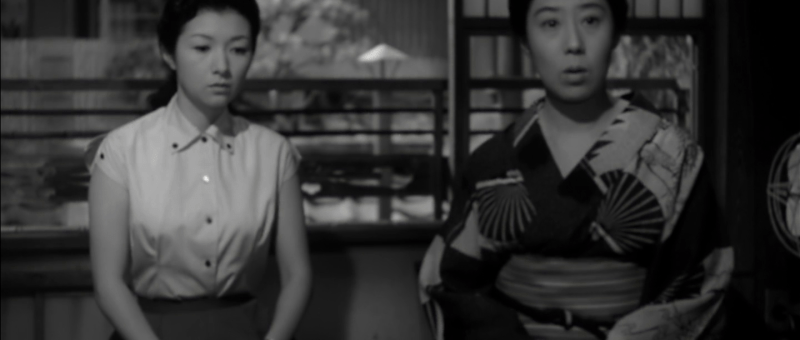
The denizens of a moribund geisha house contemplate visions of independence in post-war Japan Mikio Naruse’s thriving ensemble drama, Flowing (流れる, Nagareru). There is indeed a flowing through the geisha house, a tumble of comings and goings though mostly connected to money which is itself constantly flowing though the for geisha mainly in the wrong direction. Released in the year of Prostitution Prevention Law, the film casts a shadow over the lives of these women who are unwittingly living in their industry’s twilight but asks if it’s really possible for a woman to survive without a man while each of them is in one way or another badly let down by an inconstant lover. 

We’re constantly told that Tsutanoya is the most respectable geisha house in town yet despite its well appointed interiors, it’s clear that business is not good. As the film opens, a young geisha, Namie, is accusing the owner’s daughter Katsuyo (Hideko Takamine) of diddling her on her pay. Katsuyo acts indignant and tries to shift the blame back onto Namie but later admits that the house has indeed been skimming a little more off their wages than was agreed claiming all the geisha houses do it which is probably true but doesn’t make it right. In any case Namie will eventually quit and end up working at “some third rate place” while her uncle (Seiji Miyaguchi) causes problems for proprietress Tsuta (Isuzu Yamada) complaining that Namie was exploited and wanting both the backpay he feels she’s owed and compensation though it seems unlikely any of that money is finding its way back to Namie. Meanwhile the house is a geisha down with only former office worker Nanako (Mariko Okada) and 50-year-old veteran Someka (Haruko Sugimura) on the books.

Despite their financial situation, Tsuta hires a new maid, Rika (Kinuyo Tanaka) who is immediately renamed “Oharu” on her arrival. Oharu is a salt of the Earth type, infinitely capable, maternal, kind and loyal bringing a much needed sense of stability to the ever flowing geisha house while also fascinated by this exotic and arcane world. But then as Tsuta cautions her geisha houses may look glamorous from the outside but the life inside them isn’t always fun. Oharu runs into trouble on her first trip to the grocers when they inform her Tsuta hasn’t paid her tab and they can’t let her add to it until she does. A 45-year-old widow whose only child died a year previously, Oharu is also trying to live an independent life, a conflicted Tsuta struck with wonder at her ability to survive without a man, but may also have struggled, grateful to have been offered the job which others might have declined because of the stigma towards the sex trade as finding employment as a middle-aged woman is near impossible. 

At the film’s conclusion even she may imply it isn’t really possible to live as a woman without some kind of support or losing one’s humanity suggesting that she may return to her husband’s hometown and the family she claims not have gotten along with after learning of Tsuta’s betrayal at the hands of an old friend and former geisha, Ohama (Sumiko Kurishima), who at any rate seems to be living quite well as the proprietress of a restaurant. Traditionally, the profession of geisha was seen as a kind of independence in itself but it’s also one that by its nature is reliant on men. Tsuta is often described as someone who is not able to do anything else yet is highly skilled at music and dance having spent a lifetime in training. Without a patron she is stuck and as we learn she threw hers over to pursue a man she loved but he left her in the lurch having mortgaged the geisha house to invest in his business by taking a loan from her older sister who seems to have a nice sideline as a polite loan shark also having loaned money to Someka. 

The most outwardly cheerful, Someka is in other ways a dark vision of a geisha’s future surviving on nothing but nihilistic hedonism while apparently living with a much younger man who eventually leaves her to marry into another woman’s family. Katsuyo has rejected the geisha life explaining that she is unable to, as Nanaka puts it, say silly things to men in order to earn her keep and is essentially incapable of ingratiating herself with men she doesn’t like. She claims she has no desire to marry, unconvinced that any man would be interested in a geisha’s daughter while certain that for a man marrying into a woman’s family is humiliating while suggesting the same would be true for her. Putting her faith in industry, she buys a sewing machine and sets about figuring out how to use it less because she envisages being able to support herself and her mother through taking in needlework than she just wants to feel as if she’s doing something. 

Meanwhile, Tsuta’s niece Fujiko observes all the comings and goings of the geisha house learning the traditional arts in preparation for a future which will soon be obsolete. In a typically Narusean touch, Tsuta comes to a resolution about her future and envisages a new beginning for herself but is unaware the rug is soon to be pulled from under her by the underhanded capitalist Ohama who plans to turf her out to turn the geisha house into another restaurant. “My days of seeking favours from men are over,” Tsuta admits, not of her own volition but simply understanding that she no longer has access to that kind of independence though in essence surrendering her autonomy in leaving herself to the mercy of Ohama in order to escape her older sister’s control. Someka had laughed raucously at Katsuyo’s insistence that she need not be dependent on a man (and after everything she’s seen why would she want to be?) but the younger woman is undeterred even as we see her struggling, doubting that her efforts will in the end be enough to win her her freedom. Ever the optimist, Tsuta is perhaps doing something similar but even Oharu is considering giving up and going home, too good to survive in the dog eat dog world of the contemporary capital where the flow of currency is the lifeblood of the city implying that perhaps the answer to her question is no, a woman can’t survive alone, nor can she rely on female solidarity, but she’ll have to try anyway because there is no other choice. 

The Bad Sleep Well (悪い奴ほどよく眠る, Akira Kurosawa, 1960)

Bad Sleep Well posterThere’s something rotten in the state of Japan – The Bad Sleep Well (悪い奴ほどよく眠る, Warui Yatsu Hodo Yoku Nemuru), Akira Kurosawa’s take on Hamlet, unlike his previous two Shakespearean adaptations, is set firmly in the murky post-war society which, it becomes clear, is so mired in systems of corruption as to be entirely built on top of them. Our hero, like Hamlet himself, is a conflicted revenger. He intends to hold a mirror up to society, reflecting the ugly picture back to the yet unknowing world in the hope that something will really change. Change, however, comes slow – especially when it comes at the disadvantage of those who currently hold all the cards.

We open at a wedding. A small number of attendants lineup around a lift waiting for the arrival of the married couple only for a carriage full of reporters to pour out, apparently in hope of scandal though this is no gossip worthy society function but the wedding of a CEO’s daughter to his secretary. The press is in attendance because the police are – they believe there will be arrests today in connection with the ongoing corruption scandal engulfing the company in which a number of employees are suspected of engaging in kickbacks on government funded projects.

The rather strange wedding proceeds with the top brass sweating buckets while the bride’s brother (Tatsuya Mihashi), already drunk on champagne, takes to the mic with a bizarre speech “refuting” the claims that the groom, Nishi (Toshiro Mifune), has only married the bride, Yoshiko (Kyoko Kagawa), for financial gain before avowing that he will kill his new brother-in-law if he makes his little sister sad. Nishi, as we later discover, has indeed married with an ulterior motive which is anticipated by the arrival of a second wedding cake in the shape of a building at the centre of a previous corruption scandal with one black rose sticking out of the seventh floor window from which an employee, Furuya, committed suicide five years previously.

The police are keen to interview their suspects, the press are keen to report on scandal, but somehow or other the system of corruption perpetuates itself. The top guys cover for each other, and when they can’t they “commit suicide” rather than embarrass their “superiors” by submitting themselves to justice. The system of loyalty and reward, of misplaced “honour” mixed with personal greed, ensures its own survival through homosocial bonding with backroom deals done in hostess bars and the lingering threat of scandal and personal ruin for all should one rogue whistleblower dare to threaten the governing principle of an entire economy.

Nishi chooses to threaten it, partly as an act of revolution but mainly as an act of filial piety in avenging the wrongful death of his father who had, in a sense, cast him aside for financial gain and societal success. Wanting to get on, Nishi’s father refused to marry his mother and instead married the woman his “superiors” told him to. Later, his father threw himself out of a seventh floor window because his “superiors” made him understand this was what was expected of him. Furuya wasn’t the last, each time a man’s transgressions progress too far his “superiors” sacrifice him to ensure the survival of the system. Strangely no one seems to rebel, the men go to their deaths willingly, accepting their fate without question rather than submitting themselves to the law and taking their co-conspirators down with them though should someone refuse to do the “decent” thing, there are other ways to ensure their continuing silence.

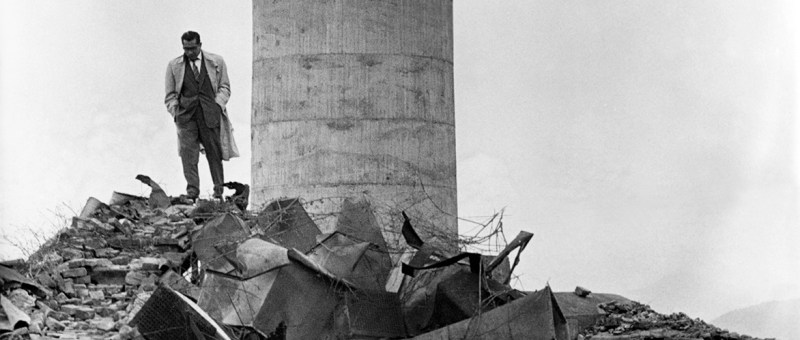
Reinforcing the post-war message, Nishi chooses a disused munitions factory for his secret base. Both he and his co-conspirator, a war orphan, had been high school conscripts until the factory was destroyed by firebombing and thereafter were forced to live by their wits alone on the streets. Nishi swears that he wants to take revenge on those who manipulate the vulnerable, but finds himself becoming ever more like his prey and worse, hardly caring, wanting only to steel himself for the difficult task ahead.

In any revolution there will be casualties, but these casualties will often be those whom Nishi claims to represent. Chief among them his new wife, Yoshiko, who has been largely cushioned from the harshness of the outside world thanks to her father’s wealth and seeming care. She loves her husband and wants to believe in her father or more particularly that the moral arc of her society points towards goodness. Nishi, tragically falling for his mark, married his wife to destroy her family but ironically finds himself torn between genuine love for Yoshiko, a desire for revenge, and a mission of social justice. Can he, and should he, be prepared to “sacrifice” an innocent in the same way the “superiors” of the world sacrifice their underlings in order to end a system of oppression or should he abandon his plan and save his wife the pain of learning the truth about her husband, her father, and the world in which she lives?

In the end, Nishi will waver. Yoshiko’s father, Iwabuchi (Masayuki Mori), will not. Goodness becomes a weakness – Iwabuchi turns his daughter’s love and faith against her, subverting her innocence for his own evil. He makes a sacrifice of her in service of his own “superiors” who may be about to declare that they “have complete faith” in him at any given moment. The only thing that remains clear is that Iwabuchi will not be forgiven, the wronged children of the post-war era will not be so quick to bow to injustice. Let the great axe fall? One can only hope.


Original trailer (English subtitles)

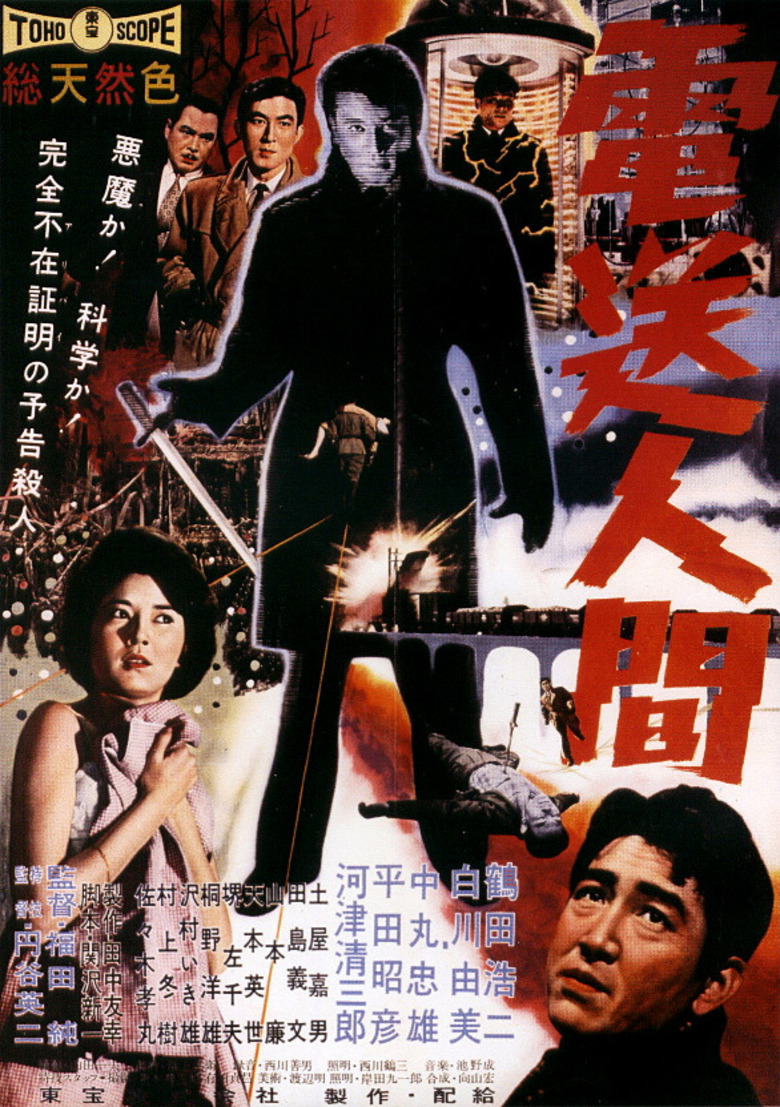
The Secret of the Telegian (電送人間, Jun Fukuda, 1960)

The-Secret-of-the-Telegian-images-df0ac23f-302b-4e88-8ec7-5423f55f51cPlaced between The H-Man and the Human Vapor, The Secret of the Telegian (電送人間, Denso Ningen) is another in Toho’s series of “mutant” movies in which “enhanced” humans find themselves turning monstrous because of ill-advised scientific endeavours. Like many in the series, Telegian has an ambivalent attitude towards scientific research, both proud and fearful. This might be 1960, but the roots of the threat once again stem back to wartime crimes and the impossibility of trust as a man long thought dead teleports himself out of his fictitious grave to wreak a terrifying and bloody revenge on those who have wronged him.

People running screaming out of the “Cave of Horrors” might not be such an unusual sight but this time it’s not papier-mâché ghosts or fancy tricks which have produced such a reaction but a real life bloody murder. The dead man, Tsukamoto, has the end of a bayonet in his chest and a cryptic letter in his pocket asking him to come to this very spot in order to learn “the truth about what happened 14 years ago”. The police are baffled, as is science journalist Kirioka (Koji Tsuruta) who is excited to discover a strange wire at the crime scene. Eventually, the trail leads to a nationalistic, military themed cabaret bar run by former lieutenant Onishi (Seizaburo Kawazu).

The bar is more or less a front for Onishi’s smuggling operation but what has him worried is that a former associate, Taki (Sachio Sakai), may think that he and another former solider, Takahashi, may have reclaimed some stolen gold and declined to share the proceeds. Onishi, Takahashi, and Taki have all received ominous gold discs which seems to point back to their failed bid to pocket some of the Emperor’s gold during the last days of the war. Charged with looking after a top scientist working on teleportation technology, Onishi decided he’d rather have the cash instead stooping so low as to kill both the researcher, Nikki (Takamaru Sasaki), and one of his subordinates who tried to stop him – Tsudo (Tadao Nakamaru). The gang were interrupted stealing the gold but went back a year later only to find the bodies and the treasure vanished without a trace.

Tsudo, now living under an alias, is hellbent on revenge not only against the men who left him for dead but indirectly against their entrenched treacheries as betrayers of their duty, country, and morality. Unlike the the villain of The Invisible Man Vs Human Fly, Tsudo is not among those who feel themselves betrayed or abandoned by their country, left out in the cold in the new post-war world, but one who has a deep seated need to make those who’ve wronged him pay for their treachery. Onishi’s strange militarism themed bar only adds insult to injury given his extremely unpatriotic conduct, though it is perhaps in keeping with the traditionally opportunist nature of nationalists throughout history.

Despite the familiar setup, the science takes a back seat as Fukuda pushes the procedural over the sci-fi and so it remains unclear to what extent, if any, the presence of the teleportation equipment is responsible for Tsudo’s strange behaviour. The teleporting Tsudo is, it has to be said, an odd man. Turning up to complain about late deliveries of the refrigeration equipment he needs for the special metals involved in the experiments,  Tsudo’s manner is creepy in the extreme, robotic yet somehow malevolent. Predictably he develops a fondness for the saleswoman, Akiko (Yumi Shirakawa), who coincidentally lives near to the first murder victim and also becomes the love interest of intrepid reporter Kirioka.

Fukuda keeps things simple over all, stopping to pay an extensive homage to Jacques Tourneur’s Cat People, though there’s a wry sense of humour at play in the bizarre fairground beginning and odd production elements such as the incongruous club and its dancing girls who are, ironically enough, entirely painted in gold. Eiji Tsuburaya’s involvement is largely limited to the transportation effect which is extremely impressive in its execution and has an appropriately unsettling feeling. Not quite as coherent as other examples of its genre, The Secret of the Telegian has a slight tonal oddity in its almost nationalistic discussion of false nationalism, literally taking aim at those who preach patriotism yet cynically betray their country, robbing it not just literally but spiritually. Even so, Fukuda’s take on the mutant formula has enough tongue in cheek humour and sci-fi inflected drama to keep most genre fans happy.


Original trailer (no subtitles)