Lonely Castle in the Mirror (かがみの孤城, Keiichi Hara, 2022)

Kokoro isn’t “lying” when she complains of a stomach ache to avoid going to school, it’s just that it’s the anxiety she feels at the prospect that is making her physically ill. Based on a novel by Mizuki Tsujimura, Keiichi Hara’s fantasy-infused anime Lonely Castle in the Mirror (かがみの孤城, Kagami no Kojo) explores the effects of school phobia in uniting a series of teenagers who each for one reason or another have turned away from education often because of bullying or the rigidity of the contemporary schools system. 

As we discover, Kokoro (Ami Toma) gradually stopped going to school after her life was made a misery by manipulative popular girl Sanada who operates a small clique of bullying minions yet appears all sweetness and light with the teaching staff. Unable to fully explain what’s been going on, Kokoro largely remains at home while her understanding mother (Kumiko Aso) explores opportunities in alternative teaching and tries to support her as best she can. Though the film is very sympathetic towards Kokoro and the children in insisting that it isn’t their fault they can’t attend school but the fault of an unaccommodating system, it perhaps misses an opportunity to fully commit to educational diversity when the end goal becomes getting Koroko back in class undaunted by the presence of her bully. 

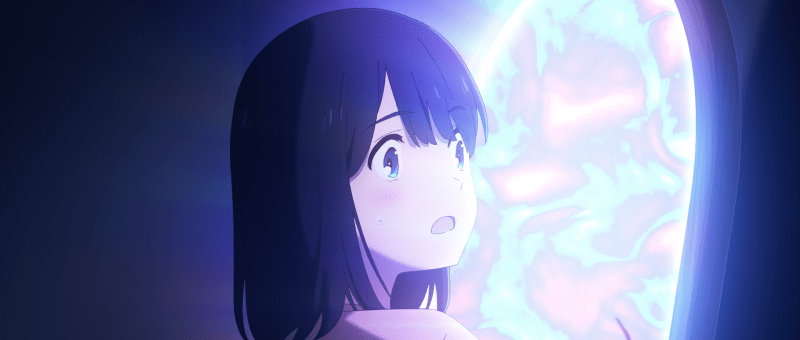
Nevertheless, it offers her another outlet when the mirror in her bedroom suddenly becomes a magic portal that transports her to a fantasy fairytale castle where she meets six other school phobic teens who are all dealing with similar issues. A young girl in wolf mask informs her that they have until the end of the school year to locate a key which if turned will grant one, but only one, of their wishes. When the key is turned, they will all lose their memory so it’s unclear if they will know whether or not the wish was granted but in any case are left with a choice between achieving their dreams and the new friendships they’ve formed at the castle. The issues that plague each of them are various from bullying to dealing with grief, purposelessness, a feeling of not fitting in, parental expectations, and an implication of sexual abuse at the hands of a close relative. As the Wolf Queen tells them “collaboration is beautiful” and it is the connections they forge with each other that give them strength to go back out into the world while each vowing to pay it forward and make sure to stand up to injustice by protecting other vulnerable kids like themselves when they’re able to. 

Even so, Kokoro takes her time on even deciding whether or not to use the mirror and for some reason the castle is only open business hours Japan time. If they stay past five they’ll be eaten by wolves! Many things about the fantasy land do not add up and Kokoro begins to worry that it’s all taking place in her head, her new friends aren’t really real, and she’s being driven out of her mind by the stress of being the victim of a campaign of harassment she can’t even escape by staying home minding her own business. But through her experiences she is finally able to gain the courage to speak out against her bullying while supported by her steadfast mother and an earnest teacher who is keen to find the best solution for each of her pupils rather than trying to force them back into a one size fits all educational system. 

In any case, Kokoro’s quest is to find her way back through the looking glass to rediscover her sense of self and take her place in mainstream society free of the sense of loneliness and inferiority she had felt while being bullied by Sanada and her clique of popular girls though in an ironic touch the film does not extend the same empathy to her or ask why Sanada has an apparent need to need to pick a target to destroy. A variable animation quality and occasional clash of styles sometimes frustrate what is at heart a poignant tale of finding strength in solidarity and learning to take care of each other in a world powered more by compassion than an unthinking devotion to the status quo.


Lonely Castle in the Mirror screened as part of this year’s Nippon Connection.

International trailer (English subtitles)
The Wonderland (バースデー・ワンダーランド, Keiichi Hara, 2019) [Fantasia 2019]

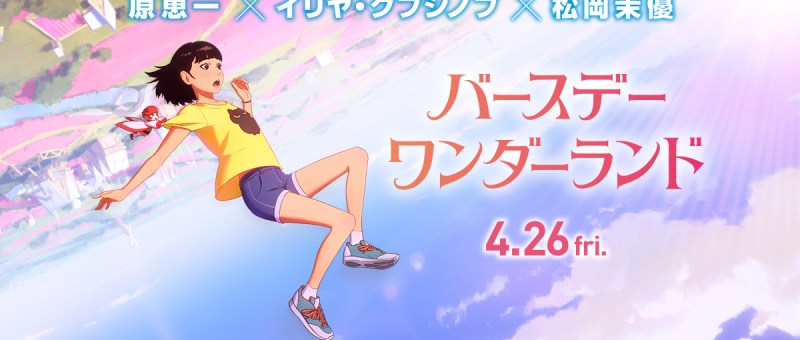
birthday wonderland poster 1The demands of adulthood are apt to overshadow any young teen’s life, but you can’t shake them off just by lying in bed and refusing to age. So the heroine of Keiichi Hara’s The Wonderland (バースデー・ワンダーランド, Birthday Wonderland) discovers as she determines to hideout from emotional complexity, waiting for the storm to pass and cowardly failing to defend a friend in the process. The last thing she wants is the responsibility of being “the chosen one”, but the thing about that is that you don’t get to choose and if the universe has plans for you it would be very irresponsible to refuse.

After (not) getting involved in a minor spat amongst friends about coloured hair clips, Akane (Mayu Matsuoka) decides the best solution is to feign illness, turn off her phone, and avoid going to school. Her kindly mother (Kumiko Aso), seemingly aware she’s not really ill, decides to let her stay home anyway but all she ends up doing is mistreating the cat in frustration and moping about, so her mum despatches her to her aunt Chii’s (Anne Watanabe) place to pick up her birthday gift which she presumably can’t open until the big day tomorrow. Truth be told, Akane doesn’t much like her aunt Chii, she’s far too free spirited and unpredictable for the neurotic teen, but she could stand to learn something from her irrepressible lust for life.

Akane gets the perfect opportunity to do just that when she sticks her hand onto a palm print in her aunt’s shop and is promptly greeted by a dapper-looking man with a fabulous moustache and his tiny minion (Nao Toyama) who crawl up through the hidden basement to explain that she is the “Goddess of the Green Wind” they’ve been searching for and must come with them right away because their nation is in peril! As expected, Akane doesn’t want to go, but is chivvied along by her overexcited aunt and a strange amulet the man, an alchemist named Hippocrates (Masachika Ichimura), places around her neck.

The amulet, he tells her, helps you move forward even if you want to go back. That is, in a sense, Akane’s entire dilemma as she finds herself on the cusp of adulthood, afraid to step forward and accept the responsibilities of maturity while longing to return to carefree childhood days when there was nothing much to worry about and always someone around to look after her. Like any good fairytale, she finds her mirror in the other world in a melancholy prince who remains so reluctant to take part in an essential ritual that he is almost willing to burn the world to avoid having to acknowledge his royal responsibilities.

Meanwhile, Akane is slow to adjust to the charms of her new Wonderland, refusing to engage and loudly stating her desire to go home while her aunt tries to encourage her to embrace a sense of adventure. Chii, the film’s best asset who proclaims “no alcohol no life” while thoroughly enjoying sparring with the uptight Hippocrates (who perhaps is also enjoying the challenge though might not want to admit it), might in some senses be a barrier to Akane’s self-actualisation but is also an important source of safety for her in an unsafe world and just irresponsible enough to push her niece towards taking the right kind of risks in order to do the right thing and save the kingdom.

The reasons the kingdom is in peril in the first place are hugely symbolic – an ongoing water crisis caused by governmental negligence is draining the world of colour while literally drying it out. Getting used to her new surroundings, Akane begins to see their charm. This world, near identical to her own in many ways, diverged around the industrial revolution. Where “our” world rocketed into a frenetic lust for convenience, the rhythms of this one stayed the same, a perpetual village society in which cheerful people live laidback lives surrounded by the beauty of nature – something Akane later comes to worry her own world is losing. Gradually letting go of her fear and getting a better idea of the kind of life she might want, Akane gains the courage to embrace responsibility through directly supporting someone else as they learn to do the same.

A whimsical coming of age tale, The Wonderland excels in world building but somehow never quite achieves the level of emotional engagement it seems to be looking for even as its sullen, detached heroine perhaps begins to realise she did a great disservice to her friend when she failed to defend her during the silly hair ornament argument largely because she personally didn’t want to rock the boat and put herself in the firing line. Her horizons suitably expanded, Akane finds she no longer needs an amulet to keep moving forward even when longing to look back and resolves to step into adulthood with an easy, laidback confidence learned from her palls on the other side.


The Wonderland was screened as part of the 2019 Fantasia International Film Festival.

Original trailer (English subtitles)

Miss Hokusai (百日紅, Keiichi Hara, 2015)

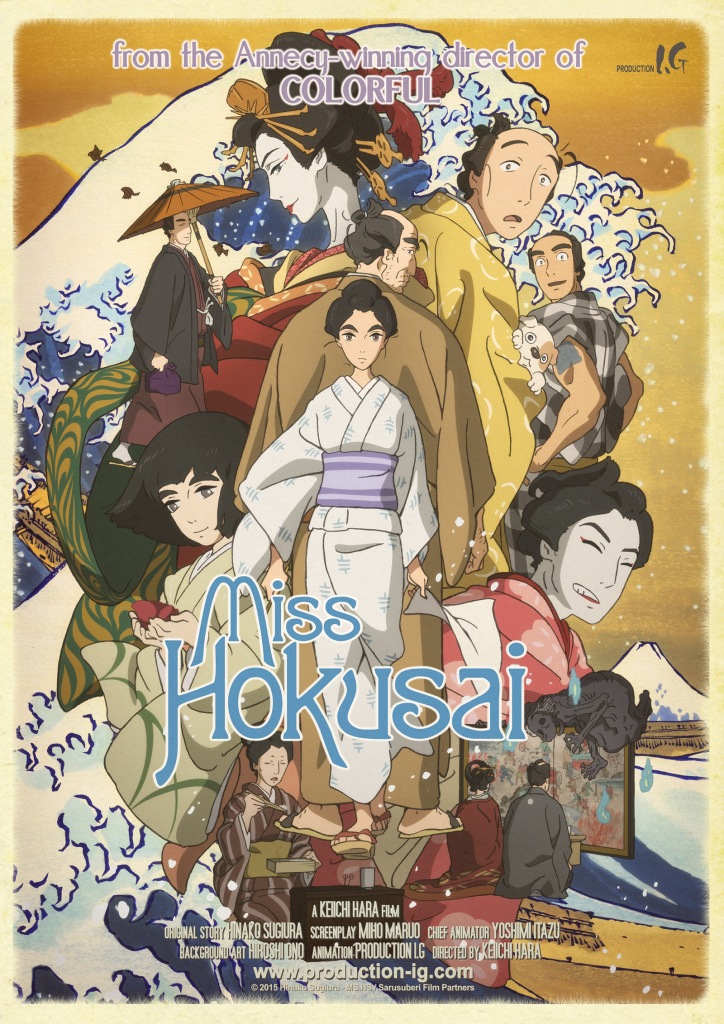
MISS_HOKUSAI_teaser_A4_oldpaper_1600When it comes to the great Japanese artworks that everybody knows, the figure of Hokusai looms large. From the ubiquitous The Great Wave off Kanagawa to the infamous Dream of the Fisherman’s Wife, the work of Hokusai has come to represent the art of Edo woodblocks almost single handedly in the popular imagination yet there has long been scholarly debate about the true artist behind some of the pieces which are attributed to his name. Hokusai had a daughter – uniquely gifted, perhaps even surpassing the skills of her father, O-Ei was a talented artist in her own right as well as her father’s assistant and caregiver in his old age.

Miss Hokusai, based on the popular 1980s manga Sarusuberi by Hinako Sugiura, takes up O-Ei’s story towards the beginning of her career before her marriage and subsequent divorce, after which she returned to her father’s side to nurse him as his health declined. Like the manga, the film is a collection of scenes from Edo life loosely tied together by its overarching theme, but broadly follows O-Ei as she lives her life as a young woman with a level of forthrightness and determination which sets her apart from the women of the time. Determined to become an artist, she lives with her father in their studio where neither of them cooks or cleans but each devotes themselves solely to art. Also living with them at the time is an ex-samurai and aspiring artist, Zenjiro, who specialises in erotica which has its own particular qualities even if his skills aren’t on a par with Hokusai or O-Ei.

When not in her father’s studio, O-Ei likes to visit her younger sister who, ironically, was born blind and is being cared for by the local nuns. O-Nao’s blindness is a sore spot for her father who hardly ever visits her, feeling as if her lack of sight is some sort of cosmic slight against him – the master painter with the daughter unable to appreciate his art and therefore his entire life philosophy. O-Ei is not so rigid and delights taking the girl out on trips where she can experience the world through her richly developed other senses. O-Nao particularly likes visiting the bridge with its complicated soundscape from the river below to the vendors above and all the passersby. There’s also a lovely set piece in which a young boy who quickly figures out that O-Nao can’t see tries to entertain her by knocking snow off a tree. Miss Hokusai, though a story of visual art, has an especially intricate sound design which proves that you can paint with materials other than ink and makes a point of calling out the stubbornness inherent in the world view of someone like Hokusai whose singleminded vision has become his entire universe.

O-Ei has her fair share of troubles as a young woman, though living with her father as his assistant she is a relatively free and unsheltered one. Her father doesn’t hide any aspect of his work from her – she even assists him with his erotic pieces and is said to be a particularly fine painter of women though her male figures lack conviction. “Sensation” itself becomes a theme, art is something which must be felt and therefore must have feeling imbued within it. As an unmarried woman O-Ei is ill equipt to complete these kinds of assignments and some say perhaps she should not be given them though her determination would never permit her to turn them down leading to rather a strange interlude in which she tries to gain some “experience” in a presumably “safe” way which won’t have much effect on her later life.

Less successfully, the film also attempts to enter the realm of the supernatural as we learn a painting can have other effects on the viewer particularly if it isn’t completed in the proper fashion. From a possessed geisha to a woman driven mad by O-Ei’s suitably creepy painting which features terrifying scenes from hell, Miss Hokusai most definitely occupies a world where ghosts, spirits and demons are real things which co-exist with real people. Luckily, Hokusai is able to fix the problem with the disturbing painting by closing its symbolic imagery with a suitable addition whilst berating O-Ei for having cut corners and not properly complete her vision so as to leave the onlooker “haunted” in an unintended way. Again, the painter is parent to the painting which attains the kind of immortality impossible for its creator in this transient world.

Clearly bound-up with the notion of transience, Miss Hokusai makes a valiant attempt to bring ordinary Edo living with its geisha houses, dusty rooms and drinking songs to life in vivid detail. However, its message becomes slightly confused with the superimposition of the modern Tokyo in the final frame of the film. At this point, the rather bizarre choice of a modern, electric guitar based soundtrack, begins to make a degree of sense at least on a thematic level but nowhere near enough to mitigate its jarring presence throughout the film.

Animated by animation powerhouse Production I.G who have been responsible for some of the most beautifully made animated movies of recent times, Miss Hokusai is a giant step up from Hara’s previous film, Colorful, in terms of its execution and boasts a number of scenes which are remarkable in their technical proficiency. The sky in particular as well as the background in general takes on a dreamy, woodblock style which is perfectly fitting for the film’s themes. An interesting look at the young O-Ei, an inexperienced female artist still looking for her voice in a world where the only thing that counts is the signature, Miss Hokusai doesn’t quite succeed in breathing life into its disparate collection of tales but makes a valiant attempt all the same.


Miss Hokusai is currently touring the UK with the Japan Foundation Touring Film Programme 2016 and will be released by All the Anime later in the year.