Haunted Mountains: The Yellow Taboo (山忌 黃衣小飛俠, Tsai Chia-Ying, (2025) [Fantasia 2025]

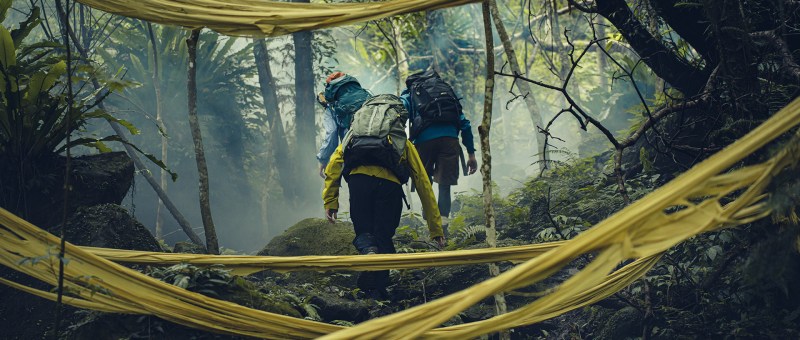
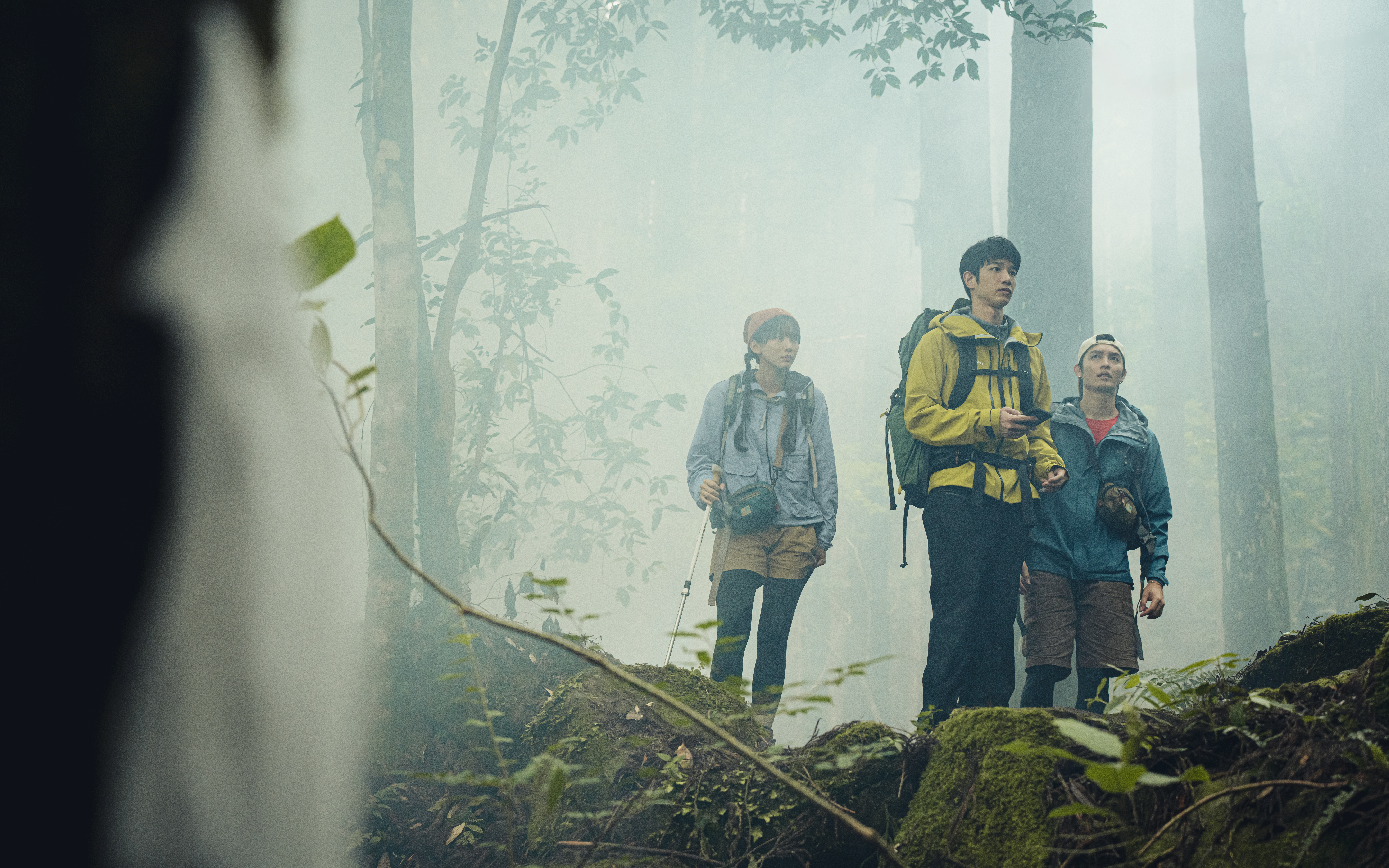
There are some things you aren’t meant to see. Or at least, should you come across them, you should think better of it and be quietly on your way minding your own business. But unfortunately, curiosity got the better of the three hikers at the centre of Tsai Chia-Ying’s timeloop horror, Haunted Mountains: The Yellow Taboo (山忌 黃衣小飛俠, shān jì huáng yì xiǎo fēi xiá) and now one of them’s trapped, forever living the same day over again and forced to watch his fiancée die in increasingly bizarre ways knowing he is unable to save her. 

To that extent, Tsai uses the time loop as a metaphor for grief in which the guilt-ridden Chia-ming (Jasper Liu) is psychologically unable to escape the mountain on which his friend, An-wei (Tsao Yu-ning), died. Five years later, he’s in a relationship with An-wei’s old girlfriend Yu-hsin (Angela Yuen)who was also on the mountain that day, but he can’t help feeling haunted by the spectre of An-wei and convinced that Yu-hsin would never have chosen him if An-wei were still alive. He worries that perhaps he didn’t try hard enough to save him knowing that he’d never have a shot at Yu-hsin with An-wei in the picture. He promised he’d get An-wei of the mountain, but in the end he left him there and in a way he’s still there too. 

This trip to the mountains seems to have been for closure. They’re still looking for An-wei’s body, but Chia-ming has a ring in his pocket and a question he’s too afraid to ask. He’s asked Yu-hsin to marry him before and she said no. He thinks it’s because she’s still hung up on An-wei, but in reality he’s the one who can’t let go and his insecurity is killing his current relationship. Repeatedly watching Yu-hsin die is a manifestation of his anxiety that she’ll never really be his, that he can’t keep or protect her, and that the only reason they’re together is because he betrayed An-wei. Yet the looping is also an expression of the way that his grief roots him in time. He literally can’t move forward and is forced to remember every day that his friend is gone. During his journey he eventually meets an older woman in a smilier position who says that she too finds each day repeating as she struggles to process the loss not only of her son who also went missing on the mountain, but of her husband, who was swallowed by his grief and ended up abandoning her in the same way that Chia-ming is unwittingly abandoning Yu-hsin.

But there are also ancient and arcane forces at work. All of this seems to have happened because An-wei broke a taboo and opened the door to the vengeful spirits of those who were killed by nature and claimed by the mountain. The mountain then becomes a place of death into which people disappear and leave those who love them lonely on the other side. The woman’s husband also felt that souls had become trapped here and wanted to free them while searching for his missing son, but as Chia-ming later discovers, though it may be possible to change the reality, it will come at a great cost and at least one sort of loss will have be to accepted before the mountain will release its grip.

Chia-ming makes his decision, but the outcome does rather have the effect of making his present life seem like a dream or thought experiment in which he imagined a future for himself in which his friend was no longer a romantic obstacle and then felt bad about it. He doesn’t really give Yu-hsin much of a say and makes (almost) all her decisions for her, never really knowing if one day she might have tired of An-wei and chosen him instead or if he could have resigned himself to loving her from afar. In the end, the only way he can free himself from this loop is to face the past with emotional honesty and reckon with his feelings along with his guilt and jealousy. The question is how much he really wants to leave the mountain or whether his obsession will eventually trap him there as just another “missing person” swallowed by grief and led astray by despair. 


Haunted Mountains: The Yellow Taboo screened as part of this year’s Fantasia International Film Festival.

Trailer (Traditional Chinese / English subtitles )
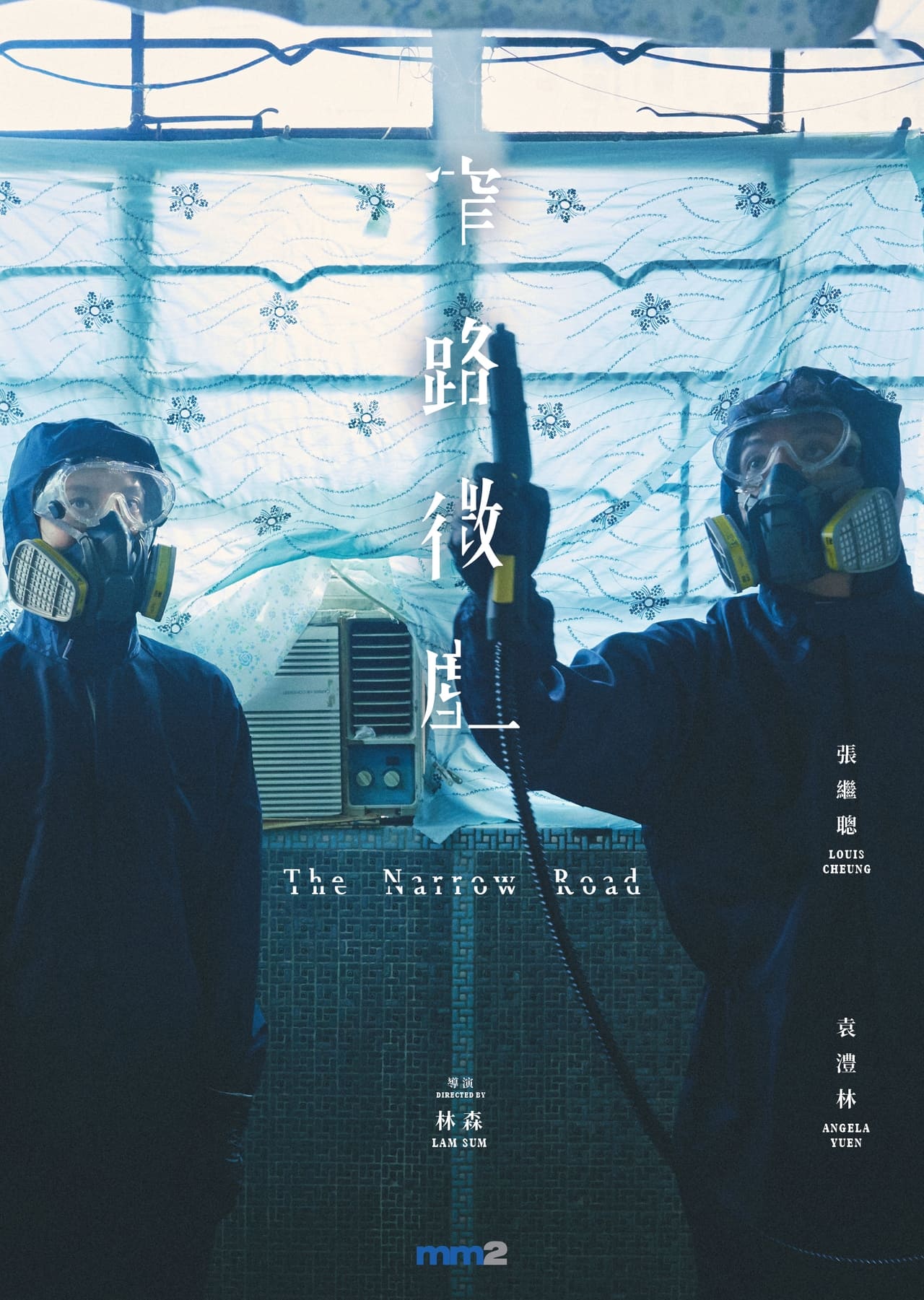
The Narrow Road (窄路微塵, Lam Sum, 2022)

An earnest middle-aged man and a cynical young woman become unlikely friends in pandemic-era Hong Kong in Lam Sum’s melancholy drama, The Narrow Road (窄路微塵). The narrow road is indeed the line they have to walk as they find their already precarious lives straitened by the increasing pressures of life under corona with few possibilities open to them other than to trust in each other and discover unexpected solidarity in their contradictory approaches to life. 

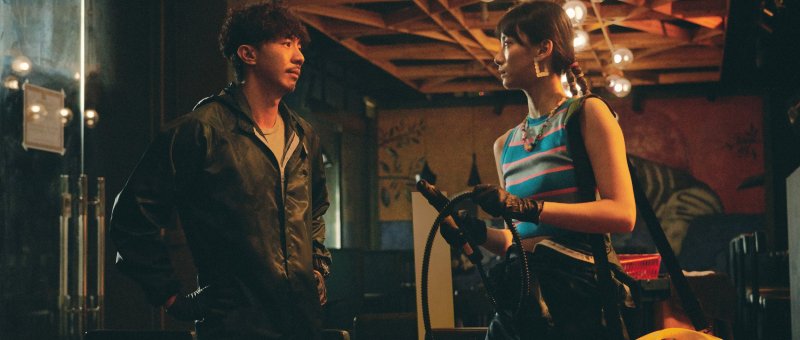
As a customer later suggests, some might say the pandemic is good for those like Chak (Louis Cheung) who runs a one man cleaning business, turning up after hours to disinfect cafes and offices which are still technically open but forced to close early because of the current restrictions. But as we can see Chak is exhausted and his faithful van which has the logo of his company proudly emblazoned on the side is on its last legs. He lives a simple life with his elderly mother who suffers with arthritis but is afraid of the expense of going to the doctor and seems to find joy only in the vague hope of getting lucky on the horses or else the lottery. 

A good-hearted man, Chak’s philosophy is life in that if you work hard and do everything properly then you’ll be alright. Hoping to take advantage of an increase in trade he takes on a young single mother, Candy (Angela Yuen), as an assistant but her outlook is the polar opposite of his as he discovers on spotting her pilfering ice cream bars from a convenience store after the clerk told her the discount had expired because she arrived a new moments after midnight. Cynical because of her experiences, Candy doesn’t see why she or her daughter should go without just because they don’t have money when some have so much they’d hardly notice a little missing, nor does she see the problem with cutting corners when it’s not like anyone notices anyway but Chak points out he’d know and wouldn’t like to feel as if he’d cheated someone or broken his word. 

But then desperate times sometimes call for desperate measures. Chak’s cleaning business is as reliant on a circulating economy as any other as he discovers when the disinfectants he needs for his work are on backorder from a supplier because of pandemic-related delays. When the pair are dispatched to clean up after a lonely death, it plunges Candy into a moment of existential crisis if the result of life is ending up as a stain on someone’s floor to be washed away by a stranger who is themselves faceless and invisible, merely “a cleaner”. As the pair work at night when no one else is around, it’s as if these properties are cleaned by magic, sparkling and new the next day, when the reality is that their work is more important than ever in ensuring public safety not to mention allowing other people to continue operating their businesses confident that they’re doing everything they can to protect their customers.  

In a poignant moment, Candy looks out at the beautiful view from a child’s bedroom in a wealthy family’s apartment and reflects that her living space does not even have a window. Her small daughter Chu eventually draws a picture of one they stick on the wall behind makeshift curtains making do with only the illusion of the light and air they have so far been denied because of their poverty. The world around them seems to be shrinking with businesses across the city closing their doors for good while those with the means to do so are choosing to go abroad for obvious political reasons hoping to start again somewhere else. Chak can only do his best to ride the waves and when even that isn’t possible to keep looking forward even if it means settling for what the moment allows while trying not to let it make him cynical or resentful. The world’s messed up but you don’t have to be, he tries to tell Candy, reminding her that children are sponges and that the lessons she’s teaching her daughter might not serve her well in adulthood. “You’ll hate me when you’re grown up” Candy concedes on doing another midnight flight to another “temporary” situation albeit one which does at least come with a window.

Still as Chak says, they might be smaller than dust but if God doesn’t see them it doesn’t matter as long as they see each other echoing the film’s central message of togetherness and solidarity not just amid the difficult background of the pandemic but as a philosophy for life. Lam’s unshowy yet poetic and beautifully lensed photography captures the sense of shrinking isolation in the early days of COVID-19 while subtly contrasting the fortunes of those like Chak and Candy living in tiny airless spaces who are forced to risk their lives with those who their labour protects. “Are poor people sentenced to death?” Candy asks and forces a concession that perhaps they are by the vagaries of an unfeeling, increasingly capitalistic society. 


The Narrow Road screens in Chicago on Oct. 29 as part of the 15th season of Asian Pop-Up Cinema.

Original trailer (English subtitles)

The White Girl (白色女孩, Jenny Suen & Christopher Doyle, 2017)

white girl posterFollowing their Hong Kong Trilogy, first time feature director Jenny Suen and veteran cinematographer Christopher Doyle get back together for another love letter to the “Pearl of the Orient”. With 2047 always in the back of the frame, The White Girl (白色女孩) is the story of a Hong Kong that was and will be as seen through the space which connects the two. In 2047 the mantra of One Country, Two Systems which has been applied to Hong Kong and surrounding territories since the 1997 handover will come to an end with Hong Kong simply becoming another region of China. With this starting point in mind, Suen and Doyle are left wondering what will happen in the next five years as they watch elements of the city begin to die or be eroded both by the passage of time and by the growing proximity of the 2047 deadline.

The White Girl (Angela Yuen), as she’s called, lives in Pearl Village where they still do things the old fashioned way. Living with her fisherman father, The White Girl dresses in long, dark clothing, and wears sunshades with a large floppy hat which hides her face and gives her a mysterious air of anonymity and otherworldliness. She does this because her father has told her that she is allergic to the sun, as her late mother was, so that she will never stray too far from him. Now a grown woman, The White Girl is beginning to think differently. She no longer takes her medication and has discovered a chest containing her mother’s clothes and a walkman with a tape inside featuring her mother singing her trademark song. Defying her father by walking around the town dressed only in her mother’s vintage white camisole and nickers, The White Girl who once felt invisible is seen by everyone including a new visitor to the village, Sakamoto (Joe Odagiri), a runaway Japanese artist squatting in local ruin.

Pearl Village, like Brigadoon, is a place that doesn’t quite exist. An example of the traditional Hong Kong fishing village which has all but died out, Pearl Village is a timeless place which seems to exist across eternity encompassing all eras and filled with a melancholy nostalgia. The White Girl longs to know the truth about her mother, putting on her very 1960s cheongsam and listening to her sing on her ‘80s walkman before walking to a pay phone to ring a DJ to ask him to play her mother’s song and then listening to it on a portable transistor radio. There are no mobile phones or computers and the major source of info in the village is the little boy, Ho Zai (whose name, in different characters, also means “oyster”), who keeps his ear to the ground and knows everything which goes on in the land that he regards as his.

What Ho Zai has discovered is that the village chief is about to sell them out. Creating controversy with the censor’s board, Ho Zai remarks on a destructive bridge project which will damage the beauty of his village, destroying wildlife and killing the beautiful dolphins which live in the sea off the coast. The “tourists” who come to the village (there is no real reason for a tourist to ever come here) are really developers who’ve come to hear the village chief’s plans which include bulldozing the beautiful mangrove forest Ho Zai loves so much to build a luxury mall.

Also on the list for eradication is the ruined mansion, built in the Chinese/British colonial style, in which Sakamoto is currently living. The White Girl regards the “ruins” as her palace but warns Sakamoto that the villagers believe it to be haunted. Sakamoto brands himself its ghost which touches a nerve with The White Girl whose pale skin and vacant aura have seen her also branded a “ghost”, leaving her feeling alone and invisible, trapped in her tiny, timeless world. Sakamoto, a temporary visitor to the unchanging village, is a literal outsider observing all around him from inside the ruins via the in built camera obscura and finding himself strangely drawn to The White Girl who reminds him of himself.

The White Girl will attempt to save her palace and succeed, but only for a time as her closing monologue tells us. In having spent so long not wanting to become invisible and insisting she is no ghost, she speaks to us as the ghost of a dying a world, occupying a liminal space between past and present where memory and dream collide. Her deeply felt non-romance with the Japanese visitor is destined to remain unfulfilled but that is its point, as she tells us, we exist in the space between us. Pearl Village is a place of endless longing in which familiar music wafts in on the breeze, haunted by its own future and existing within the shadow of an inescapable fall. Beautiful and ethereal, The White Girl is just as elusive as its heroine, lingering like a half remembered dream which ended far too soon leaving only melancholy and irresolvable longing in its place.


Screened at the BFI London Film Festival 2017.

Original trailer (English subtitles)