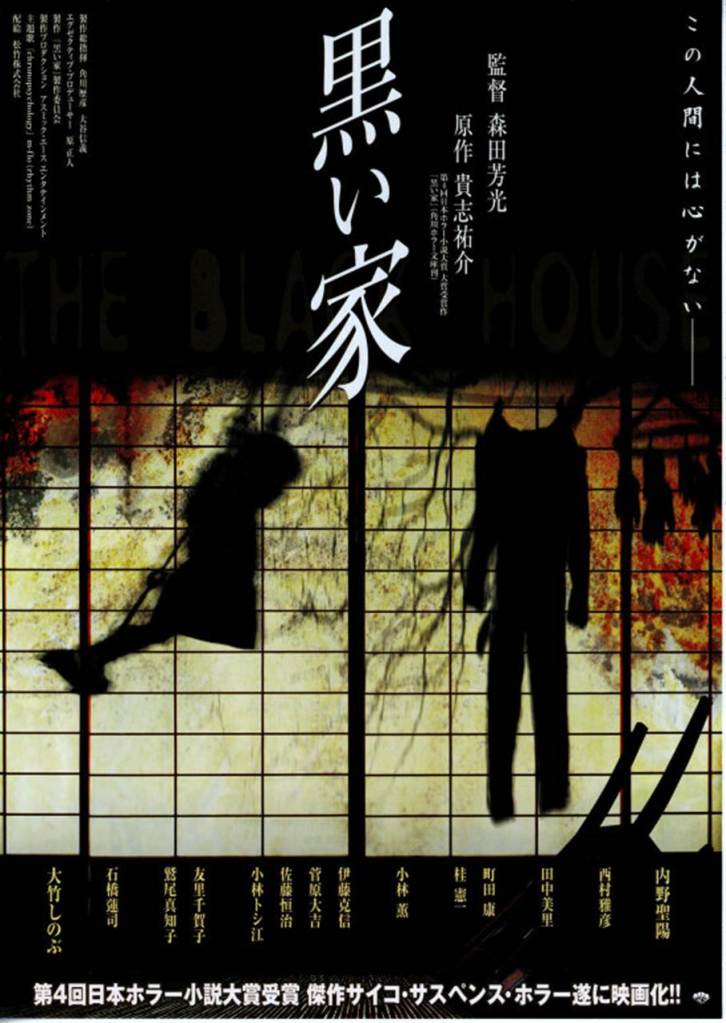
The Black House (黒い家, Yoshimitsu Morita, 1999)

black house posterYoshimitsu Morita, though committed to commercial filmmaking, also enjoyed trying on different kinds of directorial hats from from purveyor of smart social satires to teen idol movies, high art literary adaptations and just about everything else in-between. It’s no surprise then that at the height of the J-horror boom, he too got in on the action with an adaptation of Yusuke Kishi’s novel of the same name, The Black House (黒い家, Kuroi Ie). Though tagged as “J-horror” you’ll find no long haired ghosts here and, in fact, barely anything supernatural as the true horror on show is the slow descent into madness taking place inside the protagonist’s mind.

Wakatsuki (Masaaki Uchino) is a nice young man with a good job investigating claims at an insurance office. Unfortunately, this gives him a slightly dim view of humanity as he comes into contact with scamsters and even people willing to maim themselves just so that they can claim on their policies. One day, he receives a strange phone call from a woman who wants to know if her insurance policy will pay out in case of suicide. Wakatsuki, slightly panicked, tells her that it really depends on the circumstances and, jumping to the conclusion she plans to kill herself, urges her to get help and talk things over with someone before doing anything rash.

The next thing he knows, Wakatsuki is despatched to her house to sort things out whereupon he makes an extremely gruesome discovery – the woman’s son, though only a child, has hanged himself in the back room. Obviously extremely shocked and distressed, Wakatsuki heads home with the nagging suspicion that Sachiko (Shinobu Ootake) and her husband Komoda (Masahiko Nishimura) have done something truly dreadful. The couple take turns coming into the office to find out what’s taking so long with their claim and gradually the situation begins to spiral desperately out of control.

Always one for irony,  Morita’s tone varies widely here. There’s an oddly Twin Peaks-like vibe with the jolly jazz score giving way to synths at moments of high tension, not to mention the run down industrial town setting. If that weren’t enough Lynchery, there’s even a moment where a severed hand is found in a patch of grass, crawling with ants just like the ear found by Jeffrey at the beginning of Blue Velvet. Morita seems to be telling us not to take any of this too seriously yet his subjects include parents harming or even murdering their children to claim on an insurance policy as well as bloody violence and dismemberment of corpses.

In fact, the insurance guys don’t spend too long trying to figure out if the boy actually killed himself but Wakatsuki becomes preoccupied by the idea the husband, Komoda, is behind the whole thing (the boy was only his step-son after all) and will now try and kill his wife to claim her insurance too. The couple are certainly both very strange people and the insurance company also have a problem as the policy was signed off on during a campaign drive in which a now dismissed employee made use of a personal connection to try and meet her unrealistic quota. Wakatsuki eventually engages an equally eccentric psychology professor who takes him out on a weird nighttime odyssey to a seedy strip club where he expounds on a epidemic of psychopathy among the younger generation. Even Wakatsuki’s girlfriend, Megumi, has some off the wall ideas based on an essay Sachiko wrote in elementary school (though actually Megumi’s view has some merit).

Things hit a more conventional note from this point on landing us with a familiar slasher villain who begins stalking Wakatsuki, even trashing his apartment before kidnapping his girlfriend and keeping her prisoner in the “Black House”. Wakatsuki heads to the den of evil by himself in the dark (in true horror movie fashion) where he finds a whole bunch of other dismembered corpses (and a few other surprises). He might think he can put his troubles behind him after this extremely traumatic incident, but this is still a horror movie so the killer gets away to strike again by throwing a bright yellow bowling ball at his head through the office toilet window.

Morita is not being serious at all, even for a second, but somehow he still manages to create an oddly threatening atmosphere of suspense despite the extremely weird things which are going on. He creates a complex set of visual cues from the recurring sunflower motif repeated on Sachiko’s shirt to the glistening yellow bowling ball, goldfish (in a toilet bowl if not a percolator), repeated sounds of cockroaches and old fashioned reel printers, and even the green glow from both old fashioned computer systems and the company’s insurance documents. Undoubtedly bizarre, The Black House is mind bending psychological-horror-movie-cum-Freudian-slasher that is primed for both head scratching puzzlement and confused chuckling as Morita has a lot of fun messing with our senses.
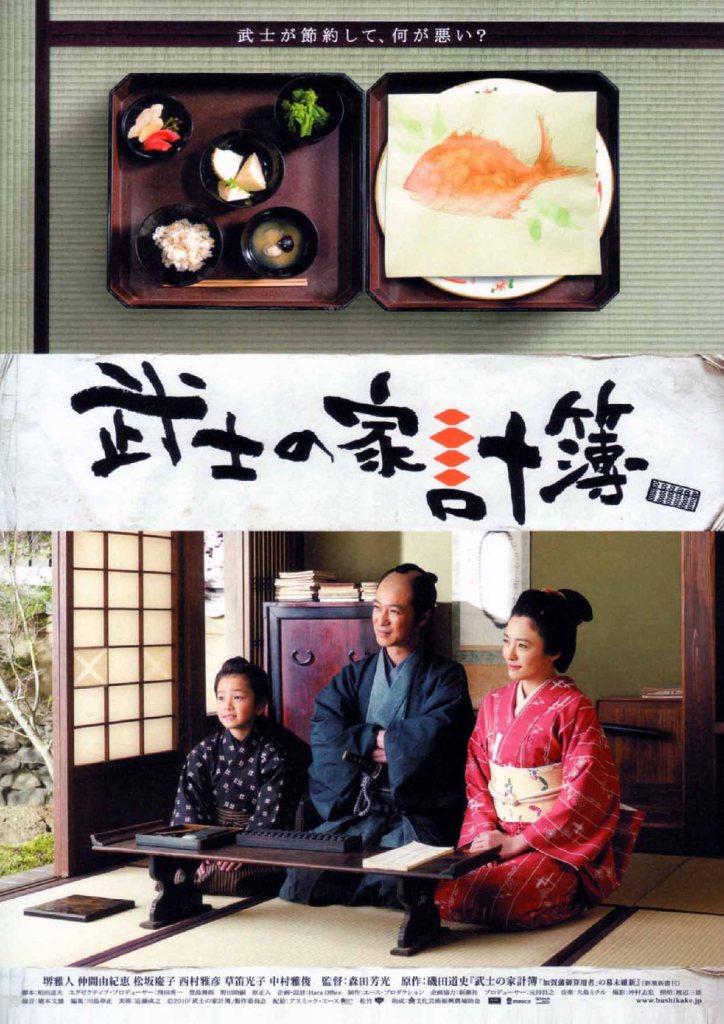

Abacus and Sword (武士の家計簿, Yoshimitsu Morita, 2010)

•Žm‚̉ƌv•ë•The stories of samurai whose soul is placed not in the sword but in another tool are quickly becoming a genre all of their own. Coming from the same screen writer as A Tale of Samurai Cooking: A True Love Story, Abacus and Sword is a similarly structured tale of penny pinching samurai accountants and a pean to the undersung heroes of the admin department without whom everything would fall apart.
Abacus and Sword (武士の家計簿, Bushi no Kakeibo) could almost be titled “a story of my father” as it begins with a voice over by the youngest adult generation seen in the film, Nariyuki Inoyama, who is at the time of speaking a naval accountant in the new post restoration world. As good an account as he is (and he must be, given his position), he feels he pales in comparison to his father, Naoyuki, whose skills with the abacus were somewhat legendary even if his people skills were often not on the same level.

Dubbed an abacus fanatic by his colleagues, Naoyuki’s top maths abilities get him into trouble right away when he notices an extreme discrepancy in the accounts details for the imperial rice dole. Around this time there are riots from farmers who are being squeezed to deliver more grain to the authorities during a time of famine but not seeing enough returned to them as well as starving people petitioning for food in the streets, so when Naoyuki asks why around a third of the rice is disappearing from the accounts or listed as “reserved” his superiors start getting nervous. As a mini underling, Naoyuki is not in a position to stop his bosses from exploiting their authority in the most devious of ways – creating a food panic and then profiting on the side through black market trading, and is simply instructed to “ensure the final accounts balance”. Unwilling to falsify his precious calculations, Naoyuki finds himself facing the possibility of exile from the imperial centre but eventually finds his persistence rewarded when the scam is finally uncovered by a higher level.

Accountants are often not respected in this era of samurai warriors who place an almost religious faith in the power of the sword. Their pay is low, hours long and taxing, and they have little prospects of advancement. After hearing the story of Naoyuki’s career Nariyuki returns to the subject of himself a little more as the conflict between austere father and wayward son takes centre stage. Naoyuki is a pragmatic man, he sees their family debts are unsustainable and embarks of prolonged plan of austerity in which he forces the entire extended family to sell all their non essential possessions and live as cheaply as possible until the debts reach a more manageable level so they can at least keep the social position their larger family home affords them rather than being moved to something less prestigious. This is an unusual move in status driven samurai circles and proves embarrassing for the rest of the family such as in one episode where Naoyuki can’t afford to buy fish for his son’s coming of age ceremony so simply puts a painting of a fish at each place setting. Creative accounting at its finest!

Nariyuki, however, can’t quite give up on the idea of the sword and goes off to fight in the various civil wars which erupt during the Meiji Restoration causing great worry to his parents, wife and children. He too becomes an accountant and is at first disappointed that it’s his skills with an abacus that can best serve the country rather than those needed on the frontlines but later comes to understand the tactical importance of maintaining the smooth financial functioning of an army.

A late career effort from the prolific Yoshimitsu Morita, Abacus and Sword is an uneven experience which is more or less devoid of the director’s usual attempts at experimentation pushing for a more general, sometimes even televisual approach to storytelling. At heart the film praises the virtues of living a thrifty, honest, and balanced life in which hard work is always fairly rewarded in the end and even when not provides its own set of rewards. However, virtuous as it is to live honestly and simply in tune with the clack of an abacus, it can prove fairly dull which is unfortunately also true of Abacus and Sword which despite brief episodes of light humour never quite engages with its twin dynamics of father son conflict which echoes that of the changing world as it emerges into the new Meiji era, and of shining a light on the forgotten admin workers who keep the world turning when everything else is falling apart. Morita’s anti-consumerist, transparency in government sympathies come to the fore and are once again timely, but like Naoyuki he fails to make his complaints sufficiently engaging to ensure his messages are received by those with the ability to take action.


English subtitled trailer:

Patisserie Coin de rue (洋菓子店コアンドル, Yoshihiro Fukagawa, 2011)

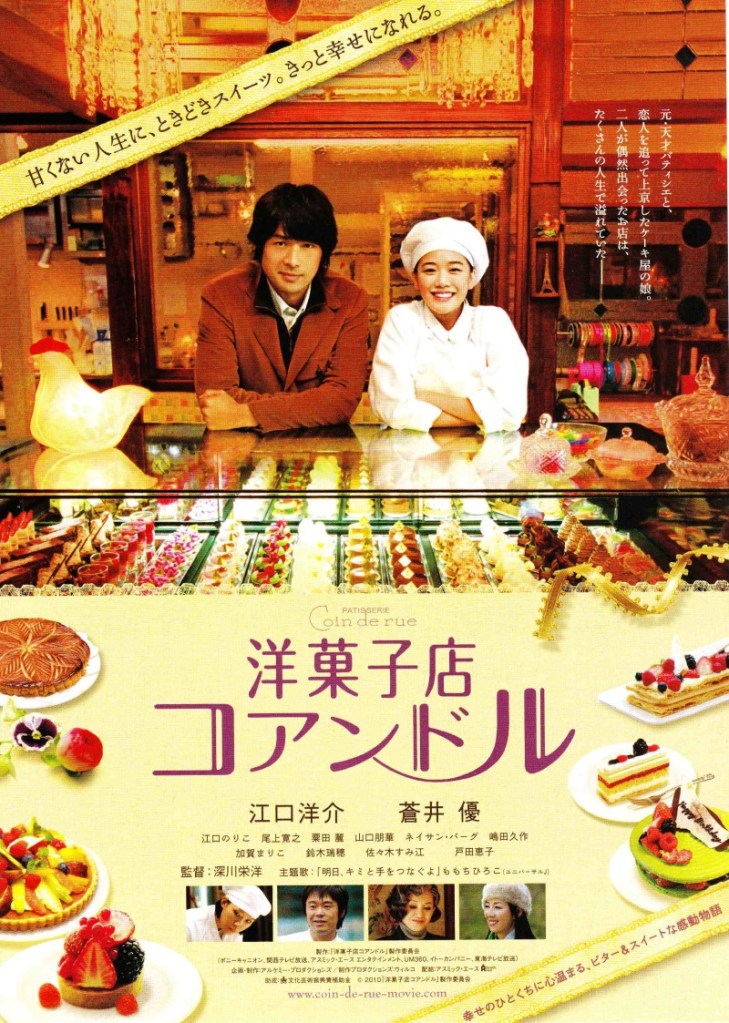
coin de rue posterYou know how it is, when you’re from a small town perhaps you feel like a big fish but when you swim up to the great lake that is the city, you suddenly feel very small. Natsume has come to Tokyo from her rural backwater town in Kagoshima to look for her boyfriend, Umi, who’s not been in contact (even with his parents). When she arrives at the patisserie he’d been working at she discovers that he suddenly quit a while ago without telling anyone where he was going. Natsume is distressed and heartbroken but notices that the cafe is currently hiring and so asks if she may take Umi’s place – after all she grew up helping out at her family’s cake shop!
However, as you might expect, even if her cakes are perfectly nice in a “homecooking” sort of way, they won’t cut it at a top cafe like Patisserie Coin de rue. Natsume is not someone who takes criticism well and is hurt that her skills aren’t appreciated but vows to stay and become the best kind of pastry chef she can be.

At heart, Patisserie Coin de rue (洋菓子店コアンドル, Yougashiten Koandoru) is a fairly generic apprentice story as Natsume starts off as a slightly arrogant country girl with an over inflated opinion of her abilities but gradually develops the humility to help her learn from others around her. Natsume, played by the very talented Yu Aoi, is not an easy woman herself and often rides a rollercoaster of emotions in just a single sentence. She’s loud but passionate and she does work hard even if her over confidence and slapdash approach sometimes cause problems for her fellow workers.

Patisserie Coin de Rue is also refreshing in that it’s one of the few films of this nature that do not attempt to pack in a romantic element. Natsume may have come to Tokyo to look for her boyfriend but no attention is paid to the possibility of winning him back or finding someone else, after calling time on her quest Natsume simply buckles down to learning her craft.

This is doubly true of the film’s secondary plot strand which centres on former international pastry star Tomura (Yosuke Eguchi) who mysteriously abandoned his cooking career eight years ago and now mostly works as a critic with some teaching on the side. He cuts a fairly sad figure as a regular visitor to Patisserie Coin de rue where he’s also an old friend of the owner and Natsume’s mentor, Yuriko. Natsume finally manages to coax him out of his self imposed isolation but the relationship is more paternal than anything else and, thankfully, never attempts to go down any kind of romantic route.

It’s a story that’s familiar enough on its own to have become something of a cliché and Patisserie Coin de rue doesn’t even try to put much of a new spin on it but it does at least carry it off with a decent amount of sophistication. Occasionally the film falls into the televisual but its production values are strong with the tone neatly flitting between mainstream aesthetics and a slightly alienated indie perspective. Of course, being a cake based film there are plenty of enticing shots of the baked goods on offer which do at least create a feast for the eyes.

The saving grace of the film is its leading actors who each turn in naturalistic, nuanced performances even given the lacklustre nature of the script. Yu Aoi carries the film as her surprisingly feisty Natsume dominates each scene she’s in while support is offered by the silent, brooding Yosuke Eguchi and the wise and patient shop owner Yuriko played by Keiko Toda. The film really owes a lot to the talent and commitment of its leading players who help to elevate its rather ordinary nature into something that’s a little less disposable.

That said Patisserie Coin de Rue is a little like a pleasant cafe you find in an unfamiliar area – the coffee’s good and the pastries are pleasant enough, you might drop in again if you’re in this part of town but you probably won’t make a special journey. A little bit formulaic and ultimately too sweet, Patisserie Coin de Rue is a shop bought cake in a boutique box which though enjoyable enough at the time is unlikely to linger long in the memory.


The R3 Hong Kong DVD release of Patisserie Coin de rue includes English subtitles.

(Unsubtitled trailer)


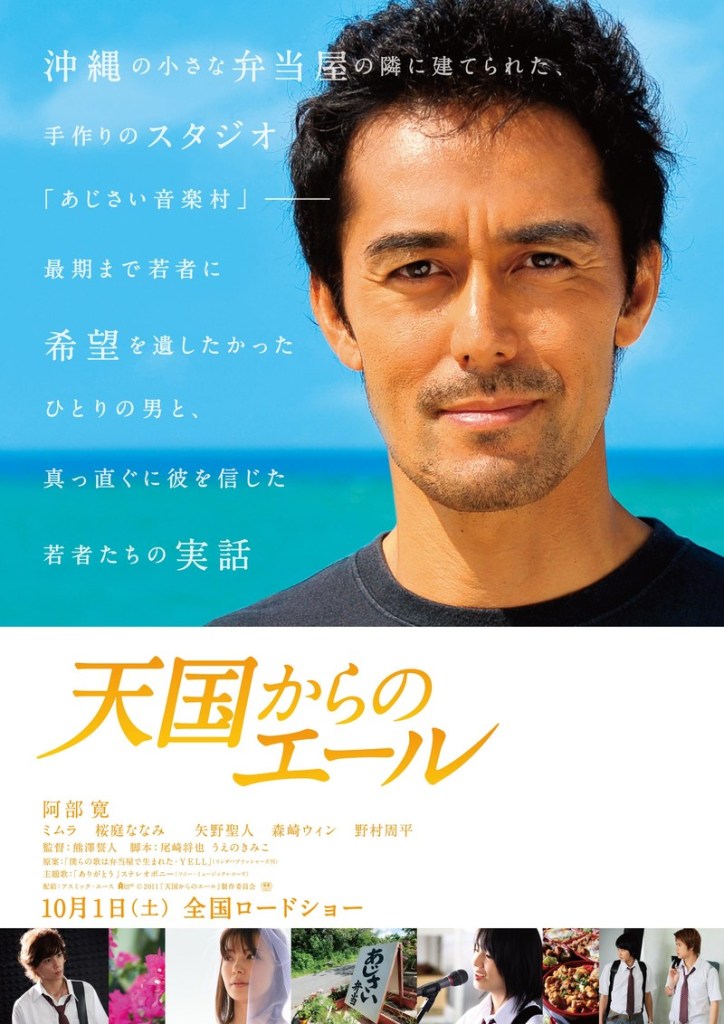
Cheers from Heaven (天国からのエール, Chikato Kumazawa, 2011)

tengoku_teaser_“üeolOkinawa might be a popular tourist destination but behind the beachside bars and fun loving nightlife there’s a thriving community of local people making their everyday lives here. Just like everywhere else, life can be tough when you’re young and the town’s teenagers lament that there’s just not much for them to do. A small group of high schoolers have formed a rock band but they’re quickly kicked out of their practice spot at school after a series of noise complaints from neighbours.
The school kids all buy their lunches from the bento shop down the street run by Hikaru “Nini” Oshiro, his wife and his mother. Whilst there, Aya – the rock band’s female singer, starts eying up a covered courtyard area and remarks that it’s a shame they can’t practice there. Nini overhears and gives them the space but once again the neighbours complain ,so the kids reluctantly decide to give up on the band for now because there aren’t any studio spaces on the island and they wouldn’t have the money to hire somewhere anyway. At this point, Nini makes a surprising decision – digging deep into his family resources, he buys the materials and commits to building a studio space on a patch of disused land next to the bento shop with his own hands.

Based on a true life story, Cheers From Heaven (天国からのエール, Tengoku kara no Yell) is a tribute to Hikaru Nakasone who really did build a studio space for the local kids that turned into something more like a youth centre offering support to all kinds of youngsters so long as they obey the rules. In the film, Nini is a fairly gruff but big hearted man who’s big on discipline and doing the right thing. His rules include being courteous to the other kids, sticking to your allotted time and crucially that your grades don’t suddenly start dropping because you’re hanging out in the studio all the time.

Nini’s wife is, perhaps unsurprisingly, originally horrified by the idea of the studio especially as it will require an additional financial burden for the family, not to mention that Nini failed to run the idea by her before launching headlong into it. However, eventually the entire family comes around and they even start catering for the kids too. When his wife asks him why he’s doing this Nini remarks that in his day people were poor, yes, but they helped and supported each other. Older people taught younger ones how to do things and how to behave but that doesn’t seem to happen now and he doesn’t want his daughter to grow up in a world like that.

The building of the studio becomes a real community project as half the kids from the local area suddenly turn up to help. The project that Nini assumed he’d be finishing with his two hands alone becomes a symbol of pride for the various teenagers who commit their time and hard work into making it happen. They’ve built something together that’s now their collective responsibility and a place where they can go to practice their music or just express themselves creatively.

Nini doesn’t stop there, he wants to help the kids in the band make it big. Convincing a fourth member to join them, taking demos around radio stations, organising live gigs – he’s their unofficial manager. The band’s young struggles hit a chord with Nini because he also had a friend with dreams of becoming a musician that were tragically cut short just as he was finally getting somewhere. It also transpires that Nini came home to Okinawa with his family following an illness which has now returned and this headstrong determination to make a difference is, in part, because he feels as if he’s running out of time.

Despite his failing health, Nini continues to do everything possible to look after the kids from the band even going so far as to discharge himself from hospital to go check on the leaking roof of the studio during a storm only to discover the kids already have it covered. A warm tribute to its real life inspiration, Cheers from Heaven proves far less sentimental than its rather melodramatic title suggests preferring to emphasise its themes of togetherness and legacy which bear out the way in which one committed soul can leave an indelible mark on its community.


Reviewed at the Japan Foundation Touring Film Programme 2016 at the ICA London on 6th February 2016.

http://www.youtube.com/watch?v=LSYWW2W4U24

The Emperor in August (日本のいちばん長い日, Masato Harada, 2015)

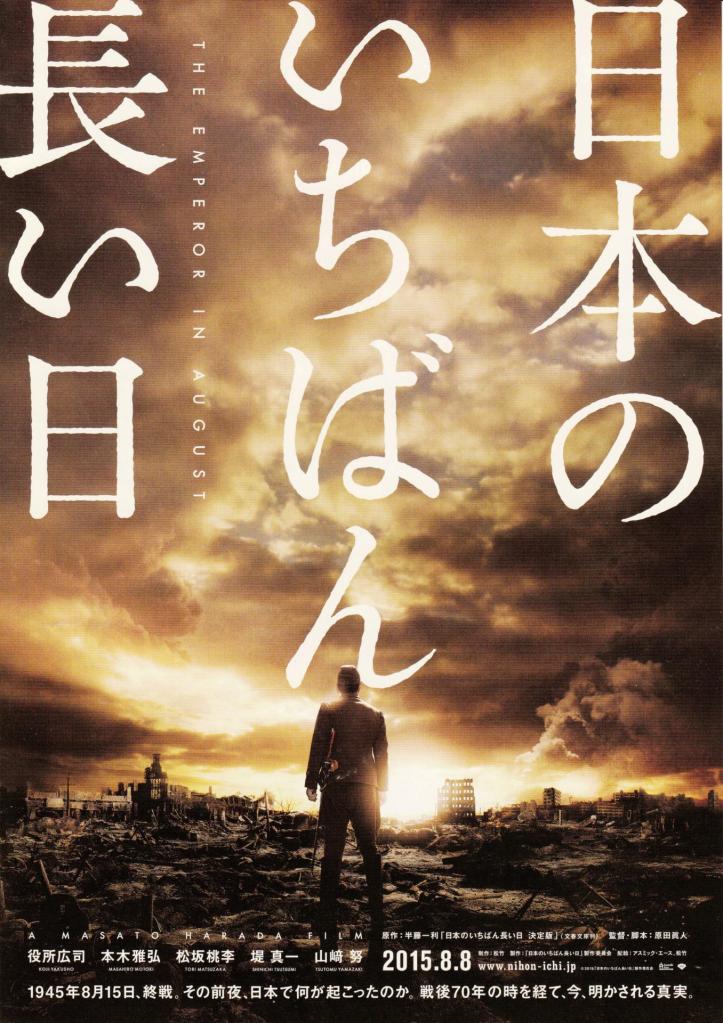
bbc56b4fff657dfc4fcc0499f8be9741How exactly do you lose a war? It’s not as if you can simply telephone your opponents and say “so sorry, I’m a little busy today so perhaps we could agree not to kill each other for bit? Talk later, tata.” The Emperor in August examines the last few days in the summer of 1945 as Japan attempts to convince itself to end the conflict. Previously recounted by Kihachi Okamoto in 1967 under the title Japan’s Longest Day, The Emperor in August (日本のいちばん長い日, Nihon no Ichiban Nagai Hi) proves that stately events are not always as gracefully carried off as they may appear on the surface.

By the summer of 1945, it’s clear that the situation as deteriorated significantly and Japan can no longer cling to any kind of hope of victory in the wider scale. Tokyo has been firebombed almost out of existence leaving only the Imperial Palace untouched – even the Emperor and his wife have been reduced to eating gruel. Everyone knows it’s time for a solution, but no one is quite ready to say it. In the wake of the atomic bomb, the situation becomes ever more desperate and even if the Emperor himself advocates a surrender, he needs the approval of his advisors. The Prime Minister, Navy and other officials are in favour but the Army, represented by General Anami, is committed to fighting on to the last man. Eventually, Anami comes around to the Emperor’s point of view but some of his men prove much harder to convince…

It might seem like a strange time to make a film about grace in the face of defeat given the recent political troubles stemming back to Japan’s wartime activities, but director Masato Harada is not lamenting the course of the war or trying to advocate for any rightwing agenda so much as trying to make plain the final absurdity of recognising when the battle is over. The civilians and even the Navy might be in favour of accepting the terms of the Potsdam Declaration and ending the war as quickly as possible but a soldier is a soldier and the Army wants to go down fighting. They aren’t alone, of course, there are ordinary people who feel this way too but the writing is well and truly on the wall here.

The bulk of the film takes place within the palace, debating halls or army buildings all of which have escaped major damaged but every time we venture outside we’re shown a scene of utter desolation. A great, gaping hole where once there was a city. Anami’s wife undertakes a four hour walk to try and get in contact with a man who knew their son and can tell them how it was that he fell somewhere in Manchuria. She sees people fleeing, some thinking the enemy are about to descend any minute or that Tokyo will be the next target for an atomic bomb, and walks on through a barren, eerie landscape emerging soot covered and, finally, too late.

Closer to home, the situation among the soldiers is reaching boiling point. Originally committed to rejecting the terms of the treaty, Anami is now in favour of a surrender (with a few caveats) and is desperately working against the threat of an internal coup. Though the top brass have seen enough of warfare to know when it’s time to put down your weapons, the young hotheads have not yet learned the value of pragmatism. Seeing themselves as a second incarnation of the February 26th rebels, a cadre of young officers breaks ranks to try and stop the Emperor’s message of surrender from hitting the airwaves, hoping instead to spread the false message that the Russians have invaded and it’s all hands on deck. Needless to say, they don’t fare any better than the young officers of 1936 and if anything their bullheaded refusal to see sense becomes a microcosmic allegory for the years of militarism as a whole.

In the midst of all this chaos, the real heart of the film is Koji Yakusho’s conflicted general who feels his era passing right in front of him. Grieving for his fallen son yet also clinging to his military duty which dictates no surrender, no retreat he finally sees each of his ideals crumbling and comes to the realisation that the only way to save Japan is to abandon the military. Making a sacrifice of himself, he ensures the safe passage of his nation along a road on which he cannot travel.

The Emperor is a sympathetic figure here, gentle, soft, wanting the suffering to end for everyone but being more or less powerless to effect it despite his title. All he can do is advocate and try to convince his council that surrender is the right course of action as his country burns all around him.

Harada manages to keep the tension high even though a lot of the film comes down to a group of men discussing the proper wording for a treaty. A timely and beautifully photographed exploration of the last days of a war, The Emperor in August is another much needed reminder that decisions which will affect millions of lives are made by handfuls of men in tiny, closed up rooms that most people will never get to see.


The Japanese blu-ray/DVD release of The Emperor in August includes English subtitles.

Unsubtitled trailer: