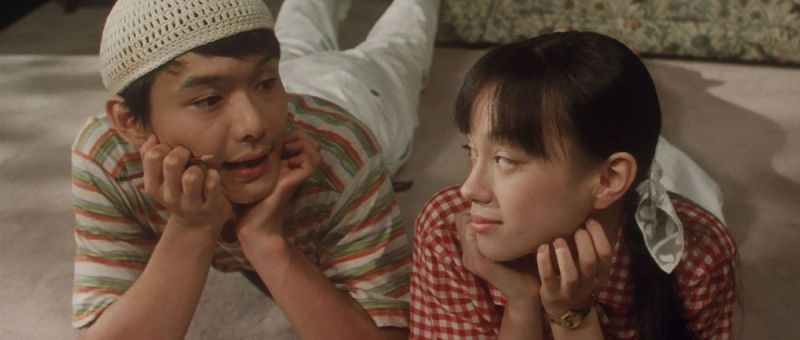
A Quiet Life (静かな生活, Juzo Itami, 1995)

“One person is not a tool for another” the heroine of Juzo Itami’s 1995 melodrama A Quiet Life (静かな生活, Shizukana Seikatsu) eventually writes in her diary quoting her novelist father but also reflecting on herself and her life in which some have indeed attempted to use others for their own ends. Outside of international mega hit Tampopo, Itami is best known for a series of anarchic comedies each starring his wife Nobuko Miyamoto as forthright woman tackling the ills of contemporary Japan from tax evasion and increasingly amoral capitalism to the yakuza and shady cults. Based on a novel by his brother-in-law Kenzaburo Oe, A Quiet Life is therefore something of an outlier yet once again addresses a number of social issues from treatment of disability in the contemporary society to the relationships between parents and children and the dangers of a rapidly modernising society. 

Middle daughter Ma (Hinako Saeki) lives in a large Western-style in the country with her father, internationally renowned author K (Tsutomu Yamazaki), mother and two brothers the oldest of which, Eeyore, has some learning difficulties but is largely independent. Nevertheless, when K, who is experiencing a moment of crisis that leads him to consider suicide when he is unable to fix a problem with the drains and has to resort to a plumber, is offered a job at a university in Australia Ma is left in charge at home and therefore responsible for her brother. Though the family fully accepts Eeyore, it’s clear the world around them is not always so kind. As they approach a centre for the disabled on a walk, others around them openly express disgust, suggesting they are a “bad influence” and wanting to leave the area entirely. 

Meanwhile as the film opens two children are locked together in a game of magnets, a collection of adults attempting to pull them apart by force. The shot is later repeated as Eeyore holds his sister in the rain following a traumatic and unexpected incident and demonstrating the close and affectionate bond between the siblings. Yet there is an uncomfortable suggestion from some that Ma is being asked to sacrifice her life to look after her brother who after all is unlikely to marry and will require additional care as long he lives, while she is perhaps slightly overprotective and wilfully self-sacrificing. “Don’t expect another human to sacrifice their life for you” goes another of her father’s lines, “to expect such a thing is the worst kind of depravity”, the family otherwise committed to the insistence that Eeyore has his own life and interiority which must neither be sacrificed, nor sacrificed for, for to do so would be to deny his personhood. Eeyore is not a tool for Ma’s charity nor is she a tool for the family’s duty towards him. 

Nevertheless even she is not immune to negative stereotyping becoming increasingly concerned that her now adult brother may pose a threat to the local community in his lack of understanding and inability to control his impulses. When a child molester is on the loose in the village, she is terrified Eeyore may be involved having read a newspaper report about a similar crime committed by someone with learning difficulties uncomfortably echoing the prejudice of the walkers by the disabled centre not to mention to middle-aged women who openly gossip about it in front of their house. Meanwhile, her own naivety becomes a threat when she allows a smarmy young man, Arai, to give her brother swimming lessons later learning that he has a grudge against her father who he feels “used” him to facilitate his art having bought and drawn inspiration from his experiences of being accused of a crime but leaving readers with the impression that he was a sex offender. 

Arai may indeed be trying to use her for revenge and at any rate is not all he seems even if the implication of her father’s story is that he wanted to sacrifice himself to save the young man. While K works through his artistic block offscreen aided by his wife (whom he soon forgets once he’s well), Ma has a series of epiphanies of her own over an eventful summer you couldn’t really call “quiet” even if there’s a strange tranquility in its anarchy. Going to some dark and unexpected places, Itami’s gentle dramedy veers away from the zany comedies of his earlier career but discovers a kind of serenity in the quiet of life of the siblings getting on with business of living in the sometimes hostile Japanese countryside. 


Original trailer (no subtitles)

Masquerade Hotel (マスカレード・ホテル, Masayuki Suzuki, 2019)

The thing about hotels is, people often go to them when they want to be someone else, so how can you be on the look out for suspicious behaviour when everyone is to some degree acting out of character? Keigo Higashino is one of Japan’s best known authors particularly praised for his elaborately plotted mysteries. In contrast to some of his famous detective novels, Masquerade Hotel (マスカレード・ホテル) leans into his softer side, taking its cues from Agatha Christie in its ultimately cheerful exploration of the strange world of hotels while praising the detective acumen both of cynical policemen and eager to please hoteliers. 

The police are hot on the trail of a serial killer and, due to clues found at the previous crime scenes, have concluded the next killing will take place at the Hotel Cotesia Tokyo. To scout out the potential crime scene, the detectives have co-opted the hotel’s basement as an incident room and are preparing to go undercover to keep an eye on things upstairs. Dishevelled detective Nitta (Takuya Kimura) has been assigned to the front desk because of his English skills apparently honed while living abroad in his youth, and is to be paired with earnest hotelier Naomi Yamagishi (Masami Nagasawa) who will do her best to turn him into a first rate hotelman. 

As might be expected, Nitta and Naomi do not exactly hit it off. Gruff and given to giving everyone in 50m radius the hard stare, Nitta is a shaggy haired middle-aged man in creased suits and shiny shoes. The first thing Naomi makes him do is get a haircut which does wonders for his image, but also plays into the peculiar art of masquerade which defines hotel life. Nitta is in the habit of calling the guests “customers” which instantly irritates Naomi who has spent the entirety of her professional life learning to be deferent. She reminds him that in here the guests are in charge, they make the rules and therefore can never break them. Her job is to provide the best service, which means she often has to set her personal pride aside and allow the sometimes unpleasant clientele, the ones who like to come to posh hotels to throw their weight around and abuse the staff, to get away with being obtuse because that’s just part of her job. 

That’s a big ask from Nitta who is both a proud man and a justice loving policeman to whom the idea of letting people act badly is almost anathema. To do his job, however, he’ll have to learn to bear it or risk letting a potential serial killer slip through his fingers. What Naomi realises is that they’re more alike than they first seemed. Both of their jobs rely on an astute assessment of their targets, even if they come at it from opposite ends. Naomi knows that each of her guests is wearing a kind of mask, taking on a slightly different persona when they enter her hotel, but her job is to see past it without ever letting on. A good hotelier knows what the guest wants before they do and is always ready to provide it, that’s the nature of service. So Naomi trusts her guests and is careful not to judge them. Nitta, meanwhile, is a policeman so he’s trained to question everything and suspect everyone. His job is to unmask and confront his suspects with who they really are. 

They both, however got into this game essentially because they want to protect people even if she wants to protect them inside and he out. Which means of course that they can work together after all, learning a little something from each other along the way. Naomi, well versed in the liberties often taken by her guests, is nearly taken in by an obvious scam that only Nitta is quick enough to catch thanks to his cynical policeman’s logic. He’s also first to suspect that there’s something not quite right with a harmless little old lady, and though Naomi senses it too she’s minded to let it go and doubles down on being the perfect servant thanks to her animosity towards Nitta. That “not quite right”, however, proves to be a slight misreading of the guest who, like many Nitta encounters, is pretending to be something they’re not for reasons that prove perfectly understandable once revealed. 

But then, Higashino characteristically pulls the rug out from under us and asks if we haven’t been suckered in buying all those reasonable excuses. Thanks to his conversations with Naomi, Nitta begins to get a grip on the crime, while she struggles with her conscience after learning that her guests may be in much more danger than she thought. Staking all on justice, the pair of them vow to abandon their respective professions if a guest gets hurt, but fail to realise that the crime may hit far closer to home than they’d anticipated. Nevertheless, what we’re left with is a strangely whimsical admiration for the weird world of hotels where no one is quite the same person they were before they walked through the revolving doors.


Original trailer (no subtitles)