Johnny Keep Walking! (年会不能停!, Dong Runnian, 2024)

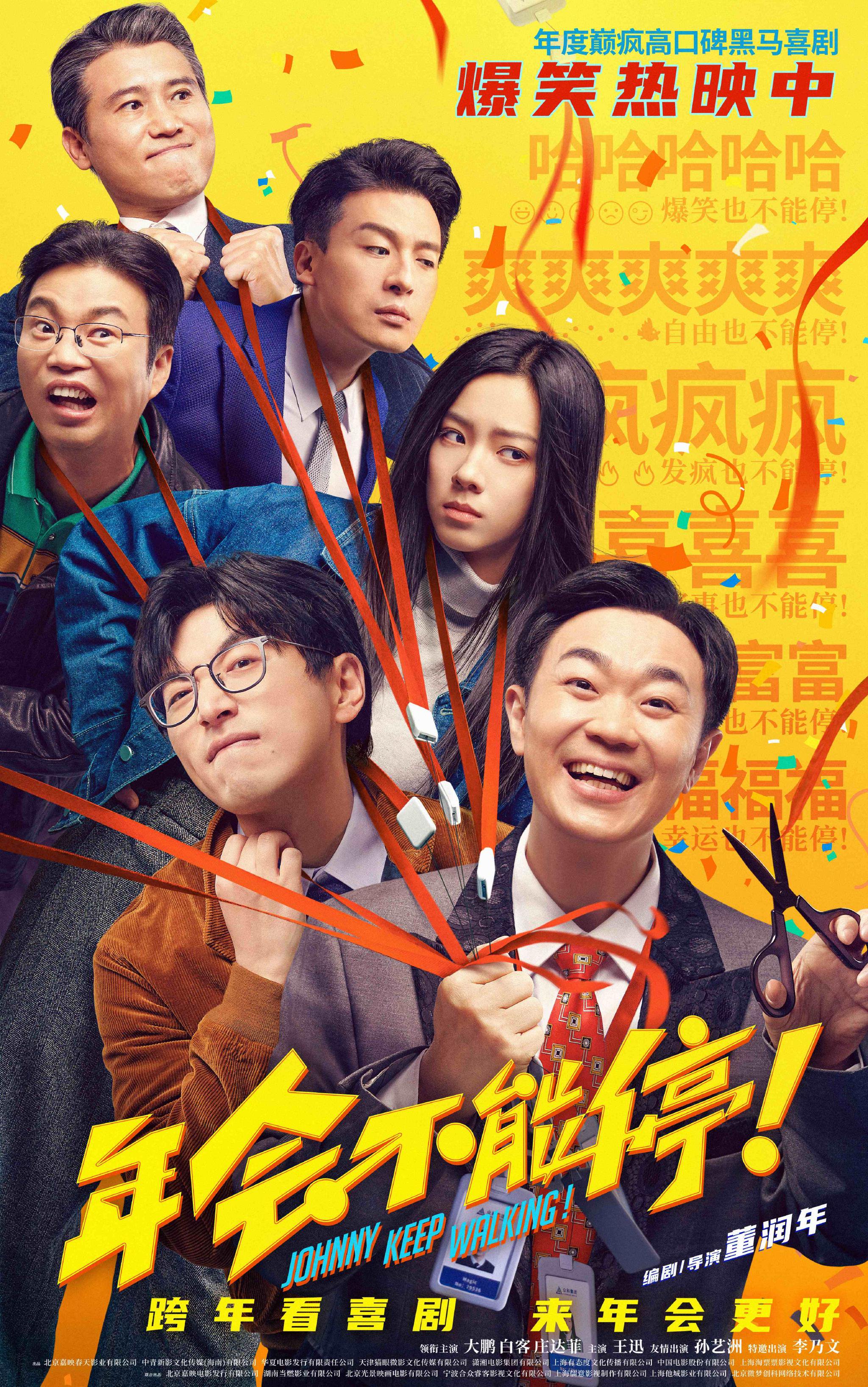
A satirical morality tale, Dong Runnian’s incredibly witty comedy Johnny Keep Walking! (niánhuì bùnéng tíng) sees a bumpkinish middle-aged factory worker still filled with an idealism that seems outdated even in the late 90s transferred into a lion’s den of corporate greed and dubious morality while ultimately expressing the younger generation’s increasing dissatisfaction with the inherent unfairness of corporate life in modern China. Ironically turning Tom Chang’s 1988 hit My Future is Not A Dream into a rallying cry from disillusioned youth, the film nevertheless places its faith in the moral generosity of a fat cat factory owner who struck gold in the nation’s 90s reforms but has largely forgotten those who helped him get there.

Key among them would be Jianlin (Da Peng) whom we first see trying to fix the disco ball at the factory’s 1998 gala and being asked to sing a song instead. 20 years pass with Jianlin still living the life of a model factory worker stuck on the same old salary while applying to perform in the company’s annual gala has become his only joy in life. Meanwhile, the factory owner has gone on to head an increasingly powerful multi-national company leaving Jianlin and those like him far behind deprived of the successes that the modern China has to offer. 

This is in part a paean for those left behind by the economic reforms of the 1990s which saw the end of the old factory system with mass unemployment and displacement amid frequent plant closures. Jianlin’s is still open, but devoid of the sense of comaradie that mark the opening scenes. His scheming floor manager, Zhangzi is trying to engineer a transfer to head office so that his son could attend a better school in the city and has been helping a series of corporate lackeys defraud the company, in addition to paying a direct bribe, in return for a job offer. A drunken mix up by office party boy Peter (Sun Yizhou) results in Jianlin being hired instead in a shock move that proves inexplicable to all. 

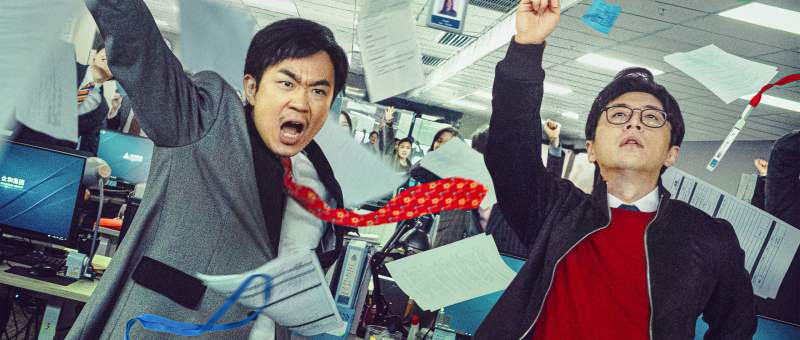
Jianlin is such an innocent that he thinks the reason he’s been given a huge promotion is because he was employee of the year for 12 years straight and the company probably want to send a message to the youngsters that hard work really will be rewarded. Of course, the opposite is true. HR manager Magic (Bai-Ke) quickly spots the mistake but is prevented from fixing it because it would get them all into trouble, and while it’s obvious to most people that Jianlin has no idea what he’s doing they choose to say nothing because they assume he must be a nepotism hire and they want to stay in the boss’ good books. Everyone at the company uses an English name with Jianlin rechristened “Johnny” though he understands no English and struggles with Chinese business jargon having no idea what people mean when they go on about “aligning the details”. Charged with firing someone under the company’s radical new “optimisation” programme, he takes the word at face value and gives them a promotion and a raise instead.

In fact, much of the film is him muddling along like typical middle-manager promoted beyond his abilities. He’s advised that good management is all about setting employees against each other so they forget about resenting you while basically delegating all your tasks to your subordinates who will be only too happy to help in order to curry favour. Slowly corrupted, Jianlin beings to play along, taking all the perks of corporate success while signing documents he couldn’t understand even if he actually read them.

Nevertheless, he develops a kind of team spirit with Magic, a man stuck in a mid-career rut because of his lack of skill at office politics, and Penny temp whose perpetually kept on the hook rather than being given full employee status so that the company can exploit her more. Penny also suffers sexual harassment at the hands of the party happy Peter with Jianlin getting her out of a sticky situation by telling her to finish a report and drinking with Peter himself. Together, and with the assistance of the workers at the factory and others about to be unceremoniously fired as part of the cost cutting enterprise, they attempt to expose corporate corruption and stage a protest against unfair working practices but the only saviour they have to turn to is the company president strongly suggesting a return to the old factory days which, it is implied, were much more wholesome and innocent. In any case, justice eventually wins out with the good rewarded and the bad getting their just desserts though it doesn’t do too much to tackle the inherent and quite ironic rottenness of the system in which the worker has been reduced to a mere tool to be used and discarded by a faceless and uncaring corporate entity. 


International trailer (English subtitles)

My Future is not a Dream (Tom Chang)
The Best is Yet to Come (不止不休, Wang Jing, 2020)

A man denied a fair chance in life because of his impoverished background comes to identify with the plight of those carrying the hepatitis B virus in Wang Jing’s true life drama, The Best is Yet to Come (不止不休, bùzhǐ bùxiū). Inspired by the story of Han Fudong, a journalist who exposed the societal prejudice against those with a previous diagnosis of the disease, the film’s Chinese title “no pause no rest” makes clear how tirelessly he strived to reveal the truth even at the potential cost of destroying his dream of becoming a professional reporter. 

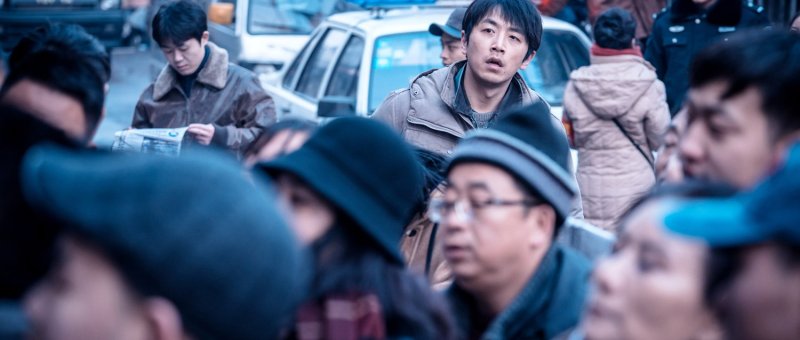
Han Dong (Bai-Ke) came to Beijing in 2003 in the hope of landing a job at a paper, but just like everywhere else journalism is a largely closed profession almost impossible to break into without elite qualifications and connections. At a jobs fair, Han Dong tries to pass off his reluctance to hand over a CV as a recruitment tactic to get people to remember him, circulating copies of his portfolio instead though recruiters quickly lose interest on realising they are all self-published articles posted online. Once he admits that he only finished middle school, it’s game over no matter how talented a writer and investigator he may turn out to be. 

It’s this sense of unfairness, of being turned away on the grounds of a few words on a piece of paper that eventually leads him to sympathise with those carrying the hepatitis B virus after investigating a company that claims it buys blood, discovering that they provide a service helping people to forge health certificates for job and school applications. Vox pop-style interviews recreated in the manner of the time feature several people describing the various ways their lives have been ruined simply because they happen to carry the virus, many of them infected since birth or early childhood. One man has been trying to apply for jobs and graduate schools for several years but finds the offers are always withdrawn after the health screening, while another woman recounts that her fiancé cancelled their engagement because his family could not accept someone with hepatitis B. 

This is also in the immediate aftermath of the SARS epidemic which perhaps caused a preoccupation with infectious disease which may be largely unfounded in the relative difficulty of passing on the hepatitis B virus. After landing a golden opportunity of an unpaid internship compensated only with 50% article fees, Han Dong finds himself conflicted. He knows the forgery operation is illegal and a threat to public health, but also cannot blame the people who make use of it when their lives have been rendered so impossible that is difficult for them simply to live. An early assignment had seen him cover a mine collapse and witness a destraught mother bounced into accepting compensation for her son’s death while shouted at by the foreman (played by film director Jia Zhangke who also produced) for having the temerity to ask to see his body. Han Dong got a front-page byline as co-author with his mentor figure, Huang (Zhang Songwen), but wonders what the point is if nothing ever changes and the truth is not enough on its own. 

For obvious reasons, films about crusading journalists are rare in Chinese cinema given that whistleblowing is not regarded as a virtue and those who try to expose wrongdoing are often shouted down or hounded into silence as seen with the doctor who drew attention to the poor medical practices in rural blood clinics that caused an HIV epidemic in farming communities, and most recently with the physician who tried to raise awareness of the new respiratory illness that later developed into a global pandemic. Journalists who report problematic stories can also find themselves facing prosecution and imprisonment. Han Fudong’s writings did however lead to an eventual change in the law and the destigmatisation of hepatitis B while he himself overcame the educational elitism of the contemporary society to achieve his dreams of becoming a professional reporter. As such, Wang’s dramatisation of his life may be in a way subversive if subtly so in hinting at a greater role for a currently not so free press in the modern China while also embracing a central philosophy that one need not simply accept an unacceptable status quo but actively reject and challenge it and that by doing so something might actually change. 


The Best is Yet to Come screens in Chicago Sept. 30 as part of the 17th season of Asian Pop-Up Cinema 

International trailer (English subtitles)

Cloudy Mountain (峰爆, Li Jun, 2021)

In recent years, Chinese big budget disaster extravaganzas have dedicated themselves to celebrating the selfless heroism of the undersung branches of the emergency services, firemen for example in Tony Chan’s The Bravest or the coast guard in Dante Lam’s The Rescue. Li Jun’s Cloudy Mountain (峰爆, Fēng Bào) features its fair share of fearless rescue teams, but is nevertheless dedicated to the rather unlikely source of pride, the Rail Soldiers whose lives, at least according to the closing credits, were sacrificed in large numbers to complete the infrastructure necessary for the expansion of the Chinese state yet in 1984 they were renamed “China Railway Construction Corporation” a development the film at least seems to regard with a surprising degree of ambivalence. 

This becomes most obvious in the conflict between the two heroes, an estranged father and son burdened by personal trauma, one a former Rail Soldier and the other a high tech engineer working for a commercial enterprise on the building of a high speed railway network through terrain known to be geologically volatile. Grandpa Hong (Huang Zhizhong) is set to visit his son Yizhou (Zhu Yilong) for New Year, though he doesn’t really want to see him knowing that his father will only criticise his work on the tunnel leading to another intergenerational argument. Meanwhile, Yizhou also finds himself unpopular at work for requesting additional safety checks many seem to regard as a pointless waste of time, and oddly they might have a point seeing as Yizhou’s monitoring fails to detect a shift in the rock formation which causes water to flood the almost complete tunnel during routine blasting. 

The fact is Hong was a Rail Soldier and is also one of those old men who think they know best about everything. He kicks off at a bored young lady at service station because she doesn’t want to accept payment in cash and has no change to offer confused as to why Hong can’t just pay with Alipay or WeChat like everyone else. Despite his years of hands-on experience, he no longer understands the modern high tech engineering industry and thinks his son is somehow unmanly with his scientific data and use of drones, believing that if you want to solve a problem you just get in there and do it. This causes a minor problem when a manmade earthquake strikes just after his arrival as he pushes rescue crews out of the way to set about rescuing everyone trapped underground on his own only to end up trapped himself. 

The film is almost on his side, definitely ambivalent about the state of modern Chinese infrastructure. Mrs. Ding (Chen Shu), the female manager of the tunnel project, is initially positioned as a villain, insisting that the tunnel must be completed on schedule and they can’t be wasting money on things like safety checks, hinting at the nation’s notoriously lax approach to public safety and widespread corruption in the construction industry. One might even ask if it was a good idea to build this tunnel at all given the geological volatility of the local area, yet Mrs. Ding later becomes something of a hero in finally agreeing to sacrifice 10 years of her own work when it becomes clear a nearby town cannot be evacuated before disaster strikes. Stepping into propaganda mode she advances that while Westerners may pin their hopes on Noah’s Ark, Chinese men move mountains convincing the workmen to blow up the tunnel they’ve been spent the last decade working on by reminding them that they can simply build it again. 

Meanwhile, Yizhou and Hong begin to sort out their father/son problems underground most of which go back to the death of Yizhou’s mother for which he blames himself but also his father for failing to return home when his wife was ill because he had important nation building work to do. This minor barb might hint at a conflict between selfless dedication to the State and familial responsibility, which would seem to run against the secondary message that unchecked capitalism is doing the same thing while also endangering public safety. One reason the crews didn’t want to fall behind through “needless” safety checks was because they’d already agreed to sacrifice New Year with their families to get the tunnel done on time. Nevertheless the only way to save both the tunnel and the town depends on father and son working together, a mix of Yizhou’s high tech data analysis and Hong’s hands-on experience as they perilously climb up the slide of a sheer rock face in torrential rain to blow up an entirely different mountain to create a protective shield. 

The major villain, if there is one, is personal greed born of irresponsible capitalism, and its only cure is, paradoxically, a recommittal to the State as Mrs Ding offers inspirational messages about the legacy of the Rail Soldiers while self-sacrifice for the public good is held up as the only moral responsibility. In any case, Li piles on the tension with a series of possible negative outcomes from the tunnel disaster not only swamping the town and killing off the local population but also endangering an adjacent chemical plant, never quite making the case for why the tunnel is so necessary in the first place even as it swaps its literality for the metaphorical in allowing the reconnection of father and son overcoming a generational divide to find an ambivalent accommodation with the demands of the modern China. 


Cloudy Mountain screens at ChiTown Movies Drive-in Chicago on Nov. 13 courtesy of Asian Pop-Up Cinema.

Original trailer (English subtitles)

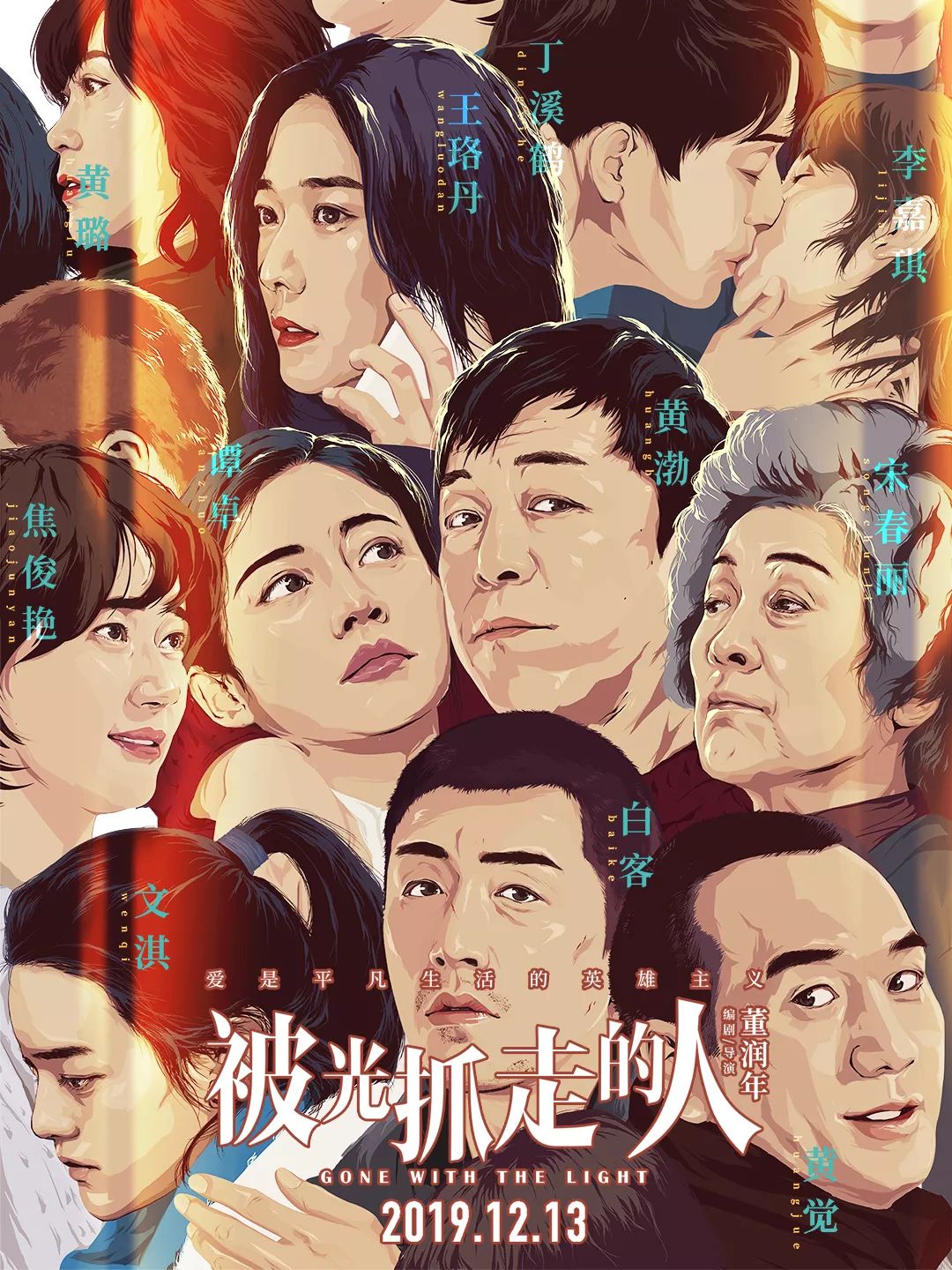
Gone with the Light (被光抓走的人, Dong Runnian, 2019)

What is love, and in the end does it really matter? It’s a question the mostly middle-aged couples of Gone with the Light (被光抓走的人, Bèi Guāng Zhuāzǒu de Rén) who perhaps assumed they were past such existential questioning find themselves contemplating after an unprecedented event causes the disappearance of seemingly random people from all over the world giving rise to the rumour that those taken were those truly in love. But if that’s so, what does it mean for the overwhelming majority left behind, suddenly lonely and uncertain wondering if they’ve been spared or judged and found wanting for their lack of emotional fulfilment. 

At 10am one spring morning, a brief flash of light creates a slight temporal disturbance causing a small percentage of the population to simply vanish. No one knows what happened or where they’ve gone, but the connection is later made that many seem to have been taken in pairs giving rise to the theory that the disappeared are the only true lovers. This is a minor problem for some of the left behind who have lost spouses twice over, not only literally but emotionally in realising that their loved one was in real, deep love with someone else. Meanwhile, those not taken begin to wonder why, questioning the validity of their relationships, doubting that their loved ones really love them but not quite daring to ask the same question in reverse. 

Dong opens the film with a vox pop session questioning several people about the nature of love, some of whom we’ll get to know better and others not. Our hero, school teacher, Wenxue (Huang Bo), unconvincingly claims that he does not put any stock in the admittedly unscientific theory that only true lovers were taken and that the rumours have not affected him or his wife but as we later see they have profoundly unsettled his unexceptional, middle-class family life which was at least superficially happy or perhaps merely unhappy in the most ordinary of ways. Before the light, we see him annoy his wife by waking her up smoking in bed before they have perfunctory, routine sex over which they discuss Wenxue’s hopes for promotion and whether or not it’s appropriate to schmooze with the headmaster to smooth the path. The fact they weren’t chosen eventually becomes a kind of embarrassment, the promotion going to a man whose wife disappeared on him for the slightly strange reason that being betrayed in love somehow grants him the moral high ground. Wenxue, like many, goes to great lengths to excuse himself, getting a fixer to photoshop pictures of his wife along with train tickets to make out she was in another town when the light descended.

Meanwhile, Li Nan (Wang Luodan), a woman who was in the middle of trying to divorce her husband when the light struck finds herself accosted by his mistress (Huang Lu) demanding to know where he is seeing as he did not ascend with her. The obvious conclusion is that he had another woman, but the quest forces each of them to reassess their true feelings towards the missing man, the mistress desperate to prove she wasn’t just an “adulteress” but a woman in love, and the wife that she really is ready to let him go. A young woman (Li Jiaqi) who threatened to commit suicide by jumping off a roof when her parents tried to stop her marrying her boyfriend (Ding Xihe) suddenly doubts her feelings when her parents disappear together while she and the man she thought she loved are left behind. A petty thug (Bai-ke), in the only subtle implication of a same sex love, becomes obsessed with the idea that his friend has been murdered by a TV presenter who had been bothering him and his death has been covered up to look like one of the disappearances, perhaps again hoping to find evidence against a romantic rejection. 

Talking to another man in a similar situation Wenxue is given a dressing-down, reminded that he’s been extremely self-involved and that the problems he’s now able to see in his marriage thanks to the light were there all along, only now he’s refusing to face them in a much more direct way. He couldn’t or chose not to see that his wife was lonely and filled with despair while flirting with an equally lonely woman at work. His confrontation with her provokes his only real moment of emotional reckoning as they each reflect on the fantasy of romance and its capacity to dissipate when realised. Walking in on his teenage daughter getting dumped for the first time he’s perhaps in the best position to offer advice, even if it’s of the fairly prosaic kind to the effect that she’ll get over it in time. “Your lies make me ashamed” she’d fired back at her parents’ middle-aged hypocrisy, a very ordinary marriage in which perhaps the “love” has gone, in one sense, but equally might be succeeded by something else. “It’s alright, you will know it in the future” Wenxue tells his heartbroken daughter but might as well be talking to himself, beginning to feel the love after love in conceding that perhaps this is what “love” is rather than any kind of “rapture” literal or otherwise. A beautifully pitched meditation on the consequences of love, the madness, violence, and loss, Gone with the Light finds its release in stillness and a gentle contemplation of that which remains when everything else is burned away. 


Gone with the Light streamed as part of this year’s New York Asian Film Festival.

Original trailer (Simplified Chinese subtitles only)