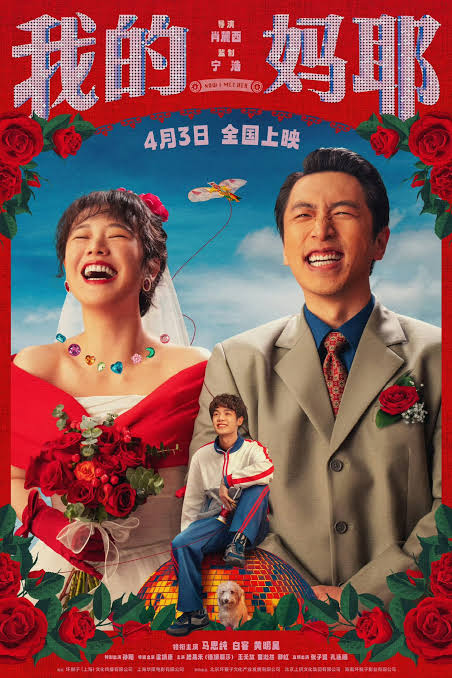
Now I Met Her (我的妈耶, Xiao Luxi, 2026)

Another in the recent trend of filiality-themed dramas such as Hi, Mom and Give Me Five, Xiao Luxi’s heartwarming comedy Now I Met Her (我的妈耶, wǒ de mā ye) is essentially a coming of age tale in which the hero confronts the lingering trauma of his mother’s death in childbirth after being presented with her diary on his 18th birthday. Paradoxically, it also taps into a sense of nostalgia among those of the parents’ generation for the bygone days of China from the 1980s to early 2000s, yet without engaging in any sort of critique or mention of the wider social issues besides youthful poverty and the rise of cross-border smuggling in the late 90s.

Though Eleven Zhang’s (Huang Minghao) doting father Xue (Bai Ke) still talks to his late mother Dongyu’s (Ma Sichun) portrait on the altar, Eleven often says things to the effect of not having a mother at all seeing as he never knew her. In some ways, he’s been reminded of her every day, though these are sometimes negative associations such as his curly hair for which he was made fun of as a child. Meanwhile, as a teenage boy, Eleven is also a little resentful of his father and wants to separate himself further from the familial domestic environment and achieve greater independence. Xue, too, seems to think this might be the time for change, irritated that Eleven doesn’t really want to have a birthday dinner with him, but equally suggesting that maybe they should try somewhere new rather than going to McDonald’s as usual, acknowledging that Eleven has probably outgrown this tradition.

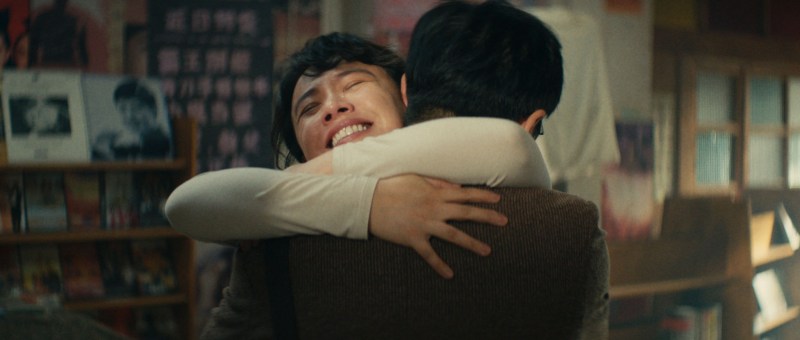
More or less forced to read his mother’s diaries which are pressed on him by some sort of spiritual power, Eleven finally has to acknowledge that he did have mother who lived a whole life before he was born, though what’s actually written is a chronicle of three periods of romance. In the first, she’s Eleven’s age, and develops a crush on a classmate who dreams of dancing glory. Because hers is a selfless love, she helps him win a dance competition knowing that if he does he’ll get the opportunity to study in Shenzhen and leave her behind. Next, she’s a university student in Guangzhou who embarks on a serous relationship with a waiter who saves her from a creep in a karaoke bar, but the pair have no money and the guy eventually turns to desperate measures in order to try and provide a more comfortable life for her. Later she marries Xue after connecting with him at her office job and returns to her hometown after her mother has a stroke to open a restaurant.

Xue’s special gift to his son is the last of the diaries which detail the time between Dongyu’s early pregnancy and her death, keying Eleven in to the sacrifice his mother willing made for him which allows him to overcome his feelings of abandonment in knowing that he was loved and wanted. Nevertheless, the vision of his mother in the diaries is perhaps somewhat idealised and partially of his own creation. What she eventually becomes is a figure of maternal sacrifice. Nevertheless, the diaries also allow Eleven to reacher a greater understanding of his father that would otherwise perhaps take a little longer to arrive, learning to appreciate the love and devotion Xue had for his late wife and their family while raising his with the help of his own mother.

It seems in a way that Dongyu may have her own issues with abandonment in her memories of her father, apparently ending up marrying a man much like him but one who was at least able to turn his life around and devote himself to his family. Though it might actually be Eleven’s vision rather than Dongyu’s, there is something quite poignant in seeing her live out the rest of her life in her last eleven minutes while encouraging a future Eleven to live to the fullest and be happy rather than dwelling on the past. In any case, in getting to “meet” his mother through her diaries, he realises that his parents had whole lives, or maybe several of them, that he never knew about, but equally that he did coexist with each of them no matter how briefly while his father is still here with him in the present day. Painting a warm and fuzzy vision of China in the late 20th and early 21st century, Xiao’s cineliterate first feature is a loving tribute to maternal devotion and the enduring nature of familial bonds.


Now I Met Her screened as part of this year’s San Diego Asian Film Festival.

Trailer (English subtitles)
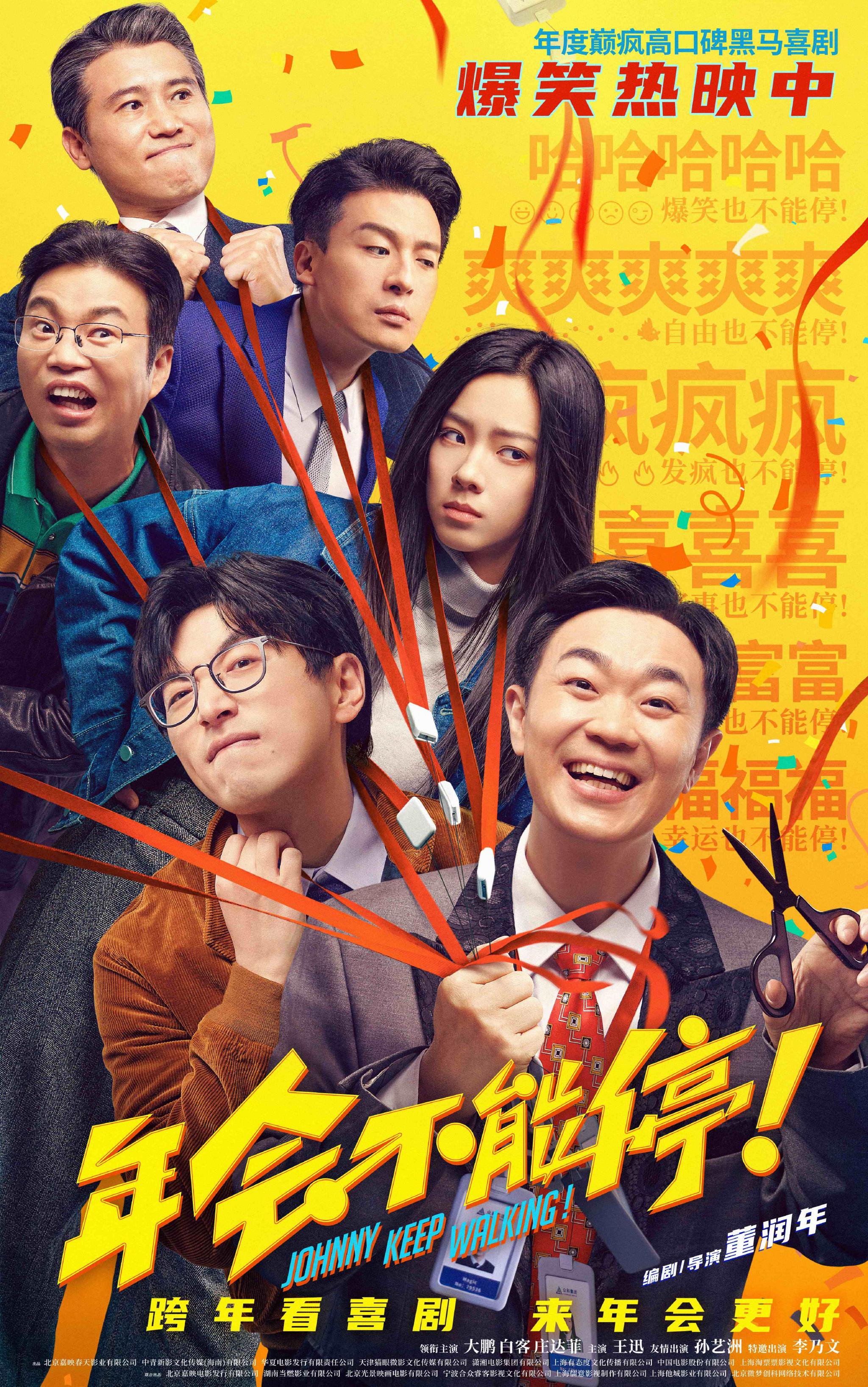
Johnny Keep Walking! (年会不能停!, Dong Runnian, 2024)

A satirical morality tale, Dong Runnian’s incredibly witty comedy Johnny Keep Walking! (niánhuì bùnéng tíng) sees a bumpkinish middle-aged factory worker still filled with an idealism that seems outdated even in the late 90s transferred into a lion’s den of corporate greed and dubious morality while ultimately expressing the younger generation’s increasing dissatisfaction with the inherent unfairness of corporate life in modern China. Ironically turning Tom Chang’s 1988 hit My Future is Not A Dream into a rallying cry from disillusioned youth, the film nevertheless places its faith in the moral generosity of a fat cat factory owner who struck gold in the nation’s 90s reforms but has largely forgotten those who helped him get there.

Key among them would be Jianlin (Da Peng) whom we first see trying to fix the disco ball at the factory’s 1998 gala and being asked to sing a song instead. 20 years pass with Jianlin still living the life of a model factory worker stuck on the same old salary while applying to perform in the company’s annual gala has become his only joy in life. Meanwhile, the factory owner has gone on to head an increasingly powerful multi-national company leaving Jianlin and those like him far behind deprived of the successes that the modern China has to offer. 

This is in part a paean for those left behind by the economic reforms of the 1990s which saw the end of the old factory system with mass unemployment and displacement amid frequent plant closures. Jianlin’s is still open, but devoid of the sense of comaradie that mark the opening scenes. His scheming floor manager, Zhangzi is trying to engineer a transfer to head office so that his son could attend a better school in the city and has been helping a series of corporate lackeys defraud the company, in addition to paying a direct bribe, in return for a job offer. A drunken mix up by office party boy Peter (Sun Yizhou) results in Jianlin being hired instead in a shock move that proves inexplicable to all. 

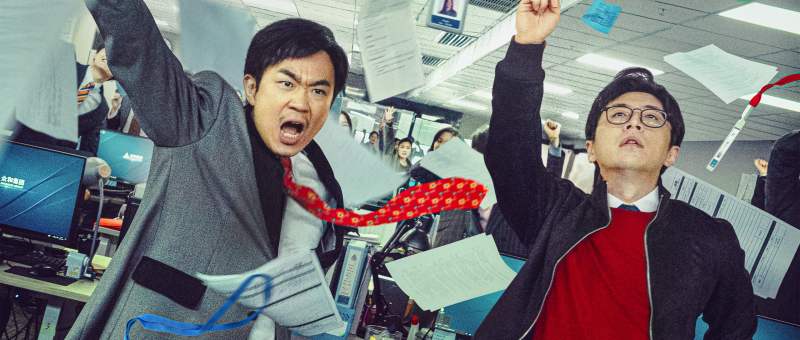
Jianlin is such an innocent that he thinks the reason he’s been given a huge promotion is because he was employee of the year for 12 years straight and the company probably want to send a message to the youngsters that hard work really will be rewarded. Of course, the opposite is true. HR manager Magic (Bai-Ke) quickly spots the mistake but is prevented from fixing it because it would get them all into trouble, and while it’s obvious to most people that Jianlin has no idea what he’s doing they choose to say nothing because they assume he must be a nepotism hire and they want to stay in the boss’ good books. Everyone at the company uses an English name with Jianlin rechristened “Johnny” though he understands no English and struggles with Chinese business jargon having no idea what people mean when they go on about “aligning the details”. Charged with firing someone under the company’s radical new “optimisation” programme, he takes the word at face value and gives them a promotion and a raise instead.

In fact, much of the film is him muddling along like typical middle-manager promoted beyond his abilities. He’s advised that good management is all about setting employees against each other so they forget about resenting you while basically delegating all your tasks to your subordinates who will be only too happy to help in order to curry favour. Slowly corrupted, Jianlin beings to play along, taking all the perks of corporate success while signing documents he couldn’t understand even if he actually read them.

Nevertheless, he develops a kind of team spirit with Magic, a man stuck in a mid-career rut because of his lack of skill at office politics, and Penny temp whose perpetually kept on the hook rather than being given full employee status so that the company can exploit her more. Penny also suffers sexual harassment at the hands of the party happy Peter with Jianlin getting her out of a sticky situation by telling her to finish a report and drinking with Peter himself. Together, and with the assistance of the workers at the factory and others about to be unceremoniously fired as part of the cost cutting enterprise, they attempt to expose corporate corruption and stage a protest against unfair working practices but the only saviour they have to turn to is the company president strongly suggesting a return to the old factory days which, it is implied, were much more wholesome and innocent. In any case, justice eventually wins out with the good rewarded and the bad getting their just desserts though it doesn’t do too much to tackle the inherent and quite ironic rottenness of the system in which the worker has been reduced to a mere tool to be used and discarded by a faceless and uncaring corporate entity. 


International trailer (English subtitles)

My Future is not a Dream (Tom Chang)