Full Strike (全力扣殺, Derek Kwok & Henri Wong, 2015)

A former badminton champ begins to rediscover herself after being permanently banned for bullying behaviour when charged with coaching a bunch of former bank robbers in Derek Kwok & Henri Wong’s zany sports comedy Full Strike (全力扣殺). Dedicated to “all the beautiful losers”, the film is less about literal winning as it is about learning to turn one’s life around in moments of profound despair and draw strength from even non-literal victories in simply refusing to be looked down or belittled.

It’s ironic in a sense that Dan (Ekin Cheng Yee-Kin), Kun (Wilfred Lau Ho-Lung), and Chiu (Edmond Leung Hon-Man) became bank robbers because they didn’t want to be bullied having grown up as friendless orphans. Former badminton champ Kau Sau (Josie Ho Chiu-Yee), meanwhile, was such as tyrannical diva that she gained the nickname “The Beast” before being banned because of her unsportsmanlike behaviour and treatment of her long-suffering assistant. But cast out of the sports world, she’s become a dejected layabout not quite working in her brother’s restaurant and otherwise hiding out from the world. Her life changes when she’s publicly mocked after running into her former assistant who has since gone to take her position as a reigning champion. Running out into the night, she spots a shuttle-cock-shaped meteor and is chased to a badminton club by what she assumes is an “alien” but might have just been a frightened homeless man.

In any case, she takes it as a sign she should pick up a racket once again which as Dan later points out she probably wanted to do anyway and was just waiting for an excuse. He can’t explain why he chose the unlikely path of becoming a badminton player to help him turn over a new leaf after leaving prison but reflects that perhaps you don’t really need a reason only the desire to change. Dan, Kun, and Chiu all developed disabilities as a result of their life of crime but slowly discover that they can actually help them on the court in a literal process of making the most of their life experiences no matter how negative they might have assumed them to be while Kau Sau similarly regains her self esteem while acknowledging the destructive patterns of her previous behaviour careful never to bully her new teammates as they all square off against her bullying cousin “nipple sucking Cheung” (Ronald Cheng Chung-Kei) who tries to use his newfound wealth to cover up a lack of skill by hiring Kau Sau’s old teammate. 

Cheung is also trying to overcome low self-esteem and is later forced to realise that becoming a champion won’t really change that much about how he sees himself, though apparently still relying on an ever capable middle-aged woman to fight (literally) his battles for him. Meanwhile, the gang are coopted by a media mogul hoping to make an inspirational documentary about them but also manipulating their lives and hyper fixating on their criminal pasts to the point of staging a fake arrest as they enter the stadium for a competition. Doubting the chances of success in setting up new lives for themselves as badminton players, Chiu is drawn back towards a life of crime while feeling somewhat distanced from the team as a tentative romance between Kau Sau and Dan seems to fall otherwise flat.

A throwback to classic mou lei tau nonsense comedy, the zany gags come thick and fast but are at times over reliant on low humour while the central premise of staking everything on an “unexciting” game like badminton perhaps wears a little thin by the time it gets to the high stakes finale with the heroes fighting twin battles squaring off against their traumatic pasts rather than the literal opponents in front of them. Winning becomes a kind of irrelevance when the contest was within the self. Each rediscovering the spark of life, the players rediscover the will to live while bonding as a team and sticking to their training in pursuit of their goal. Kwok and Wong lay it on a little thick with the martial arts parody in the uphill battle to master badminton but otherwise lend a poignant sense of warmth and genuine goodwill in sympathy with the underdogs’ quest if not quite to win then to own their loserdom on their on terms in reclaiming their self-respect and dignity. 


Full Strike is available to stream in the UK until 30th June as part of this year’s Odyssey: A Chinese Cinema Season.

Original trailer (Traditional Chinese / English subtitles)
Sugar Street Studio (糖街製片廠, Sunny Lau, 2021)

“People have always been scarier than ghosts” according to the hero of Sunny Lau’s retro horror comedy, Sugar Street Studio (糖街製片廠). He is not in a sense wrong, the gang of down on their luck filmmakers unexpectedly uncovering a minor historical injustice while operating an “authentic” haunted house, and while the ghosts may be scary they are merely attempting to connect and right an old wrong. Filled with cynical humour, Lau’s witty screenplay is often disparaging of the contemporary Hong Kong film industry and an increasingly cutthroat society but finds unexpected pathos in the romantic tragedy at its centre. 

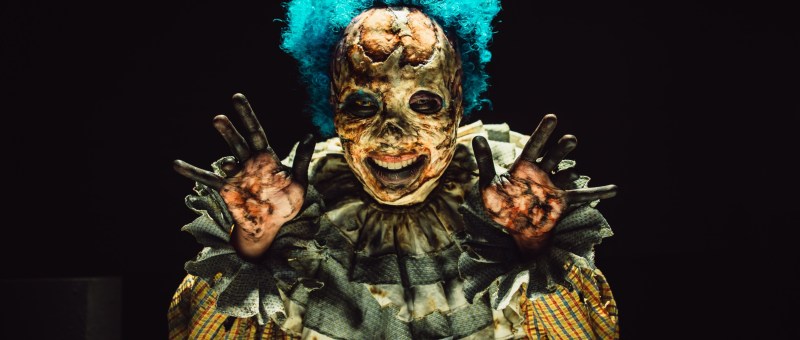
As the film opens, fast talking producer Pierre (Matt Chow Hoi-Kwong) has been hauled in front of mob boss Choi (Eric Kot Man-fai) who wants to know what the holdup is on their mutual film project. Boss Choi meanwhile has another problem in that the hotpot restaurant he’s just bought isn’t doing so well owing to the place being haunted. Ever enterprising Pierre comes up with a new idea: opening an “authentic” haunted house on the same site featuring real ghosts while shooting a movie in the same location. Getting the green light, Pierre enlists prosthetics guy Gary (Yatho Wong) to design the interiors for a horror show inspired by the real life studio fire of 30-years previously supposedly started by a clown in resentment after being turned down by the leading lady. 

Hoping to get more information, the guys talk to surviving actor Uncle Cheong (Chan Kwok-pong) who spins them a tale of his own heroism, claiming that he tried to intervene when the clown attacked his girlfriend and co-star but had to step out only to return after getting a pager message about the fire and attempt to save what lives he could. Perhaps unexpectedly, Cheong is all for their haunted house endeavour even making an appearance on opening night, but the gang can’t help but feel there must be more to this strange tale of arson and revenge. 

Mildmannered in the extreme, Gary finds himself conflicted in running Pierre’s unusual enterprise, wondering if it’s corrupting him or then again “Maybe to survive in Hong Kong, being mean is a basic necessity”. “Conning people diligently in Hong Kong is the path to success”, according to his friend even as they ironically prepare to open their “authentic” haunted house where encounters with “real” ghosts quickly find an audience who believe screaming in supernatural terror has therapeutic effects that can ease the depression and anxiety they feel as young people in contemporary Hong Kong. 

Pierre sells the haunted house idea partly on the strength that no one makes horror movies anymore because, famously, you can’t sell them on the Mainland and so co-productions aren’t interested. He describes Gary as the “tumour that’s killing the Hong Kong film industry” while constantly talking a big game, like a stereotypical producer willing to say everything and everything in order to get ahead, even hobnobbing with triads. “Hong Kong Cinema is all about discipline” he ironically claims despite being massively behind on all his projects, giving Gary a dressing down for being a few days late with his designs. 

“Some things don’t need to be completely understood” a zany medium claims, somewhat duplicitously, but it’s not until their own encounter with the ghost that the gang start to pick up on the dark legacy of the studio fire making use, possibly, of an unfair prejudice against clowns to sell the idea of a madman killer driven insane by lust and resentment towards a woman who had rejected him. What they discover is a sad tale of frustrated love, wounded male ego, and bitter regret that has perhaps manifested itself as a deeply held grudge as the guilty party holds on to their guilt and shame despite themselves. “It’s never too late to turn back” the villain is cautioned by a now elderly shaman, but in some ways it is, especially if you’ve already donned the clown suit of vicarious violence, “all debts must be paid”.  

Making the most of its whimsical premise, the increasingly surreal tale doesn’t skimp on the horror imagery with its scarred ghosts and scary clowns but also harks back to the horror comedies of old with its sutras and seals as the gang attempt to solve the mystery and right a historical injustice. Filled with amusing meta references to the contemporary Hong Kong film industry, ironic satire, and absurdist gags Lau’s charmingly off the wall comedy has only sympathy for its lovelorn ghosts of a bygone era and the hapless film crew attempting to navigate the vagaries of an often absurd industry.


Sugar Street Studio streams worldwide until 2nd July as part of this year’s hybrid edition Udine Far East Film Festival.

Original trailer (English subtitles)