
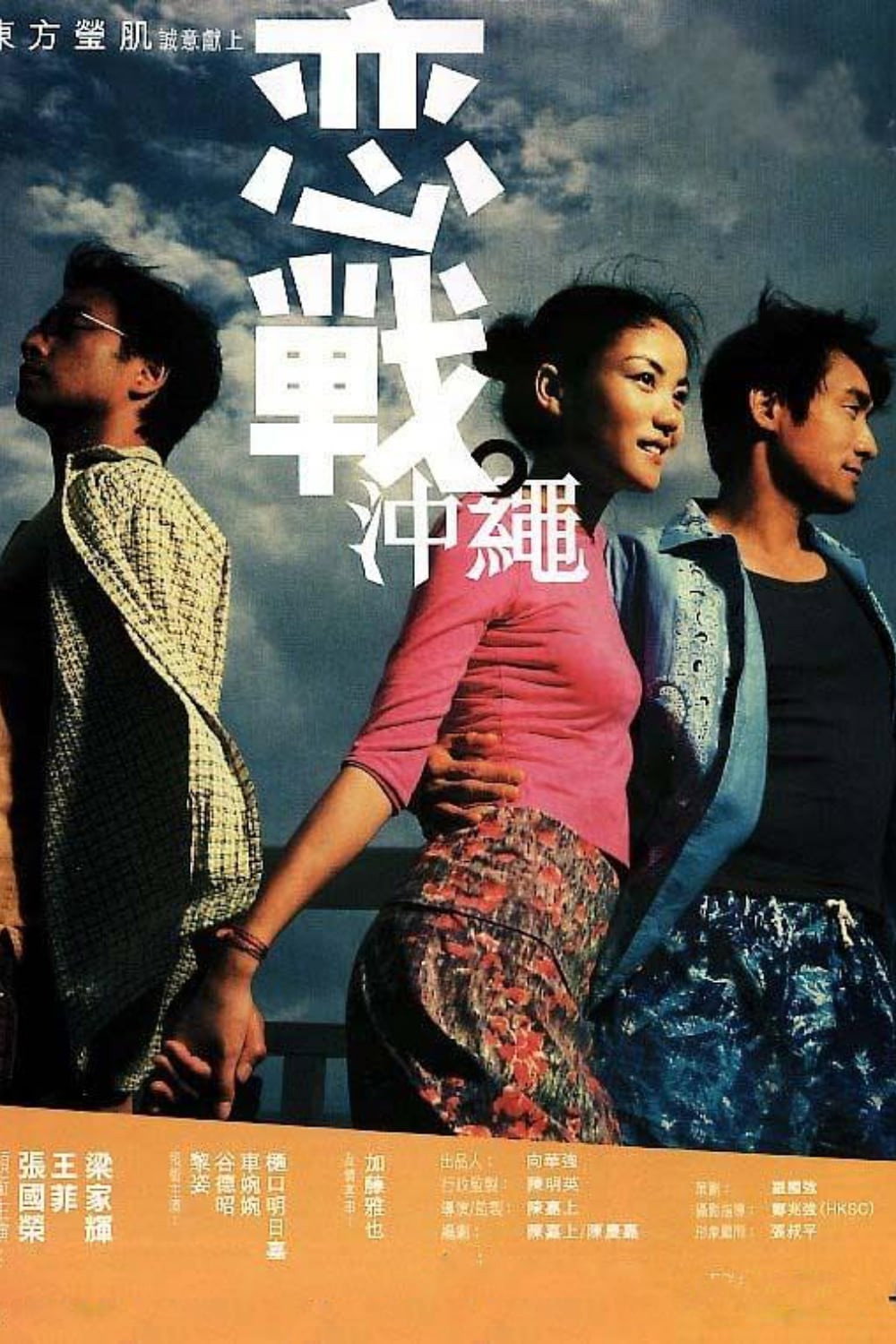
Okinawa Rendez-vous (戀戰沖繩, Gordon Chan, 2000)

Romantic confusion ensues when a collection of Hong Kongers and Japanese gangsters meet in Okinawa in Gordon Chan’s breezy rom-com Okinawa Rendez-vous (戀戰沖繩). Set in the picturesque environment of a seaside resort, the film takes on the trappings of a heist caper but is really about misdirected romanic attraction brokered by some missing money and more than a few acts of wilful deception as master thief and mailroom cop become locked in a game of cat and mouse.

Hong Kong cop Dat (Tony Leung Ka-fai) is on holiday in Okinawa with his girlfriend Sandy (Gigi Lai Chi) whom he plans to break up with and her friend Cookie (Stephanie Che) whom he hates. His trip is brightened when he spots Jimmy (Leslie Cheung Kwok-wing), a master thief he remembers from his police files but is not actually wanted for anything right at this moment. Meanwhile, Jimmy is in Okinawa trying to blackmail a yakuza by threatening to expose his diary. The yakuza, Sato (Masaya Kato), was all set to pay him, but his Hong Kong girlfriend, Jenny (Faye Wong), runs off with the money and beings living a simple life working at a seaside bar while living with the owner (Asuka Higuchi) who is so obsessed with Hong Kong hitman movies that she’s picked up fluent Cantonese through osmosis. Dat takes a liking to Jenny while using her in his plot to catch Jimmy through entrapment by plotting to a rob local bank, while Sandy draws closer to Sato who cared less about getting the money back than he did about Jenny but is learning to let go of both of them.

Apparently on a tight deadline, Chan assembled the cast in Okinawa with only a vague plot outline and no script hoping to improvise the rest. The main thread is the competition between Jimmy and Dat for the affections of Jenny, along with the obvious contrasts between the cop and the thief. Ironically named “Mr. Law”, policeman Dat is not especially sympathetic and seemingly oblivious to the fact that he is actually involved in plotting a robbery that would take him down as well Jimmy if actually went ahead. For reasons best known to himself, he’s brought his girlfriend on holiday with the idea of breaking up with her, which seems like an awkward scenario begin with, but perhaps sped up by his attraction to Jenny whom he mistakenly assumes to be some kind of pure woman at the centre of intrigue rather than a thief herself.

Jenny tells Sato that she just fell out of love with him and was looking for an exit, while Dat also says something similar about his relationship with Sandy, hinting at the transient nature of love and along with it its meaninglessness. Nevertheless, even as playboy Jimmy strings along other local women and pretends he’s only interested in conquest, he seems to develop genuine feelings for Jenny while she strings Dat along and uses both men to protect her money but is secretly trying to help Jimmy. After being dumped by Dat with a plagiarised poem he probably gives to all his girlfriends, Sandy finds love with Sato and plans to stay in Okinawa, while romance may be blossoming between Cookie and Dat and Jimmy’s right-hand man takes up with the recently dumped bar owner who finally gets the Hong Kong “killer” she’d always dreamed of.

Which is all to say that Dat was right when he said that life is unpredictable, but maybe that’s not such a bad thing. Despite the potentially dangerous nature of this situation, no one ends up getting (physically) hurt, and everyone eventually finds their way to where they’re supposed to be, positioned for maximum happiness. Making the most of its picturesque Okinawa setting, the film, in the end, comes down on the side of love. The stolen money is reduced to a MacGuffin, while the blackmail and entrapment plots fall by the wayside as each begins to discover new and unexpected romantic possibilities in this otherwise transient place. Light, breezy, and filled with gentle humour, there is, however, a genuine sense of poignancy in the final scene as the lovelorn Jimmy discovers his romantic destiny just might work out after all.


Trailer (no subtitles)

Full Strike (全力扣殺, Derek Kwok & Henri Wong, 2015)

A former badminton champ begins to rediscover herself after being permanently banned for bullying behaviour when charged with coaching a bunch of former bank robbers in Derek Kwok & Henri Wong’s zany sports comedy Full Strike (全力扣殺). Dedicated to “all the beautiful losers”, the film is less about literal winning as it is about learning to turn one’s life around in moments of profound despair and draw strength from even non-literal victories in simply refusing to be looked down or belittled.

It’s ironic in a sense that Dan (Ekin Cheng Yee-Kin), Kun (Wilfred Lau Ho-Lung), and Chiu (Edmond Leung Hon-Man) became bank robbers because they didn’t want to be bullied having grown up as friendless orphans. Former badminton champ Kau Sau (Josie Ho Chiu-Yee), meanwhile, was such as tyrannical diva that she gained the nickname “The Beast” before being banned because of her unsportsmanlike behaviour and treatment of her long-suffering assistant. But cast out of the sports world, she’s become a dejected layabout not quite working in her brother’s restaurant and otherwise hiding out from the world. Her life changes when she’s publicly mocked after running into her former assistant who has since gone to take her position as a reigning champion. Running out into the night, she spots a shuttle-cock-shaped meteor and is chased to a badminton club by what she assumes is an “alien” but might have just been a frightened homeless man.

In any case, she takes it as a sign she should pick up a racket once again which as Dan later points out she probably wanted to do anyway and was just waiting for an excuse. He can’t explain why he chose the unlikely path of becoming a badminton player to help him turn over a new leaf after leaving prison but reflects that perhaps you don’t really need a reason only the desire to change. Dan, Kun, and Chiu all developed disabilities as a result of their life of crime but slowly discover that they can actually help them on the court in a literal process of making the most of their life experiences no matter how negative they might have assumed them to be while Kau Sau similarly regains her self esteem while acknowledging the destructive patterns of her previous behaviour careful never to bully her new teammates as they all square off against her bullying cousin “nipple sucking Cheung” (Ronald Cheng Chung-Kei) who tries to use his newfound wealth to cover up a lack of skill by hiring Kau Sau’s old teammate. 

Cheung is also trying to overcome low self-esteem and is later forced to realise that becoming a champion won’t really change that much about how he sees himself, though apparently still relying on an ever capable middle-aged woman to fight (literally) his battles for him. Meanwhile, the gang are coopted by a media mogul hoping to make an inspirational documentary about them but also manipulating their lives and hyper fixating on their criminal pasts to the point of staging a fake arrest as they enter the stadium for a competition. Doubting the chances of success in setting up new lives for themselves as badminton players, Chiu is drawn back towards a life of crime while feeling somewhat distanced from the team as a tentative romance between Kau Sau and Dan seems to fall otherwise flat.

A throwback to classic mou lei tau nonsense comedy, the zany gags come thick and fast but are at times over reliant on low humour while the central premise of staking everything on an “unexciting” game like badminton perhaps wears a little thin by the time it gets to the high stakes finale with the heroes fighting twin battles squaring off against their traumatic pasts rather than the literal opponents in front of them. Winning becomes a kind of irrelevance when the contest was within the self. Each rediscovering the spark of life, the players rediscover the will to live while bonding as a team and sticking to their training in pursuit of their goal. Kwok and Wong lay it on a little thick with the martial arts parody in the uphill battle to master badminton but otherwise lend a poignant sense of warmth and genuine goodwill in sympathy with the underdogs’ quest if not quite to win then to own their loserdom on their on terms in reclaiming their self-respect and dignity. 


Full Strike is available to stream in the UK until 30th June as part of this year’s Odyssey: A Chinese Cinema Season.

Original trailer (Traditional Chinese / English subtitles)

All U Need Is Love (總是有愛在隔離, Vincent Kok Tak-chiu, 2021)

All things considered, there are worse places to quarantine than a five star hotel especially if it’s free but then again forced proximity with those you love, or those you don’t, can prove emotionally difficult. An old school ensemble comedy, Vincent Kok’s All U Need Is Love (總是有愛在隔離) features a host of A-list stars each providing their talent for free in order to support the struggling Hong Kong film industry in the wake of the COVID-19 pandemic but as its name suggests eventually offers a small ray of hope that the enforced period of reflection may have fostered a spirit of mutual solidarity and personal growth. 

Kok opens, however, with a tense chase sequence as a shifty looking man runs from the authorities at the airport only to be picked up by the PPE-clad Epidemic Task Force who whisk him away to a secret location where he’s placed inside a weird bubble and interrogated by Louis Koo. Several more top HK stars including Gordon Lam fetch up in the bubble each implicating the Grande Hotel as the centre of of a coronavirus cluster at which point an order is given to place it under total lockdown requiring everyone inside to remain for a 14-day quarantine. 

Essentially a series of intersecting skits, Kok’s ramshackle drama nevertheless has its moments of satire as the hotel chief takes to the stairs for an inspirational speech in which he frequently slips into English and bizarrely likens himself to the captain of the Titanic because we all know how well that went. He spends the rest of the picture trying to escape without anyone noticing while his dejected security guard/brother tries to bump him off. Meanwhile, two gangsters develop a homoerotic bromance while plotting how best to profiteer off the pandemic through smuggling anti-COVID paraphernalia just as panic buying takes hold on the outside. 

Nevertheless, it can’t be denied that All U Need Is Love is also guilty of some rather old fashioned, sexist humour particularly in the antics of a pair of old men (Tony Leung Ka-Fai and Eric Tsang reprising their roles from Men Suddenly in Black) and their minions who misled their wives in order to embark on a sexual odyssey only to have their plans both improved and then ruined by the quarantine order. Meanwhile, a young couple who were in the hotel preparing for their wedding banquet ironically scheduled for the last day of the quarantine find themselves at loggerheads as the man gets cold feet over his fiancée’s bridezilla micromanaging, and her father undergoes a total makeover while continuously watching Japanese pornography in his room. 

Watching it all, a little girl, Cici, becomes the moral voice of the pandemic innocently hoping that nature will continue to heal itself even after the sickness ends. It’s she who shows the gangsters the error of their ways in pointing out that if they steal all the anti-COVID equipment then they will end up being more at risk because no one else is protected, while she also softens the heart of the hotel’s cynical manager to the point that he too makes a lengthy speech about becoming a better person thanks to his experiences during in the pandemic. 

During their enforced proximity friends and strangers have indeed needed to rediscover their love for their fellow man as they band together in mutual solidarity waiting for their freedom. Culminating in an oddly uplifting wedding decked out with balloons and messages from friends and family played via iPad, Kok’s anarchic ensemble farce does its best to discover a silver lining among the fear and anxiety of the pandemic as it ironically brings people together through driving them apart. Along with his A-list cast, Kok throws in a series of movie parodies and pop culture references from an impromptu rendition of Baby Shark to a surprise appearance from the Landlady from Kung Fu Hustle as well as a suitably random cameo from Jackie Chan. Repurposing the traditional Lunar New Year movie, All U Need is Love is a classic nonsense comedy designed to lighten the mood in these trying times while celebrating the essence of Hong Kong cinema through, arguably, its most idiosyncratic of genres. 


All U Need Is Love streamed as part of this year’s New York Asian Film Festival.

Original trailer (Traditional Chinese/English subtitles)