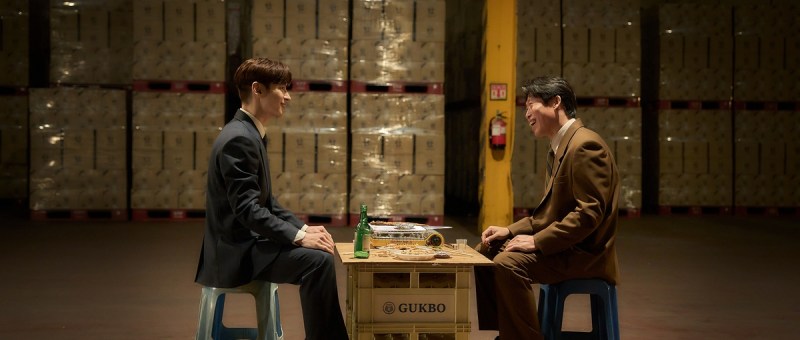
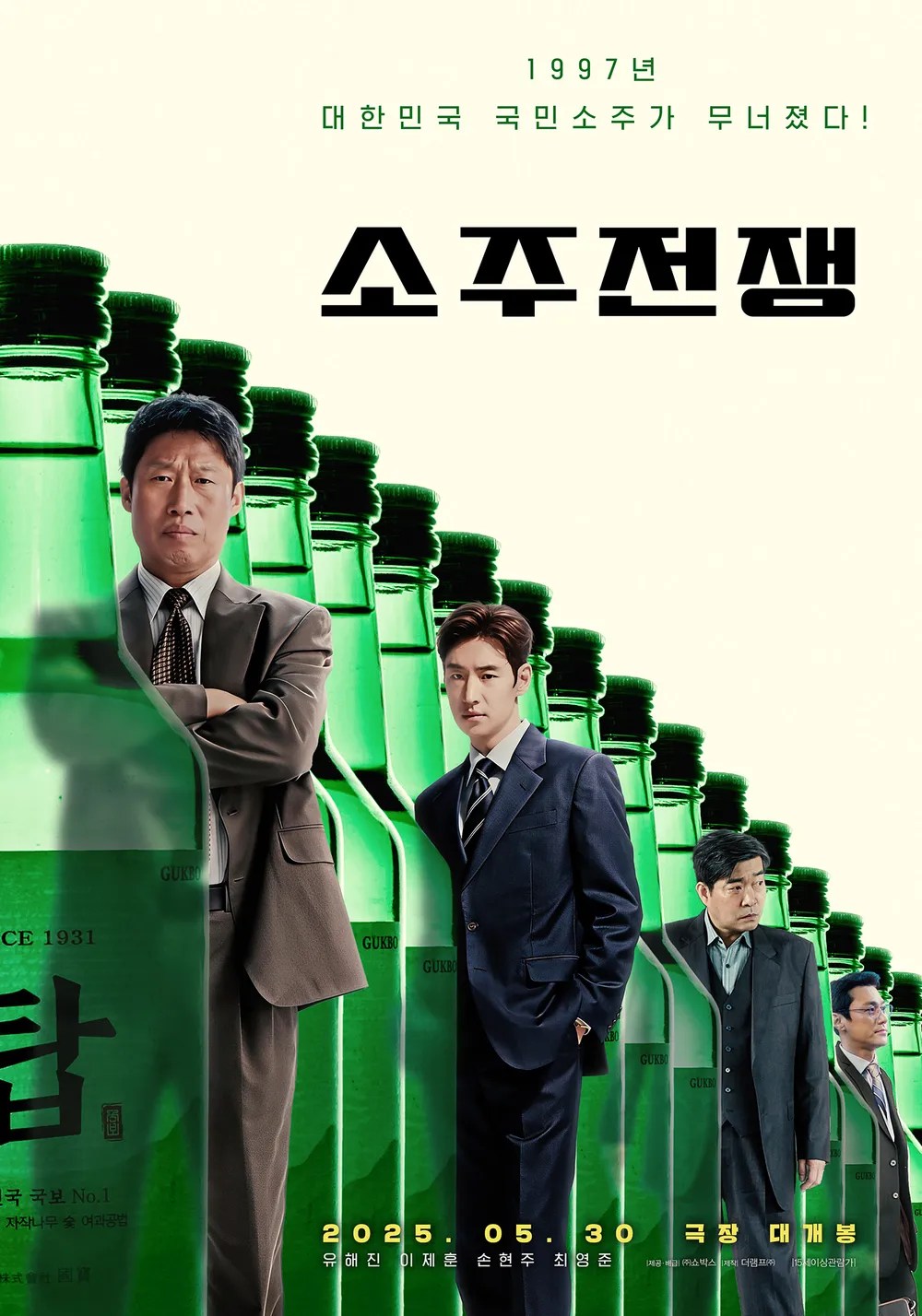
When Korea’s biggest Soju conglomerate, Gukbo, is on the verge of bankruptcy in the wake of the Asian financial crisis and the CEO’s mismanagement, it provokes a national outcry but also the attention of a hundred foreign firms all swarming over Korea like vultures eager to get a piece of the pie. Loosely based on a real life incident, Choi Yun-jin’s Big Deal (소주전쟁, Soju Jeonjaeng) is more evenhanded than one might expect at once decrying the amoral business practices of American corporate imperialism while pointing out that maybe things aren’t perfect in Korea either with its dynastic approach to company management and workaholic lifestyle that comes at the cost of familial bonds.
In fact it sort of implies that In-beom’s (Lee Je-hoon) desire to send Gukbo into bankruptcy so they can take it over and flip it is a kind of revenge against his own workaholic father who passed away 10 years previously, his death presumably hastened by stress and overwork though what In-beom resents more than anything else is that he was never really much of a father to him. That might be why Gukbo’s earnest financial officer Pyo (Yoo Hae-jin) comes to fill that role. In-beom complains that Pyo is stupid and naive, knowing nothing of how the world works, but also that his stupidity makes him feel like an arsehole because it forces him to realise that he’s doing something wrong.
Caught between In-beom whose firm, Solquin, are pretending to consult on the administration process but in reality feeding into to their subsidiary to buy up shares, and the CEO, Pyo is the only one thinking about what’s going to happen to all their employees when the place goes bust. Like In-beom’s father, Pyo is also a workaholic whose wife and daughter left him because he was never there. He remains dedicated to Gukbo, but not to the extent of breaking the rules, even if he eventually goes along with it when the CEO suggests a dodgy plan to undercut Solquin and maintain control of the company his father founded. What becomes apparent is that Seok (Son Hyun-joo) is out of his depth and that the only qualification he has is being the boss’ son. It’s his fault the company got into trouble because of his reckless expansion plans while he tries to cover up his failings through cronyism, playing golf with the great and the good while leaving Pyo to clean up the mess he’s made.
Nevertheless, for good or ill, Gukbo comes to represent a Korea preyed upon by venal foreign influence. When the plan is exposed, Pyo is sure that the creditors won’t agree to bankruptcy because they won’t be able to stand such a typically Korean business being placed into foreign hands. In-beom thinks that’s ridiculous and no one has that kind of patriotic attachment to a company, but it turns out he’s right and Solquin have an uphill battle in front of them. Yet even In-beom begins to tire of his colleagues’ underhandedness. Though there are a handful of women working at the American investment firm, the culture is extremely macho and misogynistic with liberal and frankly unprofessional use of the F-word as In-beom’s male colleagues make obnoxious jokes about who is getting their dick sucked by whom. Pyo and his team may drink too much, but at least they’re collegiate rather than adversarial.
The question is really whether as In-beom says making money is just that and can’t be either sleazy or noble, while Pyo definitely thinks there are right ways and wrong ways to earn. Solquin is definitely wrong, while Gukbo isn’t entirely right either. In-beom may have a point when he challenges his old-fashioned salaryman mentality of putting the company first every time, but the conclusion Pyo seems to come to is to let all go and just be yourself. That doesn’t mean you have to stoop to their dishonest ways of doing business, but equally it doesn’t mean you have to let them walk all over you either. Capitalism is an inherently corrupt system, but there’s not a lot either of them can do about that even if eventually meeting somewhere in the middle as Pyo loses his faith in chaebol culture and In-beom realises he’s just as disposable when his American bosses chew up him and spit him out as soon as he’s served his usefulness. A closing title reminds us we’re still dealing with a lot of these problems 20 years later with companies that are too big to fail and inadequate regulation though Pyo at least seems to have found a happy medium doing what he loves on his own terms.
Trailer (English subtitles)
Choi Yun-jin directed this film, but her name was later removed from the credits after being fired by the production company who accused her of misappropriating the script.

 Windows on Worlds