Shanghai Blues (上海之夜, Tsui Hark, 1984)

There’s a strange kind of melancholy optimism born of false courage and desperation that colours Tsui Hark’s Shanghai Blues (上海之夜). A clown soon to become a soldier tells a woman he meets in the dark under a bridge as the city burns and Shanghai falls to the Japanese to remember that they will win. 10 years later the wounded of that same war reassure each other that their time will come, they didn’t survive just to die here now seemingly cast out by the society they risked their lives to save.

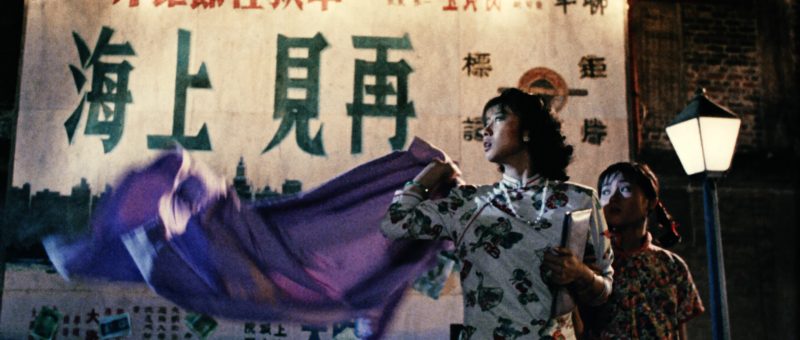
The Shanghai Stool (Sally Yeh Chian-Wen) arrives in is in a moment of euphoric liberation caught between cataclysmic revolutions with the civil war and eventual coming of the communists hovering on the horizon. A wide-eyed country girl, she’s almost lost amid the hustle and bustle of the city in which the motion never stops. Like many, she is immediately displaced on her arrival, discovering that the relatives with whom she hoped to stay are no longer at their address and she is therefore homeless and alone. The clown, Do-re-mi (Kenny Bee), now a member of a marching band unable to play his instrument, thinks she’s the girl from the bridge in part because she’s wearing the same outfit but mainly because she has the same short hair cut and so he follows but loses her. Meanwhile, she has a kind of meet cute with Shushu (Sylvia Chang Ai-Chia), now a jaded nightclub showgirl still pining for the clown, in which they each believe the other is trying to take their own life but end up becoming best friends and roommates unwittingly living directly below Do-re-mi. 

In this 30s-style screwball world, identities are always uncertain and often obscured by darkness or else the continual march of the crowd. Yet there’s a kind of romanticism in this act of seeing and not seeing. Only in darkness do Shushu and Do-re-mi finally recognise each other and when their romantic moment is interrupted by the end of a power cut, they smash the neon lights opposite to reclaim it as if to reject the intrusion of this glaring modernity. To that extent, the implication may be that this innocent kind of romantic connection can’t survive the bright lights of the big city or that light blinds as much as it illuminates. In several sequences, the characters inhabit the same space but cannot see each other while a nefarious thief lurks on the edges of the frame unseen by all. On realising that Do-re-mi is the clown/soldier for whom she’s been waiting for the last 10 years, Shushu knows that she will have to break her friend’s heart or her own and that Stool’s dream of a family of three is unrealisable amid the constant rootlessness of this transient city. 

To that extent, Stool is an echo of herself as the innocent young woman she was on meeting Do-re-mi under the bridge rather than the more cynical figure she’s become due to her experiences in the wartime city. In the film’s closing moments, Stool meets another version of herself in the form of a wide-eyed young woman in a plain dress who asks her if this is Shanghai but the only reply she can give is that she wishes her luck because for her Shanghai is now a city of heartbreak just it has been one of sadness and futility for Shushu. “I have one hope, if I give it to you I won’t have any,” Shushu tells her lovelorn boss as an expression of the despair that colours her existence in which the distant possibility of romantic fulfilment is all she has to live for. 

The fact that the lovers later flee Shanghai for Hong Kong seems to take on additional import as those in Hong Kong consider a similar trajectory with their own revolution looming while adding to the sense of continual displacement, disrupted communities, and worlds on the brink of eclipse. This Shanghai is a bleak place too with its lecherous gangsters and seedy businessmen but has a sense of warmth even amid its constant motion in its serendipitous meetings and friendships born of the desire for comfort and company in the face of so much hopelessness. In the end, perhaps romanticism is the only cure for futility just as the only thing to do in a world of chaos is to become a clown.


Shanghai Blues screens Nov. 13 as part of this year’s San Diego Asian Film Festival.
Merry Christmas (聖誕快樂, Clifton Ko Chi-Sum, 1984)

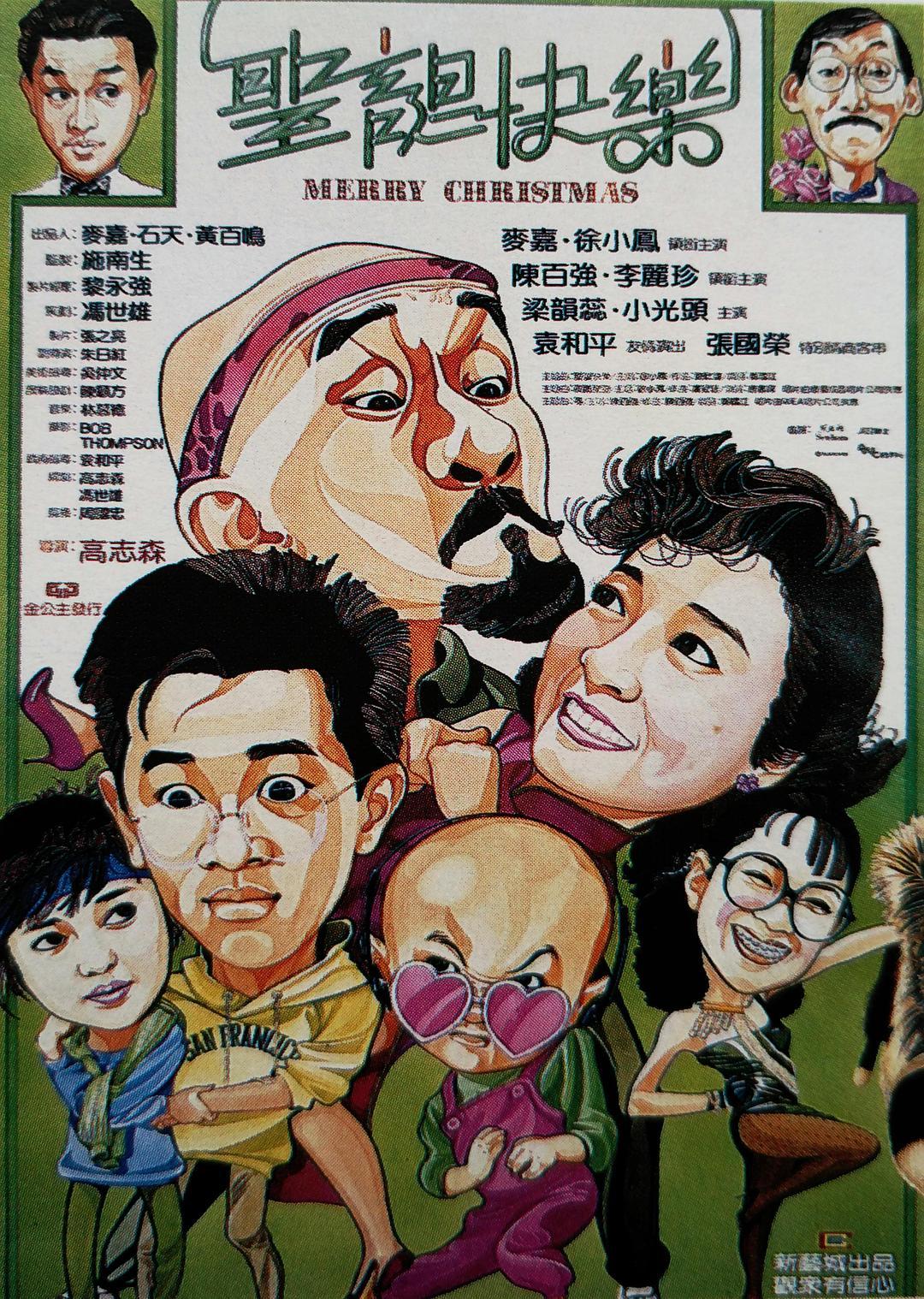
Merry Christmas poster 2The Lunar New Year movie solidified itself as a concept in the early ‘80s and is often an occasion for heartwarming silliness celebrating food and family. Arriving in 1984, Merry Christmas (聖誕快樂) shifts the zany action up to the Western festive season as a widowed Hong Kong dad struggles to express his feelings for the woman next-door who’s been looking after his young son while his two grown up kids contend with romantic troubles of their own in the rapidly developing city.

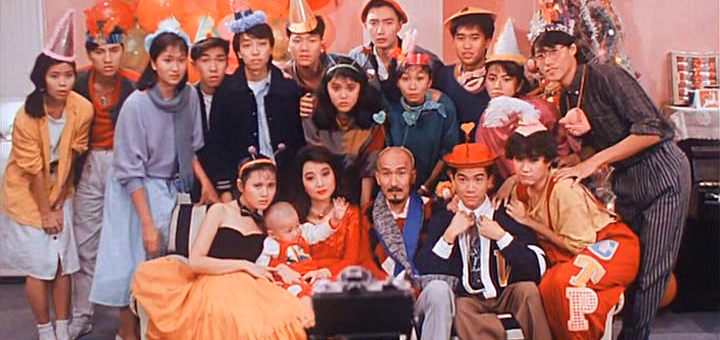
“Baldy” Mak (Karl Maka) is a newspaper editor who lost his wife some time ago. Though everyone else is getting into the holiday spirit, Baldy is celebrating his birthday which gives his goodnatured colleagues an excellent excuse to prank him and though it ends in him getting joke fired, it does eventually bring him a bonus and a new car. Meanwhile, he and the kids – earnest teenage son Danny (Danny Chan Bak-Keung) and aspiring model Jane (Rachel Lee Lai-Chun), are largely dependent on their neighbour, Aunty Paula (Paula Tsui Siu-Fung), for domestic assistance including looking after Baldy’s toddler son, Baldy Junior, while he’s out at work. Danny and Jane are hoping their dad will eventually ask Paula to marry him, but he remains diffident. Until, that is, she drops the bombshell that she might not be able to look after Junior anymore because she’s had a letter from her cousin in America (Yuen Wo-Ping) who wants to marry her and she’s thinking of emigrating to be with him.

Baldy, not a bad man but unafraid to resort to underhanded tactics, spends the rest of the picture avoiding telling Paula how he really feels in favour to trying to break up her possible romance with her cousin. An early joke sees him fighting for parking spaces in his beaten up car, something which eventually gets him into an argument with the good-looking yet similarly underhanded John (Leslie Cheung Kwok-Wing) who fakes a limp to get nearby bystanders to push Baldy’s car out of the way, causing Baldly to try and get his own back only for it to hilariously backfire. John, meanwhile, takes an instant liking to Baldy’s daughter Jane, which instantly gets Baldy on edge. A typically strict dad, he takes Danny aside to instruct him about how to get the best bang for his buck taking girls to the pictures, but is quick to warn Jane that no man can be trusted and she’s to be home by 10pm at the latest. Needless to say, it’s a moment of minor embarrassment for him when the guys at work are looking at tasteful glamour shots to include in the paper only to discover that Jane’s been earning a few extra pennies as a model.

The double standards only increase as Baldy and Danny hatch a plan to put Paula’s cousin off by convincing him she’s actually a sex worker and in debt to a sleazy pimp. Meanwhile, Baldy takes him out on the town to show him a few sights while setting up amusing tableaux that make him out to be a violent pervert, groping women, kissing men, and kicking little kids in the face. Paula, meanwhile, remains thoroughly fed up with Baldy’s antics, keeping her composure when he tries to make her jealous by dressing like a teenager and cosying up to Danny’s love interest “Jaws” (beautified by getting her braces taken off and wearing contacts), but asking her cousin to secretly record everything Baldy says to him on their weird “date” around Hong Kong.

Charming period details abound, like the “3D” adult movies Baldy rents (and inappropriately watches with Baldy Junior) which have to be watched with “sunglasses”, and Baldy’s constant inability to hail a cab coupled with his atrocious parking techniques and delightful pre-photoshop efforts to frame the cousin and then expose him with a slideshow lecture delivered solely for Paula’s benefit. Meanwhile, the festive spirit is ever present with the ubiquitous Christmas trees, Poinsettia forest outside Baldy’s door, and seasonal set piece at Paula’s nightclub. Delightfully silly, Merry Christmas is a zany holiday treat, a middle-aged rom-com in which a slightly ridiculous widower and a lonely nightclub singer discover the courage to fight for love thanks to a little Christmas magic and the fierce support of meddling family members.


Original trailer (no subtitles)