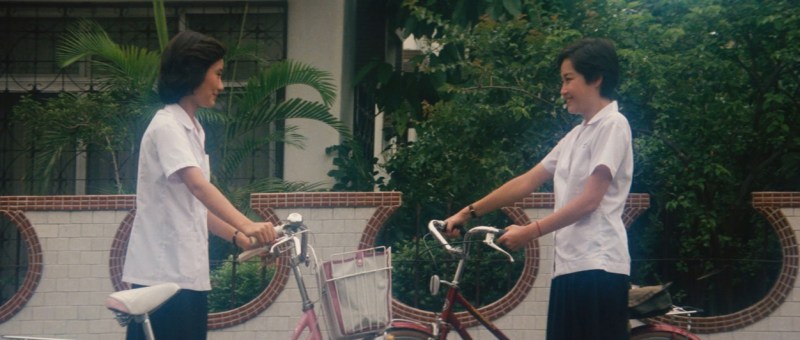
Girls’ School (女子學校, Mimi Lee, 1982)

The intense friendship between two young women is placed in jeopardy when a rumour begins to circulate that they are more than friends in Mimi Lee’s subversive 1982 drama Girls’ School (女子學校, nǚzǐ xuéxiào). The film’s educational framing may ensure that it can only reinforce the contemporary social codes of the repressive martial law era in insisting the two women must be guided back towards he “correct” path, but otherwise affords them a genuine sympathy that undercuts the sense of moral censure while simultaneously rooting the source conflict in the rejection and frustrated longing that provoke only pettiness and jealousy. 

Chia-Lin and Chih-Ting have been best friends all the way through school and are more or less inseparable but the transgressive intensity of their relationship has also isolated them from their classmates some of whom, such as Chun-Hsueh, feel rejected and excluded. Possibly with a high degree of projection, it’s Chun-Hsueh who first starts the rumour that the two young women are “lesbians” only later admitting to the teacher Mr. Mei, informed via a note from class monitor Yu-Liang who has a crush on him, that she doesn’t quite understand what the word means or what saying it might mean not only for Chia-Lin and Chih-Ting but for the other girls and indeed for the school’s reputation. In reprimanding her, Mr. Mei accuses Chun-Hsueh of casting a dark shadow over the hearts of her previously innocent classmates now corrupted with the ugliness not only of her lie but the topic of homosexuality which he and the rest of the educational body view as something shameful and taboo. 

Reminiscent of William Wyler’s The Children’s Hour, the reason the rumour takes hold may be that there is a grain of truth in it in the burgeoning feelings between the two women yet in keeping with the social attitudes of the time the main interest is in proving that it isn’t true with each keen to clear their name of such vicious slander while the other girls frequently describe them as “disgusting”. Even so, the unfairness of their separation and the obviously strong feelings between the two women cannot help but evoke sympathy while Chih-Ting, the bolder of the pair, continues to insist that they’ve done nothing wrong even as Chia-Lin is overwhelmed by the pressure all around them suggesting that they might be better to simply “keep our friendship in our hearts” shamed into repressing their true feelings by an oppressively judgmental society. 

Then again, the film also succumbs to a series of uncomfortable stereotypical tropes in rooting Chih-Ting’s potential lesbianism in her tomoboyishness having been raised by a single father and longing for maternal affection. Having been abandoned by her mother she also feels emotionally rejected by her father who has a gambling problem and rarely returns home while further rejection by Chia-Lin at the instigation of her sister who is also a teacher at their school herself nursing a broken heart after her longterm boyfriend married someone else leaves her feeling like a “monster”, constantly asking herself “what’s wrong with me?” while wondering why others treat her like a “poisonous sore”. This sense of rejection and frustrated longing is the primary motivator for the actions of all, Chun-Hsueh starting the rumour because she wanted to be included in the girls’ friendship and Yu-Liang reporting it because she wanted to curry favour with Mr. Mei after seeing him scrunch up and bin a love letter while quite obviously smitten with Chia-Lin’s sister Miss Yang. 

Mr. Mei is clearly in a difficult position and often trying to do the right thing, admitting to Chih-Ting that the teacher’s don’t know how to help them, but also somewhat insensitive while like others overly mindful of the school’s reputation rather than girls’ fragile emotions never quite considering that the intensity of their feelings and the pressure placed upon them could lead them to harm themselves or else endanger their mental health. It is then a little uncomfortable that the resolution lies in Chih-Ting who had previously professed to hate everyone except Chia-Lin undergoing a softening in which she becomes “more cheerful and mature”, eventually re-embraced by the same classmates who shunned her now satisfied the rumour isn’t true while Chih-Ting has quite literally sacrificed a part of herself to be accepted by a society whose acceptance she had been insistent was unnecessary. The starkness of her conversion along with the subversive quality of the melancholy love song which recurs throughout may attack the underlying homophobia in supporting the truth of the feelings between the two women but leaves them with little possibility for emotional authenticity in an overly conservative society. 


Girls’ School screened as part of Osaka Asian Film Festival 2022

Restoration trailer (Traditional Chinese / English subtitles)
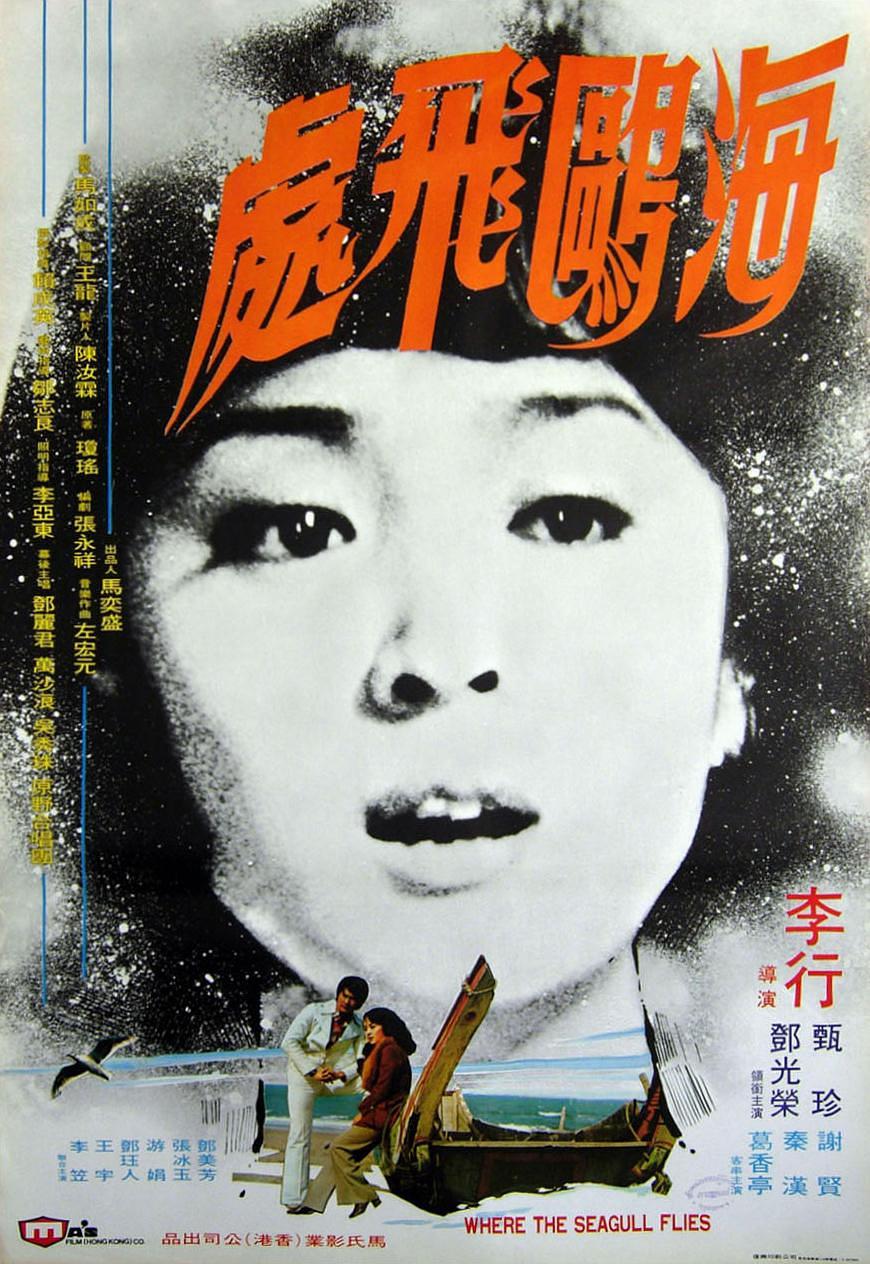
Where the Seagull Flies (海鷗飛處, Li Hsing, 1974)

Regarded as the “father of Taiwanese cinema”, Li Hsing was one of many who migrated from the Mainland during the Chinese civil war in 1949. Originally working as an actor, Li shifted into directing with the boom in Taiyupian Taiwanese language cinema in late ‘50s though he himself did not speak it, moving then into documentaries and finally self-financing the Mandarin language indie film Our Neighbors in 1963 becoming known for a particular brand of “healthy realism”. Despite this, however, the later part of the decade saw him enter into a long association with publishing phenomenon and romance writer Chiung Yao for a series of mainstream melodramas starring popular idols of the day. 

Chiung Yao’s novels are known for their depiction of relationships which are often in some way taboo as in Outside the Window the film adaptation of which launched the career of Brigitte Lin as a schoolgirl in love with her teacher. Li’s adaptation of Where the Seagull Flies (海鷗飛處, Hǎi’ōu Fēi Chǔ) by contrast erects barriers between the two lovers which are largely psychological as they struggle to overcome their pride, stubbornness, and fear of intimacy to embrace their love but also ambivalently engages with the changing nature of patriarchal society at once insisting its feisty heroine be softened in order to become a “good wife” while allowing her the agency her society denies her only by going abroad. 

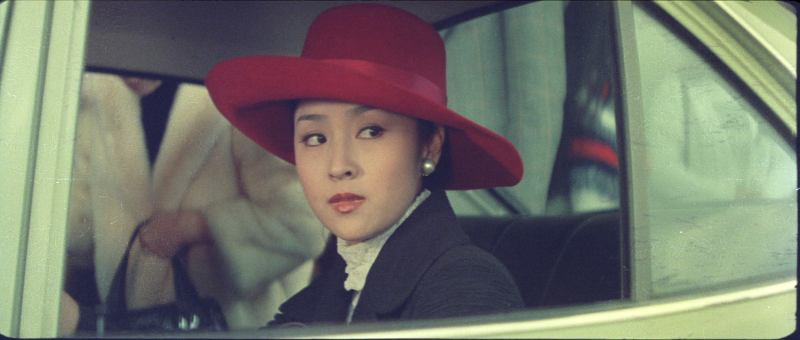
The hero, technically, is melancholy journalist Muhuai (Alan Tang Kwong-Wing) who encounters the heroine Yushang (Chen Chen) for the first time on a boat in Hong Kong where he saves her from committing suicide she later tells him, giving her name as “Seagull”, because she has just murdered her cheating husband by hitting him over the head with a wine bottle. Seagull disappears on him just as he’s trying to get through to the mistress to get her to check if the husband is really dead but he meets her again in Singapore where she gives her name as Ye Xin. Working as a nightclub singer she agrees to show him around the island, telling him that she’s originally from Manila and is supporting a troubled family. This time she doesn’t disappear but arrives too late to see off his plane at the airport. Disappointed that all his letters come back no such address, Muhuai is despondent and then extremely confused to meet the mysterious woman yet again as Yushang, a uni friend of his younger sister Mufeng (Tang Mei-Fang). 

Figuring out that all three women really are one and that Yushang is her “true” identity, Muhuai is extremely annoyed and decides to have his revenge by dating her until she falls in love with him and then ringing her to come out at 3am to tell her he was just having a bit of fun and never really loved her at all. The cause of all the drama is, at root, Muhuai’s male pride in that he resents being “deceived” by Yushang on their first two meetings during which she was essentially engaging in reckless role play as a break from her “boring” existence as a member of the new super rich elite (she can travel so freely because her father is a wealthy businessman who operates all over the world). Yushang, meanwhile, is being pushed towards an arranged marriage with her father’s business associate Shiche (Patrick Tse Yin) while attending college and falling in love with Muhuai. Each feeling spurned, their romance eventually turns dark with Yushang rebound marrying Shiche who turns out to be an abusive gold-digger. 

The barrier between herself and Muhuai then seems insurmountable. Believing she’s made her bed, Yushang quells her fiery, independent nature to conform to the image of the “good wife”, later literally beaten into submission by the cruel and manipulative Shiche. While it could be said that she’s being punished for her betrayal of love, it’s patriarchal social codes which eventually leave her trapped. Though her outwardly conventional mother had always been on her side, cautioning her to follow her heart rather than marry Shiche out of prideful self-destruction, she too thinks that her daughter should “be more like a woman, not a child. Feminine and tender”. When Yushang goes to her parents to suggest a divorce they reject the idea out of hand, refusing to believe that Shiche is really abusive, assuming that she is simply failing to adapt to married life in a refusal to accept her husband’s authority and is possibly realising she made a mistake while continuing to think of Muhuai. Yushang’s father eventually signals he may support her desire for a divorce if the marriage is unsalvageable but not if she’s merely leaving her husband for another man. 

Muhuai meanwhile has sunk into a depression, drowning his sorrows in drink and consumed by his sense of romantic impotence in having failed to fight for love while intensely resenting Yushang for making him feel this way. The barrier he has to overcome is male pride, getting over the literal inauthenticity of his relationships with the first two incarnations to realise that Yushang really is the one he loves no matter who else she might have been at various times in her life including Shiche’s wife. While the multi-country setting perhaps reflects a new globalising Taiwan as well as a rise in economic prosperity, Yushang’s globetrotting exploits are also an attempt to escape the patriarchal constrains of contemporary Taiwanese society, her “boring” life of continual ease and emotional emptiness where everyone is forever telling her that she has to be less, quieter, and above all obedient most particularly to men. 

Even so, the film too uncomfortably insists that Yushang’s feisty independence is “childish” and unfeminine while implying that her abusive relationship with Shiche turns her into a real woman capable of fulfilling her natural role as a housewife. Only by going abroad can she finally free herself of his control, and largely because he simply gets a better offer chasing an American oil heiress. It’s a minor irony that while Yushang’s problem is apparently her manly impulsivity both of her suitors are examples of male failure, Shiche in his laziness as a man who only wants to live off a rich woman rather than support himself, and Muhuai in his romantic diffidence too insecure to admit his love for Yushang. Nevertheless, Chiung Yao and Li Hsing are careful to leave the door open for love, refusing the possibility that it’s ever too late to fulfil one’s romantic destiny as the lovers each concede a movement towards the centre in finally finding the courage to open themselves to emotional authenticity. 


Where the Seagull Flies streams in the UK 21st to 27th September as part of the Taiwan Film Festival Edinburgh.

Trailer (English/Traditional Chinese subtitles)