Wolf Pack (狼群, Michael Chiang, 2022)

A disillusioned doctor quickly finds himself in over his head when he’s kidnapped by Chinese mercenaries in Michael Chiang’s oddly positioned action thriller, Wolf Pack (狼群, láng qún). Once again, the action takes place in a completely fictional Middle Eastern/Central Asian country with the mercenaries playing mysterious spy games in which their heartless amorality is at least heavily implied to be an affectation and that they are ultimately interested in “more than money” while covertly protecting Chinese interests abroad.

The film heavily implies that they are in fact in some way working for the Chinese authorities with a lengthy focus on the Chinese flag outside the place of government in this foreign nation given the unlikely name of Cooley (in fact, most of the names given for various people and places seem mildly inappropriate). The photograph sullen doctor Ke Tong (Aarif Rahman) carries around also features his father in a Chinese military uniform which might be why he is so reluctant to believe that he may also have been a member of this “private army” as his new boss Diao claims. Though Ke Tong is originally very hostile to Diao’s gang who have after all kidnapped him he later undergoes an entirely unexplained change of heart accepting that his father must have had his reasons for whatever he did so Diao is probably OK anyway. 

In any case, their current mission involves defending Chinese energy interests against a local warlord who is working with European businessmen to disrupt a gas deal by placing faulty regulators designed to engineer an explosion which will apparently domino all the way back to the Mainland. Largely kept in the dark, Ke Tong is unable to see the big picture and keeps trying to help by doing righteous things such as shooting at a soldier hassling a young girl whose father he’d just killed but unwittingly making everything worse. Eventually he realises that the end client must be the Xingli group who are running the China-Cooley collaborative gas field, though even the energy official they’re later asked to protect seems to be prepared to die in order to ensure the project’s success and prevent a mass explosion. 

Diao’s selflessness is also well signalled thanks to his tendency to listen to a recording of a baby crying and meditate on “all he’s lost” to be a mercenary which again reinforces the idea that they have a greater cause than simply money along with Diao’s position as a surrogate father not just to Ke Tong but to the other soldiers who are all, it is said, looking for a place to belong. The gang apparently also have some kind of role funding orphanages in China to prove that they aren’t just in it for the cash. Ke Tong too comes to feel a kind of brotherhood that makes the mission more than just mercenary activity and gives him an excuse to chase the evil war lord even though that is not part of their mission and really the villagers, including a small child who has been forced to do their bidding, are not their concern. 

Despite starring two prominent martial arts stars, the film is much more focussed on technical wizardry and gunplay than it is on physical fights save for a late in the game confrontation between female mercenary Monstrosity and her opposing number as they try to liberate the gas field. Diao’s incredibly well equipped crew appear to be almost all-powerful, even if Ke Tong manages to play them at their own game, using fly-shaped drones to assist them in their work though the final mission involves an improbable plot device of the local government needing to sign a document by retinal scan within 60 seconds complete with an onscreen countdown via an encrypted briefcase computer in the middle of a firefight. 

Chiang does indeed bring action with a series of high impact sequences one involving a large petrol tank explosion which results in several of the warlord’s men being engulfed in flames. It does however leave a thread of mystery hanging over Ke Tong’s quest to solve the riddle of his father’s death with the suggestion that not all of his body parts were collected hinting that there may be further conspiracies in store for a potential sequel though what seems clear is that Ke Tong has discovered his place to belong alongside a surrogate father figure doing quite questionable things but apparently working for the national good. 


Wolf Pack is released on blu-ray in the US on 23rd January courtesy of Well Go USA.

International trailer (English subtitles)

Brief History of a Family (家庭简史, Lin Jianjie, 2024)

Part way through Lin Jianjie’s smouldering social drama A Brief History of a Family (家庭简史, Jiātíng Jiǎnshǐ), two boys play a game with a series of coins in which the objective is not to be forced into claiming the last remaining piece. Shuo (Sun Xilun), a visitor to the other boy’s home who had been starting the game remarks that whoever gets to play second will always find a way to win which is quite an ambivalent statement given the questions we might ask of what playing second might mean. 

In any case, Shuo clearly has an intention and desire to work his way into this stereotypically nice, upper-middle class family with its tastefully decorated home. He gives away little about himself and we can’t even be sure how much of what he says is true, whether he really yearns for the mother who died suddenly when he was ten or is astutely playing on the frustrated maternity of Mrs Tu (Guo Keyu), or whether his father really is a violent drunk who beats him out of a sense of defeat and insecurity feeling betrayed on finding out that he’s been spending all his time with the Tus. Their son, Wei (Lin Muran) who goes to his school and seemingly befriends him, is by contrast an almost open book aside from the lies he tells his parents in choosing to follow his own desires at the fencing club rather than attend English classes.

It’s this contrast between the two boys that comes to emblematise the crises at the heart of the contemporary China in the wake of the easing of the One Child Policy. It gradually becomes clear that Tus have on some level already given up on Wei who does not fulfil their expectations as the perfect son of a middle-class couple. Mr Tu (Zu Feng) in particular is austere and traditionalist. Wei points out that he made him study calligraphy at an early age but what use is it when everyone types? He threatens to send him abroad to study if his grades don’t improve, but then begins to switch his allegiance towards Shuo who is quiet and intellectual in contrast to Wei’s perhaps outdated brand of virile masculinity. In a pregnant moment, Wei begins to realise that he’s being replaced, displaced inside his own home, when the chairs around the dinner table are rearranged from two on left and right to one on each side with his parents and Shuo huddled on the other end discussing Ivy League colleges and dismissing his news that he made it onto the county fencing team with the false enthusiasm shown to a child who’s just drawn a picture that will soon be pinned to the fridge.

Yet there’s also a transgressive element of homoerotic tension between the boys that is surprising given the censors’s usual objections. Lin frames them sheltering from the rain playing at fencing with umbrellas until Wei symbolically kills Shuo and cradles him softly in a pieta surrounded by a pool of light. At a later moment Shuo moves offscreen and we hear what sounds like a peck of a kiss, though we can’t be sure if it’s pure calculation or an attempt either to calm or needle an increasingly febrile Wei who is very definitely concerned about his place within the family and feels as if the rug is being pulled from under him. 

Every so often Lin cuts back to a circular frame, as if looking through a microscope studying the dynamics of this family and how they change once Shuo enters the picture. Shuo seems to instructively spot the loneliness in Mrs Tu, looking at photos from a holiday taken before she was married in which she looks happy and free while her life as a stereotypical housewife has robbed her of individual fulfilment outside of her husband and son. Mr Tu meanwhile looks down on his wife intellectually and is disappointed in his son who he feels reflects badly on him. Later we discover that they conceived a second child but Mr Tu insisted on an abortion rather than pay the fine though the undercurrent is that had it been born they would not necessarily have been so disappointed in their son. Mrs Tu describes Shuo as their second chance, in one fell swoop admitting their “failure” with Wei while buying themselves a shot at the kind of child they always wanted to have, a “good son” like Shuo who is quiet and intellectual and can easily fit into their world. An attempt to teach him tennis ends in disaster, but Mr Tu says it doesn’t matter because he will “train him systemically”.

This seems to be the implication the film is making, that the systematic training of the young to turn them into the children their parents want them to be is producing only barely constrained rage and resentment. The cool and clinical aesthetic of the microscope window suddenly turns a bloody red while we see Wei try to construct a beauty that might not in reality be there. The chairs are put back in their original position complete with their sense of absence but his parents seem to be in their own worlds. They eat in silence, and do not even really look at him. He goes to English cram school but is made to robotically repeat meaningless phrases until he drops the pace, looking into the camera with darkened eyes that suggest an oncoming explosion. Lin conjures a smouldering sense of dread in the urgent string score, slow creep zooms, and usual framing that often cuts someone out be it Shuo on the doorstep trying to cross a threshold or Wei with his back to us wondering how he can turn the camera around all while we place this family under a microscope doubling for the oppressive gaze of an all too conformist society.


Brief History of a Family received its World Premiere as part of this year’s Sundance Film Festival.

Images courtesy of First Light Films.

Moscow Mission (93国际列车大劫案:莫斯科行动, Herman Yau, 2023)

In the early 1990s, China and Russia were each struggling to accommodate new political and economic realities. This is at least one reason offered in explanation for the nexus of crime that overtook the long distance train connecting the two capitals in Herman Yau’s action drama Moscow Mission (93国际列车大劫案:莫斯科行动, guójì lièchē dà jié àn Mòsīkē xíngdòng). Inspired by a real life train heist in 1993, the film suggests that China was pulling ahead free of the labour protests which appear frequently in Moscow amid the collapsing Russian economy but equally insists that the bandits must be stopped because they not only endanger China’s international reputation but its trading relations with the former Soviet Union.

In truth there’s no real reason given for the mysterious D’s (Huang Xuan) heinous crime spree save a later allusion to a troubled childhood and the sudden death of his sensitive musician father when he was only 13 (which would put it shortly before the end of the Cultural Revolution). In any case, those around him have more complex motivations such as those of Zhenzhen (Janice Man Wing-San), a former sex worker employed by the gang to identify wealthy passengers and inform the rest of the crew by note, who needs the money for a sick relative. In any case, nearly everyone on this train is concealing vast amounts of hard cash, mostly in their underwear. Not content with the money, D also stops to rape a woman who had resisted but was found with a large amount of money stuffed in her bra. 

In short, there’s nothing noble about D’s gang or any implication they’re rebellious outlaws just thuggish crooks taking advantage of a geopolitical vulnerability. Local fixer Vasily (Andy Lau Tak-Wah), however, is otherwise depicted as a victim of circumstance cruelly separated from a then newborn daughter for whom he is continually searching. He made his money digging a tunnel from Shenzhen to Hong Kong and using it to smuggle luxury goods in much the same way many now use the train as is evident by the scenes at Russian station when passengers suddenly start leaning out windows flogging pairs of jeans. Vasily’s in on that trade too, as well attempting to broker a deal for a wealthy man to buy a former Soviet fighter jet, but seems unhappy with his life of petty crime selling fake passports to dodgy people and also has an ongoing non-romance with Zhenzhen who is trapped in an abusive relationship with D’s brother-in-arms Zhiwen (Jason Gu Jiacheng). 

Intense police captain Cui (Zhang Hanyu) is dispatched to catch the train robbers and avenge China’s international reputation by bringing order to the train but also stumbles on another crime in progress in the Russian capital. He has an opposite number in Sergey (Andrey Lazarev), a former KGB now FSB officer who hints at a new world order if also at a society very much in flux. In some ways the film suggests Cui’s inevitable victory is aided D’s hubristic overreach and the cooperation of the Russians rather than his own powers as a Chinese policeman, but also that China will clean up after itself taking down a Chinese gang while technically on foreign soil and making sure they return to China for justice. 

Yau opens strong with the high impact sequence of the original heist as the camera first pans along the inside of the train before finding Zhenzhen and then rest of the gang, while otherwise continuing to escalate the action with a climax at an abandoned rocket base and then a final shootout at the train depot where the carriages must quite literally change the gauge to shift from the old Soviet railways to the modern China. The gang members may implicitly be among those who’ve lost out in the face of new economic realities, though aside from D’s possibly duplicitous musing on the life he might have led if his father had not died leaves them little justification for the cruelty of their crimes. Meanwhile, Cui’s justice is not implacable, taking pity on both Zhenzhen and Vasily and promising to treat them fairly in acknowledgement of their cooperation as opposed to D who had problematic gang members bumped off by the possibly the worst hitman in Moscow and has been using Vasily’s daughter to manipulate him for last few years with no certainly that he actually knows where she is. Making a minor point about empty consumerism in the constant references to stolen watches, Yau goes big on spectacle but also homes in on the smaller stories of trauma and displacement that eventually provoke it.


International trailer (Simplified Chinese / English subtitles)

Love Never Ends (我爱你!, Han Yan, 2023)

The generational tensions in the contemporary society are gradually exposed when a retired mechanic begins to fall for a feisty widow in Han Yan’s quietly affecting romantic dramedy, Love Never Ends (我爱你!, wǒ ài nǐ). Based on a Korean webtoon by Kang Full the Chinese title “I Love You!” hints at its true intentions along with the potential for incongruity when exploring romantic courtship among the older population even as the film hints at the destructive cycles of repression and lost love in a still conservative culture. 

Something of a rebel, widower Wenjie (Ni Dahong) walks around with a chain whip clipped to his belt that should probably be illegal. He likes to get it out every now and then to whirl around while talking like the hero of a martial arts serial, claiming that his whip exists for truth and justice so he’s going to use it to punish unfilial children and heartless bullies. Quite frankly, it’s ridiculous and on this particular occasion he chooses the wrong side coming to the defence of a park manager who’s trying to move a pair of elderly scrap collectors on because inspectors will soon be arriving and he’s worried their presence will make him look bad. Wenjie mock slaps the woman, Ru (Kara Hui Ying-Hung), stopping his hand just before connecting with her face and then shatters her jade bracelet with the whip. It’s fair to say they don’t get off on the best foot, which is unfortunate as Wenjie soon discovers she is the carer for a former Cantonese opera star, Mrs Qiu (Lu Qiuping), his daughter desperately wants to take on her son, Sai, as a pupil. 

In one sense, the scene makes plain the battle for the use of space in urban environment, Wenjie insisting the park is for “everyone” to exercise, but simultaneously suggesting that Ru and her friend Dingshan (Tony Leung Ka-Fai) have no right to use it. Meanwhile, it becomes clear that Wenjie is also rebelling against a kind of infantilisation at the hands of his well-meaning children who have put up a surveillance camera in his home to make sure he isn’t drinking alcohol while his doctor also breaks medical ethics by immediately calling to tell them that the security system hasn’t worked because whatever he says Wenjie has obviously been continuing to drink. It may be for his own good, but a role reversal has taken place as his children exercise all the power not just over his life but their own chidren’s too. Wenjie’s teenage granddaughter wants to study abroad to reunite with her boyfriend, but her parents don’t approve echoing the sad story of Ru who once came from a moderately wealthy village family and eloped with a painter when her parents pressured her to accept an arranged marriage to the headman’s son only for the painter to die not long afterwards leaving her all alone in an unfamiliar city. 

Mrs Qiu too has her own sad romance in having been prevented from marrying her childhood sweetheart because of parental opposition. Despite her illustrious career, she eventually became a heartbroken recluse while her lover, Chen (Bao Yinglin), was driven out of his mind and has spent his whole life in a psychiatric hospital pushing a wooden mannequin around believing it to be Qiu save for the heartbreaking moments of lucidity in which he realises the truth. Dingshan, meanwhile, is lovingly caring for his wife who has advanced dementia and cannot bear the thought of being parted from her while she continues to dwell on a sense of guilt that her older children felt neglected that they had to spend what little they had trying to cure their youngest daughter’s illness though it eventually resulted in the loss of her hearing because they could not treat it fast enough. 

The children are, however, largely ungrateful. The sons barely visit them and are each a little repulsed by their parents’ humbleness, more or less ignoring them at their 45th anniversary celebration while one of the daughters-in-law sprays disinfectant everywhere as if she thinks this place is dirty and a danger to her children. Wenjie can barely contain himself on witnessing such unfiliality and perhaps comes to reflect that his children’s micromanaging is at least better than the total indifference of Dingshan’s sons and daughters though they suffered so much more to raise them. He blames himself for his wife’s death worried that she didn’t tell him she was in pain until it was too late or worse that she did and he didn’t listen, while uncertain how to pursue a new romance with Ru just as she wonders if Chen and Qiu are really the lucky ones living in an endless fantasy of romantic love. Conversely, she’s afraid of romance because it will inevitably lead to the pain of separation and she isn’t sure it’s worth it in the time she has left. 

Then again, Wenjie has a youthful quality, shifting from the wuxia speak of his mission for justice to embrace the new internet lingo of his grandchildren along with its meme culture before following his granddaughter’s lead in deciding to please himself rather than those around him by saying how he really feels even if it’s a bit awkward or embarrassing. A minor subplot about the inheritance of traditional culture echoes the intergenerational themes as little Sai resolves to learn from the previous generation in order to pass it on to the next, while Ru and Wenjie finally come to an acceptance of living in the moment that even if it eventually leads to heartbreak there’s no point being unhappy now too. 


Original trailer (Simplified Chinese & English subtitles)

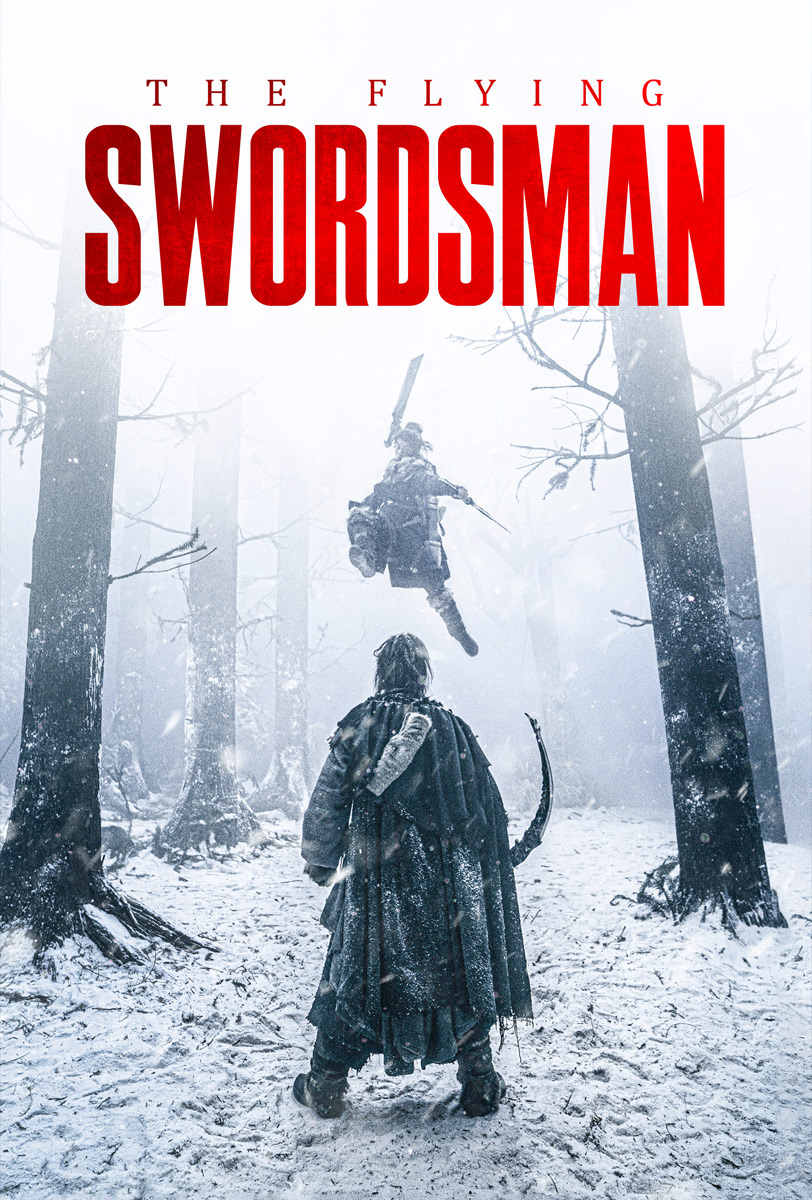
The Flying Swordsman (雪山飞狐之塞北宝藏, Qiao Lei, 2022)

Close to the conclusion of Qiao Lei’s The Flying Swordsman (雪山飞狐之塞北宝藏, xuěshān fēi hú zhī Sàiběi bǎozàng), the latest adaptation of Jin Yong’s classic wuxia novel Fox Volent of the Snowy Mountain, the villain is reminded that his quest for treasure is a headlong plunge into an abyss and it is indeed greed that eventually seals his fate. In any case, the karmic wheel is very much in motion as the sins of the past will soon catch up to him.

In a brief prologue, Lord Tian hopes to get his hands on some treasure buried deep beneath a land of cold and so engineers a duel between the treasure’s guardian Hu Yidao and the only swordsman who can match him. The two men end up killing each other, but largely due to the machinations of ambitious underling Baoshu (Chunyu Shanshan) who has poisoned their swords with arsenic. Additionally he’s massacred a local village, something of which the head of their group Tao Baisui (Raymond Lui Leung-wai) does not approve, but still didn’t get his hands on an iron box containing a map to the treasure nor the key needed to open it.

The box then turns up 10 years later but causes nothing other than chaos and discord among Baisui’s followers as they all jockey to get their hands on both the map and the key though the clever part of the plan is that no one has both at the same time ensuring the continuation of infighting and betrayal. The sad thing is that both Baisui and Baoshu are childless and have come to regard their underlings as children though they are quickly sacrificed during the internecine plotting. Gui Yu (Zhao Huawei), a mercenary picked up by Baoshu’s henchwoman Qingwen (Chen Yusi) after escaping enslavement at a coal mine, seems to vacillate, playing advantages against each side but also manipulated by both and left to die after being poisoned. Apparently each of the other eight villains has a special talent, though Gui Yu appears to have none and often claims to be doing only what he needs to survive which fair enough given the vagaries of the feudal era. 

This world is indeed quite grim, as we can see from the guy hacking up some suspicious looking meat on the way into the fort. An assassin is fond of asking if the target thinks villains never face retribution, hinting at the degree of hubris in Baoshu’s ambition and his lack of thought for the future or the various ways the karmic wheel may turn against him. His downfall is caused by greed, but then there’s also a degree of tenderness in his relationship with adopted daughter Qingwen who is often dismissed as a “little beauty” even if he at times seems willing to sacrifice her life for relatively little gain. 

In any case, the treasure becomes something of a MacGuffin, merely an unattainable object that drives the villains mad and turns them against each other or alternately can be used to manipulate them. In this supernaturally tinged world, the band come up against strange monsters including a pack of wild hyenas amid the freezing cold and otherwise have managed to keep their special powers more or less secret from each other despite their long association giving Qiao frequent opportunities for plot twists and unexpected returns. He adds to the mythological fantasy aesthetic through the forest-bound vistas of trees in bloom along with the endless snowscapes that reflect the moral and emotional emptiness of men like Baoshu. 

Karma does indeed come back to bite him, a victim of a poetic revenge destroyed by his own greed and immorality. Amid all the infighting there is a genuine degree of solidarity to be found at least among those robbed by the evils of feudalism and hoping to avenge themselves through tricking the gang into destroying itself. Qiao’s wire-heavy action sequences hint at a poetic beauty of wuxia martial arts even if close combat is necessarily brutal though mostly relying on trickery rather than simple skill with the sword. Told over a series of flashbacks, the tale eventually straightens itself out to reveal the tragic legacies that provoke the fate of all long after those who caused them have forgotten their dark deeds and believed themselves free from guilt or consequences.


The Flying Swordsman is released in the US on Digital and DVD on Jan. 9 courtesy of Well Go USA.

US trailer (English subtitles)

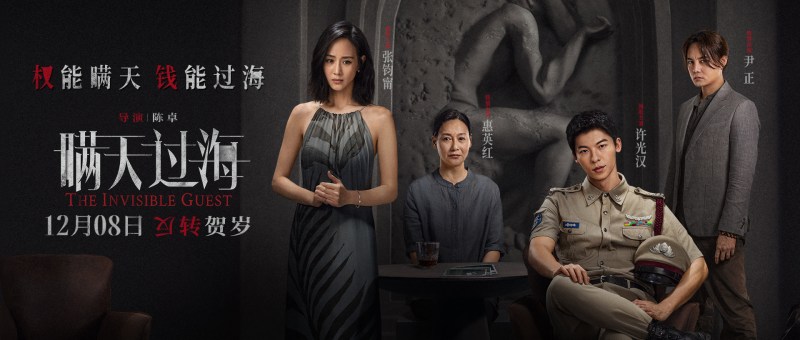
The Invisible Guest (瞒天过海, Chen Zhuo, 2023)

Prestige mystery thrillers are definitely having a moment at the Chinese box office and like last summer’s Lost in the Stars, The Invisible Guest (瞒天过海, mántiānguòhǎi) takes place in a fictional South East Asian nation among a largely Chinese community where the policemen mainly speak English and almost everyone else Mandarin. Like many similarly themed films that might partly be because there is a strong suggestion of normalised judicial corruption which would otherwise be a difficult sell for the Mainland censorship board even if very much on message in its anti-elitist themes in which it is repeatedly stated that money cannot in fact solve everything. 

Adapted from a Spanish film which was a huge hit on its Chinese release and recently remade in Korea under the title Confession, the film opens as a locked room mystery. A well-known architect, Minghao (Yin Zhung), who is also the adopted son of the nation’s only Chinese lawmaker, has been brutally murdered in a luxury hotel. Joanna (Chang Chun-ning), the wife of a filthy rich real estate magnate, has been arrested but maintains her innocence. She claims that they were attacked soon after entering the room and that she was temporarily knocked out waking up to find Minghao with his throat cut, the attacker vanished, and police kicking down the door.  

The twist is that she’s then approached by Zheng (Greg Hsu), a local cop, who offers to “help” her for a small fee promising to sort out all the problematic evidence against her if only she’s honest with him about what really happened in the room. Obviously, the depiction of such an openly corrupt law enforcement officer would not be possible on the Mainland which explains the international setting but it soon becomes clear that Joanna may not be a very reliable narrator and Zheng obviously knows a little more about what’s really going on than he pretends.

Joanna had only recently married her superwealthy husband whose business interests have been very badly affected by the scandal, suggesting at least that she may be a patsy at the centre of a corporate conspiracy with her husband’s firm possibly hoping to get rid of her or someone else’s using her to get to him. But the most essential message is that the rich and powerful shouldn’t have a right to assume that everything can be solved with money and they can get away with anything so long as they have financial means to pay for it. In a flashback which we can’t be sure is completely reliable, someone suggests that the victim’s life was meaningless and killing them no different from crushing an ant, a view somewhat validated by Zheng when he tells Joanna that he isn’t interested in people like that only people like her, wealthy. 

Conversely, a tangenital victim of the case later insists that you shouldn’t underestimate what poor people will do for their families because in the end that’s all they have. The film is sympathetic to those like them who do not have the means to face off against someone like Joanna who probably could, if she is not actually innocent as she claims, evade justice thanks to her vast wealth and social standing assuming her husband’s company don’t decide to drop her in it. There is also, however, the implication that Joanna was once herself poor and downtrodden and has been corrupted by her desire for the illusionary freedom of wealth, abandoning her integrity while carrying the innocent dream of buying an idyllic orchard where she could live in peace and comfort. 

Playing out in near realtime, Chen keeps the chamber drama tension high with frequent on-screen graphics reminding us that Joanna only has a couple of hours left to clear her name before the dossier of evidence against her will be presented to the prosecution and she’ll be charged with murder. Zheng says he can help but keeps pressing her not only for more money but more information, the “real” truth, rather than a favourable narrative though arguably the flow of hypotheses made more sense in the context of a lawyer prepping a client than a policeman probing for evidence in order to neutralise it as did the accused’s willingness to trust the person poking holes in their story. A kind of justice, at least, is done and not least poetic as the truth begins to emerge though the guilty parties or invisible guests of latent classism and social inequality are very much here to stay. 


The Invisible Guest is in UK cinemas now courtesy of CMC.

International trailer (English subtitles)

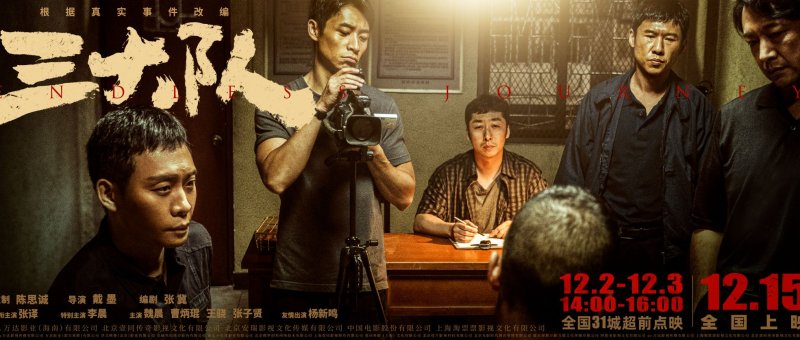
Endless Journey (三大队, Dai Mo, 2023)

The police officers at the centre of Dai Mo’s Endless Journey (三大队, Sān Dàduì) are soon stripped of their badges, accused of excessive force contravening laws existing since the medieval era to prevent vigilante justice. Yet in someways that’s essentially what they end up doing, extra-judicial investigators with a personal vendetta rather than a pure-hearted interest in justice even if the victim of the crime weighs heavily on their conscience. 

Though the film plays into the recent trend in Sino-noir and popularity of mystery thrillers at the Chinese box office, it is surprising that a film that is at least subtly critical of the justice system, featuring police who break the rules and are sent to prison, was approved by the censors board even if the central message is one of heroism as Captain Cheng (Zhang Yi) doggedly chases his suspect all over China for several years. Then again, the hero of this true life case turns out to be China itself as Cheng is reminded that his search is unnecessary given that the fugitive, Eryong (Zheng Benyu), is sure to be captured by the burgeoning surveillance network of CCTV cameras then being rolled out across the country. Years later, it’s the system that allows Cheng to identify Eryong as his DNA and fingerprints throw up positive matches within seconds of samples being taken thanks to the nation’s DNA database. 

Even so, as the veteran officer, Zhang (Yang Xinming), reminds the rookie behind every major case there’s a ruined family broken by their loss which is one reason why he doesn’t relish the prospect of investigating one so late in his career. This particular crime is so heinous that it’s become front page news which means that they’ve also got their boss breathing down their necks to get it solved as soon as possible with the existence of Division 3 itself on the line. Cheng pops home for a matter of minutes to check on his wife and daughter, shutting down his wife’s suggestion that they get a security system for their windows on the grounds that it would be an embarrassing thing for a detective’s home to have. The reason she wants one is that the victim in this case had been a little girl of around their daughter’s age unexpectedly home alone when thieves broke in by climbing over their aircon unit and smashing a window. Finding nothing of value they raped and killed the daughter. 

After a police officer dies as a result of the investigation, the squad take things too far questioning the first suspect leading to his death which is how they end up disgraced and sent to prison. After his release, Cheng has lost his family, his home, his job and identity as a protector of justice yet his determination to catch Eryong is born more of his desire to avenge a friend than it is to prevent further crime. His fellow officers join him in the beginning, but during the endless searching each make the decision to move on for easily understandable reasons such as their marriages, children, and illness but Cheng cannot let go even when prompted by an old friend from the force who tells him they have this in hand though there is perhaps a subtle implication that the police force isn’t really doing enough otherwise Cheng wouldn’t have to be chasing Eryong all over the country. 

But haunted by reflections of his own face, ageing, at times dishevelled and hopeless, Cheng is also searching for himself and a means to reclaim the self he once was by vindicating himself as a policeman along with Division 3 in finally completing their mission. The ominous score by Peng Fei with its stinging strings adds to the noirish feel as does the perpetual inevitability of Cheng’s forward motion in the dogged pursuit of his prey, unable to rest until Eryong has been brought to ground. His quest robs him of his life, but there is an undeniable poignancy to it in Cheng’s inability to find himself outside of the chase only to be left with a moment of uncertainty no longer sure who he is or where he goes now, left alone and with no sense of direction in the absence of his quarry.


Endless Journey is in UK cinemas now courtesy of CMC.

International trailer (English subtitles)

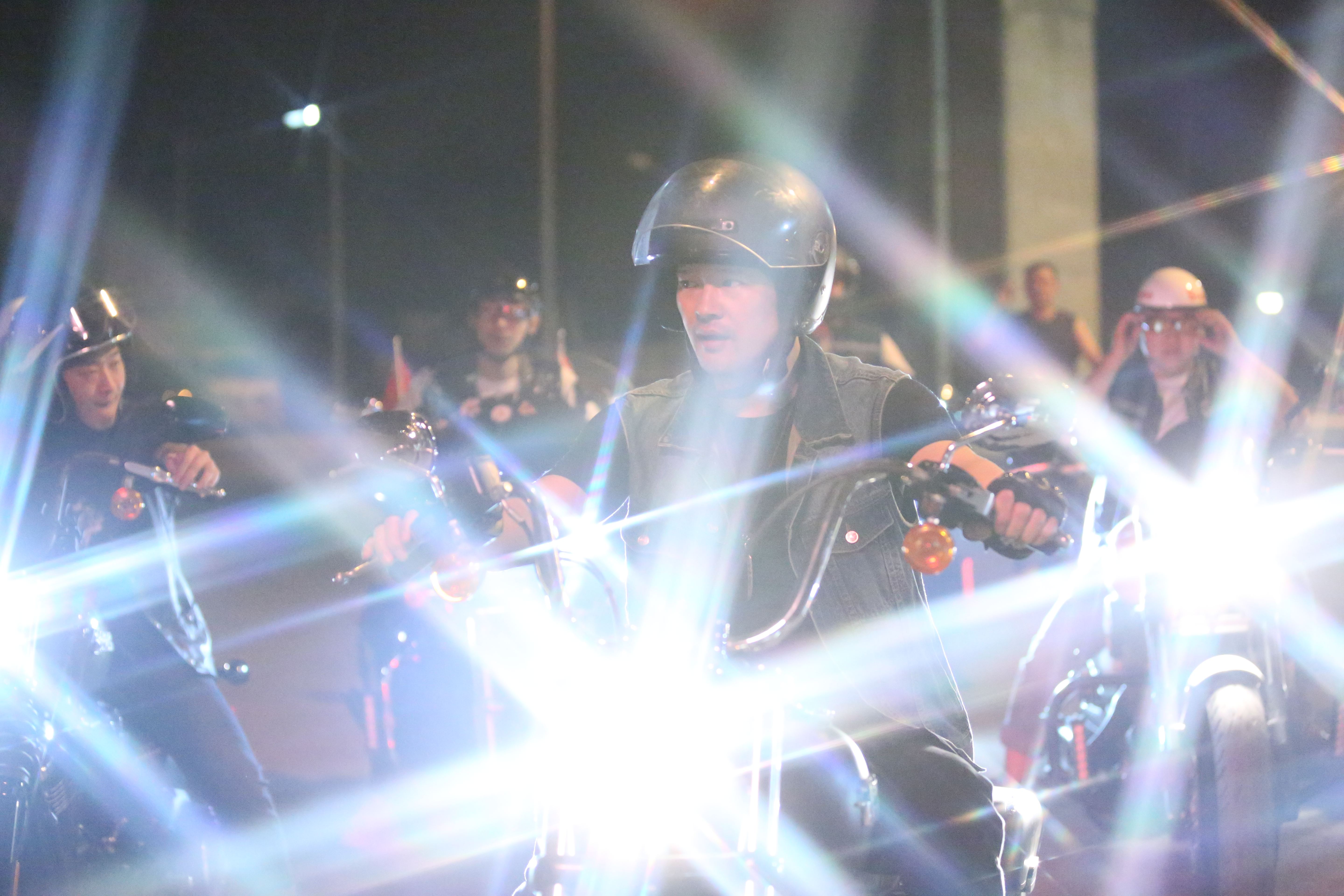
Redemption with Life (兄弟, Zhang Wei, 2023)

A young man with old-fashioned values is slowly consumed by the contradictions of the modern China in Zhang Wei’s indie drama, Redemption with Life (兄弟, Xiōngdì). The Chinese title translates as the more straightforward “brothers” and hints at the strong bond between the three men at its centre who each find that life has not turned out quite as they hoped. While one silently plugs away, another pushes the boundaries of the law, but the third allows himself to be pulled into callous inhumanity and the exploitation of the dreams of others while working for an enigmatic businessman running what is quite obviously a dodgy pyramid scheme. 

As the film opens, Jianhua has just been released from a two-year prison sentence after taking the fall for the financial impropriety overseen by his boss, Li Gang. He is met by his two sworn brothers, fellow bikers Peng and aspiring photographer Shaofeng, and is intent on starting over described by Peng as some kind of financial hotshot though it’s surprising he would even be able to return to that line of work after being imprisoned for mismanagement. In any case, he ends up returning to Li Gang while justifying himself by using the vast amounts of cash he’s been given to repay victims who lost their life savings when the bottom finally fell out of the Ponzi scheme they’d been running. 

Though his youthful dream was to travel the world, Jianhua is materially ambitious and ties his masculinity to his ability to become wealthy. After starting a relationship with a female biker, he gets deeper into the scam telling her that he wants to make enough money for them to go travelling while otherwise claiming not to be interested in the high life of fancy parties and expensive goods that Li Gang represents. She eventually leaves him because he caused her to feel insecure with all his dodgy dealings though he repeatedly fails to learn his lessons thinking he can solve all of his problems with money. Some debts must be repaid, he solemnly intones, yet as Peng reminds him there are some things that can’t simply be compensated for and some money you just shouldn’t make if causes you to act immorally.

Peng had given his dream as making a lot of money and seems to look up to Jianhua because he works in “finance”, but is otherwise happy enough with the life he’s made for himself running a motorbike garage which is mostly honest work except that he makes extra money by selling smuggled bikes to other bikers. He wants to help Jianhua but worries that he’s already in over his head and unable to escape the allure of his old life. Shaofeng meanwhile is financially stable and pursuing his art on his own terms, turning down an offer Jianhua gets him to work with some top gallery owners because on one level he knows if Jianhua’s involved it’s not legit and on another wants to do things his way even if he’s unsuccessful. 

Skipping back and forth over a number of years encompassing time served in prison the film chronicles Jianhua’s corruption and eventual disillusionment in the realisation that he too is being scammed by Li Gang and his futile attempts to make money with money are forever doomed to failure. The suggestion is that he wants the high life he wanted to reject in order to secure his masculinity in a world now more ruled by the corporate even if this kind of corporatism is itself ruled by violence and vulgarity, not to mention a healthy dose of misogyny and female exploitation. Jianhua’s partner in crime, the similarly deluded Haitao, eventually renounces desire altogether and becomes a Buddhist monk to atone for the destruction his lust for riches wrought on those around him, though Jianhua’s solution is one of old-fashioned manliness that is predictably futile. Slowly, the biker convoy makes its way towards Tibet and a more spiritual place supposedly freer of the destructive consumerism that has already consumed Jianhua and ruined the lives of those he convinced to invest in a scheme he always knew was a scam not to mention morally wrong. A mild critique of the contemporary society ruled by status and acquisition the film’s advocation for an unconstructed masculinity may sit uncomfortably but does nevertheless make the case for a beneficial brotherhood over mutual exploitation. 


Redemption with Life screened as part of this year’s New York Asian Film Festival.

Snow Leopard (གསའ།, Pema Tseden, 2023)

When a snow leopard breaks into a herder’s pen and kills nine of his castrated rams, the herder traps it and effectively holds the animal hostage in the hope of gaining compensation in Pema Tseden’s mystical drama Snow Leopard (གསའ།). He is reminded that the snow leopard is a “first class protected animal” but understandably asks who’s going to protect him, why is the snow leopard’s life so much more important than his own?

Prone to angry rants, Jinpa (Jinpa) is more often than not portrayed as a snow leopard himself grunting and struggling to get free when the forestry police attempt to restrain him. He says that the herders and local wildlife used to live in harmony. If a snow leopard eats one or two sheep, then they just accept it but as climate change and other environmental forces have pushed them further down the mountain Jinpa feels the snow leopards in particular have become greedy and must be stopped. He wants to kill the snow leopard in revenge and refuses to let it go until the government agrees to compensate him for his financial loss. His rage is such that it’s economically irresponsible, calling in a local man with a digger to rescue the remaining sheep and telling him that it’s fine if one or two die while agreeing to pay the same price as the sheep is worth to have him try to rescue them. 

Jinpa’s brother, a monk obsessed with photographing snow leopards, and father are each of the opinion that it’s spiritually irresponsible to keep the snow leopard bound up as it is the embodiment of the spirit of the mountains. It’s possible to read Jinpa’s animosity towards it as rage against the natural world and his fierce, almost mad diatribes against it as a kind of irrational hatred. Yet like him the snow leopard contains dualities. The one in the pen has a cub on the mountainside and seems to be capable of true tenderness though also violent carnality in its attack on the sheep. Jinpa more than anyone seems to be aware that the snow leopard is simply being what it is, but cannot forgive it for this very personal act of betrayal. 

The monk, meanwhile, has a unique relationship with the captive snow leopard segueing into a surreal black and white sequence in which he eventually sets it free and is rewarded for his act of kindness. This seems to hint at the ways in which human life and animal could coexist but also at the essential spiritual quality of the snow leopard as a symbol of something elemental along with the roots of traditional Tibetan culture which are now on the brink of eclipse. A TV news crew tipped off by the monk with whom the reporter went to school turn up to capture these bizarre events but appear uncertain as to what they’re actually filming. The cameraman is frequently so awestruck that he forgets to film anything while the reporter is constantly fending off calls from his girlfriend.

A farcical stand off occurs when representatives from the government turn up, seemingly looking down on Jinpa and irritated by his demands for compensation while insisting that the snow leopard must be released. He refuses to give in even as they remind him that if anything happens to it, it’s him that will be held legally responsible. The forces of authority are also intruders, making an incursion from the world of modernity much as the snow leopard descends from the mountain and the ancient past. Men like Jinpa occupy a liminal space, caught between the old and the new while their way of life is increasingly threatened by the forces of modernity. 

In a way, perhaps you could say the monk is trying to capture the snow leopard too even as he shares a special affiliation with it that connects him to the land and his culture along with something deeper and older that the modern world may lack. Yet what they need to do is set it free and restore an order that’s natural rather than manmade. Director Pema Tseden sadly passed away at the young age of 55 shortly after completing the film but offers a sense of the eternal in the snow-covered expanses of mountains and the cruel tenderness of those who live there.


Snow Leopard screened as part of this year’s London East Asia Film Festival.

International trailer (English subtitles)
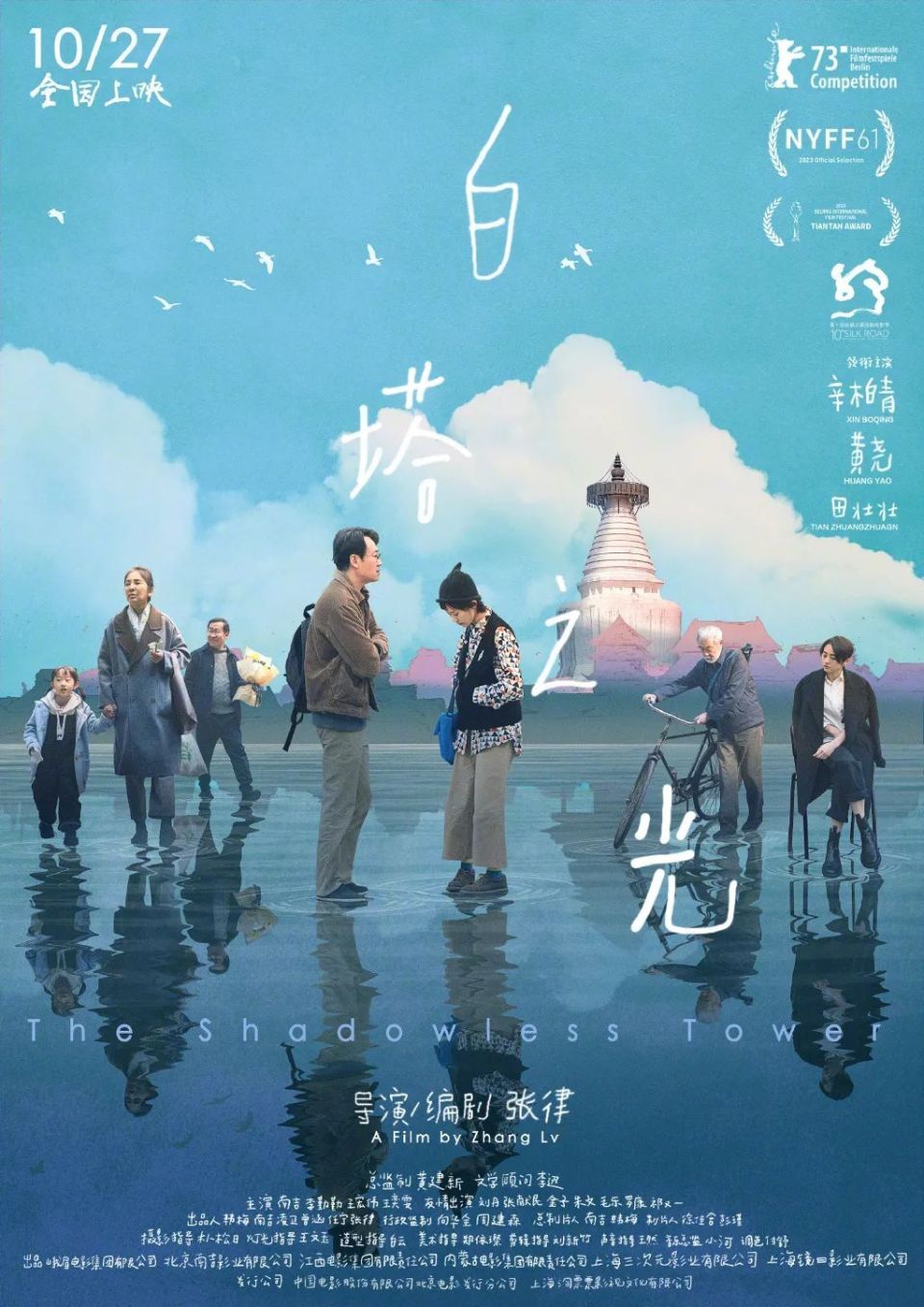
The Shadowless Tower (白塔之光, Zhang Lu, 2023)

A tale of middle-aged loneliness and regret, Zhang Lu’s Shadowless Tower (白塔之光, Bái Tǎ zhī Guāng) takes its name from a white pagoda in the centre of Beijing that is said to cast no shadow. Or at least, as the hero later suggests, its shadow may be far away in its old home town of Tibet. Most Zhang’s protagonists are somewhat displaced most particularly spiritually and existentially, cut adrift by corrupted paternity while uncertain how to progress towards the future. 

For Gu (Xin Baiqing), a former poet now a melancholy restaurant critic and divorcee with a small daughter, the problem is he’s beginning to feel more and more like the father he hasn’t seen since he was five when his mother kicked him out of the house after he was accused of groping a woman on a bus. In a meta-textual touch, Gu’s kite-flying father Yunlai is played by film director Tian Zhuangzhuang who once made a film called The Blue Kite that is also about failed fatherhood and was banned by the authorities on its release. In any case, Gu is only a part-time father to his little girl, Smiley (Wang Yiwen), who is living with his sister and her husband who has been secretly in touch with Yunlai and aware that he rides hundreds of miles by bicycle twice a year visit Beijing on the kids’ birthdays though he cannot meet them.

In many ways, it might seem to be the father, or at least the image of one, that is the shadowless tower that hangs over Gu’s life. He fantasies about interrogating him over the bus incident, wondering if what his mother did was right or if they unfairly rejected a good man because of a misunderstanding. His mother’s anger was apparently partly because Yunlai would not compromise and confess to the crime to get a lighter sentence, instead being sent to a labour camp which left her financially responsible for the children on her own. Gu’s sister Wenhai (Li Qinqin) reflects that if he had not been such a good father to begin with she could have forgiven him, but because he was his disgrace caused her to lose faith in the world. 

Gu seems not to have much faith in the world either, remarking that he separated from his wife owing to an excess of politeness, the same politeness that keeps him aloof from his surroundings and prevents him from making meaningful connections. Yet for all that, he embodies a kind of fatherhood, sitting down on the bed of his lodger and gently placing a hand on his back on hearing his crying through the wall. The young man later embraces him as a son to a father, while Gu finds himself dancing a melancholy waltz with Yunlai who is also an image of his future self. 

But even as a lifelong Beijinger, Gu remains rootless. Meeting up with old friends, all of whom might have been young in the late ‘80s, they drink and sing the song composed for the 2008 Olympics as if they were looking for a father in the city. Gu also reads from Bei Dao’s My Beijing which similarly rests on a sense of exile even while present. The only woman in the group laments that she never married and meditates on the ghost of lost love, while the only one of them who fled abroad eventually takes his own life in a foreign land.

Jolting him out of his inertia, Gu encounters free spirited photographer Wenhai (Huang Ya) who shares his sister’s name though she is also similarly displaced and struggling with a more literal orphanhood that leaves her caught between the North East and the Cantonese-speaking south where she was adopted. A gentle love story arises between them, Wenhai cutting through the wall of Gu’s politeness with refreshing frankness but also with troubles of her own and a worrying tendency to refer to him as her father which nevertheless has a kind of circularity to it. 

Crouching down by the pagoda, they can’t see their shadows either and wonder where they are. Then again, perhaps it’s not so much that tower casts no shadow, but the shadow it casts is so vast that covers everything below just as Gu’s searching for his father overshadows his life even as he is also searching for himself. Intensely moving, Zhang’s poetic drama waxes on middle-aged rootlessness but also the interconnectedness of all things, from kites to earthworms and the great dance of life in all its inescapable loneliness. 


The Shadowless Tower screened as part of this year’s London East Asia Film Festival.

Original trailer (Simplified Chinese / English subtitles)