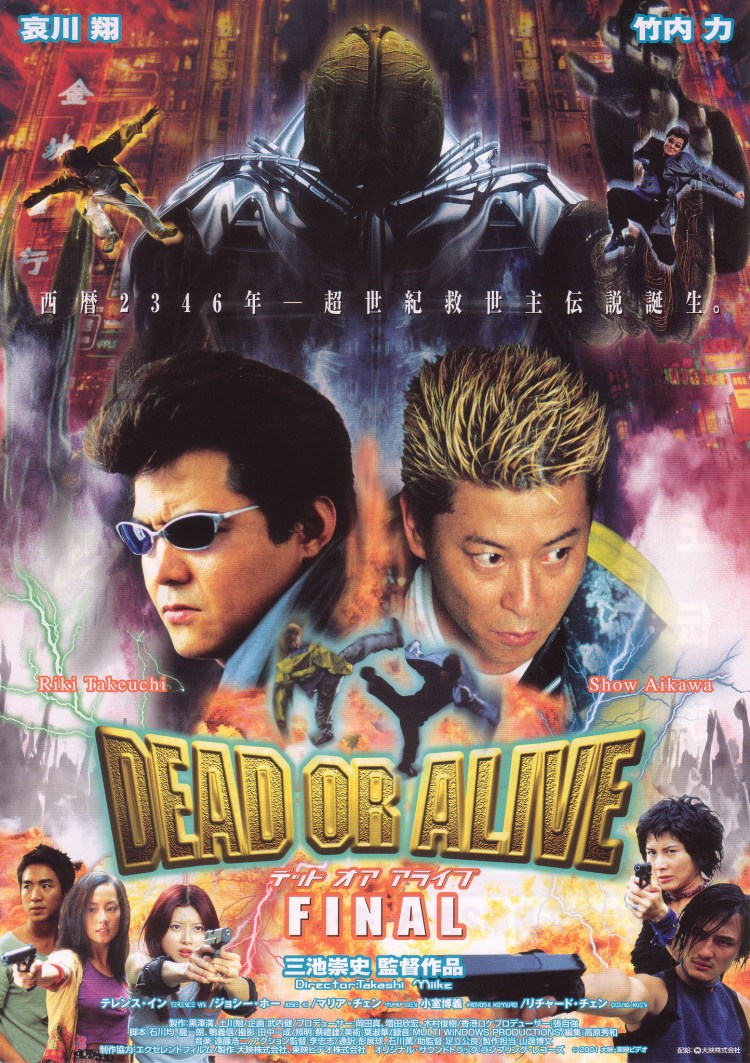
Dead or Alive: Final (Takashi Miike, 2002)

dead_or_alive_final_jap_chirashiThe Dead or Alive Trilogy began in a furious, drug fuelled hymn to violence in which a petty vendetta between the opposing forces of good and evil (mingled and bloody) eventually destroyed the entire world. Dead or Alive 2: Birds was an altogether more contemplative affair in which two orphaned boys rediscover each other as jaded hitmen and decide to put their talents to “good” use by donating the hit money to pay for medicinal drugs for impoverished children around the world. Strange and surreal, Birds moved beyond the first film’s absurd ending for an altogether more abstract approach to universe building but Final pushes the idea to its limit in a cyberpunk infused far future tale of rogue robots and sexual dictatorship.

Yokohama, 2346. A new society is being forged, a new social order has been created. All powerful Mayor Wu (Richard Chen) has decreed that the only true love is gay love and made heterosexuality taboo. Births are strictly controlled to maintain population numbers with contraception ruled mandatory. The heterosexual resistance has gone into hiding in a ruined part of the city, living in a free love commune in which the birth of children is a primary goal. Lead by Fong and his first lady Jun, the resistance aims to liberate the people from the yoke of the crazed dictator and create a better, freer world for the as yet unborn children of the future. Teaming up with a rogue “Replicant”, Ryo, (Sho Aikawa) the gang attempt to further their cause by kidnapping the young son of Wu’s chief of police, Honda (Riki Takeuchi), who later discovers some uncomfortable truths about his own existence.

The use of the world “Replicant” is a pointed one and an overt reference to Final’s key text – Blade Runner, though its intentions amount much more to a pastiche than an examination of the existential questions so central to the seminal cyberpunk classic. Online captions state the action is taking place in Yokohama – an industrial harbour town close to Tokyo, but is in reality a thinly disguised Hong Kong with a green tint. Nevertheless, Miike makes the most of rundown industrial complexes now overrun by nature and the symbols of historical hubris. Aside from the flying cars and other CGI touches, the dystopianism is all too real in its sense of economic and social failures which have allowed a man like Wu to run a strange fascist police state even in the absence of the necessary infrastructure.

In keeping with the Hong Kong setting the Yokohama of 2346 is largely Chinese with broad mix of intermingled languages. Once again the nature of family is called into question but this time more through a large scale change in the social order which sees birth strictly controlled through medical and cultural enforcement. The largely Cantonese speaking resistance movement want to create a world where children can be born and then grow up freely, neatly echoing the previous films’ preoccupation with the fates of children as considered by orphans. Aside from their idealism, the Resistance turns out not to be so far removed from the petty gangsters of the previous instalments as they ultimately turn on each other with deadly consequences.

Sho Aikawa and Riki Takeuchi face off once again with Aikawa playing a Rutger Hauer-esque android who proves his “humanity” through his affiliation with children. A “Replicant” from a long forgotten war, Ryo has superpowers which allow him to stop bullets in mid-air or send out sparks of energy but is also at home playing the clown as he brushes his teeth nonchalantly in the middle a fist fight or plays dead to entertain a little boy. Takeuchi’s Honda, by contrast, is the stereotypical gestapo inspired secret police chief whose family life is a hollow one devoid of genuine feeling and maintained solely for professional expectation.

If Miike has been playing Blade Runner all along, his finale jumps ship for Tetsuo: The Iron Man as the trilogy’s leading men relive the totality of their experiences across three different plains of existence before merging into one as a kind of angel of destruction. The cycle of violence has reached its apotheosis as the twin angels are sent to wreak revenge on those who have misused their authority. Shot on high grade video, Final makes the most of its more modest production values but can’t help suffering in comparison to its predecessors. The B-movie opening is a helpful clue to Miike’s intentions as he creates his own kind of sci-fi dystopia inspired by pop culture memories, but even if the overarching themes lack integrity, Final provides the perfect ending for this often frustratingly absurd series, defying rational explanations until the end of time.


Available now in UK from Arrow Video!

Original trailer (English subtitles)

Dead or Alive 2: Birds (DEAD OR ALIVE 2 逃亡者, Takashi Miike, 2000)

dead-or-alive-2-birds

How do you make a sequel to a film which ended with the apocalypse? Takashi Miike is no stranger to strange logic, but he gets around this obvious problem by neatly sidestepping it. Dead or Alive 2: Birds (DEAD OR ALIVE 2 逃亡者, Dead or Alive 2: Tobosha) is, in many ways, entirely unconnected with its predecessor, sharing only its title and lead actors yet there’s something in its sensibility which ties it in very strongly with the overarching universe of the trilogy. If Dead or Alive was the story of humanity gradually eroded by internecine vendetta, Dead or Alive 2 is one of humanity restored through a return to childhood innocence though its prognosis for its pair of altruistic hitmen is just as bleak as it was for the policeman who’d crossed the line and the petty Triad who came to meet him.

Signalling the continuous notions of unreality, we’re introduced to this strange world by a magician (Shinya Tsukamoto) who uses packets of cigarettes to explain the true purpose of a hit ordered on a local gangster which just happens to be not so different from the plot of the first film. Because the gangster world has its own kind of proportional representation, neither the yakuza nor the Triads can rule the roost alone – they need to enter a “coalition” with a smaller outfit no doubt desperate to carve out a little more power for themselves. The free agents, however, have decided on a way to even the power share – hire a hitman to knock off a high ranking Chinese gangster and engineer a turf war in which a proportion of either side will die, leaving the third gang a much more credible player.

Mizuki (Sho Aikawa), bleach blond and fond of Hawaiian shirts, is an odd choice for a secret mission but his sniper rifle is rendered redundant when a man in a dark suit does the job for him – loudly and publicly. So much the better, thinks Mizuki, but the memory of the strangely familiar figure haunts him. Finding himself needing to get out of town, Mizuki has a sudden urge to go home where he encounters the suited man again and confirms that he is indeed who he thinks he is – childhood friend, Shuichi (Riki Takeuchi).

Revisiting an old theme, Mizuki and Shuichi are orphans but rather than being taken directly into the yakuza world they each spent a part of their childhood in a village orphanage on an idyllic island. Miike frequently cuts back between the violent, nihilistic lives of the grown men and the innocent boyhood of long hot summers spent at the beach. The island almost represents childhood in its perpetual safety, bathed in a warm and golden light at once unchanging and eternal. Reconnecting with fellow orphan Kohei (Kenichi Endo) who has married another childhood friend, Chi (Noriko Aota), the three men regress to their pre-adolescent states playing on the climbing bars and kicking a football around just like old times.

Returning to this more innocent age, Mizuki hatches on an ingenious idea – reclaim their dark trade by knocking off those the world would be better off without and use their ill gotten gains to buy vaccines for the impoverished children of the world. In their innocent naivety, neither Mizuki nor Shuichi has considered the effect of their decision on local gangland politics (not to mention Big Pharma) and their desire to kill two “birds” with one stone will ultimately boomerang right back at them.

Innocence is the film’s biggest casualty as Miike juxtaposes a children’s play in which Mizuki and Shuichi have ended up playing a prominent role, with violent rape and murder going on in the city. Whether suggesting that the posturing of a gang war is another kind of playacting, though one with far more destructive consequences, or merely contrasting the island’s pure hearted fantasy with the cold, hard, gangland reality, Miike indulges in a nostalgic longing for the simplicity of childhood with its straightforward goodness filled with friendship and brotherhood rather than the constant betrayals and changing alliances of the criminal fraternity.

The question “Where are you going?” appears several times throughout the film and perhaps occurred to Mizuki and Shuichi at several points during their journeys from abandoned children to outcast men. Neither had much choice in their eventual destination and if they asked themselves that same question the answer was probably that they did not know or chose not to think about it. All of these hopes and ruined dreams linger somewhere around the island’s shore. Kohei is about to become a father but the birth of a child now takes on a melancholy air, the shadow of despair already hanging over him. There is no way out, no path back to a time before the compromises of adulthood but for two angelic hitmen, the road ends with meeting themselves again and, in a sense, regaining lost innocence in shedding their city-based skins.


Out now in the UK from Arrow Video!

Original trailer (English subtitles)

Dead or Alive (DEAD OR ALIVE 犯罪者, Takashi Miike, 1999)

dead or alive
Prolific as always, Takashi Miike released four feature length films in 1999, in addition to working in TV and video. Dead or Alive (DEAD OR ALIVE 犯罪者, Dead or Alive: Hanzaisha) came out within the same year as Miike’s seminal Audition and though it is the latter which has gone on to define his reputation, the Dead or Alive Trilogy is equally responsible for the director’s ongoing popularity. Following the Black Society Trilogy the finale of which, Ley Lines, was also released in 1999, Dead or Alive returns to the world of orphaned exiles and Chinese gangsters, men looking for family in all the wrong places and finding only loneliness, rage, and disappointment. Criminal or cop, everyone is looking for the same old thing but for one reason or another it continually evades their grasp.

Late ‘90s, Shinjuku night life. Miike captures all of its sordid glory in a wordlessly frenetic opening sequence which begins with a naked woman falling off a building and ends with the exploding belly of a noodle loving Triad. The Shinjuku gang scene is a large and complex one but this tiny corner is about to be torn apart by the opposing forces of petty Chinese gangster Ryuichi (Riki Takeuchi) and veteran policeman Jojima (Sho Aikawa).

A little later, the major antagonist – yakuza boss Aoki (Renji Ishibashi), asks a drugged up woman he’s immersed in a pool of her own excrement he himself extricated by means of a series of enemas if she’s high or if she’s come down. Drugs are always on the periphery from the bag in the hands of the falling woman to the deluded hopes and dreams of everyone who’s had the misfortune to find themselves here but Miike takes things one step further and structures his film like the inverted bell curve of a strange trip. The relentless pace of the opening sequence with its constant noodle refills, cocaine excess, and eventual bathroom sex and murder combo gradually winds down giving way to the comfortably numb central section in which Jojima and Ryuichi mirror and circle each other in the murky Shinjuku streets but, as he often does, Miike refuels for an angry, increasingly bizarre final sequence as two men whose quests have cost them everything they were fighting to protect prepare to burn the world rather than see the other live another day.

Ryuichi, like many a gangster hero, is an orphan. His major motivation is a desire to protect his delicate younger brother whom he has sent abroad to study in the hope that he will be catapulted into a successful middle class life while Ryuichi takes over the criminal underworld. Toji (Michisuke Kashiwaya) has returned, but such close proximity to his brother’s darkness may have destabilising consequences for both of them. Ryuichi’s “family” is a constructed one made of other similarly lost or discarded kids of Chinese descent, all looking for a home when neither of the two which present themselves is willing to offer them full acceptance but there is no unconditional love here, betrayal is an easily applied judgement met with a harsh and irreversible punishment.

Even if Ryuichi’s world is cold, Jojima’s may be colder. Despite his wife’s pleas he sleeps on the sofa and seems to have a difficult, strained relationship with the family his life is founded on protecting. Jojima’s reasons for continuing to avoid his marital bed are unclear whether from simple consideration of his strange policeman’s hours or the hushed phone call his wife receives which suggests she may be seeking comfort outside the home, but the one thing which is clear is that this is a family already deeply fractured. Adding to the strain, Jojima’s daughter is seriously ill and his wife has worked out that they will need an enormous amount of money for her treatment. Jojima continues to proclaim that he is “working on it” and will find the money somewhere, reacting angrily to his wife’s desperate suggestion of asking her family for a loan. Wanting to save his daughter himself, he ventures ever deeper into the criminal underworld, crossing the line from law enforcer to law breaker.

Miike operates a tightly controlled approach to pacing after the frenetic opening, slowing right down before exploding in a flurry of gun fire for the climactic shootout (flying chicken feathers and all) and then taking a break until the bonkers finale with its self amputations, mysterious bazookas and strange power orbs. Dead or alive, these are men living in a furious purgatory each denied the very thing they’ve been searching for, but in the end they mirror each other, locked in a vicious cycle of rage and violence which threatens to engulf us all.


Out now in the UK from Arrow Video!

Original trailer (English subtitles)