The Moon Thieves (盜月者, Steve Yuen Kim-Wai, 2024)

If something’s constructed entirely from orphaned parts of others like it, can you really say it’s a “fake”? Watchmaker Vincent (Edan Lui Cheuk-on) might say no, making his living through passing off “period correct” replicas of fancy watches as the “real” thing while trying to stay one step ahead of the authorities and the gangsters who seem to be his prime customers. Then again, The Moon Thieves (盜月者), Steve Yuen Kim-Wai’s return to the big screen in four years since Legally Declared Dead and a vehicle for phenomenally popular boyband Mirror, never really stops to ask just why vintage luxury watches are so desirable that the super wealthy are prepared to expend vast sums on a niche vanity status symbol but perhaps there really is no answer for that one. 

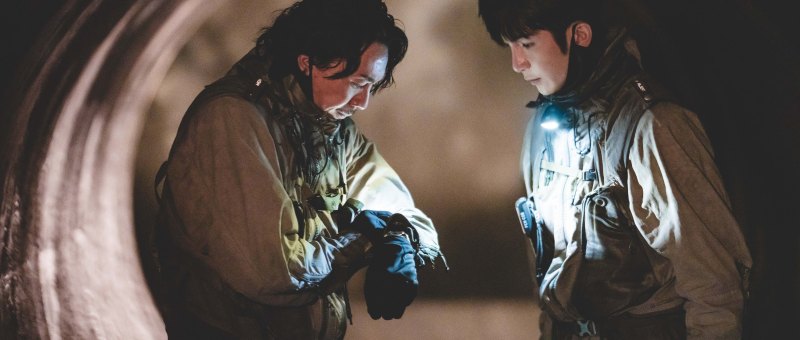
In any case, Vincent’s obsession is with the watch worn by Buzz Aldrin as he stepped onto the moon which seems to have become lost to time with NASA apparently refusing to confirm or deny its existence. His decision to make a period correct watch for a petty gangster in order to retrieve some info on the Moon Watch lands him in hot water when he’s blackmailed by local kingpin Uncle (Keung To), who is actually a youngish guy who’s taken over the name and criminal empire of his late father. Unless he wants the gangster to find out the watch is “fake”, Vincent will have to join his heist team and travel to Japan where he’ll sneakily replace three watches worn by Picasso with his homemade replicas. 

It has to be said that the film’s fatal flaw is the miscasting of Keung To as the mercurial gangster, Uncle. Though his boyish bravado might play into the idea that Uncle is out of his depth, too insecure to even use his own name rather than adopt his father’s, To’s total lack of menace or authority leaves him a rather hollow villain who alternates between super sharp intelligence and dull predictability laced with misplaced smugness. Meanwhile, Vincent is able to stay a few steps ahead of him if only in his canny knowledge of the vintage watch trade and easy power to manipulate the markets though even he probably didn’t plan on incurring the wrath of space-obsessed local yakuza who are very annoyed to have had their luxury watches stolen out from under them. 

This leaves the gang doubly vulnerable while veteran members Chief (Louis Cheung) and Mario (Michael Ning) begin to suspect that Uncle is getting rid of all his father’s previous associates and doesn’t really plan to let them live. Tensions within the group are only further strained by an unexpected hitch in the plan which brings them to the attention of the yakuza despite their incredibly careful preparations. Yuen keeps the tension high through the heist slipping into slick Ocean’s Eleven-style visuals which lend a sense of cool to the gang’s endeavours which are after all a kind of rebellion against Uncle as much as they are a capitulation to his stronghold on the local community. 

Twists and double-crosses abound as the gang try to stay ahead of him with not everything quite as it seems. Like the watches, they take everything apart to put it back together again in a way that better suits them, freeing themselves from Uncle’s thumb which might in itself stand in for another distant and corrupt authority. Ironically, the yakuza remarked that no one remembers who came second yet everyone is desperate to get their hands on the famed Moon Watch worn by the second man to walk on the moon as a kind of holy grail among horologists that they would maim or kill for though of course even if they had it they could never show it to anyone fearing they’d caught out by the authorities including NASA who apparently have a lot of say over this particular relic of the moon landing. The heist isn’t quite as daring as actually stealing the moon, though it is definitely a sticky situation for all involved which eventually requires them to hide their quarry in plain sight while doing their best to outsmart Uncle and avoid turning on each other. Smart and slick, the broadly comic overtones lend an endearing quality to Vincent’s quest for survival while targeted by a ruthlessly corrupt and infinitely implacable authority.                                                                                                                                                                  


The Moon Thieves opens in UK cinemas 23rd February courtesy of Central City Media.

UK trailer (English subtitles)

Over My Dead Body (死屍死時四十四, Ho Cheuk-Tin, 2023)

As the opening voiceover of Ho Cheuk-Tin’s darkly comic farce Over My Dead Body (死屍死時四十四) points out, the world is already quite an absurd place. A lot of us know that it’s absurd, but somehow we just roll with it without really asking why. If you stop to think about it, it really is absurd to spend every waking minute scrabbling for money to pay a mortgage on a flat you barely occupy because you’re always at work, but at least it’s less absurd than living with the constant uncertainly of arbitrary rent rises and sudden eviction. 

At least that’s the way it’s always seemed to the residents of 14A Seaside Heights, a swanky apartment block with all the mod cons and a touch of European sophistication. Technically the flat is owned by Ms. So (Teresa Mo Sun-Kwan), though home to daughter and son-in-law Yana (Jennifer Yu Heung-Ying) and Ming (Wong Yau-Nam) plus their small daughter Yoyo and Yana’s paranoid brother Kingston (Alan Yeung Wai-Leun) who is in the process of launching a “brand” selling a special “stealth suit” that can make you invisible to surveillance cameras. The obvious fact is, the flat is far too small for all these people and Ming and Yana want to move out not least so they stop having to sneak around like teenagers to get a little personal time. 

They have each, however, suffered amid the precarities of the post-pandemic economy with Yana losing her job as an air hostess when the airline she worked for went bust, while Ming’s removals business has taken a serious hit and is unlikely to recover as Mrs So points out with so many people leaving Hong Kong due to the ongoing political uncertainty. The young couple propose mortgaging Mrs. So’s flat for the downpayment on their own which they’d be paying a second mortgage on, which is why it’s incredibly bad news when they discover the naked corpse of a random man propped up against their door. 

The film plays with a minor pun in which the word for male corpse sounds like that for “Blue Ribbon”, a name for pro-government supporters during in the protests, the implication being you wouldn’t want one of those turning up on your doorstep either. In any case, any idea of calling the police or an ambulance is quickly abandoned on realising the flat would become known as a “murder house” and dramatically drop in value. The only thing to do is drag the unfortunate man to a neighbour’s door instead and let them deal with it. This goes about as well as could be expected with the whole floor eventually involved in the plan to move the body until they eventually hit on the idea of dumping it on a rundown social housing estate where people often go to commit suicide because no one’s going to notice one more corpse and no one owns those flats anyway so it doesn’t really matter if they ruin their property value. 

It is an incredibly dark and cynical sense of humour, but in its own cheerfully absurd in all the farcical shenanigans trying to remove the body from the building with no one really stopping to ask how it got there in the first place beyond connecting it with the mad streaker the security guard has been desperately trying to catch. Ho’s previous film, stylish true crime drama The Sparring Partner, had similarly had an absurdist vein of dark comedy running underneath it but Over My Dead Body does eventually rediscover a sense of hope if only in irony as it leans in to a New Year comedy-style celebration of family and community as the neighbours find themselves having to work together to protect their property investments. Even the materialistic Mrs So is forced to reflect that actually she’s lucky to be able to feel tired and frustrated, giving her blessing to her daughter and son-in-law to move out, while they in turn reflect that maybe it’s not that bad if they have to stay a little longer. It might seem like an overly saccharine conclusion for a biting satire about the rabid capitalism of a status obsessed, consumerist society but then again as an equally cynical ironic twist reveals maybe the residents are the ones who haven’t quite woken up despite their newfound solidarity. 


Over My Dead Body opens in UK cinemas on April 21 courtesy of CineAsia.

UK trailer (Traditional Chinese / English subtitles)

Hong Kong Family (過時·過節, Eric Tsang Hing-Weng, 2022)

“It doesn’t matter how the food is cooked. Let’s just enjoy it in the presence of each other and not think too much” a regretful grandmother advises giving perhaps the best advice for how to survive an awkward family gathering in Eric Tsang Hing-Weng’s autobiographically inspired familial melodrama Hong Kong Family (過時·過節). Coloured with the shades of exile, Tsang’s melancholy exploration of a fragmenting family unit ponders the limits of communication between those who should be closest along with the lingering resentments and toxic legacies that poison otherwise loving relationships. 

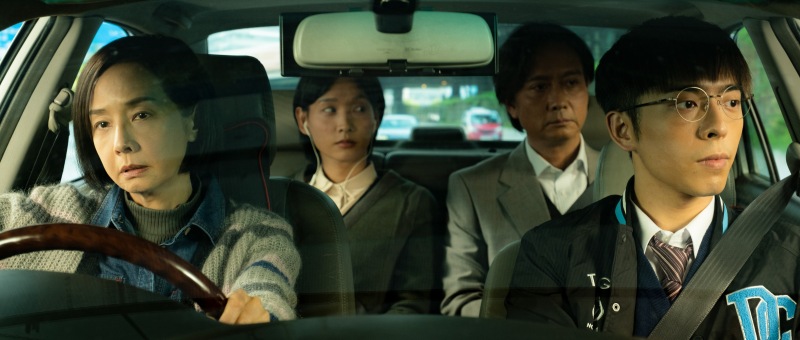
An opening sequence set eight years before the main action lays bare the tension between middle-aged housewife Ling (Teresa Mo Sun-Kwan) and her mild-mannered husband Chun (Tse Kwan-Ho) who sits silently in the back of the family car as she berates him for having recently lost his job and been unable to find another which is particularly inconvenient as they’ve just taken out a mortgage and bought a flat. 17-year-old Yeung (Edan Lui) sitting in the front passenger seat tries to keep the peace but refers to his parents as Mr & Mrs Chan, while his older sister, 20-year-old Ki (Hedwig Tam Sin-Yin), pretends not to hear escaping from reality by listening to music on her headphones. When they finally arrive at her mother’s home, a well appointed detached house out in the country, they are greeted by Ling’s brother Ming who has already fallen out with his mother (Alice Fung So-Po) in part because it seems she doesn’t like his wife who has declined to attend this Winter Solstice dinner. When his mother suspects him of stealing money, Ming angrily storms out vowing never to contact her again and provoking a similar row between Ling and Chun in which she asks for a divorce. Pushed past his limit, Chun starts hacking at a chair with a meat cleaver and eventually strikes peacemaker Yeung who then abruptly severs ties with his dad and moves out on his own. 

Yet eight years later it’s Yeung who seems to be looking for a way back to his family only he doesn’t know how to find it. He’s been working on a virtual reality “game” that would allow users to interact with AI versions of absent friends and relatives, helping them to communicate rather than offering an escape from reality though that may be in a sense what Yeung is doing in interacting with a simulacrum of his father rather than facing him directly. His parents did not divorce, but are clearly unhappy. Ling has found another simulacrum for familial life working as a housekeeper for a wealthy single father, while Chun is driving a taxi and secretly planning to start again by leaving for Mainland China and a job in a company set up by an old friend. According to grandma it seems their marriage may have been semi-arranged (by her) and years of trying have seemingly not improved their inability to communicate with each other. 

Ki, meanwhile, has been married and divorced since the fateful Winter Solstice dinner over which grandma kept trying to marry her off explaining that she married a random man to escape her family only to boomerang back two years later when it didn’t work out. She too is lying to her parents, pretending to go to work every day despite having lost her job and later drifting into an unexpected romance with a free spirited nomad from Malaysia who jolts her out of her sense of inertia in telling her to try to be true to herself. The return of Ming’s now teenage daughter Joy (Angela Yuen Lai-Lam) from exile in England offers the opportunity to repair their fragmenting bonds, but it seems some wounds run too deep to ever be fully healed. Chun is pulled towards the Mainland just as Uncle Ming had been pulled towards England, while Yeung just wants to go “home” but doesn’t know how and Ling frantically tries to preserve a sense of family just as Ki seems to have made her peace to go wherever her heart takes her.

That might be one reason that there are only women around the dinner table at another Winter Solstice, for some the first, each trying to salvage something and try to get along if only in a superficial show of togetherness while the men attempt to talk through their troubles agreeing to head towards the dinner table but in the end walking in circles. The elegantly lensed final scene may suggest that the family is in someways trapped by its history yet destined to scatter but echoes in its ambiguity offering the distant hope of a far off reconciliation but little promise of its arrival. 


Hong Kong Family is in UK cinemas now courtesy of Haven Productions.

Original trailer (Traditional Chinese / English subtitles)

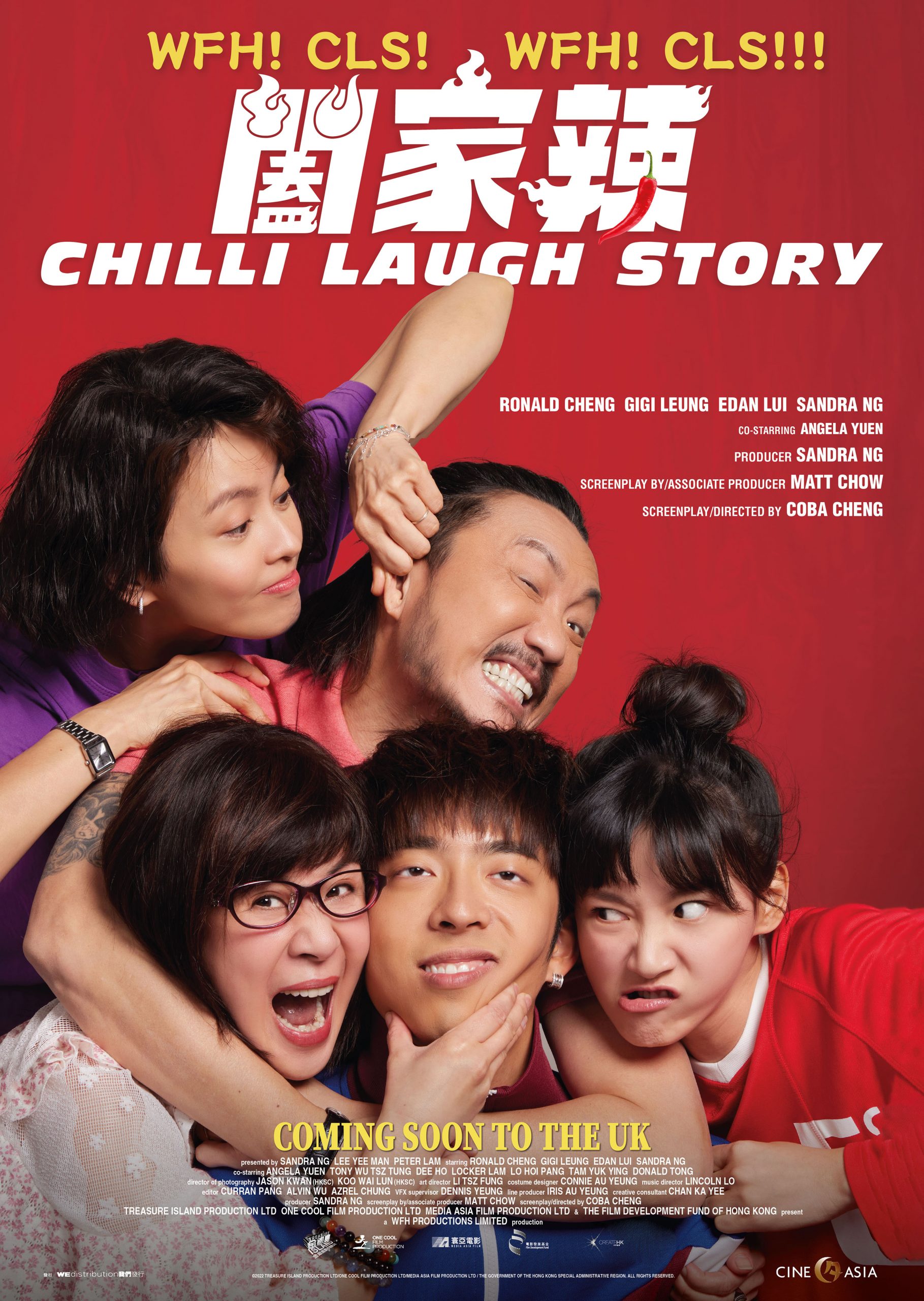
Chilli Laugh Story (闔家辣, Coba Cheng, 2022)

Family gatherings can sometimes be a little spicy, but channeling some of that passion into a family business eventually becomes too hot to handle for the ambitious hero of Coba Cheng’s New Year comedy Chilli Laugh Story (闔家辣). Set during the pandemic, the film finds its young hero embracing his lifelong dream of becoming an entrepreneur while giving his parents something to do so they won’t be bothering him but eventually discovering that the business world can be cruel and it’s family who will be there for you in the end if it all goes wrong.

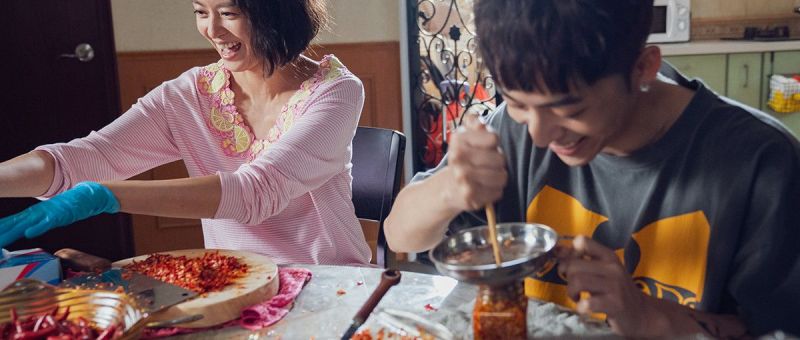
At 24, Coba (Edan Lui) lives with his parents in a rented flat and has a job as a concert promoter which is obviously suffering under the ever changing COVID-19 regulations. Though as a child he’d hated his mother’s hot sauce, he soon realises he’s on to an ideal business opportunity seeing as restaurants are closed and more people are eating at home without easy access to fiery condiments. With his mum Rita (Gigi Leung Wing-Kei) chopping chillies and garlic and his dad Alan (Ronald Cheng Chung-Kei) trying not to get in the way, Coba concentrates on the branding and creates an online sensation with their “Chiu Chiu Chiu” chilli sauce inspired by a local recipe from Rita’s hometown. But while the business begins to take off relationships between the family members suffer under the strain of their differing goals and aspirations. 

Coba’s big thing has been that he doesn’t see the point in owning property and is content with renting, whereas all his mother ever talks about is buying their own place. What she sees as security and freedom, Coba sees as a burden he doesn’t want to be saddled with tied down by a 30-year mortgage. Her plan is to get a loan in Coba’s name to take advantage of a preferential rate for first time buyers, the parents having previously owned a flat they were forced to sell, even if that means applying for one without actually telling him. They are all keeping secrets from each other, Coba choosing not to disclose that he lost his concert gig and is concentrating on the business, while eccentric auntie Wendy (Sandra Ng Kwun-Yu) suffers something similar when her son, who rarely has time to talk, abruptly tells her he’s moving abroad and may not return. Meanwhile, Rita had been using her sister’s restaurant kitchen as a cover to get around licensing regulations but their success puts them at odds with their siblings who resent not being included in the business or its profits. 

Part of Coba’s desire for success to is assert his independence, yet he learns a cruel lesson after being offered an opportunity to collaborate with a weird corporate Guru who speaks only in English and offers pithy maxims while completing a giant all-white jigsaw puzzle in his minimalist all white room. His best friends from school are rich kids who ended up accidental CEOs in the family business, and he desperately wants that kind of approval talking big about being able to buy a flat for his mum with cash to avoid being saddled with the mortgage while hustling in the local food scene trying to talk an old man running a hotdog cafe into collaborating on a chilli dog to expand the brand only for the old man to tell him he’s too old to be jumping on the next new trend. 

Annoyed with his parents for cost cutting behind his back and making his decisions for him by applying for loans in his name, what Coba comes to realise is that having no plan isn’t always a bad thing because it means there are plenty of opportunities while the family strengthen their bonds after a little mutual honesty respecting each other’s wishes and responsibilities in acknowledging they didn’t need to monetise their connection to make it meaningful. Family is after all what New Year comedy is all about. Peppered with references to the pandemic, Cheng’s familial dramedy is full of the anarchic humour the New Year movie is known for from random gags to crazy puns and even throws in a couple of unexpected cameos from major stars in its closing sequences but clearly has its heart in the right place as the family learns to find the sweetness in the spice and Cobo new directions for his future.


Chilli Laugh Story opens in UK cinemas on 15th July courtesy of CineAsia.

UK trailer (Traditional Chinese / English subtitles)