Full Strike (全力扣殺, Derek Kwok & Henri Wong, 2015)

A former badminton champ begins to rediscover herself after being permanently banned for bullying behaviour when charged with coaching a bunch of former bank robbers in Derek Kwok & Henri Wong’s zany sports comedy Full Strike (全力扣殺). Dedicated to “all the beautiful losers”, the film is less about literal winning as it is about learning to turn one’s life around in moments of profound despair and draw strength from even non-literal victories in simply refusing to be looked down or belittled.

It’s ironic in a sense that Dan (Ekin Cheng Yee-Kin), Kun (Wilfred Lau Ho-Lung), and Chiu (Edmond Leung Hon-Man) became bank robbers because they didn’t want to be bullied having grown up as friendless orphans. Former badminton champ Kau Sau (Josie Ho Chiu-Yee), meanwhile, was such as tyrannical diva that she gained the nickname “The Beast” before being banned because of her unsportsmanlike behaviour and treatment of her long-suffering assistant. But cast out of the sports world, she’s become a dejected layabout not quite working in her brother’s restaurant and otherwise hiding out from the world. Her life changes when she’s publicly mocked after running into her former assistant who has since gone to take her position as a reigning champion. Running out into the night, she spots a shuttle-cock-shaped meteor and is chased to a badminton club by what she assumes is an “alien” but might have just been a frightened homeless man.

In any case, she takes it as a sign she should pick up a racket once again which as Dan later points out she probably wanted to do anyway and was just waiting for an excuse. He can’t explain why he chose the unlikely path of becoming a badminton player to help him turn over a new leaf after leaving prison but reflects that perhaps you don’t really need a reason only the desire to change. Dan, Kun, and Chiu all developed disabilities as a result of their life of crime but slowly discover that they can actually help them on the court in a literal process of making the most of their life experiences no matter how negative they might have assumed them to be while Kau Sau similarly regains her self esteem while acknowledging the destructive patterns of her previous behaviour careful never to bully her new teammates as they all square off against her bullying cousin “nipple sucking Cheung” (Ronald Cheng Chung-Kei) who tries to use his newfound wealth to cover up a lack of skill by hiring Kau Sau’s old teammate. 

Cheung is also trying to overcome low self-esteem and is later forced to realise that becoming a champion won’t really change that much about how he sees himself, though apparently still relying on an ever capable middle-aged woman to fight (literally) his battles for him. Meanwhile, the gang are coopted by a media mogul hoping to make an inspirational documentary about them but also manipulating their lives and hyper fixating on their criminal pasts to the point of staging a fake arrest as they enter the stadium for a competition. Doubting the chances of success in setting up new lives for themselves as badminton players, Chiu is drawn back towards a life of crime while feeling somewhat distanced from the team as a tentative romance between Kau Sau and Dan seems to fall otherwise flat.

A throwback to classic mou lei tau nonsense comedy, the zany gags come thick and fast but are at times over reliant on low humour while the central premise of staking everything on an “unexciting” game like badminton perhaps wears a little thin by the time it gets to the high stakes finale with the heroes fighting twin battles squaring off against their traumatic pasts rather than the literal opponents in front of them. Winning becomes a kind of irrelevance when the contest was within the self. Each rediscovering the spark of life, the players rediscover the will to live while bonding as a team and sticking to their training in pursuit of their goal. Kwok and Wong lay it on a little thick with the martial arts parody in the uphill battle to master badminton but otherwise lend a poignant sense of warmth and genuine goodwill in sympathy with the underdogs’ quest if not quite to win then to own their loserdom on their on terms in reclaiming their self-respect and dignity. 


Full Strike is available to stream in the UK until 30th June as part of this year’s Odyssey: A Chinese Cinema Season.

Original trailer (Traditional Chinese / English subtitles)
The Dishwasher Squad (洗碗天團, Shum Sek-yin, 2021)

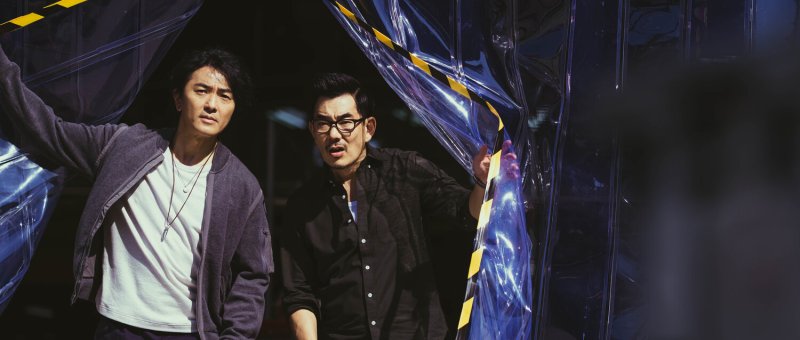
“Help those in need, then what about me?” asks the cynical hero of screenwriter Shum Sek-yin’s directorial debut, The Dishwasher Squad (洗碗天團). Another in the recent series of films exploring attitudes to disability in contemporary Hong Kong, Shum’s breezy comedy sees two self-centred businessmen with some extremely outdated and often quite offensive views decide that the only way to recover from being scammed into buying a moribund business is by exploiting the vulnerable only to eventually reawaken to their humanity if only perhaps to a degree. 

After Kyun’s (Richie Jen Hsien-chi) business fails, his best friend Lun (Ekin Cheng) comes up with a plan to buy out the industrial dishwashing plant owned by the friend of a friend who is apparently keen to sell because he wants to emigrate to Canada with his son who has learning difficulties. Strangely, on that very day, Kyun seems to find himself repeatedly running into disabled people for whom he seems to have little to no respect often using offensive language and even stealing an extra cookie from a young man with Down’s Syndrome collecting money for charity. Kyun seems fairly smug about each of these problematic encounters as if congratulating himself for getting one over on those he sees as lesser than himself. Unfortunately for him, however, while he thought he was conning the factory owner by telling him they planned to use the place to help the needy, the factory owner was actually conning him seeing as the business isn’t viable and is in fact riddled with debts. Not only that, all the staff were casual employees leaving Kyun and Lun with a huge problem seeing as they have legally binding contracts to fulfil and no staff to fulfil them. 

That’s one reason he eventually hatches on a cynical plan to take advantage of a government scheme to become a “Social Enterprise” in order to gain a subsidy by employing a majority of marginalised employees who might otherwise find it difficult to secure regular employment. Working with a local social worker (Hedwig Tam), he agrees to employ a young woman with autism and two men with learning difficulties along with another woman trying to rebuild her life after leaving prison. Aside from access to the subsidy, the main draw for Kyun is that he assumes he won’t have to pay them very much or even at all, getting the two men to work for free during their “probationary” period and thereafter attempting to fire one of them before it comes to an end. To bolster the work force, Kyun also recruits a series of undocumented South Asian migrants for much the same reasons assuming they will have little desire to make a fuss over their pay or conditions. 

Nevertheless, through close contact with each of his staff members Kyun finally begins to develop a sense of humanity though it’s unfortunate that his ability to recognise his employees as fellow humans only comes with a realisation that they are “useful” to him after all as they each and for varying reasons become attached to their new jobs and the atmosphere at the factory. It has to be said, however, that Shum’s otherwise positive message of people over profit is undercut by the series of fat jokes aimed at a female worker who at one point is seen eating from an automatic pet feeder, while a scene featuring an improvised stomach pump after an employee accidentally ingests detergent is also perhaps in poor taste even if hinting at the depths Kyun is prepared to sink to in order to protect his business interests.

Despite having bonded with his employees in a genuine sense of camaraderie, Kyun is still intent on exploiting his workforce and continues to see himself as superior if having developed a little more of a moral compass. Even so, he has perhaps developed the desire to run an honest business built on trust and compassion rather than greed and deception even if he hasn’t quite got there yet while reaffirming his friendship with Lun as they find themselves on a more even footing after a brief falling out. Mixing mild social issue themes regarding the difficulties faced by those marginalised by the contemporary society with lighthearted humour and a lot of heart, The Dishwasher Squad eventually argues for doing right by each other even if not everyone feels the same way. 


The Dishwasher Squad has its World Premiere on Oct. 17 at ChiTown Drive-in as part of the 13th Season of Asian Pop-Up Cinema.

Love in the Buff (春嬌與志明, Pang Ho-cheung, 2012)

love in the buff poster2010’s Love in a Puff was a delightfully low-key, slow burn romance in which two lonely smokers found each other over a back ally rubbish drum and a series of aimless text-based and ambulatory conversations. Jimmy and Cherie were both so diffident, fearful, and emotionally restrained that their grand love affair ended on a positive if ambiguous note, promising only to continue in forward motion. Where is there to go in a sequel? The same place again, apparently. Or, more precisely, Beijing.

So, Jimmy (Shawn Yue) and Cherie (Miriam Yeung) have found true love, moved in together and are very happy. Except, Jimmy is still Jimmy and Cherie is still Cherie and so there are problems. Things come to a head when Jimmy forgets a dinner arrangement with Cherie’s family, invites her to a beach party that turns out to be a work engagement, and then unwisely tries to win an argument by “reminding” her who plays the bills. Unsurprisingly, when Jimmy returns home Cherie has gone back to her mother’s. Jimmy takes a job in Beijing and starts dating an air hostess only for Cherie to also get an unexpected transfer to the mainland capital.

More or less following the pattern of the first film but with the roles of the protagonists reversed, Jimmy and Cherie find themselves falling back into the same old routine as they’re marooned in an unfamiliar city. Jimmy, still immature and self-centred, may have started an accidental relationship with a stewardess his friend intended to molest on an aeroplane, but it’s essentially superficial (at least from his side) and once again he finds himself texting Cherie whilst bored with his girlfriend’s elegant friend set. Cherie, not over Jimmy (much as she’d like to be) and perhaps regretting her over hasty grand gesture, begins a tentative relationship with a sensitive millionaire, Sam (Xu Zheng), whose only defects seem to be an old-fashioned idea of chivalry and the fact that he is extremely bald.

Despite Sam’s obvious goodness, Cherie can’t let Jimmy go and is ultimately disappointed to find that some of his childish strangeness has rubbed off on her – in fact, the very qualities which Sam finds attractive are ones she associates with Jimmy. Back to sneaking around, bickering, and exchanging cryptic text messages the pair are left to wonder if anything has really changed. The problems are exactly the same – neither one is willing to trust the other enough to make a real go of things. Cherie, still a little over sensitive about the (very small) age difference between herself and Jimmy as well as her ticking clock, resents being made to feel like the old ball and chain when Jimmy plays the coward in lying to her to go out drinking with friends. Jimmy still fears confrontation too much talk to Cherie in a straightforward way and so they’re locked in continuing cycles of passive aggressive drama.

Once again Jimmy and Cherie are the main draw though their friends take on a slightly larger role. Eunuch (Roy Szeto) remains Jimmy’s worst enabler as he urges him to make a series of bad decisions in making a life in the mainland capital, though there is a potential happy ending for Cherie’s “plain” friend Brenda (June Lam) whose lack of looks was the butt of such mean-spirited humour in the first film. Transposing the action to Beijing Pang takes another look at modern love with its marriage markets full of old women sitting in parks with signs selling the virtues of their sons not to mention the terrible blind dates but even if the actions of the central couple lean towards the sordid as they re-engage in accidental adultery, the romance is always gentle, innocent, and sincere. Jimmy and Cherie bonded in a puff, but now they have to learn to love each other “in the buff”, warts and all or call it quits.

Pang wisely drops the documentary conceit though maintains the laid-back aesthetic and whimsical music as the ballad of Jimmy and Cherie continues. The various cameo appearances threaten to derail the low-key style of the drama but once again Pang manages to capture something youthful, fresh, and heartfelt even if not moving very much beyond the original.


Original trailer (Cantonese with traditional Chinese/English subtitles)

https://www.youtube.com/watch?v=yoF6gwe1UOA