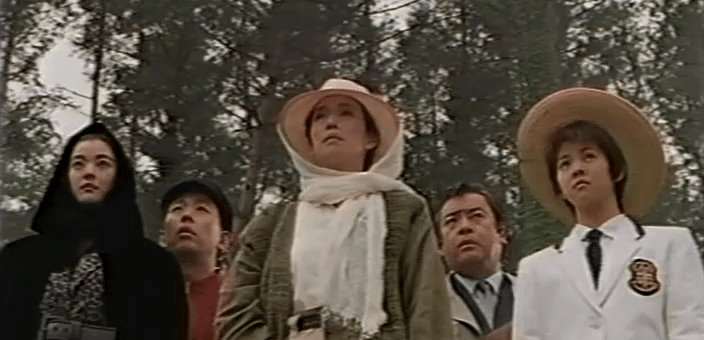
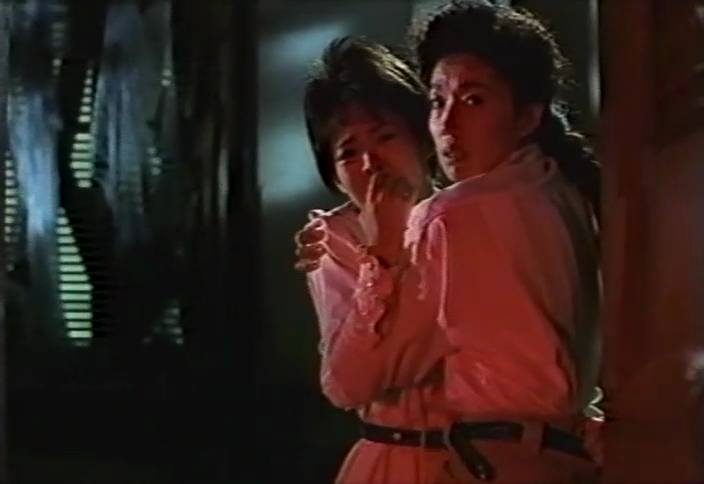
A documentary film crew hoping to discover long-hidden frescos by an artist with a tragic history find themselves on a quest to resurrect the traditional family in unlikely horror comedy Sweet Home (スウィートホーム). Written and directed by Kiyoshi Kurosawa, the film shares many of the hallmarks of his later career in his preoccupation with what lurks in the shadows, yet produced by Juzo Itami who also stars and apparently reshot some scenes himself it also mines a deep seam of ironic humour harking back to classic serials and contemporary kids adventures in the same way as Hiruko the Goblin among others would do just a few years later.
This strain of irony is perceptible in the opening scenes in which producer Akiko (Nobuko Miyamoto) appears in an elegant ’40s-style outfit more in keeping with an archeological dig than a haunted house adventure, her later attire strongly recalling that seen in Indiana Jones. The gang are waiting by their military-style jeep seemingly in the middle of a sandstorm while chief producer Kazuo (Shingo Yamashiro) is busy at the municipal office trying to get permission to enter the Mamiya Mansion which has been shut up for the last 30 years since the death of legendary artist Ichiro Mamiya who is the subject of their documentary. A diffident man as his daughter jokes, Kazuo finds it difficult to make headway until a slightly more cynical employee takes over the negotiations and hands over the key with the rationale that they’ll either find out the house isn’t haunted after all in which case they can turn it into a museum, or that they’ll get some tidy publicity out of the horrifying deaths of all concerned.
A western-style gothic mansion, the house is itself as imposing as it is ominous even without swirling mists or hovering gloom. Once inside the crew find what they’re looking for, a beautiful fresco with the title “home sweet home” painted in a corner. All we’re told about Ichiro is that he died in the house, but when all is said and done he, like Kazuo, is not terribly important and it is not his death which has cursed the mansion but that of his wife. The sweet home the couple had dreamed of was coming to fruition with the long-awaited birth of a child whose life was to inspire frescos on the remaining walls only tragedy struck. As a toddler the child somehow climbed into the furnace and was burnt alive when his unknowing mother ignited it. She then went mad, kidnapping other children and apparently burning them so her child would not be lonely before eventually throwing herself in too.
Perhaps uncomfortably, Sweet Home leans in to the kind of maternal questioning common to the genre as it considers the formation of a new family in the awkward romance between the shy widower Kazuo who has brought his teenage daughter Emi (Nokko) along on the job, and capable producer Akiko who is repeatedly questioned about marriage, children, and the reasons she currently has neither of them. Keying in to the terror of the house, Emi reveals that as she grows older the memories of her birth mother begin to fade to the extent that she can barely make out her outline, envisioning her merely as an indistinct light. She is prepared to accept Akiko as second mother, offering her the dress which her own mother used to wear only for Akiko to diffidently refuse on the grounds that the dress should be worn by Emi as her mother would have wanted perhaps hinting at the way Emi often treats her father as a clueless child in need of mothering himself.
Nevertheless, it’s the dress of maternity that Akiko must finally put on in order to claim the maternal space in venturing back into the haunted house in order to save Emi from becoming another playmate for Mrs Mamiya’s child. Rather than Kazuo, who proves rather ineffectual, she is guided by a weird old man, Yamamura (Juzo Itami), from the petrol station who apparently knows all about fighting ghosts but bluntly tells her she has no chance of success because she is not a mother herself and cannot understand the pain of a mother who has lost a child nor the magnetic pull between a childless mother and motherless child. In order to defeat the vengeful spirit, Akiko must fully embrace the role of the mother, easing the spirit’s pain with maternal compassion in returning to her what was lost. Her child restored to her, the spirit takes on the appearance of the Holy Mother ascending to Heaven bathed in golden light lifting the shadowy gloom that cursed the house.
Even so there is something insidious in the fact that as Yamamura says if you attempt to fight shadow with light all you get is more of the same, the crew trapped in the house with no means of defence against the encroaching darkness. This unknown, shadowy sense of threat, of being swallowed by darkness, is a key harbinger of a Kurosawa’s signature style as well as a clear evocation of the gothic dread focused on the house with the ironic failure of the “sweet home” dream which is in essence what Akiko, Kazuo, and an Emi are chasing as they try to escape the haunted mansion. Ironically enough, Sweet Home has become best remembered for fathering a video game which eventually led to the Resident Evil series while Kurosawa himself has all but rejected the film claiming Itami’s later interventions undercut his directorial vision. Featuring effects work by Dick Smith, the horror is visceral and disturbing at one point a man’s face melting, his skin slipping from his bones, while the score is cheerfully whimsical in keeping with the absurd lightness of tone that recalls classic teen adventures before heading into the fable-like conclusion in which Akiko must wrest her surrogate child from a vengeful spirit through maternal exchange. Having served its purpose the mansion implodes, freeing not only the spirits trapped inside but the new family now freed of the weight of traditional mores to embrace their new connection founded on love and empathy rather than duty or convention.
Original trailer (no subtitles)
 Some people love ramen so much that the idea of a “bad” bowl hardly occurs to them – all ramen is, at least, ramen. Then again, some love ramen so much that it’s almost a religious experience, bound up with ritual and the need to do things properly. A brief vignette at the beginning of Juzo Itami’s Tampopo (タンポポ) introduces us to one such ramen expert who runs through the proper way of enjoying a bowl of noodle soup which involves a lot of talking to your food whilst caressing it gently before finally consuming it with the utmost respect. Ramen is serious business, but for widowed mother Tampopo it’s a case of the watched pot never boiling. Thanks to a cowboy loner and a few other waifs and strays who eventually become friends and allies, Tampopo is about to get some schooling in the quest for the perfect noodle whilst the world goes on around her. Food becomes something used and misused but remains, ultimately, the source of all life and the thing which unites all living things.
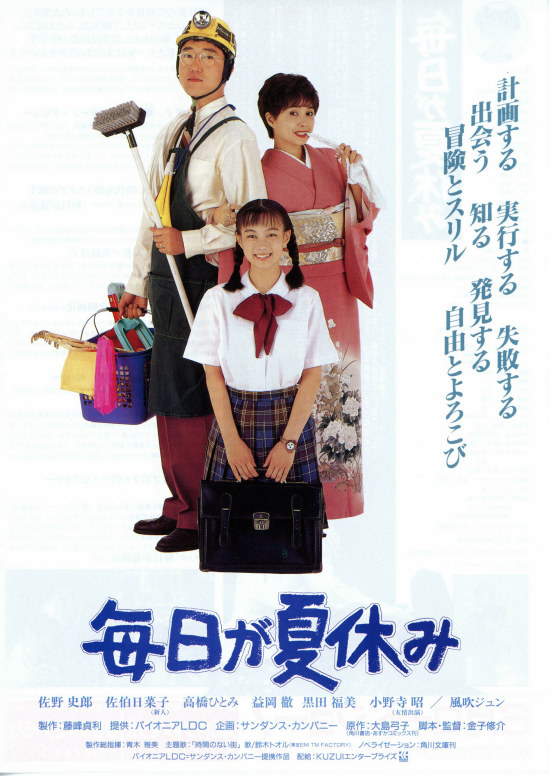 Summer Holiday Everyday – It’s certainly an upbeat way to describe unemployment but then everything is improbably upbeat and cheerful in the always sunny world of Shusuke Kaneko’s adaptation of Yumiko Oshima’s shoujo manga. Published in the mid-bubble era of 1988, Oshima’s world is one in which anything is possible but by the time of the live action movie release in 1994 perhaps this was not so much the case. Nevertheless, Kaneko’s film retains the happy-go-lucky tone and offers note of celebration for the unconventional as a path to success and individual happiness.
 Windows on Worlds