The White Storm 3: Heaven or Hell (掃毒3︰人在天涯, Herman Yau, 2023)

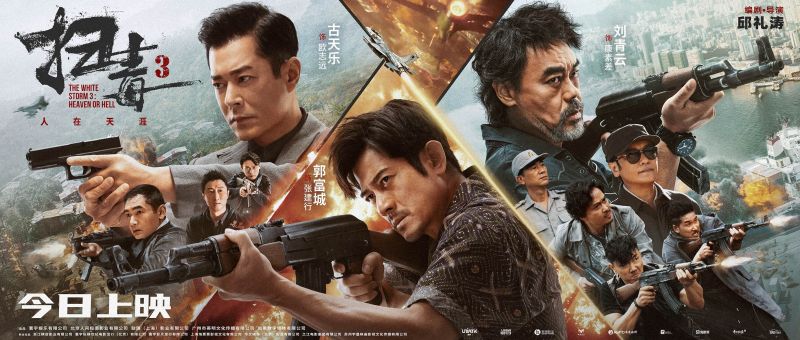
Who is the most foolish, the arch criminal who didn’t realise his two best buddies were undercover cops, or the cops that killed or took bullets for him? The latest in the White Storm series of standalone action thrillers with starry casts thematically dealing with drugs and organised crime, White Storm 3: Heaven or Hell (掃毒3︰人在天涯) like its immediate predecessor casts the net a little wider than just Hong Kong and is keen to stress the real victims of the international drug trade are the economically disadvantaged farmers who are left with no other option than to turn their fields to poppies. 

Back in Hong Kong, meanwhile, the film opens with local drug lord Suchat (Sean Lau Ching-Wan) retrieving a huge haul of drugs dropped in the ocean by helicopter only to be interrupted by the police who were watching all along. Suchat’s righthand man Yuen (Louis Koo Tin-Lok) blows his cover by pulling a gun to convince him to surrender, but Suchat chooses not to and in the firefight that ensues his other buddy, Hang (Aaron Kwok Fu-Sing), who is also an undercover cop and in fact very good friends with Yuen, is seriously wounded. In a show of loyalty, Suchat rescues Hang and manages to flee to Thailand where he sets up in his home village soon coming to the attention of the warlord who controls the local drug trade.

Describing the gang as the “rising stars of the Golden Triangle”, Suchat eventually cuts a deal with the general to provide security for his logistical operation in which drugs, mostly ice but also heroin, are transported inside fruit and other foodstuffs to be moved through the local market. Suchat had originally tried to set up his own operation only to fall foul of the general but also concedes that the margins in this game are fairly thin, no one in this area has any money to spend on drugs and there’s no point trying to produce them with the general in town so his only option is to provide a different service at another point in the chain. Hang becomes fond of the young woman who nurses him back to health, Noon, who explains that the only crop anyone is interested in is opium so aside from the food they grow for themselves it’s all they can produce to support themselves. There may a particular implication in her reply when Hang asks her if she’s ever considered moving that this even if this place is not a “home” because she has no remaining family members (her grandfather in fact seems to die of opium poisoning) it is still her hometown and why should she have to leave it. 

Before being taken to Thailand, Hang’s boss had worried that he might have spent too long undercover to successfully come back and it’s true enough that he seems to have become conflicted not only in his feelings for Noon but reflecting on the genuine brotherhood that exists between himself and Suchat whom he will eventually have to betray. Hang almost died for him, and Suchat repaid the favour by refusing to leave him behind. But on the other hand, there’s also a degree of homoerotic tension between himself and Yuen who rushes straight over to Thailand to rescue him once he’s able to make contact only to be frustrated when Hang tells him he has to go back to the village to save Noon who, as she’s already told him, does not actually want to leave despite the danger of constant violence from drug gangs and army raids. 

The film ends with the razing of the village of the Thai authorities who evidently decide the loss of life is justified in the necessity of stopping the general though it’s the ordinary farmers who lose their lives, families, homes and livelihoods because of their proximity to the trade in drugs. “I miss Hong Kong” Hang finally exclaims as if longing to shake off his undercover persona and recommitting himself to his role as a policeman but also perhaps hinting at a more subversive meaning as Yau ends on the clouds parting to reveal the famous city skyline amid picturesque terrain. Filled with a series of incredibly elaborate action sequences culminating in the all out warfare of the village raid, Yau’s heroic bloodshed subversion has its share of absurdity in the complicated relationships between its central trio and the ambivalent justice of its final resolution.


Original trailer (Traditional Chinese / English subtitles)
Crocodile Island (巨鳄岛, Simon Zhao & Xu Shixing, 2020)

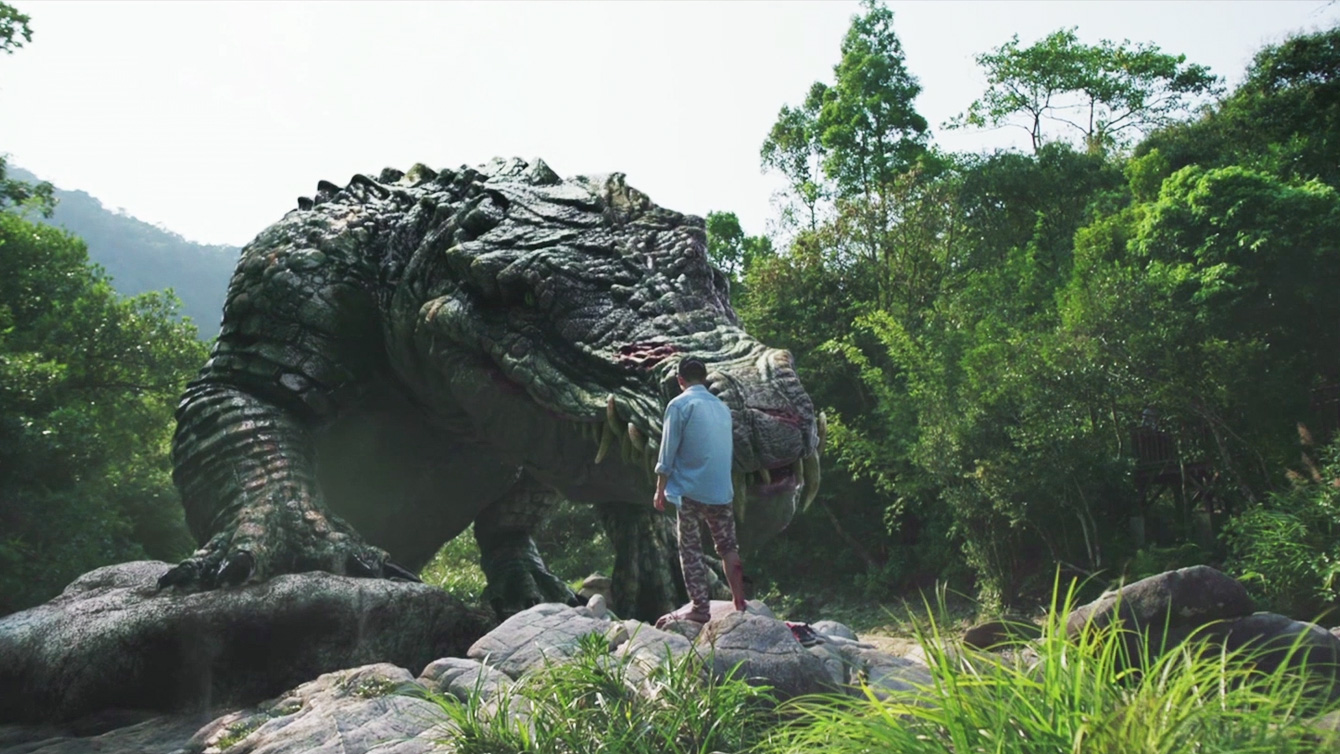
Monster movie streamer Crocodile Island (巨鳄岛, jù è dǎo) became a surprise hit in the early days of the pandemic as people increasingly preferred to entertain themselves at home, though of course in a way it may be somehow comforting to see people battle more obvious threats that they can actually see and physically resist. In any case, the film never promises much more than its nature as fodder for online streaming would suggest while admittedly pinching plot elements from other similarly themed movies such Train to Busan and positioning the central conflict as effective paternity rather than the monster itself.

A brief prologue finds American pilots flying through the Dragon Triangle during the Second World War while ominously carrying cargo labeled as containing dangerous radiation though the reason they later crash on an uncharted island is that they are suddenly attacked by what appear to be pterodactyls. Nevertheless, the radiation is later given as an explanation as to why all the creatures on the island have evolved into huge and terrifying monsters including the titular crocodile.

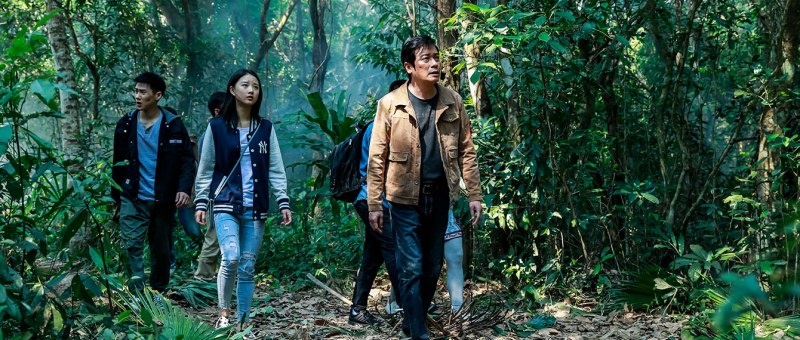
Flash forward to the present day and grumpy middle-aged man Lin Hao (Gallen Lo Ka-leung) is escorting his estranged 19-year-old daughter Yiyi (Liao Yinyue) home to China following the sudden death of her mother in Australia where the pair had been living. Yiyi has secretly been accompanied by her university student boyfriend Cheng Jie (Wang Bingxiang) of whom Lin clearly does not approve, not yet able to shift his perspective on the daughter he hadn’t seen in five years to realise she is no longer a little girl. Family bonding will however have to wait as the plane they’re travelling on alongside a pregnant lady and her husband, an influencer, and an obnoxious man travelling home for a heart transplant, is pulled into Dragon’s Triangle by magnetic interference and crash lands on the island where several of the survivors are quickly swallowed by the crocodile. 

Those who remain are therefore faced with a series of dilemmas as to whether to help each other or prioritise their own survival with Cao Fang (He Qiwei), the heart transplant candidate, actively pushing several of his fellow passengers towards the crocodile so that he can get away. Lin meanwhile quickly takes charge and is more or less unchallenged as they try to explore the island in search of clues hoping that the radio equipment in the ‘40s plane they read about in a diary one of the pilots left behind will allow them to make contact through the outdated tech of radio waves. 

This is might be something of a plot hole seeing as it obviously didn’t work for the American pilot though perhaps there just weren’t any ships in range given the circumstances, and it seems he too might have come to a sticky end. But thanks to his sudden promotion to father of the group, Lin begins to reassess his role as a father to Yiyi in beginning to cede ground and actually listen to some of her ideas along with accepting support from Cheng Jie to help him protect her not lease because he realises he may not survive. There are also a few other giant and very hungry monsters on the island who in this case turn out to be more of a threat than other people who with the exception of Cao Fang are more community minded than individualistic. 

A mild social message is conveyed through Yiyi’s eventual discarding of the cigarettes she secretly smoked, symbolising the end of her rebellion and the re-acceptance of her father along with his patriarchal authority as if shifting back onto the right path thanks to the experience of fighting a giant crocodile together and realising that he really did stay to protect her instead of just going off on his own. Some undeniably ropey special effects and a general lack of coherence in the film’s internal logic frustrate its ability to maintain momentum though English-speakers aside, the performances are strong even if the plot developments at times feel unoriginal. Even so the film sells its message of family reunion and perhaps less palatably patriarchal social conventions as Lin Hao steps up to protect his daughter and community from the threats that surround them be they giant crocodiles or otherwise.


Crocodile Island is out now in the US on Digital & DVD courtesy of Well Go USA.

US release trailer (English trailer)