Dead to Rights (南京照相馆, Shen Ao, 2025)

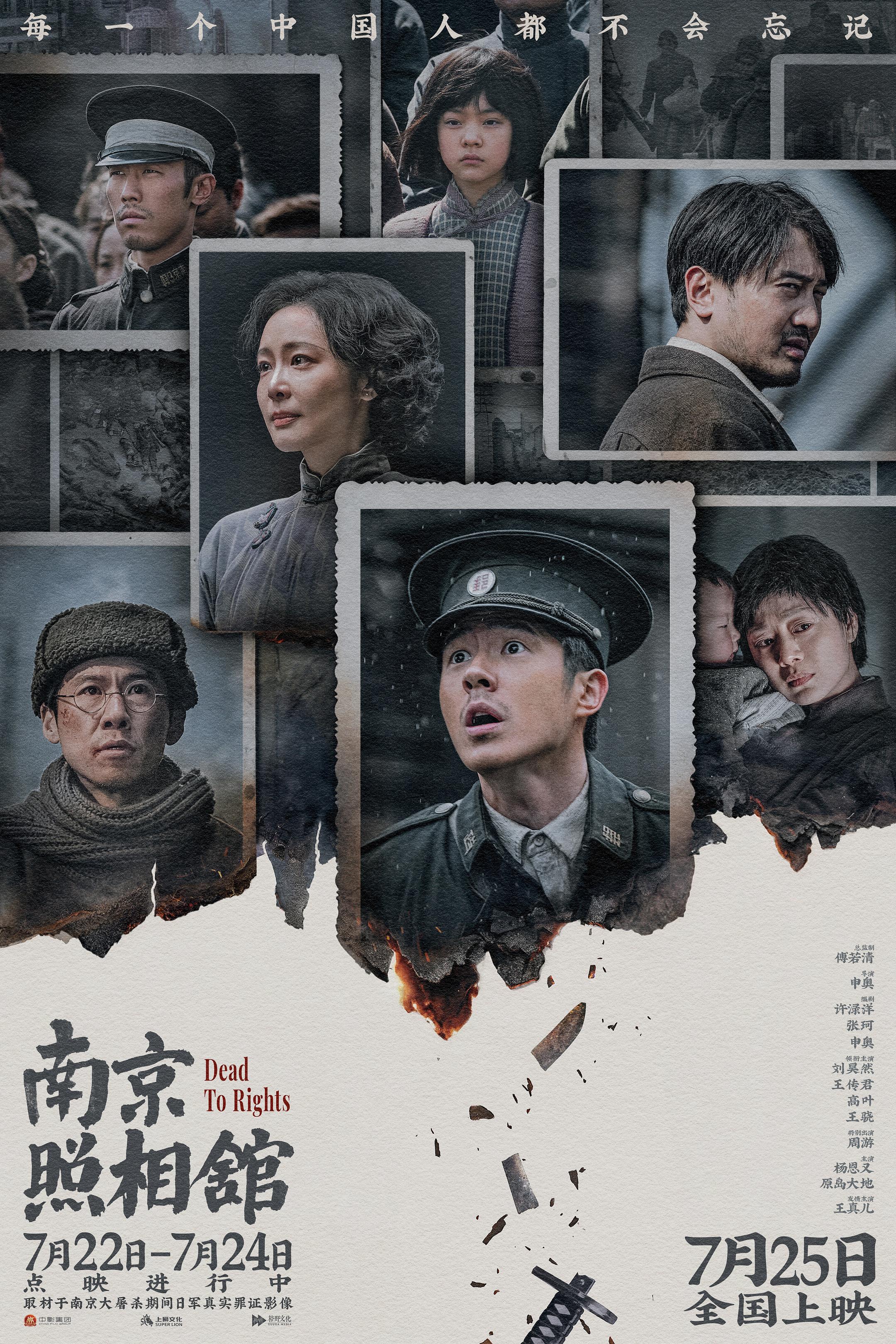
“All you have to do is survive,” turncoat translator Guanghai (Wang Chuanjun) tells his conflicted mistress Yuxiu (Gao Ye) in trying to justify his decision to collaborate with the Japanese whom he assumes will end up winning this war and taking control of China’s future. Perhaps his strategy is understandable, even sensible in some ways, in allying himself with an invading force and using them for protection while trying to get his hands on exit visas for his wife, son ,and mistress too, but is this level of complicity really permissible given the unfolding atrocities all around him?

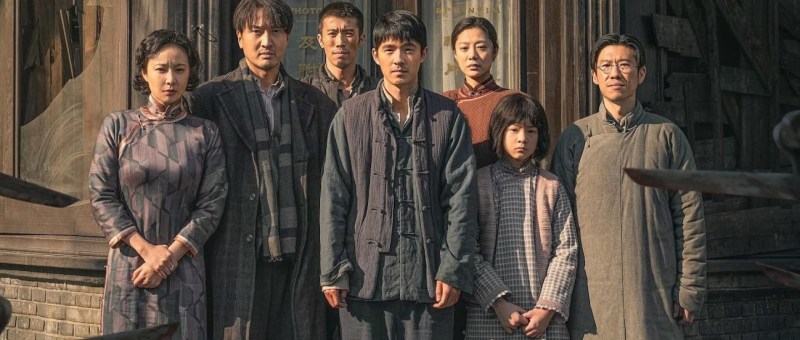
Released to mark the 80th anniversary of the end of the war, Shen Ao’s gritty drama is inspired by the efforts to expose the horror of the Nanjing Massacre, though it was not actually exposed in the way the film implies. This might explain the strangeness of the English language title which is perhaps intended to signify that they have the Japanese bang to rights for the atrocities they committed because of the photo evidence which they themselves took. A young Japanese officer, Hideo Ito (Daichi Harashima), whom the film seems to imply is a descendant of Hirobumi Ito who was assassinated by Korean Independence activists in Harbin in 1909, is employed as a war photographer having apparently been given this position to keep him safe while fulfilling his elite family’s military duty. Ito appears in some ways conflicted but in others indifferent to the chaos around him. He cheerfully takes photographs of Japanese soldiers holding the heads of Chinese citizens they’ve beheaded or bayoneting babies, and is genuinely confused when his pictures come back marked “no good” because he thought they’d be good for encouraging morale rather than evidence of inhuman depravity that would dishonour his fellow countrymen. 

Neverheless, he baulks at the idea of killing anyone himself which is one reason he looks for an excuse not shoot Ah Chang (Liu Haoran), a postman caught in the street trying to flee the city. Noticing a photo album that fell out of his postbag, Ito asks him if he knows how to develop photographs. Chang nods to everything he says to save his own life and Ito makes him his personal developer. Of course, Chang doesn’t know anything about photography, but is unexpectedly saved first by Guanghai who realises he’s not who he says he is but says nothing, and then by the owner of the photo studio, Jin (Wang Xiao), who is hiding in the basement with his wife and two children. Chang develops the photos with Jin’s help, but becomes conflicted on discovering those of the atrocities in feeling as if by developing them he has become complicit in the Japanese’s crimes. 

Ito insists that he and Chang are “friends”. When the Japanese marched into the city, they said they’d abide by the Geneva Convention and surrendering soldiers would be treated kindly. They repeatedly state that it’s the Chinese who have spurned their “friendship” by resisting them, but the Japanese soldiers refer to the Chinese as pigs and dogs, raping, killing, and pillaging without a second thought. One of the women at Yuxiu’s theatre tries to flee but is caught and made into a comfort woman later losing her mind. Yuxiu too is raped by Japanese soldiers after being forced to sing Peking Opera for them, which they do not really appreciate, just as the soldiers other than Ito fail to recognise the value of traditional Chinese art. 

In what’s become a famous and potentially incendiary line, Chang eventually fires back that “we are not friends” and it’s true enough that the film is also, to some extent, indulging in a contemporary anti-Japanese sentiment which has already led to violence. The poster tagline reads “No Chinese person can ever forget”. Nevertheless, it largely avoids overt propaganda aside from some jabs at the KMT who fire on their own soldiers and featuring a large picture of Chiang Kai-shek who abandoned Nanjing which had been the capital, ceding it to the Japanese and retreating to Wuhan, until the second half of the film in which Jin flicks through the various backdrops he has of famous Chinese landmarks and Chang remarks “not one inch less” emphasising that in any era China will give no ground. The sentiment undoubtedly also applies to “lost” territories to which the Mainland thinks it has a claim such as Taiwan.

The act of photography thereby becomes a means of resistance in turning the images that Ito had intended to be pro-Japanese propaganda into those which will eventually damn them. Chang and Yuxiu are forced to pose with a dead baby murdered by a Japanese soldier as part of Ito’s staged photoshoot designed to disprove the earlier pictures in insisting that the Chinese population have welcomed the Japanese and are happy to be citizens of its empire, but discover their way of resisting in reversing the historical truth by keeping hold of the negatives. 

But Ito is perhaps, like Guanghai, caught out by his own naivety in failing to realise that allowing Chang to develop the photos has also made him a witness, so now he knows too much. Though he originally tries to protect him and insists they’re “friends”, Ito soon changes his tune on realising his mistake and that he could end up in trouble if his photos of the atrocities are leaked. Though the generals express distaste and instruct their officers to stop the soldiers rampaging, the local commander, Inoue, tells Ito that they must destroy China to take it which is why he lets the men do as they please in an attempt to break their spirit. But their spirit doesn’t break. Chang and the others continue to plot escape and the eventual exposure of the horrific acts committed by the Japanese in Nanjing. Technically accomplished and elegantly staged, Shen’s harrowing drama seems to say that the truth will out and that sooner or later there will be a reckoning in which all will have to answer for the choices they have made.


Trailer (simplified Chinese / English subtitles)

Article 20 (第二十条, Zhang Yimou, 2024)

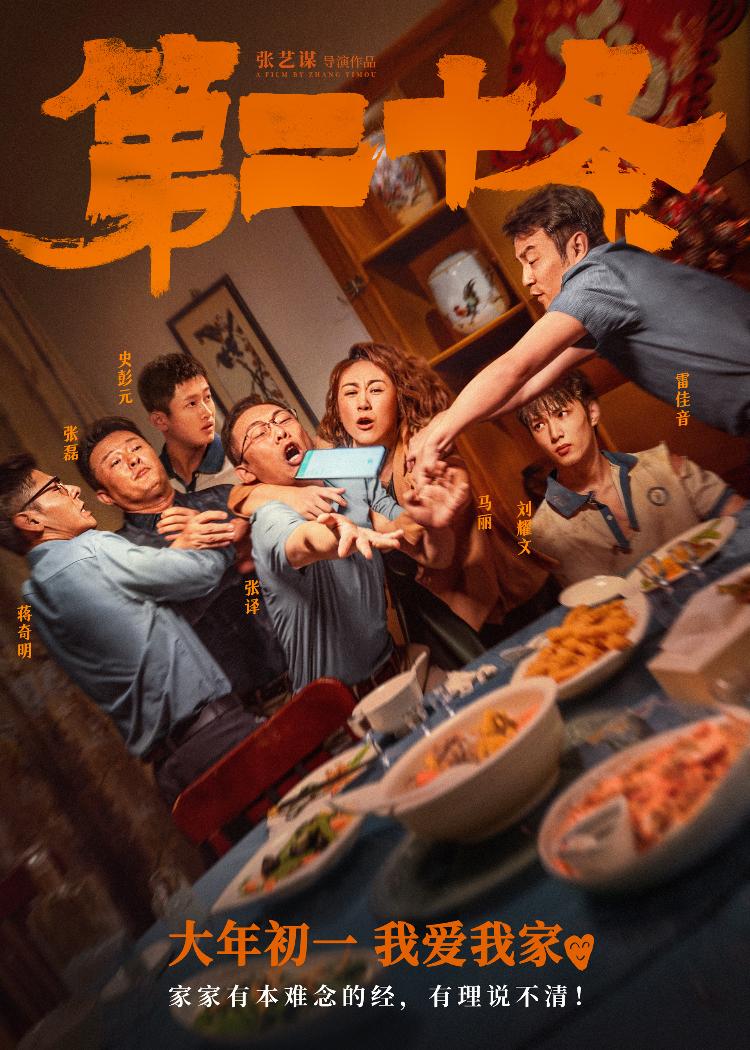
There’s something quite strange going on in Zhang Yimou’s New Year legal dramedy Article 20 (第二十条, dì èrshí tiáo). Generally speaking, the authorities have not looked kindly on people standing up to injustice in case it gives them ideas, yet the film ends in an impassioned defence of the individual’s right to fight back in arguing that fear of prosecution should not deter “good” people from doing “the right thing” such as intervening when others are in danger. Nevertheless, the usual post-credits sequences remind us that the legal system is working exactly as it should and the guilty parties were all caught and forced to pay for their crimes.

In this particular case, the issue is one akin to a kind of coercive control. Wang (Yu Hewei) stabs Liu 26 times following a prolonged period of abuse and humiliation. After taking out a loan to pay for medical treatment for his daughter who is deaf and mute like her mother Xiuping (Zhao Liying), Wang was terrorised by Liu who chained him up like a dog and repeatedly raped his wife. Prosecutor Han Ming (Lei Jiayin) eventually argues that his attacking Liu qualifies as self defence under Article 20 of the constitution because even if his life was not directly threatened at the time it was in the long term and he did what he did to protect himself and his family from an ongoing threat.

Han Ming becomes mixed up in several different cases along the same lines only with differing levels of severity. Some years ago he’d worked on the case of a bus driver who was prosecuted after stepping in to help a young woman who was being harassed by two louts. His problem was that he got back up after they knocked him down and returned to the woman which makes him the assailant. Zhang has spent most of his life since his conviction filing hopeless petitions in Beijing. Meanwhile, Han Ming’s son, Chen (Liu Yaowen), gets into trouble at school after stepping in to stop obnoxious rich kid and Dean’s son Zhang Ke from bullying another student.

Now jaded and middle-aged, Chen first tells his son that he should he give in an apologise to get the boy’s litigious father off his back though Chen is indignant and refuses to do so when all he did was the right thing in standing up to a bully. Bullying is the real subject of the film which paints the authoritarian society itself as a bully that rules by fear and leaves the wronged too afraid to speak up. The choice Han Ming faces is between an acceptance of injustice in the pursuit of a quiet life and the necessity of countering it rather than live in fear while bullies prosper.

The thesis is in its way surprising given that the last thing you expect to see in a film like this is encouragement to resist oppression even if the idea maybe more than citizens should feel free to police and protect each other from the immorality and greed of others. It is true enough that it’s those who fight back who are punished, while the aggressor often goes free but according to Han Ming at least the law should not be as black and white as some would have nor be used as a tool by the powerful, or just intimidating, to oppress those with less power than themselves. 

Other than the theatrical drums which play over the title card, there is curiously little here of Zhang Yimou’s signature style while the film itself is not particularly well shot or edited. It also walks a fine line between the farcical comedy of Han Ming’s home life in which he perpetually bickers with his feisty wife (an always on point Ma Li) who worries he’s too interested in his colleague Lingling (Gao Ye) who turns out to be an old flame from his college days during which he too was punished for standing up to a bully by being relegated to the provinces for 20 years. A minor subplot implies that the justice-minded Lingling is largely ignored because of the sexist attitudes of her bosses who feel her to be too aggressive and often dismiss anything she has to say in what amounts to another low level instance of bullying. The film ends in a rousing speech which seems more than a little disingenuous but even so ironically advocates for the right to self-defence against a bullying culture while simultaneously making a case for the authorities having the best interests of the citizen at heart which would almost certainly not stand up particularly well in court.


Article 20 is on limited release in UK cinemas courtesy of CMC.

International trailer (English subtitles)

Endless Journey (三大队, Dai Mo, 2023)

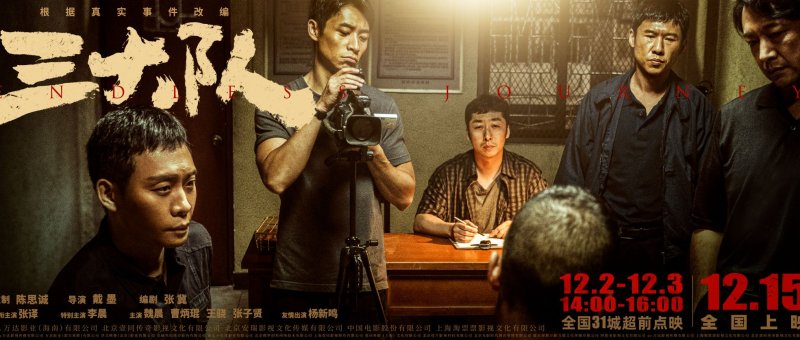
The police officers at the centre of Dai Mo’s Endless Journey (三大队, Sān Dàduì) are soon stripped of their badges, accused of excessive force contravening laws existing since the medieval era to prevent vigilante justice. Yet in someways that’s essentially what they end up doing, extra-judicial investigators with a personal vendetta rather than a pure-hearted interest in justice even if the victim of the crime weighs heavily on their conscience. 

Though the film plays into the recent trend in Sino-noir and popularity of mystery thrillers at the Chinese box office, it is surprising that a film that is at least subtly critical of the justice system, featuring police who break the rules and are sent to prison, was approved by the censors board even if the central message is one of heroism as Captain Cheng (Zhang Yi) doggedly chases his suspect all over China for several years. Then again, the hero of this true life case turns out to be China itself as Cheng is reminded that his search is unnecessary given that the fugitive, Eryong (Zheng Benyu), is sure to be captured by the burgeoning surveillance network of CCTV cameras then being rolled out across the country. Years later, it’s the system that allows Cheng to identify Eryong as his DNA and fingerprints throw up positive matches within seconds of samples being taken thanks to the nation’s DNA database. 

Even so, as the veteran officer, Zhang (Yang Xinming), reminds the rookie behind every major case there’s a ruined family broken by their loss which is one reason why he doesn’t relish the prospect of investigating one so late in his career. This particular crime is so heinous that it’s become front page news which means that they’ve also got their boss breathing down their necks to get it solved as soon as possible with the existence of Division 3 itself on the line. Cheng pops home for a matter of minutes to check on his wife and daughter, shutting down his wife’s suggestion that they get a security system for their windows on the grounds that it would be an embarrassing thing for a detective’s home to have. The reason she wants one is that the victim in this case had been a little girl of around their daughter’s age unexpectedly home alone when thieves broke in by climbing over their aircon unit and smashing a window. Finding nothing of value they raped and killed the daughter. 

After a police officer dies as a result of the investigation, the squad take things too far questioning the first suspect leading to his death which is how they end up disgraced and sent to prison. After his release, Cheng has lost his family, his home, his job and identity as a protector of justice yet his determination to catch Eryong is born more of his desire to avenge a friend than it is to prevent further crime. His fellow officers join him in the beginning, but during the endless searching each make the decision to move on for easily understandable reasons such as their marriages, children, and illness but Cheng cannot let go even when prompted by an old friend from the force who tells him they have this in hand though there is perhaps a subtle implication that the police force isn’t really doing enough otherwise Cheng wouldn’t have to be chasing Eryong all over the country. 

But haunted by reflections of his own face, ageing, at times dishevelled and hopeless, Cheng is also searching for himself and a means to reclaim the self he once was by vindicating himself as a policeman along with Division 3 in finally completing their mission. The ominous score by Peng Fei with its stinging strings adds to the noirish feel as does the perpetual inevitability of Cheng’s forward motion in the dogged pursuit of his prey, unable to rest until Eryong has been brought to ground. His quest robs him of his life, but there is an undeniable poignancy to it in Cheng’s inability to find himself outside of the chase only to be left with a moment of uncertainty no longer sure who he is or where he goes now, left alone and with no sense of direction in the absence of his quarry.


Endless Journey is in UK cinemas now courtesy of CMC.

International trailer (English subtitles)

Lost, Found (找到你, Lü Yue, 2018)

Lü Yue’s Lost, Found (找到你, Zhǎodào Nǐ) follows hot on the heels of Korean kidnap drama Missing but it is not, apparently, a remake but part of an increasing trend of global filmmaking in which an original scenario is developed for several territories simultaneously with Qin Haiyan’s script reportedly produced while the Korean version was shooting. Despite sharing the same plot outline, however, Lost, Found puts a distinctly Chinese spin on the central dilemma as its cynical heroine is forced to reassess her life choices and her entire relationship with her society when her daughter disappears.

Li Jie (Yao Chen) is a high flying, cynical lawyer who only cares about winning cases. At home, she’s mother to two-year-old Duo Duo and is currently engaged in a custody battle with her daughter’s father following the breakdown of her marriage to a successful surgeon. To help her out at home with her busy schedule, she’s employed a young woman, Sun Fang (Ma Yili), as a nanny but is at times jealous that her little girl seems more attached to the traditionally maternal home help than to her biological mother. Her worst fears are realised one day when she returns home to find dirty breakfast dishes still on the table and the flat empty. Worrying her mother-in-law has managed to snatch Duo Duo, Li Jie is reluctant to get the authorities involved but is eventually forced to acknowledge that something more serious may have occurred with Sun Fang nowhere to be found.

Talking to her former husband, Li Jie insists that a woman’s future shouldn’t be decided by love or marriage and that she wants Duo Duo to have more freedom but she’s distinctly slow to warm up the theme of female solidarity as shown by her callous treatment of the defendant in her divorce case in which she is trying to win custody on behalf of an adulterous husband by calling into question the wife’s mental stability. Despite the woman’s pleas as one mother to another, Li Jie coldly tells her that the circumstances are largely irrelevant – she is merely a lawyer wielding the law and will do her best to win the case because that is her job.

Forced to investigate the life of Sun Fang, however, her perspective begins to shift. Busy as she is, Li Jie did not perhaps pay as much attention to her nanny as she should have. She took the word of a neighbour with whom she was not particularly close that Sun Fang was a trusted relative with childcare experience without asking for documentation or employment records. Besides, Sun Fang was good with the child and Duo Duo seemed to like her so Li Jie felt comfortable leaving her in Sun Fang’s care. What she discovers is that Sun Fang had experienced many difficulties in her life which she, as an urban middle-class and highly educated woman, had largely been protected from. Because she personally had not suffered, she was content not consider the suffering of others and thought only of herself, even perhaps regarding possession of Duo Duo as something to be won on a point of pride rather than an expression of maternal love or a deeply seated belief that she could offer better care.

Despite its fairly progressive message of social responsibility and female solidarity, Lost, Found takes a disappointing turn for the conservative when it implies that Li Jie should ease back on her career to focus on motherhood rather than allowing her simply to re-embrace her love for her daughter without fear or anxiety. Yet it does also encourage her to contemplate the increasingly unequal nature of the modern China – men/women, town/country, rich/poor, destinies are decided largely by circumstances of birth rather than individual merit. If Li Jie had been born in the same place as Sun Fang, her life might have been much the same. Realising she should have taken more of an interest in the woman raising her child, Li Jie is forced to accept that her own privilege has blinded her and that she does indeed have a responsibility to others and to her society if most particularly to her daughter. A tense, frantic tale of frustrated motherhood, Lost, Found is at once a condemnation of modern disconnection and a quiet plea for a return to kindhearted altruism.


Lost, Found was screened as part of the 2019 Udine Far East Film Festival.

Original trailer (English subtitles)