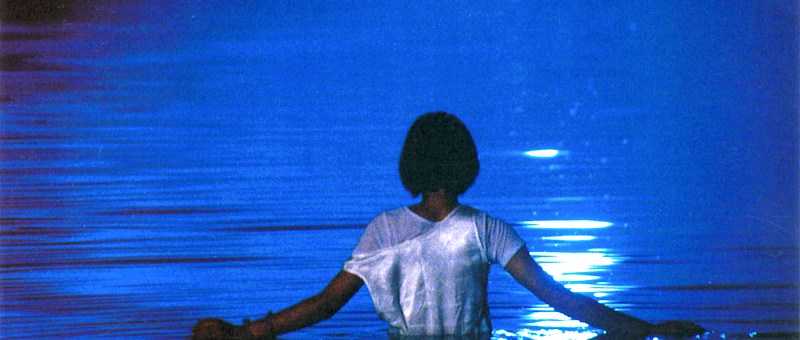
August in the Water (水の中の八月, Sogo Ishii, 1995)

How does the world, or perhaps the cosmos, attempt to communicate with us? As Douglas Adams once did, August in the Water (水の中の八月, Mizu no naka no Hachigatsu) suggests it maybe through the dolphins who here at least seem to be quasi-mystical beings existing in what is really the lifeblood of humanity. In the film’s opening scenes, we’re told that the hero, Mao (Shinsuke Aoki) whose name means “true fish” and his friend Ukiya (Masaaki Takarai) have taken part-time jobs at a marine part to learn how to communicate with dolphins, but it’s the heroine Izumi, whose name means “spring” who eventually claims to have learned to do so. 

At least, her final words are that the dolphins have taught her “the perfect balance” which has allowed her to open the floodgates both literal and metaphorical to return water to an arid land. We’re repeatedly told that there’s been a lengthy drought and a water shortage leading to rationing and locked pipes though the marine park remains open and the local festival goes ahead  hinting at the ways in which we do and don’t value our natural resources. Izumi’s science teacher tells the kids that humans don’t contribute to the Earth and waste the resources that it gives us which might help to explain the gradual ossification of the planet including a mysterious condition known as the Stone Disease which causes people to collapse in the street as their organs harden. 

Izumi’s sister Yo later remarks that she thinks humanity came from a distant planet long ago and yearns to go home but to do so we must become stone because water is a substance that exists only here on Earth. Turning to stone is however seen as quite a bad thing and also echoes a millennial distrust in increasing technology with TV pundits positing that if human brains were replaced with computer chips we wouldn’t need to worry about water shortages anymore. In Yo’s dream, after people’s brains have become computer chips they become connected to the universe and can transport their minds to the moon enabling them to communicate with anyone anywhere at any time. 

But then despite the potential for communication that computers were only just beginning to offer in the mid-90s, Izumi warns her sister to stay away from them as they leave you vulnerable to the Stone Disease. The boys’ ultramodern friend, Miki (Reiko Matsuo), is a computer addict and it’s she who eventually manages to unlock parts of the mystery but paradoxically as if she were some kind of seer correctly predicting that an accident will befall Izumi on 23rd August and discovering a prophecy that in the year humanity neglects the water god two meteorites will fall in close proximity and drought will follow. Only a ritual conducted by the chosen one under a full moon will be able to cure it. Two child-like old men also warn that nothing’s been the same since they moved the old shinto shrine over which there have also been sightings of UFOs.

After the diving accident in which Izumi plunges meteor-like into the pool, she herself feels as if she’s been split in two almost like the world itself which is divided between these ancient beliefs and modern advancements that have perhaps blocked the flow that once allowed us to communicate with each other and with the universe. A psychiatrist suggests that Izumi may be suffering with sudden onset schizophrenia as a result of her accident and that all of her talk about secret messages from dolphins and mysterious aliens who want to turn the world to stone is nothing but confused delusion though in the film’s closing scenes she herself takes on a supernatural quality as a kind of etherial saviour figure who realises that she may have been dead ever since the accident and is now something different, different and distant as her sister puts it, charged with the mission of rejuvenating a human spirit long since dulled by mechanisation.

In contrast to Ishii’s earlier films which brimmed with punkish energy, August in the Water unfolds at a leisurely pace with eerie yet nostalgic mood music and a new age sensibility speaking to millennial youth with a sense of turn of the century anxiety and human remorse that perhaps we’ve already poisoned our futures. Nevertheless, despite his youthful heartbreak, what Izumi bequeaths to Mao and humanity itself is seemingly the ability to live in the abundant fullness of existence until that existence is done and we return once again to water and the comforting embrace of the Earth.


August in the Water screened as part of this year’s JAPAN CUTS.

Knockout (どついたるねん, Junji Sakamoto, 1989)

Knockout cap 1Thirty years after his debut, the career of director Junji Sakamoto has proved hard to pin down. An early focus on manly action drama gave way to character pieces, issue films, and comedy, but it was with his breakout first feature Knockout (どついたるねん, Dotsuitarunen) that something like a signature style was born. One of Japan’s many boxing movies (perhaps an unexpectedly populous genre), Knockout is once again the story of a man fighting himself as he struggles to overcome serious physical injury, emotional trauma, and his own fiercely unpleasant personality to finally become the kind of champion he has always feared himself incapable of becoming.

Dreaming dreams of boxing glory, Adachi (Hidekazu Akai) trained hard since he was a small boy and eventually became a champion of the ring. However, an ill-timed blow from a subpar opponent left him with an unexpected, life threatening injury requiring brain surgery after which he was advised to stay behind the ropes for the remainder of his days. A total asshole with a violent streak, Adachi can’t help alienating all those around him including childhood friend Takako (Haruko Sagara) whose father owns the National Brand gym where he used to train and had given vague promises of taking over once he retired. In his newly irritable state, Adachi has decided to start his own high class gym and has teamed up with a boxing enthusiast friend, Harada (Tetsuya Yuki), who runs a gay club, to buy National Brand’s promoter license to set up alone.

This being the kind of film that it is, it’s a given that Adachi will eventually want to get back in the ring despite all the inherent risks to his physical body. Nevertheless, the journey towards that realisation will be a humbling one as he is forced to confront the fact that he is a terrible person whose intense self obsession and intimidating behaviour has everyone around him walking on eggshells. Consequently, he does not make a particularly good boxing coach thanks to his didactic methods and rigid insistence on doing everything his own way. Only the kindly assistance of an older man, Sajima (Yoshio Harada), who also retired from the ring through injury, begins to show him the error of his ways but it’s not until he’s truly alienated all of his prospective pupils, as well as his patient backer, that he finally understands where it is that he belongs. 

Set in his native Osaka, Sakamoto weaves a rich tapestry of local life from the feisty Takako who dearly wanted to get in the ring herself only to be met with the constant refrain that boxing’s not for girls, to the mysterious Harada and his largely offscreen gay bar at which Adachi seems to be a frequent yet unwilling visitor who claims the place is too “weird” and fears interacting with others in the establishment. Meanwhile the applicants at his new gym which promises training with a “kindly” coach run from young toughs to softening salarymen desperate to engage with their dwindling masculinity. This is definitively a manly affair in which the frustrations of young(ish) men take centre stage though mainly through the destructive effects they have on the world around them – you’ll nary find a face around here that doesn’t have a bruise on it. While Adachi’s parents tiptoe around their own son as if he were some sort of gangster, Takako is the only one willing and able to stand up to him save the late entry of Sajima who appears to be dealing with some neatly symmetrical family issues of his own.

Starring real life boxer Hidekazu Akai, Knockout strives for realism in the ring even whilst emphasising the ongoing psychodrama that lies behind it. Adachi, like many boxing heroes, is engaged in constant battle with himself, trying to overcome the frightened little boy he once was rather than accepting him and admitting that even older he is often still scared and angry without really knowing why. Perhaps through his final, infinitely dangerous entry into the ring he will find some kind of answers to the questions he has been too afraid to ask but he has, in any case, become less of a problem for those around him in his continued quest towards becoming the best version of himself.


The Fallen Angel (人間失格, Genjiro Arato, 2010)

fallen-angelThe Fallen Angel (人間失格, Ningen Shikkaku), based on one of the best known works of Japanese literary giant Osamu Dazai – No Longer Human, was the last in a series of commemorative film projects marking the 100th anniversary of the author’s birth in 2009. Like much of Dazai’s work, No Longer Human is semi-autobiographical, fixated on the idea of suicide, and charts the course of its protagonist as he becomes hopelessly lost in a life of dissipation, alcohol, drugs, and overwhelming depression.

Even when we meet him as a small child, Yozo Oba (Toma Ikuta), feels himself set apart from his peers. Unable to connect fully with the people around him, Yozo gets through life by playing the clown. As a teenager, he meets another boy, Takeichi, who can see straight through his mask and encourages him in his artistic pursuits. Eventually, Yozo moves to Tokyo where he meets another artist, Horiki (Yusuke Iseya), who introduces him to the seedier pleasures of the city including drinking and hostess bars.

Yozo still feels adrift and is unable to cement his new found friendship with true connection. After asking Horiki to die with him (which he laughingly refuses to do), Yozo begins an ill-starred romance with a melancholy bar hostess with whom he does actually attempt double suicide. She dies, he doesn’t but his life is changed when he loses access to his familial wealth and is kicked out of university because of the scandal. Yozo has another shot at conventional happiness by briefly forming a family with a single mother and her little girl before leaving them because of problems resulting from his alcoholism. Eventually marrying a kind hearted woman, Yozo kicks the booze for a while and builds a career in manga but sure enough Horiki finds him and ruins his marital bliss by setting him back on the road to dissipation.

Arato makes a few changes to Dazai’s novel, mostly streamlining the book’s tripartite structure by eliding two events into one, but perhaps because of the well known nature of the story, he feels comfortable in making abrupt cuts and wide ranging shifts in terms of time. Dazai’s novel is much more focussed on the mental condition of its protagonist, whereas Arato has opted for a more overt display of the increasingly tense political environment with soldiers lurking in the background, later occupying a train shortly before the scene turns into a surreal segment in which Yozo reacquaints himself with all those he’s wronged throughout the course of the film.

Yozo’s tragedy is his inability to connect with other people even though he leads an ostensibly successful social life. Making himself an amiable presence, Yozo keeps people around him by making himself a figure of fun – a mask which gradually becomes far too heavy to wear. This buffoonish aspect of his personality is not very much in evidence in Arato’s film which focusses much more on his underlying depression than the joviality he uses to try and prevent anyone noticing just how broken he is inside. For this reason it becomes harder to see why everybody lets Yozo get away with his extremely bad behaviour for so long. Toma Ikuta captures Yozo’s listlessness and despair but without the necessary intensity to back them up and, ironically, without his sad clown routine Yozo does not always seem like someone anyone would want to hang out with for any great length of time.

Arato has recreated the novel’s pervading sense of numbness and despair to the letter with the consequence that his film remains resolutely cold. As appropriate as that may be, it makes it harder to achieve the kind of connection forged through Yozo’s first person narrative in the book. This approach brings out Yozo’s unpleasant qualities – his selfishness, weakness, cowardice, and propensity to addiction, but fails to display his better ones which lead to him being characterised as the ruined “angel” of the title. In distancing us from Yozo, Arato encourages us to see him either as a metaphor for the political turmoil taking place in his country during his lifetime, or simply as a someone whose intense self loathing eventually destroys his sense of self. What it does not encourage us to do is see that Yozo’s struggle is our own struggle, his despair is our despair felt to a greater or lesser degree. Too obtuse to be affecting, The Fallen Angel fails to capture the overwhelming nihilism of Dazai’s novel and ironically remains far too distant to achieve true connection.


Original trailer (no subtitles)