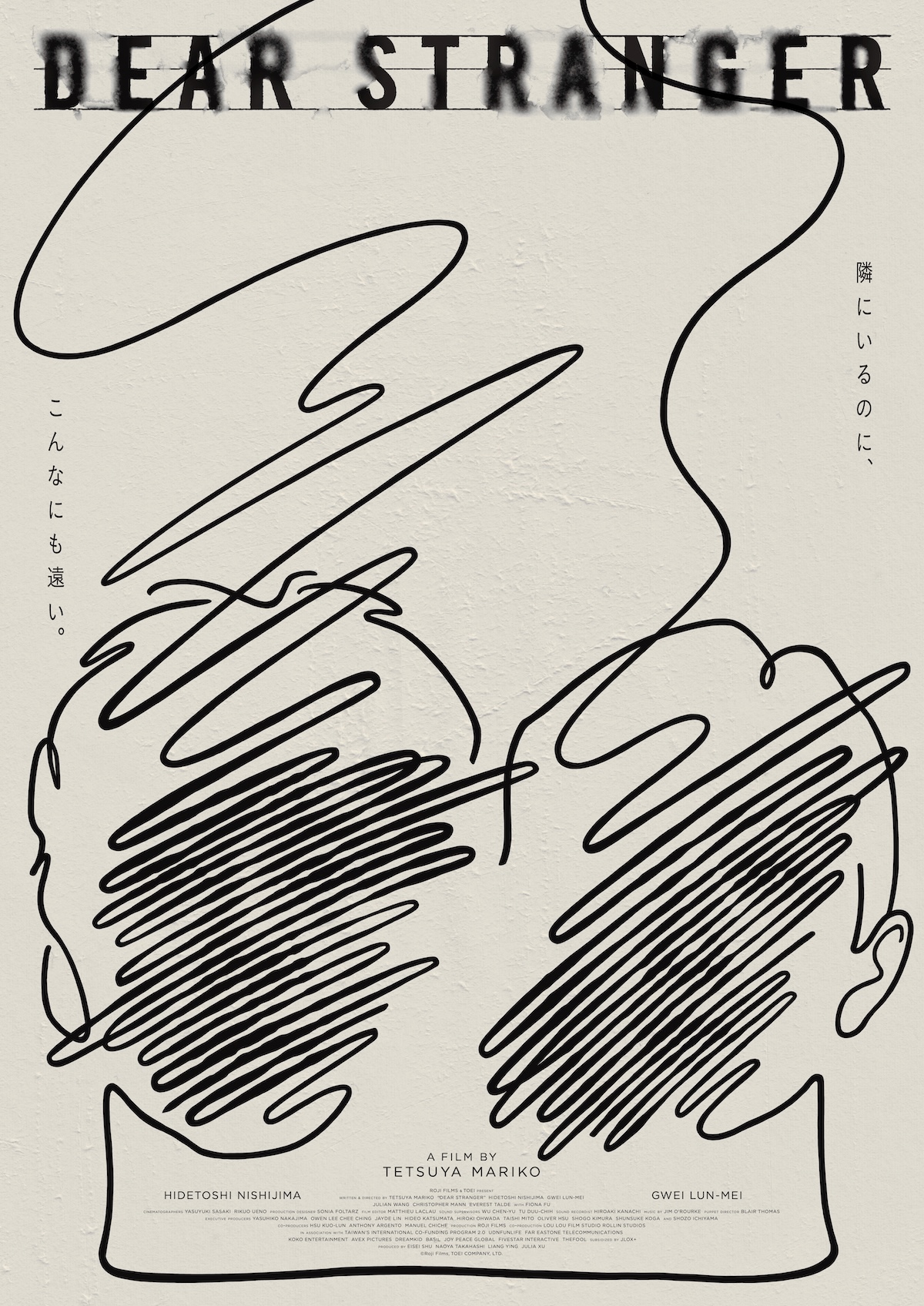
Dear Stranger (ディア・ストレンジャー, Tetsuya Mariko, 2025)

The Japanese film industry is generally regarded as fairly insular and focused solely on the domestic market with half an eye on other Asian territories where its stars are already popular. It has, however, made some attempts to enter Hollywood particularly in the 1970s with films such as Kinji Fukasaku’s Virus which for various reasons was largely unsuccessful in either market and suffered artistically from its attempts to bend itself to an international audience. 

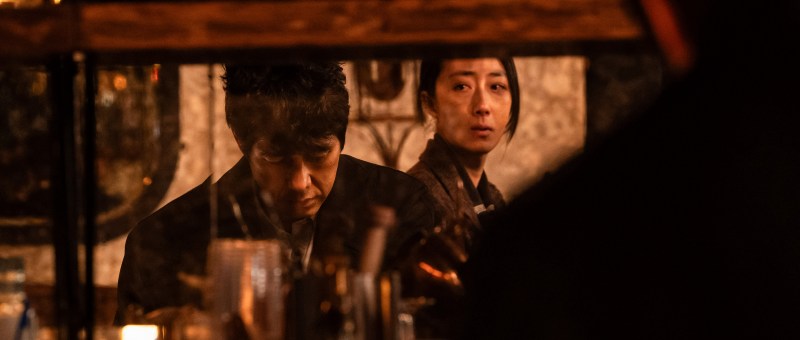
Tetsuya Mariko’s Dear Stranger (ディア・ストレンジャー) is the first in Toei’s contemporary attempt to court an audience outside of Japan as part of its Toei New Wave 2033 initiative, but it seems to be suffering from some of the same problems. The biggest is that 90% of the film is in English but the delivery is often stilted and inauthentic from both the international and native-speaking cast. That may in one way be ironic, as one of the major themes is the impossibility of communication. Emotional clarity is only really revealed during the puppetry sequences when no dialogue is involved. Set in New York, the film shifts between Mandarin, Japanese, Spanish, English and sign language, but simultaneously suggests the problem is less an external language barrier than an internal one that prevents people from saying what they really mean or encourages them to keep the truth of themselves hidden.

It’s living in this liminal third space that disrupts the marriage between Taiwanese-American Jane / Yi-zhen (Gwei Lun-mei) and her Japanese husband Kenji (Hidetoshi Nishijima) as she points out that they speak to each other in a language is not their own. At moments of high tension, they argue in Mandarin and Japanese, though as we largely discover there are more issues in play, beginning with the fact that their marriage may at least partially have begun as one of convenience. Kenji is not the biological father of their young son Kai. Jane finds herself asking who they are as a couple without him and if she ever really loved Kenji at all. Kenji suggests he married her because he loved her and accepted the child as his own for the same reason, but throughout the film is in an incredibly angry and hostile mood. He appears at times sexist, criticising Jane for not keeping the house tidy while he is “under a lot of pressure” at work and resents “the chaos” of their life. Jane’s mother doesn’t approve of her working either and calls her a bad mother for doing so even while expecting her to mind their convenience while she tries to find a carer to look after her father who is living with advanced dementia and can’t be left alone.

Part of that is likely that they need someone who speaks Mandarin, hinting at the sense of isolation and orphanhood that comes with migration in lacking extended familial support that in this case does not seem to be met by community. Jane too feels isolated and trapped by her role as a mother. She expresses herself only through her puppetry, which is also something denied her by Kenji and her mother. Kenji, meanwhile, feels undervalued at the university where his supervisor seems dismissive of him and his work which he regards as unoriginal. He may have decided to marry Jane in part in search of family having lost of his own in Japan with his mother never having been found after the Kobe earthquake when when he was a teenager, but simultaneously struggles to integrate himself within their family. His loss of Kai who disappears while he was supposed to be taking care of him is then symbolic in reflecting his own frustrated paternity and fear that the biological father will return to take all this away from him.

In many ways, it’s Kenji’s own psyche that’s in ruins informing his academic practice which focuses on abandoned and disused buildings and the effect they have on the surrounding environment. He’s asking himself how to create a new world from the ashes of the old, but doesn’t appear to have done so successfully in his own life and is increasingly unsure if he wants to. Perhaps because of its awkwardness, the film takes on an increasingly surreal quality as Kenji is heckled by irrationally angry guests at his book presentation and basically accused of facilitating urban crime in his praise of disused spaces and then descends into some kind of fugue state chasing the larger-than-life puppet version of Kai from Jane’s play which is also an embodiment of her own frustrated yearning for freedom. 

“In the wreckage we find truth,” Kenji answers one of the questioners at his presentation and it may in a sense be true for him but in another perhaps not. It becomes unclear what exactly he experiences as “real” and what not, what a product of his own mythologising and what actually happened, while Jane slips quietly into the background and her sudden acceptance of Kenji whom she previously regarded as “unreliable” and appeared to resent, seems somewhat hollow given that he continues to treat her coldly and is extremely hostile with all around him from the police, who are actually trying to help find his son, to the well-meaning kindergarten teachers, and his employers. In the end, it’s really Kenji who is stranger to himself much more than a stranger in a strange land trying to forge a new identity in a place of psychological ruin.


Dear Stranger was screened as part of this year’s Busan International Film Festival

Trailer (English subtitles)

City of Lost Things (廢棄之城, Yee Chih-Yen, 2020)

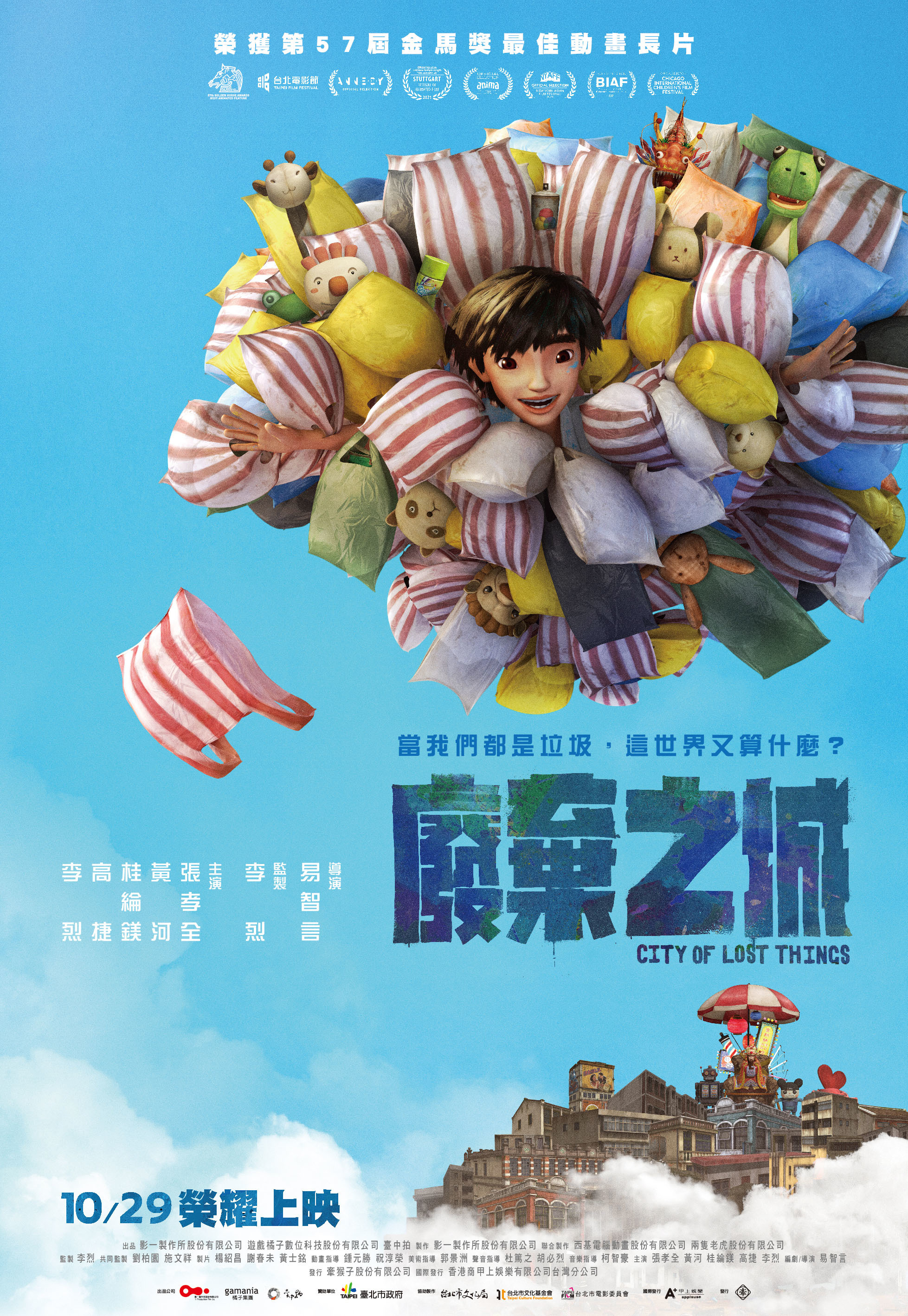
A traumatised teenage boy attempts to escape his sense of alienation by relegating himself to the literal junkyard of humanity in the first animation from Blue Gate Crossing’s Yee Chih-Yen, City of Lost Things (廢棄之城, Fèiqì zhī Chéng). Not to be confused with tragic noir Cities of Last Things, Chen’s eventually inspirational drama resounds with positive energy as the embittered hero determines to love himself a little more in order to find the place where he belongs, where he can he strong and beautiful and “turn into something not trash”, while remaining unafraid to explore the darker edges of his loneliness and desperation as he searches for connection and community. 

As he explains in the opening voiceover, 16-year-old Leaf (River Huang) doesn’t like it at home where it seems his mother drinks, nor does he like it at school, or on the streets where he becomes the victim of violence. Coming to the conclusion he has nowhere else to go, Leaf is almost swept away by a giant rubbish truck along with a host of “other” refuse, accidentally saving a sentient plastic bag imaginatively named “Baggy” (Joseph Chang) which gets stuck under his shirt. Baggy guides him to Trash City where unwanted and discarded items live in a kind of ghetto ruled over by an oppressive guardian deity statue, Mr. G (Jack Kao), who also looks quite like the figure of legendary Chinese general Guan Yu. Baggy explains to him that he and many of the other pieces of “trash” trapped in the city long to escape the “siege” in order not to be “quiet trash” anymore but find a place they can be beautiful, and strong, and love themselves a little more. 

In contrast to the heroes of most children’s animation, Leaf is not a particularly sympathetic character, his obvious self-loathing of which “Trash City” is perhaps a metaphor beginning to boil over into something dark and potentially dangerous. In Trash City he finds a source of eternal escape, not wanting to leave but to remain in this place where he can feel at home, unjudged, and unbothered by the adult world while accepted by those around him as an equal. This is one reason he clings so fiercely to his new friendship with Baggy, immediately anxious on discovering his plan to leave Trash City in realising it must necessarily mean that they will one day have to say goodbye. Not wanting to lose this new friendship and return to loneliness he finds himself taking the self-destructive step of snitching on his friends little realising the consequences of his actions. 

Yet if Trash City represents Leaf’s sense of depression is also perhaps functions as a political allegory through the oppressive rule of Mr. G who refuses Baggy and the others permission to leave though he does so apparently for their own safety in order to evade the “armoured trucks” which literally suck up dissidents and crush them like rubbish in their rear compactors. In escaping Trash City, however, what Leaf must overcome is his sense of powerlessness and inconsequaility to believe that there is a place for him where he can lead a happy life surrounded by people who love him rather than regarding himself as human “trash” rejected by and unworthy of regular society. 

Nevertheless, there’s a slightly less cheerful metaphor in play in the obvious ironic twist that the place they’re looking for is a recycling centre which points to an external transformation rather than the change from within implied by Baggy’s constant messages of the importance of learning to love one’s self a little more. It also gives rise some awkward humour as Leaf looks for his friend in plastic buckets and subway seats which eventually leads to a slightly inappropriate adult joke likely to confuse younger viewers while uncomfortably implying that people and things only have value when they’re transformed into something “useful”. While the animation style is relatively simple, the charming worldbuilding and innovative production design of the almost steampunk city with its mannequin lamp guards and disco-crazy white goods help to smooth over any sense of hollowness while the overarching story of growing self-acceptance as the path out of despair is a refreshing take on potentially destructive adolescent angst as the hero resolves to find his place in the world rather than exiling himself from it. 


City of Lost Things screened as part of this year’s New York Asian Film Festival.

Original trailer (English / Traditional Chinese subtitles)

A Leg (腿, Chang Yao-sheng, 2020)

“Life is long. We all have some regrets.” a grieving widow is told by a disingenuous doctor in full damage limitation mode. He’s not necessarily wrong, nor is his advice that the widow’s pointless quest to retrieve her late husband’s amputated limb has little practical value though of course it means something to her and as he’d pointed out seconds earlier a physician’s duty is to alleviate suffering of all kinds. Apparently inspired by the true story of director Chang Yao-sheng’s mother, A Leg (腿, Tuǐ) is in many ways a story of letting go as the deceased man himself makes a presumably unheard ghostly confession while his wife attempts to do the only thing she can in order to lay him to rest. 

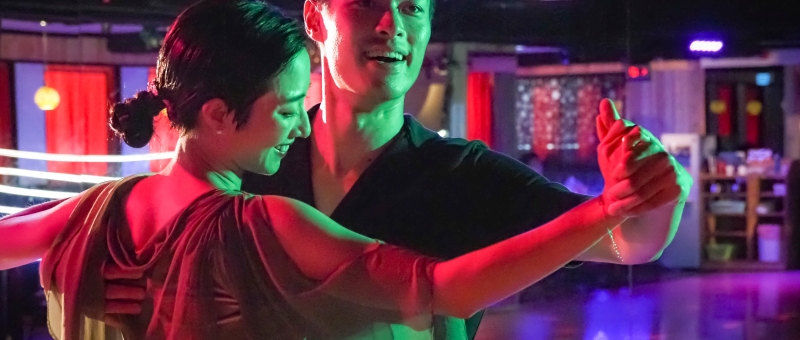
Husband Zi-han (Tony Yang) is in hospital to deal with a painful, seemingly necrotic foot which eventually has to be amputated in a last ditch attempt to cure his septicaemia. “Keep the leg and lose your life, or keep your life and lose the leg” the otherwise unsympathetic doctor advices wife Yu-ying (Gwei Lun-mei) in a remark which will come to seem ironic as, unfortunately, Zi-han’s case turns out to be more serious than first thought and he doesn’t make it through the night. Grief-stricken, Yu-ying leaves in an ambulance with the body but later turns back, determined to retrieve the amputated foot in order that her husband be buried “complete” only it turns out that it’s not as simple as she assumed it would be. 

The loss of Zi-han’s foot is all the more ironic as the couple had been a pair of ballroom dancers. As Yu-ying makes a nuisance of herself at the hospital, Zi-han begins to narrate the story of their romance which began when he fell in love with a photo of her dancing in the window of his friend’s photography studio. Explaining that, having died, he’s reached the realisation that everything beautiful is in the past only he was too foolish to appreciate it, Zi-han looks back over his tragic love story acknowledging that he was at best an imperfect husband who caused his wife nothing but pain and disappointment until the marriage finally broke down. He offers no real explanation for his self-destructive behaviour save the unrealistic justification that he only wanted Yu-ying to live comfortably and perhaps implies that his death is partly a means of freeing her from the series of catastrophes he brought into her life. 

Given Zi-han’s beyond the grave testimony, the accusation levelled at Yu-ying by his doctor that the couple could not have been on good terms because Zi-han must have been ill for a long time with no one to look after him seems unfair though perhaps hints at the guilt Yu-ying feels in not having been there for her husband when he needed her. As we later discover, however, this is also partly Zi-han’s fault in that he over invested in a single piece of medical advice and resisted getting checked out by a hospital until he managed to sort out an insurance scam using his photographer friend, wrongly as it turned out believing he had a few months slack before the situation became critical and paying a high price for his tendency to do everything on the cheap. Nevertheless, Yu-ying’s quest to reattach his leg is her way of making amends, doing this one last thing for the husband whom she loved deeply even though he appears to have caused her nothing but misery since the day they met. 

In order to placate her, the slimy hospital chief offers to have a buddhist sculptor carve a wooden replica of Zi-han’s leg made from wood destined for a statue of Guan-yin goddess of mercy but Yu-ying eventually turns it down, struck by the beauty of the object but convinced that turning it to ash along with her husband’s body would be wrong while believing that wood ash and bone ash are fundamentally different. She regrets having ticked the box on the consent form stating she didn’t want to keep the “specimen”, never for one moment assuming that her husband would not recover. Despite their dancing dreams, she thought the leg was worth sacrificing against the long years they would have spent together after, though this too seems a little unlikely considering the state of their relationship prior to her discovery of Zi-han’s precarious health. Zi-han meanwhile is filled with regret for his continually awful behaviour and the obvious pain he caused his wife. Getting his leg back allows him to begin “moving on” while doing something much the same for Yu-ying though his afterlife pledge about the endurance of love seems a little trite given how he behaved while alive. A little more maudlin than your average quirky rom-com, A Leg nevertheless takes a few potshots at a sometimes cold, cynical, and inefficient medical system, inserting a plea for a little more empathy from a pair of unexpectedly sympathetic police officers, while insisting that it’s important to dance through life with feeling for as long as you’re allowed. 


A Leg screens Aug. 14  & streams in the US Aug. 15 – 20 as part of this year’s New York Asian Film Festival.

Original trailer (English/Traditional Chinese subtitles)

The Wild Goose Lake (南方车站的聚会, Diao Yinan, 2019)

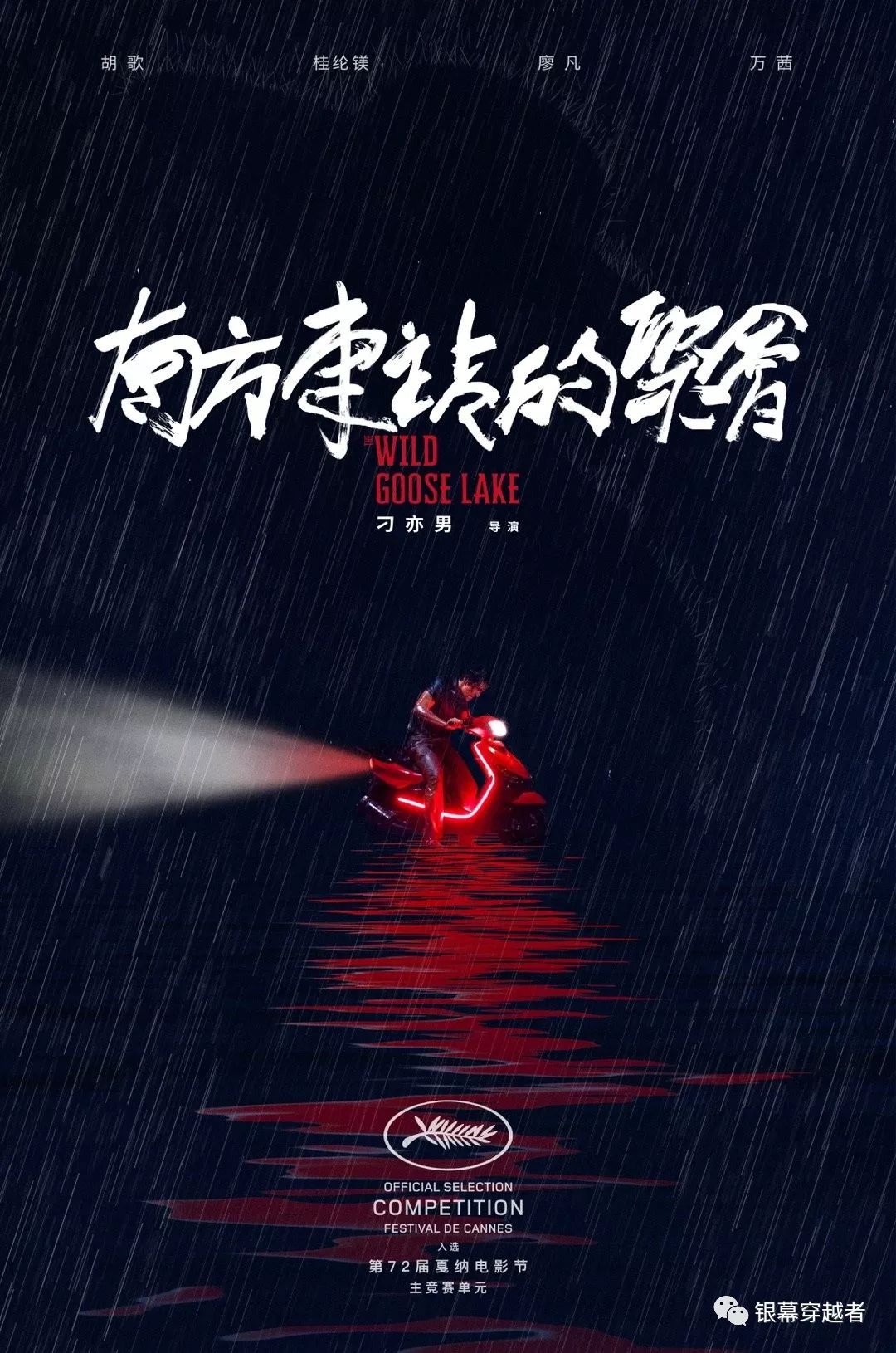
wild goose lake poster 1Chaos and desperation are about as far as it’s possible to get from the image of the modern China the nation’s cinema has been keen to project, but that’s exactly where we find ourselves in the murky world of The Wild Goose Lake (南方车站的聚会, Nánfāng Czhàn de Jùhuì). Diao Yinan’s Black Coal, Thin Ice followup finds the director in much the same territory only this time embracing the absurdity of existential flight as his twin heroes seek impossible escape in the garish neon of a provincial underworld.

Diao opens on the rain-drenched streets as sullen gangster Zhou Zenong (Hu Ge) waits impatiently for a rendezvous with his estranged wife Shujun (Wan Qian), only to be met by a stranger – “bathing beauty” Aiai (Gwei Lun-mei), who explains she won’t be coming. A lengthy flashback reveals that Zenong is currently on the run after getting embroiled in a dispute over turf assignments at some kind of gangster briefing session during in which one of his guys shot one of the Cat brothers’ men in the leg. To settle the matter, the boss proposes a good old-fashioned competition to see who can nick the most bikes in one night with the winner getting the prime spot, but Zenong doesn’t know he’s been set up and mistakenly kills a policeman after being attacked by Cat Eyes. Realising there’s no longer any way out for him, Zenong’s last hope is to keep the police at bay long enough to get back in touch with his wife and convince her to turn him in to the police so that she can claim the reward money.

Like many men of his generation, Zenong couldn’t find the kind of honest work that would allow him to provide for his family and so he left home. Too ashamed to own his no-good gangster ways, he stayed away for five years but all that’s on his mind is family and this is the only chance that he will ever have to provide for them. Shujun isn’t even really sure she wants anything to do with her absentee husband, but is dragged back into his orbit once again harassed by the police every step of the way.

In striking contrast to most Chinese crime dramas, these police are far from a force for order. Describing Wild Goose Lake as a lawless land, they have their very own briefing to formulate a plan to catch Zenong but aren’t averse to underhanded tactics like threatening Shujun and trying to undermine her attachment to her husband through a fabricated story about a pregnant girlfriend. The line between cop and thug isn’t so thick as you’d think it would be, and you can’t trust the police any more than brotherhood or honour amongst thieves.

Devoid of morality, Wild Goose Lake is indeed a chaotic place defined by shifting loyalties and unexpected betrayals. Fights break out without warning, plans change, and there are no safe spaces. Bumbling as they are, the police are everywhere watching everything and trying to blend in. Anyone might be a cop, or secretly working against you. Zenong is on the classic wrong man path, except that he’s the right man and he knows it. He might not have pulled the trigger if he knew it was a policeman he was firing at, but pull the trigger he did and now he’ll have to make peace with it. Trying to outrun the law only so long as to subvert it, he finds himself slipping past checkpoints distracted by pointless officiousness and consistently evading the net.

When Shujun is unable to make it to the rendezvous, Aiai offers to take her place by turning Zenong in and claiming the reward money to pass it on to Zenong’s wife (minus a small fee), meaning they will need to trust each other until the mission is completed. Aiai, a dejected young woman supplementing her income with casual sex work as one of the “bathing beauties” found at the lake, longs to escape her dead end existence, eventually telling the policeman she’d use the reward money to open a small store back in her hometown. Like Shujun, she lives in a fiercely patriarchal, unforgiving society  from which there is little sign of escape or independence. Yet, as afraid of everything Zenong represents as she eventually becomes, Aiai remains steadfast and true, keeping her promise and paving the way towards a brighter future for Shujun and her son away from the haphazard chaos of Wild Goose Lake. An absurdist fable drenched in neon, Diao’s conception of life on the margins of provincial China is as bleak as they come but eventually finds space for positivity on returning to a world more ordinary in which two women walk away from the traumatic past arm in arm and the law has to be content to let them go.


The Wild Goose Lake was screened as part of the 2019 London East Asia Film Festival.

International trailer (English captions)

The Big Call (巨额来电, Oxide Pang, 2017)

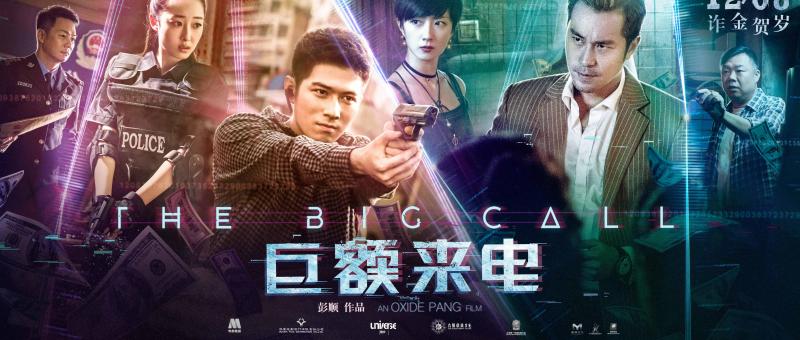
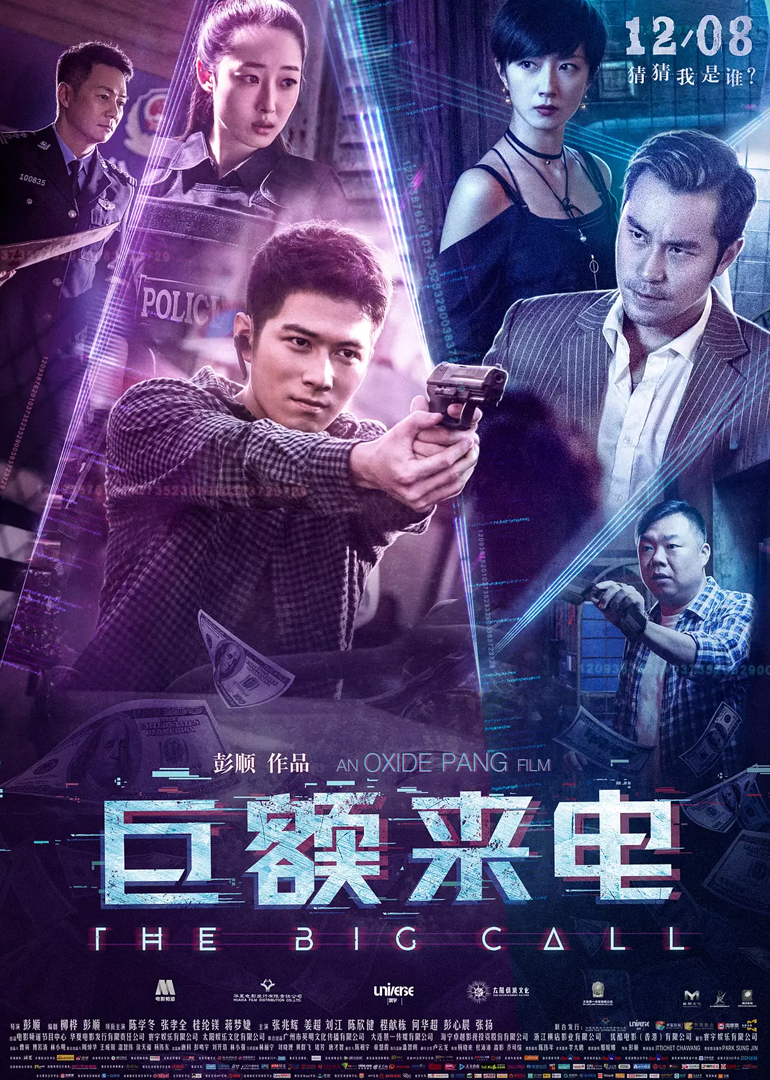
The Big Call posterOnce upon a time people sneered at telephone scams, unable to believe anyone would fall for something so obviously dubious, yet technological innovation has turned them into an underground industry as our data is bought and sold across a spectrum of nefarious forces whose use for it runs from relentless spamming to the intention to defraud. Oxide Pang’s The Big Call (巨额来电, Jùé Láidiàn) pits an earnest Mainland cop against an entrepreneurial kingpin running a multinational operation which he half-brands as a Robin Hood exercise intended to rob the super rich of their excess wealth, but then he never quite intends to redistribute it, only to put it straight back to work so that it might reproduce.

Our hero, straight as an arrow rookie policeman Ding (Cheney Chen), fails to save his old high school teacher from committing suicide after being defrauded of a vast amount of money through a telephone scam. Fraud isn’t really his division – he’s just a regular street cop, but he’s determined to protect the people in his precinct and seeing as he’s already found numerous similar cases is convinced he has a shot at unmasking the criminal. Ding’s investigation, however, unwittingly throws a spanner into an Anti-Telecommunication Fraud Centre operation. Despite their irritation, the guys in the fraud squad decide to let Ding in on the action whereupon he quickly realises that his old academy girlfriend is in fact undercover in the Thai sweatshop where his prime suspect, Lin Ahai (Joseph Chang), and his partner/girlfriend Liu Lifang (Gwei Lun-mei) run a call centre staffed by trafficked women. Teaming up with Taiwanese gangsters, Ahai and Lifang make use of extremely detailed personal information to create convincing telephone scams so that their marks will never suspect they aren’t who they say they are until it’s too late.

Ahai is perhaps a symptom of modern Chinese inequality. A poor young man who sought to better himself, Ahai is ignored by the business world and revels in getting his own back by making millions defrauding millionaires. Yet it’s not only “evil” millionaires that the pair target but ordinary men and women who don’t have the kind of money they can afford to lose. Ahai’s own sister (Peng Xinchen) left the village and refused to take his ill-gotten gains but later falls victim to a cruel scam herself – she’s just a college student with hardly any money but the scammers use exactly that against her, pretending to be from the education authorities so they can persuade her to part with her tuition money or else threaten her with problems in her enrolment. Meanwhile, he and and Lifang dream of the life that was far out of their reach – a swanky flat on Hong Kong’s fashionable Hennessy Road where they could live together with all the comforts of the elite and raise a family free of economic anxiety.

Some might think telephone fraud is a victimless crime, that the banks will cover the loss for their investors and so the only casualty is capitalism. This is however not true. Not only will many people be deprived of their life savings – money they needed in the short term for medical bills, tuition, mortgages etc, but will suffer intense humiliation at having been so cruelly caught out. The scammers attention to detail is intense. Having acquired vast amounts of confidential information, they have enough to convince most rational people that they are who they say they are but aren’t afraid to take things to the next level if they need to. Unable to get over the shame of having been taken in, suicide is a very real possibility for those who feel they’ve lost everything including their good name and future possibilities. Ahai, of course, refuses responsibility for the secondary effects of his crimes, thinking only about money while Lifang silently pines for him and the life he promised her while dutifully doing his dirty work in the hope that they can finally be together. 

Pang stages the cat and mouse game between the earnest Ding and the amoral Ahai as an ironic battle of wits though the odd bursts of absurd humour often feel out of place alongside the sometimes grim story of underworld life. Yet it’s the spiky psychological drama between undercover cop Xiaotu (Jiang Mengjie) and gangster’s moll Lifang which really sets things alight as Lifang at once suspects Xiaotu is not all she seems but can’t help respecting her tough as nails survivor attitude. Meanwhile, Ding is given two additional reasons to chase Ahai besides his shining love of justice – the first being that Ahai loves pretending to be a law enforcement official and thereby tarnishing the reputation of the police, and the other being that Xiaotu is an old flame. Slick if superficial, The Big Call is a return to the HK cop dramas of old only robbed of its edgy street punk energy by the upscale and emotionless world of faceless cybercrime.


The Big Call was screened as part of the New York Asian Film Festival 2018.

HK trailer (English subtitles)

On Happiness Road (幸福路上, Sung Hsin-yin, 2017)

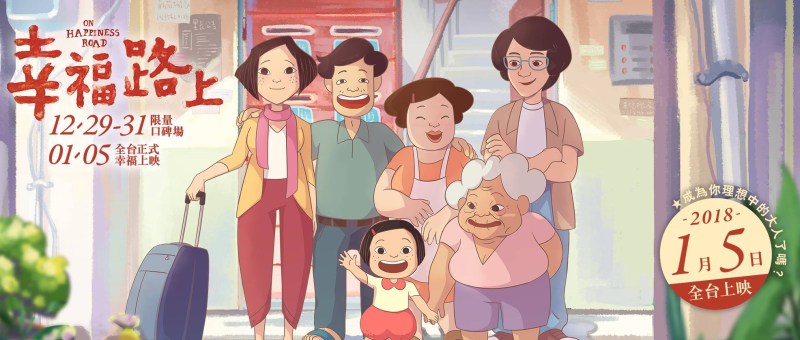
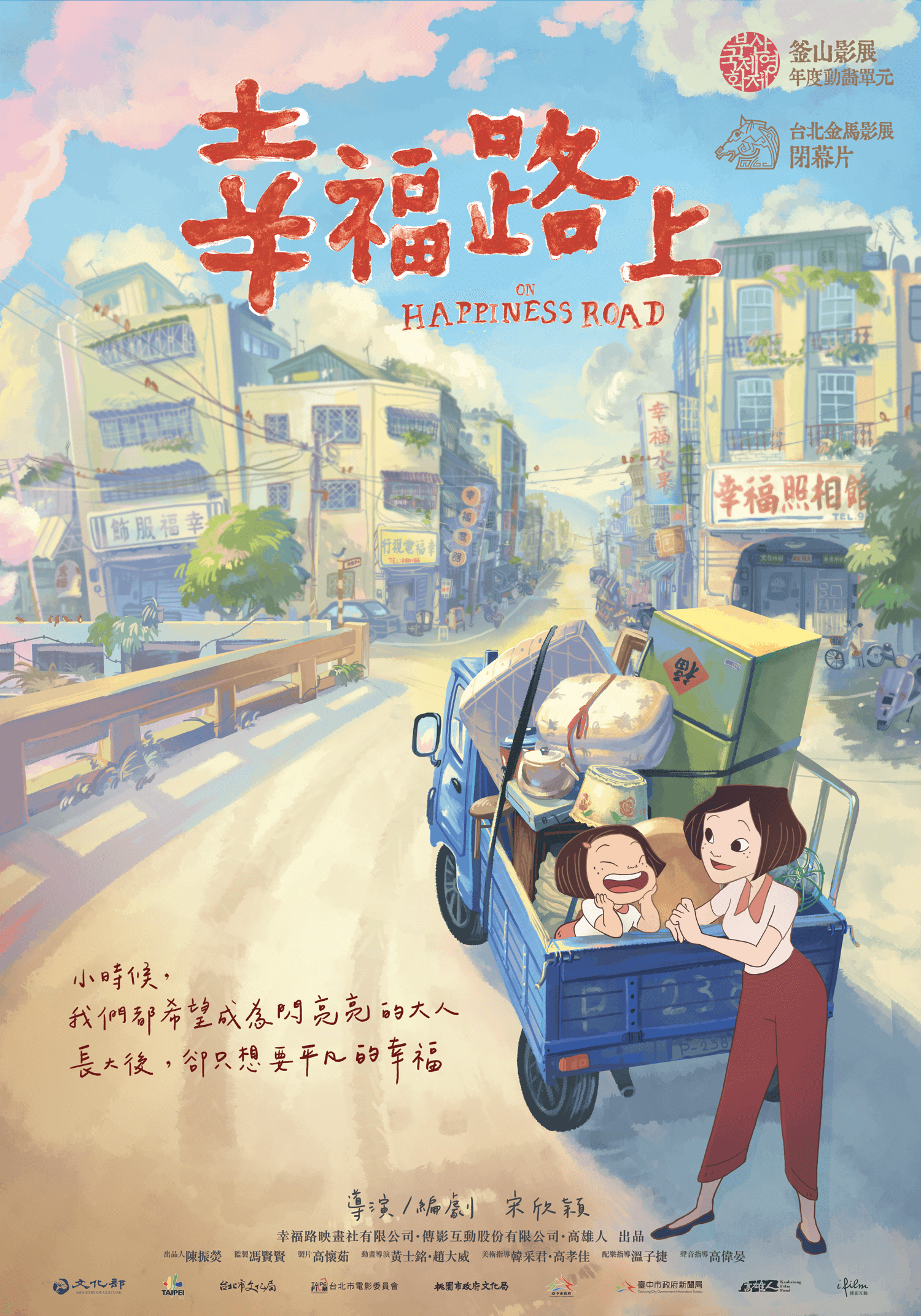
On happiness road posterSung Hsin-yin attempts a series of impossibles with her debut feature, On Happiness Road (幸福路上, Xìngfú Lùshang). In a bold move she has crafted what is possibly the last Taiwanese animated feature while attempting to pack 40 years of turbulent political history into the story of a lost middle-aged women ruminating on her cheerful, uncomplicated childhood on the distinctly humble Happiness Road. Battling the weight of parental expectation and the false promises of a better life overseas, her heroine, Chi, makes an enforced return to source on hearing that her beloved, part-aboriginal grandmother has passed away.

Chi (Gwei Lun-mei), an unhappy 30-something woman, receives the call in America where she has been living with her American husband. Unbeknownst to her family, Chi’s marriage is all but over and she finds herself at something of a crossroads, half wondering if it’s time to come home to Taiwan and half humiliated in being seen to have returned with her tail between her legs. She comes home, alone, to mourn her grandmother but finds herself wandering back through the streets of memory and fantasy recalling all the small details and minor incidents that brought her to his point in the hope of figuring out where it is she needs to go next.

Chi was born in 1975 on the very day that Chang Kai-shek died. Chang was by then a brutal dictator but the brainwashed little Chi who still sees his picture everywhere and has been taught to respect his many virtues idolises him all the same. Her family, uneducated ordinary working people, speak Taiwanese Hokkien at home but at school she has to speak Mandarin – the “official” language, all dialects are banned. Thus little Chi finds her parents’ language backward and embarrassing, their failure to adapt to “modernity” a hurdle in her own forward development.

As time moves on, Chi’s “Taiwaneseness” becomes something she feels she must sacrifice in order to purse the conventional success expected by her parents and the society at large. Little Chi, riding in the back of a pickup truck with her parents on the way to Happiness Road, asks them one of the biggest questions of all – what does “happiness” mean. Her parents, unable to answer, shush her, but her father (Chen Po-cheng) seems pleases his daughter has such big thoughts and wonders if she might become a philosopher one day. Oh no, replies her mother (Jane Liao). There’s no money in that – she’ll be a doctor! Her parents want for her all the material comforts of the settled middle classes, but her society tells her to attain them she must leave her nativeness behind – speak Mandarin, forget about granny’s ancient wisdom, and eventually go abroad leaving the “old fashioned” island far behind.

Chi has done everything she was supposed to do. She studied hard, got a good degree, got an OK job, and then ended up going to America almost on a whim. She reached the destination expected of her, but still she isn’t happy. Her marriage is failing as she and her American husband want very different things out of life and Chi wonders if she really belongs in this insincere culture which, at the end of the day, has never quite accepted her. In America she experienced mild forms of racism but then didn’t her half-American friend, Betty (Li Chia-hsiu) – blonde with blue eyes but speaking only Mandarin, experience exactly the same thing in Taiwan? Pregnant but seeking an escape from an unhappy marriage, Chi also worries what the future will be if she chooses to come home and raise her half-American child alone in a perhaps unforgiving society.

Yet reuniting with Betty she discovers that even if her life has not quite turned out the way she planned, she is blissfully happy as a single mother to two children, blonde like her but with brown eyes. Chatting with the ghost of her late grandmother who still has a few lessons to impart, Chi learns to see with the eyes of her heart and comes to realise that sometimes the road to happiness passes through a few uncertain turns but that that’s OK. Her parents, whom she feared would judge her for a failed marriage and a child born after divorce, are predictably enough only too happy at the prospect of their only daughter coming home for good and finally making them grandparents no matter the circumstances surrounding the origin of both those events. Chi may not have wanted the “road” her parents and her society had attempted to lay down before her, but discovers that departing from it is not failure and that “happiness” is a concept you are free to define for yourself. Beautifully animated and filled with whimsical flights of fancy, On Happiness Road is a sometimes melancholy but heartwarming tale of life in modern Taiwan as one lost woman finally discovers the road home and realises it has been waiting for her all along.


Screened at the 20th Udine Far East Film Festival.

International trailer (English subtitles)