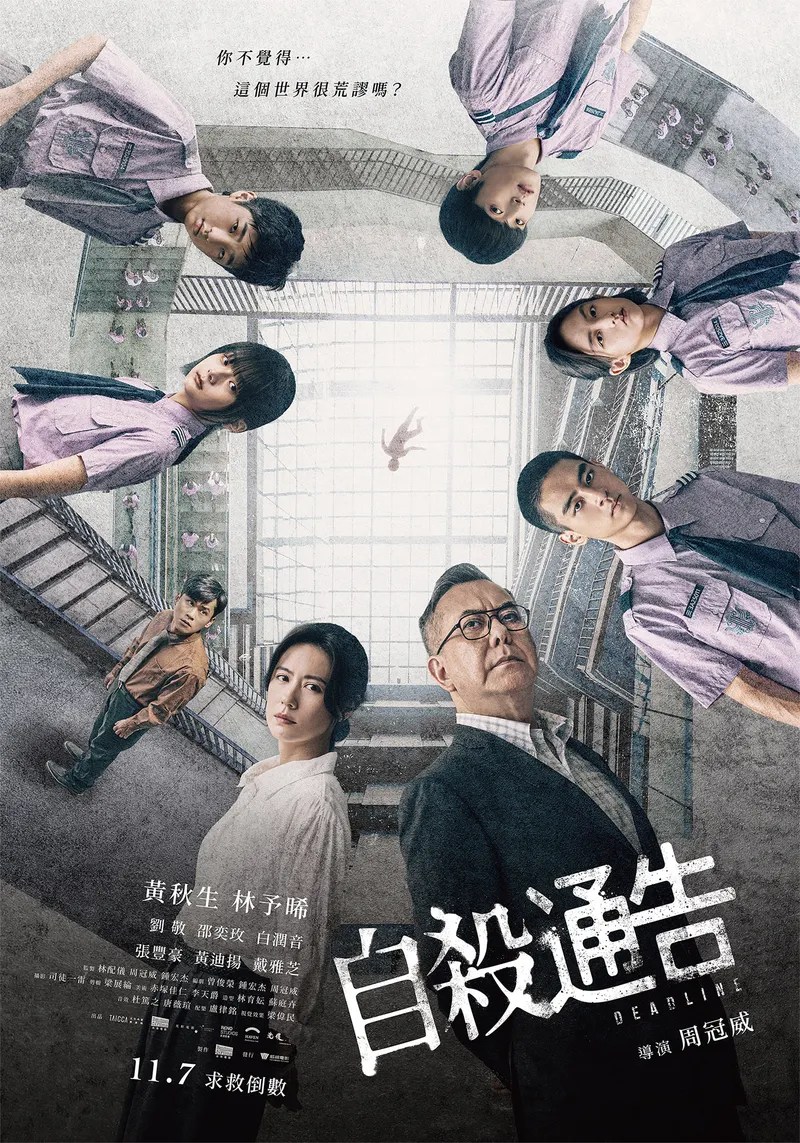
What does it mean to get “an education”? Is the school system only really there to brainwash the young into following accepted the path and prepare them to be receptive to authority, actively destroying both the ability and desire to think for oneself? The fact that Kiwi Chow’s Deadline (自殺通告, zìshā tōnggào) was not approved for release in Hong Kong on the grounds of “national security” may indicate the direction of its perspective on the interplay between the intensity of the education system and entrenched authoritarianism.
The mere fact that En Shan high school is described as “elite” already implies that it exists to perpetuate a kind of social inequality, though in other ways some might say that it also encourages social mobility in that the students come from all backgrounds and are selected for academic excellence rather than simply the ability to pay the fees. Education does seem to be life’s make or break. Students who don’t make it to university are perceived as being relegated to a kind of underclass from which there is no other escape. Yet at the same time, perhaps university isn’t right for everyone and not all of the pupils want to live a life dedicated to achieving conventional success that might otherwise leave them miserable.
Chun Chiu (Jimmy Liu) is one of the few brave ones who’s decided he doesn’t want to go to university and is happy enough pottering around with his plants. He doesn’t care if people look down on him because he knows he’s happy in himself, and they probably aren’t. Consequently, he’s also the only one to really see what’s going on at the school and to want to try to stop it. Despite its elegant name, there’s a kind of bloodthirstiness that underlines the survival of the fittest mentality at En Shan where they wear mildly fascistic uniforms and start the day with a haka-style dance in which they recite the school’s mantras about being the best of the best and that there’s no point coming second. These children are prevented from forming real friendships or developing social skills and empathy because they’ll always be rivals waiting for the ideal time to stab each other in the back.
The school reinforces this sense of judgment and hierarchy through adopting a social credit-style system in which pupils’ “privileges” are linked to their performance and obedience levels. Chun Chiu is at one point locked out of the garden because his scores have fallen so low he’s not allowed outside the prison-like school environment. Everyone at the school, including the teachers, is under constant surveillance with an AI programme responsible for assigning grades and points. Headmaster Kung wants to get rid of Mr Gao (Huang Di-yang) because the system says his performance is poor, while star teacher Mrs Tien tries to defend him. To begin with, Gao seems as if he might be resisting in another way by giving care and attention to struggling pupils like Heng (Bai Run-yin) who is taking medication for ADHD. But it turns out that Gao is so worried about losing his job as he has to pay maintenance for his ex-wife and child that he’s been giving the kids performance enhancing drugs in the hope of boosting his own approval ratings in the app.
Heng is also getting bullied by some of the other pupils, not just because he’s different but because they resent it that they think he’s being given special advantages by taking medicine that helps him concentrate and being given extra time to finish exams. This leads Heng to try and and cancel his accommodations in a bid to avoid being singled out and in a mistaken gesture of solidarity with the other kids to prove he’s not being given any extra privileges. Meanwhile, they’re all taking similar medication that’s designed to aid concentration and reduce the need for sleep for they can study for longer. But the drugs also prevent them from sleeping when they want to and suppress their appetites so they don’t eat. They cause low mood and suicidal ideation, which, coupled with the already high-stress environment, is a recipe for disaster.
To combat this culture, someone drops a series of ominous flyers threatening the school that there will be a suicide if they don’t “stop poisoning us” by ending the practice of holding exams under medication. While headmaster Kung appears oblivious to the monster he himself has created and has no real idea what’s going on in the school, to his credit he does seem keen to find out if there are any pupils in danger of harming themselves rather than solely trying to silence the whistleblower or save the school’s reputation. He has no idea about the drugs and is shocked on realising how prevalent they’ve become in the school. When they start doing drug tests and discover that over half the pupils are taking them, the director of the board of governors, who has the real power, tells him to stop the testing before they find any more.
But it turns out that this problem extends far beyond the school as in some cases it’s the parents who are making their kids take these drugs, and the head of the student council, Mo (Michael Chang), that’s been selling them. After a few deaths have occurred, Tien and Kung want to stop the exams, but are prevented from doing so, in part because the education system is a national machine. The kids can’t just take the exam on another day because they can’t come up with all new papers just for them at short notice. In a truly chilling moment, Mo gets up on his chair begins chanting the nonsensical mantra “exams are a human right” while insisting on being allowed to take them even if it means that more pupils end up dying. After all, that’s just less competition for him. They’re already locked into this system and refuse to be cast out of it, in part because they’ve learned how to manipulate it so perfectly.
Then again, obsessive study doesn’t leave you with much time to think about anything else even if you’re not also sleep deprived and malnourished as a result of long-term drug use. Chun Chiu’s friend Peiching (Tai Ya-chih), the current number one, becomes conflicted in part because she realises that she does not really know who she is and is incapable of determining what she wants out of life. She said she wanted to be a doctor because that’s what her parents were so she thought she was supposed to be too, but doesn’t know if that’s actually what she wants. Peiching seems genuinely worried about rival Ruoyan (Mimi Shao Yi-mei) who self-harms out of frustration and feelings of inadequacy, but equally only perhaps because thanks to the drugs she stands a real chance of knocking her off the top spot. Mrs Tien may secretly be thinking of moving abroad precisely because her own daughter does not suit this rigid educational system, but remains largely unable to change it while the students have, it seems, already internalised its tenets unable to let go of a world in which everything is defined by numbers and ranking without the intrusion of independent thought or human empathy.
Deadline screened as part of Hong Kong Film Fest UK and opens in UK cinemas 16th October.
Trailer (English subtitles)