A man who tries to escape his poverty ends up imprisoning himself in Kozaburo Yoshimura’s tragicomedy An Osaka Story (大阪物語, Osaka Monogatari). Inspired by the work of Saikaku Ihara, Kenji Mizoguchi had intended to direct but sadly passed away before shooting started with Yoshimura appointed to take over. The broadly comic overtones may be at odds with Mizoguchi’s signature style but ultimately lend weight to the film’s ironic conclusion in which the hero finds himself essentially oppressed by his own wealth in being entirely unable to relate to other people or see the world in ways undefined by money.
It may be possible to understand Omiya’s (Ganjiro Nakamura) mania as a reflection of his intense fear of poverty, that he is so terrified of possible destitution that he can never really have enough or allow himself to enjoy what he has in case there is no more to come in the future. Even as so his daughter later says, wealth changes him. As the film opens, Omiya is a peasant farmer with a bad harvest who can’t pay the onerous taxes demanded by his exploitative lord. He decides to flee to Osaka with his family but is soon rebuffed by the man he’s gone to see who has just become a samurai and wants nothing to do with him. Wandering around the city, the kids eventually discover a thin layer of discarded rice at a storage area they manage to sweep up giving Omiya a new idea of how to save their family.
In some ways, his fate is foreshadowed when he alone is unable to slip through the fence while his wife and children mop up grains from the floor. The image of him on one side of the bars is repeated in the closing scene, while his loyalty to the family he tried so hard to save is weakened by the influence of money. Yoshimura shows us a world founded on exploitation. “Those who worked so hard to grow it won’t see a single grain,” Omiya bitterly laments watching workmen unload vast quantities of rice while the peasants starve. When the rest of the family have finished sweeping up what others so casually discarded, Omiya does not use the rice to feed them but sells it to a broker and gives them millet instead. His life is then ruled by the doctrine of good enough, living in painful, penny-pinching austerity even after becoming wealthy as a dodgy tea merchant/loan shark.
Omiya is one of those people who know the price of everything but the value of nothing. Back at their farm, he’d firmly rejected his wife’s offer to sell herself into sex work to save the family, asking “How could I carry on happily knowing you were suffering for it?”, but this is exactly what he proceeds to do. Omiya no longer cares about his family’s feelings and thinks only abut money but simultaneously refuses to spend any of it. One has to wonder what the point of the money is when he’s living a life not all that different from a peasant farmer save being free of the anxiety of immediate starvation. The only person he has any kind of respect for is a widow much like himself who is equally obsessed with penny-pinching and maximising profits.
The pair bond in their parsimonious natures, but the mutual desire to get a good deal necessarily comes between them especially when Omiya decides to marry off his daughter (Kyoko Kagawa) to Mrs. Abumiya’s foppish playboy son Ichinosuke (Shintaro Katsu) who has been secretly spending money in the red light district without her knowledge. He too is being exploited, in his case by a geisha who manipulates him into getting the money to buy out her contract by threatening suicide. Meanwhile, Omiya’s meanness means he’s never actually taught his son much about handling money. His invitation to the pleasure quarters by Innosuke eventually provokes his rebellion as he starts to question his father’s philosophy and what money is for if you still can’t live a comfortable life.
HIs daughter Onatsu asks him something similar, pleading with him to learn to understand other people’s feelings before leaving the shop to be with a kindhearted clerk, Chunzaburo (Raizo Ichikawa), with whom she has fallen in love. So little does he care for people that Omiya doesn’t even bother to live up to the image of a wealthy man. The man who turned him away after becoming a samurai eventually racks up large debts and loses his title allowing Omiya to buy his house as an act of revenge despite his wife and daughter’s protestations that they already have “enough” and did not need more. He refuses contracts the previous owners had set up, throws out a hairdresser who comes to give the ladies a more class-appropriate haircut, and refuses a loan to the daimyo in incredibly rude fashion not to mention embarrassing just about everyone by refusing to serve any food at a wake.
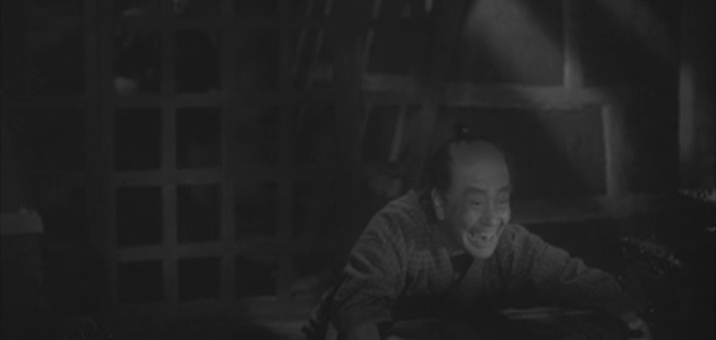
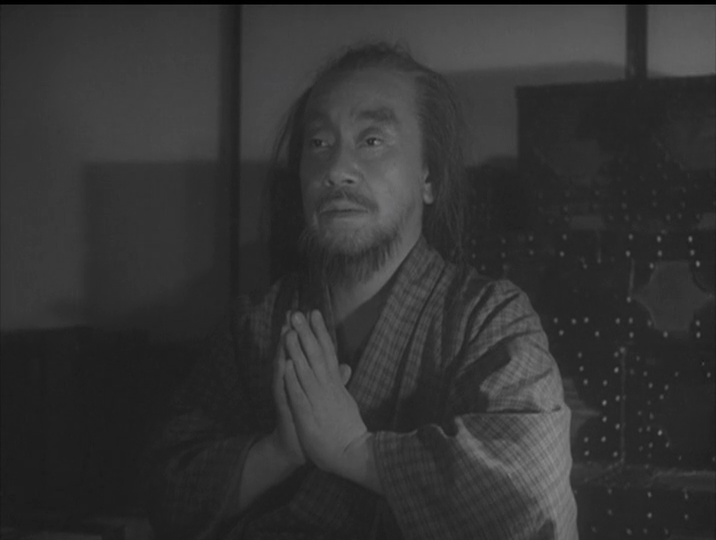
After ruining all of his personal relationships (except that with Mrs. Abumiya), Omiya experiences a kind of mental breakdown throwing himself over the chests of money in his vault and locking himself inside raving that everyone’s out to get their hands on his wealth. He’s just as much of a prisoner of this system as he was as a peasant farmer and has now imprisoned himself within a destructive delusion of capitalistic wealth. “Do what you have to do for a comfortable life,” Omiya’s son Kichitaro (Narutoshi Hayashi) had advised his sister, but this is what Omiya was trying to do too only for it massively backfire no matter what your personal definition of a “comfortable life” may be. Mrs. Abumiya tearfully wonders who’s going to inherit her money if not for her feckless son, but all Omiya can do is cackle wildly one like one possessed insisting that the money is his and his alone and not even death shall part him from it. In part a humorous take down of the contemporary society’s economic obsessions in a bid for ceaseless acquisition, the film is also a tragic tale of a man laid low by his addiction to money and the illusionary sense of comfort it provides him.


 Windows on Worlds