Roppa’s Honeymoon (ロッパの新婚旅行, Kajiro Yamamoto, 1940)

One of the most surprising things about Kajiro Yamamoto’s defiantly silly comedy Roppa’s Honeymoon (ロッパの新婚旅行) is how devoid it seems to be of political import with no overt patriotic content or references to the ongoing conflict even if the central messages of the necessity of enduring hardship are otherwise very on brand. Likewise and contrary to expectation, the film is clearly influenced by Hollywood comedies and heavily features American ragtime music presented largely without prejudice. 

In fact it’s the confrontation of these different influences which eventually sparks a crisis between father and son. As the film opens, beer magnate Garamasa is sitting in his bath practicing his gidayu recitation with the help of a shamisen player in an adjacent room, but his idiot son Ichiro (Roppa Furukawa) keeps singing “stupid Western songs,” which is very annoying for him but apparently not enough to actually get out of his bath which is why he rings an employee and gets him to ring Ichiro to tell him to shut up. This seems in part to be a slightly subversive gag poking fun at fat cat CEOs with Garamasa weirdly berating the staff member for being lazy and suggesting that he’s probably only just got up despite it being already 7am even if Garasama himself is still in the bath. The employee has, however, been busily at work for quite some time and spends the rest of the film toadying up to Garamasa. Later on, Yamamoto includes a similar gag in which a maid is forced to run back and forth between Ichiro’s annex and Garamasa’s office to deliver messages between the two.

In any case, Garamasa’s grand plan to get his son to be quiet is to marry him off to someone who also likes Western music which is why he visits a pair of servants he actually kicked out of the house when they decided to get married 20 years previously but have since opened a shop selling Western records. They suggest a young woman, Eiko, known as the nightingale of Japan (real life opera singer Hamako Watanabe) who is also a member of the nobility and the daughter of one of Garamasa’s friends, yet Ichiro has been seeing a young woman, Chiyo, who works in an oden restaurant and in fact finds out he is “engaged” from the same newspaper article she does. Eventually he makes the decision to run away from home and elope only to flounder while being entirely ill-equipped to live a “normal” life in which he must attempt to support himself financially.

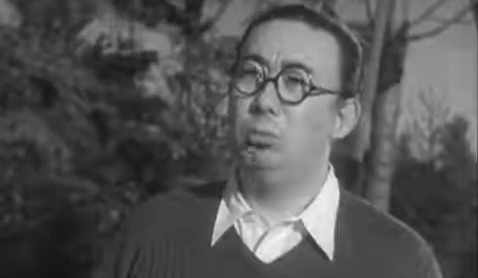
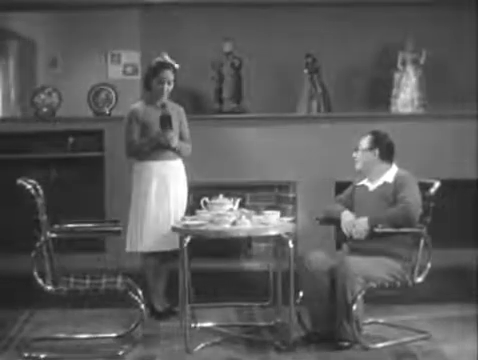
Star Roppa Furukawa was himself a member of the aristocracy and one of a small number of performers popular enough in the 1930s that their names were often inserted into the titles of the files in which they appeared even if their characters did not share it. Roppa was well known for his rather comical face, round and a little pudgy with big round glasses which seem to capture something of the zeitgeist of the interwar years. He was also an excellent singer and the film is quite notable for its use of an ironic song in which Roppa narrates his “honeymoon” in which he and Chiyo are forced to move several times, first sitting in their living room on the back of a truck before their belongings slowly decrease from truck to cart to hand. Chiyo is eventually forced to return to work at the oden restaurant while the relationship suffers because of Ichiro’s refusal to do a common man’’s job. Ironically, he is disturbed by the singing of Eiko who lives close by and on visiting to tell her to be quiet is talked into buying a pair of charity concert tickets.

Chiyo actually approves because she doesn’t like the idea of people looking down on them for not having the money to pay, but is then jealous, insisting that she’ll pay for the tickets herself while forbidding Ichiro to go. It’s this that forces him to accept a job he previously thought demeaning as the leader of a marching band singing a ragtime-themed jingle for a brand of toothpaste. All of this absurd silliness might be thought too trivial for the early 1940s in which censorship concerns usually some kind of patriotic content (aside from gidayu) but there is a message to be found in Garamasa’s eventual acceptance of their relationship in which he thanks Chiyo for introducing his son to hardship and thereby making a man of him as reminding the audience that a little bit of suffering is character building though doubtless they don’t have such wealthy parents to bail them out nor can they really look forward to better days any time soon. In any case it paints a rather rosy of picture of life in the early ‘40s, harking back to a distinctly ‘30s brand of foppish comedy with Ichiro a kind of Bertie Wooster suddenly plunged into “real” life and realising being the stupid son of a CEO obsessed with gidayu recitative wasn’t so bad after all.

Mysteries of Edo (ふり袖捕物帖 若衆変化, Shoji Matsumura, 1956)

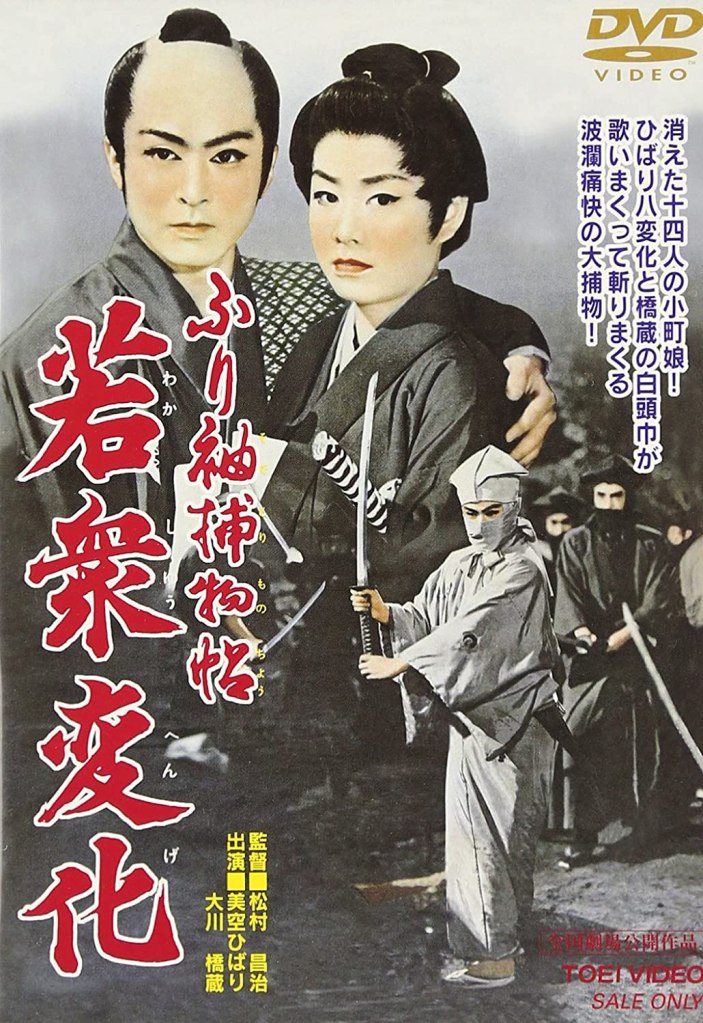
The voice of the post-war era, Hibari Misora was a major marquee star but in contrast to expectation, appears to have been fully in command of her contradictory brand, selling an image of herself not as docile and innocent in the manner of many a manufactured idol but feisty and true, refusing to backdown in the face of injustice. In her contemporary movies, she stood up to gangsters and corrupt corporations alike with salt of the earth charm, while her period roles saw her do much the same only against the inherently corrupt samurai order. An early outing for Toei, Mysteries of Edo (ふり袖捕物帖 若衆変化, Furisode Torimonocho: Wakashu Henge) sees her star in the first of a series of films as a princess in hiding turned feminist detective, investigating series of abductions in the rapidly changing bakumatsu society. 

A “newspaper” seller in the street informs us that 14 girls have recently gone missing in this area of town, and no one’s doing much about it. A dance teacher escorts her pupils home to be on the safe side while her apprentice, Oshichi (Hibari Misori), stays behind to teach cowardly samurai Kawashima (Hashizo Okawa) some moves. Local bobby Gorohachi (Shunji Sakai), himself a dance enthusiast, arrives to get some guidance from Oshichi but their lesson is interrupted by the news that the dance mistress and her daughter have become the latest two abduction victims. Oshichi springs into action but quickly falls under suspicion from a rival policeman, Gonroku (Haruhisa Kawada), who questions her background. All too soon, the body of a young woman is discovered at the local shrine and believed to be connected to the abduction cases. Gonroku accepts a bribe from a samurai to get rid of the body as quickly as possible, but Oshichi immediately notices the bruises on the woman’s neck and concludes it’s a murder. She and Gorohachi trace the samurai back to the red light district and discover some shady goings on in a “back house” behind a brothel belonging to a prominent merchant. 

During this era, Japan was still in its isolationist period during which consorting with foreigners was forbidden outside of a few explicitly designated trading spots. Oshichi figures out that the merchant, Nagasaki (Ryosuke Kagawa), is involved with smuggling and uses his second house as a place to entertain foreigners in collusion with local politicians. When he ran out of courtesans from the brothel next door, he started simply abducting random women off the street to entertain his guests with more authentic charms. Those who don’t comply are threatened with being sold off on slave ships, itself another evil of the age. 

Of course, a lowly dance teacher and a bumbling policeman aren’t much of a match for entrenched samurai corruption, but Oshichi has a trump card – she’s secretly a princess in hiding. Bored with the life of an upperclass noblewoman, she ran away from her brother’s home to live an independent life in Edo but can still rely on her class background when necessary. Stealing a pistol and a letter box, she rebrands herself as a man and gets a job in the ministry to try and spy on the corrupt lords while hoping to save her boss, keeping up the ruse well enough but eventually unmasked as a girl. 

As in many of her films, Misora plays on gender ambiguity. Rejecting the cosseted life of a lady, she takes to the streets and then takes charge. She’s technically Gorohachi’s subordinate, but in reality he follows her lead, and she gives as good as she gets in the frequent fight sequences. In the end, however, she’s “rescued” by a masked samurai dressed in white with whom she becomes instantly smitten. She dreams of meeting him in a deserted field where he mildly berates her for her lack of femininity, insisting that he liked “the Oshichi from before”, meanwhile she conjures up the figure of Kawashima who manfully wades in to save her. Previously, in refusing to help, Kawashima had told her that “a woman should know her place and act like a woman”. Oshichi tells him perhaps he should act like a man, practice kendo or something else more manly rather than prancing about learning to dance. His words have perhaps cut her because he tells her the same thing in her dream, insisting that he “could fall for the womanly Oshichi”.

Oshichi tries on womanliness for size, but it only seems to confuse the “real” Kawashima who describes her attempt at genial femininity as “creepy”. She quickly goes back to holding her own, pushing forward where the men hold back perhaps bashful in love but never in justice. Even if it’s true that the dashing samurai arrives to save the day, Oshichi is no damsel in distress watching passively from the sidelines but an active participant threatening bad guys with a gun cunningly smuggled in while she distracted them with a song, and grabbing a sword off the wall to wade into the fray. Rewarded for her good work and asked what she’d like in return, Oshichi chooses her freedom, intending to stay in the town a little longer, solving crimes in old Edo and ensuring that no one, even those who think they have a right to be, is truly above the law.