The Heart of Hiroshima (愛と死の記録, Koreyoshi Kurahara, 1966)

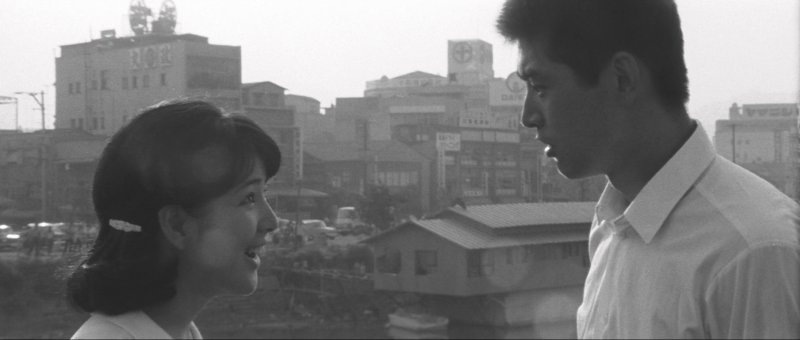
Sayuri Yoshinaga was the top female star at Nikkatsu in the mid-1960s. Together with her regular co-star Mitsuo Hamada, she starred in a series of hit youth romances such as The Mud-Spattered Pure Heart, The Sound of Waves, and Gazing at Love and Death which was Nikkatsu’s biggest box office success at the time. The Heart of Hiroshima (愛と死の記録, Ai to Shi no Kiroku) was intended as the latest in the series, but Mitsuo Hamada was attacked by a drunk customer at a bar shortly before filming after which he needed surgery to save his eyesight. Normally, the film would be postponed, but Nikkatsu was having financial difficulties at the time and refused to wait despite pleas from Yoshinaga and even from the actor who replaced him, Tetsuya Watari, who was a good friend of his. 

At the same time, Yoshinaga was now 21 years old and uncertain how long she could convincingly go on performing in Nikkatsu’s typical teen dramas. The studio was also worried about the possibility of losing their top star if she decided to move into more serious dramatic roles while they did not believe they had a suitable replacement. They were currently on bad terms with Ruriko Asaoka who ended her exclusive contract that year and moved to Ishihara Pro, and were worried that their other popular actresses such as Chieko Matsubara weren’t ready to take on that kind of responsibility. To try to convince Yoshinaga that the film would be more artistic in nature they hired New Wave director Koreyoshi Kurahara rather than studio stalwarts like Buichi Saito who’d directed Gazing at Love Death, but when she again tried to refuse insisting they wait for Hamada, they forced her hand by simply beginning to shoot the film on location in Hiroshima without her. Casting Tetsuya Watari may have also been an attempt to shake up the franchise as at that point he was known more for action and hadn’t really played this kind of very intense, romantic role before.

Though it follows a familiar pattern in exploring a doomed romance between a boy and a girl whose pure love is obstructed by social division, the film does deal with some quite controversial themes in touching on the discrimination faced by those who were affected by the atomic bomb. Yukio (Tetsuya Watari) lost his whole family in the blast and was taken in by Mr Iwai (Asao Sano) after being released from a long-term hospital stay. He’s doing well working at Mr Iwai’s print shop and has no current health worries when he has a meet cute with Kazue (Sayuri Yoshinaga) knocking into her on his bike and smashing some records she was carrying which he insists he compensate her for, though he doesn’t know she works in a record shop so it doesn’t really matter. After a comical misunderstanding in which Yukio mistakenly thinks Kazue is dating his friend, and she thinks he’s a creep who’s coming on to her while dating another girl from the shop, they fall in love and want to get married.

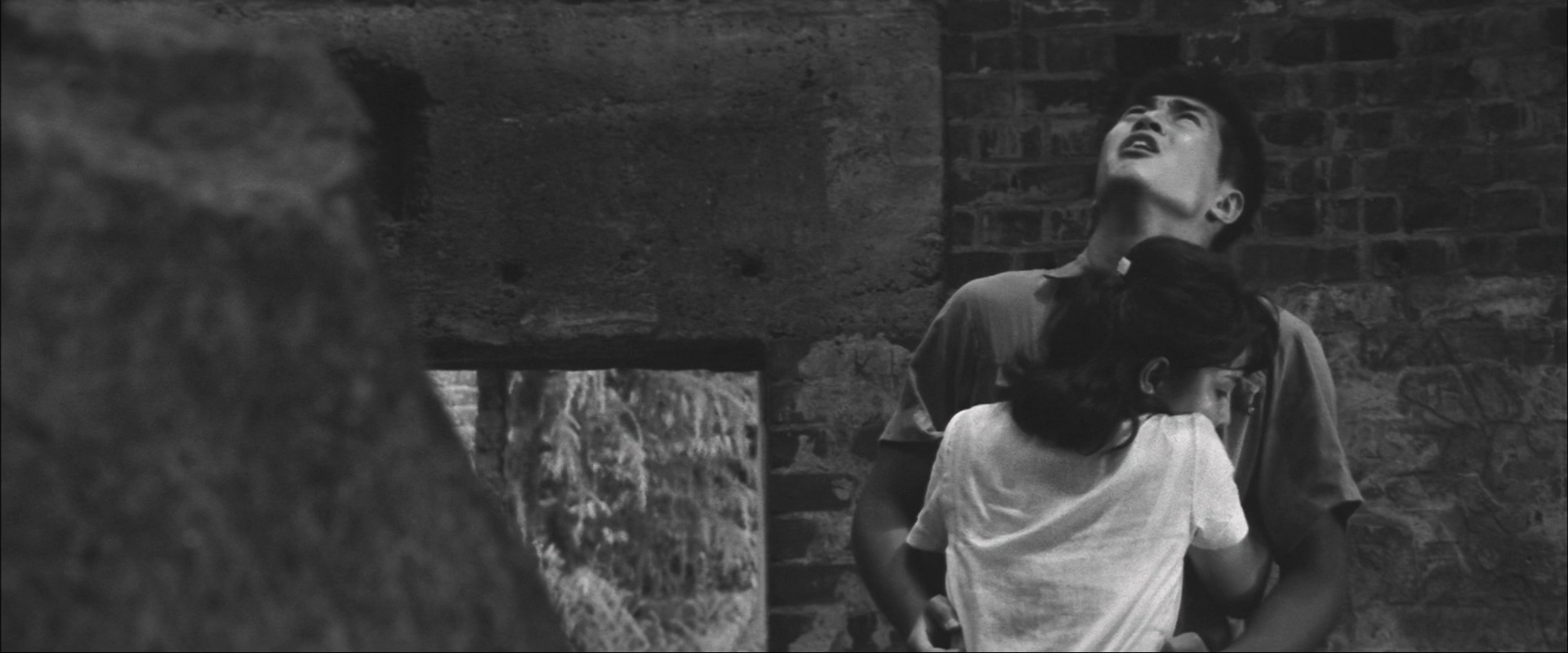
However, Yukio’s symptoms start to resurface and he asks himself if he really has a right to start a romantic relationship and get married, especially as there’s a risk any children he may have could be born with genetic abnormalities. Because of the stigma directed towards those who were affected by radiation from the bomb, he feels he can’t explain any of this to Kazue and continues to blow hot and cold, while she too is close to a young woman (Izumi Ashikawa) who seems to have had a romantic past with her brother but once tried to take her own life because she has a large radiation scar on her face. She has since resigned herself to living for her parents, suggesting that she will not marry. When Yukio eventually has to tell Kazue, he does it inside the dome at the Hiroshima Peace Memorial Park where she, of course, says it doesn’t matter and is only hurt and upset that he suggested they break their engagement.

The underlying suggestion is that those who were affected by the atomic bomb are being denied love by an unforgiving society that has avoided fully processing its traumatic past. Though it’s strongly suggested to her that Yukio will not survive his leukaemia, Kazue remains devoted to nursing to him but is also placed into an impossible position. She tells Yukio that she is already his wife and will stay with him, but is persuaded to leave by her mother and sister-in-law who tell her it’s “improper” for her to be with him overnight in the hospital despite the fact he’s in a communal ward with several other people there all the time as well as the medical staff. Her friend advises her to leave permanently, but then also calls her heartless knowing Yukio has no one else when Kazue begins to waver and suggests he may give in to the pressure given the emotional toll the whole experience is already taking on her. Nevertheless, she never really gives up on Yukio and is ultimately unable to reconcile herself to a world in which he would become “a man that no one could love”. The film ends on a rather bleak and ghostly note as a group of school children walk past the dome, suggesting that to some these comparatively recent events have already become history rather than a living memory and lingering trauma hanging over a rapidly changing society.


Late Chrysanthemums (晩菊, Mikio Naruse, 1954)

The post-war economy was difficult for most, though by the mid-1950s the situation was perhaps improving. The four former geishas at the centre of Naruse’s Late Chrysanthemums (晩菊, Bangiku) , adapted once again from a series of stories by Fumiko Hayashi, are all in their way attempting to find a way through to the modern society but are nevertheless stuck in the past, unable to move forward as women more or less left behind by a changing idea of “modernity” which no longer has a place for them. 

The most successful of the women, Kin (Haruko Sugimura), has become a ruthless moneylender engaging in real estate speculation. As the film opens she’s waiting for the arrival of a business associate for a meeting about a house she’s trying to flip, clear that they’ll need to kick out the desperate widow who is currently living there. Kin has lent money to her old “friends” with whom she spent her youth as a geisha before the war. Otamae (Chikako Hosokawa) and Otomi (Yuko Mochizuki) are widows with unfilial children, Otamae now working as a maid in a love hotel while her son Kiyoshi (Hiroshi Koizumi) struggles to find a job, and Otomi a washerwoman selling blackmarket cigarettes as a sideline while her daughter Sachiko (Ineko Arima) is a forthright modern woman who refuses to enable her mother’s irresponsible vices. Nobu (Sadako Sawamura), meanwhile, married late to a man from outside of Japan and has opened a small bar where she hopes to start a family, brushing off Kin’s insensitive insistence that she is already too old to bear a child. 

Kin has prospered and become wealthy, but she’s done so largely at the sacrifice of maternity. She disparages the other women, telling them she’s grateful not to have had children because not even they can be depended upon, but is also embittered that she’s missed out on life and love, substituting material wealth for emotional fulfilment. Otomi and Otamae have problems with their children and regrets about their lives, but they both resent Kin for her heartless rationality. Kin is in a sense supporting them with her money, even if she wants it back with interest, and continues to see herself as doing a favour for women she considers friends, hurt that they often run or hide when they see her coming but insisting that she is only trying to survive while implying that the other women have failed to achieve the self-sufficiency she has achieved because they’ve lived irresponsibly by placing their trust in men and frittering their money away on the temporary pleasures of drink and gambling. 

Otomi’s thoroughly modern daughter Sachiko thinks something much the same. When Otomi approaches her for a loan, she says no, fearing that her mother has another lover she will end up subsidising or that she will spend it all on drink and pachinko. Sachiko does, however, offer to buy her mother dinner which at least ensures she will get a good meal. Sachiko’s shock news is that she plans to marry an older man, though he seems not to be particularly wealthy seeing as she later sarcastically asks Kin to buy her a house because they’ll be living with other tenants in a small flat. Otomi objects, not only because Sachiko hasn’t mentioned any of this to her before, but because she thinks Sachiko is being overly practical and gives her some surprisingly transgressive advice to the effect that she should have her fun with various men while she’s young so she’ll be able to figure out which is the best to spend a life with. Sachiko quite reasonably asks how that worked out for her, to which Otomi obviously has no answer and leaves the restaurant feeling dejected enough to ask Kin for the money she was after instead. 

Otamae’s problem is of the opposite order. Her son Kiyoshi cheerfully rolls home in the morning after staying out all night and tells her he’s become a kind of gigalo, dating a slightly older woman who is technically the kept mistress of another man. The situation is ironic in the extreme, but despite her own past as a geisha, Otamae doesn’t like it that her son is engaging in a compensated relationship, while he suggests that perhaps she messed him up by making him refer to her as his sister in public. Eventually Kiyoshi is offered a job in a mine in Hokkaido, salmoning the post-war migratory movement and leaving his mother (as well as the mistress) behind to fuel the economic recovery from the provinces. 

Otomi and Otamae have only each other to rely on, men and children have all proved undependable. Kin, the most fiercely independent, is literally haunted by the spectre of failed romance. Nobu, snaps that Kin made her money by swindling her clients, which might be why she takes the side of Seki (Bontaro Miake), a man who tried to commit double suicide with Kin but survived and was ruined. Kin sees it differently. Seki tried to kill her when she refused to die with him, so understandably she is not keen to reconnect. Nobu advises him to visit her and ask for money as “compensation”, which whichever way you look at it is crass and troubling, that Kin is expected to compensate a man for his ruined prospects caused by his obsessive romantic violence towards her which she claims has put her off men for life. Nevertheless, she continues to meditate on the memory of Tabe (Ken Uehara) whom she loved when he was a student, even visiting him in his Hiroshima barracks after he was drafted. She is thrilled to receive a letter from her first love, but declares herself disappointed minutes after he arrives for a visit. Tabe is just another failed salaryman who thinks women like her have it easy and harps on about how looking at his “old” wife makes him nostalgic for the women he loved in his youth. Like everyone else, he’s after her money. Kin burns the photo of him in uniform and gives up any lingering dream she might have had of romantic fulfilment. 

The women find themselves trapped by conflicting visions of “modernity” which are wildly different from those of their youth. They miss their “carefree” lives as geishas, now perhaps somewhat romanticised, along with the misplaced idealism of their time of Manchuria, while lamenting that as single older women they cannot be anything other than dependent. Only Kin is able to achieve self-sufficiency, but does so effectively as the film suggests at the cost of her “femininity”, becoming hard and cold, ruthlessly practical but not perhaps uncaring even as she continues to subsidise the only “friends” she has perhaps in the knowledge that they fiercely resent her. Yet their lives continue. Nobu runs her bar, Otomi and Otamae send their children off with grudging respect while vowing to follow their examples, and Kin, after a moment of crisis, ventures off towards new prospects. For good or ill they shift towards the modern world, more understanding of its rhythms and their place within it than before, but perhaps no more secure.


Floating Clouds (浮雲, Mikio Naruse, 1955)

(C) 1955 Toho

floating clouds poster“The past is our only reality” the melancholy Yukiko (Hideko Takamine) intones, only to be told that her past was but a dream and now she is awake. Adapted from a novel by Fumiko Hayashi – a writer whose work proved a frequent inspiration for director Mikio Naruse, Floating Clouds (浮雲, Ukigumo) is a story of the post-war era as its central pair of lovers find themselves caught in a moment of cultural confusion, unsure of how to move forward and unable to leave the traumatic past behind.

We begin with defeat. Shifting from stock footage featuring returnees from Indochina, Naruse’s camera picks out the weary figure of a young woman, Yukiko, drawing her government issue jacket around her. She eventually arrives in the city and at the home of an older man, Kengo (Masayuki Mori), whom we later find out had been her lover when they were both stationed overseas working for the forestry commission but has now returned “home” to his family. Kengo had promised to divorce his wife, Kuniko (Chieko Nakakita), in order to marry Yukiko but now declares their romance one of many casualties of war. With only the brother-in-law who once raped her left of her family, Yukiko has nowhere left to turn, eventually becoming the mistress of an American soldier but despite his earlier declarations the increasingly desperate Kengo cannot bear to let her go and their on again off again affair continues much to Yukiko’s constant suffering.

Floating Clouds is as much about the post-war world as it is about a doomed love affair (if indeed love is really what it is). Kengo and Yukiko are the floating clouds of the title, unable to settle in the chaos of defeat where there is no clear foothold to forge a path into the future, no clear direction in which to head, and no clear sign that the future itself is even a possibility. Naruse begins with the painful present marked by crushing defeat and hopelessness, flashing back to the brighter, warmer forests of Indochina to show us the lovers as they had been in a more “innocent” world. At 22, Yukiko smiles brightly and walks tall with a lightness in her step. She went to Indochina in the middle of a war to escape violence at home and, working in the peaceful environment of the forestry commission, begins to find a kind of serenity even whilst dragged into an ill-advised affair with a moody older man more out of loneliness than lust.

Yet, Yukiko’s troubles started long before the war. Assaulted by her brother-in-law she escapes Japan but falls straight into the arms of Kengo who is thought a good, trustworthy man but proves to be anything but. Kengo, frustrated and broken, attempts to lose himself through intense yet temporary relationships with younger women. Every woman he becomes involved with throughout the course of the film comes to a bad end – his wife, Kuniko, dies of tuberculosis while Kengo was unable to pay for treatment which might perhaps have saved her, an inn keeper’s wife he has a brief fling with is eventually murdered by a jealous husband (a guilty Kengo later attempts to raise money for a better lawyer to defend him), Yukiko’s life is more or less destroyed, and goodness only knows what will happen to a very young errand runner for the local bar whom he apparently kissed in a drunken moment of passion.

The lovers remain trapped by the past, even if Kengo repeatedly insists that one cannot live on memory and that their love died in Dalat where perhaps they should have remained. Yukiko’s tragedy is that she had nothing else than her love for Kengo to cling to, while Kengo’s is that he consistently tries to negate the past rather than accept it, craving the purity of memory over an attainable reality, chasing that same sense of possibility in new and younger lovers but once again squandering each opportunity for happiness through intense self obsession. “Things can’t be the same after a war”, intones Kengo as an excuse for his continued callousness, but they find themselves retreating into the past anyway, taking off for tropical, rainy Yakushima which might not be so different from the Indochina of their memories but the past is not somewhere one can easily return and there can be only tragedy for those who cannot let go of an idealised history in order to move forward into a new and uncertain world.