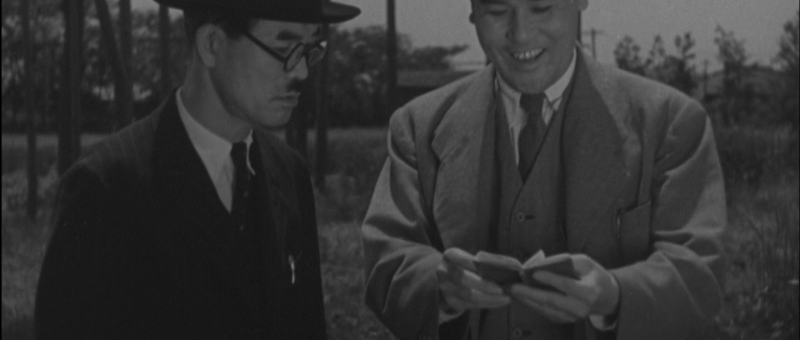
Both You and I (俺もお前も, Mikio Naruse, 1946)

Two dippy salarymen finally rise up against a feudalistic corporate culture in a rare comedy from Mikio Naruse, Both You and I (俺もお前も, Ore mo Omae mo). Essentially a vehicle for real life manzai double act Entatsu Yokoyama and Achako Hanabishi, it’s also an Occupation-era social message movie intended to discourage workers from extending too much deference to their employers, though its positioning of the left-wing student movement as the future countering the militarist past is perhaps surprisingly radical.

In other ways, however, it harks back to the salaryman movies of the 1930s such as Naruse’s own Flunky, Work Hard and Ozu’s I was Born, But… in which the male office worker has been essentially emasculated and forced to debase himself in order to please his boss. As the film opens, Ooki (Achako Hanabishi) and Aono (Entatsu Yokoyama) are guests at their boss’ dinner party at a geisha house where they’ve been ironically invited as entertainment. The pair of them take the place of the geisha doing a silly dance to entertain the boss who quips that they’re cheap considering how much it would cost to hire a pair of comedians. It’s worth saying that Ooki and Aono are not particularly doing this in a calculated way but actively appreciate being appreciated by the boss and see it as their duty to keep him happy. At times, others suggest that it’s their attempt to ingratiate themselves with him, though they seem quite surprised by the suggestion in part because they still believe in an old-fashioned idea of the employer-employee relationship in which the company is supposed to look after them, so they assume they’ll make career progress naturally by being affable team players and aren’t really worried about losing their jobs despite all this talk of restructuring.

Their boss, however, thinks the pair of them are idiots and takes advantage of their loyalty towards him by getting them to dig his garden and complete other inappropriate personal tasks. He gives them a pair of tickets for an onsen resort as a kind of reward, but once they get there, they realise he’s done it to get them to bring back his “luggage” which is actually black-market supplies for his daughter’s birthday party. The boss’ superiority over them is signalled by his large Western-style house, while Ooki and Aono both live in humbler, traditionally Japanese homes. Aono is a widower with four children though he can’t remember how old they are the oldest two daughters are of marriageable age. The boss even requests the eldest, Hatsuko’s presence at the party, but it quickly transpires that he wasn’t inviting her but asking her to do unpaid serving work signalling the class disparity between the middle-ranking salarymen and the boss.

But it’s at the party that things start to change as Hatsuko talks her father out of doing another silly dance as part of the entertainment, in part because of her embarrassment but mostly because her sister Yasuko’s (Itoko Kono) boyfriend is a guest and she’s worried it’ll put him off marrying her. This angers the boss, who insultingly suggests that Aono and Ooki aren’t even fully human and only become a whole person when together so one alone is as useless as an orphaned sandal. Meanwhile, Ooki’s son, whom he’s very proud to say is in university, is rehearsing a communist play that’s about a strike at factory. Ooki doesn’t really understand it, but is worried about the neighbours overhearing and the police getting involved. He still has a pre-war mindset and hasn’t realised that things like freedom of expression now exist. His son tells him that it’s only right to speak up. If you can’t say anything because you’re afraid of getting fired, then you’ll just end up getting exploited. But Ooki and his wife insist they feel too indebted to the boss to be able to talk about him like that. He thinks his son will change his mind when he enters the world of work. Sadao replies that he understands why his father had to do it, but insists that the world is unjust and has been created by the capitalists for their own benefit.

Pushed too far, Ooki and Aono do eventually decide to confront the boss even if they immediately back track when he arrives at the office by hanging up his hat and dusting his desk. They accuse him of being a wartime profiteer who caroused with militarists and made his money by exploiting their labour while he now abuses the black market. They find themselves supported by the other workers from the other side of the door as they insist they’ll fight the restructuring along with the boss’ underhanded plan to sell the company to a rival. They’ve discovered workers’ solidarity and resolved not to be complicit any more with a feudalistic working culture, though it’s unclear if anything will really come of it. They are nevertheless free from their lives of constant debasement and have reasserted their individual identities while otherwise being an unbreakable pair.
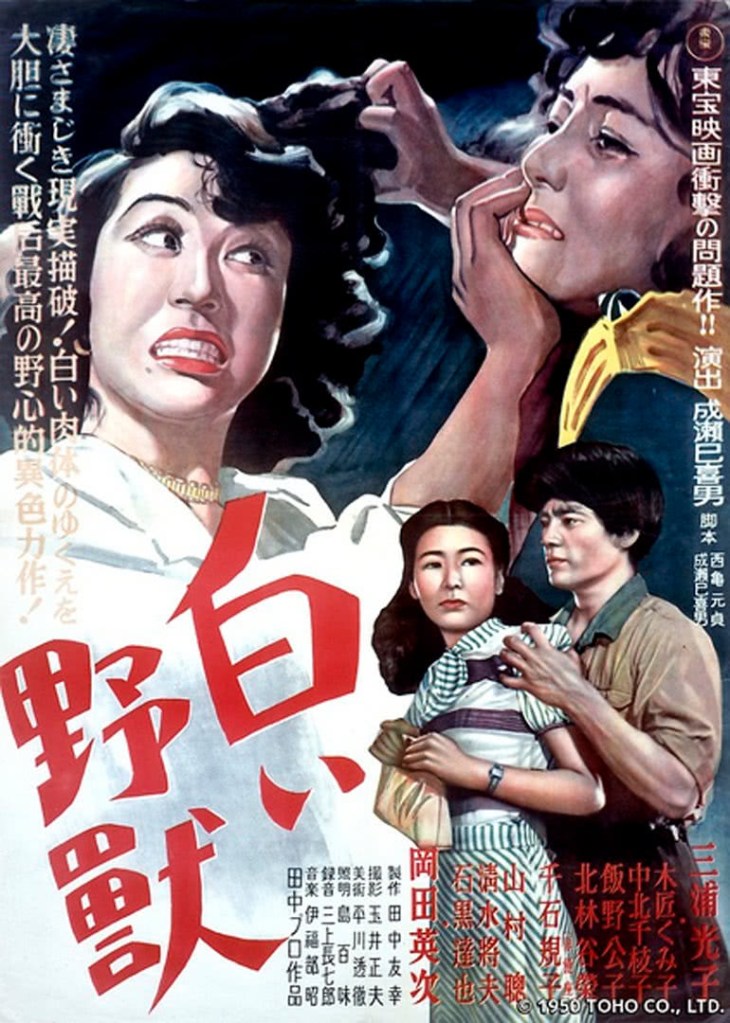
White Beast (白い野獣, Mikio Naruse, 1950)

Though motions were made towards criminalising sex work under the American occupation from as early as 1946, not that much changed until the passing of the Prostitution Prevention Law 10 years later. In the desperation of the later war years and their immediate aftermath, many women who’d lost husbands, families, and their homes, found themselves with no other way to survive than to engage in sex work, but the existence of these women who were only doing something that though not exactly well respected was fairly normalised five years previously became an acute source of embarrassment most especially given the views of the morally conservative Occupation forces. 

Slotting in right next to the pro-democracy films of the era, Mikio Naruse’s White Beast (白い野獣, Shiroi Yaju) is a surprisingly progressive effort which locates itself in a “home for wayward women”. The White Lily Residence is run with love and compassion and even if the older female warden is stern in a practical sort of way she is never unkind or uncaring, while the male governor Izumi (So Yamamura) is patient and supportive, always keen to tell the women in his care that they are not spoiled or dirty and are fully deserving of the bright new futures he is certain are waiting for them. Rather than lecturing the women, the home makes a point of teaching them new skills such seamstressing so that they will be able to find honest jobs on the outside, though the conviction that those jobs exist may be a little optimistic in itself. 

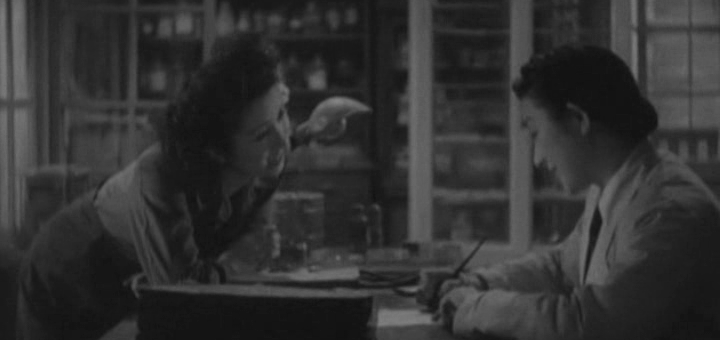
Our first introduction to the White Lily is through the eyes of Yukawa (Mitsuko Miura), an educated woman who claims she engaged in sex work simply because she enjoyed it and doesn’t see why she’s been arrested. She tries to leave and is told that she is technically free to do so, but they will have to call the police if she does. Yukawa decides to stay, especially once she locks eyes with cheerful female doctor Nakahara (Kimiko Iino). Perhaps surprisingly, the central drama revolves around an awkward love triangle between Yukawa who becomes fixated on the doctor who to be fair is unambiguously flirting back, and the bashful Izumi who has designs on Nakahara himself. 

Refreshingly direct and professional, Nakahara nevertheless has an engaging warmth that has made her a real asset to Izumi’s team as she deals with the sometimes quite difficult medical circumstances of the women at the centre, many of whom are understandably suffering with various STIs including syphilis. Never judging them she remains sympathetic and egalitarian, even joining in when Yukawa cheekily invites her to dance while some of the other women are listening to records. Appearing to understand what Yukawa is asking her, she tells her that she has remained single by choice and has no intention to marry because she’s prioritising her career. Yukawa’s confidence is, however, shaken when she hears a rumour that Nakahara and Izumi may be romantically involved. 

Yukawa looks to Nakahara to try and understand why she’s ended up at White Lily. She asks her what it means to have a “dirty” body and gets a diplomatic medical answer which nevertheless coyly places the blame on sexual repression. Nakahara admits that marital relationships can also be “dirty”, not because of infidelity but because of patriarchal inequalities – marriages in which the wife is treated as a “doll” or a “maid” for example. The answer seems to satisfy Yukawa, but Nakahara has also cut to the quick of her psychological trauma in asking her if she is not also internalising a sense of shame in secretly battling with the idea that she is somehow “dirty” because of the way she’s lived her life. 

Given her fixation with Nakahara, we might wonder what it is that Yukawa so struggles to accept about herself despite her outwardly liberated persona. Beginning to reflect on her past life, she sees the faces of the men she slept with looming over her but seems confused. Was she deflecting desire rather than embracing it, trying to prove or perhaps overwrite something? In any case, her time at the centre begins to soften her but, crucially, not towards accepting a social definition of herself as dirty but emerging with new degrees of self knowledge and acceptance. 

The one sour note in Izumi’s otherwise progressive philosophy sees him encourage one of his star pupils, Ono (Chieko Nakakita), to reunite with a man she was engaged to before the war who has just been repatriated and claims his feelings haven’t changed despite finding her at White Lily. Ono is reluctant, partly because she feels a sense of unworthiness, but also because she suspects that whatever Iwasaki (Eiji Okada) says now, he will someday hold her past against her. She’s proved right when she gets a day pass to visit him in his flat where he eventually rapes and then tries to strangle her. Ono vows not to see him again, but Izumi convinces her otherwise, as if this is all her fault, telling her that two people who love each other can work through anything, implying that it’s her job to fix his wartime trauma (if perhaps mildly implying the reverse is also true for him). For an otherwise compassionate man, telling a vulnerable woman to return to a violent partner because “love is enough” seems an oddly patriarchal gesture. 

Nevertheless, despite the late in the game swerve towards conservatism, White Beast presents a surprisingly progressive critique of an inherently misogynistic, hypocritically puritanical society. At one point, a wealthy big wig arrives to lecture the women, berating them for “bringing down Japanese womanhood” while insisting that women who justify sex work as a means of avoiding starvation are being disingenuous because most women are just “decadent” and wanting handbags etc. Yukawa, unable to control herself, fires back, asking him who it is he thinks buys their services in the first place. It’s very valid point, and one it seems few are willing to consider. 


Short clip (English subtitles)