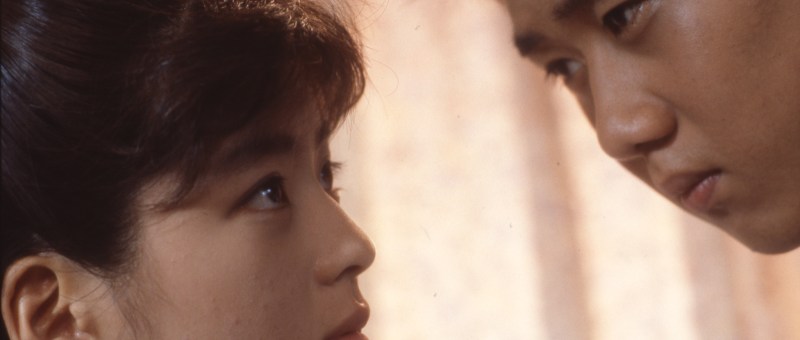
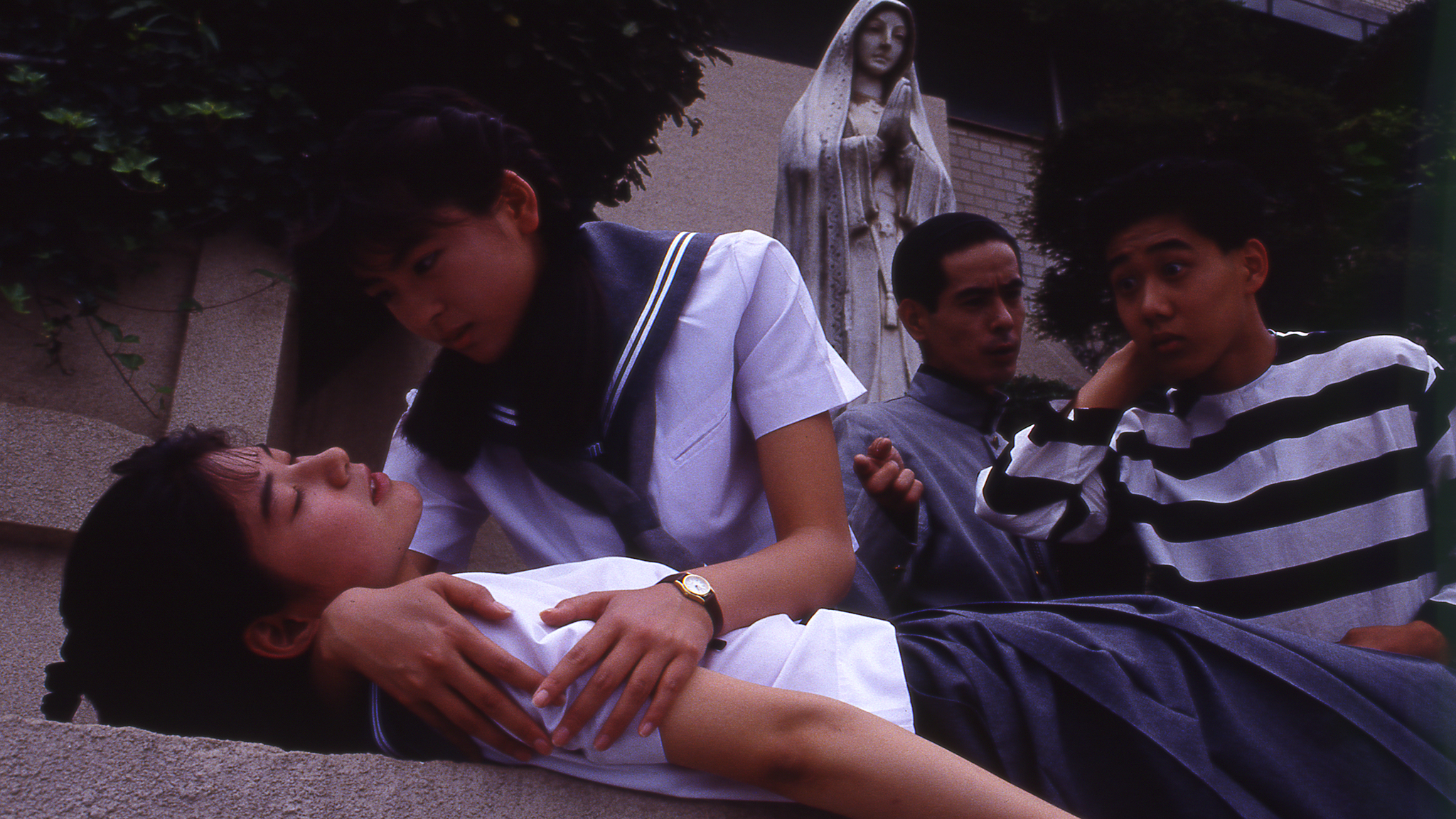
A cocky young man gets hit by a truck on his way to lose his virginity, but manages to get a heavenly civil servant to give him a second chance in Shun Nakahara’s surprisingly nuanced teen sex comedy, Anxious Virgin: One More Time I Love You (Doki Doki ヴァージン もういちど I LOVE YOU, Doki Doki Virgin Mo Ichido I Love You). The second in Nikkatsu’s entry in the straight-to-video market, the title might hark back to their Roman Porno days and conjure an image of something salacious and exploitative, yet what the hero Hideki (Yasufumi Hayashi) eventually comes to realise is that there’s no rush when it comes to something like physical intimacy and that it’s important to consider the other person’s feelings along with your own emotional readiness.
He learns this mainly because he’s abruptly forced into a female body, that of Mari who is the best friend of the innocent Sachiko (Shinobu Nakayama). Much to Hideki’s annoyance, Sachiko has a crush on his old school rival, Kakinuma. Good-looking and successful, Kakinuma is a bit of a cad but also envied by the other boys because he lives in a private annex and has a reputation for bringing girls back there to have sex. Neither Hideki nor any of his friends think much about the girls as people with thoughts and emotions of their own, but fixate solely on the action of sexual intercourse. One of the boys has a weird sexual fantasy about his sister whom he saw naked in the shower. While looking at her, her physical form became divorced from her personhood so that he forgot the taboo of incest and appreciated only the presence of a naked woman in close proximity.
The boys do something similar on coming across a girl from another school who is about to engage in outdoor sexual activity with a boy they know. After he blindfolds her as an ironic way of mitigating her embarrassment, the boys cart him off and begin digitally penetrating the girl themselves without any real thought for her personhood let alone her consent. They hear the boy repeating the phrase “I love you” and come to see it almost as a spell that makes a girl let someone have sex with her. Masao, the most lovelorn, tries this again later in trying to get Hideki in Mari’s body to kiss him, though Hideki is obviously not at all interested.
By this point, Hideki is interested in Sachiko on an emotional as well as purely sexual level but is hampered by his female body. “Mari” appears to the audience as Hideki throughout, amusingly dressed in old-fashioned prison clothes, though the film only sort of flirts with the idea of same-sex desire. In reality, the conflict that caused Mari to lose her consciousness was that she too was in love with Kakinuma, though the problem now is that Hideki can’t support Sachiko in her romance not only because he has a rivalry with Kakinuma and knows him to be a poor romantic prospect, but because he desires her himself. When he eventually kisses Sachiko, she doesn’t quite know what to make of it. She evidently gives it some thought, but decides two girls dating each other doesn’t seem quite right to her and sets “Mari” up with a date with Masao, which is still accidentally a gay date that Hideki isn’t interested in.
Thus the film defaults to heteronormativity, if in a sensitive and empathetic fashion. Nevertheless, through his experiences in a female body Hideki begins to come to a greater appreciation of what it’s like for girls. Despite having spent the entire film trying to lose his virginity, he tells Mari’s younger sister Riko that she won’t die if she doesn’t have sex and that he disapproves of her whirlwind romance. He understands both that Sachiko is naive and that Kakinuma is no hero but a destructive predator who just wants to have sex whether the girl wants to or not. Giving up his chance to lose his virginity and risking being dragged to hell, Hideki decides to save Sachiko from being pressured into sex and then engages with her in a conversation about the importance of consent and emotional readiness in which they both agree that “rules and timing” are important when it comes to physical intimacy. What began as a rather raucous teen sex comedy has morphed into a sweet and sensitive coming-of-age drama in which rather than obsessing over the physical act, the hero falls in love and is content to end his life having given voice to his feelings.
Screened as part of the International Film Festival Rotterdam’s Focus on V-Cinema.
 Chekhov’s The Cherry Orchard is more about the passing of an era and the fates of those who fail to swim the tides of history than it is about transience and the ever-present tragedy of the death of every moment, but still there is a commonality in the symbolism. Shun Nakahara’s The Cherry Orchard (櫻の園, Sakura no Sono) is not an adaptation of Chekhov’s play but of Akimi Yoshida’s popular 1980s shojo manga which centres on a drama group at an all girls high school. Alarm bells may be ringing, but Nakahara sidesteps the usual teen angst drama for a sensitively done coming of age tale as the girls face up to their liminal status and prepare to step forward into their own new era.
 Windows on Worlds