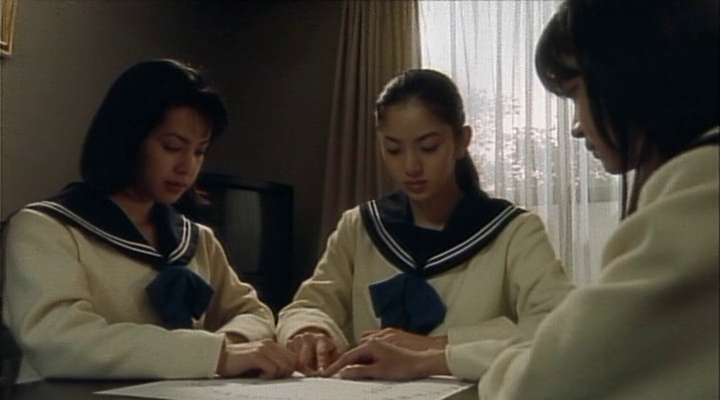
The tensions between a trio of young women are brought to the fore by an ill-advised consultation with Kokkuri-san in Takahisa Zeze’s atmospheric horror movie. Some more than others, these girls are all haunted if only by adolescent confusion and suppressed desire. Looking for answers with no one turn to in the absence of parental authority, they rely doubly on a late-night radio show, Midnight Blue Bird, hosted by a girl their age calling herself “Michiru”.
“Michiru” is the heroine of the Japanese version of Blue Bird fairytale about a brother and sister who leave in search of the blue bird of happiness only to return and realise that it was waiting for them at home all along. While the moral of the fairytale might be that happiness is all around us if only you know how to look, there is precious little surrounding the girls outside of their friendship which is already beginning to fracture under the weight of adolescence, not to mention a series of overlapping love triangles.
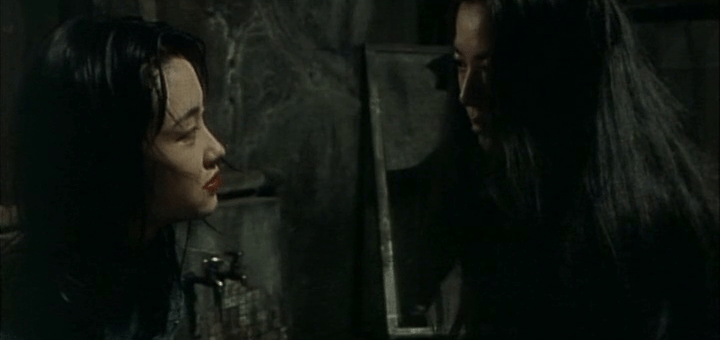
What neither of the other girls know, is that Michiru is actually a persona constructed by Mio (Ayumi Yamatsu) who is actually the host of the radio show. As Michiru she claims to be sexually experienced and rebellious, answering the questions that come from other young women though, in reality, a regular high schooler and romantically naive. As we gradually become aware, she is in love with her friend Hiroko (Hiroko Shimada), but Hiroko has a crush on Masami’s fickle boyfriend Akira. It was Mio who suggested the Kokkuri-san game on her radio show, a Ouija board style means of divination, but it quickly turns dark with Masami (Moe Ishikawa) manipulating the board to needle Hiroko after realising she’s after her boyfriend.
The resulting fallout pushes Hiroko and Mio towards a confrontation with their shared traumas as survivors of a drowning. Hiroko is haunted by a little girl in red, ironically named “Midori” which means “green”, and struggles to get over the guilt she feels over a childhood friend who drowned in a public bath. Mio, meanwhile, gives contradictory biographical information on her show, but it seems that Mio’s mother intended to take her own life with Mio in tow after she caught her with her new husband to be following the death of Mio’s father. Echoing the central motivation of the film, Mio’s mother suggests the “go together” to where her father is, but later saves Mio alone.
But while Hiroko becomes preoccupied with the notion of sex, vowing to become more like Michiru, she tells Michiro that thanks losing her virginity will change her though she later laments that it’s changed nothing at all. Mio, meanwhile seems to have a hangup having caught her mother with another man. In disgust, she rubs at her libs in the same way that the older Mio later does after finally finding the courage to kiss Hiroko who lips have, by then, been coated in striking red lipstick. The colour red seems to represent the curse of Kokkuri-san and with it repressed guilt, regret, and forbidden desire. Though it seems that by learning to accept herself, publicly unmasking herself on her radio show and confessing her love for Hiroko live on air, Mio alone is able to overcome the curse. The kiss she gives Hiroko is one of life that seems to break the spell and free them both from Kokkuri-san’s trap, though all may not be as it first seems.
Nevertheless, the fact that Hiroko does not remember makes this something of a private evolution for Mio even as voices from the past resurface and encourage them “go together” toward whatever fate awaits them in the film’s ambiguous conclusion that echoes that of Zeze’s earlier pink tale of frustrated same-sex desire, Angel of September, which shares many of the same themes. Even so, in finally accepting her sister, who is impressed and supportive of her coming out live on air even if she cynically adds it can be her new gimmick, Mio has undergone a transformation into adulthood and symbolically been reborn, emerging from the cleansing waters with greater clarity and self-assurance if perhaps no more certain of what the future may hold.
Trailer (no subtitles)
 Chekhov’s The Cherry Orchard is more about the passing of an era and the fates of those who fail to swim the tides of history than it is about transience and the ever-present tragedy of the death of every moment, but still there is a commonality in the symbolism. Shun Nakahara’s The Cherry Orchard (櫻の園, Sakura no Sono) is not an adaptation of Chekhov’s play but of Akimi Yoshida’s popular 1980s shojo manga which centres on a drama group at an all girls high school. Alarm bells may be ringing, but Nakahara sidesteps the usual teen angst drama for a sensitively done coming of age tale as the girls face up to their liminal status and prepare to step forward into their own new era.
