Hey! Our Dear Don-chan (おーい!どんちゃん, Shuichi Okita, 2022)

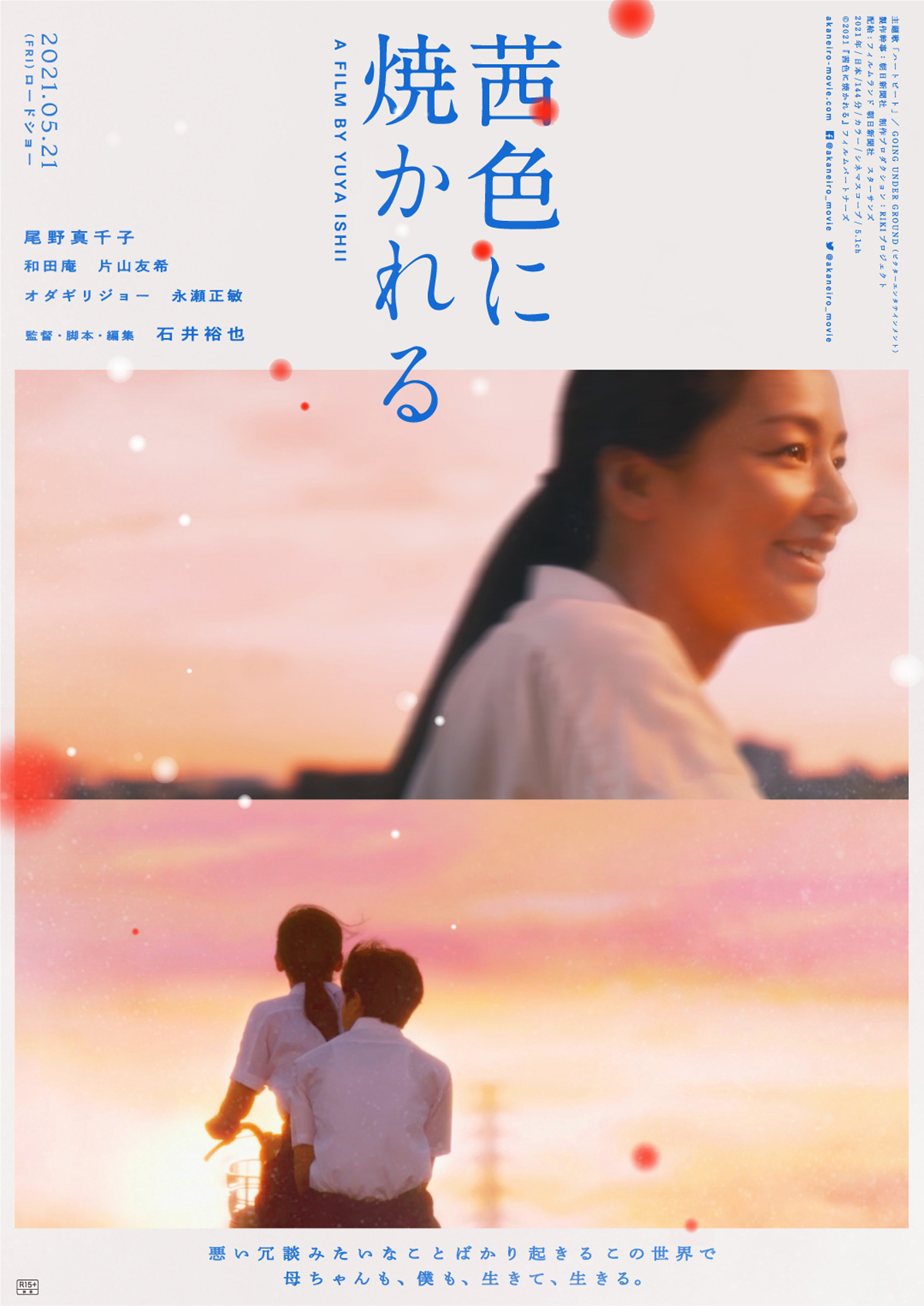
A trio of actors undergo a coming-of-age tale of their own when a baby is suddenly abandoned on their doorstep in Shuichi Okita’s charming slice of life dramedy, Our Dear Don-chan (おーい!どんちゃん, Oi! Don-chan). A take on Three Men and a Baby, the film stars the director’s own daughter and follows her over a period of three years as the actors attempt to adjust to fatherhood and the new kind of family that has arisen between them. 

As the film opens, Michio (Tappei Sakaguchi), Ken (Hirota Otsuka), and Gunji (Ryuta Endo) are struggling actors working in slightly different media but having about the same amount of luck and continually dejected about their lack of career success. Ironically while playing the game of life, Ken has a baby girl in the game but is surprised to hear one crying for real on the street below. On reading a note in her pushchair, Ken realises that the baby has been left by a previous girlfriend, Kaori, with the instruction that he raise it. 

Of course, the situation gives rise to a degree of panic, Ken wondering not only if he is the father but if he can be while supported by the other two guys, along with former houseman Sakamoto and his girlfriend Akari, taking care of more practical matter likes getting nappies and baby food. Then again, some of the practical details are already overcome by virtue of their occupations which allow them to be home during the day taking shifts to watch the baby they christen “Don-chan” on account of not knowing her real name. 

As they struggle with the demands of fatherhood, the three men each commit themselves to Don-chan’s well being, mindful of the memories she’ll make in the future and wanting to make her present as happy as possible. At one point they decide to take a camping trip in order to show her that they can be “manly dads”, but otherwise entertain her at home or take her on trips to the aquarium acting as a trio even if Ken is technically the primary dad forming a new kind of family that makes it easier to care for a small child than it might otherwise have been. If Ken had been on his own, he may not have been able to raise her. Michio and Gunji both complain at the precarious state of childcare facilities, lamenting that you can’t get a place unless you work full-time but you can’t work full-time if you can’t get childcare for when you’re at work. 

Meanwhile, they continue to struggle in their professional lives. A humiliating audition for a TV commercial causes Ken to rethink his career plans, stopping off to buy new toys for Don-chan on the way home lamenting that he “danced like an idiot for no reason.” Michio continues to go full method over researching all his roles for seconds of screen time in TV and movies, while Gunji’s stage career is disrupted when the manager of his troupe decides to admit himself to a psychiatric facility for long term care. Through their interactions with Don-chan, however, they all begin to grow up gaining further life experience which enhances their performance ability and gives them a greater goal to work towards aside from mere career success. 

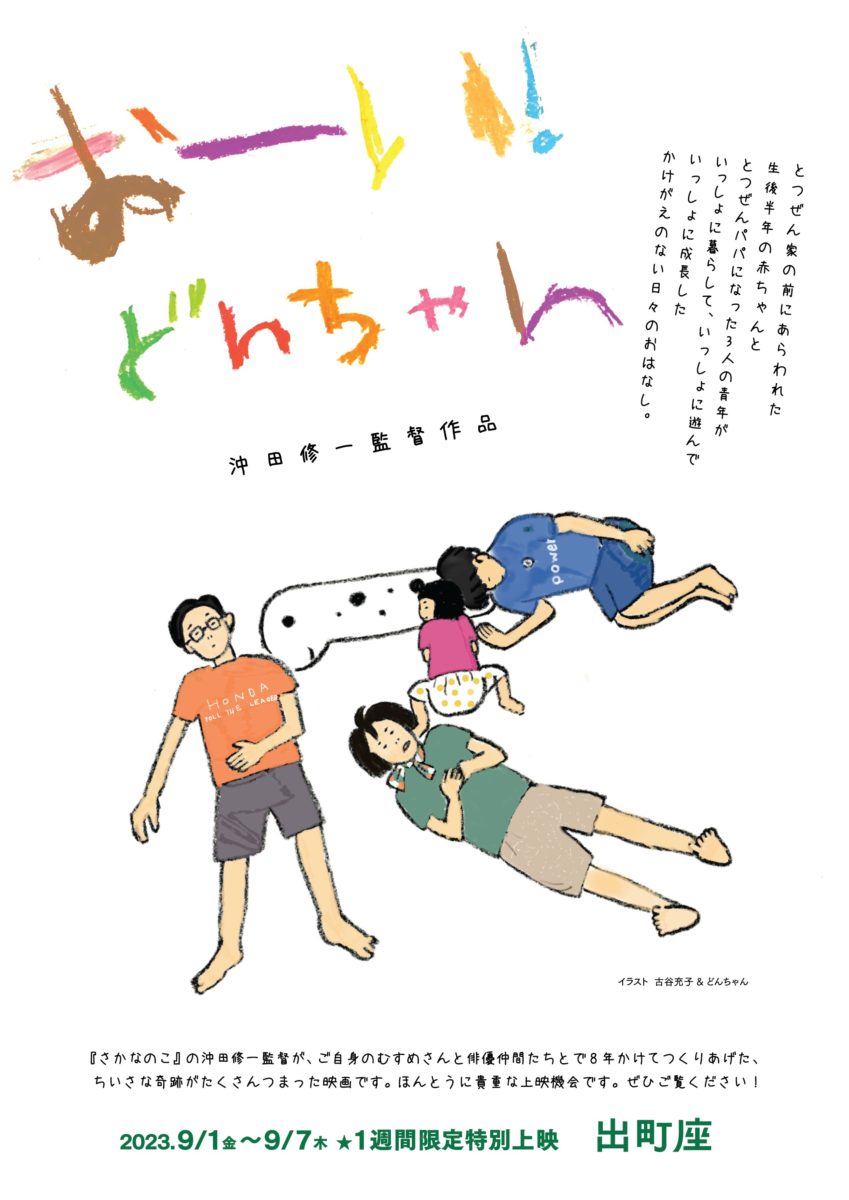
A heartwarming familial drama, the film doesn’t gloss over how difficult it can be to raise a child in contemporary Japan especially as a single-parent but rather embraces a larger idea of the word family which centres platonic friendship and community while simultaneously understanding of Kaori’s position in the knowledge that none of this is easy and she may not have had access to the kind of support that made it possible for Ken to care for Don-chan with so much love and attention. In any case, little Don-chan is certainly lucky to have so many people around her all invested in her happiness and future whose lives she has also enriched just by her existence. A truly happy film, Okita adds small doses of absurdity to the already surreal events along with a nostalgic sense of childhood comfort right down to the childish font of the film’s titles complete with corrections and crossings out that are, much like life, evidence of joyful trial and error. 


Trailer (English subtitles)

The Moon (月, Yuya Ishii, 2023)

If you can judge a society by the way it cares for its most vulnerable, then at least according to Yuya Ishii’s The Moon (月, Tsuki), adapted from the novel by Yo Hemmi, Japan is not doing very well. Inspired by a real life incident in which a disaffected young man went on a rampage murdering patients at a facility for the disabled claiming they were a drain on national resources, the film probes into some dark areas of the human psyche asking what people really think deep down and who we do and don’t see as being human just like us.

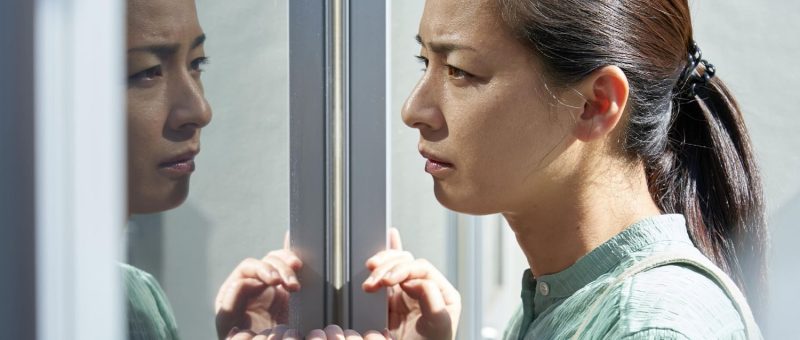
Blocked writer Yoko (Rie Miyazawa) only takes the job at a care facility because her literary career has stalled and her husband (Joe Odagiri) is out of work. Each of them is still reeling from the death of their three-year-old son who was born with a heart defect and suffered brain damage during an operation that meant he never spoke and was fed through a feeding tube. Working at the care facility brings up painful memories and directly confronts Yoko with realities of her son’s life and death while she later discovers that she is pregnant again and isn’t sure whether or not to have the baby fearing it may have the same condition and knowing that as a woman over 40 there is an increased chance she may give birth to a child who has complex needs.

In many ways it’s Yoko’s own reaction to her pregnancy which underlines the film, the lunar imagery intensely linked with that of her ultrasounds while she reckons with her own feeling of perhaps not wanting to bear an “abnormal” child, as someone puts it. Of course, this very personal sentiment is informed by the loss of her son and the experience of living and caring for him for the three years he was alive, but it also informs her perspective on the care, or lack of it, sees at the facility where patients are sometimes confined to their rooms indefinitely, left covered in their own excrement, or allowed to harm themselves through lack of stimulation. Like Yoko most of the other orderlies seem to have no medical training and two in particular mistreat the people in their care for their own amusement. On witnessing an orderly strike a patient for no reason while frogmarching him back to his room, she asks him if that’s really okay but he just replies that okay or not it’s the way they do things here. She tries to take her concerns to the facility’s director, but he basically tells her the same thing and even threatens her employment if she continues to make a fuss. 

Yoko closely identifies with another woman who happened to be born on exactly the same day she was yet has been confined to bed for 10 years and is assumed to be unable to communicate. According to another orderly, also called Yoko (Fumi Nikaido), Ki-chan could walk and was partially sighted when she arrived but someone decided that it would be easier to care for her if she stayed in her room so now her muscles are too wasted to walk while they also covered up her windows because they thought dim lighting would keep her more docile. Essentially, they further disabled her for their own convenience and concluded that because she could not communicate with them in a way they considered usual that she had nothing to communicate. It doesn’t seem to occur to them that biting the other Yoko’s arm, for instance, is also communication as are some of the behaviours exhibited by the other patients which the orderlies respond to with force or violence.

Shoko, the girlfriend of another orderly Sato (Hayato Isomura), is deaf and remarks to the other Yoko that she doesn’t need to hear to be able to understand yet a value judgement seems to have been placed on these people’s lives based solely on their ability to communicate through conventional means. Yoko is accused of romanticising notions of disability, while many people may outwardly say they believe those with physical or intellectual disabilities are equal to themselves and deserve the same levels of respect and dignity they are also unwilling to deal directly with the unpleasant side of their care such as cleaning up bodily fluids which may have strong and penetrating odours. Both the other Yoko, who has literary aspirations of her own, and Sato make frequent reference the stench of reality, something which often left out or not spoken of. The other Yoko accuses Yoko of leaving the smell of decay out of her award-winning book on the Great Kanto Earthquake of 1923 which she later reveals was something urged by her editor who instructed her to soften the edges to create a story that readers would find uplifting and inspirational.

One of the unpleasant things glossed over about 1923 earthquake was the pogrom against Koreans which took place in its wake, something that is tacitly referenced during the attack on the care facility as the killer determines to ask each of the victims if they have a soul despite having already decided that those who cannot speak do not. During the pogrom, those suspected of being Korean were often asked to pronounce certain words to see if they had a Korean accent, only many people from other areas of Japan also pronounce them in the same way so the test proved nothing. The killer wants to see themselves as “normal”, that their way of thinking is just the same as everyone else’s only they don’t have the courage to speak and that their course of action is one most people tacitly support because they also do not believe that the people at the care facility are human or that they have a soul.

Raising her concerns, Yoko has a long philosophical conversation with Sato which doubles as a self-interrogation while it is also in some senses true that the people at the care facility are each refractions of herself. In any case, the conditions and contradictions of the facility appear to place a strain on the mental health of those who work there who are encouraged to simply get used to the way the system works rather than attempt to change it. Sato complains that he struggles to discern dream from reality, while reality itself is often distorted by a lack of desire to talk about anything that might be unpleasant or inconvenient.

Even a discussion that might have been unpleasant or inconvenient to have is interrupted in the closing moments, though the most important things are indeed said while Yoko and her husband are able to sit face to face and begin rebuilding their relationship in the wake of the loss of their son. Ishii conjures an atmosphere of true dread as events slowly creep towards an inevitable conclusion, but also peppers Yoko’s life with small moments of joy if underscored by a searing horror that many are prepared to unsee until brought to a violent confrontation with the contradictions and hypocrisies that dwell deep within their own hearts.


The Moon screened as part of this year’s Camera Japan.

Trailer (English subtitles)

A Madder Red (茜色に焼かれる, Yuya Ishii, 2021)

©︎2021 "A Madder Red" Film Partners

A single mother and her son face the myriad injustices of the modern society with dignity and grace in Yuya Ishii’s quietly seething pandemic-era social drama, A Madder Red (茜色に焼かれる, Akaneiro ni Yakareru). The heroine is constantly asked why she isn’t angrier, those around her confused by her stoical attitude and tendency to simply sigh and say “let’s get through this” rather than railing against the persistent unfairness that defines her life but then she doesn’t have a lot of time for being angry nor would it particularly help her situation or bring about change. All she can do is persevere in the hope that it won’t always be this way, her run of bad luck will end, and she will eventually be permitted to rest. 

Ishii opens the film with a 3D model simulation of a traffic accident in which a cyclist is killed by an out of control car on a zebra crossing in an otherwise tranquil residential area. Ryoko’s (Machiko Ono) husband Yoichi (Joe Odagiri) is sent flying and ends up squished like a bug on the windscreen of a vehicle travelling in the other direction. The driver, an elderly man later revealed to have been living with Alzheimer’s, mistook the accelerator for the brake but as he had been a prominent local official the matter was swept under the carpet and he faced no consequences. What people can’t seem to understand is why Ryoko chose to attend the old man’s funeral when he eventually died. It seems attend was all she did, but the man’s son had security throw her out and his lawyer accuse her of “harassment” while expressing anger and resentment that her presence tarnished his father’s lavish ceremony when he had been such a good a man. Her presence perhaps annoys him because he knows on some level he’s in the wrong, while her strength and dignity shame him knowing that they should have just apologised. The lawyer implies she’s being unfair targeting the family who were not themselves responsible for the accident, except that in a sense they were because they failed to protect the old man by continuing to allow him to drive by himself. 

Ryoko refused the compensation money for this reason, that they tried to settle it with cash as if her husband’s life had no meaning. She lives in subsidised government housing, but doesn’t claim any benefits supporting herself after she was forced to close her cafe through a part-time job in a supermarket floristry department and after hours sex work. “Break a rule, break your life” she teaches her 13-year-old son Junpei (Iori Wada) yet constantly falls foul of rules written or otherwise while doing nothing wrong in the eyes of those who rant about benefit scroungers and routinely belittle those without means. She’s taken to task by her manager for taking home flowers that were due to be thrown out and for taking a phone call outside the store after clocking off, but when they fire her on a pretext to hire the daughter of a prominent client who can’t find a part-time job because of the pandemic, they refuse to honour the two month notice clause in her contract. Similarly when bullies from Junpei’s school set fire to some books left outside their apartment, they are the ones who have to move for violating the rule about causing a disturbance to the other residents. 

Given all of this no one can understand why Ryoko isn’t seething mad. She still pays for her father-in-law’s nursing home and even child support for a girl she’s never met fathered by Yoichi with another woman. Struggling herself, the child’s mother later turns to a sleazy friend of Yoichi’s, Ryu (Tateto Serizawa), to petition Ryoko to increase the child support but like her also worries that it “doesn’t seem right” to further burden a woman who is also struggling to raise a child alone just like herself while Ryu, as he had unsuccessfully with Ryoko, attempts to extort sexual favours in return for his assistance. Ryoko does these things when she doesn’t strictly have to and many people wouldn’t less out of pride or stubbornness than because it’s the right thing to do and if she can satisfy herself that she’s done right by others even if they’ve not done right by her then she maintains her dignity and their scorn can’t harm her. 

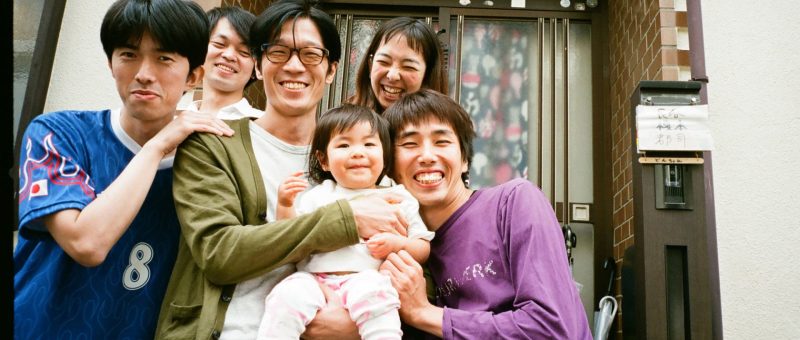
Even so, sick of being treated like a bug Ryoko’s rage eventually begins to boil over her subdued outfits giving way to a fiery red as her hopes of escape are once again dashed on realising a potential romantic suitor only ever viewed as a plaything. Everyone is always telling Ryoko’s that she’s “strange”, “weird”, “crazy”, in her passive resistance living by her own rules while constantly betrayed by those of others which they only enforce when it suits them. Ishii flags up all of her various expenses on the screen making it clear just how much it costs for Ryoko to be this poor while she seemingly grins and bears it. Then again as the film’s only title card tells us Ryoko is a good actress, and perhaps she has to be to get by in this indifferent society filled hidden suffering and an almost sadistic lust for self-preservation. “Mom, it’s all too much” Junpei sighs as he comes to an appreciation of his mother’s fortitude and her desire to simply “get through this” as they ride a mamachari towards a glowing technicolour sunset which ironically enough refuses to end trapping in them in this space of grief and unfairness but carrying with it a far off hope perhaps cruel in its elusiveness.


A Madder Red streamed as part of this year’s Nippon Connection.

International trailer (English subtitles)

Images: ©︎2021 “A Madder Red” Film Partners