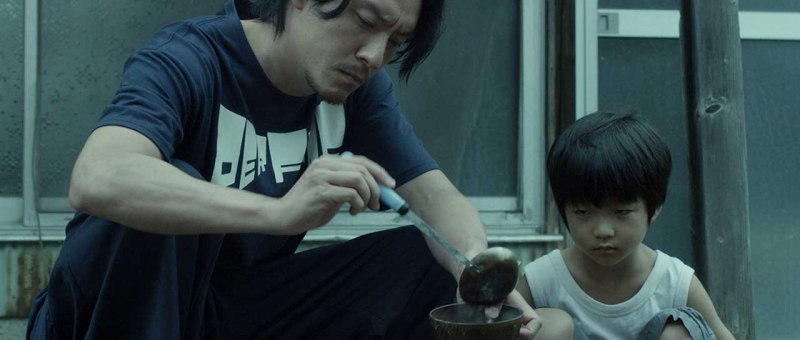
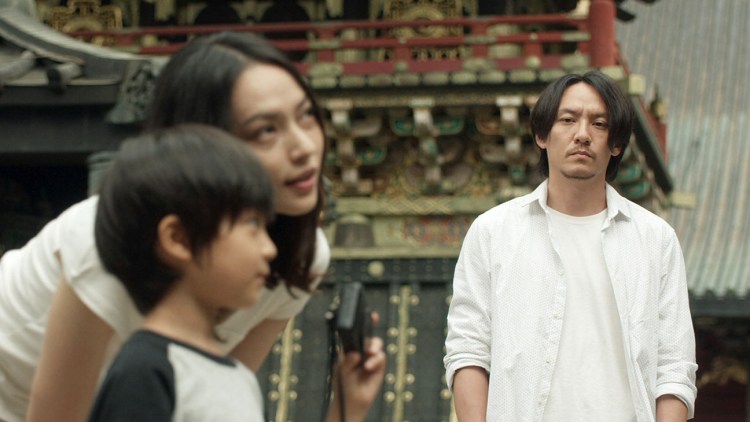
 Taiwan and Japan have a complicated history, but in SABU’s latest slice of cross-cultural interplay each place becomes a kind of refuge from the other. Working largely in Mandarin and with Taiwanese star Chang Chen, SABU returns to a familiar story – the lonely hitman tempted by a normal family life filled with peace and simplicity only to have his dreams taken from him by the spectre of his past. Only this time it isn’t just his past but that of others too. Despite the melancholy air, Mr. Long (ミスター・ロン) is a testament to the power of simple human kindness but also a condemnation of underworld cruelty and its vicelike grip on all who enter its grasp.
Mr. Long (Chen Chang) is the best hitman in the Taiwanese underground. A part-time cook, he’s known for his knife skills and fearless action, entering a room full of gangsters and instantly eviscerating them before they can even reach for their weapons. Sent to Japan to take out a prominent yakuza, Mr. Long finds his usual methods ineffective owing to the fact his target is wearing a stab vest. Captured, beaten and driven out into the middle of nowhere, Mr. Long is beginning to think this is the end of his story when the gangsters are attacked by another knife wielding assailant repeatedly asking them to free his girl. Mr. Long escapes in the ensuing chaos but has no money or way back home.
Marooned and bleeding in a rundown area, Mr. Long is saved by quiet little boy who brings him first medical supplies and then some probably stolen vegetables. Mr. Long manages to find an abandoned house which still has running water and cooking facilities and shares his improbably tasty soup with the little boy whose name is Jun. Surprisingly, Jun can speak fluent Mandarin because his mother, Lily, is also from Taiwan. Soon enough, other people in the area start to hear about the mysterious stranger and his wondrous cooking. Before he knows what’s happening, the tiny town has adopted him and built a stall on a cart where he can sell Taiwanese beef noodles.
SABU embraces his absurd sense of humour as Mr. Long’s capture becomes a cartoonish slapstick affair which ultimately sees him running off into the night with a sack on his head before regaining his quintessential cool. Mr. Long is the archetypal movie hitman – the major reason why he doesn’t say much is firstly that he doesn’t know any Japanese but his conversations with the boy are pretty one sided and he doesn’t seem to be the chattiest even in Taiwan. Confused as to why all of this is happening Mr. Long asks Jun for guidance only for him to point out that it’s his own fault for acting so cool and never saying anything.
Yet for all the comedy there’s an underlying sadness as Mr. Long comes to care for this strangely friendly village which has more or less adopted him, providing him with food, clothing, and even an occupation in his brand new beef noodle stand. Even though he’s been in contact with his bosses and is supposed to get a boat to Taiwan in just a few days, Mr. Long doesn’t quite want to go home and let all of these nice people down. Especially as he’s begun to bond with the boy and grow closer to his mother.
Both Mr. Long and Lily are people who’ve had their lives ruined by proximity to the underworld – his by being trapped into a profession of killing with no possibility of escape, and hers by losing the love of her life to men who claimed to own her. Lily’s story is a sad one which eventually sees her fall into prostitution as a means of caring for her son only to be exploited by a duplicitous customer who gets her hooked on heroine as a means of control. Mr. Long frees her from this particular demon and the three begin to look as if they could make a go of things together only for the past to suddenly reappear and ruin everything.
Unexpectedly dark, Mr. Long veers between whimsical comedy and heartbreaking tragedy as its hero begins to long for another life which he knows he will be denied. Filled with SABU’s typically absurd world view mixed with balletic yet horrifying violence as the lonely hitman becomes the dragon spelt out in his name, Mr. Long is a familiar gangland tale in which a man cannot escape his past or his nature and risks rejection from those who’ve come to love him when they discover who he really is, but even if there can be no escape for some there is hope of redemption in human kindness and genuine connection.
Mr. Long was screened at the 17th Nippon Connection Japanese Film Festival.
Original trailer (no subtitles)
 “Memories are what warm you up from the inside. But they’re also what tear you apart” runs the often quoted aphorism from Haruki Murakami. SABU seems to see things the same way and indulges an equally surreal side of himself in the sci-fi tinged Happiness (ハピネス). Memory, as the film would have it, both sustains and ruins – there are terrible things which cannot be forgotten, no matter how hard one tries, while the happiest moments of one’s life get lost among the myriad everyday occurrences. Happiness is the one thing everyone craves even if they don’t quite know what it is, little knowing that they had it once if only for a few seconds, but if the desire to attain “happiness” is itself a reason for living could simply obtaining it by technological means do more harm than good?
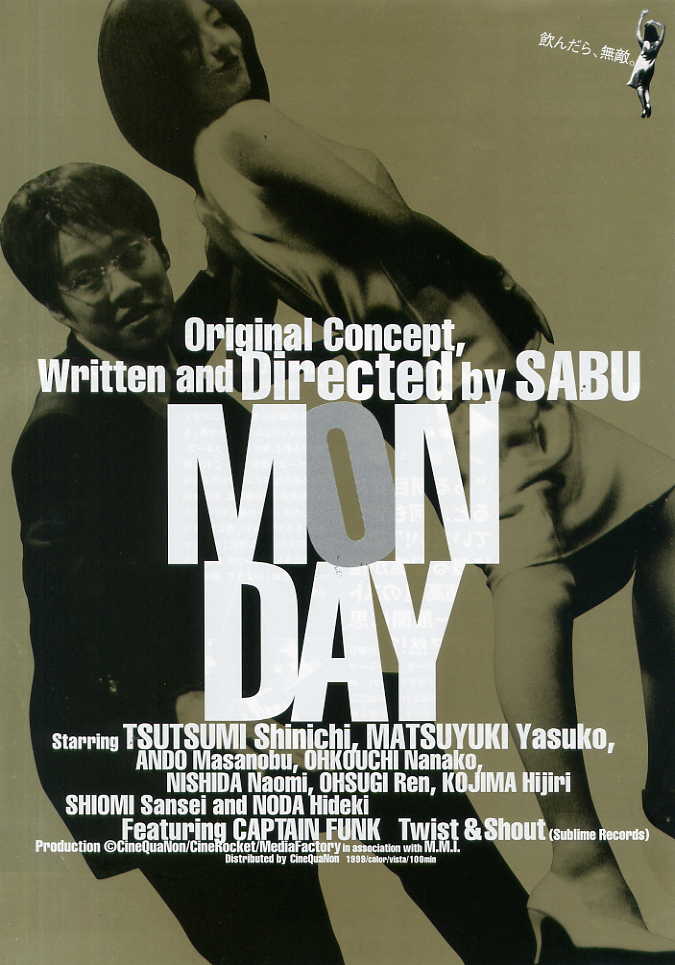 Waking up in an unfamiliar hotel room can be a traumatic and confusing experience. The hero of SABU’s madcap amnesia sit in odyssey finds himself in just this position though he is, at least, fully clothed even if trying to think through the fog of a particularly opaque booze cloud. Monday (マンデイ) is film about Saturday night, not just literally but mentally – about a man meeting his internal Saturday night in which he suddenly lets loose with all that built up tension in an unexpected, and very unwelcome, way.
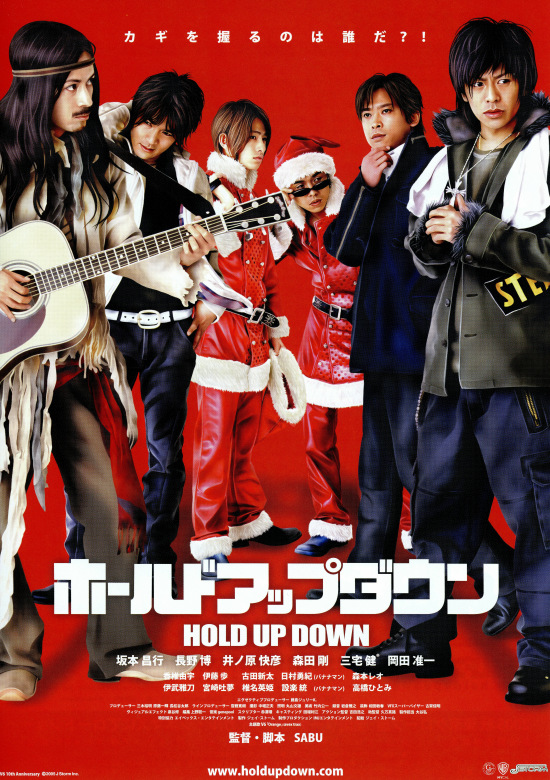 Reteaming with popular boy band V6, SABU returns with another madcap caper in the form of surreal farce Hold Up Down (ホールドアップダウン). Holding up is, as usual, not on SABU’s roadmap as he proceeds at a necessarily brisk pace, weaving these disparate plot strands into their inevitable climax. Perhaps a little shallower than the director’s other similarly themed offerings, Hold Up Down mixes everything from reverse Father Christmasing gone wrong, to gun obsessed policemen, train obsessed policewomen, clumsy defrocked priests carrying the cross of frozen Jesus, and a Shining-esque hotel filled with creepy ghosts. Quite a lot to be going on with but if SABU has proved anything it’s that he’s very adept at juggling.
 SABU might have gained a reputation for his early work which often featured scenes of characters in rapid flight from one thing or another but Dead Run both embraces and rejects this aspect of his filmmaking as it presents the idea of running and its associated freedom as an unattainable dream. Based on the novel by Kiyoshi Shigematsu, Dead Run (疾走, Shisso) is the tragic story of its innocent hero, Shuji, who sees his world crumble before him only to become the sacrifice which redeems it.
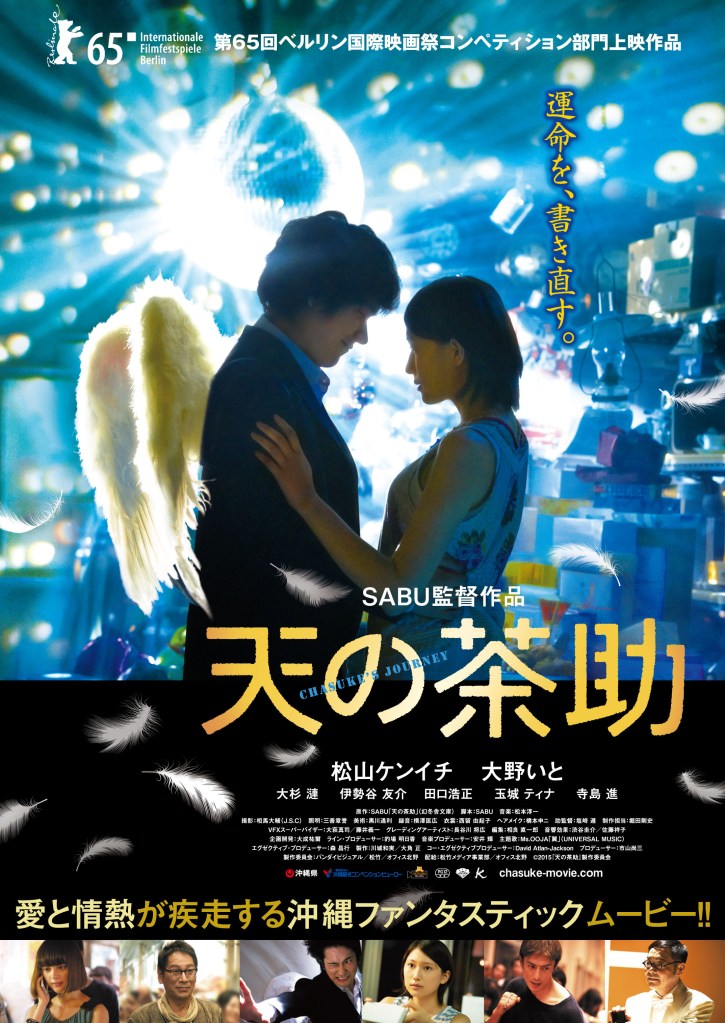 No fate but what we make – to steal the lines from another film just as one of the heavenly scriptwriters might in the latest film from the prolific Japanese director SABU (otherwise known as the actor Hiroyuki Tanaka), Chasuke’s Journey (天の茶助, Ten no Chasuke). Adapting his own novel for the screen (though the book was actually published after the film was completed), Sabu creates a romantic fantasy in which a lowly tea boy from heaven descends to Earth on a quest to save the woman he loves from certain death.
 Windows on Worlds