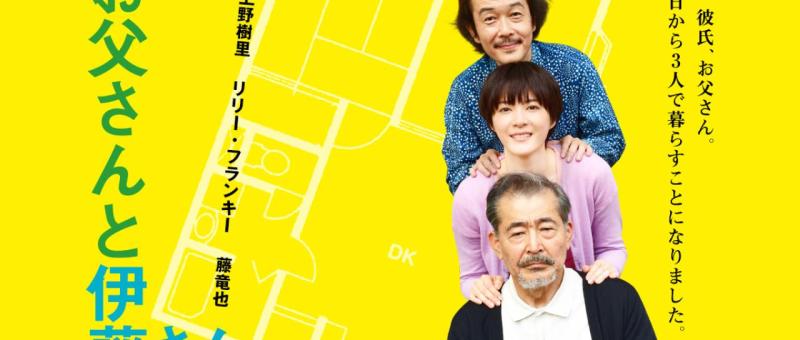
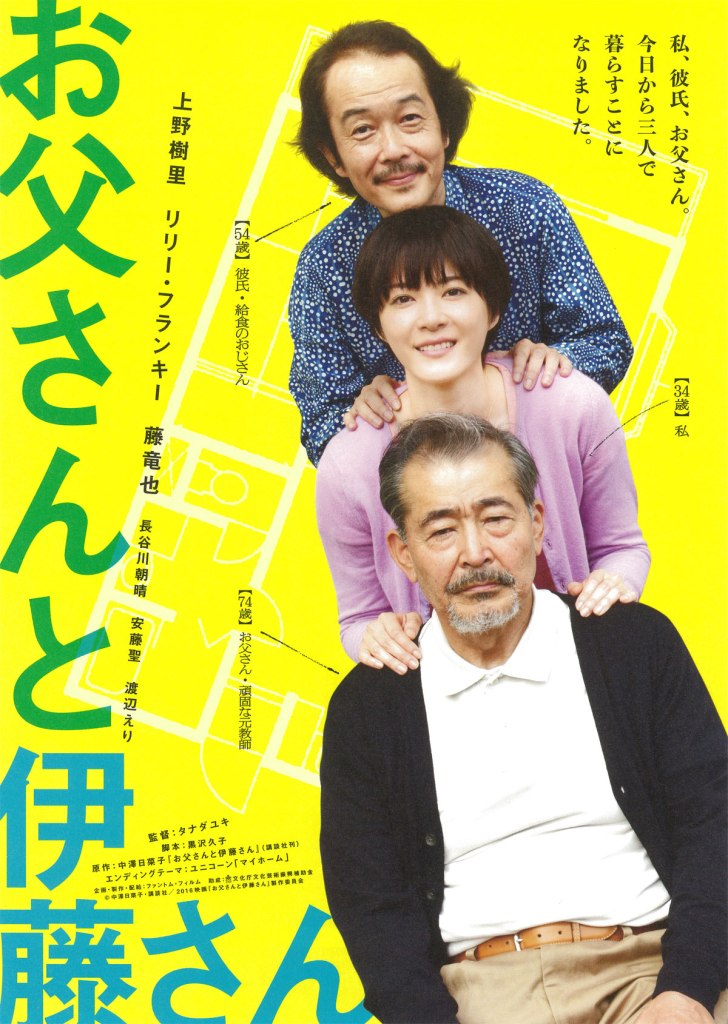
Family. It can be surprisingly hard work. The rootless patriarch at the centre of Yuki Tanada’s exploration of the dissolution of the family in contemporary society My Dad and Mr. Ito (お父さんと伊藤さん, Otosan to Ito-san) is a case in point, “stubborn and difficult” as his daughter describes him to the man she lives with but had never seen the need to introduce to her relatives. He might be impossible, a “ticking time bomb”, but he’s still your dad even if he doesn’t approve of any of your life choices and insists on presiding over your home as if it were a schoolroom and he the headmaster.
34-year-old Aya (Juri Ueno) is currently living with but not legally married to Mr. Ito (Lily Franky), a 54-year-old school cafeteria assistant she met while they were both working part-time at the same convenience store. Despite the age difference, the couple are very well suited and though they are not exactly wealthy, Aya now working part-time in a bookshop, they have enough for what they need and enjoy a quiet life growing their own produce in the small patch of garden behind their apartment. She is evidently not particularly close with her brother Kiyoshi (Tomoharu Hasegawa) who had no idea she is no longer living alone, otherwise he might not have asked her to take in their widowed 74-year old father for the next six months while his twins cram for exams to get them into an elite middle school. He quickly apologises, but as soon as Aya gets home she realises they have an unexpected visitor. Dad (Tatsuya Fuji) has already arrived carrying a mysterious box and is non-plussed to say the least on having encountered Mr. Ito. Nevertheless, he abruptly declares that he’ll be moving in, announcing that he prefers Japanese-style food, lightly seasoned.
Dad, as he points out, was a schoolteacher for 40 years and has a distinctly conservative, authoritarian outlook. He’s not been in Aya’s apartment more than a few minutes before he starts criticising her lifestyle choices, though evidently like Kiyoshi he knew almost nothing about her and had no idea that she is not a regular company employee but a laidback part-timer. Obviously, he has issues with Mr. Ito, not least the age gap, but also with his equally laidback approach to life, poking Aya for information by idly remarking on the private lives of baseball players in the paper while she reveals that she knows almost nothing of him save that as far as she can remember he’s from Yokohama and has been married once before. She has no desire to know who he was before he met her and is happy enough to know the man he is now and draw her conclusions from that.
Mr. Ito does indeed seem to be a very nice man, played by Franky with a characteristically laidback charm. Detecting a degree of hostility between father and daughter he tries to diffuse the situation with patience and kindness, immediately making space for Dad in their lives and trying to accommodate him as best as possible despite his unpleasantness and tendency to correct their “bad habits” such as serving teriyaki sauce with tonkatsu like common people while the civilised settle only for “Wooster”. After an initial period of hostility, Dad eventually warms to Mr. Ito, describing him as “my son-in-law” and bonding with him over manly things like power drills and oversize screws to the extent that he eventually considers moving back to his childhood country home and randomly asks Mr. Ito, but not his daughter, to come too.
Mr. Ito, however is no Noriko, the child-by-marriage who alone is willing to shoulder the burden of filial responsibility, only someone attempting to mediate a difficult family situation. We realise that the reason Dad has been kicked out of Kiyoshi’s house is because he’s driven his wife Ririko (Sei Ando) into a near nervous breakdown with his tyrannous tendency for “correcting” what he sees as poor behaviour, apparently even criticising the way his late wife held her chopsticks right up until the day she died. His behaviour borders on the abusive and though we have no idea how his wife coped with it, it’s clearly too much for Ririko who is consumed with guilt in having “failed” in her filial responsibilities as daughter-in-law by no longer being able to bear his constant microaggressions, the final straw of which is apparently his attempt to interfere in the kids’ education by demanding they put a stop to the intensive cram schooling and give-up on elitist private tuition.
Aya and Kiyoshi could not be more different, he a wealthy and conservative middle-class salaryman obsessed with money and status, and she a laidback, hippieish part-timer happy to live the simple life. Dad disapproves of them both. After all things were different in his day, but perhaps he’s not quite as rigid as you’d think, quickly getting over his qualms about his daughter living over the brush with a man 20 years her senior while sick of his children’s “pity” and realising that he’s not wanted in either home even if superficially tolerated. Mr. Ito advises him to take some responsibility for himself, but is also keen to help Aya do the same by supporting her desire to take care of her difficult dad even if traditionally speaking the “obligation” is Kiyoshi’s by reassuring her she won’t have to make a choice even if Dad is a definite loose cannon. Capricious to the last, he may surprise them yet again with another unilateral decision but perhaps it’s never really too late to make up for lost time.
My Dad and Mr. Ito streams for free in the US on June 20 as part of Asian Pop-Up Cinema’s Father’s Day Cheer mini series. Sign up to receive the viewing link (limited to 300 views) and activate it between 2pm and 10pm CDT after which you’ll have 24 hours to complete watching the movie.
International trailer (English subtitles)
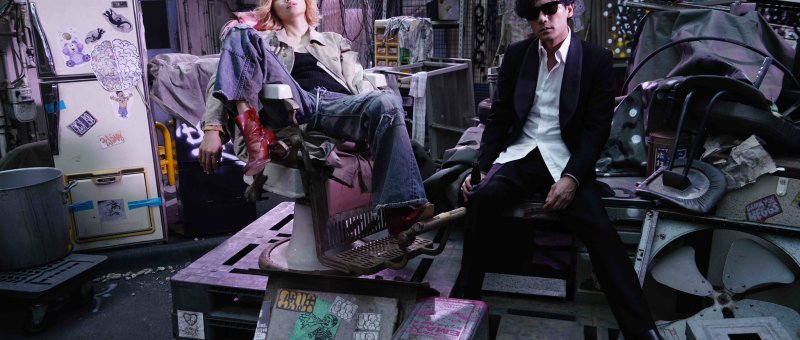

 Koji Wakamatsu made his name in the pink genre where artistic flair and political messages mingled with softcore pornography and the rigorous formula of the genre. Wakamatsu rarely abandoned this aspect of his work but in adapting a well known story by Japan’s master of the grotesque Edogawa Rampo, Wakamatsu redefines his key concern as sex becomes currency, a kind of trade and power game between husband and wife. Caterpillar (キャタピラー), aside from its psychological questioning of marital relations, is a clear anti-war rallying call as a small Japanese village finds itself brainwashed into sacrificing its sons for the Emperor, never suspecting all their sacrifices will have been in vain when the war is lost and wounded men only a painful reminder of wartime folly.
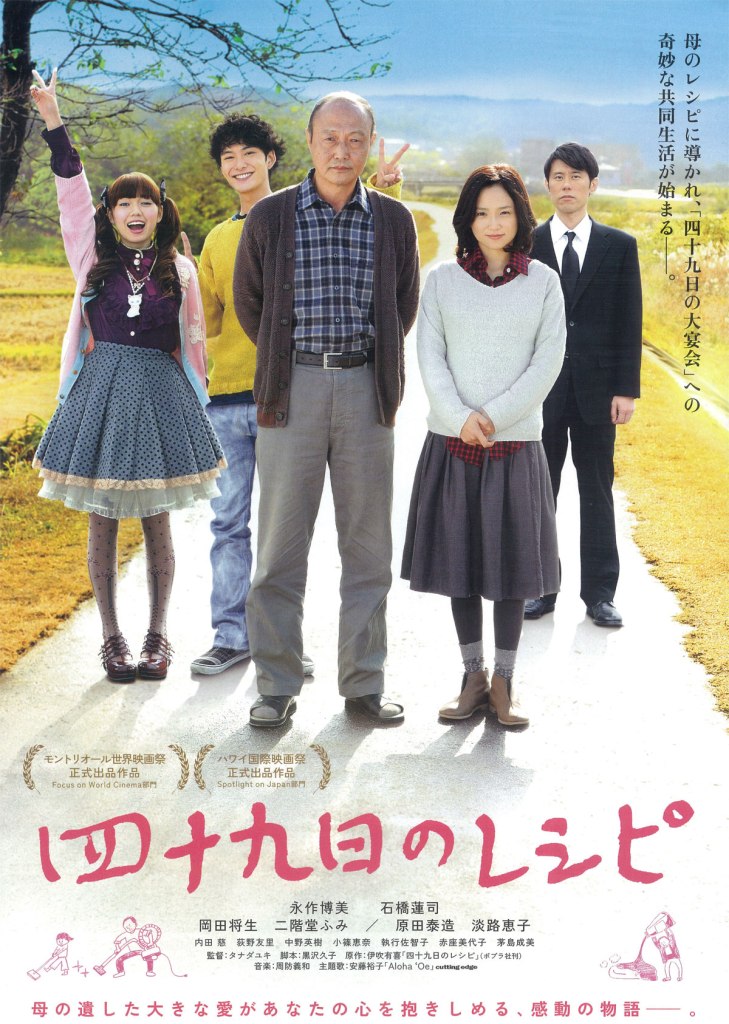 When everything goes wrong you go home, but Yuriko, the protagonist of Yuki Tanada’s adaptation of Yuki Ibuki’s novel might feel justified in wondering if she’s made a series of huge mistakes considering the strange situation she now finds herself in. Far from the schmaltzy cooking movie the title might suggest, Mourning Recipe (四十九日のレシピ, Shijuukunichi no Recipe) is a trail of breadcrumbs left by the recently deceased family matriarch, still thinking of others before herself as she tries to help everyone move on after she is no longer there to guide them. Approaching the often difficult circumstances with her characteristic warmth and compassion, Tanada takes what could have become a trite treatise on the healing power of grief into a nuanced character study as each of the left behind now has to seek their own path in deciding how to live the rest of their lives.
 Windows on Worlds