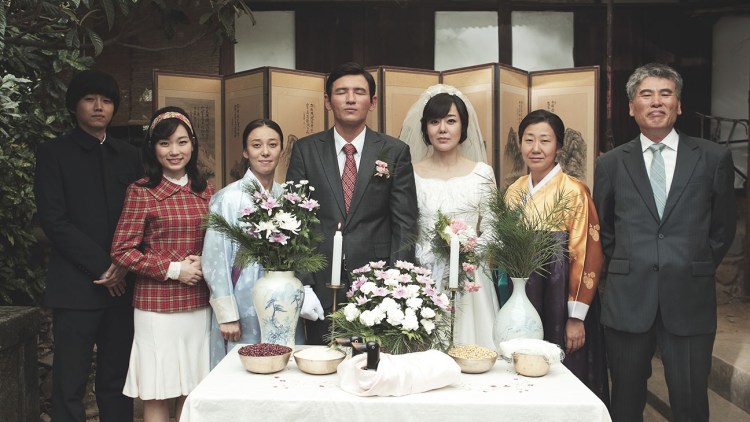
The Himalayas (히말라야, Lee Suk-hoon, 2015)

HimalayasBecause it’s there. As good a reason as any for doing anything but these were the only three words of explanation offered by George Mallory in answer to the question “Why climb Everest?”. In Powell & Pressburger’s The Red Shoes, the heroine reacts in a similarly philosophical fashion when asked “Why do you want to dance?” replying with the question “Why do you want to live?”. What makes some people prepared to dance until their feet bleed and their toes break, and sends others to the peaks of snowcapped mountains staring death in the face as they go, is something which cannot be fully explained in words but cannot be denied by those who hear its calling.
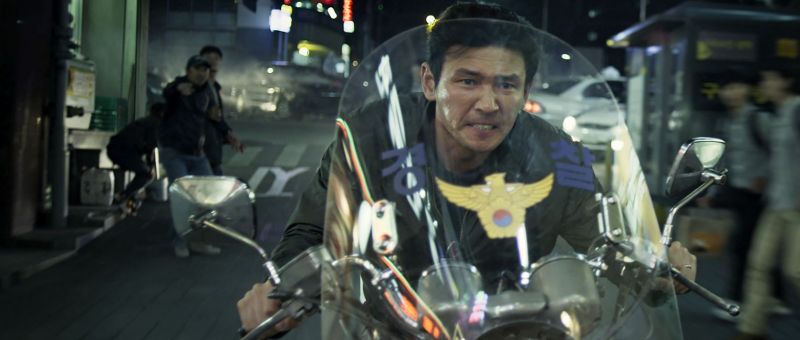
Korea’s most well known mountain climber, Um Hong-gil (Hwang Jung-min), was undoubtedly one who heard the call and The Himalayas (히말라야) is his story (more or less). Based on his real life exploits, the film charts his continuing successes as an international climber until a foot injury forces him to remain on a more usual altitude, but the real heart of the story is in his growing relationship with rookie Moo-taek (Jung Woo) who’s every bit as fearless as he is. Together the pair scale the peaks of the world’s highest mountain ranges until it’s finally time for Hong-gil to hang up his pick and keep his feet on the ground for good.

However, tragedy strikes as one of Hong-gil’s closest friends is suddenly killed after getting caught in an unexpected storm. The mountain ranges of the world are littered with the corpses of unfortunate climbers who got into difficulty and couldn’t be rescued. The bodies remain where they fell, becoming one with mountain itself in a lonely climbers graveyard, frozen and perfect for eternity. Risking your own life to retrieve the lifeless body of a friend may seem like a perverse, irrational thing to do, yet understandable. Wracked with guilt and grief, Hong-gil assembles a team and embarks on a sentimental journey to bring his friend home, and, ironically, learn to let him go.

What starts off as a sports movie with its training sequences and tough coach inspires maverick rookie routine branches off into the classic expeditionary adventure format before falling into its unexpected home genre – the melodrama. Though in one sense a kind of biopic, the realm aim is to get those tears rolling as these brave men and women risk all for glory and comradeship in pushing the limits of the human condition far past their breaking points.

Hong-gil himself is, despite his gruff exterior, a dreamer and idealist in love with the soulful purity of the mountains. His is a journey of self discovery as he tells us that there is no pretence when it comes to mountain climbing. When you’re up there alone, just you and the vast snow covered emptiness, all of your masks and defences fall away. Hong-gil climbs the mountain to explore landscape of his own mind. He also objects to the often uttered phrase “conquer” a mountain as he believes the mountain gives you permission to ascend making this way of thinking disrespectful and even likens the mountain itself to woman when bemoaning Moo-taek’s pointlessly noble romantic gesture by stating that you don’t conquer the “mountain” you console it.

For all that, the real world is ever present as we see in one particularly awkward marketing pitch in which Hong-gil is trotted out as a model to have the prospective sponsor’s logo plastered all over him in the hopes that they will fund an expedition. When someone raises the very sensible point that this could look very bad for them should one of the climbers die with their logo on their chest, the marketing guys slowly start peeling them all off – velcro solves everything, it seems.

The team also becomes a marketing tool for their nation, carrying the Korean flag around with them for any photo opportunities which might present themselves. When tragedy strikes and the remainder of the Korean expeditionary group refuse to go after their fallen friend (the right and practical decision given the weather conditions and the low probability of success), base camp puts out a message over the radio in English pleading for help. The British contingent continue with their crosswords and cups of tea, steadfastly ignoring the emotional mayday call. The Chinese at least begin reassuring each other that it’s far too dangerous to contemplate.

The Himalayas begins as a comedy but the laughs fall away once the tears start rolling. Though it may affect a poetic tone the philosophical meandering is generally at the service of the melodrama which is very much underpinned by male bonding, pride, honour, debt and responsibility. Hong-gil’s “Human Expedition” is one of grief stricken madness but a perfectly understandable one in which he both needs to atone for “abandoning” his mountaineering brother and come to terms with the fact that the death zone has claimed another sacrifice. Often impressively filmed, The Himalayas suffers from its extremely melodramatic, sentimental tone which is only exacerbated by the intrusion of its loud and syrupy score. Anchored by strong performances from its leading players including Hwang Jung-min as the tough yet sensitive Hong-gil and Jung Woo as the young firebrand Moo-taek, The Himalayas spends too long at the destination rather than on the journey and ultimately fails to make either its character drama or expeditionary environment sufficiently engaging.


Seen as part of a teaser programme for the upcoming London Korean Film Festival 2016.

US release trailer:

https://www.youtube.com/watch?v=S9UeQ0qhWnc

Black House (검은집, Shin Terra, 2007)

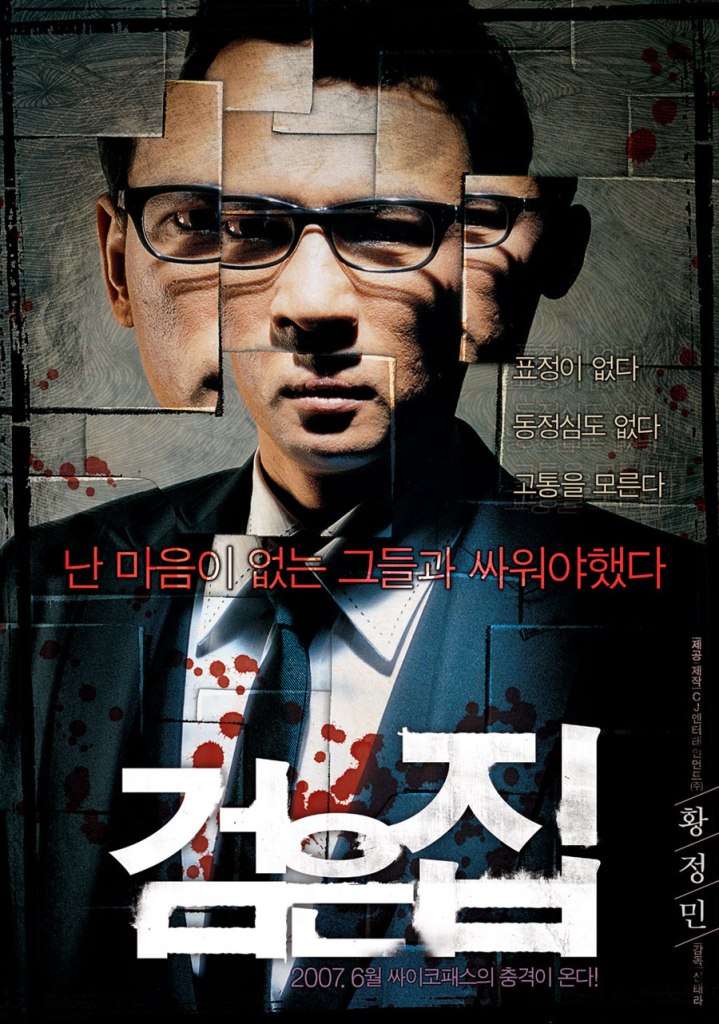
Black House (korea)Yusuke Kishi’s Black House source novel was previously adapted by Yoshimitsu Morita in its native Japan back in 1999, but eight years later the tale made its way to Korea by way of director Shin Terra who opts for a much more straightforward approach than Morita’s characteristically bizarre take. Sold as K-horror, the tone is closer to nasty thriller only giving way to classic slasher action in the final stretch. In eschewing Morita’s idiosyncratic tendency to insert himself into the material, Shin crafts a more mainstream aesthetic, but loses the various layers of social and psychological commentary that went with it.

Juno (Hwang Jung-min) is a mild mannered insurance clerk, new on the job and extremely naive. His first case involves a visit to a hospital with his boss to visit a persistent claimant whom they believe is deliberately scamming the system and possibly with the hospital’s help. In many ways, Juno is an innocent, he believed in insurance as a safety net and a power for social good so he’s shocked that anyone would deliberately manipulate the rules in this way – particularly when he discovers some people will go so far as to deliberately maim themselves just to claim on their insurance policies.

Not long after he starts working at the company, Juno gets a strange phone call from a man asking if insurance policies pay out in case of suicide. It’s possible, Juno says – he’ll need to check the policy to make sure. Suddenly worried the person he’s talking to is in a dark place, he starts trying to dissuade him from the idea of taking his own life and unwisely gives a lot of first hand advice despite the highlighted section in his employee guide cautioning him never to reveal personal information to clients. Soon enough, a client has asked for him personally to go out to their remote house and chat about a policy. When he gets there he receives a nasty surprise as the man’s young son has apparently hanged himself in the back room. Appalled, Juno waits to greet the police but becomes convinced the man has deliberately killed the boy, who was his step-son, to get the payout on his life insurance.

Juno refuses the claim but Choong-bae, the claimant, won’t give up and starts coming to the office everyday to ask for his money. Choong-bae is a scary looking guy and frightens most of the other staff with his vacant staring. He also has an insurance policy on his wife leading Juno to fear that she is next but his decision to try and alert her to her husband’s plans will prove a mistaken one, drawing him into the web of a dangerous and psychopathic serial killer.

Shin’s adaptation is most likely closer to the original novel but he is far less interested in the psychological or social implications than Morita was. There is no explanation offered for the actions of the killer though the childhood sequences with their reliance on dreams and hearsay remain intact, only with lesser impact. The question of insurance fraud and scamsters, people so desperate for money that they will literally sacrifice an arm or a leg, only exists as background and isn’t presented as a societal problem so much as just something that happens because there are some shameless people out there who would rather play the system than do an honest days work. Juno has also been given his own tragic backstory which tries to play him off as a mirror of the killer though somehow this never quite works and Juno’s own flashbacks are overplayed.

Beginning as a slow burn thriller where Juno plays the nervous, softhearted neophyte as yet uninured to the murkiness of the insurance world, Black House (검은집, Geomeun Jip) takes a huge detour during the final third which sends it into slasher territory when Juno decides to travel to the titular Black House, alone, during the middle of the night, because the police won’t listen to him and there are people in danger. When he gets there he finds a veritable house of horrors with body parts and nooses hanging from the ceiling, blood and carnage everywhere. Then it’s a straightforward fight to the death as Juno faces off against the psychopathic terror despite his nervous disposition culminating in some unexpectedly gory business with a key.

Like most slasher movies, Black House has several endings and finishes on a note of uncertainty but it never quite manages to make its sudden descent into violence work in its favour. Lacking the depth of Morita’s adaptation, Shin’s Black House may have stronger genre influences but with nothing to back them up all that remains at the end is a darker than usual serial killer tale with mild slasher tendencies. A decent enough mainstream thriller, Black House has a lot to offer despite stumbling in its final third but nevertheless lacks a distinctive element to mark it out from similarly themed genre efforts of recent times.


Unsubbed trailer:

Miss Granny (수상한 그녀, Hwang Dong-hyeok, 2014)

131212-001_1401140436597Review of Hwang Dong-hyeok’s age swap comedy Miss Granny (수상한 그녀, Soosanghan Geunyeo) up at UK Anime Network.


Miss Granny is something of a departure for Korean director Hwang Dong-hyeok whose previous two films have both explored fairly weighty subjects firstly in The Father which, based on a true story, features an American adoptee looking for his father only to find him languishing on death row, and more recently in Silenced (also known as The Crucible) which depicted the harrowing, and again true, events that occurred at the Gwangju Inhwa School for the Deaf in which pupils were routinely abused by teachers and staff. So far as we know, Miss Granny is not based on a true story and is a more mainstream comedy in which a “difficult” old lady suddenly finds herself transformed into her 20 year old self.

At the beginning of the film, Oh Mal-soon is a bad tempered 74 year old woman who terrorises everyone around her into submission including her middle aged daughter-in-law who eventually lands up in the hospital with a heart condition that may in part have been brought on by Mal-soon’s constant criticism. Mal-soon’s son faces an impossible choice, ship his mother off to a home and give his wife some peace or risk losing either his marriage or his wife by keeping his mother around. Heartbroken at the thought her son maybe about to abandon her, Mal-soon wanders around the city before deciding to enter a mysterious portrait photographers and dolling herself up for a “funeral photo”. However, when she emerges she’s mysteriously transformed into a lithe and pretty 20 year old! Suddenly young again with potentially a whole life in front of her, what sort of choices will Mal-soon make this time around?

Much of the comedy of Miss Granny centres around the young Mal-soon, renamed Oh Doo-ri after her favourite actress, Audrey Hepburn, speaking and acting as if she really really were a 74 year old woman with all of the freedoms (and the invisibilities) that age grants you. Snapping away in her thick rural dialect and handing out unsolicited advice in the way only a nosy old woman can, Doo-ri is a very strange, and perhaps a slightly frightening, young woman. Undoubtedly, as we find out, Mal-soon has had a difficult life – starting out as an upperclass woman before becoming a young, penniless single mother dependent on the kindness of others and doing everything in her power to ensure that her son will grow up a fine man. Life has made her hard and in turn she makes things hard for all around her.

As a young woman she’s initially much the same yet comes to understand something of who she was and who she is. In her younger days she dreamed of being a singer and even as an old woman was well known for her fine voice. After unexpectedly jumping up to sing at a senior’s event in order to best another old lady rival, she’s “discovered” by a producer who’s tired of all the soulless idol stars who walk across his stage. Doo-ri is exactly what he’s been looking for, a young and pretty face with a voice that’s full of a lifetime’s heartbreak. Here is the real coup of the film – the younger actress, Shim Eun-kyung, reinterprets these classic pop songs from 40 years ago beautifully with exactly the right levels of pain and regret perfectly matching the montage flashbacks to Mal-soon’s youth. Becoming young again, experiencing everything again as if for the first time – opportunity, romance, friendship, Mal-soon finally begins to soften as if some of the harsh years of her original young life had been smoothed away.

Of course, nothing lasts forever and Mal-soon eventually has to make a choice between her newly returned youth and something else precious to her. She comes to understand that however hard it was she’d do it the same all over again because the same things would always have been the most important to her. Though it’s far from original and drags a little in the middle, Miss Granny still proves a warm and funny tale that walks the difficult line between serious and funny with ease and throws in a pretty catchy soundtrack to boot.


Reviewed at the London Korean Film Festival 2015.

Also here is one of the musical sequences in the film – I think this is a famous song from the ’70s (?) called White Butterfly. ‘Tis quite beautiful (mild spoilers for the film as it includes a montage of Mal-soon’s youth in the ’60s).


Ode to My Father (국제시장, JK Yoon, 2014)

ode_to_my_father_stillReview of JK Yoon’s Ode to My Father (국제시장, Gukjeshijang) – first published by UK Anime Network.


Of late, we’ve seen a lot of films attempt to trace the history of a nation through the story of one man and his family which ultimately becomes a metaphor for the that of the land itself. Many of these have come from China which shares something of the turbulent history that has affected the Korean peninsula over the last hundred years. In Ode to My Father, director JK Youn has tried to pay tribute both to his own father and to all the fathers of modern Korea who underwent great difficulties and suffered immensely in the hope of building a better, happier, future for their own children.

Mostly we view events from the point of view of Duk-soo – an old man at the beginning of the film who has made a success of himself and is surrounded by a large, loving family though seems to retain a kind of unresolved sadness. When we travel back with him, he’s just a small boy fleeing his homeland with his parents and siblings. As the oldest, he’s put in charge of his sister only to have her cruelly snatched away from him during the final escape. This event colours the rest of Duk-soo’s life as he carries with him both the tremendous guilt of having failed to protect his sister and of losing his father has he went back to look for her. The remaining family members gather together at the small imported goods shop belonging to an aunt which becomes another motif of the film.

Growing into manhood, Duk-soo is now the man of the house with both his siblings and his mother to provide for. Making countless sacrifices which see him abandoning his own dreams and travelling abroad to seek better paid work – first in the coalmines of West Germany and later the warzone of Vietnam, Duk-soo puts his family before himself every single time. Working tirelessly, Duk-soo grows up but inside he’s forever the little boy on a boat watching his father drift away him and desperately hoping he’ll some day miraculously turn up at the shop with a smile and an improbable story.

This is a story of painful separations and the shockwaves they send through the rest of one’s life and of all the lives throughout history. Having fled the Chinese and the communists in the North, Duk-soo and his family are excited about the prospect of being able to go home at the “end” of the war. However, this is a war which is still not technically over, merely suspended by a truce, and Duk-soo will never see his hometown again. Eventually, during the ‘80s, 30 years since Duk-soo was separated from his father and sister, a nationwide campaign is held to try and re-unite family members forced apart by the traumatic events of the 1950s. Entire squares in the city are covered with people desperately looking for each other wearing signs with their relatives’ names and point of last sighting, clothing etc all in the hope of finally finding each other again. Needless to say, some of these people are luckier than others and there are tears of both joy and sadness.

Still, all in all, Duk-soo and South Korea made a success of themselves even if there’s a resulting ache from the great wound which has split the nation in two. Much of the story is universal – a father’s love for his family, but Ode to My Father will obviously speak loudest to Koreans who can identify more strongly with the historical context. Yoon has also injected some humorous incidents involving real life Korean historical celebrities which may mystify international viewers even if they’re sign posted well enough that one gets the gist of it anyway.

Unabashedly sentimental and oftentimes overblown, Ode to My Father nevertheless succeeds in tugging at the heartstrings in all the intended ways. A paean to the post war generation and all that they endured in building the modern Korea that their children could live in without fear or hunger, Ode to My Father is in the end far too sugary but also, it has to be said, affecting.


Reviewed at the London Korean Film Festival 2015.


Veteran (베테랑, Ryoo Seung-wan, 2015)

1439210220_베테랑1Review of Ryoo Seung-wan’s Veteran (베테랑) – first published on UK Anime Network.


One of the top Korean box office hits of 2015, Ryoo Seung-wan’s Veteran is a glorious throw back to the uncomplicated days of ‘80s buddy cop crime comedy thrillers. A little less than subtle in its social commentary, Veteran nevertheless takes aim at corrupt corporate culture and the second generation rich kids who inherit daddy’s company but are filled with an apathetic, bored arrogance that is mostly their own.

Seo Do-cheol (Hwang Jung-min) is, as one other officer puts it, the kind of police officer who joined the force just to beat people up. He loves to fight and isn’t afraid of initiating a little “resisting arrest” action just to make things run a little more smoothly. However, when he strikes up a friendship with a put upon truck driver and his cute as a button son only to miss a crucial telephone call that eventually lands said truck driver in the hospital, Do-cheol’s sense of social justice is inflamed. After trying to join a trade union, Bae, the truck driver, is unceremoniously let go from his company. On taking his complaint directly to the head of Sin Jin Trading, play boy rich kid Tae-oh, Bae is subjected to the most cruel and humiliating “interview” of his life before apparently attempting to commit suicide after having realised the utter hopelessness of his situation. Incensed on his new friend’s behalf, Do-cheol is determined to take down these arrogant corporatists what ever the costs may be!

Veteran makes no secret of its retro roots. It even opens with a joyously fun sequence set to Blondie’s 1979 disco hit, Heart of Glass. Like those classic ‘80s movies, Veteran manages to mix in a background level of mischievous comedy which adds to the overall feeling of effortless cool that fills the film even when things look as if they might be about to take a darker turn. The action sequences are each exquisitely choreographed and filled with sight gags as the fight crazy Do-cheol turns just about any random object that appears to be close to hand into an improbable weapon.

Make no mistake about it either, this is a fight heavy film. Though Veteran has a very masculine feeling, it is to some degree evened out by the supreme Miss Bong whose high class high kicks can take out even the toughest opponents and seem to have most of her teammates looking on in awe, and the withering gaze of Do-cheol’s put upon wife who seems determined to remind him that he’s not some delinquent punk anymore but a respectable police officer with a wife and child who could benefit from a little more consideration.

Indeed, Tae-oh and his henchmen aren’t above going after policemen’s wives in an effort to get them to back off. Though this initial overture begins with an attempt at straightforward bribery (brilliantly dealt with by  Mrs. Seo who proves more than a match more the arrogant lackeys), there is a hint of future violence if the situation is not resolved. Tae-oh is a spoiled, psychopathic rich kid who lacks any kind of empathy for any other living thing and actively lives to inflict pain on others in order to breathe his own superiority. Probably he’s got issues galore following in his successful father’s footsteps and essentially having not much else to do but here he’s just an evil bastard who delights in torturing poor folk and thinks he can do whatever he likes just because he has money (and as far as the film would have it he is not wrong in that assumption).

He also loves to fight and finally meets his match in the long form finale sequence in which everything is decided in a no holds barred fist fight between maverick cop and good guy Do-cheol and irredeemable but good looking villain Tae-oh. Veteran never scores any points for subtlety and if it has any drawbacks it’s that its characterisations tend to be on the large side but what it does offer is good, old fashioned (in a good way) action comedy that has you cheering for its team of bumbling yet surprisingly decent cops from the get go. Luckily it seems Veteran already has a couple of sequels in the pipeline and if they’re anywhere near as enjoyable as the first film another new classic franchise may have just been born.


Reviewed at the first London East Asia Film Festival and the London Korean Film Festival.

Pluto (명왕성, Shin Su-won, 2013)

GSEOiWzAs we’ve seen lately, there are certainly no shortage of films looking at the complicated and often harsh world of high school in Korea. Pluto (명왕성, Myungwangsung) takes a sideways look at the darker side of academic excellence when the praise and prestige of being one of the top students becomes almost like a drug and makes otherwise bright young people do things even a heroin addict in serious need of a fix might at least feel bad about afterwards with an all encompassing sense of entitlement that gives them a lifetime free pass for even the worst transgression.

June (David Lee) is a bright young boy from a regular high school who’s just transferred into an elite boarding school educating the country’s next great hopes. He may have been a top student at his old school, but here he’s merely average as the school hotshots are pretty quick to point out. Here, the top ten students are treated like princelings – a special computerised teaching room, no curfew, better rooms, better resources and they can more or less do what they like so long as they keep their grades up. Occasionally someone manages to bump one of the top ten from the list but they quickly get kicked out again. The top ten operate like some kind of swatters mafia – they all stick rigidly together, swapping hot tips for the upcoming exams that they refuse to share with the others and engaging in a series of increasingly cruel “pranks” they term rabbit hunts.

The film opens with the police finding the body of the previously number one student Yu-jin (Sung Joon) in a wood with June’s phone lying next him having been used to film the entire grisly affair. June is arrested for the murder but is released after his alibi checks out. Sick of all the struggle and unfairness, June puts his particular talents to use to try and teach the world a lesson about the sort of people this system is producing.

The picture Pluto paints of the Korean schools system is a frankly frightening one in which academic success is virtually bought and paid for or guaranteed by class credentials. Yes, the top students obviously must have ability – some of their activities may come close to cheating but interestingly nobody seems to want to try actual deception to get ahead. However, that natural ability has clearly been bolstered by their parents’ wealth. Attending an elite school and spending more than some people earn on private tutors geared towards knowing how to get into the best universities undoubtedly gives them advantages which are out of reach for others no matter how smart they may be. Perhaps that’s fair enough in a capitalist society, they didn’t ask to be born to rich parents and who would turn that sort of help down if offered it? However, though they may possess the virtues of discipline, hard work and a desire to succeed what they lack is any sort of empathy or even common human decency. Engaging in a series of manipulative hazing exercises, the elite group will stop at nothing to protect their status specialising in thuggery, blackmail, rape and even murder. The sort of people this system is advancing are not the sort of people you want running your schools and hospitals, they are morally bankrupt and only care about their own standing in the eyes of others.

Perhaps it’s fitting that this elite boarding school is housed inside a former compound of the Korean secret police, including a subterranean layer of prison-like tunnels once used as a torture chamber. Aside from the obvious school as torture analogies, much of them film seems to be about what people choose to ‘unsee’. The headmaster of the high school is aware of the ‘untoward’ behaviour of some of his pupils but refuses to do anything in case it upsets their well connected parents, damages the reputation of his school or has an adverse effect on those all important test results. The ‘Pluto’ of the title is referenced in June’s university application essay on the demotion of Pluto from the accepted list of planets. He argues that this is unfair and a fallacy as it’s illogical to measure anything by its proximity to the sun which is, after all, just another star which will eventually die like all the others. Just because it’s a little different looking, you shouldn’t necessarily categorise it as being in some way ‘inferior’ based on a set of fairly flimsy criteria. June, like Pluto, hovers in uncertain orbit on the periphery – always wanting in but perpetually locked out. Naturally gifted but from an ‘ordinary’ background where his single mother sells insurance for OK money, June can’t hope to compete with these elite kids even if his capabilities may be greater. A lot of decisions have already been made as to what people choose to see, have chosen to regard as an ideal, even if the reality is painfully obvious.

Though oddly funny in places for such a hard hitting film, Pluto is a difficult watch at times and paints a depressing picture of the high pressured nature of the Korean educational system and of human nature in general. The elite group are universally awful people who run the gamut from arrogant, entitled prigs to snivelling cowards which makes it difficult to feel any sort of sympathy and you start to long for bad things to happen to them which somewhat undermines the film’s premise. Perhaps the problem is just that they were awful people who were enabled by a system rather than people who started out good and were corrupted by it. Stylishly shot and supported by well grounded performances from its young cast, Pluto is a welcome addition to this perhaps overcrowded genre which brings more than a few new thought provoking ideas to the table.


Review of first Pluto published by UK Anime Network.