General’s Son 3 (將軍의 아들 3 / 장군의 아들 3, Im Kwon-taek, 1992)

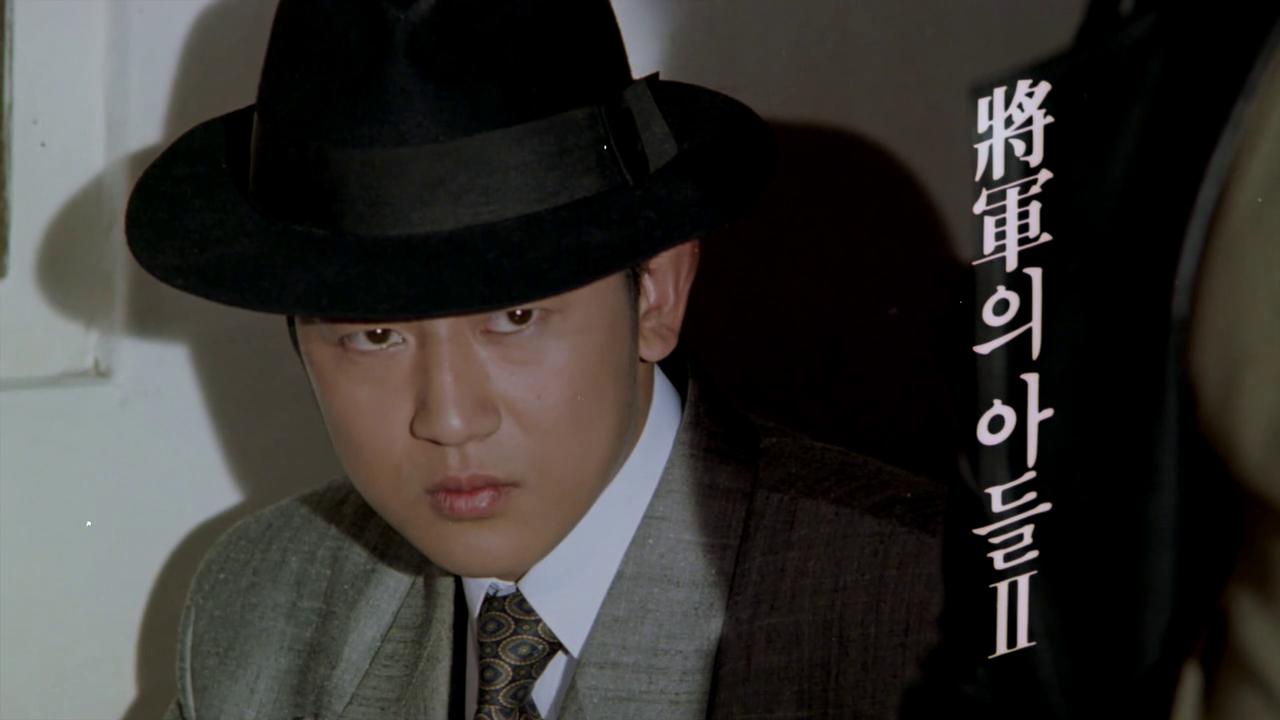
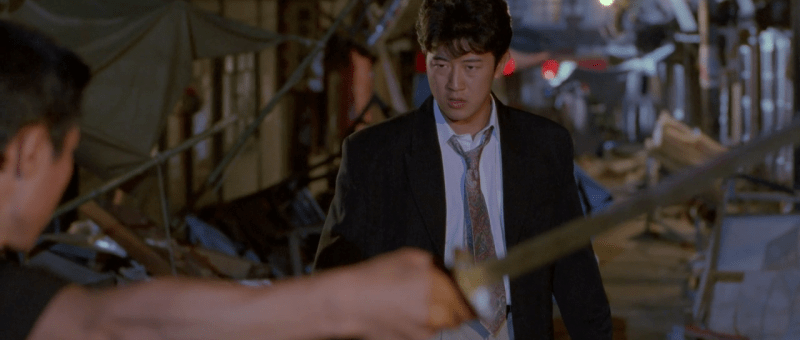
The third and final instalment in the General’s Son trilogy picks up some time after the events of the previous film, not with Doo-han (Park Sang-min) being released from prison but emerging from hiding. After his showdown with Kunimoto, he’d been lying low in a temple but is now on the run, heroically jumping off a train to avoid the police and thereafter making his way to Wonsan and seeking asylum with an affiliated gang. By this time, Doo-han’s role as the son of a legendary general who was murdered by communist traitors while fighting bravely for independence seems to have been forgotten as he wanders around trying to evade the colonial net. 

In Wonsan, he immediately starts causing trouble by objecting to gang leader Shirai’s treatment of an aspiring singer, Eun-sil (Oh Yeon-soo), whom he has more or less imprisoned until she agrees to sleep with him. Doo-han helps her to escape and encourages her to continue pursuing her dreams of stardom, but motions toward romance create an ongoing instability which indirectly echoes throughout the rest of the film as he tries to balance his desire for Eun-sil with the ongoing battle for Jongno and resistance against the Japanese. 

For her part, Eun-sil falls for Doo-han as the man who saved her from Shirai and restored her freedom but still finds herself at the mercy of the Japanese as otherwise sympathetic lieutenant Gondo (Dokgo Young-jae) takes a liking to her after being struck by her singing talent which he apparently did not expect seeing as she is a mere Korean. Later Gondo and Doo-han become accidental rivals when Eun-sil is arrested because of her associations with Doo-han and they have to work together to get her out. Gondo is fiercely critical of their relationship, not only out of romantic jealously but because he finds the Korean approach to romance vulgar. Despite her later agency which sees her primed to reject both men in order to pursue her career, Eun-sil is also a mere device to emphasise Doo-han’s virility as the entire neighbourhood is kept awake by her moans of ecstasy even after Doo-han has been badly injured in a fight, is covered in bandages, and has been told he will need to stay in bed for the next month to recover. 

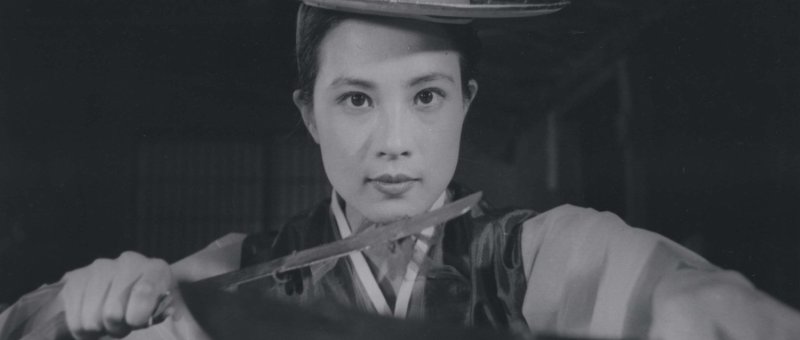
Gondo meanwhile, in a slightly symbolic gesture, tries to force Eun-sil to marry him by laying his sword on the table and making it plain that if she refuses he will kill her and then himself. Perhaps in a more romantic tale, he might have threatened Doo-han and asked her to make a sacrifice, but in any case Doo-han tries something much the same on hearing the news, having a kitchen knife brought to him and thrusting it into the table. Eun-sil merely seems amused, or perhaps worryingly pleased at open show of romantic jealousy as proof of love, knowing that it is quite unlikely Doo-han is actually going to hurt her (the same cannot be said for Gondo). He still however tries to command her to stay and marry him, refusing to let her leave because she is “his”, but in the end of course it’s bluster and if she chooses to leave he cannot stop her because he is not a man like Shirai or Gondo who would willingly restrict another’s freedom. He is still “fighting for our liberty” after all. 

Meanwhile, he undergoes a parallel “romance” with Dong-hae (Lee Il-jae) who left alone for Manchuria after renouncing the gangster life but has apparently left the Independence Movement because it was too socialist when what he seems to want is individual capitalist prosperity which is why he’s got mixed up in the opium trade. Still on the run, Doo-han seeks out Double Blade, the street thug mentor who brought him into the gang all those years ago. Unfortunately he makes a lot of trouble for Double Blade in annoying one of his underlings who runs a local Chinese gang and then starting a turf war after getting himself into trouble with the bandits who run the drugs trade. He and Dong-hae are eventually separated in the escape from the bandits but reunite when Hayashi (Shin Hyun-joon), who is still nominally running the yakuza but has delegated Jongno to his sadistic brother-in-law Uda, tries to use him in a plot to take out Doo-han once and for all. 

Throughout the series, Doo-han has been a mythic, comic book-style hero who is respected for the integrity of his fists, refusing to use weapons and leaving his opponents beaten but breathing so that they can verbally concede the victory. The previous film had seen him enact a more serious kind of violence, but even so his rival apparently survived only permanently changed. His final confrontation with Hayashi, by contrast, sees him kill for the first time by picking up a blade and then a gun. Nevertheless, he is perhaps the General’s Son after all. According to his gang members, scattered after he left, he is the only force with can keep Jongno free, without him they fell apart and let the Japanese take their streets from them. The final instalment in Doo-han’s story ends on a moment of tempered victory which avenges his gangster honour but places him firmly in the arms of his brother Dong-hae as they temporarily retreat from the battlefield towards an increasingly unstable future. 


General’s Son 2 (將軍의 아들 2 / 장군의 아들 2, Im Kwon-taek, 1991)

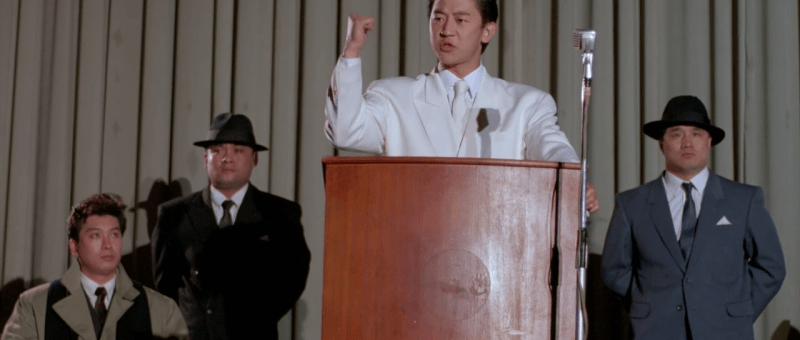
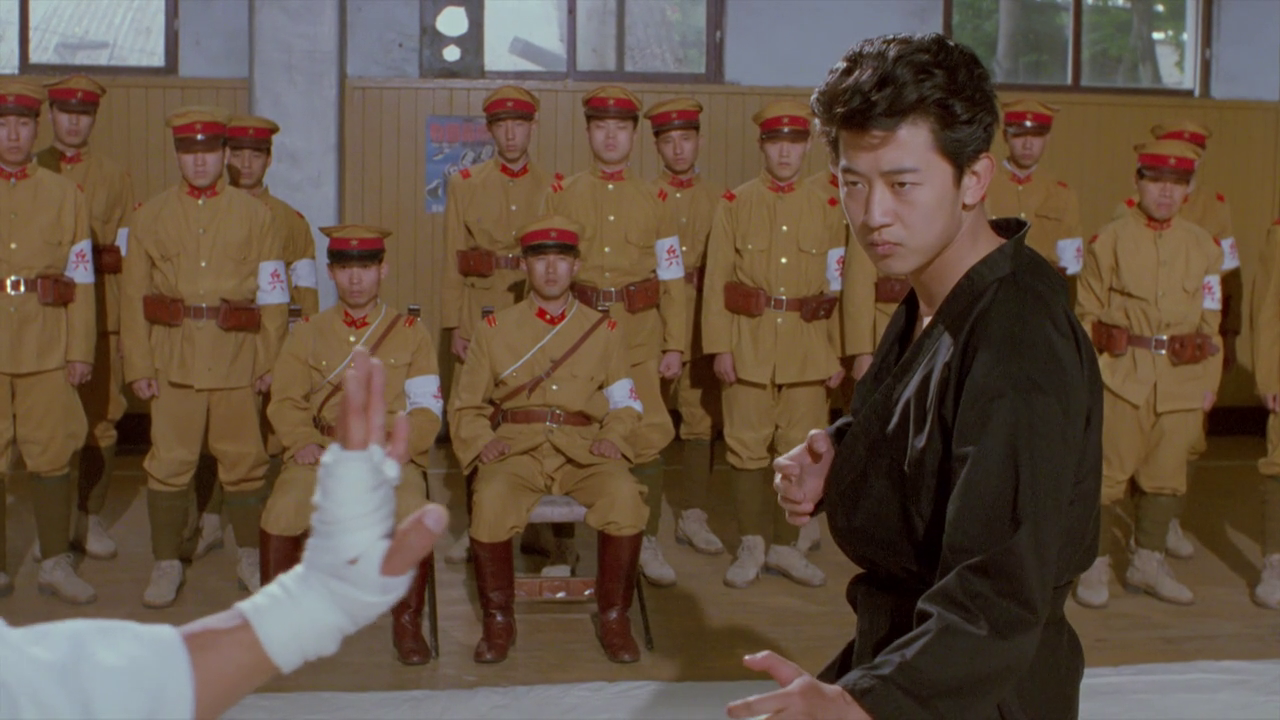
A year after General’s Son struck box office gold, Im Kwon-taek returns to colonial Korea picking up pretty much where he left off with Doo-han (Park Sang-min) once again getting released from prison only this time to a hero’s welcome. Pushing deeper into the colonial era, The General’s Son 2 (將軍의 아들 2 / 장군의 아들 2, Janggunui adeul 2) takes place in increasingly straitened times in which the Japanese are both in control and on the offensive, using the colonial base to strike further into Manchuria while Doo-han discovers a little more about his legendary father and the fate of the Independence Movement in exile. 

Like the first film, the sequel largely consists of a series of episodes in which Doo-han fights and defeats his various rivals. The major change this time is that he begins in defeat as the early celebrations of his return give way to a dawn raid by Hayashi’s yakuza after which Doo-han is dragged into the town square and forced into submission. When Doo-han’s mentor Ki-hwan (Min Eung-shik) is also released from prison, the gang opts for a truce, but Ki-hwan then absents himself after realising Hayashi has tricked him leaving Doo-han in charge. 

During the first film Doo-han’s Korean gangsters had been presented as unambiguously good, standing between the ordinary people and Japanese oppression. While Doo-han was away, however, things have changed. The Japanese have infiltrated Jongno and the Jongno gang has lost the support of the merchants through pressing them too hard for collection money. Doo-han’s first task is then to get the smaller Korean gangs back on side, fighting the local Mokpo kingpin to ensure he resumes sending taxation payments back to Jongno. His main source conflict, however, is still with Dong-hae (Lee Il-jae), the Korean fighter working for the yakuza whom he defeated at the end of the previous film but who got his own back by getting the jump on him at the beginning of this one. 

As a defender of Korean liberty, Doo-han’s side mission is to win back Dong-hae to the side of right, reminded of their childhood meeting by a repeat of the flashback in which he helps a starving Dong-hae cadge a meal by teaching him how to dine and dash. The Dong-hae dilemma is compounded by Doo-han’s increasingly complicated love life which begins with a brief flirtation with Setsuko, a half-Korean Japanese woman working at a gangster-friendly bar who seems to have taken a liking to him, but then later transfers to Chae-hwan (Song Chae-Hwan), a new gisaeng at his regular hangout who is sweet on Dong-hae and is also carrying baggage because her late husband was stoned to death as a traitor when the Japanese discarded him. 

Through Chae-hwan, Doo-han gets to know a dissident author, Park Gye-ju, whose novel Pure Love he pays two high school students to read aloud to him because he is still illiterate. According to Gye-ju, Doo-han’s general father is dead, assassinated by communist traitors among his men including such esteemed names as Kim Il-sung, placing Doo-han at a peculiar intersection of anti-communist and anti-Japanese ideology. Despite that however, Doo-han is warned off associating with Gye-ju because of his “suspicious ideology” by his arch nemesis, Kunimoto, formerly “Lee” the Korean detective working for the Japanese who arrested him all the way back at the beginning of his journey in the first movie.

Traitorous Koreans rather than the Japanese are the main antagonists with Kunimoto first among them, but then as Chae-hwan puts it it’s not the fault of the world only the Japanese whose continuing oppression has placed them all into these perilous positions. Dong-hae weighs up his options, persuaded to end his problematic associations with Hayashi despite his previous assertion that he didn’t care where the money came from he only wanted to survive. The world abandoned us first, he explains, what else was there to do? Chae-hwan criticises Doo-han, suggesting that he’s using his fists not for the people of Korea but for himself, convincing Dong-hae that he can be “saved” if he leaves the gangster world behind. Like his nation, he decides he wants “independence”, eating his own food bought with his own money, rather than remaining at the mercy of a higher authority be that Hayashi or Doo-han. 

The Japanese army, however, believe themselves above the law and answer only to the emperor. Dong-hae’s decision brings him further into conflict with Doo-han, rejecting not just the law of the street but provoking romantic jealousy. As Chae-hwan points out love isn’t a fight you win or lose, but it’s still at the mercy of the various political forces in play and in not in any way helped by Doo-han’s childish provocation of Japanese soldiers at Setsuko’s bar. In any case, Doo-han remains a folk hero, concluding his final showdown with his first show of real violence with active consequences, but in the end protected by the people of Jongno as they offer themselves as human shields holding back the forces of oppression while Doo-han remains trapped in a world of pointless gangster violence. 


General’s Son (將軍의 아들 / 장군의 아들, Im Kwon-taek, 1990)

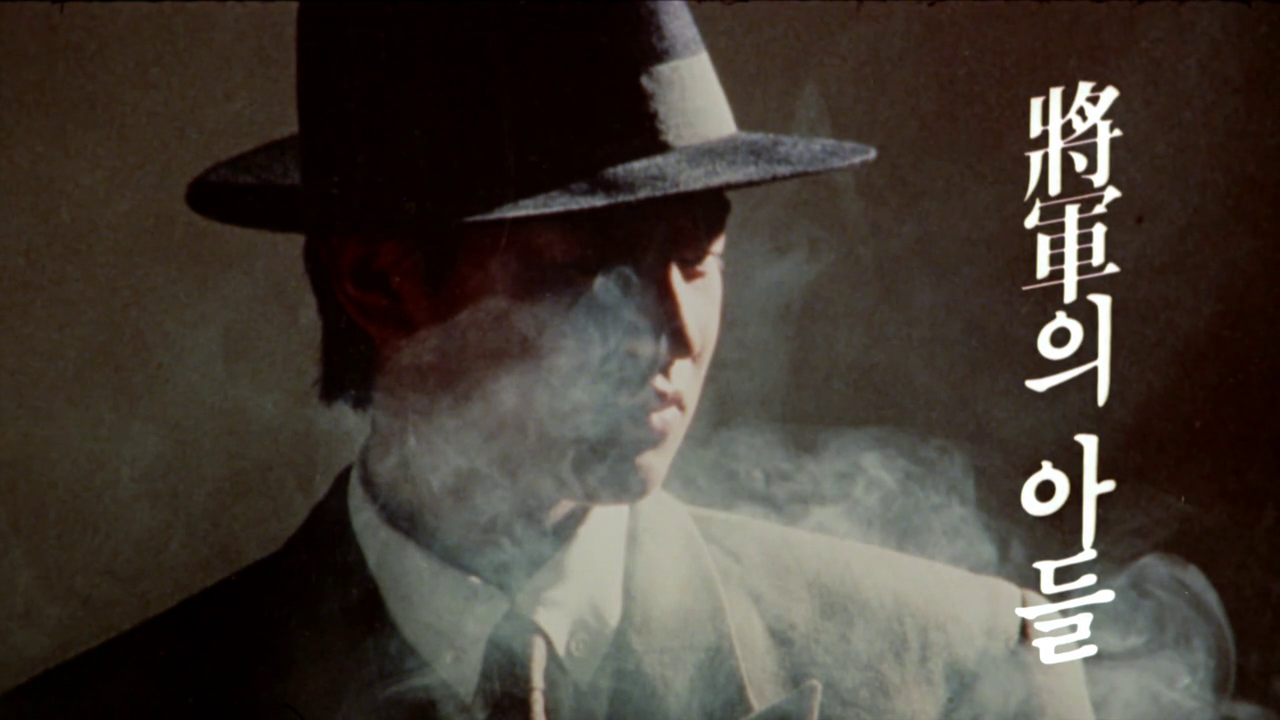
Im Kwon-taek may have been among the first Korean film directors to secure a spot on the international festival circuit, but his long and meandering career began with action cinema which is where his early ‘90s blockbuster trilogy General’s Son (將軍의 아들 / 장군의 아들, Jangguneui Adeul) returns him. Quite clearly influenced by recent Hong Kong martial arts movies, ninkyo eiga yakuza dramas from Japan, and episodic fighting comics, General’s Son creates legend from recent history in further mythologising a real life street king who eventually shifted into politics in the 1950s which might be one shift too far in terms of the film’s complicated politics. 

This first instalment in the trilogy opens with Doo-han (Park Sang-min) being released from prison after apparently having been picked up for sneaking into a Japanese cinema and getting into some kind of fight. An orphan, Doo-han has spent his life on the streets as a beggar but also has a deep love of the movies and is determined to get a job at the cinema, eventually landing one as a sandwich board/announcements guy parading through the streets shouting about what’s currently on for which he gets two tickets on top of his pay. The tickets become a bone of contention when some lowlife punks try to cheat him out of them, but Doo-han is a handy boy and so he manages to beat the guys up and get the tickets back despite being stabbed in the thigh. The altercation brings him to the attention of a local gang boss who decides to recruit him because he’s in need of street muscle and even helps him get a job at the cinema which turns out to be a hub for the local organised crime community. 

The complication is that this small area of Jongno which is ruled by the gangs is also the last remaining outpost of a “free” Korea where Japanese interference is apparently minimal. There is, however, a Japanese gang presence in the form of traditional yakuza led by the youthful and handsome Hayashi (Shin Hyun-joon), who becomes the central if not direct villain. In typical gangster origin fashion, Doo-han climbs the ranks by using his fists, taking down one big boss after another but, crucially, only while his own guys collectively decide to make way for him. As one after the other is killed or arrested, they each affirm that their era has passed, they’ve been beaten, and it’s all up to Doo-han now. In fact, in this highly ritualised setting, most fights ends with the defeated party solemnly admitting that they have lost and will politely leave Jongno at their earliest opportunity. 

As for Doo-han himself, he belongs to the noble brand of gangster and becomes something of a folk hero for his spirited defence of the ordinary man in the face of “Japanese tyranny”. Of course, that ignores all the ways in which the gangsters themselves could be quite oppressive and the film does indeed resist any mention of how they make their money other than a veiled allusion to collecting protection from the market traders in order to keep them safe from harassment by the Japanese.

At the end of the film, Doo-han receives an explanation for all the crytic hints to the film’s title to the effect that he is the son of a legendary general in the Independence Movement. His role is, in effect, to be the general in Jongno holding back the Japanese incursion and saving the soul of Korea from being despoiled by colonisers intent on erasing its essential culture. Just as his father is fighting in Manchuria, Doo-han is “fighting for our liberty” on the streets of Jongno while standing up for the oppressed wherever he finds them, including the gisaeng one of whom he saves from being sold into a Chinese brothel by her father by robbing wealthy Japanese officials to pay her debt. What he’s mostly doing, however, is fighting with fellow gangsters, proving himself in tests of strength which leave his opponents breathing but humiliated and thereafter removing themselves from the game in graceful defeat. It’s unlikely the Japanese will do the same, but Doo-han will be monitoring the streets until they do.


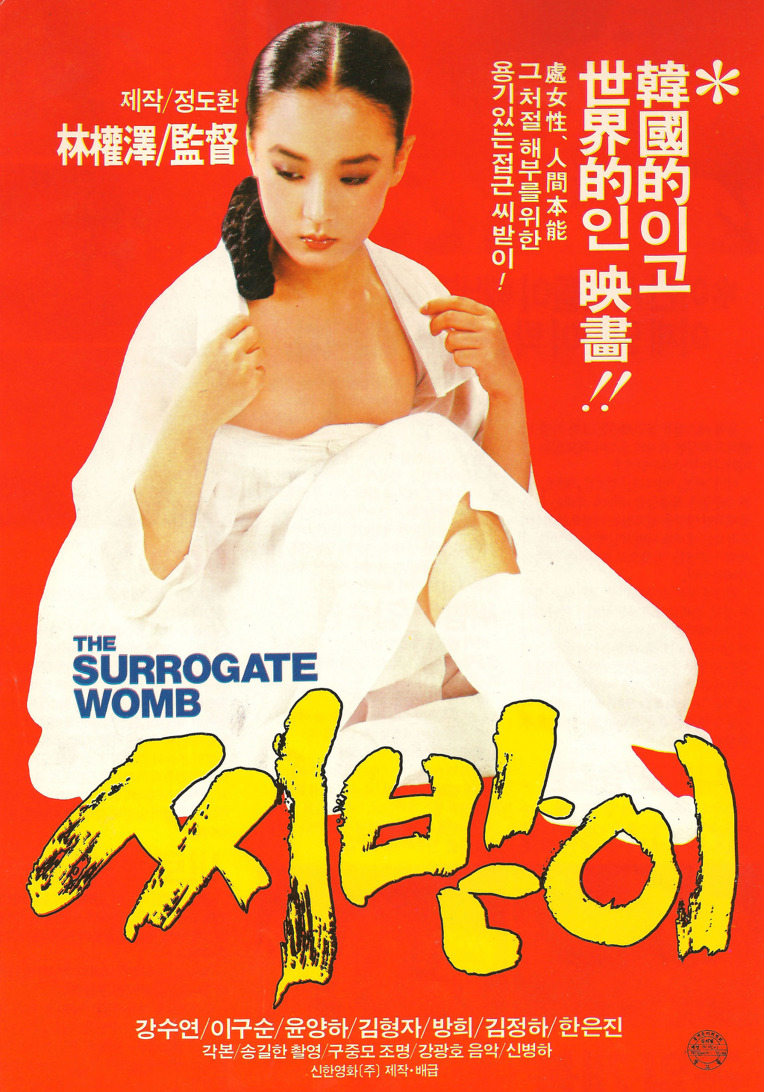
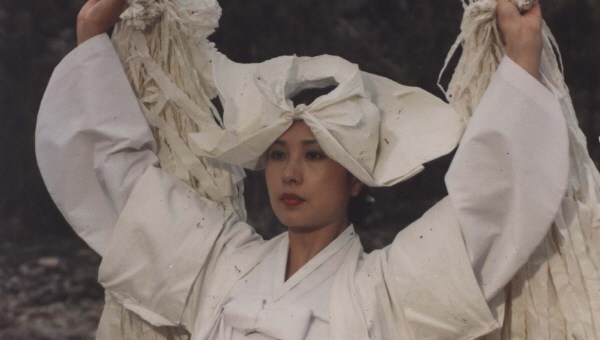
The Surrogate Woman (씨받이, Im Kwon-taek, 1986)

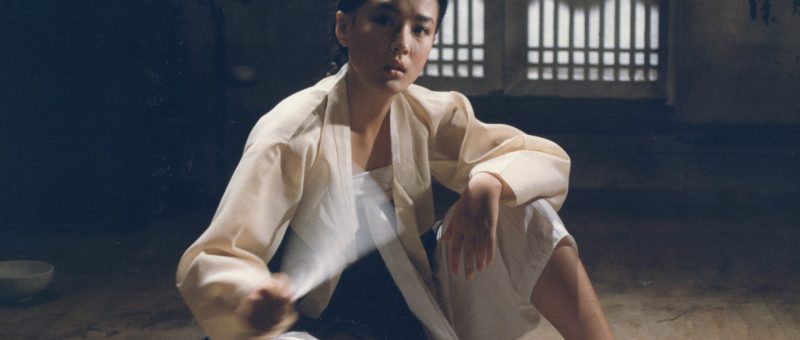
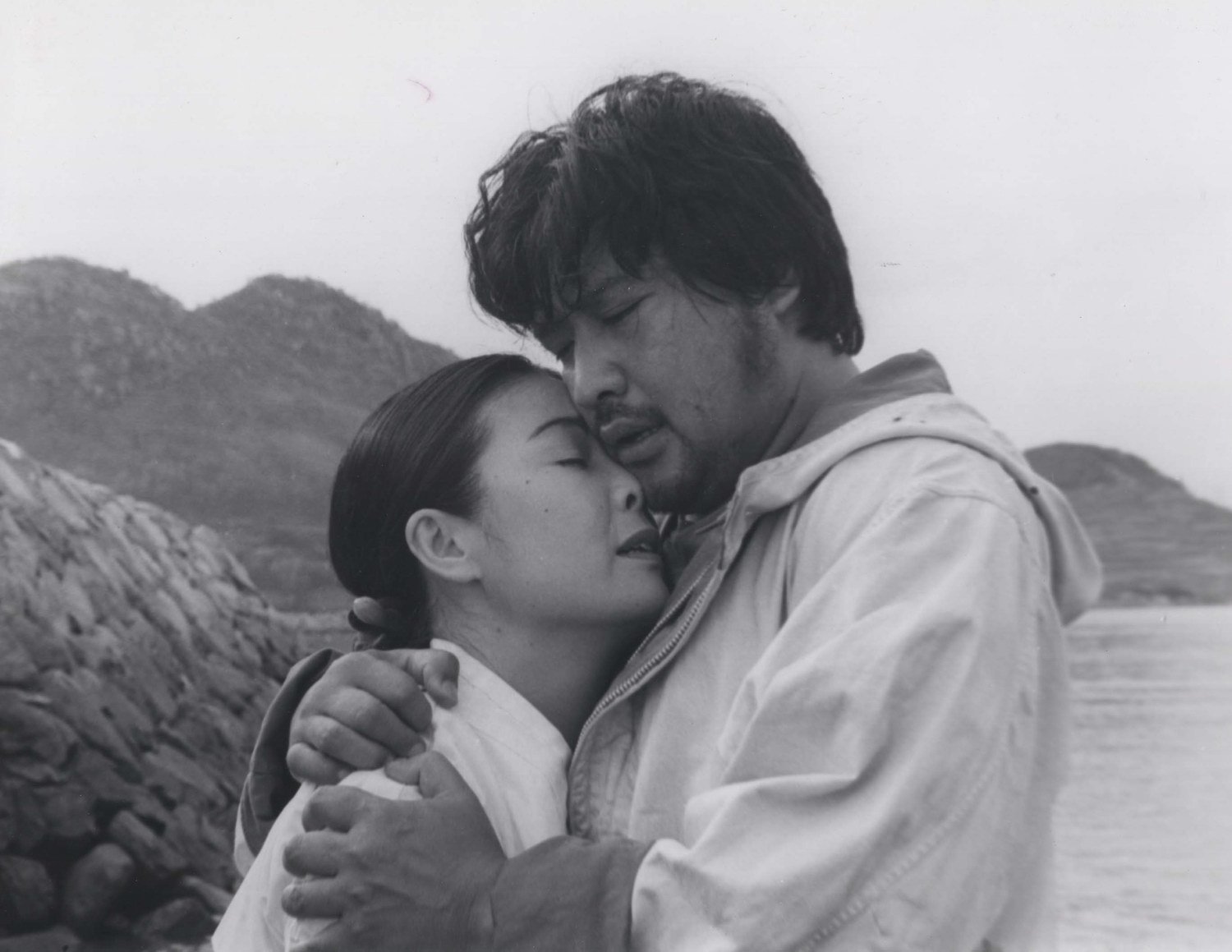
“They seem to live for honouring the dead” the bemused heroine of Im Kwon-taek’s Surrogate Woman (씨받이, Ssibaji) explains to her visiting mother of the noble society she has been unwittingly plunged into but still struggles to understand. A condemnation both of a society which continues to value sons over daughters and of the absurdity of ancestral rites along with the hierarchies of the feudal order, Kwon’s impassioned historical drama speaks directly to the contemporary era in which in many ways nothing has changed.

In any case, Ok-nyeo (Kang Soo-yeon) is fated to become a surrogate woman. As the woman who seems to be in charge in a small community ensconced in a valley which from a certain vantage point seems to resemble female genitalia explains, surrogate mothers who bear daughters are expected to raise them themselves but the children are considered undesirable for marriage and generally end up becoming surrogate mothers themselves. Ok-nyeo’s mother had not wanted such a fate for her daughter, but is in the end powerless to prevent it especially given the allure of the generous payment promised on the birth of a male child. Ok-nyeo thinks she can endure anything for the promise of a comfortable life afterwards but is simply too young and naive to understand the emotional consequences of her decision, that her child will be removed from her seconds after birth and handed to another woman to raise. 

The situation is not much better for the wife who is made to feel as if she has failed in not having conceived a child during her 12 years of marriage. Both she and the grandmother who is so insistent on ensuring the existence of a male heir now that her husband has died and their only son is childless, express anxiety about Ok-nyeo’s youth, as did the women in the village, fearing that at 17 she is not yet physically or emotionally mature enough to bear a healthy child. The man they sent to select her seems to have done so out of personal preference, explaining that of all the women he picked a virgin though this raises several practical issues given the nature of surrogacy. Even so there is something quite perverse in the fact that it is the grandmother, the wife of a noble family of Confucianist scholars, who is actively participating in this system that renders women little more than wandering wombs now that she has the only real power that she will ever experience in her life as a widow turned head of household. 

On the other hand, it’s clear that this isn’t an ideal arrangement for the man either. The husband, Sang-kyu, is reluctant. He thinks it’s morally wrong and against his Confucianist philosophy while he is also attached to his wife and has no desire to sleep with other women. Nevertheless, he becomes attached to Ok-nyeo to a degree that is regarded as inappropriate by his family members and advisors, sneaking out to sleep with her for reasons other than conceiving an heir. When Ok-nyeo becomes pregnant they send him away to a temple in an attempt to sever their emotional connection, though he immediately sleeps with her again on his return despite the fact that she is already pregnant. For this transgression, Ok-nyeo’s mother is beaten while Ok-nyeo herself had earlier been punished for seducing him though she is completely confined to a single room for the entirety of her stay at the house lest anyone find out the embarrassing secret that the family have hired a surrogate. 

While Ok-nyeo and Sang-kyu make love in the bushes, drunken men from the party he’d been attending have a dull conversation about the nature of ancestral rites which is in its own way transgressive as they ask themselves where these ancestral spirits actually are, trying to make sense of what the rituals are for and what they mean but emerging with only confusion for they are largely meaningless. They praise women for rescuing the ancestral tablets at the expense of their children and constantly incur vast expense sacrificing food for those who can no longer eat. As someone remarks, the dead dislike their world and long to stay in ours but the living hardly live at all and spend all their time in service of those who are no longer here. All of it, this vast system that traps women like Ok-nyeo along with men like Sang-kyu the Confucian scholar, stems from this desire to placate departed souls at the expense of those still breathing. 

Yet Ok-nyeo is almost like a ghost herself, an invisible presence locked up in a backroom concealed as a dirty secret. Her mother reminds her that Sang-kyu is an aristocrat and she is not, they do not really regard her as human and what she is is stabled like a horse brought for mating to be taken home once the foal is born. They snuck her in by night and will insist that she leaves in darkness mere hours after her son’s birth. Meanwhile, she will be tortured by her captors who burn her stomach and force her to drink strange potions in the name of having a son. Sang-kyu too is forced to drink deer blood to improve his manliness while Ok-nyeo is advised to stare at the moon to the point of dizziness. She perhaps falls for Sang-kyu because he is her only real human contact though it appears they never actually speak to each other, while he discovers a kind of liberation in the permission to dispense with the sublimation of his sexual desire normally demanded by his Confucianist teachings. 

But few of them acknowledge the cruelty with which Ok-nyeo and the surrogate women are treated, the pain and despair her mother had tried to warn her of. Ok-nyeo had said anything was worth the price of 10 fields, but soon cries out that she’d give them all up for her son unable to accept that the boy will never be hers for to be a surrogate woman is to be denied one’s own existence. Caught in the night, she can only stare back through the fog as the carriage departs forever separating her from her child and the man she had unwisely come to love. As the closing titles explain, returning to the funereal scenes with which the film had opened, Ok-nyeo has become a victim of a society that prizes sons over daughters as have so many women like her even centuries later in which enlightenment has brought little freedom for those oppressed by class and patriarchy.


The Surrogate Woman screened as part of this year’s London Korean Film Festival.

Trailer (no subtitles)

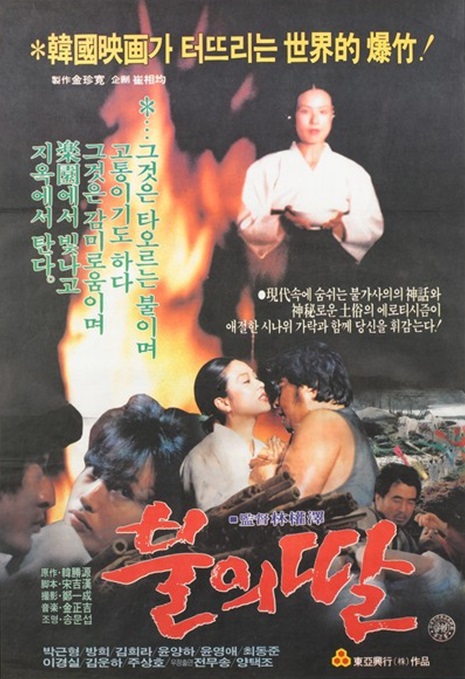
Daughter of Fire (불의 딸, Im Kwon-taek, 1983)

“Doctor, is it possible in our modern society for someone to suffer from that kind of illness?” the conflicted hero of Im Kwon-taek’s Daughter of Fire (불의 딸, Bul-ui ttal) asks his psychologist, plagued by nightmares of the mother who abandoned him at 11 and suffering what seems to him to be the call to shamanism, only what place could such a backward and superstitious practice have in “our modern society?”. In many ways, it’s exactly that question which Im seems to find so essential, implying in a sense that even in the politically repressive but increasingly prosperous Korea of the late ‘70s that they have perhaps lost something of their essential Koreanness in their abandonment of their ancestral beliefs in favour of modern “sophistication”.

Listening to his troubles, the disinterested psychiatrist reassures Hae-joon that it’s just a “minor neurosis” caused by “frustration” which can easily be cured. On his way home, however, Hae-joon is accosted by an older woman dressed in shaman’s clothing who addresses him as a son, reminding him that he has the blood of shamans running in his veins and try as he might he’ll never be able to escape it. Her intervention perhaps links back to an earlier encounter with the pastor at his wife’s church who explained to him that his wife is at the end of her tether, embarrassed by his lack of faith believing that it reflects badly on her as a religious woman hoping to lead others towards the lord if she cannot at least count her husband among the saved. So great is her distress that she has apparently even considered divorce. This is perhaps one reason Hae-joon is so keen to exorcise his shamanistic desires, though it’s also clear that his presence in his home is intensely resented, his wife later only warmly greeting him by hoping that he’ll be able to let go of his “dark and diabolical life” for something brighter and more cheerful, ie her religion though the grey uniformity and intense oppression of her practice only make her words seem more ironic. 

The pressing problem in his family is that his daughter is also sickly, seemingly with whatever it is which afflicts Hae-joon. She has begun sleepwalking and later suffers with fits and seizures which to a certain way of thinking imply the onset of her shamanistic consciousness. Hae-joon’s Christian family, in a touch of extreme irony, are convinced that an exorcism in the form of a laying on of hands will cure her, yet they like many others view the ritualised religious practice of the shaman as a backward relic of the superstitious past. The ironic juxtaposition is rammed home when Hae-joon is sent to cover a supposed miracle for his newspaper that his wife and her friends from church regard as the second act of Moses, standing ramrod straight and singing hymns while a noisy festival of shamanic song and dance occurs further along the beach apparently a rite to appease both the sea god and the vengeful spirit of an old woman accidentally left behind when her community migrated to another island to escape an onslaught of tigers. Stuck in the middle, Hae-joon exasperatedly explains to his photographer that this parting of the seas isn’t any kind of miracle at all, merely a natural result of low tide revealing that which would normally be hidden. 

Yet despite his unsatisfactory visit with the psychologist, Hae-joon becomes increasingly convinced that only by finding his mother can he come to understand what it is that afflicts him. Speaking to the various men who knew her from the step-father he later ran away from to escape his abuse after his mother disappeared, to a blacksmith who cared for him as an infant, and the men she knew after, Hae-joon begins to understand something of her elemental rage. Driven “mad” by the murder of her lover by the Japanese under the occupation, she wandered the land looking for fire to exorcise her suffering only later to lose that too when the oppressive Park Chung-hee regime outlawed shamanism entirely in his push towards modernity. Consumed by the fires of the times in which she lived, there was no place in which she could be at peace and nor will there be for Hae-joon or for his daughter until they embrace the legacy of shamanism within. 

“Shamanism will not disappear and die” Hae-joon later adds, now able to see that there is or at least could be a place for it in “our modern society” or perhaps that it’s the modern society which must change in order to accommodate it. Despite his long association with depictions of Buddhism, it is the shaman which Im considered the foundation of Korean culture, something he evidently thinks in danger to the perils of a false “modernity”, Hae-joon eventually professing his concerns that without it Korea will forever be oppressed by foreign influence. Only by accepting the shaman within himself can he hope to find freedom in an oppressive society. 


Daughter of Fire streams in the UK until 11th November as part of this year’s London Korean Film Festival.

Divine Bow (神弓 / 신궁, Im Kwon-taek, 1979)

“From now on we need think only of our children. We can’t pass on shamanism to them. Our children at least should have a bright future” insists a man whose horizons have in one sense been broadened but perhaps in another narrowed following forced immersion in the modern world. A classic “island” film, Im Kwon-taek’s Divine Bow (神弓 / 신궁, Singung) finds a conflicted modern day shamaness reassessing her place in a community which has systemically betrayed her while trying to find a path through the intensity of her grief and sorrow. 

Set almost entirely on the small fishing island of Naro, the film opens with a series of short, static shots of the rainy harbour where an old man sits and strokes his beard wearing traditional Korean dress while a group of seemingly unemployed young men look on listlessly from the boats. It seems the community is in crisis for a number of reasons, the most pressing being a non-existent harvest of fish which they are choosing to attribute to the local shamaness’ refusal to perform the customary rituals. Unmoved by their petitioning, Wangnyeon (Yoon Jeong-hee) advises them to hire her daughter-in-law instead, but for unexplained reasons they only want her, threatening to hire a shaman from a neighbouring island if she continues her policy of non-cooperation. As we will discover, Wangnyeon has her reasons beyond a simple desire for retirement from what is a fairly strenuous job for an ageing woman, but the return of her long absent son Yongban prompts her into a reconsideration of her past and future as well as her place in this community. 

Though the tale is set in the present day, the fishermen are convinced that Wangnyeon’s refusal to conduct the ritual is the reason their harvest has failed, apparently for the first time in 30 years ever since she “retired”. But then they also tell us themselves of more rational reasons they may no longer be able to fish including an oil leak in the surrounding seas and the corrupting influence of larger corporations for which many of them are now reluctantly working. It is precisely this incursion of modernity that has led to all the trouble. Taken off the island, presumably to fulfil his military service, Wangnyeon’s husband Oksu (Kim Hee-ra) observes the modern world during his time in the army and comes to the conclusion that his home culture is backward and superstitious. Hired to perform an important ritual on a neighbouring island for the first time, Wangneyon repeatedly delays the contract to align with her husband’s discharge so he can play drums for her as he always had before. His newfound sophisistication, however, has robbed him of the ability to play. He no longer believes in shamanism and eventually leaves once again to work on a ship in order to one day own a fishing boat of his own. 

“What does a shaman do if not rituals?” Wangnyeon irritatedly asks her husband, in her case the answer apparently being a defiant nothing. Her refusal is part of her resistance to a world that has repeatedly betrayed her. Yet suffering economically temporarily loses her her son who, perhaps unlike his father, returns after a year of travelling more convinced than ever by shamanism if resentful that his mother has not yet relented and resumed her ritual duties. What we realise is that Wangnyeon has grown weary of her complicated place in the island hierarchy, existing to one side of the rest of the community who view her both with mild disdain and fearful awe. A victim of petty island politics, she takes literal aim at the corruption in her society and purifies it with her “divine bow”, mindful of Yongban’s pleas that her rituals are not just for her but for the many people who need to see them performed. 

“Everything, everything, everything is a dream” Wangyeon sings, living perhaps in her own ethereal purgatory, her jagged life story revealed to us in a series of fragmentary flashbacks as she reflects on her present predicament while finally understanding what it is she must do, determining to pick up the divine bow once again and reassume her rightful role as the shamanness. Marking Im’s first collaboration with cinematographer Jung Il-sung, Divine Bow is rich with ethnographic detail exploring this small rock pool of traditional culture on an otherwise moribund island subject to the same petty authoritarian corruptions and ravages of an increasingly capitalistic society as anywhere else. 


Divine Bow streams in the UK until 11th November as part of this year’s London Korean Film Festival.

Ticket (티켓, Im Kwon-taek, 1986)

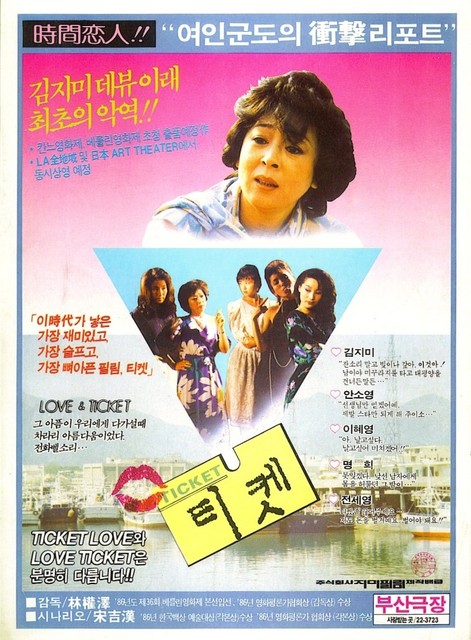
Ticket posterThe times may have changed but the double standard is still very much in existence in Im Kwon-taek’s Ticket (티켓). Set in a tabang ticket bar – a delivery coffee establishment in which customers may by “tickets” for unspecified “services”, Ticket follows five ordinary women in Kangwon Province who’ve found themselves trapped in the world of casual sex work for various different reasons but each dreaming of finding something better in the difficult mid-80s economy.

Im opens with stern madam Ji-suk (Kim Ji-Mi) selecting three pretty girls from an employment office to work at her bar in rural Kangwon Province. As she explains, the cafe is located in a quiet port town and mainly caters to seamen and tourists. Ji-suk views refinement as one of her selling points and so she expects her ladies to mind their manners and avoid vulgarity. The girls were given an advance on their wages as a signing bonus, but are technically indentured servants until they pay it off which may take some time seeing as Ji-suk is fond of adding fines onto their accounts should they break any of her rules or request any additional advances for work related expenses such as medical fees, clothing, or cosmetics.

While two of the new recruits, Miss Hong (Lee Hye-young) and Miss Yang (Ahn So-young), have had experience of this type of work before, Se-yeong (Jeon Se-yeong) is much younger and struggles to come to terms with the nature of the job, frequently incurring Ji-suk’s wrath by running out on clients who get fresh. Miss Ju (Myeong Hui), who has been working at the tabang for three years with ballooning debts, tries to warn the girls that in order to avoid her mistakes they should abide by three rules – cash only, no mercy, and no repeats. All quite sensible rules in theory but difficult to enforce in practice.

Unlike Miss Hong and Miss Yang who’ve come from impoverished rural backgrounds, Se-yeong is from Seoul but has found herself responsible not only for her immediate family but also for her down on his luck student boyfriend Min-su (Choi Dong-joon) who is currently studying to become a teacher but struggling to support himself. Min-su, not the sharpest knife in the drawer, hasn’t quite figured out that the girls don’t really just deliver coffee but in any case remains conflicted over his dependence on Se-yeong for money. Still struggling to accommodate herself to sex work, Se-yeong eventually decides to seduce a friendly sea captain as a means of easing herself into it while also trying to get Min-su a job on his boat.

Meanwhile, Miss Yang dreams of becoming an actress and is naive enough to think sleeping with a famous actor will help, and Miss Hong concentrates on being the best but usually ends up getting herself into trouble. Miss Ju, a divorcee, misses her son while Jin-suk turns out to have a sad story of her own in which she was driven into sex work after her husband, a dissident poet, was picked up by the authorities in less liberal times. Unable to bear the shame she left him, but still harbours hope he may find her again only to have that hope cruelly dashed with the stark message that life is like a bus – if you miss it, it won’t come back for you. Each of these women has, in a sense, already missed a bus and is stuck in Kangwon for the foreseeable future with no clear way out.

Though Jin-suk seemed the toughest and the least sentimental of the ladies, it’s she who wants “forgiveness” most of all which is perhaps why she goes to the trouble of taking Min-su to task for his unreasonable treatment of Se-yeong. Pointing out that nobody chooses this way of life freely, Jin-suk snaps on realising that there really are no sympathetic men and all now view her and her girls as “dirty” while continuing to use their services. Im closes with an improbably happy ending, if ambiguously, which promises a more positive future for each of our ladies as they manage to find ways out of the rural sex industry and into something more hopeful but even this abrupt tonal shift only serves to reinforce the miraculous nature of their sudden opportunities in a society which appears to remain hostile to their very existence.


Ticket was screened as part of the 2019 Udine Far East Film Festival. It is also available to stream online via the Korean Film Archive’s YouTube Channel.

Jagko (짝코, AKA Pursuit of Death, Im Kwon-taek, 1980)

Jagko poster

During the dark days of the dictatorships, the “anti-communist film” was a mainstay of the Korean film industry. Though it wasn’t exactly possible to make a pro-communist film and that therefore any and all films were at least implicitly anti-communist, the authorities had been especially keen on films which took a hardline on anything remotely leftwing. By the late ‘70s however times were changing and a more nuanced view of recent history began to become possible. Im Kwon-taek is thought to be among the first directors whose work precipitated a shift from the “anti-communist” to the “division” film in which the tragedy of the division itself takes precedence over the demonisation of the North (though such views were perhaps not as uncommon as might be assumed in films from the late ‘50s and early ‘60s before the passing of the Motion Picture Law). Jagko’s (짝코) two haunted protagonists are both flawed men betrayed by their country and changing times realising they have wasted their youth on a cat and mouse game over an outdated ideological disagreement when the conflict that defined their lives was merely a proxy war fought by two super powers on Korean soil.

Song (Choi Yoon-seok), a former policeman, is picked up by a vagrancy patrol and taken to a “rehabilitation centre”. Despite the name the centre is more like a debtors’ prison and Song is now a prisoner of poverty who will not be allowed to leave unless redeemed by a family member (of which he has none or he might not be here). Nevertheless, the men are treated well, fed three meals a day, and only asked for a couple of hours of non-strenuous work with the rest of the time marked “free”. Once Song has begun to calm down, he makes a shocking discovery. He is convinced that a man lying ill a few beds over is none other than Jagko (Kim Hee-ra) – a former North Korean partisan and the man he holds responsible for ruining his life.

Im lets us in on the stories of both men via a series of flashbacks. Though he pretends not to know him, the other man, calling himself Kim, is indeed “Jagko” though his life has been just as miserable as Song’s. Back on Mount Jiri at the end of the Korean war, Song was a respected policeman – he left school at 12 and made a name for himself catching partisans. When he catches the legendary Jagko, wanted for a series of atrocities and terrorist acts, all Song can do is boast and talk of his imminent promotion after which he will enjoy a life of comfort. Unsurprisingly, Jagko is not exactly happy for him but allows his captor to prattle on in order to buy time for his escape. It is Song’s own arrogance which permits him to do so. Claiming to need the bathroom, Jagko offers Song a gold ring hidden in his shoe which Song scoffs at, but he does loosen his cuffs to facilitate Jagko’s relief at which point he manages to headbutt him and run away. Song is accused of taking bribes and dismissed. He is humiliated and loses his status, job, and family all in one go. Fixated on Jagko, Song gives up everything to chase him in order to turn him in to his former commander and have him clear his name by confirming that he was not bribed and did not sell out his country for gold.

Almost thirty years later both men are older than their years, broken and defeated. As one of the rehabilitation centre residents puts it, they’re all about to die – what does it matter now if someone was a communist or a partisan, what good could it possibly do to drag the past up all these years later? For Song it’s almost as if there is no “past”, the last few decades have been spent in a relentless pursuit of the man who holds the key to his good name. He wants to undo the folly of his hubris by overwriting it, but time has passed and what he’s lost cannot be reclaimed. Meanwhile, Jagko is not an ideologically crazed leftist, but a lonely old man who is now in poor health and has nothing but regrets. The two men bond in their mutual suffering and work together to escape, but the world they emerge into is not that of their youth. Song was disempowered when he entered the facility – they took his arrest rope away from him, but when he tackles the weakened Jagko to the ground and tries to call two policemen on patrol over to arrest him as an “escaped communist guerrilla” the young officers of the law have no idea what he’s talking about. Those words no longer mean anything. The bemused policemen conclude the old men must be escaped mental patients before spotting the rehabilitation centre uniform and jogging off to phone someone to come and take them back.

The old men’s quarrel is exposed as ridiculous. Jagko, less angry more soulful, remarks that men like he and Song are the most pitiful souls on Earth as he watches America sit down with Russia on the TV and realises he is merely a victim of ongoing global geopolitical manoeuvring. It’s no longer a question of left and right, both men are victims of their times, neither “good” nor “bad” but flawed and human. We do not know if Jagko did the things Song says he did but he has paid a heavy price all the same. Song, by contrast, has shifted all the blame for his fate onto Jagko, believing that if he can catch him he can somehow make it all right, but of course he can’t and is trapped in a spiral of denial in refusing to accept his own responsibility for the tragedies of his life. What is to blame is the folly of war and particularly of an internecine fraternal conflict which remains unresolved and may well be unresolvable unless an attempt is made to address the past with empathy and understanding in place of enmity and rancour.


Jagko is available on blu-ray courtesy of the Korean Film Archive. The set includes subtitles in English, Japanese, and Korean with the audio commentary by Kim Dae-seung and editor of Cine21 Ju Sung-chul also subtitled in English. The audio commentaries from the DVD edition included with the Im Kwon-taek boxset, one by director Im Kwon-taek and film critic Huh Moon-yung, and the other by screenwriter Song Gil-han and film critic and director Kim Hong-joon, unfortunately do not carry over the English subtitles. The set also comes with a bi-lingual Korean/English booklet featuring an essay by film critic and professor Park Yuhee. Not currently available to stream via the Korean Film Archive’s YouTube channel.

Mandala (曼陀羅 / 만다라, Im Kwon-taek, 1981)

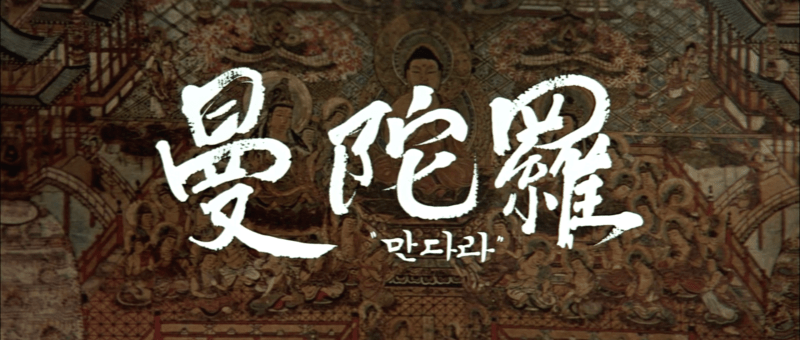
Mandala posterIn a world defined by suffering, does one have the right to retreat into the self and engage in a personal quest for enlightenment or is true enlightenment to be found in the confluence of human consciousness? Im Kwon-taek has some profound questions to ask about human spirituality, the futility of existence, and the transcendence of the self in his 1981 masterpiece, Mandala (曼陀羅 / 만다라). Two monks with very different ideas of spiritual fulfilment meet, part, argue, and perhaps finally understand each other as they walk solitary, individual paths towards Nirvana, each also doubting the purpose of their quest and its ultimate resolution.

Beob-wun (Ahn Sung-ki) dropped out of university and broke-up with his girlfriend in order to become a monk. Consumed with nihilistic thoughts about the futility of existence, he could not go on living a meaningless life. Six years later, Beob-wun is on a bus which is stopped at a checkpoint. Another man in monk’s robes fails to furnish an official monk’s ID card to the authorities and is unceremoniously ejected. Beob-wun gets off the bus too out of a sense of professional courtesy and a desire to help, but Jisan (Jeon Moo-song) is not exactly the kind of monk a serious minded man like Beob-wun would usually want to associate with. Nevertheless, he is oddly fascinated by him, conflicted yet drawn.

Jisan has a sad history of his own. After an indiscretion with a girl at a mountain temple, he was falsely accused of rape and subsequently defrocked. Nevertheless, he continues to practice as a wandering monk, seeking enlightenment in his own way and at his own pace. Jisan’s Buddhas are buried at the bottom of bottles of soju and in the hearts of women – most especially that of the girl from the temple, Ok-sun (Bang Hee), to whom he often returns and is unable to forget. Beob-wun retreats when tested, he doesn’t look at the things which tempt him. Jisan runs headlong towards his demons and defeats them by satiation, but the relief is only temporary – the old emptiness soon returns and the cycle of spiritual deaths and rebirths begins itself again.

When Beob-wun’s former girlfriend, Young-ju, tracks him town to a mountain retreat and confronts him over his “selfish” decision to run away from all his problems by hiding in a temple, he tells her that temples aren’t places for the defeated but to lead one’s life and save the lives of others. She quite fairly asks why he can’t save her life by returning to the world, but Beob-wun looks away. Beob-wun is in denial. He can’t forget Young-ju and has come to resent her as an obstacle to his path towards enlightenment, blaming her for existing rather than himself for his failure to “overcome” her.

There is something dark and dangerous in Beob-wun’s wilful negation of his desires which later manifests as violence, first in a memory or perhaps a fantasy of rape, and then more directly against a woman who was attempting to tempt him into breaking his self affirmed vows of chastity. Jisan’s philosophy is melancholy and perhaps hopeless in its own way, but brighter and free from artifice or malice. Having separated from Jisan, Beob-wun reunites with a fellow monk who has taken their mentor’s instructions to “burn away” the fetters of the mind literally by setting fire to his fingers in order to transcend himself through conquering physical pain. His friend tells him of a funny monk he met on an island who was the only one to rush in and help when the islanders were struck down by a mysterious plague. Jisan fulfilled his duty to others. The other monk sat in the woods on his own praying for his personal enlightenment while the islanders continued to suffer alone.

Jisan, and later Beob-wun’s friend Sugwan, have chosen to look for themselves as reflected in the souls of others, but Beob-wun remains trapped within his own solipsistic belief that he can only overcome his suffering and find an answer to his existential crisis through entirely negating the outside world. Beob-wun is the kind that keeps his head down and avoids getting involved with other people’s troubles – the reminders of an authoritarian regime are everywhere, but a part of him knows that Jisan, for all his faults, is the most “enlightened” man he’s ever known, if only for being the least like himself. The quest for “enlightenment” might be an intensely selfish act of self harm, but the need to create meaning from meaningless persists, for good or ill, and Beob-wun remains lost on the never-ending road to Nirvana, a solitary traveller without hope or expectation.


Mandala was screened as part of the Korean Cultural Centre’s Korean Film Nights 2018: Rebels With a Cause screening series. It is also available on DVD as part of the Korean Film Archive’s Im Kwon-taek box set, as well as online via the Korean Film Archive’s YouTube channel.

Revivre (화장, Im Kwon-taek, 2015)

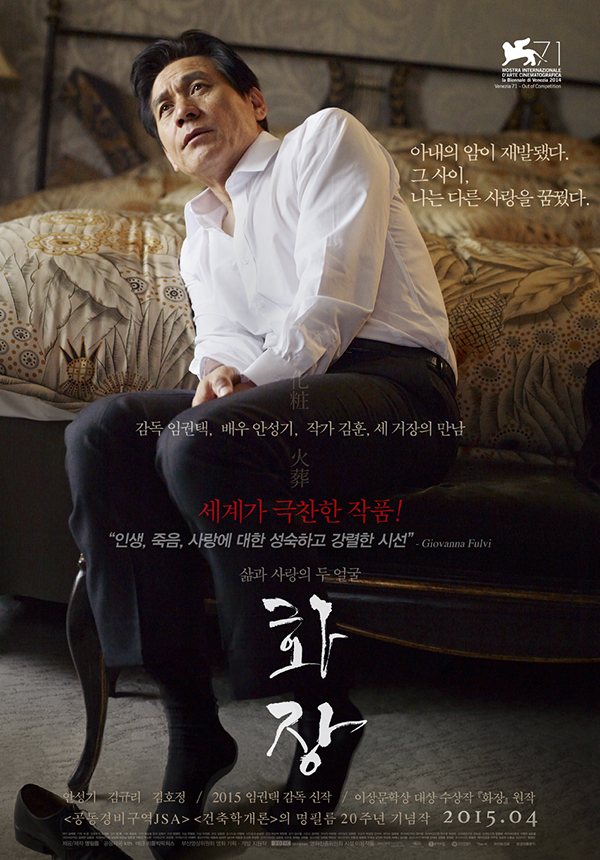
revivreThe 102nd film from veteran Korean film director Im Kwon-taek may appear close to the bone in its depictions death, suffering, and the long look back on a life filled with the quiet kind of love but Revivre (화장, Hwajang) is anything but afraid to ask the questions most would not want to hear as the light dwindles. The inner journey is just too hazy, as one man puts it, unknowingly commenting on the human condition, yet Im does manage bring us nicely into focus, if only for a moment.

Oh (Ahn Sung-ki), a successful salaryman working in marketing for a cosmetics company, finds himself slightly adrift as the brain tumour his wife, Jin-kyung (Kim Ho-Jung), had previously suffered from resurfaces. The treatment this time is apparently not as successful leading to prolonged hospitals stays as Jin-kyung’s condition deteriorates and she begins to require a greater level of medical care. While all of this is going on, Oh is still very much dedicated to his work but has also begun to indulge in an old man’s folly, fantasising about the pretty new girl at the office.

Much of Revivre is concerned with Oh’s inner life, the things he does not say (which are many because Oh is a quiet sort of man). Ahn Sung-ki captures this quality well in playing Oh with a kind of blankness that could be the numbing sensation of grief or an extension of his ordinarily reserved nature. This makes his impromptu verbal attack on the figure of his fixation, Choo Eun-joo (Kim Gyu-ri), all the more unexpected though his remorse over having acted in such an out of character way may actually help to generate a kind of relationship between the pair albeit more of a paternal than romantic one.

Oh’s continuing fixation on Eun-joo, the woman who becomes the accidental focus of his world even though his wife lying dies in a hospital, is intended to be a fantasy and nothing more. An early dream sequence sees Oh participating in an elaborate traditional funeral taking place in a desert in which all of the mourners are dressed in black, except, of course, for Eun-joo – the only fixed point of reference, clothed in vibrant purple and smiling back at him in contrast to the solemn faces of the other guests, each staring at the floor. In the real world time slows down for him as Eun-joo dances youthfully in a nightclub and as he leaves the party early, her’s is the lone still face, haunting him as he looks back at the other revellers still enjoying themselves heartily even outside the club.

Indeed, “looking back” with all of its various advantages and disadvantages becomes another central theme as Oh becomes a kind of Orpheus descending into his own personal hell in the hope of dragging back his departed Eurydice – an idea neatly recreated in one of the film’s few outright fantasy sequences in which Oh dreams himself into an avant-garde dance show. Like Orpheus, Oh cannot help but look back though he risks losing all in the process. What Eun-joo represents for him is perhaps not the woman herself but an image of his own youth and a desire to live again as he once lived before. The present and the past begin to overlap for him, Eun-joo becomes the future he cannot touch as well as the returning spectre of a past he cannot return to.

Oh’s daughter asks him at one point if he ever really loved her mother. His reaction to losing his wife is, it has to be said, restrained, practical. Yet this question is answered with an immediate cut to Oh helping his wife to the bathroom, performing the most intimate of tasks with unwavering devotion. As his wife fades, Oh’s fantasies become a shield against the growing fears of his own mortality as his body also begins to fail him. The melancholy sense of loss and loneliness coupled with the inevitability of the passage of time pervade as each of Oh’s points of reference slips away from him at exactly the same time.

Im opts for a non-linear approach beginning with Jin-kyung’s passing and thereafter moving freely, reflecting Oh’s fleeting memories and interior confusion as he deals with such a traumatic, life altering event. Neatly framing Oh’s dilemma within his work in which he faces a choice of sticking with the current marketing strategy or striking out in a bold new direction, Im plays with the eternal theme of transient beauty in a society which prizes bodily perfection above all else. The film’s Korean title plays on a pun involving a homonym which means both “cremation” and “makeup” perhaps harking back to the central theme that you dig a grave for yourself if you attach the wrong sort of importance to the impermanent, but is in a sense ironic as one represents a final acceptance and the other an attempt to hold off the inevitable. Poetic and intensely moving, Revivre is another characteristically multilayered effort from Im, still at his full strength even in this late career effort.


International trailer (English subtitles/captions)