God Man Dog (流浪神狗人, Chen Singing, 2007)

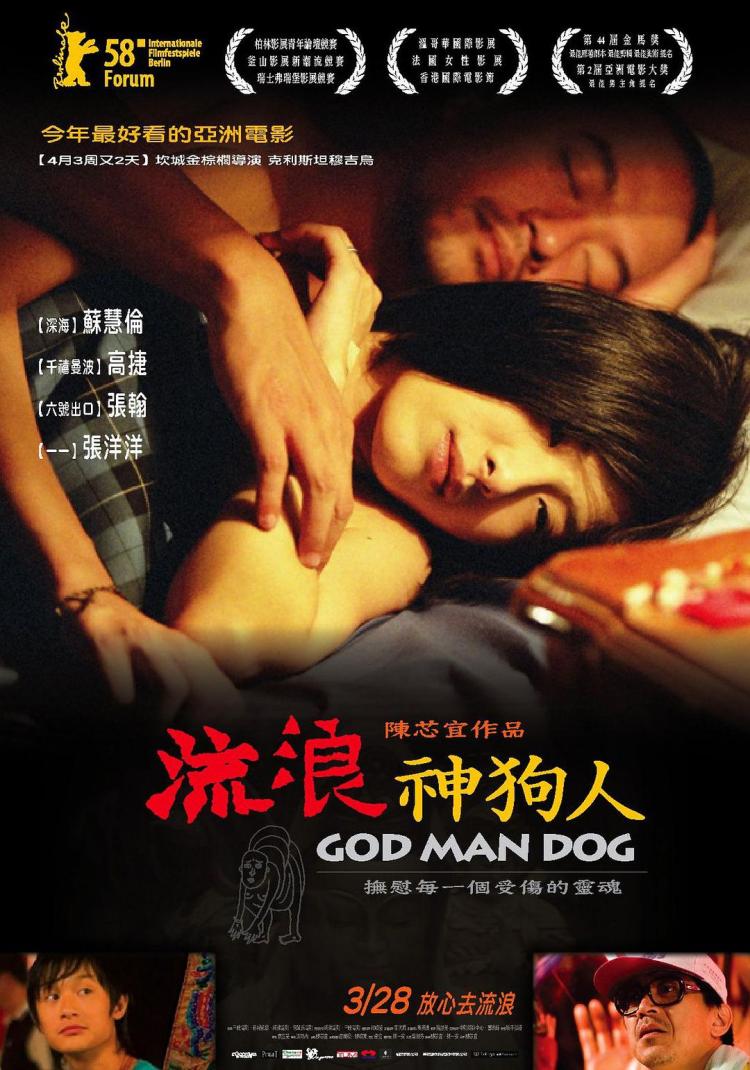
God Man Dog posterEverybody’s looking for something but mostly in all the wrong places in Chen Singing’s spiritually inclined God Man Dog (流浪神狗人, Llàng Shén Gǒu Rén). Lonely and disaffected, Chen’s portrait of contemporary Taiwan is of an island set adrift with no clear path to the future and no reliable guides to follow. Many turn to religion, be it Eastern or Western, while others embrace consumerism or literally fight to find a way out while refusing to let those around them drag them down. Cosmic coincidence does perhaps begin to show them the way, but it’s less a matter of faith than chance as they each find opportunity to refocus and reclaim what it is they really wanted out of life.

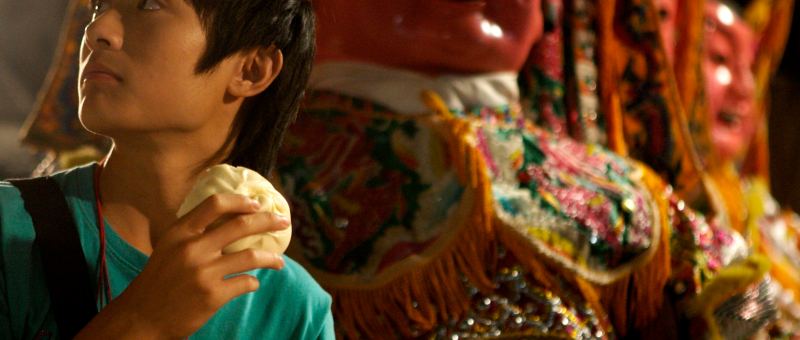
Hand model Ching (Tarcy Su) is suffering from postnatal depression after the birth of her first child but her husband, Hsuing (Chang Han), remains detached and insensitive – running off to new age country retreats to avoid the strain of caring for his delicate wife and baby daughter. Meanwhile, an indigenous couple have lost a child of their own and then suffered the departure of both their daughters because of the father’s persistent alcoholism. Their daughter, Savi (Tu Hsiao-han), is living in Taipei with a beauty obsessed friend who’s doing dodgy modelling to pay for a boob job while Savi works hard on her martial arts as a possible path out of rural poverty. A chance encounter brings her into contact with mysterious Buddha bus driver Yellow Bull (Jack Kao) who is saving money to pay for a new prosthetic leg while making a point of rescuing and reviving the many broken and abandoned Buddha statues which seem to call out to him from around the island, adopting a stray child, Xian (Jonathan Chang), in the process.

Everybody here wants something that they aren’t convinced they can have. The upper middle class couple Ching and Hsuing might seem comfortable enough but are filled with spiritual emptiness and feel trapped by conventionality. They’ve started to drift, and the baby far from bringing them together has only forced them further apart in thinly veiled mutual resentment. Hsuing refuses to play any role in caring for his daughter, or in trying to care for Ching whose dangerously deteriorating mental state seems to be receiving almost no support from family or medical personnel even when she tries to ask for it. In desperation she turns to Christianity, creating a further rift between herself and the intensely Buddhist Hsuing (not to mention his fortune telling obsessed mother).

Christianity is also a dominant force in the life of the indigenous couple who have been participating in AA meetings led by the local church in an effort to get their daughters to return though their faith is beginning to wane thanks to constant setbacks and the lingering conviction God has it in for them. Only through an improbable encounter with the Goddess of Mercy sitting beatifically on the back of Yellow Bull’s truck does the drunken father begin to wake up in making a symbolic act of sacrificial recompense in the hope of being forgiven for a transgression he did not perhaps wholly make. Guanyin, apparently, is there for them even if God was sleeping.

The indigenous couple, whose land is being infringed on by those like Hsuing who want to repurpose it to turn the beautiful natural surroundings into man made spas and thereby turn spiritual peace into a marketable commodity, tried to escape their troubles via alcohol and then turned to religion to save them from drink only to find it not quite as supportive as they’d hoped. Then again, kindly Yellow Bull stuffs his fortune telling box full of positive fortunes because, after all, people looking for fortunes are looking for hope so perhaps it’s not so much that Buddhism is “better” than Christianity, as it is that people are basically good and in the end that’s what you ought to have faith in. On the other hand, Savi and her friend end up making extra pennies through a fake dominatrix double act during which the girls rob their sleazy johns in a potentially dangerous piece of societal revenge that is, ironically, her friend’s plan to save money for a boob job to conform to those same patriarchal conventions they were just superficially rebelling against.

In any case, some kind of cosmic force eventually pulls them all together through the intervention of the many “abandoned” stray dogs who run free across the landscape, as does one supposedly million pound pedigree pup after making a break for freedom as the sole survivor of a nasty car wreck. “Freedom” might mean different things to different people at different times, but each of these lonely souls is in a sense trapped by their own sense of disconnection and the anxiety of feeling abandoned by those around them. Dogs, or maybe gods, bring them back together and accidentally reawaken their faith in themselves and each other to send them back out into the world with slightly lighter hearts if in acceptance more than hope.


God Man Dog was screened as part of the Taiwan Film Festival UK 2019. Also available on DVD in the UK courtesy of Terracotta Distribution.

UK Terracotta release trailer (English subtitles)
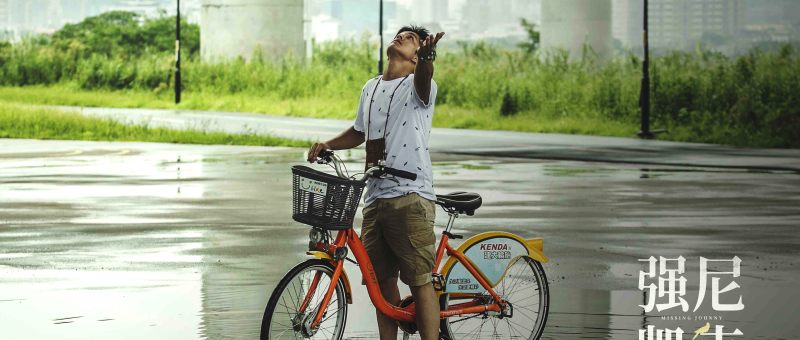
Missing Johnny (強尼.凱克, Huang Xi, 2017)

missing johnny poster 2“When people are too close they forget how to love each other” – so claims a lonely soul at the centre of Huang Xi’s debut Missing Johnny (強尼.凱克, Qiáng ní. Kǎi kè). A Taipei tale of urban disconnection, Missing Johnny is defined by mysterious absences and dangling connections as its three melancholy protagonists try to break free of their various obstacles to move towards a more fulfilling future. Family becomes both tether and support, a source of friction for all but very much a part of a the vice-like grip the traditional society is wielding over their lives. Yet there is hope for genuine connection and new beginnings even if you have to get out and push.

Casual labourer Feng (Lawrence Ko) has returned to Taipei after a failed venture only to see his car repeatedly break down, forcing him to seek help from a childhood friend. Meanwhile, Hsu (Rima Zeidan), a young woman living alone, fills her life with colourful birds which attract the attention of her landlady’s son, Li (Sean Huang) – a mildly autistic young man who finds it difficult to manage his life but resents his mother’s attempts to manage it for him. When Hsu’s newest parrot makes a bid for freedom, she enlists Li and Feng who has taken a job working on a nearby apartment to help her “rescue” it, sparking a series of connected epiphanies among the otherwise disparate group.

Each of them is, in someway, trapped. Feng is trapped by his difficult familial circumstances and resultant lack of social standing. His parents divorced when he was young and he came to the city alone for high school, forming a close bond with his teacher, Chang (Chang Kuo-chu), and his son, Hao (Duan Chun-hao). Feng is now welcomed as a member of their family but the Changs are not a happy bunch. Mr and Mrs Chang argue endlessly, usually ending with one of them asking for a divorce and Mr. Chang certainly seems to be a “difficult” older gentleman who requires all around him to walk on egg shells lest they say the wrong thing and set him off. Most of his scorn is reserved for Hao whom he regards as a disappointment in not having repaid on his investment. Divorced with a son and boomeranged back home, Hao resents his father’s moodiness and longs to move back out again but with things as they are, possibilities seem slim.

Money becomes a bone of contention for all. Hsu is involved in a long distance relationship with a controlling salaryman who tolerates her love of birds but doesn’t really want to be involved with them. It’s obvious the relationship has all but run its course and Hsu probably wants to end things but doesn’t quite have the energy so just doesn’t make as much time for him as perhaps she once did. Eventually we discover the boyfriend is married to someone else – a wealthy woman he married for her money which he now uses to “support” Hsu, her birds, and her business. Hsu’s boyfriend thinks the money he’s “invested” in the relationship means he’s bought something concrete, throwing it back in Hsu’s face just as Mr. Chang did to Hao. All he can offer her is a mistress’ life but he resents her desire to be free and expects her to be available to him whenever he wants as part of a reciprocal relationship. Mistaking the passage of money for genuine connection may be an ancient failing, but it seems one unlikely to go away.

Feng wants to build a family, despite himself, just a happier one than those he’s known while Hsu and Li are trying to assert their independence in a world which doesn’t quite want to give it to them. Li is almost a grown man but he can’t deny his mother’s suggestion that he needs some help here and there just to get by and that his life really does become confusing when he fails to read the notes she leaves for him reminding him what it is he’s supposed to do today. Like any young man, however, he wants to be free of his mother’s control to pursue his own destiny even if it might mean he gets lost along the way. His mother understands this, but she worries. She doesn’t stop him going but is hurt by his selfish refusal to accept that he causes her pain by wandering off for days on end without sign or warning.

And then what of “Johnny”? Hsu keeps getting calls on her mobile from various people looking for “Johnny” – presumably the same Johnny but really there’s no way to tell. Someone is missing him, anyway. Li asks Feng a philosophical question. He wants to know if birds in flight are still or in motion. A bird, flying, seems to be moving but it occupies a fixed point and is therefore “still” from moment to moment. The same could be said of our three protagonists, each living lonely lives of spiritual inertia carried along only by the rhythms of city life. Thanks to a missing parrot, however, they might finally find the courage to take flight even if they seem to stall at the beginning of their journeys.


Missing Johnny was screened as part of the 2018 New York Asian Film Festival.

Promo video (English subtitles)

https://www.youtube.com/watch?v=i9-Ozjp1xvQ

Project Gutenberg (無雙, Felix Chong, 2018)

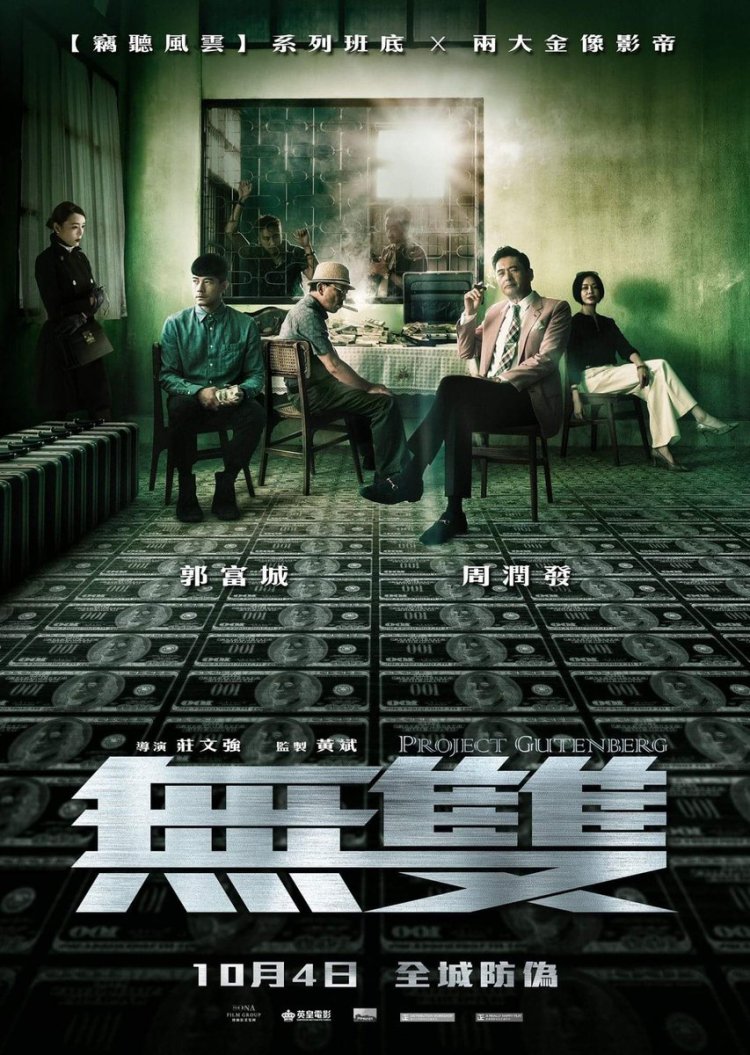
Project Gutenburg poster“Sometimes a fake can be better than the real thing” intones mild mannered counterfeiter Lee Man in Felix Chong’s cineliterate thriller Project Gutenberg (無雙) . At first glance, Project Gutenberg would seem to have nothing at all in common with the archival programme from which it takes its name but perhaps there is something in its continual questioning of whether a facsimile can replace an original. Chong plays with perception, narrative, and a human need for authenticity but most of all with the legacy of heroic bloodshed as a melancholy young man attempts to rewrite his own history with himself in the lead.

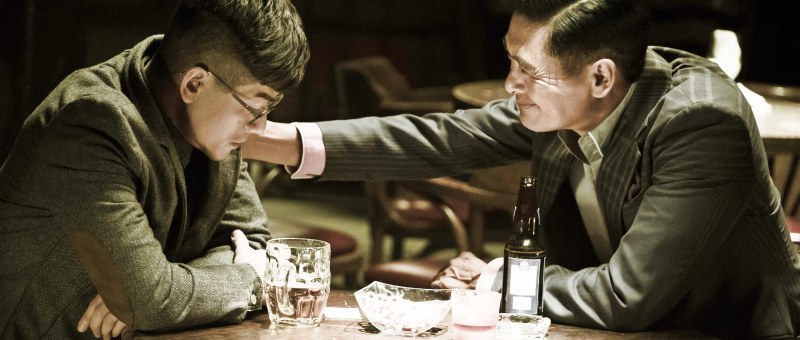
In the late ‘90s, Lee Man (Aaron Kwok) is languishing in a Thai jail from which he manages to get himself rescued by scraping blue powder off the walls and creating an expert forgery of a postage stamp to send a letter of help. Soon after he gets himself picked up by the Hong Kong police who want his help tracking down a notorious counterfeit currency trafficker known only as “Painter” (Chow Yun-fat). Lee is scared witless because Painter has a habit of ruthlessly hunting down associates who talk – something which is well known to HK police inspector Ho (Catherine Chau) who is after him because he killed her Canadian policeman boyfriend. Painter also murdered the fiancé of Lee’s old flame Yuen (Zhang Jingchu) who is the woman he sent the letter to and who has come to his rescue. Which is to say, the situation is much more emotionally complicated than one might expect.

Through flashback, Lee elaborates on how he came to get mixed up with crime. He and Yuen were living on love in 80s Vancouver trying to make it in the art world. While Yuen’s work began to gain traction, Lee’s was going nowhere. Technically proficient, his paintings were thought soulless and derivative but his talent for mimicry soon brings him to the attention of master forgers and thence to Painter who needs someone with expert skills for his next project – forging the US $100 bill.

Lee tells his tale with melancholy relish, dwelling on his days of youthful abandon with Yuen to the extent that Ho interrupts to declare herself disinterested, advising he skip the prologue and get to the bit where Painter shows up. Painter, a suave yet unpredictable criminal type, determines to help Lee become “the leading man” he knows he can be, but to be fair all anyone is ever interested in is the intensely charismatic Painter. As it turns out, there are more reasons for that than it might at first seem, but in the end Lee’s internalised feelings of inadequacy are still the fuel to his fire. Unable to find artistic success, forgery offers Lee the life of a skilful craftsman and he feels himself to have found his niche but in betraying his artistic integrity he also risks forever losing the woman he loves.

Painter has a weird obsession with Lee’s love life, assuring him that once the deal is done he will help him win back Yuen. “A man who gives up on love is destined to fail at everything” Painter tells him. Lee, however, repeatedly gives up on love. He refuses to fight, embraces his own sense of inferiority, and resolves to live on in misery falling ever deeper into Painter’s world of surrealist crime. Leaving aside Painter’s strangely homoerotic relationship with his protege, Lee’s life gets still more complicated when he becomes involved with a woman, Sau-ching (Joyce Feng), who falls in love with him in Thailand and, for complicated reasons, ends up with Yuen’s face thanks to plastic surgery and name thanks to a fake passport. Painter taunts him with a facsimile of his love but berates him for settling for a substitute while Sau-ching resents getting the Vertigo treatment from a man who refuses to let a failed love fade.

Almost offended by her betrayal of true love, Inspector Ho probes Yuen about her fiancé, asking if he was merely a “substitute” for Lee. Yuen asks if the next man Ho will fall in love with will merely be a “substitute” for her fallen colleague to which Ho fires back that there will never be anyone else because her love is “irreplaceable”. Yuen scoffs at her strangely naive romanticism and Ho does indeed appear to meet an echo of her former love in someone new carried once again on noirish cigarette smoke. If you can’t be with the one you love, love the one you’re with the old adage goes but it turns out that inauthentic romance is the hardest kind to bear.

Chong lets Lee’s retelling of his history play out like a heroic bloodshed movie in which Chow re-inhabits the classic characters of his youth. An unreliable narrator, the movie in Lee’s mind is one of honour and glory in which he still cannot allow himself to take the lead. Chong over eggs the pudding with a series of twists and reversals, undercutting all that’s gone before and muddying his message in the process but there’s no arguing with his high stakes style as he turns a simple crime story into an interrogation of authenticity and the power of personal myth making.


Screened as part of the 2018 London East Asia Film Festival.

Original trailer (English subtitles)