The Golden Bat (黄金バット, Hajime Sato, 1966)

Named after Japan’s oldest brand of cigarettes, Golden Bat is regarded by some as the nation’s first superhero created as a character for Kamishibai in 1931 by Takeo Nagamatsu and Suzuki Ichiro. Drawing inspiration from mythological illustrations, Nagamatsu and Ichiro had however intended Golden Bat to be rooted in science rather than legend which might seem ironic on viewing Hajime Sato’s 1966 piece of Toei tokusatsu titled simply The Golden Bat (黄金バット, Ogon Bat). 

Though Toho might be more closely associated with big screen tokusatsu adventures, Toei also had a small sideline in special effects movies as well as a series of hugely popular television franchises. Back in the 1960s, however, Golden Bat was something of an outlier in that it shifts away from the predominant messages that underlined many post-war tokusatsu in the importance of responsible science favouring instead a kind of throwback to the 1930s serial origins of the title character. As the film opens a factory worker with an obsessive though amateur interest in astronomy, Kazahaya (Wataru Yamakawa), tries to convince a professor that the planet Icarus has left its regular orbit and is on an imminent collision course with the Earth. The professor, however dismisses him, stating that his story might appeal to the tabloids but “it is essential that scientists examine any situation carefully” (which he doesn’t seem interested in doing). An assistant then arrives to back him up, adding that as they live in a world in which mankind has been to the moon “the universe no longer poses any terror for us” which sounds like quite an irresponsible statement for a scientist to make. 

In any case, according to Kazahaya Icarus is going to collide with the Earth in under 10 days so there isn’t much time for careful investigation anyway. On his way out of the building he’s accosted by two scary looking guys, but contrary to expectation they aren’t from some shady government organisation carting him off because he knows too much but from the super secretive Pearl Research Institute which has apparently been following him closely and wants to offer him a job because he’s right about Icarus. In another break with the usual tokusatsu anti-nuclear messages, Pearl has developed the “Hyper Annihilator Beam Cannon” which, using a special lens they haven’t developed yet, can turn a ray of atomic light into a heat beam with the power of a thousand H-bombs. They plan use this to blow up Icarus before it hits the Earth (no mention is ever made about whether or not Icarus is also inhabited). It’s about this time that their expeditionary force begins sending distress signals and then drops out of contact, the gang then discovering Icarus is part of a master plan operated by the evil inter galactic villain Nazo who thinks that only he deserves to exist so wants the Earth destroyed. 

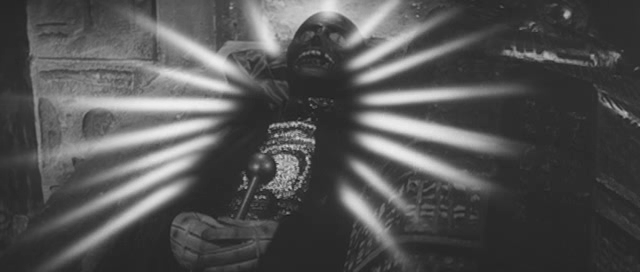
Nazo is Golden Bat’s arch enemy, here a man in a rat costume with four eyes and a large metal wrench for a hand. Travelling to find their fallen comrades, the gang discover Golden Bat in his sarcophagus hidden in what looks like an ancient temple with instructions to wake him up with a single drop of water should humanity be in crisis which he predicts will happen 10,000 years after he went into storage in Atlantis. Professor Pearl’s adorable 12-year-old granddaughter Emily (Emily Hatoyama) does just this and then becomes his point of contact, but in true tokusatsu fashion after simply gifting them the special lens and fighting off Nazo’s goons Golden Bat flies off into the sunset with important superhero business to attend to. Meanwhile, Captain Yamatone (Sonny Chiba) and the others attempt to save the Earth while battling Nazo’s three most dangerous henchmen: wolfman Jackal (Keiichi Kitagawa), fish woman Piranha (Keiko Kuni), and Keloid (Yoichi Numata) who has a large skin lesion on his face which honestly seems in poor taste. 

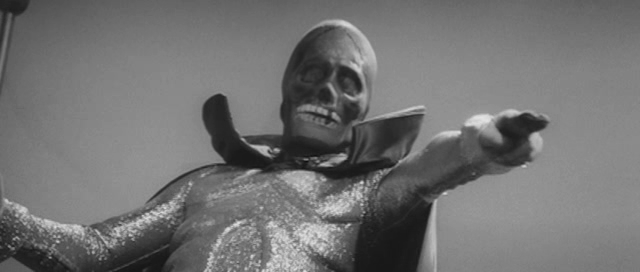
As in his other films, Sato appears to have his tongue very much in his cheek given that the performances of his cast are decidedly broad with a tendency towards evil glares and reaction shots, his camera often zooming in directly on villainy. Golden Bat meanwhile is often seen striking theatrical poses while uttering phrases such as “for justice alone do I fight!” and hitting people with his baton to make them behave. You might think children would find a skeleton man with an eyeless gold skull a little frightening, but Golden Bat seems to make it work while offering his own non-evil laugh as he cheerfully returns to save the day until finally forced to tap the sign he’s helpfully put up reading “those who attempt to subjugate the world through force by their own force shall perish”. Nazo meanwhile has a definite nautical theme, travelling by shark submarine/aeroplane and giant squid-shaped earth borer with laser eyes but is finally undone in surprisingly violent fashion by Golden Bat’s Baton of Justice. Defiantly irreverent and flying in the face of tokusatsu’s general responsible science stance, Golden Bat is exceptionally silly and makes little literal sense but is undeniably fantastic fun as the skeletal superhero does his best to ward off galactic imperialism. 


Original trailer (no subtitles)
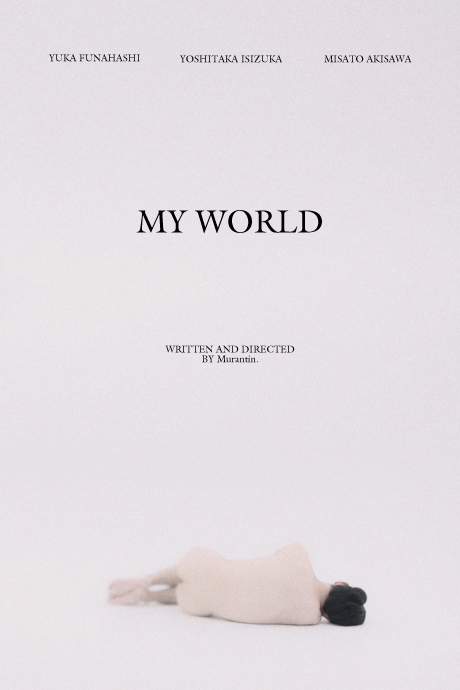
My World (Murantin, 2021)

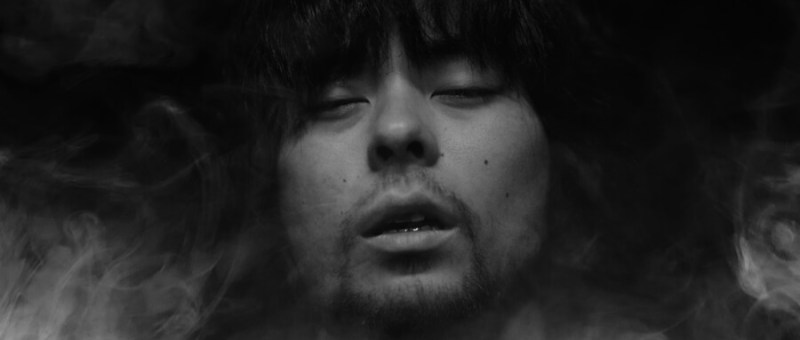
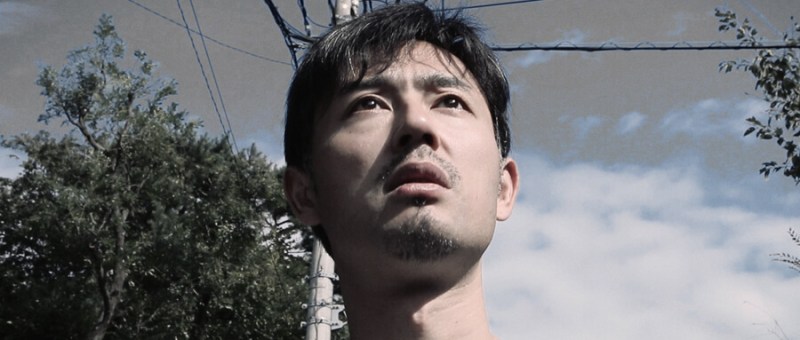
Perhaps we’ve all had that lonely feeling recently, walking around eerily empty streets as if somehow the world had ended while we were asleep and now we’re all alone, but the hero of theatre actor Murantin’s feature debut My World is about to discover that he really is (almost) the last of his kind as he struggles to reconstruct his history, identity, and sense of self while encountering only two other women one young and one more his own age but each with strange and unclear motives. 

A man wakes up naked in a park, almost rebirthed in a sense, and rises in confusion. Finding a grey tracksuit abandoned a little way away he wanders through a town he doesn’t recognise where all the stores are closed and there are no people nor any traffic on the streets. With no sign of life to be found he’s drawn towards a library but finds little in terms of illumination before leaving and noticing a second Earth hanging in the sky where the moon ought to be. Returning to the park he sleeps, but is woken in the morning by an apparently concerned high school girl who later offers him a place in her home where she is currently living alone as her siblings are away and her parents abroad. A kind gesture, but perhaps not very sensible given her circumstances. In any case, she tells the man not to go out, buying him some nicer clothes and cooking dinner every night.

With no memories of his own, the man remains confused. The high school girl appears to be living normally. She leaves every day to attend class which suggests there are other people around though he never sees any and the strangely old-fashioned TV in the living room only displays static. One day she informs him her boyfriend wants to come over so he’ll have to make himself scarce, later escorting him to the basement where she handcuffs him to a water pipe. Why would a regular high school girl own a pair of sparkly handcuffs with fairytale-esque little blue keys? Why is he not supposed to look into any of the other bedrooms? What secrets is this world hiding from him? The plot begins to thicken when he decides to break the rule and follow the high school girl to see where she goes, only to find himself at the library again where he encounters a middle-aged woman in what appears to be her negligee. 

The man is in a sense imprisoned within the house, the handcuffs a literal extension of his mental constraint in a world which may be of his own making in wilful self-exile from a traumatic past. His strange dreams hint at another life, possibly on the other Earth, in which there are flashes of potential violence. Before long he begins encountering other versions of himself, fracturing under the weight of his internal confusion when directly confronted. The high school girl tells him he’s creating too much “disorder” and the only way to repair it is to go back to his own world, but the man doesn’t want to. Describing it as painful, he insists there’s no need to return if he can stay with the high school girl but in the end he will have to face himself and the traumatic past from which he seems to be in mental flight. 

Dreamlike in its uncanniness, Murantin’s camera chases a man on the run from himself as he walks through a world already dead, a still place with no past or future. He does not know himself, and no one else does either or at least that’s what they claim. The world is quite literally his, a place which he has unwittingly created in refuge from his trauma but he is no god only a man imprisoning himself, a wilful exile from a world he couldn’t accept. A tale of guilt and loneliness, My World offers its hero a chance at redemption through facing his past, accepting his responsibility, and learning the truth about himself but nevertheless concludes that there may be only one path to freedom while atoning for his transgressions in a world suddenly more alive and once more in motion. 


My World streamed as part of Yubari International Fantastic Film Festival 2021.

Trailer (English subtitles)

Apart from Life (地の群れ, Kei Kumai, 1970)

By 1970, Japan had more or less cemented its economic miracle and in terms of cinema at least memories of the war were beginning to recede with the young keen to address other concerns such as dissatisfaction with increasing consumerism or resistance towards American foreign policy in Asia. Unjustly neglected by international scholars, Kei Kumai by contrast refused to turn away from issues others might have found taboo or at least unpleasant enough to avoid mentioning. Like A Chain of Islands, Apart of From Life (地の群れ, Chi no Mure) has an overt anti-American sentiment but in essence criticises a society in which people are dying of guilt and shame though essentially blameless while those marginalised continue to oppress each other and fight amongst themselves rather than unite to resist their marginalisation. 

Based on a novel by Mitsuharu Inoue, the film opens with a brief prologue set in 1941 before jumping forward to the mid-1960s in the naval port town of Sasebo, the naval facilities now operated by American forces. An ensemble drama, the tale revolves around a drunken doctor, Unan (Mizuho Suzuki), though this one is far from an angel merely another wounded and compromised soul of the post-war era wracked by guilt over his various moral failures which began with the incident in the prologue in which he attempted to weasel out of his responsibility after getting an ethnically Korean girl pregnant as a young teenager working in a coal mine. He is the first of many to insist “I know nothing” that he’s “responsible for nothing” firstly denying the child is his then trying to smooth it over with money before coldly telling the woman’s sister to take her to a hospital in nearby Sasebo where no one will know them in order to get an abortion and avoid the social stigma of unwed pregnancy. The sister can only look at him with contempt. Later he discovers that the young woman lost her life while trying to provoke a miscarriage. 

Hako died, in a sense, out of shame. Many of Unan’s patients face the possibility of something similar. One woman comes to him about her teenage daughter, Yoshiko, who is bleeding continuously as if constantly menstruating. Unan asks the mother if she was in Nagasaki at the time of the atomic bombing as the symptoms are similar to the effects of the radiation poisoning he observed while working as a doctor in the city. She continues to deny it, but flashbacks to conversations with her now absent husband and daughter suggest she may not be telling the truth at least in its entirety even though her daughter’s life is at stake. She doesn’t want to be associated with “those Kaito Shinden people”, referring to the industrial slumland where many refugees from Nagasaki have settled which is treated as a kind of plague town by the rest of the local area. If her daughter survives but is unmasked as a second generation A-bomb victim her mother fears she will never be able to marry and that she will have “no future”. 

Yet they are not the only ones facing marginalisation. A young woman, Tokuko, comes to Unan’s office wanting a certificate that proves she has been raped, but Unan doesn’t help her firstly for the understandable reason that she is, understandably, unable to explain the exact circumstances to him, and secondly because he just isn’t very invested in her wellbeing bizarrely suggesting she come back with a relative or the person responsible. As she later explains, the rapist threatened to expose the fact that her family are burakumin in order to keep her quiet while she clearly remembers that he wore a glove on his left hand which she believes probably hides a distinctive keloid skin lesion marking him as an A-bomb victim and probable resident of Kaito Shinden. Tokuko’s father had also been a victim of workplace discrimination presumably because of his burakumin heritage, his wife told that he had stabbed himself while confronting the workers who were harassing him advised to keep quiet rather than attract the attention of the authorities. Tokuko is originally shamed into silence not by her violation but by her marginalisation, later deciding to track down her assailant by herself after someone else reports the crime to the police who arrest a local Kaito Shinden troublemaker and attempt to frame him for the crime. 

The confrontation however leads to a small war between the Kaito Shinden A-bomb survivors and the burakumin community which results in the death of a burakimin woman after they tactlessly insist that Kaito Shinden is a buraku below the buraku and that their blood is “rotten” and will be for generations. Discussing the case, some had even suggested that the rape was itself a result of prejudice towards the A-bomb survivors seeing as they are unable to find wives. Yet Tokuko’s mother had asked if being burakumin means it’s OK to rape her daughter, in much the same way Hako’s sister might have asked if being ethnically Korean made it OK for Unan to so casually discard her. Explaining that the locals regard Kaito Shinden as a “sick village” Yoshiko’s mother says she doesn’t think the people there are any different from anyone else despite her determination not to be associated with the A-bomb “disease”. “If Kaito Shinden is sick, the whole of Japan is sick!” Unan fires back revealing that he himself was also in Nagasaki shortly after the bomb dropped, apparently objecting to these baseless prejudices but seemingly unwilling to cure them even while his patients quite literally die of shame. 

In his own case, however, it’s not prejudice or wartime trauma that have led to Unan’s alcoholism but his many moral failures and their resulting guilt. His wife (Noriko Matsumoto) wants to divorce him, partly because of the drinking, but also because of his longstanding guilt over the death of a friend who retreated to the mountains with the communists during the Red Purge of the early 1950s of whom he is also jealous in that he was previously his wife’s lover and he can’t get over wondering if he’d lived his wife would have chosen him. Guilt over Hako, perhaps mixed with the fears of his radiation exposure, have also led him to emotionally blackmail his wife into several abortions as if he thinks it improper to father a child. 

Meanwhile, we seem to see pregnant women everywhere. Nobuo (Mugihito), orphaned by the A-bomb, sees a pair of them walking ahead of a gaggle of nuns which he later decides to freak out by creepily staring at them before lunging wildly like a dog among geese. The film’s conclusion finds him on the run from a gang of burakumin boys looking for revenge, running far out of the slums into the suburbs and through one of those nice new danchi housing complexes where a row of pregnant housewives sits silently knitting, something almost creepy in the vacant way they smile at him as he runs past before tripping over a child’s toy car. Boys like Nobuo are it seems cast out from the newly consumerist society of the economic miracle while just about everyone is in some way marginalised and in some cases several times over: rape victim, burakumin, A-bomb survivor, troublemaker, orphan, divorcee, communist, Christian. Nobuo wonders why God chose Nagasaki for an A-bomb when it’s where all the Christians live while the head of a Virgin Mary statue is repeatedly smashed as if to imply there’s no more mercy to be found here. 

Kumai regularly cuts back to a disturbing visual motif of a cage filled with rats who kill a live chicken and fight over the scraps of rotting meat until ignited by a gust of fire, the survivors scrabbling over each other blindly looking for an exit. Meanwhile, US jet planes fly constantly overhead and all Unan can think to do is throw a rock at a flag flying on the base. “She was killed by everybody” Tokuko exclaims of the burakumin woman, suddenly seeing the webs of prejudice, oppression, and selfishness which created the circumstances which led to her death by stoning. Shot in a crisp black and white and academy ratio, Kumai’s steely drama lets no one off the hook implying that all of Japan is indeed “sick” wilfully leaving these marginalised people to fight amongst themselves for the scraps of a newly prosperous society. 


DVD release trailer (no subtitles)

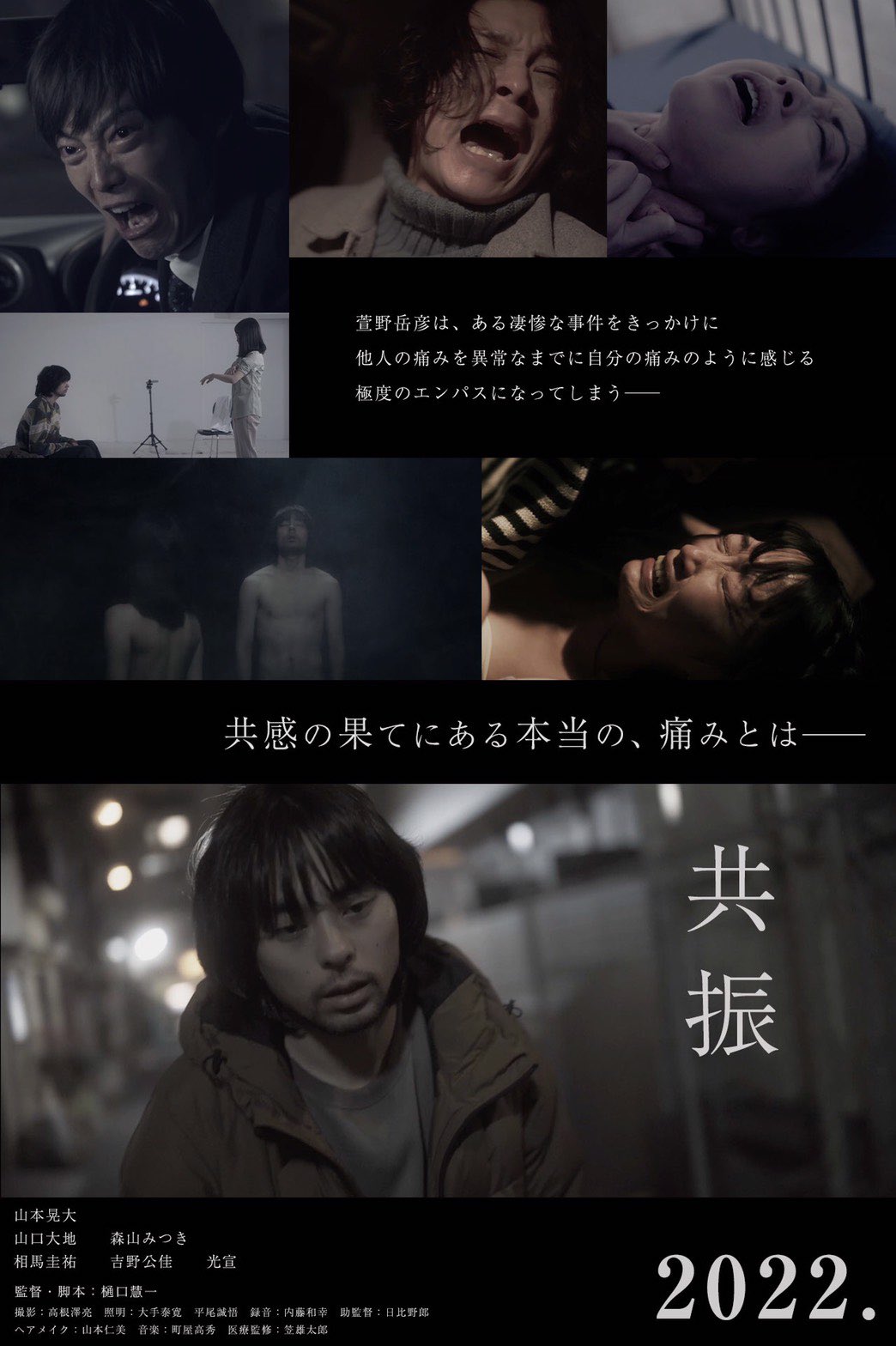
Kyoshin (共振, Keiichi Higuchi, 2021)

In modern society we often criticise others, but not always ourselves, for a perceived lack of empathy but what would it be like to truly empathise with everyone, all of the time, with no control over our own feelings? The hero of Keiichi Higuchi’s psychological drama Kyoshin (共振) finds himself with just this problem after a traumatic incident leaves him with both intense PTSD and the unwelcome side effect of being forced to feel the pain of others as his own. 

26-year-old Takehiko (Akihiro Yamamoto) thought of himself as perhaps a little over sensitive, feeling obvious discomfort sat opposite two salarymen arguing loudly in a crowded restaurant while also somewhat disconnected from his partner in a moment of supposed intimacy. It’s one evening on the beach, however, when everything goes into overdrive. Spotting two guys manhandling a screaming woman into a van he and his friend Gin (Keisuke Sohma) intervene but aren’t much of a match for two the young thugs and find themselves tied up and stunned in the back while the woman is forced to provide oral sex to the driver. Taking advantage of a momentary lapse from the other man who was busy interrogating Gin and Takehiko, the woman takes drastic action of her own in a bid to escape. Gin tries to help her, but seeing what’s befallen the driver Takehiko is plunged into fugue state able to do nothing other than scream in pain as if it were he that had suffered the catastrophic injury. 

A year on, Takehiko is a broken shell of a man unable to venture outside owing to the intense assault of other people’s pain. Ignoring calls from Gin, he’s cared for by his older brother Yuya (Daichi Yamaguchi) who ferries him to various doctor’s appointments, jeopardising his own employment in the process. Sick of medical professionals unwilling to admit they don’t know how to help him and obsessed with the curse of 27, Takehiko decides he’ll take his own life if there’s no improvement in his condition by his next birthday but then discovers potential salvation in an experimental programme run by a lesbian couple in which he will receive treatment from a woman who once experienced something very similar to himself but claims to have learned to live with it. 

The irony is that Takehiko’s condition is caused by extreme empathy in that he cannot avoid feeling other people’s physical pain as his own, yet he continues to treat those around him badly blind to the emotional toll caring for him is taking on them. His brother, feeling a parental responsibility as their parents passed away young, drops everything to help him but his boorish boss, ironically, has a fundamental lack of empathy. Annoyed that Yuya takes so much time off, he openly mocks him making the rather irrelevant point that Takehiko is 26 not six and therefore shouldn’t need so much care virtually accusing him of mollycoddling as if the problem were Yuya’s anxiety rather than his brother’s precarious mental health. 

Yet the experimental programme Takehiko finds himself involved with raises its own collection of ethical questions as the psychiatrist pushes him into a series of erotic situations arguing that if he learns to empathise across the emotional spectrum to experience other people’s pleasure as well as their pain he’ll be able to turn it off much more easily or at least flatten it out. She implies that similar therapies are what has enabled her to live a relatively normal life, but fails to disclose that she is also carrying a similar trauma which the treatment ironically recalls while largely failing to deal with the obvious possibility of transference in the potentially inappropriate lack of boundaries between patient and doctor. 

It might not be appropriate to ask how much empathy is too much empathy, but Takehiko’s path to recovery ironically enough lies only in secondary shock and a brush with death that allows him to reconnect with his friend Gin, suffering alone in their shared trauma, while empathising emotionally with his brother’s obvious care for him. It isn’t so much that Takehiko needs to disengage with those around him, but learn how to process effectively so that he can better help and understand rather solipsistically internalising external suffering. Shot with a sense of uneasy eeriness and a sci-fi twist in the manifestation of Takehiko’s descent into an oppressive empathy bubble, Higuchi’s provocative drama advocates for caring a little more about the pain of others but not so much that it stops you seeing where it hurts. 


Kyoshin streamed as part of Yubari International Fantastic Film Festival 2021.

Original trailer (no subtitles)
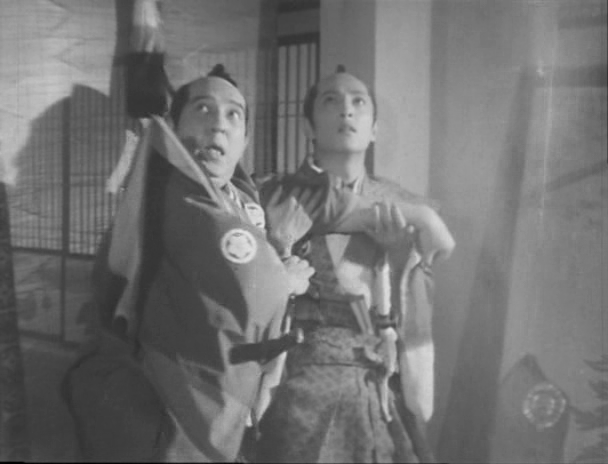
The Ceiling at Utsunomiya (怪異宇都宮釣天井, Nobuo Nakagawa, 1956)

Crime does not pay for a series of conspirators at the centre of Nobuo Nakagawa’s supernaturally-inflected historical tale, The Ceiling at Utsunomiya (怪異宇都宮釣天井, Kaii Utsunomiya Tsuritenjo). As the title implies, Nakagawa’s ominous jidaigeki is inspired by a historical legend in which a retainer supposedly attempted to assassinate the shogun through the rather elaborate device of a mechanical ceiling designed to crush him as he slept. In actuality no such thing took place, the shogun changed his route and subsequent investigations of Utsunomiya Castle found no sign of a false ceiling, yet the story took on a life of its own as local folklore. 

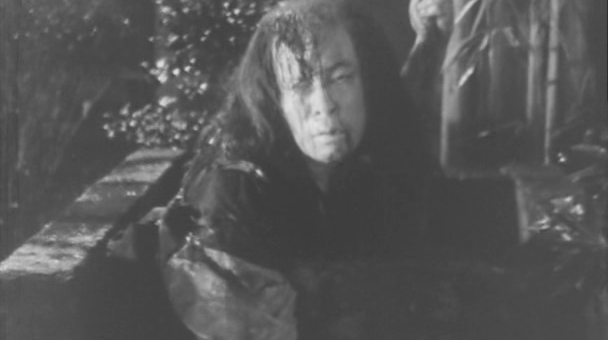
In this version of the tale, conspirators Councillor Kawamura (Ureo Egawa) and local yakuza Kagiya (Masao Mishima) are conspiring to depose Tokugawa Iemitsu (Yoichi Numata) in favour of his brother, manipulating Lord Honda (Shuntaro Emi) of Utsunomiya Castle by convincing him that his clan will prosper when the other retainers fall in behind the new shogun. The pair have arranged for nine talented craftsmen to be shut up in the castle to install “the mechanism” in time for the arrival of the shogun who is due to stay at the castle on his way to Nikko. Meanwhile, Kawamura is also intent on sleeping with the daughter of head carpenter Toemon (Yoji Misaki), Ofuji (Konomi Fuji), whom chief minion Tenzen (Tetsuro Tamba) is supposed to kidnap once the workmen have gone into isolation in the castle. Righteous samurai Ryutaro (Hiroshi Ogasawara) however, an undercover shogunate bodyguard, begins to disrupt their plan saving Ofuji while bonding with a friendly bar hostess, Onobu (Sachiko Toyama), and secret princess forest woman Oshino (Akemi Tsukushi). 

The plot represents in itself a malfunctioning of the feudal order in the essential weakness of Lord Honda, the ambition of his underling Kawamura, and the cruel greed of Kagiya. As the two men conspire, Kagiya jokingly laments that he isn’t a samurai while Kawamura reminds him that if the plan comes off he’ll be fantastically rich. Kagiya, a yakuza who sends his thugs to extort protection money from the local market, is representation of the threat of the rising merchant class whose financial power presents a challenge to the authority of the samurai. Toemon, meanwhile, a master craftsman, is manipulated into participating in the plan because he is in debt to Kagiya, later promised that he too will be “promoted” in being given permission to carry a sword little knowing that Kawamura and Kagiya not only plan to kidnap and rape his daughter but never intend to allow any of the craftsmen to live because they simply know too much. 

The Ceiling at Utsunomiya is not a ghost story in the manner for which Nakagawa is best known but it certainly plays like one, Kagiya eventually haunted by the figure of a betrayed Toemon which in turn leads him to a self-destructive attack on Tenzen and his eventual demise collapsed over his ill-gotten gains, a koban falling from his hand. Greed and violence will only repay in the same, the weak-willed Lord getting his comeuppance from the ever confident shogun even if he himself coolly stands back while others risk their lives to protect him. Even so, the eventual operation of “the mechanism” is intensely startling, the ceiling abruptly collapsing with alarming ferocity though one wonders what the advantage is in such an expensive, elaborate contraption aside from its ironic symbolism when the point of a sword will do. 

Then again, the heroic Ryutaro is almost assassinated while crossing a river via zip wire later fished out of the river by sullen forest woman Oshino, first encountered hunting birds with darts but later revealed to be the illegitimate child of samurai parents who fell foul of political intrigue. In a sense this revelation emphasises the restoration of the political order, Ryutaro permitted to fall in love with Oshino because they are of the same social class, while the romance between Ofuji and craftsman Yoshichi (Kotaro Sugiyama) also comes to fruition eliding the minor class difference between them in allowing the boss’ protege to marry the now orphaned daughter. Onobu meanwhile pays heavy price for her misplaced love for Ryutaro, denied romantic fulfilment in her liminal existence as a bar hostess. In any case, the corruption is exorcised and the normal order resumes reinforcing the hierarchical shogunate society with each of the players back in their rightful positions and possessing new hope for the future as Ryutaro and the shogun continue their tour while their former comrades kneel at the roadside. 


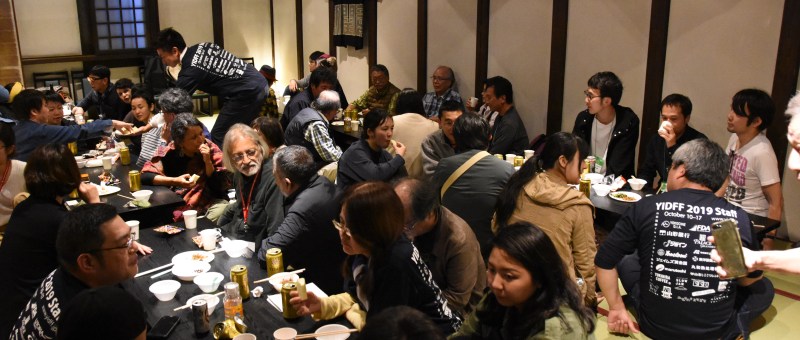
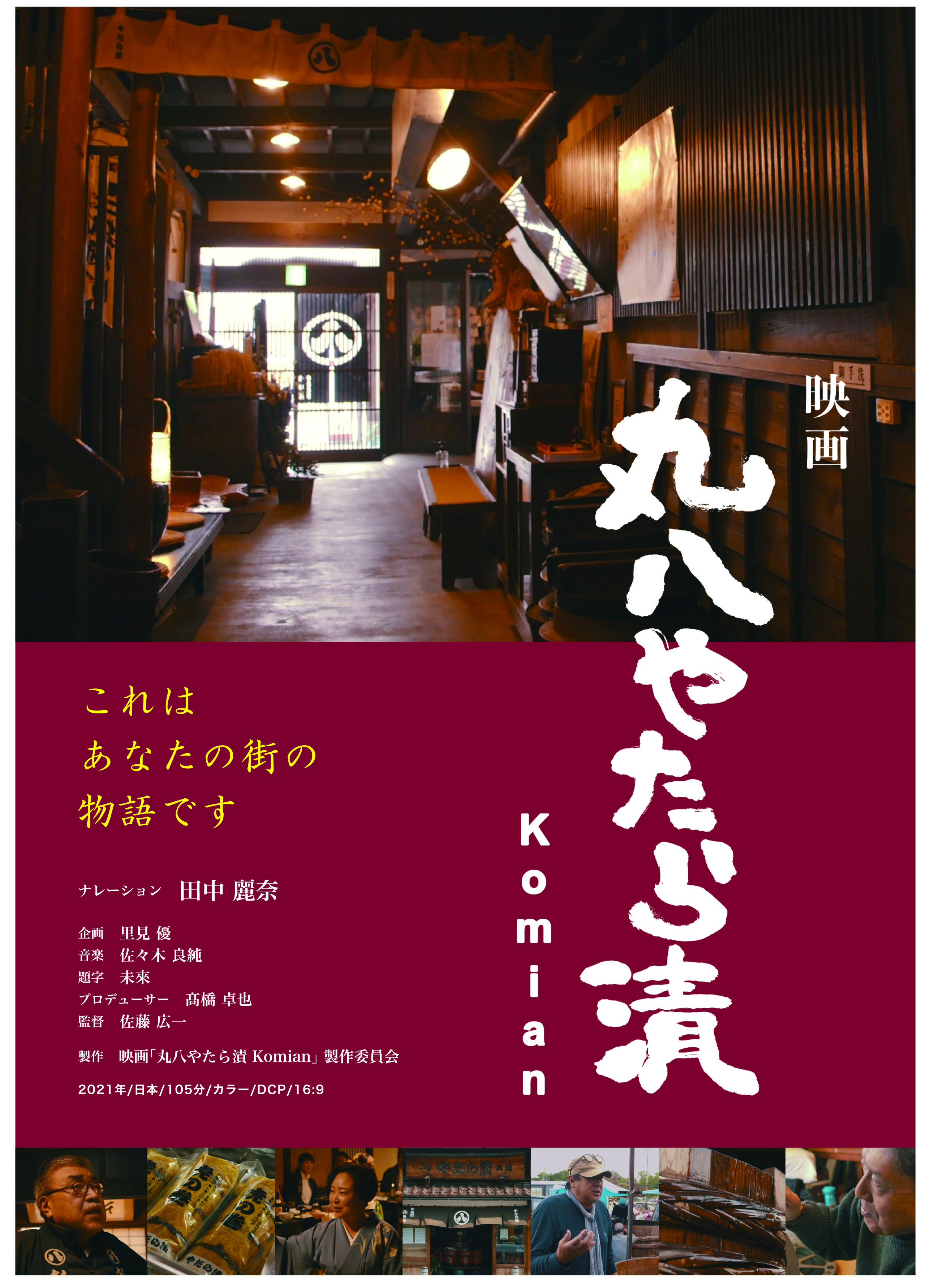
Pickles and Komian Club (丸八やたら漬け, Koichi Sato, 2021)

For years the Komian Club had been a familial haunt for visitors to the Yamagata International Documentary Film Festival becoming almost an artificial hub where filmmakers and spectators could meet on equal terms. However, the 135-year-old family-run pickle store was left with little choice other than to close given the decline in demand for pickles among younger consumers and the additional strains placed on their business by the conoravirus pandemic. 

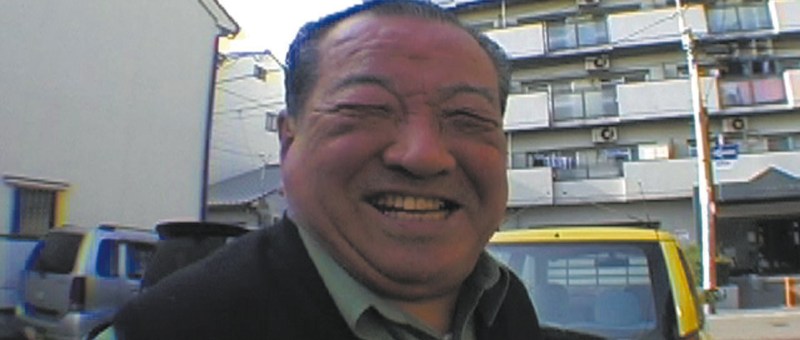
Pickles and Komian Club (丸八やたら漬け, Maruhachi yatarazuke Komian) is as much about the film festival and the wider Yamagata community as it about the building at its centre. The loss of the store leaves many feeling quite literally displaced, not only lacking a new place to gather and mourning the atmosphere of the traditional building, but reflecting on the absence of these kinds of structures in the urban environment which places value only in the land on which new structures more profitable to the modern economy may be built. We’re told that the pickle store had been approved as an intangible cultural asset because of its luxurious interior, but this does not apparently provide much protection under Japanese property laws. The store’s owner Yoshinori mentions the possibilities of someone buying his storehouse and moving it to a new location preserving all of its period features but is eventually forced to sell to developers who plan to knock it down to build build yet another generic apartment block. 

As he explains, in Japan property depreciates over time and the value that it has is essentially sentimental rather than financial. Few people are interested in preserving these traditional buildings along with their classical architectural styles because there is no real financial incentive to do so. The best that can be done is to salvage what one can that could be re-used or incorporated in another structure such as the heavy wooden beams and ornate friezes. Yoshinori sells one of his giant wooden pickling vats to an old friend who runs a traditional Japanese inn which is then repurposed as a bath. His friend worries what the decline of traditional culture might mean for his business, inns largely being the repository of the traditional in the modern society. But the repurposing of the vat which in essence turns something used for industry into something used for leisure is an example of one way to bring something of the past into the present finding new uses for old technology. 

While the pickle store could not be saved, other owners of similar properties have been able to breathe new life into old spaces, turning a small outside guesthouse into a cinema which the local community can enjoy or renting out part of the premises for local events taking full advantage of the calming atmosphere such traditional buildings can offer. Though as an architecture student later makes plain what’s needed is further action at the legislative level to ensure that older buildings are better protected and less likely to be torn down because of an economic imperative that has no interest in tangible history. Seeing the buildings stripped of their assets then roughly broken apart is a heartrending sight as is the giant empty space they leave behind robbing the area of its unique atmosphere in favour of the generically urban. 

One interviewee makes the point that in choosing to focus on documentary film the festival in a sense made an investment in its future by choosing the unique over the flashy, building a friendly atmosphere of openness and equality rather than the red carpets and VIP areas which can often define some other events. In a sense it’s this loss of traditional spaces which damages the fabric of the community in further distancing one person from another while robbing it of the architectural history that gives it its sense of place.  Even so the presence of the festival providing a place in which filmmakers and film lovers from all over the world can gather is a potent symbol of alternative community bolstering the local, while the young are also busying themselves finding new ways to incorporate the traditional into their modern lives or breathing life back into that which had been thought old-fashioned but might now be reappreciated for its quality of serenity in an ever changing society.


Pickles and Komian Club Storytellers streams worldwide (excl. Japan) via DAFilms until Feb. 6 as part of Made in Japan, Yamagata 1989 – 2021 (films stream free until Jan. 24)

Trailer (no subtitles)

Storytellers (うたうひと, Ryusuke Hamaguchi & Ko Sakai, 2013)

Many tend to forget the folktales and fables they were told when young or at least until they themselves have a child yet it’s often through mystical stories that we first begin to learn about the world and our place within it. Third in a series of documentaries by Ryusuke Hamaguchi & Ko Sakai focussing on the Tohoku region in the wake of the 2011 earthquake and tsunami, Storytellers (Utauhito) follows folklore scholar Kazuko Ono of Miyagi Minwa no Kai as she travels the local area visiting friends in order to hear the various stories they remember from their youth. 

Yet as she explains during a trademark Hamaguchi backseat monologue in a car he and co-director Sakai are driving, folktales may have different meanings and interpretations to different people and in different eras in their own particular context. As an example she cites the tale we’ve just heard recited by an elderly woman titled The Monkey’s Bride in which a farmer with three daughters unwisely promises a wife to a monkey who agrees to help him with his rice paddy. The first two daughters refuse, but the third agrees because her father made a promise only to trick the monkey, who has been nothing but kind to her, into drowning himself in a lake. As a child, Kazuko like many disliked the story feeling sorry for the monkey who had acted only with humanity and does not seem to warrant being killed in such an unkind fashion. But then she began to reconsider how her grandmother from whom she first heard it may have read the tale as a woman married off at 16 who constantly tried to run away and only wanted to escape cruel treatment at the home of her in-laws. To her the daughter in the story was brave, doing that which she could not in freeing herself from a forced marriage after being sold to pay her father’s debt. Looking deeper again she began to wonder if the monkey wasn’t also a metaphor for the rich landowners who oppressed peasant famers with only poor quality paddies who were often forced to sell off their daughters in return for financial assistance. 

Other stories meanwhile speak of the ingenuity of the poor, a little girl rewarded after responding to an ad promising vast riches for anyone who manages to bore the story-loving lord, she managing it quickly by making him repeat a lengthy nonsense phrase at regular intervals. A story apparently meant to encourage young couples to find “clever” ways of sorting out marital disputes similarly finds a husband returning from the city selling his wife’s lover whom she hastily shut in a water jar, getting one over on him and her, getting his hands on 10 ryo, and even getting the jar back too. Such stories tell us something about the world in which they took place, female adultery in this case not so much of problem able to be solved with some comedic shenanigans rather than the point of a sword, while we might equally find it an absurd way to deal with marital infidelity. Then again there are also a series of thematically similar stories cautioning against marginalised members of society who create problems in order to gain fame and fortune through solving them such as two bizarre tales of magical instruments which cause people’s bottoms to sing an absurd and annoying song which only the holder of the object can stop allowing them to leverage their new talents for unearned wealth and status. 

Even so it isn’t perhaps the tales that matter so much as their transmission, many of the elderly storytellers recalling memories of their grandmothers from whom they first heard how the shrimp got its curved back or of eagles who tried to fly to the edge of the ocean. Each of the storytelling sessions begins in ritualised fashion, Kazuko and the other party introducing themselves to each other though they have all been friends for years or sometimes decades and already know each other well. As in the story of the girl and the lord, we’re reminded that tales like these expect call and response, an exchange between the storyteller and the listener that transcends the story itself. A now elderly man recounts that he’d forgotten most of the tales his eccentric grandmother had told him before joining the folktale group in his 40s, but also advances that the stories she gave him were intended to foster a sense of wonder in the world along with a confidence and security that would allow him move freely through the darkness. A lesson in oral history in which these ancient tales are shared and retold before reaching new generations is perhaps a sign of hope that something has and will survive in the simple act of speaking and listening even as Kazuko explains that in order to hear the story she must also change herself so she too may keep moving forward . 


Storytellers streams worldwide (excl. Japan) via DAFilms until Feb. 6 as part of Made in Japan, Yamagata 1989 – 2021 (films stream free until Jan. 24)

Dear Pyongyang (Yang Yong-hi, 2006)

“Whether she accepts my ideas or not, I’m glad because she’s all grown up” the father of documentarian Yang Yong-hi insists implying perhaps that he has more respect for his daughter’s questioning nature than she had assumed he might. Deeply personal, Dear Pyongyang is Yang attempting to parse the disconnect between her loving parents’ lifelong faith in the Great Leader and her own upbringing in a much more open society which has encouraged her that she should be free to live her own life and make her own decisions rather than as her father would have it devote herself to a “fatherland” which remains unfamiliar to her. 

As the opening titles explain, Korea was annexed by Japan in 1910 and fell under colonial rule until its independence was returned with the collapse of the Japanese empire at the end of the war only to be partitioned in 1948. During the colonial era, many Koreans had settled in Japan, divisions also emerging between them as those who supported the North chose to take North Korean nationality even if in reality from the south. Yang’s father was one such person, having grown up around ardent Marxists on Jeju Island. A member of pro-North organisation Chongryon, he devoted his life to activism campaigning for the rights of other Zainichi Koreans while proselytising for Kim Il-Sung thought. He even sent his three sons “back” to North Korea as part of a repatriation program in 1971 incorrectly believing that the North’s economy was improving, the nation would soon be reunified, and relations with Japan would become normalised. Had he known it would mean an almost permanent separation, he may have made a different choice. 

Six years old at the time and kept behind as the only daughter, Yang attended North Korean schools and was in a sense indoctrinated with North Korean propaganda yet she was also coming of age in Japan where she was free to listen to the Beatles and watch movies while it gradually became obvious to her that the place her brothers had been sent to was far from the paradise they’d been promised. She herself was able to meet with them in 1983 as part of a school trip but even then she was only permitted to see them for short periods of time agreed with North Korean authorities. Permitted to travel back and forth with some regularity she finds herself noting more each time how the images in her mind don’t line up, fixing her gaze on a incomplete tower construction long since abandoned as an ironic symbol of the North’s false prosperity. 

In actuality Yang cannot show much of this in her film for obvious reasons and in the time she spends with her brothers and their families, their lives seem comfortable enough save the odd power cut. Her young nephew has even benefitted from the CDs she used to send his father and is an accomplished piano player. Nevertheless, her mother Yon has been sending heat packs en masse to each of the brothers as well as other friends and relatives after receiving a letter telling her that one of the grandchildren had been suffering frostbite because of the extreme cold. Yon had always sent care packages to her children, so shocked on receiving the first photo of them from the North and noticing how much weight they’d lost that she tore it up rather than let their father see it, but boxes have increased significantly in size as the families grew and she became more aware of the reality of the situation in Pyongyang. Still she and her husband remain loyal to the Great Leader, unable to discern the level of cognitive dissonance in the evidence of their eyes and their faith in North Korean communism. 

It’s the disconnect that Yang can’t understand or forgive, finding it particularly galling that her parents have been supporting whole communities with their care packages but everyone attributes the largesse to the goodness of the Great Leader even though the packages wouldn’t be necessary if the system itself had not failed. Her ideological opposition to her father manifests itself in her desire to change her nationality though opting not for a Japanese passport but a South Korean one that would allow her to travel more easily if also ironically preventing her from visiting her brothers and extended family in the North. Finally he seems to relent, admitting that the “circumstances have changed” and he wants her to have more opportunities in her working life. In any case, even if she lived in the South she would be free to visit him in Japan in a way his sons are not, his exclusion of her from his instructions that his sons and grandchildren should devote their lives to the “fatherland” perhaps a tacit acknowledgement that she need not follow his path but should seek her own. Then again perhaps it’s also an acceptance that his life’s work has not turned out as he’d hoped and has in fact robbed him of the company of his children through literal and ideological divide. Even so this moment of compromise allows Yang to begin to bridge a division she thought unbreachable, able for the first time to see her father as just that, longing to hear his thoughts and have him listen to hers only to be immediately robbed of the opportunity. At times raw and filled with a sense of melancholy regret, Yang’s incredibly personal documentary is partly a treatise on the destructive effects of cognitive dissonance and blind faith, but also on the freedom to be found in mutual acceptance. 


Dear Pyongyang streams worldwide (excl. Japan) via DAFilms until Feb. 6 as part of Made in Japan, Yamagata 1989 – 2021 (films stream free until Jan. 24)

US Trailer (Japanese & Korean with English subtitles)

The Cheese & The Worms (チーズとうじ虫, Haruyo Kato, 2005)

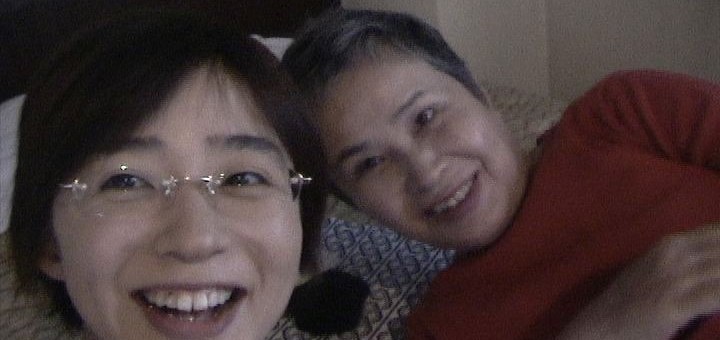
A series of quotidian observations of an ordinary life, Haruyo Kato’s moving personal documentary The Cheese & The Worms (チーズとうじ虫, Cheese to Ujimushi) sees the director returning to her hometown in order to spend time with her mother, Naomi, who is suffering with a terminal illness, and her elderly grandmother. Yet hers is not so much an exploration of sickness or old age as what it means to live in the shadow of death through the tiny moments of the everyday which ultimately construct a life as her mother tries to find joy in ordinariness and the director an acceptance of the abruptness with which a life can end. 

Kato structures her tale as a series of vignettes each preceded by a title card featuring two words joined by an ampersand until such time as her mother passes away at which a single word remains only later joined by others. She begins and ends with the sky, but otherwise captures the small moments of everyday life that might otherwise be forgotten such as her mother cooking, attempting to grow vegetables in the field behind her home or appreciating the cosmos flowers blooming near by. Poignantly they decide to plant more the following year though uncertain if Naomi will see them bloom. 

Meanwhile, Naomi uses her remaining time perfecting old hobbies such as learning to play the shamisen or painting in preparation for an exhibition alongside others from the retired teachers association. She spends time with her two young grandchildren and witnesses the birth of a third, the family coming together to celebrate grandma’s birthday. They do not talk very much about death save discussing Kato’s childhood trauma having lost her father young contributing to her sense of despair regarding her mother’s illness and declining health. We see her undergo various hospital treatments and gradually become weaker though trying to live as normal a life as possible. 

Kato asks her grandmother if she fears death but is told that once you reach a certain age it no longer frightens you, she hoping only that it be peaceful and as painless as possible for herself and those left behind. One of Naomi’s regrets had also been that in dying first she would be abandoning her elderly mother while grandma too struggles to accept the loss. Poignant pillow shots capture the anxieties of ageing in her scattered mobility aids and the false teeth sitting in a glass, or otherwise find her too trying her best to live while reflecting that Naomi at least got to see her four grandchildren and lived a full and happy life. On her death she had said she wanted to become dust of the cosmos, while grandma after thinking for a moment answered that she’d like to be the earth which is perhaps a touching metaphor for a life of a mother and a daughter. 

Yet the reality of Naomi’s death is echoed in its absences. Kato flipping through an old day planner as the number of appointments gradually declines before all of a sudden the pages are blank save for the boxes where her mother had penned in the days of the week, the book thereafter one of constant emptiness that reminds her of all the life left unlived in the terrible abruptness of its ending. She and her siblings later attend a sumo match in her mother’s place, reflecting that the camera flashes are like twinkling stars and wishing she could have come with them to see it. 

Kato and her grandmother rewatch the home videos she had shot of her mother, reflecting on lost moments and their own memories as they each try to find acceptance and accommodation with loss. At her funeral, Naomi’s youngest grandson had attempted to crawl over her body, too young to understand the meaning of death and bursting into tears at the adults’ reaction, a confused mixture of horror and bemusement as they gently lift him away. It’s in these small, forgettable moments that Kato eventually finds meaning in life a sense of everyday happiness now unburdened by fear or anxiety and existing only as fragmentary memories of warmth and humour and given in a sense a second life in their constant replay through the art of Kato’s gentle filmmaking. 


The Cheese & The Worms streams worldwide (excl. Japan) via DAFilms until Feb. 6 as part of Made in Japan, Yamagata 1989 – 2021 (films stream free until Jan. 24)

A2 (Tatsuya Mori, 2001)

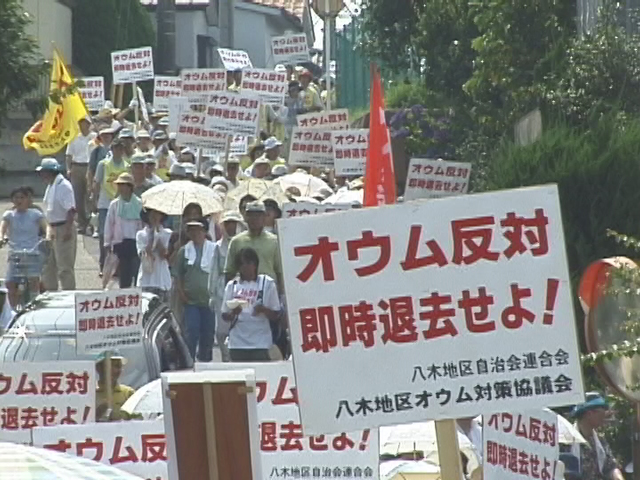
“Japanese society is definitely worse than it was five years ago” according to director Tatsuya Mori, returning to the subject of Aum Shinrikyo following his 1998 documentary A, “It is definitely warped.” In A2, he wonders if the legacy of the 1995 sarin gas attack on the Tokyo subway has affected society in unexpected ways as its rage and fear is channeled in the wrong direction in its pathological hatred of the new religion sect without attempting to understand why the attack happened or why people continue to follow the cult’s teachings given its violent history. 

Five years on, Aum has rebranded as Aleph and distanced itself from the teachings of Shoko Asahara but is still holding out on coming up with a plan for compensating victims and their families while some members directly involved in the attack remain on the run (the final fugitive was apprehended only in 2012). The government has decreed that those who had no connection to the incident should be allowed their constitutionally guaranteed rights to practice their religion, but as Mori follows them the current members face constant harassment in the local communities in which they attempt to settle. As someone later puts it, there is no real solution, once Aum is rejected they have no option but to move on to another town where the same thing will happen again with no real progress made. 

Even so, in one particular community the locals become almost friendly to the Aum members they are also keeping under close and intensive surveillance. Though instructed not to interact with them, some residents explain that they personally would prefer to be on friendly terms, others jokingly even offering them food or alcohol over the fence and almost sorry to see them leave when their rental contract finally expires. Through their admittedly hostile interactions, they’ve come to accept the members of Aum as distinct from their association with the sarin gas attack and no longer harbour the same sense of fear they once held for the unknown quantity of the new religion organisation. 

On the other hand, the fear and anxiety which has become linked with Aum has been hijacked by right-wing nationalist groups seeking to manipulate it for their own gain as they step into the vacuum created by a lack of action with their own ideas for potential solutions to the Aum problem. Their solutions are not as extreme as one might assume, but advocate for Aum’s forced disbandment with no practical plans for how that might happen. As Aum members admit, as a new religion organisation they often attract those who are vulnerable and looking for solutions to their own mental anguish. Faced with the intense harassment they face in smaller communities, these members are often pushed towards taking their own lives while the press has sometimes also attempted to manipulate their image for personal gain one man claiming he was essentially abducted and taken to hospital on the grounds he seemed malnourished but was prevented from leaving after getting the OK from a doctor as the police had already issued a statement about him which the press had printed without verifying. 

The current Aum members frequently complain that they have been misrepresented by the press while Mori himself is on one occasion accused of being an Aum sympathiser when challenging potential inaccuracies or asking if those participating in anti-Aum activity might be better off trying to understand them instead. This seems to be the direction in which some of the protests have drifted, local societies putting up signs to encourage thse who might want to leave the organisation to reassure them that they will be reaccepted by mainstream society, that their friends and relatives with whom they have severed ties are waiting for their return. The members, however, are often so disconnected from “worldly” matters that they may not know what mainstream society is, Mori’s brief questioning of an official revealing that she is unable to recognise the names of even the biggest contemporary pop stars. “Ultimately harmony can’t be achieved, can it?” Mori asks somewhat rhetorically, worrying that the psychological strain placed on the followers not only in the austerity of their religion but their treatment by wider society cannot but lead to further damage while opinions on either side are unlikely to soften. 


A2 streams worldwide (excl. Japan) via DAFilms until Feb. 6 as part of Made in Japan, Yamagata 1989 – 2021 (films stream free until Jan. 24)

Original trailer (no subtitles)