Samurai Fury (室町無頼, Yu Irie, 2025)

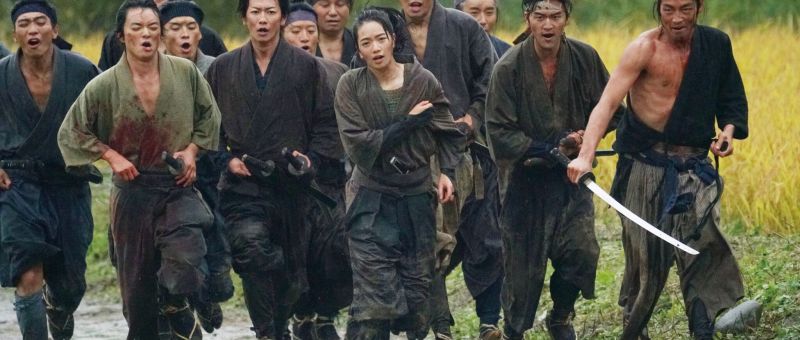
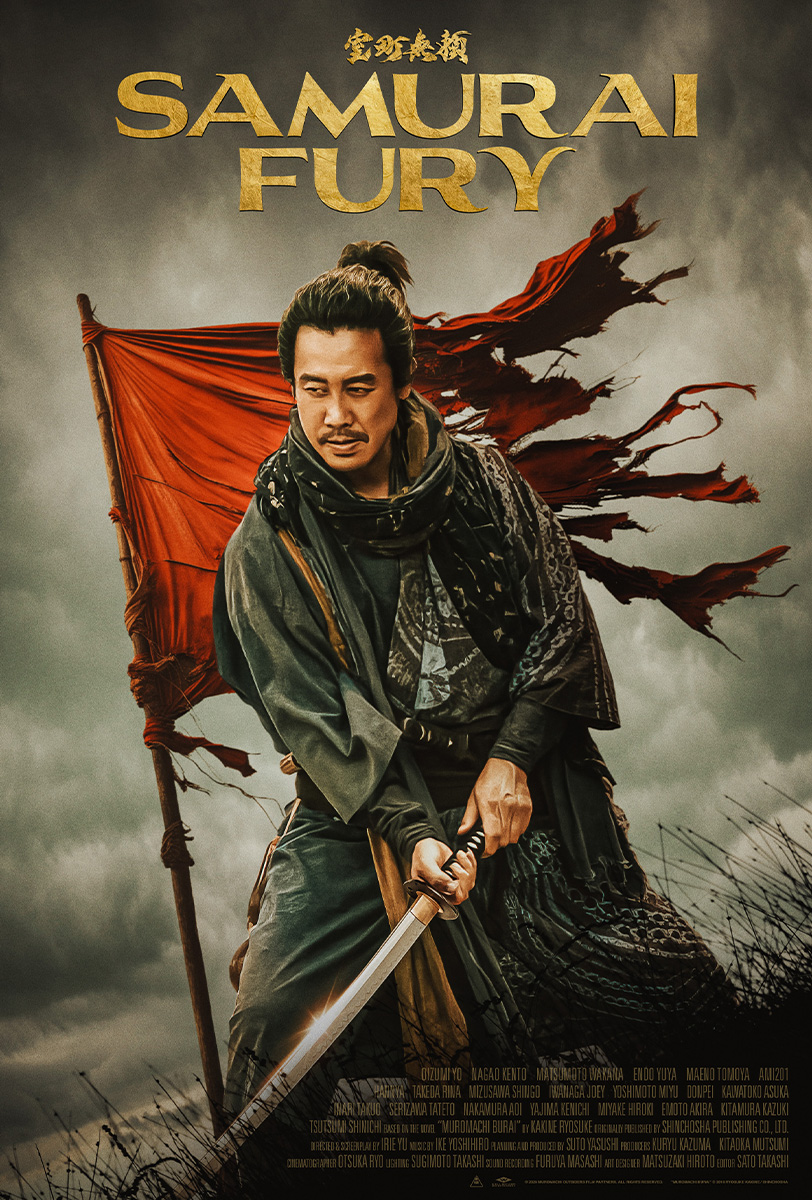
Retitled Samurai Fury (室町無頼, Muromachi Burai) for it’s US release, Yu Irie’s Muromachi Outsiders is indeed a tale of righteous anger though like many jidaigeki the rage is directed towards the corrupt samurai class and wielded by a ronin with a noble heart. Based on a novel by Ryosuke Kakine, it recounts a rebellion that took place five years before the Onin War that would lead to the end the Ashikaga Shogunate and initiate the Sengoku or warring states period that lasted until the Tokugawa era began. 

The cause is, really, the incompetent government of shogun Ashikaga Yoshimasa (Aoi Nakamura) who is largely seen here gazing out at his view from the palace in Kyoto which he is obsessed with rebuilding. Meanwhile, famine has taken hold following a period of drought that ended with a typhoon and flooding of the river Kamo, and the starvation has also led to a plague. Between the lack of food and disease, 82,000 people will die, but the government doesn’t really do anything because they don’t think the lives of peasants are all that important. This is of course very shortsighted because someone has to plant all that rice that gets delivered to the palace and they can’t do that if they’re too busy starving to death. In the opening sequences, peasants are whipped and beaten as they transport a giant rock for the shogun’s new garden, though when it gets there he doesn’t like it. Meanwhile, a giant pile of bodies in approximately the same shape is dumped at the edge of the river where they’re burning the dead.

The farmers are forced to take such onerous jobs for extra money because they can’t produce enough to pay their taxes which the samurai keep putting up. To make up the shortfall, they have to take out loans from usurious monks who seize their property or take their wives and daughters when they can’t pay. A young man pressed into working for debt collectors from the temple is told to kill a man who owed them money but hits the barrel beside him instead and exposes him for keeping his seed grain without which he won’t be able to plant more rice but they’re going to take that anyway which means that in the end everyone is going to starve. A village favoured by the hero, Hyoe (Yo Oizumi), is also subject raids from disenfranchised ronin who’ve taken to banditry to survive. 

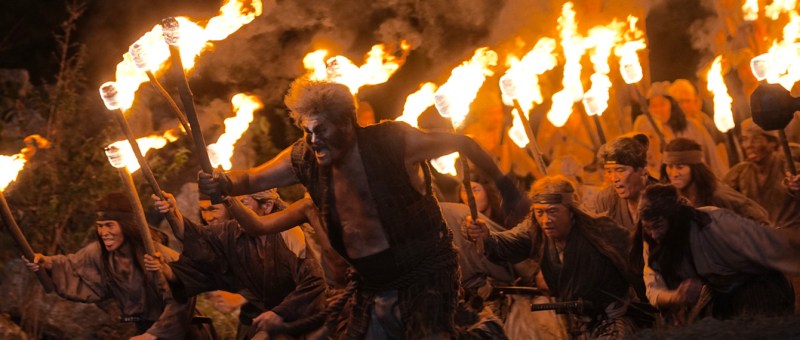
Hyoe is also a ronin, but in his life of wandering he’s found a kind of freedom even as he straddles an awkward line, sometimes working with an old friend from the same clan, Doken (Shinichi Tsutsumi), who has turned the other way and is now the security chief for the government in Kyoto with his own gang of bandit dent collectors. Hyoe’s role is, ostensibly, to stop peasant uprisings, which he does, but mostly because he knows they’re pointless and the farmers armed with little more than hoes and stolen armour will simply be massacred, but he’s also secretly plotting a giant rebellion of his own, harnassing the forces of the ronin and the fed up peasants to storm the capital, burn the debt agreements, and rescue the women taken in lieu of payment. 

But to do so means he’ll have to betray his oldest friend and that he likely won’t survive. Still he thinks someone’s got to do something about this rotten world and sees a better one beyond it if only they can throw off the yoke of the samurai class that thinks peasants are the same bugs to squeezed dry under their boots. That’s perhaps why he trains a young successor, knowing that can’t remake the world with just this one assault on the mechanisms of government and that even if they get rid of the drunken fool Lord Nawa (Kazuki Kitamura), someone not all that different will pop up in his place. “Tax is supposed to improve people lives,” one of the revolters screams at a young soldier, not pay for a new wing at the palace, though it’s a lesson the young shogun seems incapable of learning even as the city burns all around him. 

Taking a leaf out of The Betrayal’s book, the climax is a lengthy action sequence in which Hyoe’s apprentice Saizo (Kento Nagao) takes on half the Kyoto garrison single-handed armed only with his staff. Though the themes are common enough for jidaigeki, though in truth jidaigeki mainly refers to films set in the Edo era under the Tokugawa peace, Irie modernises the way battle is depicted to incorporate wuxia-style wirework and rooftop chases along with martial arts training sequences for the young Saizo who learns the way of the warrior from a cackling old man with a long white beard (Akira Emoto) who has also taken in a young Korean woman (Rina Takeda) who was sold to a brothel by her father in just another one of the injustices of the era but has now become a badass archer and another of Hyoe’s righteous avengers. Solidarity is it seems the best weapon, along with biding your time and knowing when to retreat because this is a war that’s never really won but only held back while the powers that be never really learn.


Samurai Fury is released Digitally in the US Oct. 7 courtesy of Well Go USA.

Trailer (English subtitles)
Baby Assassins 2 Babies (ベイビーわるきゅーれ2ベイビー, Yugo Sakamoto, 2023)

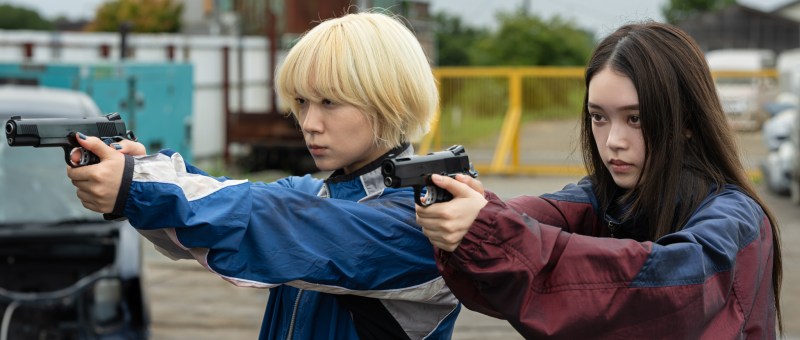
Chisato (Akari Takaishi) and Mahiro (Saori Izawa) continue to struggle with everyday life in Yugo Sakamoto’s sequel to the hugely popular slacker comedy action fest, Baby Assassins, Baby Assassins 2 Babies (ベイビーわるきゅーれ2ベイビー, Baby Valkyrie 2 Baby). A deadpan satire on institutional bureaucracy in the underground hitman society, the film sees the girls targeted by a pair of rivals that in any other film may be the heroes of the story only this time around they’re hapless challengers whose attempt game the system only results in more chaos and misery. 

Beginning to get their act together, the girls are still it seems completely hopeless at managing their money and are suddenly faced not only with a hugely expensive bill for a gym membership they took out five years previously and forgot to cancel, but also reminded that they were upgraded from the “Jolly” insurance scheme to the “Merry” insurance scheme when they graduated high school so their payment information has expired and needs updating. It’s this extreme set of circumstances that lead to them being in a bank at the moment it is robbed by a pair of fugitive thieves. The terms of their assassins contract forbid them from using their skills outside of the job, but they can’t afford to wait any longer and decide to tackle the robbers so they can send their transfer through before the deadline but end up getting suspended for their pains. While suspended they’re forbidden from killing anyone and get no salary so they’re back where they started looking for part-time jobs to help make ends meet. 

Their predicament is mirrored by antagonists Yuri (Joey Iwanaga) and Makoto (Tatsuomi Hamada) who as the film opens end up killing completely the wrong gangsters because of a logistical mixup. The problem is that Yuri and Makoto are subcontractors not yet admitted to the Assassins Guild which means they don’t get access to the best jobs and have no workplace protections. Essentially what they want is to join the union, but they aren’t qualified so their boss, Akagi (Junpei Hashino), comes up with the neat idea of knocking off Chisato and Mahiro to free up their spots in the Guild. 

Sakamoto has great fun satirising Assassin’s Guild bureaucracy as the girls are constantly forced to reference their contract through Mr Susano (Tsubasa Tobinaga) and his little blue book to figure out what is and isn’t allowed in their lives as top hit women. Meanwhile, they’re once again forced to try and live “normally” and find they aren’t very good it at it while having to take quite literally odd jobs as shopping arcade mascots managed by a weird old man (Tetsu Watanabe) obsessed with Masaki Suda and the film We Made a Beautiful Bouquet which becomes something of a running gag. Both Chisato and Mahiro and Yuki and Makoto reflect on the strange cafe hierarchy of being offered a selection of tiered menu sets at escalating prices all the way from basic chicken to barbecued meats as reflective of a wealth-based social system while the boys continue to vacillate over asking out the pretty waitress. 

It’s kill or be killed but the girls know on some level that the guys are just like them and even quite good hitmen for “amateurs” so it’s a shame they have to die for having attacked and nearly killed one of their friends. After sorting out who’s won through a high octane series of shootouts and one on one fights, the four sit down on the ground and share snacks while waiting for the inevitable like they’d just been having a violent picnic while hanging out in a disused warehouse. Even the losers seem to accept their fates, acknowledging that they’ve lost in a fair fight and making no further attempt to resist. 

In any case, adulting is hard even when you’re not a top assassin struggling with when it’s appropriate to put your training to use. As the girls point out, it’s hard to get by on part time work when it would take a hundred days dressed in a humiliating panda outfit to earn what they’d get for one kill while freelancing is strictly forbidden along with strike action and taking one’s grievances to Twitter. Turns out the assassin life is more complicated that you’d think and just as filled with annoying bureaucracy as any salaryman job. Thankfully the friendship between Chisato and Mahiro has only grown stronger as they face off against the twin threats of red tape and adulting in their lives as “contract” killers.


Baby Assassins 2 Babies screens in Frankfurt 10/11th June as part of this year’s Nippon Connection.

Original trailer (English subtitles)

Images: ©2023 “BABY ASSASSINS 2” Film Partners

Samurai Marathon (サムライマラソン, Bernard Rose, 2019)

Samurai Marathon posterAfter two and a half centuries of peaceful slumber, Japan was jolted out of its isolation by the arrival of Commodore Perry’s Black Ships. The sudden intrusion proved alarming to most and eventually provoked a new polarisation in feudal society between those who remained loyal to the Shogun and the old ways, and those who thought Japan’s best hope was to modernise as quickly as possible to fend off a foreign invasion if it did eventually arise as many feared it would. Lord Itakura (Hiroki Hasegawa) has a foot in both camps. He has no desire to move against the Shogun, but fears that centuries of peace have made his men soft and complacent. His solution is to institute a “Samurai Marathon”, forcing his retainers to run 36 miles to prepare for a coming battle.

If you’ve spent your life sitting around and occasionally waving a sword at something just to keep your hand in, suddenly trying to run 36 miles might not be the best idea, as many samurai keen to win favour through racing glory discover. There is, however, an additional problem in that, unbeknownst to anyone, samurai accountant Jinnai (Takeru Satoh) is a secret ninja spy for the shogun. Confused by the preparations for the race, he reported that a possible rebellion was in the offing only to bitterly regret his decision on realising Itakura’s anxieties are only related to external, not internal, strife. All of which means, the Shogun’s men are on their way and Itakura’s retainers are sitting ducks.

Helmed by British director Bernard Rose, Samurai Marathon (サムライマラソン) plays out much more like a conventional European historical drama than your average jidaigeki. Where samurai movies with an unusual focus tend to be comedic, Rose opts for a strangely arch tone which is somewhere between po-faced Shakespeareanism and post-modern irony. Rather than the stoical elegance which defines samurai warfare, the violence is real and bloody, if somewhat over the top in the manner of a gory Renaissance painting complete with gasping severed heads and gruesome sprays of dark red blood.

A chronicle of bakumatsu anxiety, the film also takes a much more pro-American perspective than might perhaps be expected, taking the view that the arrival of the Americans heralded in a new era of freedom and the origins of democracy rather than the more ambivalent attitude found in most jidaigeki which tend to focus much more strongly on the divisions within samurai society between those who wanted to modernise and those who just wanted to kick all the foreigners back out again so everything would go back to “normal”. Itakura, like many, is suspicious of foreign influence and the gun-toting, yankee doodle humming Shogunate bodyguard is indeed a villain though it’s Itakura himself who will end up firing a gun as if conceding that the future has arrived and the era of the sword has passed. 

Ramming the point home, Itakura is also forced to concede to the desires of his wilful daughter, Princess Yuki (Nana Komatsu), who wanted to travel and see the world while her society (and conventionally minded though doting father) insisted all there was for her was marriage and a life stuck inside castle walls. Managing to escape and disguising herself by cutting her hair and putting on peasant clothes, Yuki is able to evade detection longer than expected precisely because few people have ever seen her face. She also gets to make use of some of the samurai training she’s received by holding her own out on the road, though it seems improbable that her father would let her ride out alone even if he finally allows her free rein to go where she chooses.

Meanwhile, other ambitious retainers try to use the race to their own advantage though there’s poignant melancholy in one lowly foot soldier’s (Shota Sometani) dreams of being made a samurai considering that in just a few short years the samurai will be no more. The final sepia shift into the present day and a modern marathon may be a stretch, as might the unnecessary final piece of onscreen text informing us that we’ve just watched the origin story for the Japanese marathon, but the main thrust of the narrative seems to be that the samurai were running full pelt into an uncertain future, preparing to surrender their swords at the finish line. An unusual take on the jidaigeki, Samurai Marathon perhaps takes an anachronising view of Bakumatsu chaos in which the samurai themselves recognise the end of their era but finds its feet on the road as its self-interested heroes find common purpose in running home.


Samurai Marathon screens as the opening night gala of the 2019 New York Asian Film Festival on June 28 where actress Nana Komatsu will be in attendance to collect her Screen International Rising Star Asia Award.

Original trailer (no subtitles)

The Blood of Wolves (孤狼の血, Kazuya Shiraishi, 2018)

korou_honpos_0220_fin.aiJapanese cinema, like American cinema, is one of the few in which the hero cop is a recognisable trope. Though they may be bumbling, inefficient, obsessed with bureaucracy, or perhaps just lazy, police in Japanese cinema are rarely corrupt or actively engaged in criminality. Even within the realms of the “jitsuroku” gangster movie, the police maintain a fringe presence, permitting the existence of the underground crime world in order to contain it. “Jitsuroku” is, in a fashion, where we find ourselves with Kazuya Shiraishi’s throwback underworld police story, The Blood of Wolves (孤狼の血, Koro no Chi). Set in 1988, the end of the Showa Era which had seen the rebirth of post-war Japan and the ascendency of yakuza thuggery, The Blood of Wolves is based on a novel by Yuko Yuzuki rather than a “true account” of life on the frontlines of gangsterdom, but otherwise draws inspiration from the Battles Without Honour series in updating the story of nihilistic yakuza violence to the bubble era.

In 1988, a young accountant “goes missing” sending his sister to ask the police for help in locating him. The case gets passed to sleazy detective Ogami (Koji Yakusho) and his new rookie partner, Hioka (Tori Matsuzaka). Ogami leers disturbingly at the dame who just walked into his office before dismissing the newbie and extracting a sexual favour from the distressed relative of the missing man. Unfortunately, the accountant turns up dead and the bank he worked for turns out to be a yakuza front caught up in a burgeoning gang war between the Odani with whom Ogami has long standing connections and the gang from the next town over who are looking to increase their territory.

Ogami, a chain smoking, hard drinking, womanising detective of the old school, has one foot in the yakuza world and the other on the side of law enforcement. Hioka, a recent graduate from the local but also elite Hiroshima University (something of a rarity in his current occupation), is not quite sure what to make of his new boss and his decidedly “unorthodox” methods, becoming increasingly concerned about the way the police force operates in a town defined by organised crime. Deciding that Ogami has gone too far, he eventually makes the decision to go to IA with a list of complaints but there’s still so much he doesn’t know about Hiroshima and it is possible he may have picked the wrong side.

What he discovers is that the police force is so intrinsically rotten as to have become little more than a yakuza gang itself, only one with the legal right to carry guns and a more impressive uniform. Ogami, for all his faults, apparently has his heart in the right place. His “friendships” with gangsters are more means to an end than they are spiritual corruption, gaining leverage that will help him keep a lid on gang war – after all, no one wants a return to the turbulent days of the 1970s when the streets ran red with the blood of unlucky foot soldiers and that of the civilians who got in their way. Meanwhile Hioka, starting out as the straight-laced rookie, is himself “corrupted” by the corruption he uncovers, developing a complex mix of disgust and admiration for Ogami’s practiced methods of manipulation which, apparently, place public safety above all else.

Ogami, as he tells the conflicted Hioka, knows he walks a tightrope every day, neatly straddling the line between cop and yakuza, and the only way to stay alive is to keep on walking knowing one slip may lead to his doom. He may say cops can do whatever they like in pursuit of “justice” (and he does), but Ogami has his lines that cannot be crossed, unlike others in his organisation who care only for themselves and have long since given up any pretence of working for the public good.

Shiraishi channels classic Fukasaku from the noticeably retro Toei logo at the film’s opening to the voice over narration, garish red on screen text, and frequent use of freeze frames familiar from the Battles Without Honour series and associated “jitsuroku” gangster fare that followed in its wake. Moving the action up to 1988, the gangster world is once again in flux as it tries to corporatise itself to get in on the profits of bubble era prosperity which largely has no need for the thuggish gangster antics of the chaotic post-war years in which the yakuza could paint itself as a defender of the poor and oppressed no matter how ridiculous it might have been in reality. Ogami is a dying breed, a relic of the Showa era meeting its natural end, but perhaps you need to be a wolf to catch a wolf and guardian spirits can come in unexpected forms.


Screened at the 20th Udine Far East Film Festival.

Original trailer (English subtitles)