Zero (零戦燃ゆ, Toshio Masuda, 1984)

The Zero Fighter has taken on a kind of mythic existence in a romanticised vision of warfare, yet as Toshio Masuda’s Zero (零戦燃ゆ零戦燃ゆ, Zerosen moyu) implies its time in the spotlight was in fact comparatively short. Soon eclipsed by sleeker planes flown by foreign pilots, the Zero’s glory faded until these once unbeatable fighters were relegated to suicide missions. On one level, the film uses the Zero as a metaphor for national hubris, a plane that ironically flew too close to the sun, but on another can never overcome the simple fact that this marvel of engineering was also a tool of war and destruction. 

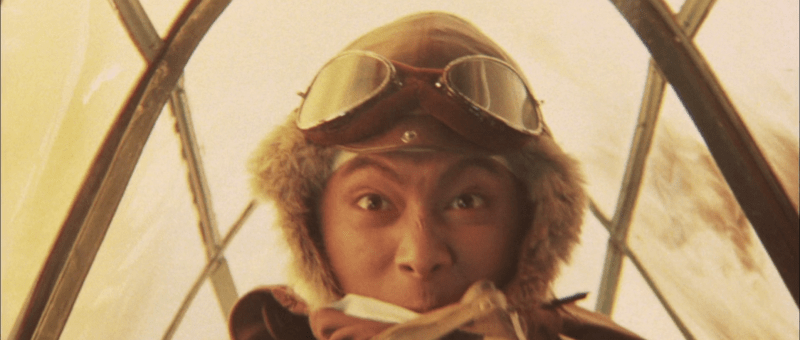
The film is loosely framed around two members of Japan’s Imperial Navy, Hamada (Daijiro Tsutsumi) and Mizushima (Kunio Mizushima), who as cadets consider deserting to escape the brutality of Navy discipline. Having left the base they’re accosted by an inspirational captain who talks them out of leaving by showing them a prototype model of the Zero and convincing them they only need to stick it out for a few more years in order to get the opportunity to fly one. Mizushima, the film’s narrator, doesn’t qualify as a pilot and is related to the ground crew while Hamada does indeed get to pilot a Zero fighter and becomes one of the top pilots in the service. 

The viewpoint is is then split between the view from the ground and that from the clouds. Mizushima makes occasionally surprising statements such as candidly telling love interest Shizuko (Yû Hayami) that they are unlikely to win the war, while becoming ever more concerned for Hamada at one point telling him there’s a problem with his plane in the hope that he won’t take off that day. Hamada meanwhile is completely taken over by the spirit of the Zero and even when given a chance to escape the war after being badly injured, chooses to return because he does not know what else to do. When he visits home after leaving hospital, no one is there. His mother eventually arrives and explains that the family has become scattered with his siblings seconded to the war effort in various places throughout the country. 

Hamada’s dedication and personal sacrifice are in some senses held up as the embodiment of the Zero. The reason for its success is revealed to lie in the decision to remove the armouring for the cockpit leaving the pilot’s life unprotected, something which the American engineers describe as unthinkable. In an early meeting, a superior officer complains that they’re losing too many pilots and need to reinstall some of the armouring, but finds little support. Not only this is a cold and inhuman decision, but it’s poor economic sense given that skilled pilots are incredibly valuable and in short supply. After all, you can’t just make more. If you start from scratch you’ll need to wait 20 years and then teach them fly, but it’s a lesson the Navy never learns that is only exacerbated with the expansion of the kamikaze squads which squander both men and pilots for comparatively little gain. 

These “philosophical differences” are embodied in the nature of the Zero which is configured to be nimble and outmanoeuvre the enemy but is quickly eclipsed not least when foreign powers figure out the way to beat it lies in numbers in which they have the advantage. There is something of a post-Meiji spirit in the feeling that Japan is lagging behind Western powers and desperately needs to develop its own military tech in order to defend itself. On hearing rumours of the Zero fighter, MacArthur scoffs and says that Japan can’t even build cars so he doesn’t believe they could design a plane that could fly such large distances while others suggest that they will still need the element of surprise if they ever go to war with America because its technology is still superior. 

Walking a fine line, the film tries to avoid glorifying “war”, but it cannot always help indulging in nationalist fantasy such as in its statement that thanks to the Zero “the Japanese flag covered a vast area of the Pacific” in the wake of Pearl Harbour. These may be fantastically well designed machines that were incredibly good at what they were created to do, only what they were created to do was kill and destroy. The plane’s fortunes and Japan’s are intrinsically linked, the sense of superiority in the air lasts only a short time before Western technological advances over take it and the war continues to go badly. The film dramatises the tragedy of war through the friendship between the two men which eventually causes Mizushima to sacrifice his love for Shizuko by convincing her marry Hamada hoping that his priorities would change and he’d decide to take a position as an instructor rather than heading back to the front. 

For her part, it seems that Shizuko was also in love with Mizushima, but also caught in a moment of confusion between love and patriotism that encourages her to think she should do as Mizushima says and embrace this man who has dedicated his life to his country. In the end, it buys them each loss and misery, but also a moment of transcendent hope even if it was based on a falsehood in the pleasant memory that Mizushima gives Hamada of the life he is giving up by rejecting it to return to the front. For Mizushima, Hamada and the Zero may become one and the same. At the end of the war he can’t bear to see the remaining Zero’s sold for scrap and asked to be “gifted” one as the Captain who’d first shown one to him said he would be, so that he can give it a proper a “funeral”, or perhaps send it to Hamada in the afterlife after he is killed mere days before the surrender. Masuda cannot help romanticising the wartime conflict with his dashing pilots and their thrilling dogfights, often depicting it more as a kind of game than an ugly struggle of death and destruction, but does lend a note of poignancy to his tale of lives thwarted by the folly of war.


Trailer (no subtitles)

Will I Be Single Forever? (ずっと独身でいるつもり?, Momoko Fukuda, 2021)

If you can achieve financial independence in the contemporary society, then what is or should be the primary purpose of and motivation for marriage, what does it mean, should you want it at all or is it merely an outdated institution designed to keep women in their place by making them dependent on men? Adapted from the manga by Mari Okazaki, Momoko Fukuda’s Will I Be Single Forever? (ずっと独身でいるつもり?, Zutto Dokushin de Iru Tsumori?) finds a series of young women asking just these questions wondering why it is everyone themselves included is still intent on viewing marriage and motherhood as the only markers of success as if none of their other achievements really matter if they’re going to write spinster of this parish on their headstone. 

10 years previously the now 36-year-old Mami (Jun Hashizume) shot to stardom penning a best-selling book about how it isn’t a sin to be single and the worst thing isn’t to be alone but to settle for less solely to escape loneliness. These days, however, she’s beginning to wonder, growing fearful of what it might mean to spend the rest of her life alone and worrying she’s about to miss the marriage boat witnessing it pass by passively without making a concrete decision of her own. Expressing her views on a talk show where “the troubled women of today are slapped with harsh reality”, Mami disappoints some of her longtime fans who found validation in her book reassured that there was nothing wrong in their desire to live independently rather than get married right after college and become regular housewives. Yet they are also ageing and facing the same dilemma, wondering if their life choices are really OK or if they’re missing out on a family life by refusing to settle for Mr. Almost-Right. 

The film’s English-language title flips the Japanese as if the question is self-directed, the women asking themselves when Mr. Right’s going to come along or worrying about the consequences if he never shows up, while the Japanese is more like the dreaded question every young woman is asked by an invasive female relative at a family gathering reminding her she’s not getting any younger and will end up alone if she’s not careful. Meanwhile, Mami is reminded that women who’ve bought their own apartments seldom marry, men aren’t interested in women who can be financially independent and don’t need to rely on them for economic support as Yukino’s (Miwako Ichikawa) longterm boyfriend explains breaking up with her immediately before moving in together as it turns out right next to Mami though she doesn’t know it as she takes out her frustrations online through an embittered anonymous Twitter account. 

For her, the point of marriage is supposed be escaping loneliness yet as her school friend Ayaka (Eri Tokunaga) will testify marriage can be the loneliest thing of all. Her husband is happy to play with the baby but hands it back every time it cries or needs changing unwilling to engage with the less fun sides of marriage or parenthood. Husbands are emotionally absent and rarely help at home, Ayaka’s trying to be helpful by taking the baby to the park so that she can focus on her chores both leaving her out of their fun and reinforcing the idea the home is all her responsibility and none his. “Don’t end up like me” Mami’s mother (Mariko Tsutsui) advises instantly seeing that her decision to marry casual boyfriend Kohei (Yu Inaba) just because he asked is doomed to end in failure, warning her that you have to “be ready to live alone” even if you marry, “no good comes of being a slave to a husband” she adds uttering the unthinkable in trying to warn her daughter of the realities of a patriarchal marriage. 

And as it turns out though five years younger vacuous rich kid Kohei is a patriarchal man whose friends all praise him for being brave and understanding in marrying an older woman while he pats himself on the back for being progressive in granting her permission to continue using her maiden name professionally after they marry. When they go to meet his conservative parents he criticises her outfit for making her look “old” while he’s worn shorts to a fancy restaurant and then orders a ridiculous green soda drink, forcing Mami to go along with his mother’s prodding that she’ll give up work when they marry to devote herself to childrearing though he’d also refused to attend a fertility/genetic screening session Mami had recommended on the grounds that it’s unnecessary because he’s a man as if childbirth is only a female concern and only women can have fertility issues or potential problems in their medical history. The more she tries to voice her worries the more he overrules her, the final straw coming as he refuses to listen to her anxiety about getting behind the wheel of a car, generally unnecessary in Tokyo, having previously been involved in an accident. She begins to wonder why it’s so important to follow the “correct path” even if it brings you no happiness solely in order to avoid people asking you with barely suppressed pity if you’re going to be single forever. 

The question comes from an older era in which it was it was near impossible for a woman to survive without a husband, but now that she can why should she put up with poor treatment and restrictions on her freedom if she is perfectly capable of supporting herself? Much younger than the others, sugar baby / professional socialite Miho (Sayuri Matsumura) meanwhile has gone the other way in trying live off men without the constraints of marriage only to find herself hamstrung by patriarchal expectations once again in having failed to realise that her lifestyle has an expiration date while she’s painted herself into a corner with no qualifications or work experience at the age of 26. The bulk of her business model is already rooted in the selling of other younger, prettier women as party guests for wealthy men and the consequences of continuing down that path are largely unpalatable to her. 

Touched by a further TV update from Mami, each of the women has a kind of epiphany that allows them to move forward into happier lives reassuring them that it’s alright to ask for more and they don’t have to hold any part of themselves back to meet the outdated expectations of traditional femininity, even Miho finding another way of harnessing the skills she does have to achieve true independence. The answer is not a total rejection of marriage or committed relationships but a reacknowledgment that to marry or not should be their own choice based on their own happiness rather than something you have to get over with to avoid the social stigma of becoming an old maid. A relatable exploration of the lives of young women in the contemporary society Fukuda’s empathetic drama eventually advances that in the end the best cure for loneliness is female solidarity in the face of a still overwhelmingly patriarchal society. 


Will I Be Single Forever? streams in the US until March 27 as part of the 14th season of Asian Pop-up Cinema

International trailer (English subtitles)

My Identity (神様のいるところ, Sae Suzuki, 2019)

“You’re not the only one suffering because of language barriers” the heroine of Sae Suzuki’s My Identity calmly explains to her mother after spending a few days away perfecting her language skills. My Identity (神様のいるところ, Kamisama no Iru Tokoro) is perhaps less about identity in itself than the difficulty of communication but nevertheless finds a young woman displaced, quite literally pushed out both by her frustrated mother and by a society which continues to be fiercely intolerant of difference. What she realises however, is that she’s not the only one feeling lost, discovering an alternate maternal figure in an orphaned adult herself at the mercy of an unforgiving and judgemental patriarchal society. 

As we first meet her, high schooler Rei (Hinata Arakawa) is physically pushed out of her family home, the door closed behind her as her mother lays in to her father with accusations of fiscally irresponsible infidelity in her native language. As we later discover Rei is half-Taiwanese and in fact lived on the island until she was five but now feels under-confident in both a perhaps more familiar Mandarin and the Hokkien between which her mother switches freely. At school meanwhile she is taunted by two horrible boys who bully her for being “Chinese”, calling her “creepy” and “ugly” while questioning her ability to speak Japanese. When they tear up a thank you card she’d written in Chinese claiming not to understand it she finally loses her temper and fights back, hitting one of the boys on the head with her backpack. Ironically, she is the one that gets into trouble. Her mother takes a cane to her legs, angry most of all it seems that people will think that foreign mothers raise badly behaved children and will continue to look down on her. Rei just wants to connect with her mother, but her mother isn’t listening. 

That might be why she makes unwise decision to look into dodgy compensated dating after hearing about a forum where “gods” congregate looking to pick up teenage girls. She thinks better of it at the last minute only to be chased by a weird old man claiming to be worried about her which is how she bumps into Aoi (Kaho Seto) who cooperates by pretending to be her responsible adult. A youngish office worker, Aoi has problems of her own and has apparently been out on a night of heavy drinking with a colleague, something which becomes a source of gossip among the other women at work who seem to universally dislike her. She’s coming up for a transfer, but is aggressively harassed by her boss who tells her that he’s going to wait for her when she gets off, causing her to alter her schedule in order to avoid him. 

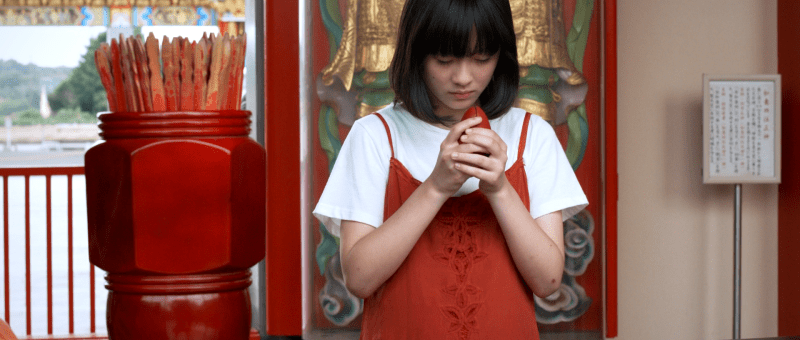
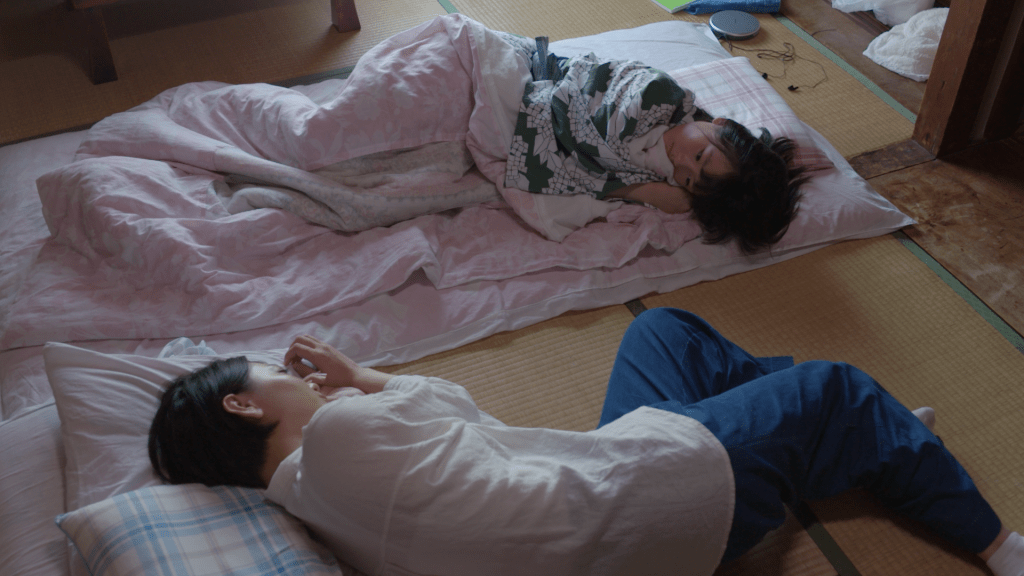
After a traumatic incident, the two women find themselves on the run, breaking into a disused inn which they end up operating in a temporary illusion of domesticity. Rei practices her Mandarin, looking to Aoi for guidance, but discovering that her worries are fairly universal. What if you can’t communicate your feelings she asks, but Aoi has no answer for her, and Rei can only lament that people start hurting each other when communication fails. Her Taiwanese heritage, however, becomes an unexpected, two-fold threat to her new familial connection when the pair visit a local Taiwanese temple which is also home to a Japanese researcher who speaks perfect Mandarin and has identified the two women as the fugitives from the news, but has also developed a quite obvious attraction to Aoi. 

Rei came here to face herself, but is consciously working towards a resolution, determined to make a connection while asserting her own agency. Aoi meanwhile worries she’s doing the opposite, “playing house”, “running away”, “refusing to face reality”. The researcher tells her, perhaps not altogether altruistically, that she’s being irresponsible, and that her indulgence of Rei may in the long run be harmful. She too feels lost and alone, confessing that she found herself subject to unwanted male attention she couldn’t directly deflect and feigned an ignorance that put her at odds with other women who came to resent her for it. Preoccupied, she too fails to understand Rei’s feelings, trying to be kind but nevertheless causing pain along the way. 

Through visiting the temple and reconnecting with her Taiwanese heritage, Rei finds the words she needs in order to communicate what it is she really feels and hopes that, finally, someone is going to listen. Contending with miscommunication, prejudice, ignorance, and a fundamental “language barrier” in the difficulty of translating feelings accurately and being fully understood, Rei does her best to become her most authentic self, integrating her identity and defiantly embracing it but doing so with openness as she strives for communication as a weapon against hate and violence.


My Identity streamed as part of this year’s Japan Cuts.

Original trailer (English subtitles)