Negotiator (交渉人 真下正義, Katsuyuki Motohiro, 2005)

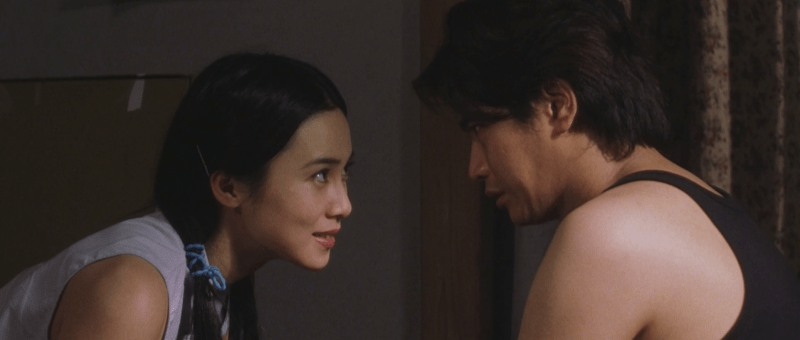
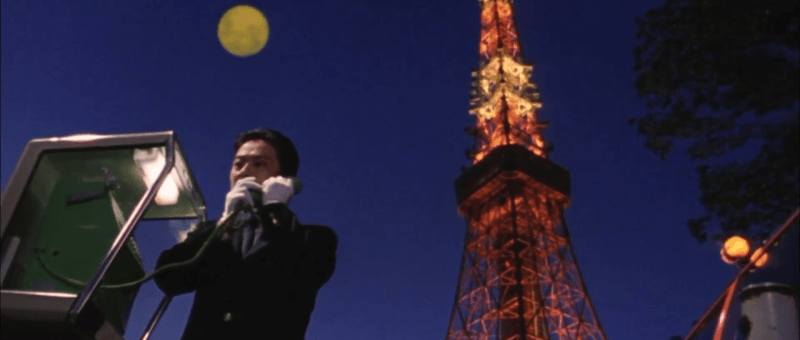
Beginning as a popular television drama, Bayside Shakedown developed into hugely successful franchise. Released two years after the second theatrical feature, 2005’s Negotiator (交渉人 真下正義, Koshonin: Mashita Masayoshi) is a self-contained spin-off revolving around Japan’s first specialist negotiator Mashita, whose name actually appears in the title. In Bayside Shakedown 2, he’d returned to the Wangan police department having left to pursue specialist training in the city. Though some of his former colleagues make cameo appearances and Motohiro maintains the lighthearted tone the series is known for, Negotiator essentially reverses the position of previous instalments, adopting the outsider’s perspective as Mashita finds himself implanted in the control room of the metropolitan mass transit system. 

For some reason in Japanese cinema, terrorist threats seem to arrive on Christmas Eve with alarming frequency, significantly upping the stakes for Mashita personally as he was planning to propose to fellow police officer Yukino (Miki Mizuno) after a romantic date the details of which he seems to be rather sketchy on. In any case, the crisis at hand is a rogue and unexpected train on the Tokyo subway. It quickly becomes apparent that someone has hijacked a remote-driven experimental “Spider” train designed to automatically switch gauges so that it can travel between differing lines on the complicated transit map. The hijacker will apparently only speak to Mashita, impressed or irritated by his accidental celebrity status following the Rainbow Bridge incident in Bayside Shakedown 2. One of the problems of that crisis had been the police discovering they do not actually have the power to unilaterally close a bridge because it requires the consent and co-operation of numerous other transportation officials (though actually in the end they just do it anyway). 

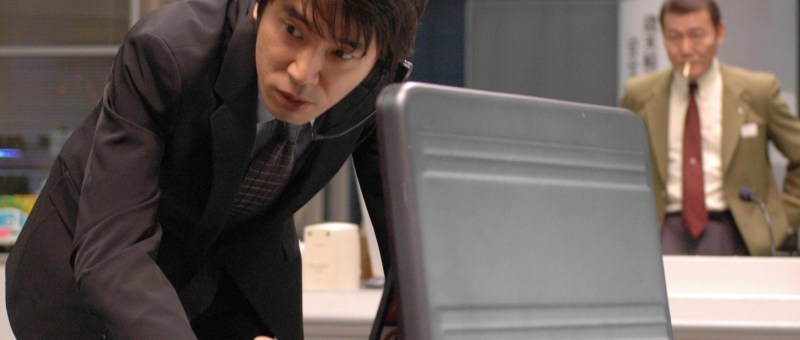
Something similar happens to Mashita when he fetches up in the control room to help. The official in charge, Kataoka (Jun Kunimura), directly tells him that they don’t require his assistance. He will just be in the way and should sit quietly in the corner while they get on with solving the crisis. In this scenario, Mashita is the outsider akin to the HQ guys descending on the Wangan police station and taking over, though as a trained negotiator he is more aware of the implications of his actions and temporarily agrees to take a back seat while his team set up shop in a meeting room only to be further embarrassed when it becomes apparent that the hijacker is intent on playing a game with him personally while thousands of ordinary passengers, not to mention railway and law enforcement officials, are placed in danger. 

Unlike previous instalments in the franchise, Negotiator is prepared to leave several questions unanswered such as the hijacker’s identity, purpose, and intentions focussing instead on the approach of the police and railways in response to the crisis. As in Bayside Shakedown 2, a solution is only possible once both sides have learned to trust each other letting go of any sense of division so that they can work together in total harmony. Meanwhile, there is also a minor criticism of institutional insularity as it becomes clear that part of Kataoka’s reluctance to cooperate is out of a sense of duty to the rail service in that he feels himself duty bound to withhold “secret” information that would help Mashita solve the case, that being the existence of tunnels and sidetracks not listed on the map because they are intended for use by the government and the military only in the event of an emergency fearing that revealing them would, ironically, present a security risk. Meanwhile, on the other side, Mashita and his team find their investigations hampered by the fact most of the data they need from HQ is stored on outdated media such as floppy disks, Jazz and Zip drives they do not immediately have the capability to open. 

Meanwhile, Mashita is engaged in a game of cat and mouse with a train obsessive who baits him with movie trivia and inevitably threatens his romance by targeting the oblivious Yukino who thinks she’s been stood up again and has no idea she’s actually in the middle of a terrorist incident. Like the previous films in the franchise, however, the central thesis is that in the end you just have to ignore all of the annoying bureaucracy and learn to work together for a common goal which is in essence what a negotiator is for, Mashita smoothing over conflict and differences of opinion with sympathetic politeness while unafraid to put on a show for the hijacker in order to get what he wants. A seasonal thriller, Negotiator is in an odd way about peace and harmony to all men and saving Christmas from the forces of disorder. 


Trailer (no subtitles)

Vital (ヴィタール, Shinya Tsukamoto, 2004)

“There is the vast realm of the unconscious,” one of the professors explains to vacant medical student Hiroshi a soon-to-be physician attempting to heal himself from a trauma he doesn’t fully understand. Perhaps as the title implies, Vital (ヴィタール) sees Tsukamoto branch out from his vistas of urban alienation to find a new paradise in nature albeit one that it exists largely in the mind and that the hero can never fully return to because this place of life is also one of death which exists inside a kind of eternity.

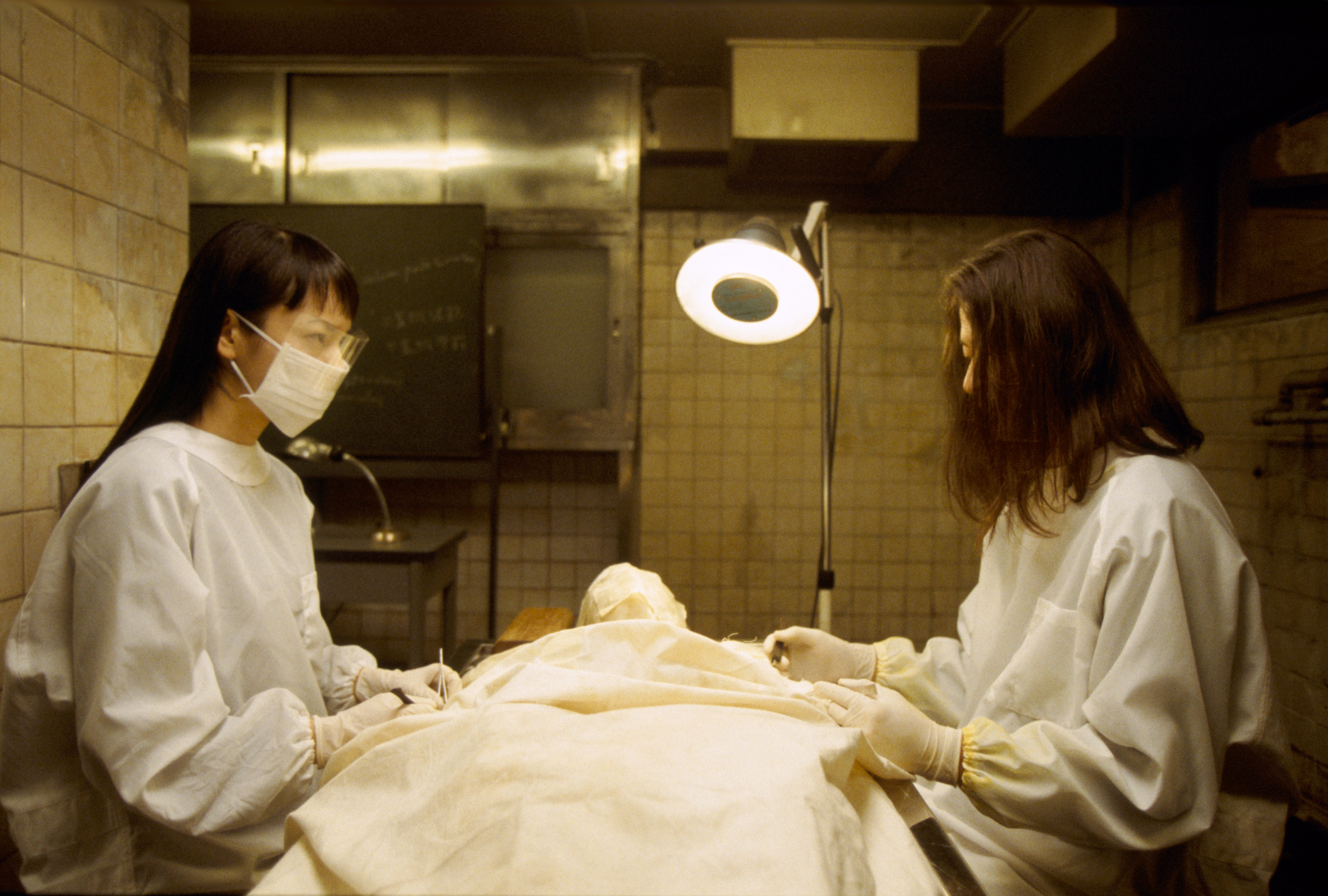
This explains to some extent Hiroshi’s (Tadanobu Asano) temporal confusion. Having lost his memory following a car accident in which he later learns his girlfriend Ryoko (Nami Tsukamoto) was killed, he shifts between “reality” and what first seems to be flashbacks of his unremembered past but are actually taking place in a kind of alternate, perhaps idealised reality in the “vast realm of the unconscious” as Hiroshi attempts to reconstruct his image of Ryoko along with that of himself. Another of his professors more philosophically asks were lies the seat of the soul in the human body and is this something that Hiroshi maybe unconsciously looking for during his anatomy classes in which he is coincidentally assigned Ryoko’s body to work on only realising when he sees her tattoo in one of his visions. 

In some ways this grim task of dissection is a bid for greater intimacy, to take Ryoko apart and then put her back together as the students diligently do at the end their studies reassembling the bodies and placing them in coffins in keeping with culturally specific death rituals. The faces of the cadavers are covered with a bag until the students are instructed to remove them, but they are always reminded to treat the dead with dignity and that their role here is one of understanding as they attempt to work out not only how these people died but also how they may have lived. Hiroshi causes conflict with some of his fellow students on just this point, seeming rather creepy in his vacant intensity over the body while also wanting to take ownership over that of Ryoko rather than work as part of the group complaining that the others are too clumsy and it’s affecting his ability to learn. 

Ryoko’s father comes to say that though he once blamed Hiroshi, his daughter had been in a way dead for a long time before she died, the light apparently going out of her eyes when she was still in high school. Only in Hiroshi’s unconscious does she say that she didn’t want to die despite an apparent obsession with death in Hiroshi’s other resurfacing memories/visions of her as symbolised in her repeated requests for him to strange her during in sex. Another of the professors had said that the suppressed desires of the unconscious could create conflict and this alternate reality is also in some senses Hiroshi’s own latent desire for death, to be with Ryoko in this new paradise that is founded on an idyllic beach rich with nature and sunshine where they are free to be together liberated from the oppressions of civilisation. 

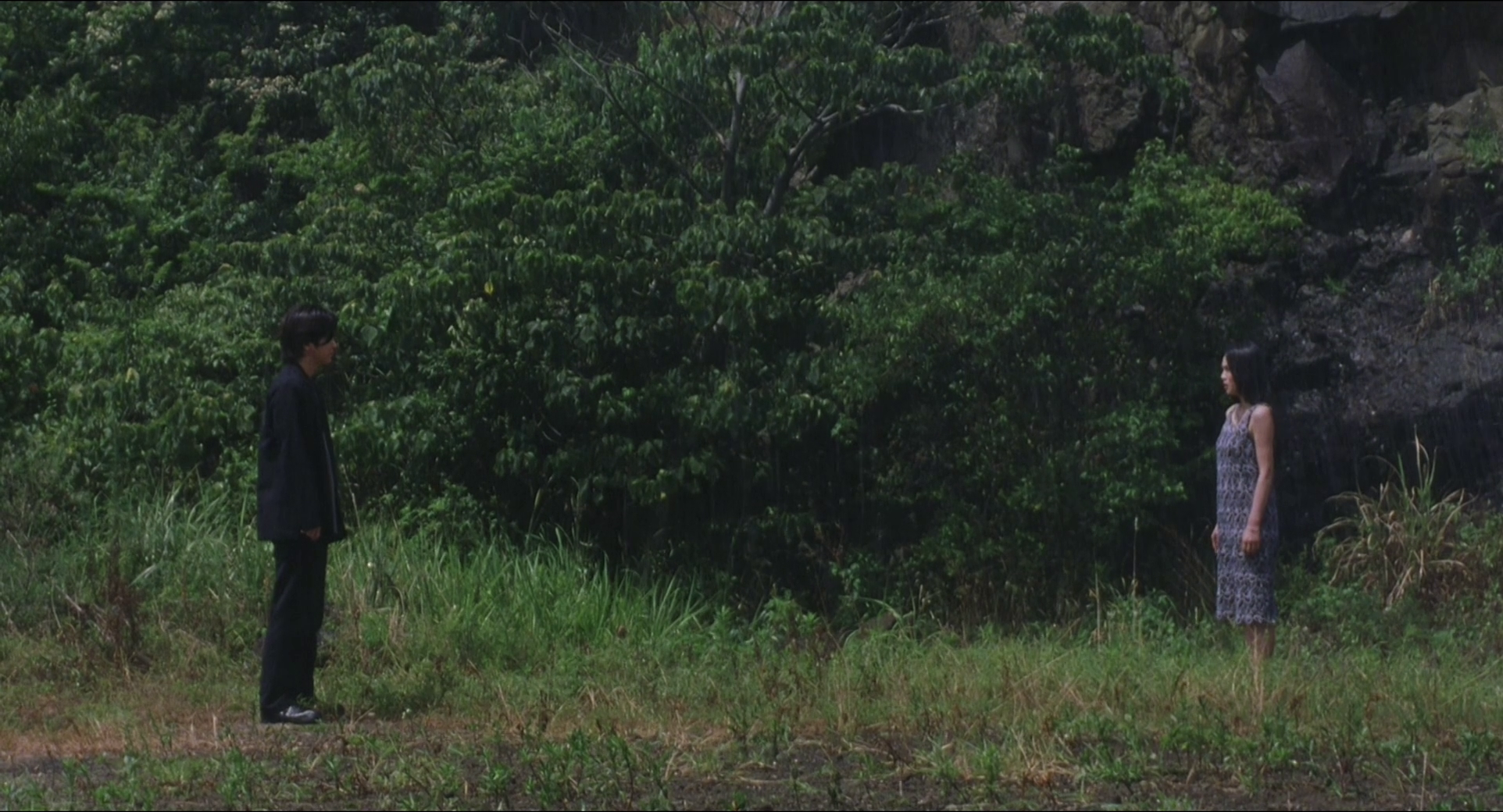
Indeed, it’s been raining all through the film as if in expression of Hiroshi’s gloomy mental state but we later learn that Ryoko’s most treasured memory was simply standing in the rain with him and breathing in its scent. Verdant nature is aligned with the vitality that is often absent from the soulless concrete of a city in which everyone seems to exist in tiny, separate worlds which only border on but never join each other. Ikumi (Kiki), a strange female student who develops a fascination with Hiroshi, has an illicit conversation with a professor she’s apparently been sleeping with each of them speaking into mobile phones while standing steps apart. Tsukamoto often isolates the protagonists, placing them in corners or blurring the periphery as if they alone existed in this moment. In Hiroshi’s idealised alternate reality, these barriers disappear as he and Ryoko share an entire world in love and freedom. 

The irony is that he resurrects himself through the process of dissecting Ryoko’s dead body. His Da Vinci-like sketches begin to shift as do the ink-like shadows on the wall amid the reflection of the rain as Hiroshi stares vacantly trying to reassemble his past. Through accepting Ryoko’s death, he rediscovers life and is in a sense reborn insisting he will continue medicine even though his professor and parents advise him not to given what he’s just been through though his parents had also said that before the accident they didn’t really think he had it in him to become a doctor. Their disapproval may explain some of the pressures he was experiencing as perhaps was Ryoko that may have urged them to long for death. In any case, what the film presents is the archaeology of grief, a prolonged period of introspection and loneliness and a seeking of intimacy no longer really possible but discovered only in the vast realms of the unconscious.


Vital is released on UK blu-ray 30th September courtesy of Third Window Films.

Original trailer (English subtitles)

The Yin Yang Master Zero (陰陽師ゼロ, Shimako Sato, 2024)

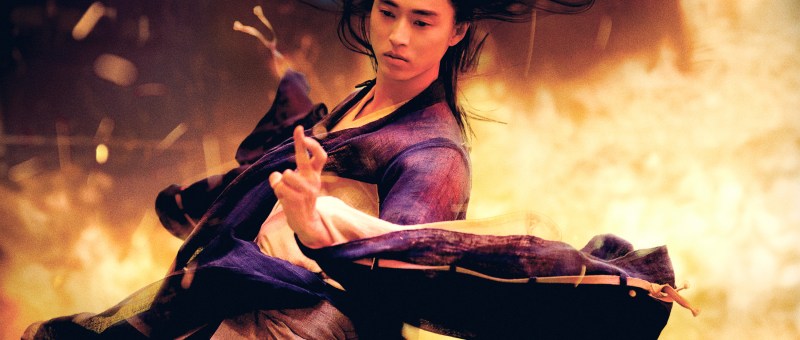
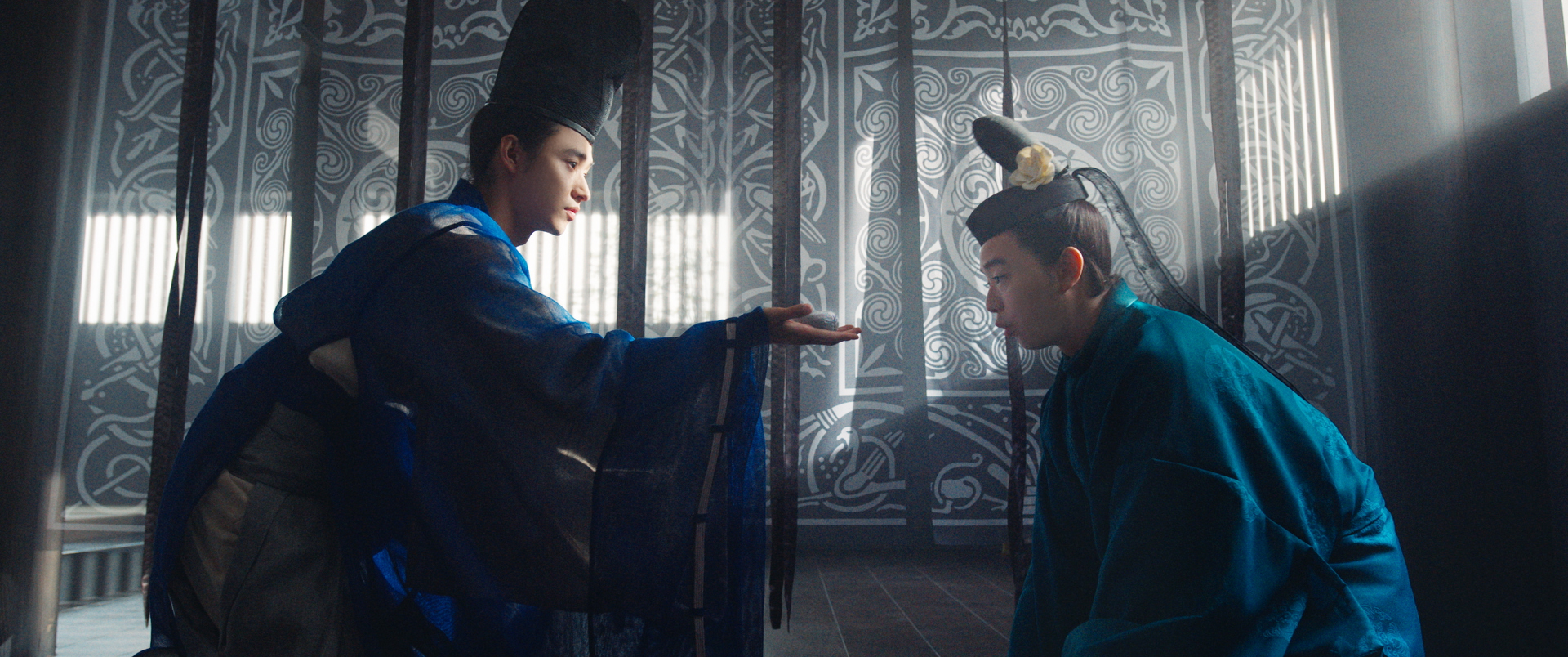
In the Heian era, who was it that kept the social order in check if not the onmyoji or “Yin Yang Master”? Shimako Sato’s big budget fantasy drama is technically a kind of prequel origin story adapted from Baku Yumemakura’s series of novels which were previously adapted as pair of movies in the early 2000s, and introducing the young Abe no Seimei (Kento Yamazaki), a Detective Dee-esque exorcist working as a state magician to protect the nation from supernatural threats such as demons and curses in an era in which ordinary people lived side-by-side with goblins and monsters.

That said, Seimei doesn’t really believe in that sort of thing, though in an ironic twist knows it to have a kind of truth at least, and is sick of being called out to look at a potential goblin infestation that turns out to be nothing more than a creaky old house settling amid the changeable weather. Which is all to say, he is both an earnest scientist looking for rational explanations to strange phenomena and an excellent diviner who can catch a dragon spirit in a bottle. In a touch of the Sherlock Holmes, he’s also gruff and aloof, distinctly uninterested in achieving high position and makes no secret of his contempt for his fellow alchemists insisting the Ying Yang Masters merely perpetuate superstitions to keep people frightened and themselves in employment.

When one of the other alchemists turns up dead of a suspected curse, the cat is set amongst the pigeons as the young apprentices respond to the offer of his higher status spot of they can solve the crime. This of course exposes their own greed and vanity as they each fall over each other desperate for a chance to get another foot on the ladder in a hierarchal system, a step that must be taken if they’re to make it all the way to the position of the emperor’s advisor on spiritual matters. Seimei’s disinterest further arouses suspicion against him with a fellow alchemist already 45 years old and stuck at the bottom rank directly accusing him of the crime perhaps less out of a genuine conviction than a desire to advance himself. 

In any case, Seimei investigates in a more modern, scientific way gaining access to crime scene and corpse ironically through a connection he’s made at court to an influential musician, Hiromasa (Shota Sometani), who hired him to sort out a problem the princess, Yoshiko (Nao Honda), was having with snapping strings on her harp. That turned out to be caused by a giant golden dragon spirit which Seimei later claims represented her feelings for Hiromasa, who is also quietly in love with her, which are somewhat forbidden because of the class difference between them. In this way, the spirits are merely a manifestation of the conflict between personal feelings and the social order as Yoshiko finds herself all but powerless, a princess in a golden cage to be sent wherever she is called with no real say over her fate. 

Fittingly, these feelings are resolved in a kind of artificial reality that Seimei believes to be a space of shared consciousness though he’s also fond of remarking on the malleability of “reality” and the ways in which vision and perspective can be manipulated. Then again, he also says all that matters is what they are seeing and experiencing in that very moment which is as good a benchmark for objective reality as anything else. There is something quite poignant about his developing relationship with Hiromasa which has its homoerotic qualities even as he becomes the “idiot” stand in for the audience, a kind of Watson figure that Seimei can explain everything to so that he can explain it to us. Even we can see the restrictions of the court and the irony in the eventual victory of “order” rather than personal freedom as volatile emotional forces must be put back in their bottles lest they create problems for everyone. Such conditions will doubtless create a series of cases of Seimei and Hiromasa to solve in a potential series starring the ace exorcist and his flautist friend in a Heian society beautifully brought to life by Sato’s sumptuous production design and flair for fantasy action.


The Yin Yang Master Zero screened as part of this year’s New York Asian Film Festival

Original trailer (English subtitles)

Bushido (碁盤斬り, Kazuya Shiraishi, 2024)

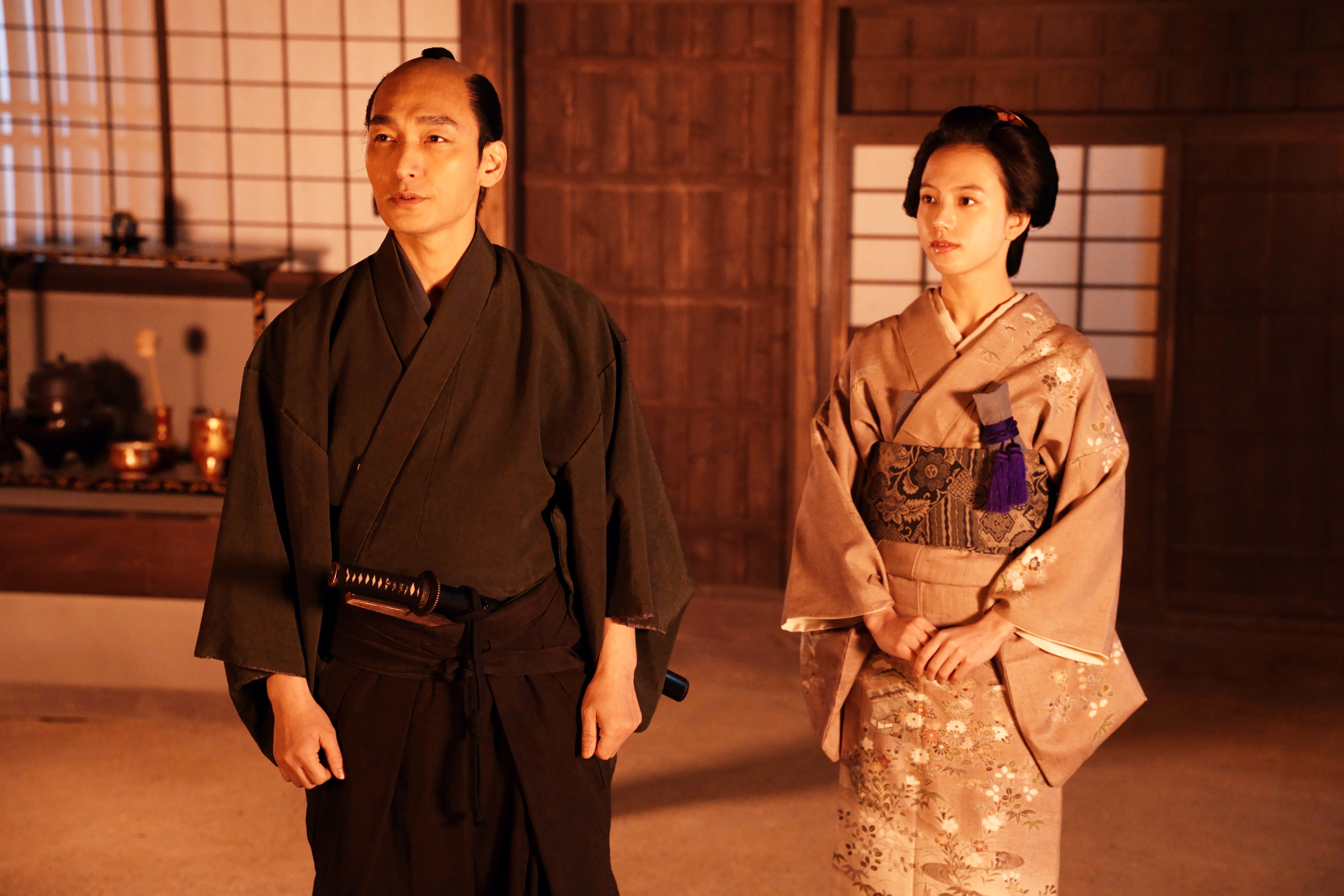
The hypocrisies of samurai society have led a dejected ronin into prideful penury but there is perhaps a fine line between properness and priggery that he struggles to accommodate. Like his earlier film Blood of Wolves, Kazuya Shiraishi’s Bushido (碁盤斬り, Gobankiri) is a loving homage to a classic genre, in this case jidaigeki, albeit one with a modern twist in which it’s the murkiness of the society and contradictions of its code that make it impossible to live in rather than the innate corruptions of the samurai class. 

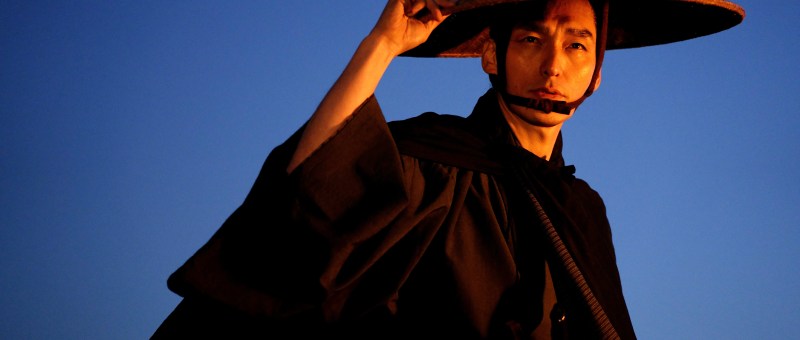
Even so, it’s samurai society which has betrayed Kakunoshin Yanagida (Tsuyoshi Kusanagi), now a seal-carving ronin living in a tenement house and months behind on his rent. Largely silent, Yanagida projects an air of calm but also a dangerous tension that hints at a deeply buried rage often echoed in the hellish glow of the candlelight that bathes his face in red. Not a natural gambler, he is nevertheless a Go enthusiast and talented player who gives the impression that he is always several steps ahead of any game in play. 

But that turns out not quite to be the case when he’s blindsided by a series of unexpected events that quickly destabilise his calmly ordered existence. Cast out of his clan after being accused of thievery, he is accused once again of taking 50 ryo from a pawn broker who had become a friend, Genbei (Jun Kunimura). Behind on his rent as he may be, Yanagida would not steal for stealing is beneath the dignity of a samurai and this stain on his honour is more than he can bear. But for all his righteousness we learn that he is also an ironic victim of his own priggishness and responsible for several other men meeting similar fates, cast out of the clan for something Yanagida turned them in for. In his reduced state, he seems to feel guilty and wavers momentarily on hearing the man who framed him for stealing a scroll from his former lord say he did so to gain money to support disenfranchised samurai but is caught between the spirit of samurai integrity and its letter. As his quarry told him, fish cannot live in water that is too clean and his oppressive enforcement of these arbitrary rules did no one any good. 

Yet his seeming righteousness does seem to improve the world around him, proving an epiphany in pawnbroker Genbei who develops a new determination for doing business fair and square after witnessing Yanagida’s conduct at the Go table. The irony is perhaps that everything on the Go board is black and white whereas Edo society is decidedly grey. Even the madam from the Yoshiwara Yanagida and his daughter are on good terms with (Kyoko Koizumi) can switch from wise mother to heartless gang boss in an instant. One moment, she’s giving maternal advice to Yanagida’s daughter Okinu (Kaya Kiyohara) and the next berating a runaway geisha who’s obviously been beaten while her lover has been killed for his transgression. The theft of 10 ryo will also it seems get you killed in this world of heartless rigidity and universal suspicion. 

Yanagida may not be much better in some respects. He is prideful and reckless, endangering himself and his daughter, whom he allows to pawn herself in the Yoshiwara knowing it’s very unlikely they will be able to repay the debt before the New Year deadline seeing nothing other than his obsession with vengeance against the man who wronged him in so many ways, Shibata (Takumi Saito). Shibata is his opposite number, cynical and amoral he subverted the samurai code for his own gain yet in its way perhaps it’s just a rebellion against the kind of austerity a man like Yanagida represented. In the end he can only escape his self-imposed prison by abandoning his rigour and accepting compromise, slashing the Go board with its black and white mentality in two though it leaves him further exiled. He cannot return to the world of samurai, but neither can he live among these ordinary people and like so many jidaigeki heroes seems to be condemned to wandering in this imperfect world. To that extent, the resolution seems much more cheerful than we might have been expecting. Everything works out, no harm done, but there’s a lingering tension even amidst apparent good fortune in a world of constant watchfulness. 


Bushido screened as part of this year’s New York Asian Film Festival.

Original trailer (no subtitles)

Tokarev (トカレフ, Junji Sakamoto, 1994)

The discovery of a pistol concealed under a vending machine provokes a prolonged crisis of power and masculinity in Junji Sakamoto’s tense psychological drama, Tokarev (トカレフ). So named for the guns at its centre, the film roots itself in post-Bubble anxiety in the push and pull between two very different men mediated through the kidnapping of an innocent child who in the end pays a very heavy price for the anxieties and resentments that drive his parents’ generation.

That said, the kidnappers are actually very nice to little Takashi who looks strangely happy in the videotaped ransom note as the friendly voice of a youngish man encourages him to look towards the camera. They take him to an amusement park, buy him new shoes and ice cream, and even let him wave the gun around during the money drop but are it seems otherwise callously indifferent to his fate.

The boy’s father, Nishiumi (Takeshi Yamato), has just moved onto a danchi housing estate with his wife Ayako (Yumi Nishiyama). They seem very excited to start their new life, yet the danchi itself speaks of a post-war aspiration which now seems dated and largely absent in the contemporary society. Nishiumi drives the bus to the local kindergarten picking up the surprisingly large number of children from their block each morning. Meanwhile, their neighbour, Matsumura (Koichi Sato) seems irritated by their presence perhaps jealous of their happy family life as he returns home alone and angrily flips the cover over his motorbike before opening the door. 

On the morning in question, Matsumura has trouble kickstarting his bike yet Ayako seems strangely drawn to him perhaps attracted by a different and older kind of masculinity. Unlike her husband, Matsumura wears a suit to work everyday and carries a little salaryman-style purse yet he works a job that could be considered manual in a printing press where they produce newspapers. He later excitedly tells Ayako that he gets to read the news before anyone else, though his hands glide over notices of violent crimes including a shooting which may seem additionally exciting to him given that he is the man who discovered a gun under a vending machine in Christmas-set opening sequence. His cluttered home otherwise at odds with the sense of order he projects is full of old newspapers while he seems to listen to the same weather broadcast every day. 

The gun is later used by another man who fires it at Nishiumi before abducting Takashi from the kindergarten bus. It takes Nishiumi a few seconds to realise it’s Takashi who’s been taken, suddenly taking off at speed after him endangering the lives of the other kids. The sense of guilt and inadequacy slowly consumes him. “Takashi must be so disappointed,” he later laments to Ayako over the phone in his failure to live up to the socially defined codes of masculinity. His son was taken from him in front of his eyes yet he couldn’t do anything to save him. Matsumura meanwhile turns up near the crime scene having been shot in the shoulder claiming the kidnapper stole his bike. 

Perhaps it’s this uncanny proximity along with his odd expression and obvious effect on Ayako that leads Nishiumi to believe that Matsumura was somehow involved in the crime. In another instance of mid-90s technophobia, the clue is once again discovered via videotape as a guiltridden Nishiumi spots Matsumura in the crowd at his son’s sports day which is odd considering he has no children of his own and no reason to be there. The kidnapper also films the random drop on camcorder, black and white images capturing a crowded Shibuya presumably as some kind of insurance plan.

After being attacked and seriously injured, Nishiumi ends up in hospital where he ironically discovers a gun of his own stashed in the restroom by a visiting yakuza. As it had Matsumura, the gun gives him a new sense of power but also drives him into a frenzied obsession, dressing like a yakuza himself in a suit and dark glasses having alienated Ayako who eventually leaves him for Matsumura who has by this point usurped him as a man and patriarch, taking everything he ever had. No longer wishing to live, he embarks on a suicide mission to get his revenge on Matsumura. The pair of them essentially trade places, Matsumura now in check shirt and jeans while Nishiumi approaches in a suit each of them corrupted by the illusionary power of the gun. 

It later transpires that the kidnapper was also facing a crisis of masculinity in that his business was about to go bust, though Nishiumi was not a wealthy man or particularly good candidate for a ransom. The police, who are in fact completely useless, bungling their only opportunity to retrieve Takashi because they were caught off guard by the kidnapper giving him the gun, keep asking him if there’s anyone who might have held a grudge but as he points out there must have been thousands of incidents of petty annoyance that may have pushed someone over the edge dating all the way back to his childhood. The battle he finds himself in is one of vengeance to reclaim his wounded sense of masculinity while Matsumura in turn is determined to defend the new life he’s bought for himself or perhaps stolen from Nishiumi as a happy family man. Sakamoto keeps the tension high through the near wordless closing sequence in which the two men square off against each other with the intention of meeting their endgame each victims of the pervading sense of futility of the post-Bubble era.


The Boy and the Heron (君たちはどう生きるか, Hayao Miyazaki, 2023)

Sales of Genzaburo Yoshino’s 1937 novel How Do You Live? (君たちはどう生きるか, Kimitachi wa Do Ikiru ka? went through the roof when it was announced that the no longer retired Hayao Miyazaki would be directing a new film with the same title. Predictably, Miyazaki’s film turned out not to be an adaptation at all, or at least not a literal sense, but was intensely interested in the question not so much how do you live but how will you? Will you allow the past to make you bitter and live in a world of pain and resentment, or will you choose to live in a world of peace and beauty free of human malice?

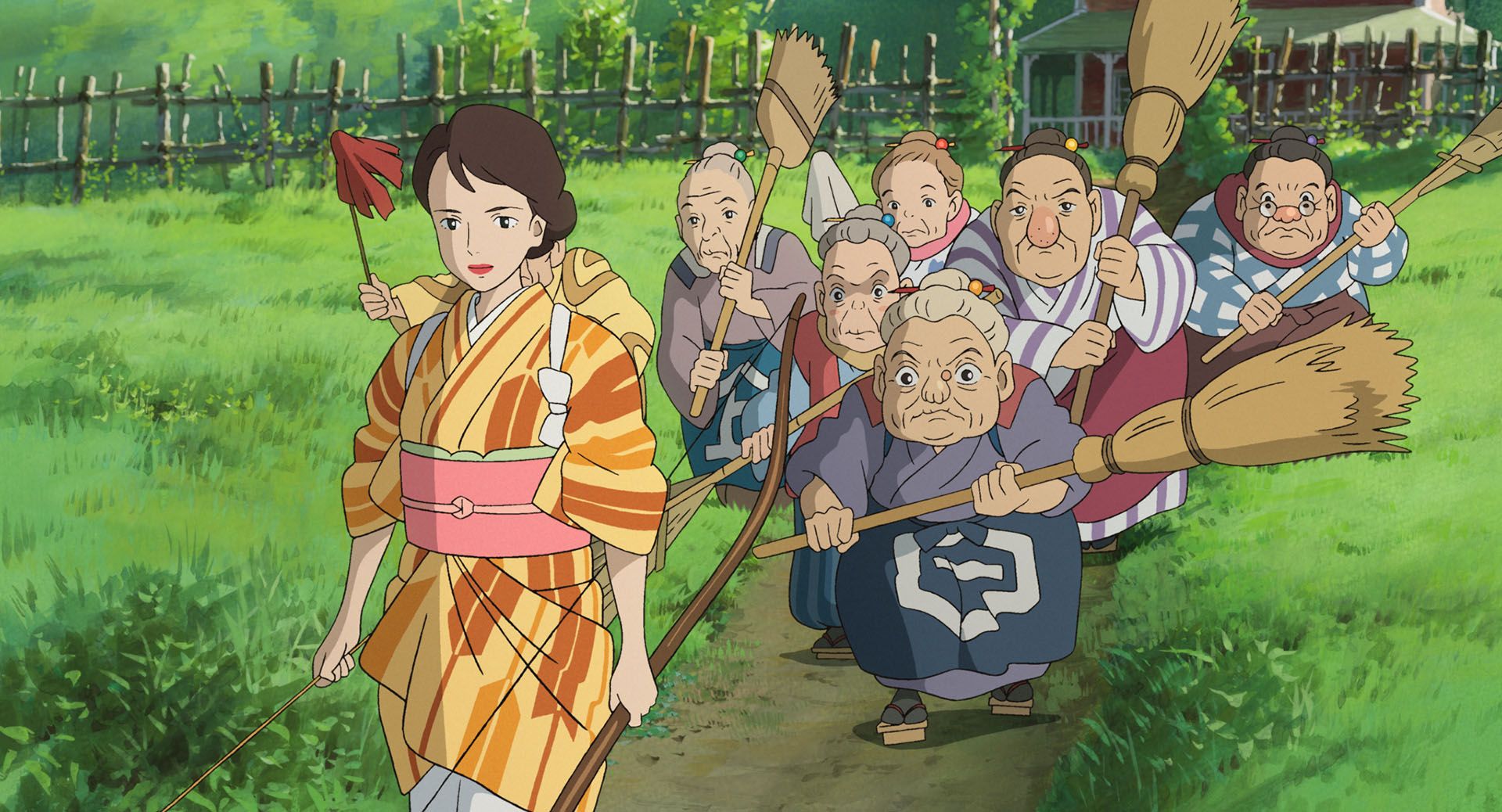
These are of course the questions faced by a post-war generation, the children of Miyazaki’s own era who came of age in a time of fear and suffering. Mahito (Soma Santoki), the hero, loses his mother in the firebombing of Tokyo. He runs through a world of shadows to save her from the flames but of course, he cannot. A year later everything has changed. His father has remarried, taking his mother’s younger sister Natsuko (Yoshino Kimura) as his new wife. Natsuko is now pregnant which suggests the relationship began some time ago though Mahito knew nothing of it and had no recollection of ever having met Natsuko before being sent to live in her giant mansion in the country more or less untouched by the war. 

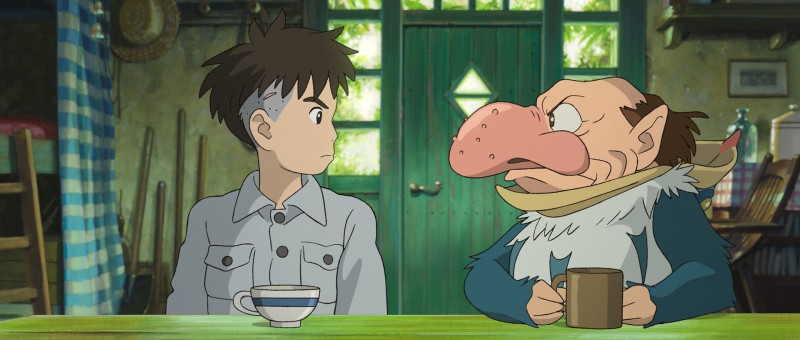
It’s here that Mahito’s own malice rises. He is polite, if sullen, but cannot warm to his new stepmother and resents his father’s relationship with her. Perpetually bothered by a grey heron (Masaki Suda) his first thought is to kill it, crafting a bow and arrow from bamboo and one of the heron’s own feathers. Shunned as the new boy at school he hits himself on the head with a rock while his father, Shoichi (Takuya Kimura), comically vows revenge and lets him stay home. As he points out, there’s not much “education” going on anyway with most of the students pulled away from their studies for “voluntary” labour in service of the war effort in this case agricultural. 

Shoichi has moved to the country to open a factory which it seems produces canopies for fighter planes which is all to say that he is profiting from the business of war, though transgressively referencing the failure in Saipan over breakfast with the mild implication that it might work out alright for him. There is after all a grim reason they’ll be in need of large numbers of aircraft parts in the near future. Mahito’s dark impulses are directly linked to those of militarism and the folly of war. When he finally enters the tower of madness apparently constructed by a great-uncle who went insane through reading too many books, he discovers that his enemies are an ever expanding clan of fascistic, man-eating parakeets led by a Mussolini-like despotic leader attempting to manipulate the Master of the tower. 

Inside the tower is a land out of time, a place for those already dead or in essence an eternal past. It’s here that Mahito is presented with a choice, how will he live? Will he choose malice and destruction, or will he choose to leave and build a new world of beauty and peace above? In many ways, the important point is that the choice is his as it is ours, that we are free to decide and that our choices create the world in which we live. Through his adventures in the tower, Mahito begins to come to terms with his situation and resolves to accept Natsuko as a mother and make friends of those he once considered enemies. When the tower itself crumbles, it takes with it the last vestiges of authoritarianism and tyranny.

Prompting his epiphany, Mahito discovers a copy of How Do You Live? in his room, a present from his late mother inscribed to the grown-up Mahito. He is surrounded by the world’s ugliness, forced into a surprisingly graphic fish gutting session that leaves him wiping away blood, recalling his profusely bleeding head injury and the scar it will forever mark him with. Pelicans imprisoned in the other world meanwhile tell him that they have no choice but to behave as they do for the Master of the Tower neglected to put enough fish in the rivers intending them to destroy rather nurture new life while their young too learn all the wrong lessons. Yet there is beauty and strangeness here too, along with kindness and humanity. Boundlessly inventive, Miyazaki couples surrealist visions of murderous birds and the hellish scenes of a city on fire with Mahito the only figure visible in his pale blue school uniform darting through the soot and the shadows. A vivid symphony of life, the film may in its way be about grief and the pain of moving on but finally discovers a kind of serenity in an accommodation with the present and the eternally unfinished question of how you yourself will live. 


The Boy and the Heron screened as part of this year’s BFI London Film Festival.

All Under the Moon (月はどっちに出ている, Yoichi Sai, 1993)

Throughout Yoichi Sai’s All Under the Moon (月はどっちに出ている, Tsuki wa Dotchi ni Dete iru), an earnest taxi driver, Anbo (Akio Kaneda), repeatedly calls in to despatch to inform them that he’s become lost and has no idea where he is despite rocking up next to such prominent landmarks as Tokyo Tower and Mount Fuji. His confusion reflects that of the changing post-Bubble society in which those like him struggle to reorient themselves and find new direction just as the nation appears slow to recognise itself and adjust to a new reality. 

It does seem that many of the drivers at Kaneda Taxi have themselves lost direction in their lives and are living very much on their margins while their rather deluded boss Sell is behaving like it’s still the Bubble dreaming of building a golf course and then a hotel to accommodate 2000 people. The Korean loan shark working with him alternately tells fellow Zainichi taxi driver Chun (Goro Kishitani) that he’s acquiring wealth to use for the reunification of Korea, and Sell that they are all children of capitalism, “Damn Reunification!”. At the wedding Chun attends, the guests take phone calls to deal with business and each remark on the precarious economic situation while one suggests that the North Korean association he represents is probably on the brink of failure joking that he fears they may sell their school and pocket the money. 

Yet despite the economic turbulence, the country has been slow to accept the presence of workers from outside Japan and many, including those at the taxi firm, still face discrimination as does Chun himself by virtue of his Korean heritage. One Japanese employee also seems to face a good deal of stigmatisation simply because he has a speech impediment, while an older mechanic with a limp insists on calling an Iranian colleague by a similar sounding Japanese name while baselessly accusing him of theft. Hoso (Yoshiki Arizono), a man with mental health issues provoked by his previous career as a professional boxer in which he accidentally killed an opponent during a bout, is fond of saying “I hate Koreans, but I like you” while otherwise fixating on Chun as a dependable big brother figure and resentful enough when he starts dating a Filipina hostess, Connie (Ruby Moreno), who works at his mother’s bar to pound down the door of her flat and demand to be let in. 

Chun himself is at least problematic and especially by the standards of today as he tries a series of crass pickup lines on Korean women at the wedding and then eventually forces a kiss on Connie not to mention physically striking her during a heated argument. He also insensitively tells her about his family’s tragic history in the war emphasising that citizens of Korea were abused for slave labour while seemingly unaware of the history of the Japanese occupation of the Philippines. Meanwhile, he also lies that his father was killed by the Japanese and that all his brothers died of malnutrition whereas they are (presumably) alive if possibly not so well in North Korea. His hard as nails mother (Moeko Ezawa) points out that she came to Japan at 10, while Connie counters that she came at 15, though their experiences have perhaps been very different leaving them somewhat at odds rather than sharing a kind of solidarity as otherwise echoed in the marginal status of each of the migrants who are similarly othered as merely not Japanese yet largely left to fend for themselves while facing possible exploitation and deportation. 

Divisions exist even within the Korean population with guests at the wedding complaining that there have been too many long and boring speeches along with North Korean propaganda songs, claiming that it is discriminatory against South Koreans and finally being allowed to sing a South Korean folksong instead which is at least a good deal more lively. The gangsters leverage the idea of reuinifaction to carry out their scams while later claiming that they have been scammed by their Japanese backer who turned out to be more racist than they had first assumed. Yet as Chun says during one of his cheesy pickup attempts, what really has reunification got to do with them, the younger post-war generation who know no other homeland than Japan? He too flounders, caught between a series of names from “Tadao Kanda” to “Chun”, to the name which appears on his taxi license “Kang” the Korean pronunciation of character read “ga” Japanese which is only otherwise used in the word for ginger as pointed out by a slightly racist fare who goes on to remark that he doesn’t see the point of the “comfort women issue”. Chun has to grin and bear it while technically powerless despite being in the driver’s seat. Predictably, the prejudiced passenger also attempted to make a run for it rather than actually pay Chun his money. “I was born after the war too” Chun reminds him, “but we say after the liberation.”

Sai introduces us to the world of Kanda Taxis through a roving long shot around the carpark travelling from one employee to another before drifting up to management on the second floor. He returns to a similar scene near the film’s conclusion as the remaining workers playfully hose each other with water while literally watching their world burn. Yet for some at least it may be liberating experience, Chun finally gaining the courage to choose his own destination and go after something that he wants, even if it he does it in a characteristically problematic way, seemingly no longer worrying about where it might be taking him but content to simply drive in the direction of the moon. 


Original trailer (no subtitles)

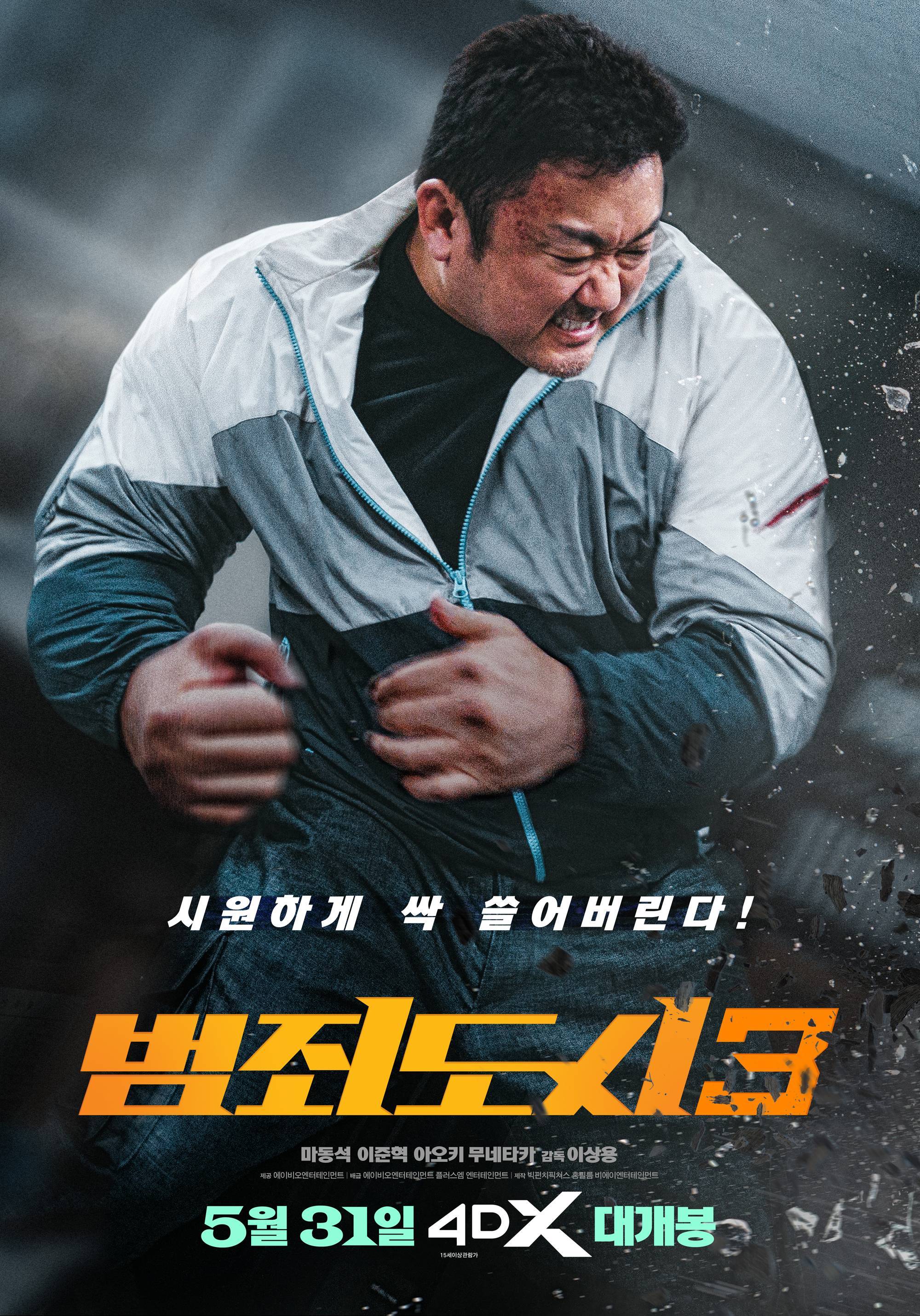
The Roundup: No Way Out (범죄도시 3, Lee Sang-yong, 2023)

Ma Dong-seok has been cultivating an image of himself as an action star for quite some time. The kind of marquee name who generally plays the hero, Ma looks back to the genre’s heyday presenting an uncomplicated vision of righteous masculinity, a bruiser with a heart of gold. The Roundup: No Way Out (범죄도시 3, Beomjoedosi 3) is the third in a series of films that began with The Outlaws and is projected to total at least eight instalments each starring Ma as the maverick detective his superiors hate to love. 

It’s true enough that you can’t get away from the more problematic elements of his unreconstructed good bad cop persona. We often see Seok-do (Ma Dong-seok) beat information out of suspects which the film treats as a cheeky joke in an otherwise tacit endorsement of police brutality that suggests red tape is the reason the guilty often evade justice. Meanwhile, in a step back from other Ma vehicles there are almost no women in the film and none in the police force. The heart of the case is the death of a 28-year-old woman who “fell” from a hotel room window and is later discovered to have died of a heart attack after being drugged in a club and dragged off by a random man who then literally threw her away to distance himself from the crime. The murder which Seok-do is supposed to be investigating is totally forgotten in his all encompassing drive to find out where the drugs are coming from which eventually descends into a battle of wits with a corrupt police officer who’s teamed up with a Korean-Japanese yakuza to skim his boss’ supply of new designer drug Hiper. 

There is a distinctly uncomfortable thread of xenophobia that runs through the series even if in this case the villainy is discovered closer to home in the form of police corruption. This time around, the threat is once again Japan which is apparently where Hiper originated though petty yakuza Tomo (An Se-ho) now manufactures it in Korea where he’s cut a freelance deal with dodgy cop Joo (Lee Joon-hyuk) to distribute it in the local night life scene without the knowledge of his boss back in Japan, Ichijo (Jun Kunimura). Joo has also cut a deal to sell the drugs to a Chinese gang, so it’s quite bad news for him when Ichijo gets wind of the situation and Tomo takes off with a suitcase full of pills for his own protection. Unluckily for him, Ichijo has already sent his most intimidating assassin, Riki (Munetaka Aoki), to find out what’s been going on behind his back. 

Problematic as it may be, Ma’s retro take on the action star is undeniably entertaining with his frequent hero moments and penchant for one liners. The first time he appears, we see him break up a street fight but mostly interested in finding out if the guy on the ground started it the implication being that perhaps if he did it’s none of his business but otherwise he’s going to have to intervene. Then again as he tells his exasperated boss, his personal motto is “punish and serve” and he’s here to get the job done even if that means wading in all fists blazing without much thought for regulations or procedure. At one point Seok-do and his guys stumble on a crime scene and walk around it touching everything in sight without bothering to even put on so much as gloves. 

In any case, Lee makes every punch land and quite literally as the screen seems to vibrate on contact almost as if the camera itself were taking a blow. Ma’s thunderous fists clash with the sound of justice as he all too easily disables hardened gangsters with one well placed slap. At times, his invincibility borders on the ridiculous but he does eventually allow himself be “defeated” if only temporarily as in his miraculous recovery from being run over by a gangster’s car. In many ways, Joo is Seok-do’s mirror, a bad bad cop with crazy eyes who kills without a second thought and behaves with narcissistic recklessness, overconfident in his abilities to sort his problems through his status as a law enforcement officer. Bruiser he may be, but Seok-do likes arresting people and never uses lethal force even when the opportunity is presented to him, symbolically snapping Riki’s katana and then proceeding to slap him seven ways to Sunday leaving the ice cool assassin collapsed amid a display of Japanese parasols. An end credits scene set three years later in 2018 sets up a fourth instalment and the return of a familiar face besides that of Seok-do himself who continues to charm as the world weary bruiser slapping down crime wherever it rears its ugly head. 


The Roundup: No Way Out is in UK cinemas now.

International trailer (English subtitles)

Punk Samurai (パンク侍、斬られて候, Gakuryu Ishii, 2018)

Gakuryu Ishii began his career under the name Sogo as a representative of the youth voice, in fact still a college student when invited by Nikkatsu to film a feature-length version of his Panic High School short though they paradoxically saddled him with the more experienced Yukihiro Sawada as a co-director in case his voice turned out to be more youthful than anticipated. In any case, he went on to make his name with a series of anarchic punk films such as Burst City and The Crazy Family before retreating from filmmaking in the early 2000s. When he returned in 2012 with Isn’t Anyone Alive?, he did so under a new name, Gakuryu, as if signalling a new phase in his artistic career that seemed to have left punk behind.

Like 2015’s That’s it, Punk Samurai is billed as a kind of return to Ishii’s anarchic roots while also harking back to surreal samurai movie Gojoe. Even so, Punk Samurai isn’t really a punk samurai film even in its irreverence towards the genre so much as an ironic jidaigeki comedy which eventually positions its hero’s nihilistic outsider status as his saving grace in a “fake” world where nothing has true meaning. “This world might be fake, but I’m alive” he insists, claiming not to ask anything of it, simply stating that he is “different” because he belongs to no group and has been a lonely a wanderer.

Nevertheless, Kake (Go Ayano) had wanted to join a clan so desperately that he spun a tale of dangerous cult rebellion to a naive retainer of a useless lord whose inability to rule has ruined his fiefdom. After killing a pilgrim he believed to be a member of the Bellyshaker Party, Kake is taken in by the Kuroae where he is enlisted by duplicitous councillor Naito (Etsushi Toyokawa) who seizes on the idea of the Bellyshaker threat as a means of undermining his rival, Ohura (Jun Kunimura), to seize the reins from overly serious lord Kuroae (Masahiro Higashide). 

The Bellyshaker cult believes that this “fake” world exists within a giant tapeworm and seeks escape though being excreted by it into the “real” world as a means of achieving some kind of spiritual enlightenment. Their furious belly shaking is deliberately meaningless in an effort to antagonise he tapeworm to such a degree that it gives it spasms to “spew” the believer into a more authentic existence. Not even the cult leader believed this to be true, and as Kake later suggests the appeal lies in a kind of Manichaeanism that allows the believer to believe nothing is their fault it’s just that this “fake” world is wrong. In the end, the conflict comes down to a battle between “monkeys and idiots”, while even an enlightened ape (Masatoshi Nagase) finds his revolution failing and is left with no option other than to retreat to the Heavens. 

The world is indeed in disarray, Kuroae is constantly plagued by his own poor decision making, or failure to make decisions at all, while there are constant allusions to the decline of his clan from persistent famine to military weakness after having made most of his foot soldiers redundant as part of an austerity programme. Many of the recruits to the “fake” Bellyshaker cult resurrected by Naito with the assistance of former devotee Chayama (Tadanobu Asano), who has two telepathic servants who speak for him, are in fact refugees from Kuroae who fled its disorder. Kake prides himself on being an outsider but in reality had wanted to join the clan, and there is perhaps something in the sudden collapse of the world around him along with a return to blue skies the moment his rebellion is ended. 

Yet for all its weirdness and incomprehensibility, for much of is running time Punk Samurai is a typical jidaigeki comedy about a useless lord, his clever underlings, and a chaotic ronin if one that also hints at the absurdist meaninglessness of the hierarchical samurai society. Only in its closing moments does the film truly embrace its punk spirit with psychedelic kaleidoscope backgrounds, electric swords, and the true slash down of the social order as Kake’s life comes full circle proving that even in this “fake” and meaningless world there are some things from which there is no escape.


Punk Samurai is released on blu-ray in the UK on 13th March courtesy of Third Window Films.

Original trailer (English subtitles)

Just Remembering (ちょっと思い出しただけ, Daigo Matsui, 2021) [Fantasia 2022]

A communication breakdown gradually erodes the love of a young couple in Daigo Matsui’s melancholy romantic drama, Just Remembering (ちょっと思い出しただけ, Chotto Omoidashita Dake). Inspired by Jim Jarmusch’s Night on Earth, Matsui’s city vistas are drenched in loneliness and regret made all the deeper by the enforced isolation of the coronavirus pandemic while echoing the sense of rueful nostalgia that draws the fated lovers back together but unites them only in their shared sadness. 

Told in a non-linear fashion, the film follows taxi driver Yo (Sairi Ito) and lighting technician Teruo (Sosuke Ikematsu) through the course of five year relationship picking up on each of Teruo’s July 26th birthdays as time ticks by with a weary fatalism expressed by an ever present wall clock. As the film opens, a lonely Teruo celebrates a birthday alone watching Night on Earth which we later learn to be his favourite film, a poster adorning the wall above his bed, and something of a touchstone in his relationship with Yo who is like Winona Ryder in the movie a woman who drives a taxi. Echoing the film’s title, each of them repeatedly encounters reminders of their time together from forgotten hair clips to outdated profile pictures that hint at the unresolved nature of their failed romance. In a park that leads to Teruo’s apartment, a man (Masatoshi Nagase) is often seen sitting by a tree waiting for his wife to arrive he says from the future. The man and his wife may perhaps represent an older version of Teruo and Yo though in contrast to his absolute faith and willingness to wait it’s uncertainty and an inability to reckon with intangible feeling that eventually disrupt their connection. 

Awkward and anxious, Yo struggles to express herself in words yet is unable to understand the world without them whereas Teruo communicates through dance and feels words to be largely unimportant unable to fully convey thoughts and emotions. The pair are indeed the most connected when they’re dancing, the otherwise shy and subdued Yo captivated by Teruo’s movement and dropping her guard to dance spontaneously in a quiet back alley while the street guitarist who forever connects them plays quietly behind. When Teruo injures himself and is left unable to dance, it destroys his ability to communicate and places an unbearable strain on the relationship as he retreats to lick his wounds unwilling to bother Yo with his mental and physical pain while she resents the distance he places between them and reads his reluctance to burden her as a fault line in their romance. She tells him that however he may change her feelings won’t, which only sounds to him as if she only loves an abstract idea rather than the reality while he too fears that she won’t like the him that that isn’t a dancer because not even he really knows who that Teruo may turn out to be. 

It’s telling in a way that the central love confession occurs in a taxi that’s being driven by someone else, a bemused older man who encourages the pair that it’s best to say what you want to say while you can and literally stops time for them by pausing the meter as twinkle twinkle little star echoes ironically in the background. Yo says she likes her taxi job because she has a desire to travel but not the ability to choose a destination and driving the taxi allows her to feel as if she’s on the way to something though she’s only following her passengers’ instructions. Her essential trait is passivity, feeling lost and aimless in her life and often allowing others to make her choices for her save when she follows the advice of a lovelorn barman (Jun Kunimura) who tells her that sometimes you have to chase after what you want only to later be disappointed when the wounded Teruo fails to chase after her. The barman tells her that she doesn’t understand love, and perhaps she doesn’t unwilling to trust her romantic destiny while perhaps neither does Teruo, always somehow waiting while gazing at visions of love on ordinary street, high school girls gossiping about boys, an elderly couple helping each other down the stairs, and a mother carrying her infant son. 

It’s tempting to view their romance as doomed because they speak different languages while their continual role reversal suits neither of them very well, Yo quite literally in the driving seat but by her own admission having no idea where they’re going while Teruo struggles to communicate with her in terms she can understand. Yet they also share moments of true connection and vulnerability in which they are each understood by the other in a way they may never be again that leaves each of them with a lingering loneliness and regret for their failed romance. Love is an escape route, according to the wise old barman, but it’s one that continually eludes the two lovers who like the like man at the park are trapped in a state of perpetual waiting for a far off resolution. 


Just Remembering screened as part of this year’s Fantasia International Film Festival.

Trailer (English subtitles)