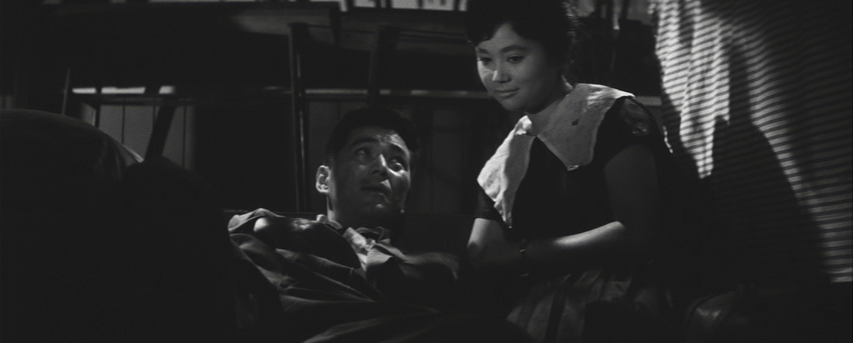
Procurer of Hell (地獄の饗宴, Kihachi Okamoto, 1961)

By 1961, the Japanese economy had largely recovered and the nation was emerging into an era of rising prosperity, but there were also those who were left behind or could progress into the new Japan. Shot with Okamaoto’s trademark irony, Procurer of Hell (地獄の饗宴, Jigoku no Kyoen) is a darkly comic tale of one such man who could have quit while he was ahead and started a new life if only he hadn’t been so greedy or perhaps so hung up on revenge. 

In a sign of the newly international society, Tobe (Tatsuya Mihashi) runs a shady business that claims to provide “English lessons” with blonde women are that are in reality appointments with sex workers. He also peddles pornographic images and dabbles in blackmail. When he finds a roll of film at the station, he gets it developed and discovers it contains photographs of his sergeant during the war, Itami (Jun Tazaki), who raped the Chinese woman he wanted to marry back in Manchuria. Tobe was unable to help her after getting his hand impaled on a tree branch from which he could not free himself. The scar he still bears on his hand is a mark of his corruption and a reminder of the moment which seems to have soured him on humanity and turned him into a cynical and amoral man. He decides to use the photographs to torment and blackmail Itami to get the money to help a widowed single mother he’s interested in secure a better future for herself by taking over a coffee shop from the owner who plans to retire.

As such, he does it for “good” reasons and Kazuko (Junko Ikeuchi) and her son Saburo represent for him a better future in the new Japan in which he would own a photo studio and live a law-abiding life. Saeko (Reiko Dan), Itami’s secretary with whom he was also having an extra-marital affair, is in other ways his opposite number and the representative of the dark side to which Tobe is drawn. Like him, she tries to play the situation to her advantage by playing the innocent before finally throwing her lot in with Tobe and suggesting he help her double-cross Itami so they can run off with the money he embezzled from his company before faking his own death in a convenient train crash. That Tobe extracts sexual favours from Saeko in return for giving her the photos and negatives interferes with the supposed nobility of his quest and apparently pure-hearted love for Kazuko and her little boy, while Saeko gradually shifts from exploited victim to calculating conspirator manipulating Tobe just as he believes himself to be manipulating her.

In any case, it remains true that he could have just settled for the money he needed for the cafe and walked away from this overly complicated situation involving Itami’s legal wife and associates who have actually embezzled the money and want the pictures back because they need Itami to be dead for their plan to work, but he doesn’t. He becomes fixated on getting his fair share of the ill-gotten gains much more than helping Kazuko or getting his revenge against Itami, which wasn’t really much of a revenge anyway considering what Itami had actually done during the war. But on the other hand, Itami seems to have become a rather powerless figure having married into his wife’s family to work in their business while she plots to have him confined to a psychiatric hospital to keep him out of her way. Saeko too is manipulating him. She has no real feelings for Itami and only wants the money, masterminding this whole scheme to get her hands on it with no intention of fleeing abroad with him. Similarly, she plays the victim with Tobe, telling him that Itami paid for her brother’s school fees and that she wants the photos back to avoid her brother or Mrs Itami finding out it about it and feeling hurt.

But while they’re fixating on the 150 million yen embezzled from the business, there are crowds of angry people turning up at the building society Itami runs complaining that their savings have disappeared and wanting to know if they’re going to get the houses they’ve been promised. Tobe walks through the May Day protests calling for better working conditions and higher wages, pointing to the ways this society is still veering off course in deliberately leaving some-people behind by rooting the new economic prosperity in exploitation. Tobe’s assistant wants to join the protest, but Tobe tells him they don’t really belong with the workers because of their nature of their business. The blackmail scam is his revenge not only on Itami but on everything that’s happened to him since the war and this ridiculous post-war society that he nevertheless hopes to join through these immoral means. The song of the canary he buys for Saburo begins to haunt him as a symbol of the wholesome life he might lead, but that life cannot really be won that way. He and Saeko are really two of a kind, she apparently brought low by her unexpectedly genuine feelings for him as even the police, picking him up for something else, leave them bleeding in the street surrounded only by emptiness and futility mere feet from the hospital in their own relentless pursuit of the “real” criminals.
Beast Alley (けものみち, Eizo Sugawa, 1965)

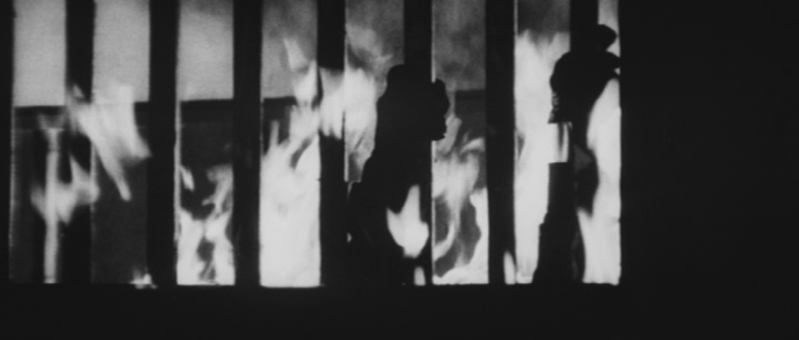
In the opening title sequence of Eizo Sugawa’s Beast Alley (けものみち, Kemonomichi), a thick blob of inky blackness gradually expands over an aerial view of the city until it obscures it entirely. The title card which then appears is written in plain white, but will reappear at the film’s conclusion this time ashen as if it too had been singed by the deeply ironic flames with which the film ends. Based on a novel Seicho Matsumoto and scripted by The Beast Shall Die’s Yoshio Shirasaka, the film similarly takes an incredibly cynical view of the modern post-war society in which it is revealed the militarists are still basically in charge and presiding over a deeply corrupt social order. 

The big bad, Kito (Eitaro Ozawa), says as much when he states the need for reforming the nation’s “rotten political system” by which he means post-war democracy. Kito made his made his money doing deeply dodgy things in Manchuria in addition to running an exploitative coal mine in Japan. Now mainly bedridden, he basically runs the country as a far-right political fixer working in tandem with big business and the yakuza who have traditionally been big supporters of conservative and nationalist forces. Early on we see one of his underlings negotiating with politicians to ensure that Taiyo Roads will be hired be hired for a large scale construction project planning to put highways all the way through Tokyo. As we later discover, he’s prepared to go to great lengths in order to achieve his goal, going so far as to have a sex worker murdered to implicate the uncooperative CEO of a rival construction film into resigning by threatening to frame him for the crime so they can install their stooge in his position. 

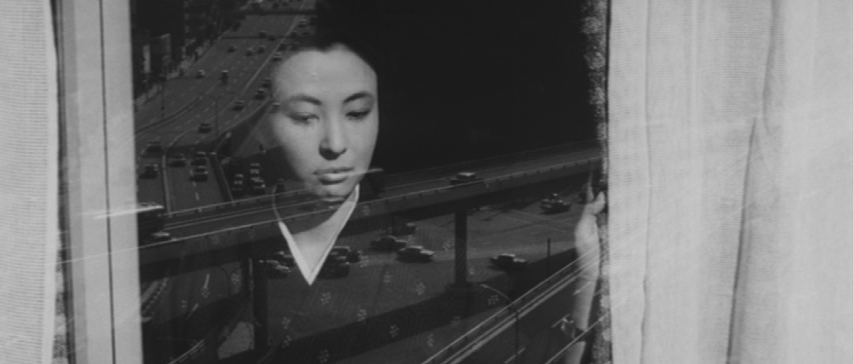
It’s into this world that everywoman Tamiko (Junko Ikeuchi) is drawn while working as a hotel maid at a traditional Japanese inn. Trapped in a bad marriage to a man who is also bedridden yet still attempts to rape her when she returns home to find him in bed with the housekeeper, Tamiko longs for escape and is therefore ripe for the picking when approached by Kotaki (Ryo Ikebe), the manager of an upscale Western hotel, to join him in an unspecified enterprise which will apparently make her very rich. The only catch is that she will have to “get rid” of her “dependent”, which she probably wanted to do anyway, by burning down her house with him inside it. Once she’s done this, there is no turning back for her even if she had not developed complicated feelings for Kotaki who is both her salvation and damnation. 

Tamiko’s husband had failed to give her the comfortable life that he had promised, something which she thinks Kotaki can deliver even if it requires her to become the plaything of Kito whom does she actually seem to like even if aware of the precarity of her position and still in thrall to Kotaki. Leaving the hotel so abruptly was however a strategic error as it arouses the suspicious of (originally) earnest cop Hisatsune (Keiju Kobayashi) who quickly realises that Tamiko set the fire to kill her husband. Though he seemed to be motivated by justice, Hisatsune too is soon corrupted explaining to Tamiko that he has become cynical and jaded. Years of police work have shown him that true criminals know how to break the law and get away with it so he can’t do anything about them, but “good” people, like he implies Tamiko, are pushed into crime by desperation and are easily caught. Tamiko wields her sexuality against him by agreeing to a tryst, though when it doesn’t go to plan he tries blackmail and then rape before she, ironically, manages to escape from his bungled crime. 

Hisatsune’s corruption is gradual and self serving. He starts with suspicion, tailing Tamiko in the interests of justice but also because he desires her, before stumbling on the conspiracy, putting the pieces together, attempting to use them for his own gain and trying to blow a whistle mostly out of resentment. Kito’s reach is all encompassing. Hisatsune is warned off investigating certain aspects of the crime by his senior officers and is then fired on Kito’s instructions for fiddling his expenses after harassing Tamiko. He tries to give his findings to his boss but it goes nowhere and then tries the press but is given the brush off, the editor his reporter friend refers him to gently implying he’s just a crank with an axe to grind. Of course, it turns out that the reporter is already in league with dodgy lawyer Hatano (Yunosuke Ito) who is Kito’s right-hand man. 

The connections between the three men, Kotaki who was once a communist, Hatano, and Kito go back to Manchuria and the corruptions of militarist era which it becomes clear has never really ended. Kito has only one rival and it’s another faction of the conservative ruling party who are probably just waiting for him die. Attempts are made on his life and they don’t go well for those who make them. Even if Hatano hoped to simply inherit an empire he, as he points out, put in much of the work to build he is sorely mistaken while Tamiko may intellectually understand that Kito’s death would place her in a precarious position but carries on regardless. “You never know who will betray you in this world” Kotaki laments, echoing Kito’s later claim that his Buddhist statues are the only ones will never betray him even as sleeps next to a statue of Aizen Myo whom he ironically claims protects mankind from their lust and desire. 

It could be said that desire is Tamiko’s undoing, but as Hisatsune had suggested perhaps you couldn’t blame her for longing to be free of the bedridden husband who had not delivered what he promised her. As she said, she was doing what could to survive even if you’d think she’d know putting on a ring taken from the finger of a murdered woman is akin sealing your own fate. Sugawa shoots with a noirish sense of dread, tracking Tamiko with her coat drawn up around her face as she tries to leave the scene of her crime, and makes the most of his fiery imagery before ending on a note of cynical laughter amid the inescapable hell the of post-war society. 


Original trailer (English subtitles)

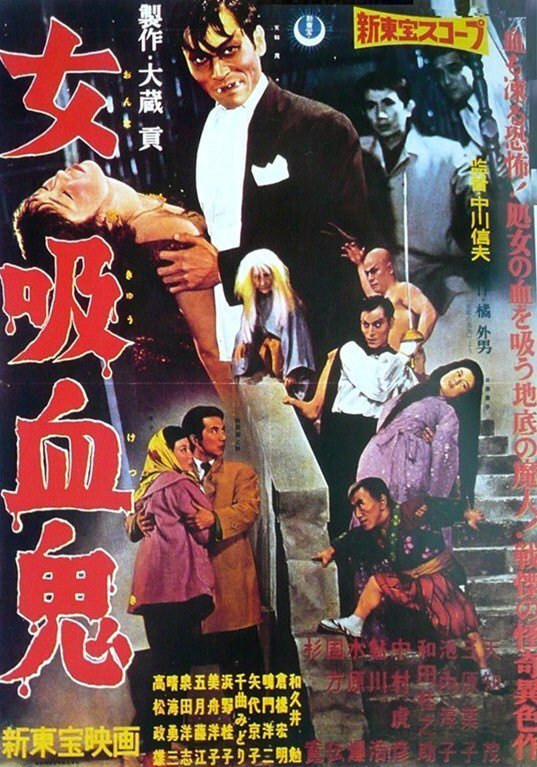
The Lady Vampire (女吸血鬼, Nobuo Nakagawa, 1959)

Three years after the Vampire Moth, Nobuo Nakagawa returns to the realms of bloodsucking adventure with the misleadingly titled The Lady Vampire (女吸血鬼, Onna Kyuketsuki). The only “vampire” on offer here is male, though his victim is indeed a “lady” in being the descendent of a noble family apparently the subject of a mysterious curse which, along with her resemblance to a beautiful ancestor, makes her so attractive to the sensitive, artistic bloodsucker at the tale’s centre. Heavily influenced both by Hammer Horror and Universal’s monster films from the ‘30s, Nakagawa plays fast and loose with his mythology while indulging in a common though problematic association between vampirism and Christianity.

Beginning in high style, the film opens with a driver escorting ace reporter Tamio (Takashi Wada) to the birthday party of his fiancée Itsuko (Junko Ikeuchi) for which he is already very late. The driver stops the car believing he has hit a woman pedestrian, but she seems to have vanished. Later, Tamio spots her wandering around near Itsuko’s home, while Itsuko brings darkness into her party by accidentally cutting her finger and getting a suspiciously large amount of blood on her cake. This alarms Itsuko’s father Shigekatsu (Akira Nakamura) because it reminds him of something that happened right before his wife, Miwako (Yoko Mihara), mysteriously disappeared 20 years previously. 

Of course, the mystery woman turns out to be none other than Itsuko’s long lost mother who is discovered in a long disused room by her extremely confused husband. To everyone’s consternation, Miwako looks exactly the same as she did 20 years ago and for the moment is more or less catatonic. The doctors can’t explain it, and no one is quite sure what to do about this miraculous development. Itsuko stops to make sure Tamio isn’t going to put any of this in his paper, fearful that people will think of her mother’s condition shamefully as a disease or a deformity. Paying a visit to a local art gallery, the pair are shocked to discover that the prizewinning work by a previously unknown artist seems to be a nude painting of Miwako and begin investigating to find out if it has some connection to her disappearance and present vacant state.

Meanwhile, a “fiend” is making trouble in the modern city. The artist behind the painting, using the name Shiro Sofue (Shigeru Amachi), is a brooding, dapper young man in a dark fedora and sunshades with a white scarf fashionably tied around his neck. We learn that he has an extreme aversion to moonlight because it makes him go crazy, feasting on the poor hotel maid who was only trying to make his stay as comfortable as possible. Aided by his dwarf minion Tiny (Tsutomu Wakui), Shiro (not his real name), puts the body neatly outside like a room service tray and pleads ignorance when the police, and crime reporter Tamio, arrive to investigate the heinous murder. The same thing happens again in a Ginza bar where, for reasons not quite obvious, Tiny starts making trouble and smashes a window letting the moonlight in sending Shiro into a murderous rage where he slashes six women with Tamio watching from the sidelines. 

Shiro steals the painting back and delivers it to Shigekatsu where Miwako eventually sees it and regains her memories. At this point, Shigekatsu enlightens us about the “Matsumura curse” which dates back to the 17th century and the rebellion of Shiro Amakusa who led Japan’s secret Christians in revolution against the Shogunate but was defeated. His troops were massacred and he himself was beheaded as a traitor. The Matsumuras are apparently direct descendents of the Amakusa clan and so have “cursed” blood. “Shiro Sofue” is not Amakusa Shiro but a lovelorn retainer, Takenaka, who coveted the princess Katsu but was unable to have her. When she asked him to take her life to save her from the Shogunate forces he complied, but then drank her blood out of love for her and apparently became an immortal being with the occasional urge to sustain himself with the blood of other young women. 

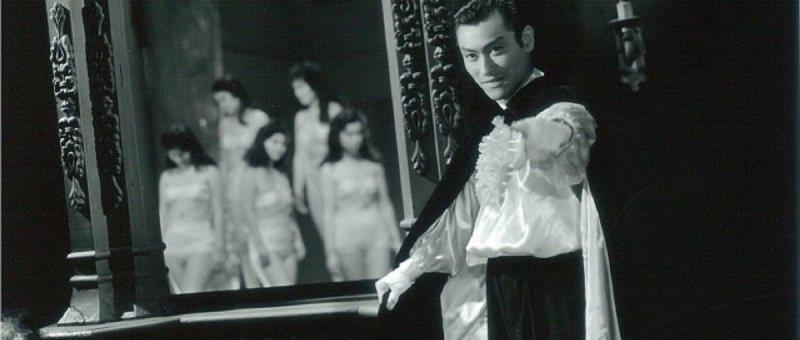
How this became a “Matsumura” curse or really what the curse supposedly refers to is unclear, especially as Takenaka isn’t even part of the family but a lesser retainer damned by love for an unattainable princess. Like subsequent Japanese vampires, the “curse” is directly linked to Christianity. Takenaka’s sales patter uses heavily ritualised language he likens to a “baptism” . “Accept my love, and you will live forever in eternal, unfailing youth” he tells his victims after drugging them with sweet smelling flowers and dragging them back to his underground castle which is built in the Western gothic style and, ironically, filled with crosses. This vampire makes good use of mirrors and has co-opted religious imagery for his own ends. Later we see that he has attempted to find an eternal mate several times before, turning his victims into fleshy statues by placing a gold cross on their heads in the same way a Taoist priest might stop a hopping vampire with a Buddhist sutra. The final of these is a direct echo of the archetypal Virgin Mary statue found at Christian churches all over the world. 

Through this, the “curse” is rendered a foreign import existing outside of and presenting a direct threat to traditional Japanese culture, again aligned somewhat problematically with Christianity by way of an overly literal interpretation of ritual. The  settings too are predominantly Western – the European-style mansion, hotels, bars, and galleries, while Takenaka dresses in a billowing white shirt and cape, living in a stone “castle” built in a cave, and eventually fighting with a fencer’s rapier rather than a katana. His minions, however, have a slightly more diverse flavour in addition to Tiny with a giant mute bald man providing security and a witchy old woman looking like she’s just walked out of Throne of Blood dispensing advice with a seemingly more “Japanese” context. As usual, Itsuko becomes mere bait hysterically running around the castle chased by Tiny while intrepid reporter Tamio heroically battles both the bald man and Takenaka himself until the police finally arrive and bring “order” to this orderless place. The young free themselves from an ancestral curse and prepare to move on, no longer burdened by “bad blood” as they watch the past dissolve while preparing to move into a freer future. 


Hibari Ohako: Benten Kozo (ひばり十八番 弁天小僧, Yasushi Sasaki, 1960)

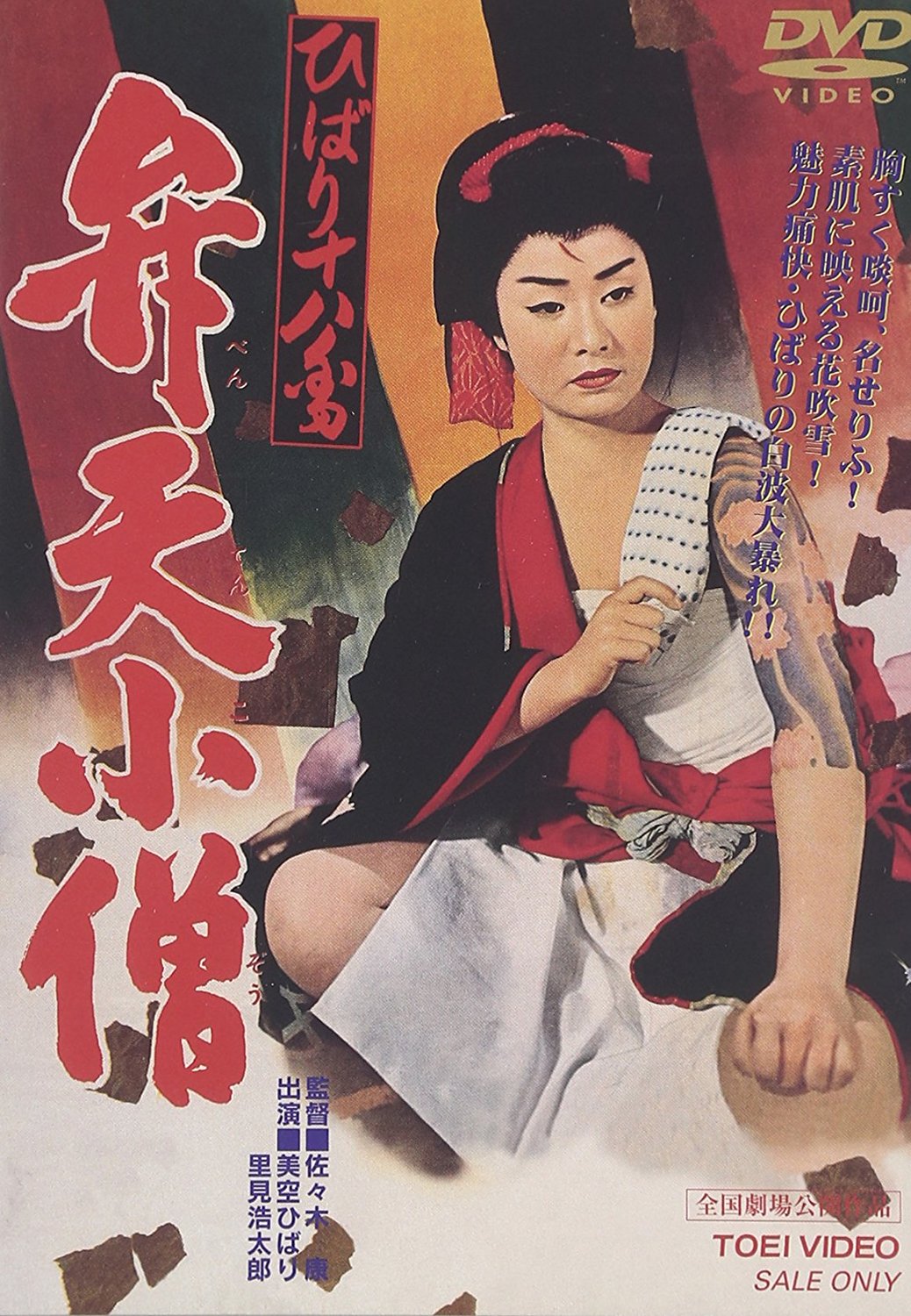
Benten Kozo dvd coverStarting out as a child actress, Hibari Misora was one of the biggest singing and acting stars of the post-war period whose songs are often pointed to as embodiments of the era’s melancholy yet determined spirit. Though it’s her singing career which has perhaps had the most historical impact, Misora made an immense number of films most of them in ’50s and ‘60s, many typical star vehicles of the time – silly comedies and softer musicals, usually finding an opportunity or two for a song even in straight drama. Hibari Ohako: Benten Kozo (ひばり十八番 弁天小僧), released in 1960 for Toei, is very much of this mould and showcases another somewhat interesting facet of Misora’s career in her readiness to play ambiguous gender roles.

Based on the well known kabuki play, Benten Kozo, which had also been adapted two years previously in a version starring male actor Raizo Ichikawa, Sasaki’s film stars Hibari Misora in the title role – a 13 year old boy who was given up at birth to be raised in a temple which specialises in performing Noh theatre. Kikunosuke (Hibari Misora) is their star, but there’s a dark side to temple performing companies in that they’re dependent on donations and it’s accepted practice to allow wealthy patrons to do whatever they like with the talent, no matter their age or gender. Kikunosuke knows this and isn’t having any of it. Pushed into a room with a lecherous, overly made-up older woman, Kikunosuke balks at the old monk’s attempts to pimp him out and tries to leave, much to the monk’s disappointment.

Unfortunately, just as Kikunosuke is leaving, a thief arrives to steal the money meant for the monk and kills the old woman in the process. Kikunosuke kills the thief but is accused of killing the old woman too and is forced on the run. Tracking down his birth mother, Ofuji (Mitsuko Miura), Kiku thinks he’s found a home but is betrayed, at which point he adopts the name “Benten Kozo” (lit. “Benten Kid” where Benten is the name of the goddess at the temple where he was raised) and joins a gang of Robin Hood-style outlaw thieves.

Like many period films of the time, Benten Kozo revolves around exposing the corruption of the samurai order. In this case, it’s a salt scam – the samurai elders have been stockpiling salt to push the price up, endangering the lives of ordinary people for their own financial gain and thinking nothing of it. The thieves, led by later Lone Wolf and Cub star Tomisaburo Wakayama, are dedicated to robbing the rich to feed the poor but they also aim to expose those in power for the reckless bullies they really are. Benten Kozo joins the “Shiranami Five Alliance” both out of self preservation and out of genuine sympathy with their cause, eventually encountering the same corrupt monk who turned a blind eye to his attempted molestation when he intervenes to save a woman forced into prostitution to pay her father’s debt whom the monk was attempting to rape.

Benten Kozo listens to the woman’s story and decides to give her his savings (which he no longer wants after being betrayed by his mother for whom he’d been saving the money) to pay off her family debt. In fact the pair met earlier when Benten Kozo was on the run and she helped him hide from the authorities. The woman, like several in the film, falls for Benten Kozo’s androgynous charms though he remains resolutely noble and indifferent. Benten Kozo would originally have been played by a male actor on the kabuki stage which did not allow female performers. The “onnagata” or actors who specialised in playing women were often effeminate younger men or boys much like Benten Kozo himself who plays these skills to the max throughout the film.

Hibari Misora, with her low, husky voice, effortlessly switches between the elegant upperclass women Benten Kozo impersonates on stage and in service of the gang’s scams, and the rough and ready dialect of a street ruffian. In a shocking display of bravado, Benten Kozo drops the top of his kimono to show his off his tattoos proving once and for all that he’s no lady but still his appeal lingers perhaps precisely because of his gender ambiguity.

Benten Kozo is not a musical but finds two occasions for Misora to sing – once as Benten Kozo takes off on the road, and the other at the end as he paddles a boat away back to his new found friends. The film ends with a giant mass brawl and also provides ample scope for Misora to escape across roof tops and fight off the unjust but it’s otherwise fairly straightforward fare and not exactly among the singer’s most memorable outings. It is however generally entertaining and interesting enough in its central theme of woman playing man playing woman to warrant attention from more than just diehard Misora fans.


Hibari Misora singing Benten Kozo in concert some years later.

Illusion of Blood (四谷怪談, AKA Yotsuya Kaidan, Shiro Toyoda, 1965)

vlcsnap-2017-07-01-00h50m36s347Shiro Toyoda, despite being among the most successful directors of Japan’s golden age, is also among the most neglected when it comes to overseas exposure. Best known for literary adaptations, Toyoda’s laid back lensing and elegant restraint have perhaps attracted less attention than some of his flashier contemporaries but he was often at his best in allowing his material to take centre stage. Though his trademark style might not necessarily lend itself well to horror, Toyoda had made other successful forays into the genre before being tasked with directing yet another take on the classic ghost story Yotsuya Kaidan (四谷怪談) but, hampered by poor production values and an overly simplistic script, Toyoda never succeeds in capturing the deep-seated dread which defines the tale of maddening ambition followed by ruinous guilt.

As usual, Iemon (Tatsuya Nakadai) is a disenfranchised samurai contemplating selling his sword due to his extreme poverty. Iemon had been married to a woman he loved, Oiwa (Mariko Okada), whose father called her home when Iemon lost his lord and therefore his income. Oiwa’s father is also in financial difficulty and Iemon has now discovered that he has been prostituting Oiwa’s sister, Osode (Junko Ikeuchi), and plans a similar fate for Oiwa.

Still in love with his wife, Iemon decides that his precious sword is not just for show and determines to take what he wants by force. Murdering Oiwa’s father, Iemon teams up with another reprobate, Naosuke (Kanzaburo Nakamura), who is in love with Osode and means to kill her estranged fiancee. Framing Osode’s lover Yoshimichi (Mikijiro Hira) as the killer, Iemon resumes his life with Oiwa who subsequently bears their child but as his poverty and lowly status continue Iemon remains frustrated. When a better offer arrives to marry into a wealthier family, Iemon makes a drastic decision in the name of living well.

The themes are those familiar to the classic tale as Iemon’s all consuming need to restore himself to his rightful position ruins everything positive in his life. Tatsuya Nakadai’s Iemon is among the less kind interpretations as even his original claims of romantic distress over the loss of his wife ring more of wounded pride and a desire for possession rather than a broken heart. Selling one’s sword is the final step for a samurai – it is literally selling one’s soul. Iemon’s ultimate decision not to is both an indicator of his inability to let go of his samurai past and his violent intentions as the fury of rebellion is already burning within him.

Iemon defines his quest as a desire to find “place worth living in”, but he is incapable of attuning himself to the world around him, constantly working against himself as he tries to forge a way forward. Oiwa’s desires are left largely unexplored despite the valiant efforts of Mariko Okada saddled with an underwritten part, but hers is an existence largely defined by love and duty, pulled between a husband and a father. Unaware that Iemon was responsible for her father’s death, Oiwa is happy to be reunited with him and expects that he will honour her father by enacting vengeance. Only too late does she begin to wonder what her changeable husband’s intentions really are.

An amoral man in an amoral world, Iemon’s machinations buy him nothing. Haunted by the vengeful spirit of the wife he betrayed, Iemon cannot enjoy the life he’d always wanted after purchasing it with blood, fear, and treachery. Despite the odd presence of disturbing imagery from hands in water butts to ghostly presences, Toyoda never quite achieves the level of claustrophobic inevitability on which the tale is founded. Hampered by poor production values, shooting on obvious stage sets with dull costuming and a run of the mill script, Illusion of Blood has a depressingly unambitious atmosphere content to simply retell the classic tale with the minimum of fuss. Only the final scenes offer any of Toyoda’s formal beauty as Okada appears under the cherry blossoms to offer the gloomy message that there is no true happiness and her husband’s quest has been a vain one. Achieving her vengeance even whilst Iemon affirms his intention to keep fighting right until the end, Oiwa leaves like the melancholy ghost of eternal regret but it’s all too little too late to make Illusion of Blood anything more than a middling adaptation of the classic ghost story.