Honeko Akabane’s Bodyguards (赤羽骨子のボディガード, Junichi Ishikawa, 2024) [Fantasia 2025]

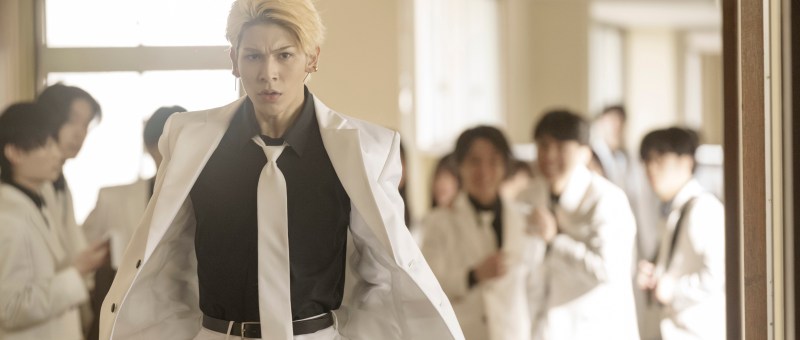
Unbeknownst to her, a high school girl’s entire class is actually made up of bodyguards hired by her distant father, whom she doesn’t know either, to keep her safe because his work makes her an easy target for international criminals. Adapted from the manga by Masamitsu Nigatsu, Junichi Ishikawa’s Honeko Akabane’s Bodyguards (赤羽骨子のボディガード, Akabane Honeko no Bodyguard) is in some ways fairly typical of the genre in its parade of unrealistic hairstyles and over-the-top humour, but also anchors itself in a genuine sense of friendship and youth solidarity as the class come together under a charismatic leader not only to protect Akabane but each other too.

That charismatic leader would be Ibuki, a cocksure delinquent and childhood friend of Akabane’s who’s also been carrying a torch for her all these years. Nevertheless, it comes as quite a surprise when he’s officially hired by Jingu (Kenichi Endo), a man who claims to be the head of Japan’s Security Services. After his wife died, he decided to place Akabane for adoption to keep her safe from the duplicitous world in which he lived. But now there’s a 10 million yen bounty on her head and every criminal enterprise he’s ever been after is desperate to get their hands on her. What Ibuki doesn’t know is that he’s hired the rest of the class too who all have various skills from rhythmic gymnastics to torture. It’s imperative that Akabane never find out that she’s a target, nor that Jingu is her biological father, and continues to live a “normal” carefree life.

She certainly appears to have no skills of her own other than her ability to quote legal infractions in her desire to become a lawyer like her adopted parents. While this may on some level remove her agency in making her dependent on her classmates for protection, it’s also Akabane that takes the initiative in romance by making overtures to the otherwise diffident Ibuki. Other the other hand, she’s painted as the mirror image of her sister, Masachika (Tao Tsuchiya), who has been raised as a boy and taught to be an assassin but craves the kind of love and affection Jingu pours on Akabane. 

This is one reason that she is eventually able to find unexpected common ground as she and Akabane are obviously both firmly on team Ibuki with Akabane thankful that someone else can see Ibuki’s good side even if most people mistake him for being a scary and dangerous person. Like his father, the late policeman, he believes that to protect someone you must protect everything they love which is why he’s desperate to protect the whole of the class too so that Akabane’s world remains consistent. Most of the other students aren’t too invested in their jobs and are only doing this for the paycheque, but eventually end up coming together thanks to Ibuki’s insistence that he won’t leave them behind. Not only does he need their help to protect Akabane, but genuinely respects their friendship and wants to save them too.

Then again, we’re presented with a series of images of paternal and hierarchal failure. Ibuki’s own father was killed in the line of duty and while alive had little time for his son, if like Jingu trying to keep his child out of the dangerous world in which he lives. Jingu gave up one daughter to keep her safe, but has a strained relationship with the second who feels like a failure and is desperate for a chance. Even the head of the class is compromised as he first proves himself willing to sacrifice the lives of his men in achieving their goal of protecting Akabane and then seems to commit several blunders including being unable to unmask a mole. Ibuki becomes a de facto leader, but at the same time what emerges under him is a relationship of equals and solidarity between those in a similar situation. They are no longer working for Jingu or following their leader’s orders but thinking for themselves and actively protecting each other. 

Ishikawa puts together some excellent action sequences that demonstrate what a well-oiled machine the students can be in standing up against criminality while maintaining the zany humour and making Ibuki an oddly pure figure of warmth and integrity as he resolves to protect all of those around him if most especially Akabane to whom he is unable to voice his real feelings. She meanwhile, admittedly a damsel in distress, is at least taking the lead when it comes to their romance even if she continues to needle him about his rough and uncouth behaviour. Honeko Akabane is it seems very well protected from any threats that come her way save perhaps that of her hidden past.                                                                                                                                    


Honeko Akabane’s Bodyguards screened as part of this year’s Fantasia International Film Festival.

Original trailer (no subtitles)

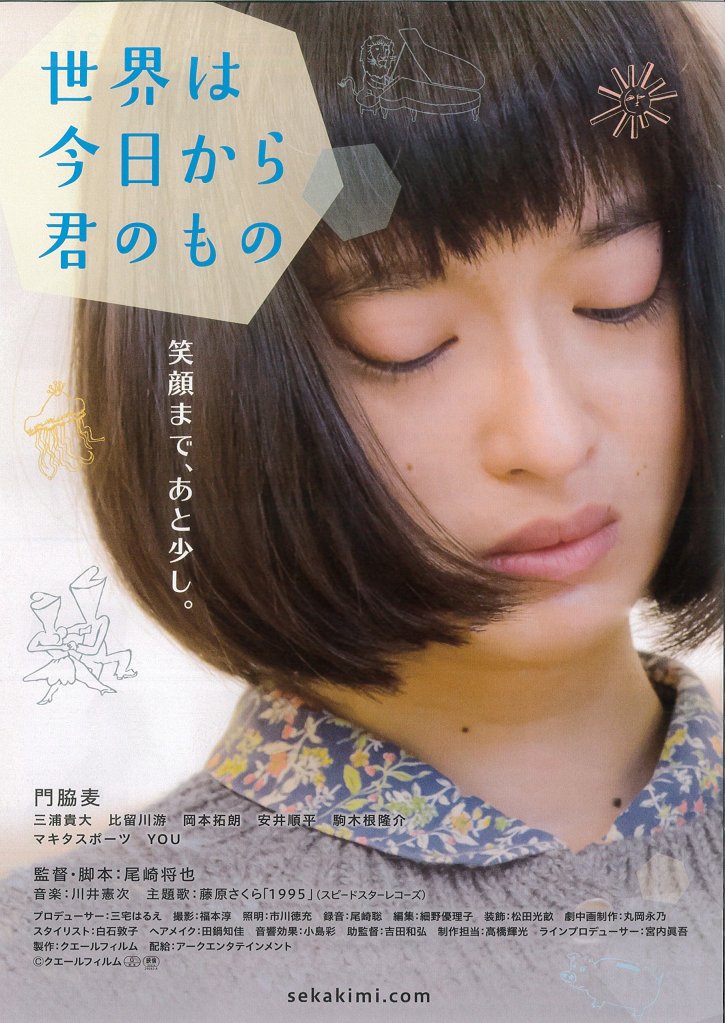
Her Sketchbook (世界は今日から君のもの, Masaya Ozaki, 2017)

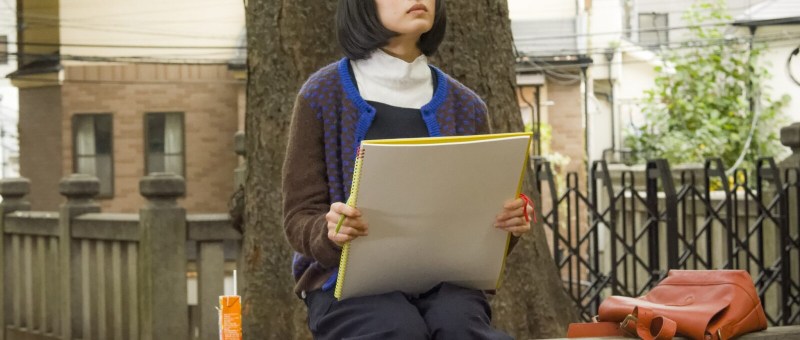
Many young people struggle to find their place in the world, but for young Mami who largely just wants to be left alone, the struggle is all the greater. Less a hikikomori drama than a tale of destructive parenting and buried talents, Her Sketchbook (世界は今日から君のもの, Sekai wa Kyou kara Kimi no Mono) charts the gradual blossoming of a young woman who begins to take root after finding the right environment in which to thrive, encouraged by others who take the time to see and appreciate her for who she is rather than all they fear she’s not. 

A shut-in since dropping out of middle school, Mami (Mugi Kadowaki) has recently taken a factory job but is laid off after a little misadventure at the seaside leaves her with an injury that prevents her from strenuous labour. Her father Eisuke (Makita Sports), recently made redundant himself, is worried for her future and wants her get out more so he sets her up with a job that seems ideal, testing games for bugs at a software company. It’s there that she crosses paths with harried project manager Ryotaro (Takahiro Miura) who is getting fed up with the artistic temperament of his usual character designer. He drops a sketch covered in markup notes and she tries to hand it back to him but is too shy and ends up taking it home where she diligently corrects it according to his instructions and mails the revised illustration to the address on the bottom, trying to make up for her failure in being unable to approach him in person. The new drawing is exactly what Ryotaro had envisioned, but he has no idea who the mystery illustrator is. Nevertheless, he decides to start mailing additional requests to the unfamiliar email address. 

Eisuke thinks he’s doing the best for his daughter, but even he in unguarded moments describes her as odd and a failure. He had no idea that she had any kind of “talent”, believing she was just sitting in her room twiddling her thumbs. But for Mami, the discovery of her boxes of illustrations is something of a mixed blessing. She’s glad people seem to be pleased, but partially resents the new attention and quickly realises that they’ve misunderstood her capabilities. She’s good at mimicking the style of others and correcting proofs according to instructions, but struggles when asked to come up with ideas of her own. 

That struggle is essentially a mental block on being able to see herself. Always a little “different”, Mami never fit in at school and while her father fretted that she wasn’t making friends, her mother (You) was content to let her be. Unfortunately that wasn’t because she accepted her daughter for who she was and wanted to support her, but that she knowingly or otherwise used her difference against her as a reason to keep her close. Now having left the family for unclear reasons, Mami’s mother remains possessive and domineering, never missing an opportunity to undermine her daughter’s sense of confidence or to remind her that she doesn’t belong in regular society. Mami’s struggle is, in that sense, to break free of her mother’s toxic parenting and reject her view of her as someone who is entirely unable to lead a normal life as independent adult. 

Essentially infantalised, Mami finds herself learning adult life lessons at an accelerated pace but also battling unhelpful attempts to exploit and misuse her hikikomori past. A sleazy public servant who threatens to assault Mami after bringing home her drunken friend from a bar convinces her to appear at a panel he’s running on the hikikomori phenomenon but completely ignores everything she tells him, trying to twist her words to suit his own hypotheses in presenting her as someone who has successfully reintegrated into mainstream society. He wants her to say that she took the factory job to help out after her dad was laid off, but really she took it because his being home all day was quite annoying so she got a job to avoid him. The public servant simply isn’t listening, but a shy little girl in the back is and finally knows there’s nothing wrong with her and she’s not alone. 

What gives Mami the courage to move forward is the gentle encouragement of her new friends who never treat her as if she’s weird or incapable and are prepared to be patient while she finds her footing. Just like the flower in the flip book she draws while waiting for inspiration, Mami blossoms after finding the right environment in which to thrive, gaining confidence from other people’s confidence in her but resolving to take things one step at a time, harnessing her newfound talent to claim a space for herself in a world opening up before her.  


Screened as part of the Japan Foundation Touring Film Programme 2020.

International trailer (English subtitles)