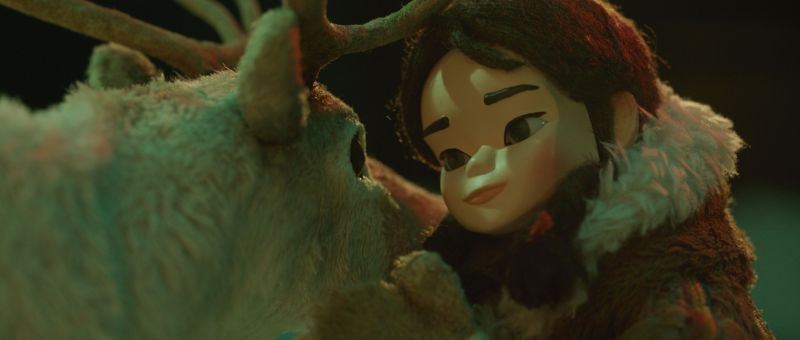
Mother Land (엄마의 땅: 그리샤와 숲의 주인, Park Jae-beom, 2022) [Fantasia 2023]

A little girl becomes the spiritual defender of her traditional culture in her quest to cure her mother’s mysterious illness in Park Jae-beom’s stop motion fairytale, Mother Land (엄마의 땅: 그리샤와 숲의 주인, Eommaui Ttang: Geulisyawa Sup-ui Ju-in). Taking place seemingly in mid-20th century Siberia, the film focusses on the Yates people, nomads who live on the tundra raising reindeer in much the say way they have for centuries even as their existence is threatened by the militant modernity of Soviet Russia.

Krisha is a young woman who has begun having strange dreams believing she can see a huge red bear with shining eyes. Distracted, she is almost hurt when wind threatens to blow their half-built yurt down during a move but is saved by her mother, Shura. Shortly after they are visited by Captain Vladimir and Bazak, a member of the Yates who has betrayed his people to team up with the government in an effort to kill the “Master of the Forest” in order to claim the tundra and bring it into a fully modern society. When Krisha’s father Tokcha tells him it’s not a good idea and he’ll be punished for desecrating their sacred land, Vladimir counters that they too should join the collective farm threatening the very survival of their traditional culture. After insisting that the tundra is their home and they won’t leave it, Shura is taken ill with a mystery condition a shamaness says she has only seen in a Western village which no longer exists. 

It could be said that Shura’s sickness is born of the threat that modernity poses though her family is faced with a choice over what to do about it. The shamaness says she knows no cure and their only hope lies in visiting The Master of Forest to ask for his help but Tokcha balks that no one’s ever seen him and he’s not convinced that he exists let alone that he could help. While Krisha wants to follows the Shamaness’ advice, her father instead decides to ride into the city in search of modern Western medicine. Once he’s gone she secretly steals away with her little brother Kolya and their trusty reindeer steed Serodeto to look for the Master of the Forest whom she thinks may be the big red bear that’s been haunting her dreams. 

When she eventually finds him, the bear tells her that it is not his place to save her mother though he has been waiting for her for he believes she has come to save him. Bazak, who is in search of vengeance for his wife and daughter, asks what the point is of a god who only watches while others suffer but Krisha comes to see him as a manifestation of the healing power of the land he tells her is being lost because of its mistreatment by those like Captain Vladimir who describes Tokcha as an “arrogant barbarian” and has no respect for his culture or even for nature itself. 

Vladimir isn’t wrong when he calls the tundra the hope of the country though obviously not in the way that he means it. Krisha’s quest to save her mother is also a quest to save her land, the bear and her mother becoming symbolically linked while Krisha develops a maternal sense of herself as a guardian of her culture insisting that she will remain on the tundra practicing what she’s learnt as a link between heaven and earth. 

Even so, Park captures a sense of nature red in tooth and claw in the opening scenes in which a deer is butchered and some of its blood returned to the land in a ritual of gratitude to mark its sacrifice. The icy emptiness of the tundra is broken only by the appearance of Vladimir’s military van spewing black smoke into the otherwise pure landscape, while Park’s designs have a kind of warmth in their tactile quality from the powdery snow to the fabric covering the yurt and the tunic made for Krisha by her mother out of deer pelt and fur. Impressive scenes of wolves running are tempered by quiet moments of self-reflection as Krisha goes about her quest and begins to accept her destiny as a guardian of her culture. A quietly powerful fable, the film mediates on gods and nature along with the costs of modernity but ends on a note of comfort and relief in a longed for reunion and a restoration of normality.


Mother Land screened as part of this year’s Fantasia International Film Festival.

International trailer (English subtitles)
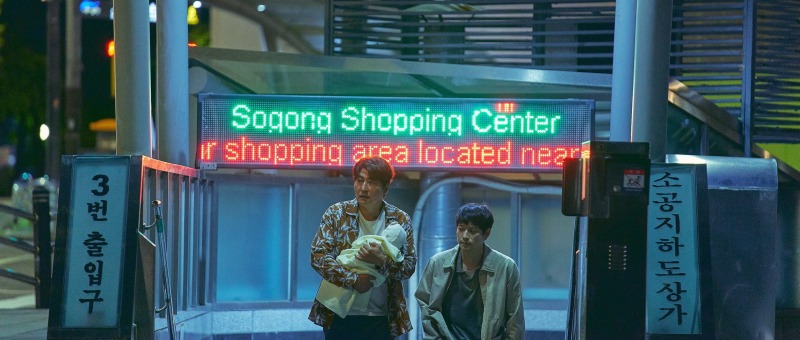
Broker (브로커, Hirokazu Koreeda, 2022)

Perhaps more than any other contemporary director in Japan, Hirokazu Koreeda has persistently interrogated the concept of the modern family asking what exactly the word has come to mean and how it is or should be defined. In Nobody Knows he showed us a case of parental neglect as abandoned siblings attempted to get by on their own in the absence of maternal care, while the separated brothers of I Wish struggle to define the nature of their relationships in the wake of their parents’ divorce. In Like Father, Like Son, Koreeda asks whether it’s blood relation that defines a family tie or whether it is forged more by mutual affection and shared memories, and in festival hit Shoplifters, he showed us a family who were not related by blood but had found in each other a home and a place to belong. 

Billed as a kind of companion piece, Broker (브로커) once again features a found family “brokered” by criminal activity but goes a step further, asking once again what the rights and responsibilities are when it comes parenthood and if the choice to abandon a child can ever be justified. Set in Korea where Christian morality has a greater influence, the film opens with a young woman leaving her infant child in front of a church yet abandoning him on the floor rather than placing him inside the “baby box” in the church’s wall. A policewoman staking out the church in the belief that someone is using the baby box to traffic children gently places the infant inside with what looks like maternal care but then we start to wonder, perhaps she only does so in order to see what happens when someone picks up him from the other side. 

Indeed, the policewoman will later concede that perhaps she herself was the one who most wanted the baby, Woo-Sung, to be sold so that she could catch the traffickers redhanded. We might feel a degree of revulsion towards the idea that a baby could be exchanged for money, but then perhaps we don’t stop to wonder who might buy and for what purpose. Sang-hyun (Song Kang-ho), a dry cleaner with gambling debts, and his partner Dong-soo (Gang Dong-won) who himself grew up in an orphanage, later recount selling a baby to two gay men who would otherwise be unable to adopt in the still conservative country suggesting in part that it’s a repressive society that forces people into this morally questionable underground trade in human children. It’s also societal conservatism that necessitates the existence of something like the baby box in that often very young women who bear children but cannot keep them either out of shame or simple economic impossibility have few other options than to abandon their child in the hope that someone will take it in. 

Detective Lee (Bae Doona) nevertheless brands these women as “irresponsible” and blames the baby box for tacitly encouraging their behaviour. An abandoned child himself, Dong-soo also struggles with his attitude towards the mother, So-young (Lee Ji-eun), who against all the odds does come back to reclaim her son after changing her mind. He and Sang-hyun justify their actions that they’re “saving” Woo-sung from being placed into the care system by finding him a loving home with parents who can give him a comfortable life. After taking to the road, the trio arrive at the orphanage where Dong-soo was raised which is less a home for him than a painful reminder of all he’ll never have and will never achieve as someone without a clear idea of a place to belong.

The man running the orphanage even concedes he’s not doing so well after the losing the subsidies for a few of the kids who have left, though few people adopt kids over six and the law makes it more difficult at eight which is a particular problem for football enthusiast Hae-jin (Im Seung-soo) who ends up climbing into Sang-hyun’s van and demanding they take him in. “Blood is thicker than water” the man sighs, explaining that kids are often sent back when it doesn’t work out or even end up suffering abuse despite the supposedly rigorous processes for vetting potential parents which causes some to simply buy a child on the black market instead. 

Despite the image of Dong-soo and Sang-hyun as heartless child traffickers they nevertheless take good care of Woo-sung and are up to a point careful that they should give him to someone responsible, mindful of those who might want a baby for untoward purposes or are intent on selling him on. A visual motif of tangling threads from the cotton on Sang-hyun’s sewing machine to the rope that pulls the busted back door of the van closed hints at the various ways these five dispossessed people are slowly bound together, becoming an accidental family forged through a process of mutual understanding in which Dong-soo is able to re-evaluate his feelings towards his mother through bonding with So-young and realising that in abandoning her child she may only have been trying to protect him and give him the better life that she never had. 

So-young tells Dong-soo that she sometimes has a dream in which the rain washes away her life until now, but on waking she realises it’s raining and nothing’s changed. He tells her perhaps all she needs is an umbrella that’s big enough for two, a metaphor for the protective quality of family he could perhaps have given her. Even she later concedes that had she met them earlier, none of this would have been necessary while Detective Lee’s more sympathetic partner (Baek Hyun-jin) likewise asks why they couldn’t have intervened earlier and done something to help this struggling young woman whose only problem was her aloneness before it came to this. What emerges is an unexpected compassion and the extension of an umbrella from an unexpected source in the acknowledgement that nothing’s ever quite as simple as it might seem. Koreeda leaves us with an outcome that is possibly as happy as it could be in an imperfect world, which might in itself be a little unrealistic but nevertheless in its own way hopeful in having reclaimed a notion of “family” brokered by selflessness and mutual compassion if not quite love for the orphans of an indifferent society.


Broker opens in UK & Irish cinemas on February 24th. For more information head to http://broker.film/

UK release trailer (English subtitles)

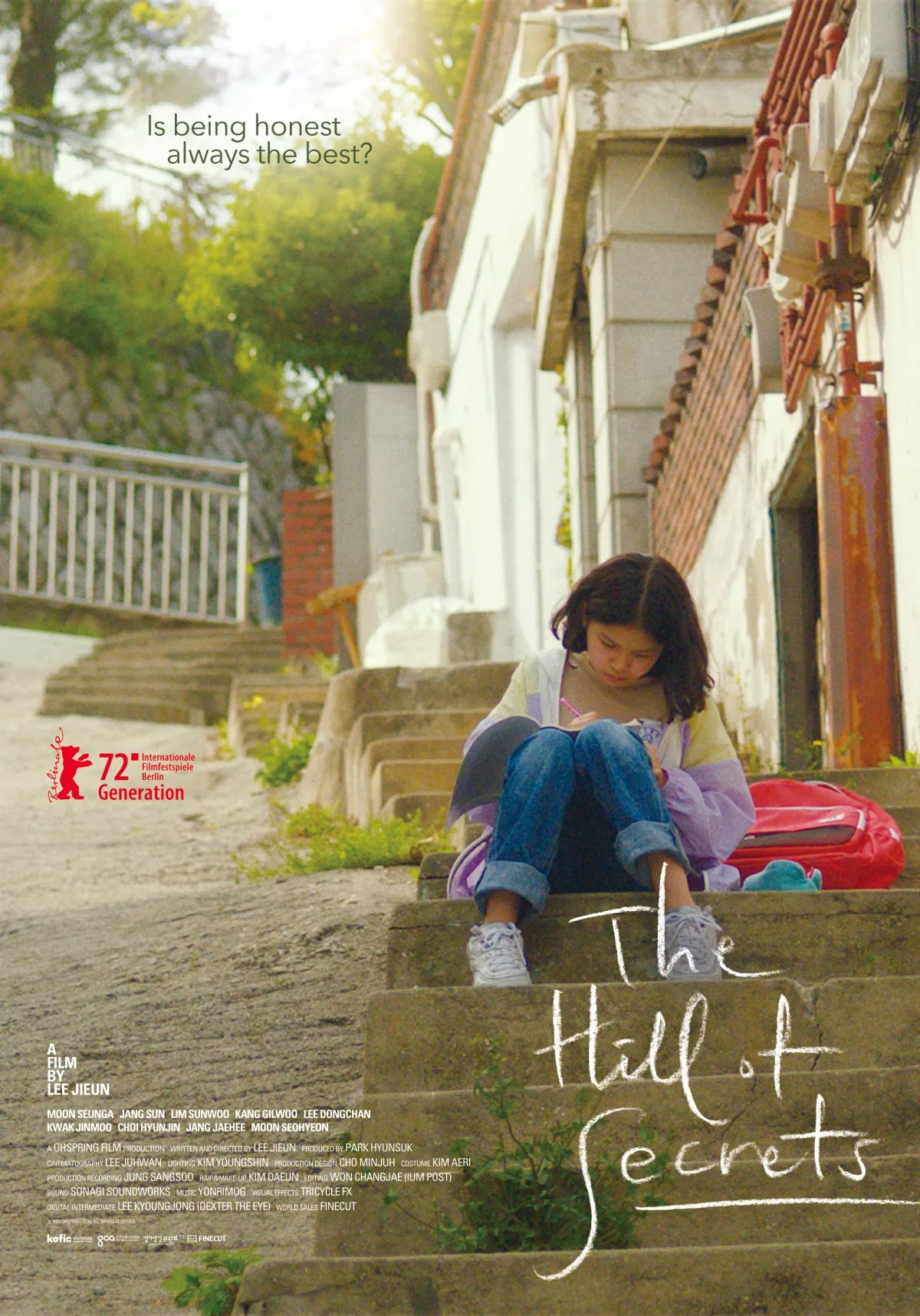
The Hill of Secrets (비밀의 언덕, Lee Ji-eun, 2022)

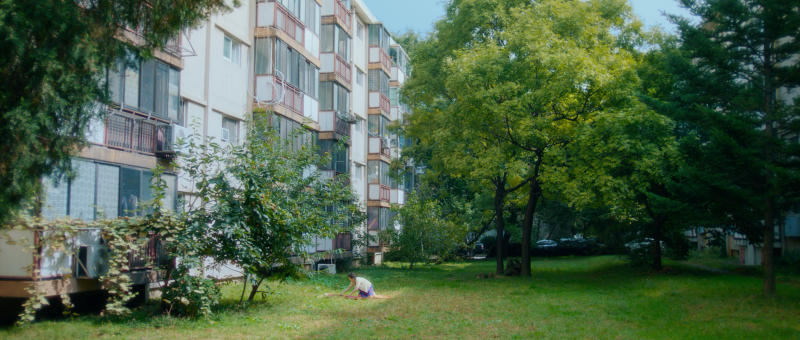
A little girl contends with the boundaries of social responsibility, the nature of the contemporary family, classism, and a deep desire to be accepted while confronted by the ambivalent “honesty” of adulthood in Lee Ji-eun’s charming coming-of-age tale, The Hill of Secrets (비밀의 언덕, Bimileui Eondeok). Set in 1996 and filled with nostalgia for simpler times, Lee’s tale of the painful lessons of adolescence is in its own way timeless as the heroine begins to reprocess her complicated relationships with her family while simultaneously preparing to step away from it. 

12-year-old Myeung-eun’s (Moon Seung-ah) problem is that she’s a bit of a snob. Surrounded by children from wealthier families at her school, she feels ashamed of her background and looks down on her working class parents whom she brands “terrible people” for their every man for himself philosophy. When her brother asks their father what their family motto is for a homework assignment, he looks confused and answers that they don’t have one, but her mother jumps in with “give nothing, take nothing” having experienced a moment of outrage when Myeung-eun wanted to donate some money to a struggling family on the television. Her father had insisted that the family is only struggling because they’re lazy and aren’t trying hard enough, reminding her that their lives are hard too but they’ve made their way through buckling down and working without complaint. Myung-eun resents his explanation in part because she thinks he’s selfish and unkind, but also finds it hypocritical in that she sees her father as lazy and irresponsible while her mother is a workaholic who only cares about money and is indifferent to the suffering of those around her. 

To demonstrate that she’s different from her family, Myung-eun has developed conservative social values with a strong aspiration to achieve conventional middle class success as symbolised by the incredibly prim dress she’s forever trying to get her mother to buy for her while she opts for something a little less particular that Myung-eun won’t grow out of too quickly. So ashamed of her family is she, that Myung-eun lies at school telling her teacher that her dad’s an office worker and her mum a housewife while making constant excuses as to why they can’t come to parents’ days. Challenged by her rival, rich kid Kyung-soo, she even goes so far as to bamboozle an executive at a nearby company into an “interview” for her “homework” taking a series of fake photographs while getting a friend’s mother to pose as her own as they cheerfully bake cookies together at home. 

Wanting to knock Kyung-soo off her perch Myung-eun runs for class president and pulls off a shock victory but soon becomes drunk on her power and driven further into a narcissistic drive for approval from her harried teacher. She sets up a secret letterbox so her classmates can make anonymous suggestions, but is actually writing them all herself sometimes using her left hand, different coloured pens, and weird handwriting to cover up her crime. When she fears her brother is about to blow her cover, she gets into a physical fight with a friend accusing her of disrespecting the office of class president, and struggles to accept herself at her new status because of her internalised shame over her class background. 

Yet confronted with the incredible cynicism of transfer student Hye-jin who matter of factly answers the teacher’s question about workers making people happy that her mum makes loads of people happy because she runs a brothel which is why Hye-jin has had to change schools so often, Myung-eun begins to reconsider her notions of honesty and deceit. Hye-jin is tired of hiding her background and really doesn’t care what anyone thinks anymore, while Myung-eun is desperate to keep up an image of conventional respectability rather than admit that her parents sell salted fish at the market. As her teacher later tells her, honesty is not necessarily the best policy and sometimes you might have to lie to protect someone’s feelings but that’s really the opposite of what Myung-eun has been doing. Her lies are all about protecting herself and told out of fear of rejection ironically because she feels rejected by her family who appear disinterested in her successes and indifferent to her feelings. 

But then as her brother tried to remind her, her mother works hard to support their family while crafting a sketchbook of the ideal home she’ll probably never be able to afford. Myung-eun decamps to stay with her mother’s step father and brother who are much more stereotypically respectable than her parents, living in a nicer flat which belonged to her grandmother and outwardly religious. But then again her uncle has the same internalised shame as she does, a failed artist working part-time in construction but putting on a suit and carrying a briefcase when he picks her up from school so that people will assume he’s a middle-class office worker. Her grandfather berates her uncle for not having a proper job while he later reveals that Myung-eun’s rmother’s resentment stems from the fact she’s been supporting both families financially even though her mother has passed away and they aren’t related by blood. Myung-eun’s father complains about his domineering wife, but as his friend points out he’d be lost without her. 

An exercise in rigorous honesty confronts Myung-eun with her true feelings surrounding her family but also with the consequences of her actions as she realises an autobiographically-themed prize-winning essay may end up hurting their feelings while she herself would not necessarily come out of it looking very good. Through her friendship with Hye-jin and her sister, Myung-eun comes to a better understanding of emotional authenticity edging away from her snooty social group who as Hye-jin points out enforce hierarchy by taking turns leaving each other out and beginning to accept herself no longer so desperately in need of external approval having understood a little of the way she fits in to her family. A gentle, nostalgic coming-of-age tale, Lee’s charming debut feature is both a mild critique of deeply ingrained classism and an empathetic contemplation of what it is that “family” really means.


The Hill of Secrets screened as part of this year’s London Korean Film Festival.

Clip (English subtitles)

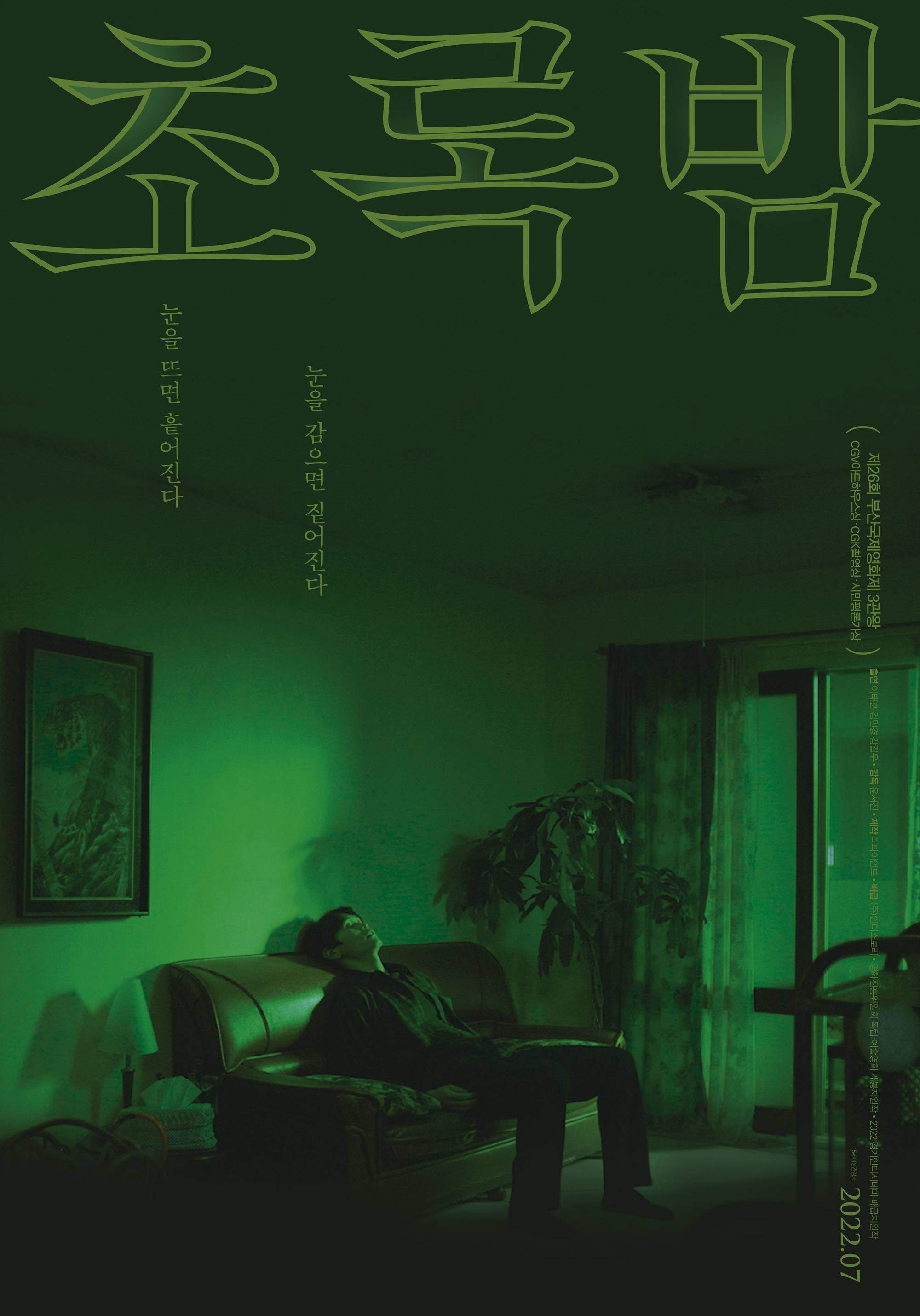
Chorokbam (초록밤, Yoon Seo-jin, 2021) [Fantasia 2022]

A small family contends with the persistent unfairness of contemporary Korean society in Yoon Seo-jin’s slow burn indie drama, Chorokbam (초록밤). Translated literally, the title means “green night”, the family often bathed in a neon green that seems to reflect their sense of despair and anguish unable to envisage much of a future for themselves in a world ruled by greed and envy which leaves them little option other than to become insensitive to the joy and pain of others. 

As the film opens, the nightwatchman patriarch is busy giving out parking tickets when he suddenly spots a cat hanging from from a children’s climbing frame. Shocked and feeling pity for the small creature, he cuts it down and buries it by the green light of the moon but finds little sympathy when relating his traumatic discovery to his wife. The nightwatchman’s wife is preoccupied with more practical affairs, irritated by her husband’s annoying habits such as leaving the bathroom door open and not washing his hands after finishing his business, while their grown-up son Won-hyung wants to get married but can’t afford a place to live on his salary as a care worker. When it comes to that, they’re soon to be turfed out themselves because their landlord wants to tear the building down. 

Matters come to a head when the grandfather passes away, the nightwatchman’s sisters getting into an actual physical altercation at the wake while loudly complaining about who did or didn’t pay for the funeral. Totting up the condolence money they accuse supposedly cheapskate guests of freeloading, implying they only turned up for a free meal that they have in a sense stolen. Meanwhile, the sisters also want to ensure that their father’s house is sold quickly so they can divvy up the inheritance. What they realise, however, is that there were things about their father’s life they may not have known which raise questions about moral responsibility when it comes to dealing with the affairs of someone who has died. 

The nightwatchman comes to identify with the strangled cat, though the spectre of hanging seems to loom over the rest of the picture with even the nightwatchman’s wife eventually discovering the body of someone whose death she may unwittingly have contributed to. She complains about her husband’s fecklessness, that he, who barely talks at all, makes her deal with anything unpleasant including his hotheaded sisters. She tells him that she regrets marrying into his “horrible” family and is thoroughly sick of dealing with them only to be pursued by a wounded dog with whom she perhaps also identifies. The nightwatchman’s wife is often excluded from the frame, a disembodied voice from behind a wall as she is as she feeds her husband breakfast and again when he asks her to deal with an emotionally difficult situation in a cafe. The nightwatchman simply smokes by a widow as if physically removing himself from the scene. 

Won-hyung meanwhile becomes increasingly resentful with his friends’ wedding coming up, unable to escape the feeling of belittlement in being unable to marry or move forward with his life with little prospect that anything will change. Yoon frames the family’s dilemmas with a deadpan realism, bathing the everyday grimness of their lives in an putrescent green that suggests there may be no escape from this maddening society where all relationships are built on transaction. The family are doing their best but are also estranged from each other, the nightwatchman barely speaking while his wife is left to deal with the uncertainty of their lives alone. She even laments they’ll likely not see the sisters again until the next person dies because their familial connection is essentially hollow and valueless in a society ruled by money. 

The nightwatchman comes to think of himself as a strangled cat, finding himself facing a noose during a poetic dream sequence that encourages him to think of suicide as the only possible escape from his impossible situation. Bleak in the extreme, Kim’s slow burn drama paints an unflattering portrait of the contemporary society as one in which all hope has long been lost leaving only dread and despair in its wake. 


Chorokbam screened as part of this year’s Fantasia International Film Festival.

Original trailer (English subtitles)

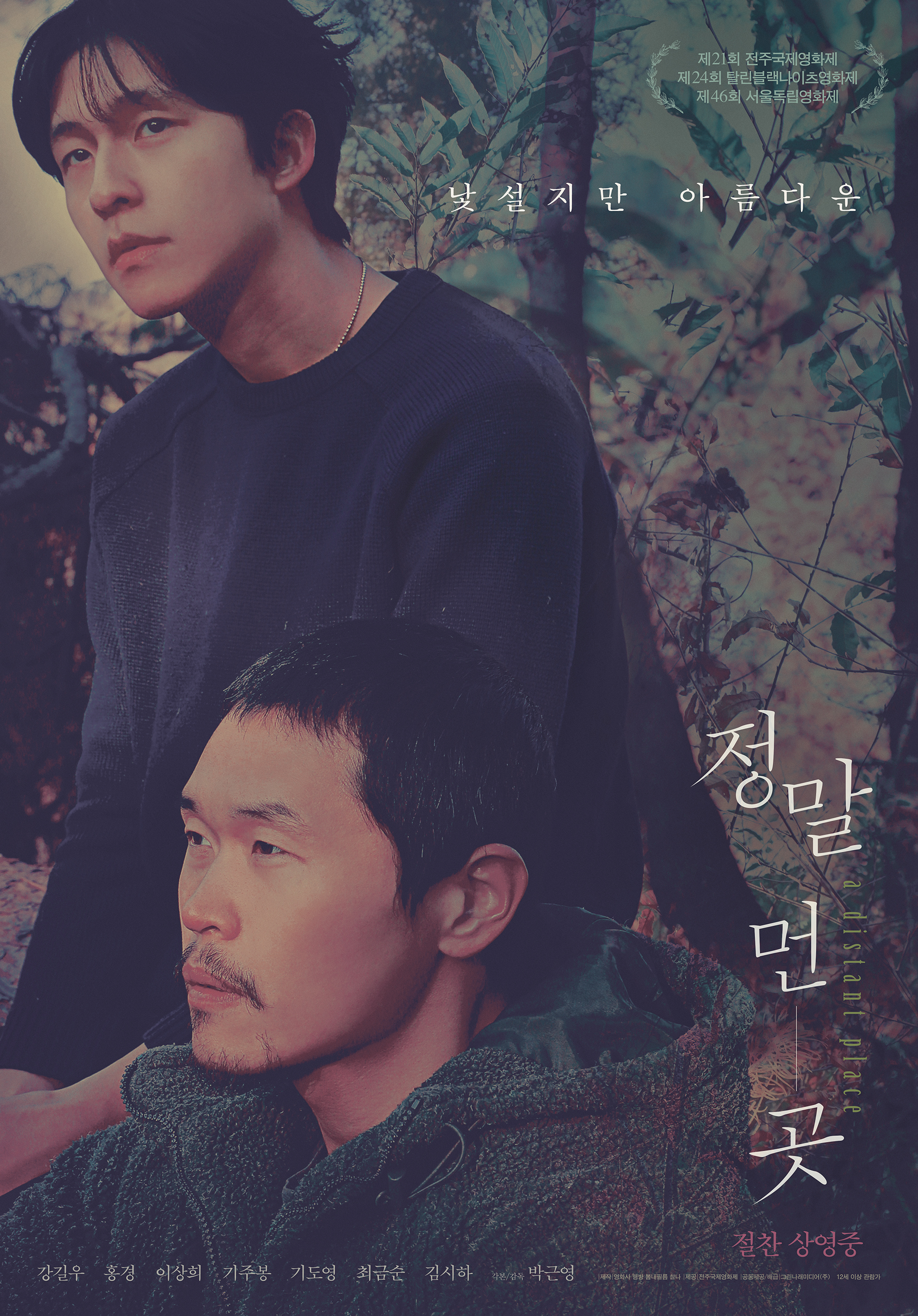
A Distant Place (정말 먼 곳, Park Kun-young, 2020)

A gay couple searching for a far off land of love and acceptance find their rural dream crumbling in Park Kun-young’s melancholy autumn drama, A Distant Place (정말 먼 곳, Jeongmal Meon Gos). As it turns out, you can’t outrun yourself nor an internalised sense of shame and if you can’t find a way to root yourself firmly in the ground you risk losing those close to you lashing out in anger towards a needlessly judgemental society. 

Jin-woo (Kang Gil-woo) is indeed a man on the run, chased out of Seoul by his internalised homophobia and seeking a quieter life in a small mountain town with fewer people around to feel rejected by. Having studied fine art, he now works as a hired hand on a sheep farm where he’s bringing up his daughter Seol (Kim Si-ha) while waiting for his partner, Hyun-min (Hong Kyung), a poet, to join him. Once he arrives, everything goes well for them living a discreet life in the mountains where no one it seems has noticed that they are a couple though as we later realise the farmer, Mr Choi (Ki Joo-bong), and his daughter Moon-kyung (Ki Do-young) have figured it out and little care choosing to say nothing. The real drama begins, however, with another arrival in that of Jin-woo’s estranged twin-sister Eun-young (Lee Sang-hee) who as we discover is actually Seol’s birth mother having abandoned her to Jin-woo only to come back to try and reclaim her having married and opened a cafe. 

Jin-woo’s conflict lies partly in wondering if he’s being selfish in his desire not to return Seol to Eun-young while genuinely believing that a life of isolation in the mountains is better for her longterm future. His ideal is undercut when Seol upsets another child at a formal occasion by snatching his toy away from him, hinting at the costs of her lack of socialisation spending almost all of her time on the farm helping with the sheep or talking with Mr. Choi’s elderly mother (Choi Geum-Soon) who is suffering with advanced dementia. In a certain sense, each of them is trapped by their environment, the elderly grandma seeking escape in her small moments of lucidity. Moon-Kyung is beginning to fear her dreams of escaping small-town life will not come to pass while she has perhaps also missed the boat for becoming a wife or a mother snapped at by her grandmother in a moment of frustration. Her realisation that her crush on Jin-woo is misplaced on finding him in bed with Hyun-min is then a double moment of disillusionment leaving her only the vicarious position of becoming a surrogate mother to Seol who continues to refer to Jin-woo as “mama” rather than father. 

This framing in itself foregrounds the primacy of the traditional family in highlighting both the absence of a female caregiver and then by implication a father while simultaneously feminising Jin-woo as a man who is raising a child as we later find out with another man, if secretly. When the pair are accidentally outed, it not only strains the relationship between the two men but implodes Jin-woo’s dream of discreet country living. Though the townspeople had previously been friendly towards them, they find themselves shunned in town, figures of gossip and ridicule. Having been essentially run out of Seoul by his internalised homophobia, Jin-woo begins to fear he has nowhere left to run. Hyun-min tries to convince him that he’s asking for too much, that they should live quietly and keep the peace, but his shame gets the better of him lashing out that he’s never felt comfortable with Hyun-min around always self-conscious and paranoid about what others may be thinking of him. 

As Hyun-min puts it in a poem, only the hope of a “distant place” keeps them going even as the road ahead crumbles at a rapid pace with the abyss creeping ever closer. While there are small rays of hope in the quiet acceptance of Mr Choi who has come to think of Seol as his own granddaughter, Jin-woo begins to fear that his distant place is beyond his reach and that no matter how far he runs he will never reach a point of comfort or happiness where he can live openly with the man he loves and the little girl he has raised since birth as his daughter. Figures of loneliness and disappointment haunt the otherwise idyllic landscape shattering the nurturing image of a simple life in the country but even as the film opened with an ominous death it ends in new life promising perhaps a new if uncertain dawn. 


A Distant Place screens at Genesis Cinema on 26th May as part of this year’s Queer East.

International trailer (English subtitles)