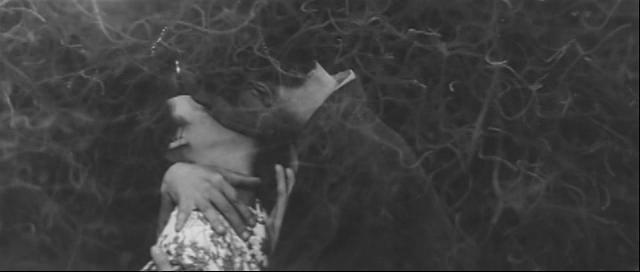
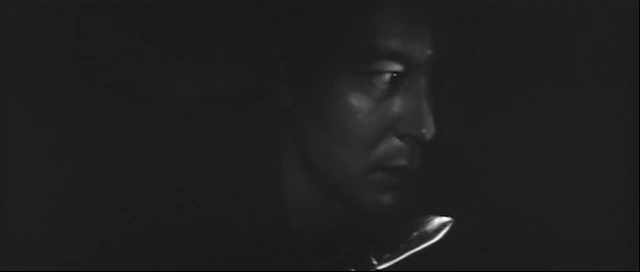
Whirlpool of Flesh (おんなの渦と淵と流れ, Ko Nakahira, 1964)

A intellectual professor and his wounded wife find themselves trapped in a toxic marriage after returning from Manchuria in Ko Nakahira’s fatalistic drama, Whirlpool of Flesh (おんなの渦と淵と流れ, Onna no Uzu to Fuchi to Nagare). Set in the late ‘40s, the film does indeed position Manchuria as a point of corruption while otherwise suggesting that Japan itself has been emasculated by the Occupation, but otherwise demonstrates how the couple drag each other into a cycling whirlpool of jealousy and obsession that it seems neither of them are really equipped to understand let alone escape.

Claiming to have been struck by her bright and smiling face in her omiai photo, Keikichi (Noboru Nakaya) married Sugako (Kazuko Ineno) in Manchuria without actually meeting her before the wedding. Apparently uninterested in sex, Keikichi was a virgin on their wedding night but harbours doubts Sugako may not have been. In any case, he seems put out that Sugako is not in his opinion his intellectual equal. He chances on her diary in which she details how bored she is by his constant lectures about English literature and that she feels him to be more schoolteacher than husband, but he merely scoffs that it’s not particularly well written. He begins to suspect that she’s sleeping with customers who come into the speakeasy she opens in their home during the days between the Russian invasion and repatriation and succumbs to a generalised sense of impotence hiding out in his room upstairs reading while she takes care of business below. 

In the present day, convinced that she’s having an ongoing affair with a merchant, Otani (Kazuo Kitamura), Keikichi pretends to go to a hot springs resort and then sneaks back to spy on her from an adjacent room. Though he feels no desire for her as his wife, through the eyes of these other men he rediscovers a sense of Sugako as the woman from the photograph for whom he does feel some attraction and satisfies his latent sexual desires through watching her sleep with Otani. As an escape from the war, he’d been working on a translation of Shakespeare’s Troilus and Cressida the heroine of which he seems to superimpose on Sugako in wondering if she is a faithless woman or true, angel or devil. 

Yet from Sugako’s point of view, she begs him for physical intimacy which he refuses to grant despite his jealousy over her relations with other men. Traumatised by her sexual abuse at the hands of her uncle, Sugako believes that she has a body designed to satisfy men’s desires and is drawn into meaningless, and often transactional, sexual relationships. When Keikichi later questions her, it seems she doesn’t remember any of them in detail for to her they were simply “men” and nothing more. The situation is somewhat complicated by the fact that her uncle was a scholar of Chinese literature, which in part aligns him with Keikichi, but also points back to Manchuria as a source of corruption though coming uncomfortably from the opposite direction. 

Sugako equates this corrupted sexuality with the great emptiness inside her that frequently leads to thoughts of suicide. Nakahira constantly shows us shots of Keikichi’s knife as if implying some kind of violence is inevitably going to take place, though in the end it signals nothing so much as Keikichi’s impotence. Then again, the emptiness is also linked to a sense of despair in Japan’s defeat that is manifested most obviously in the house next-door where the widowed mother may have been having an affair with Sugako’s uncle and unsubtly tries to blackmail her by threatening to expose the secret of her sexual abuse about which she had tried to tell Keikichi but he had refused to listen. The daughter has become a sex worker catering to American servicemen to support the family while her brother, Kenichi (Tamio Kawachi), allows her to sacrifice herself for him justifying himself that it’s for the greater good as he’ll eventually become a doctor and save countless other lives. He’s also masquerading as a Christian to get a scholarship to an American university through the church which is all very contradictory not to mention selfish and cynical. The sister, meanwhile, appears to have lost her mind and frequently rants and raves, blaming her mother by claiming that walking in on her with Sugako’s uncle permanently corrupted her sense of self and sexuality. Like Sugako, she exorcises her trauma through abusing her body, in her case through sex work with “nasty GIs who don’t always pay.”

Keikichi refers to this as “post-war nihilism” like the frequent strikes and workers parades that take place around him, but partially repairs his sense of masculinity after moving to Tokyo and getting a job. At work he meets another young woman who is a mirror of the young lady from next-door in that she was also repatriated from Manchuria where her father was a member of the government. With her mother dead and father unable to work, Shimura (Kaori Taniguchi) also supports her family with her secretarial job and often goes without lunch herself to make ends meet. Keikichi notices this and offers her his bento claiming to be feeling unwell, but fails to notice how his pity wounds her dignity even if he meant in kindness while acknowledging that he’s never known hunger. Unlike the mismatched Sugako, Keikichi and Shimura are an ideal match. She also wanted to study English literature and can meet him on his level discussing politics and culture though he does not seem to be aware that he is attracted to her and acts almost paternally in offering to pay her university fees to help her escape her life of poverty, echoing Sugako’s claims that he had become her “little boy” rather than her husband. 

The irony is that Sugako insists Keikichi, who does little but look down on her and alternately complain that she’s either impure or unattractive, is the only man she’s ever loved and blames his lack of sexual interest in her on the unresolved trauma of her childhood abuse. Having asked Kenichi to help her get her hands on some cyanide, she is shocked and disgusted when despite his need he rejects her money and asks for her body instead. He insists that it’s “only the friction of mucus membranes” and that she might as well sleep with him first if she’s going to die, though her refusal is in part a desire to die “pure” and finally overcome the emptiness and despair inside her. This inability to reconcile herself is also aligned with Keikichi’s vision of “post-war nihilism” and suggests that in the end this trauma can’t be healed and must necessarily lead to destruction. Meanwhile, Keikichi seems to have discovered a path towards his rebirth in his friendship with Shimura only to potentially have the rug pulled from under him. His new future too, may end up poisoned by Sugako’s unilateral decision to facilitate it. Dark and twisted in true Nakahira fashion, the film paints the post-war society itself as a deepening whirlpool from which there is no escape or at least not for those like Keikichi and Sugako forever locked in a deathly embrace and drawn ever deeper into the waves.


Black Sun (黒い太陽, Koreyoshi Kurahara, 1964)

black sun still 2The Warped Ones showed us a nihilistic world of aimless youth living not so much on their wits as by their pleasures, indulging their every animalistic whim while respectable society looked on in horror. By 1964 things have only got worse. Tokyo might have got the Olympics, Japan might be back on the international map, and economic prosperity might be on the rise but all around the city there’s an arid wasteland – a literal dumping ground in which the unburied past has been left to fester as a grim reminder of historical follies and the present’s reluctance to deal with them.

Akira (Tamio Kawaji), now calling himself “Mei” (perhaps a play on the reading of the character for his name 明), seems to have mellowed since the heady days of his youth. Living alone save for a dog named Thelonious Monk, Mei has co-opted a disused church and turned it into a shrine for jazz. The walls and ceilings are covered in photographs of famous jazz musicians and posters for club nights and solo shows. He has his own turntable and a well stocked selection of LPs, though he still seems to frequent the same kind of jazz clubs that so defined his earlier life.

Change arrives when Mei boosts a fancy car and is almost caught in a police net caused by the body of an American serviceman found floating in the harbour. Apparently the crime is the product of an internal GI squabble, but the offending soldier is on the run with a machine gun. As coincidence would have it, the wounded killer, Gil (Chico Lourant), fetches up at Mei’s church and, as Gil is a black man, Mei assumes that they will definitely be friends. It is, however, not quite that simple.

As in the earlier film, jazz is the force which keeps Mei’s mind from fracturing. His life still moves to improvisational rhythms even if apparently not quite so frenetically as it once did. Rather than the rampant animal of The Warped Ones, this Mei has embraced his outsider status through literally removing himself from the city in favour of self-exile and isolation as a squatter in the house of God – a place about to be torn down.

While Mei has been literally pushed out with only his beloved dog as evidence of his latent human feelings, his formerly delinquent friend, Yuki (Yuko Chishiro), has gone on to bigger and better things. No longer (it seems) a casual prostitute catering to foreigners, Yuki has repurposed the skills her former life gave her to shift into an aspirational middle-class world as a translator for those same American troops she once performed another service for. The American occupation is long over, but the US Army is everywhere.

Mei thinks of himself as one of Japan’s oppressed outsiders – an outcast in a land subjugated by a foreign power. He squats in a ruined church while the Americans “squat” in his ruined country. He likes jazz because it fits the rhythms of his mind but also because he believes it to be the music of the oppressed. In Gil he thinks he sees another like him, a man oppressed in his own homeland and ironically enough by the same forces that are (in part) oppressing him. Mei has a lot of strange, stereotypical ideas about black men – he’s excited to meet Gil because he thinks all black men must love jazz and that Gil must be some kind of jazz god, but Gil is a frightened rabbit on the run, terrified and bleeding. Thinking he’s in the middle of a visitation, Mei tries to make plain his enthusiasm despite the obvious language barrier, pointing wildly at his shrine to jazz, but all Gil wants is quiet and help with the bullet wound currently suppurating on his thigh.

The “relationship” deteriorates, but a strange kind of camaraderie is eventually born between the two men. Things take a turn for the surreal when Mei dons black face and paints Gil’s white, only to get stopped by GIs who want to see an ID from a “foreigner” driving a fancy car, and for Mei to introduce Gil at his favourite jazz bar as his new “slave”. In hindsight it’s all a little awkward as Kurahara throws in stock footage of the civil rights movement and tries to equate it both to the recent protest movements in Japan and to Mei’s self-identified status as one of Japan’s oppressed masses. Still, you can’t argue with the fact that the two men have found a bond in their shared alienation and desire to escape from the impotence of their current situations.

Ironically enough Kurahara does seem to believe in an escape, though it’s perhaps not so positive as it sounds. The tragic friendship of the two men in which one must save the other by releasing him towards the sea and the sun pushes Mei out of his self-exile and back into the “real” world even if he still considers himself to be an outsider within it. The sun is bright but it’s also dull, shining not with hope but with consolation for a hopeless world in which the only victory lies in the final act of surrender.


Short scene from the beginning of the film (English subtitles)

Cruel Gun Story (拳銃残酷物語, Takumi Furukawa, 1964)

cruel-gun-story-poster.jpgIn the history of Japanese noir, the name Haruhiko Oyabu looms large. Oyabu’s gritty, pulp infused tales of tough guy heroes found their clearest expression in the hardline ‘70s with Toru Murakawa’s unique brand of macho action as seen in Resurrection of the Golden Wolf or The Beast Must Die, but a decade earlier they were also finding fertile ground in Nikkatsu’s harder B-movie noir. Based on a novel by Oyabu, Cruel Gun Story (拳銃残酷物語, Kenju Zankoku Monogatari) seems to owe more than a little to Kubrick’s The Killing in its crime never pays tale of honest crooks undercut by their unscrupulous comrades but the central message is that the gun is a cruel master and those living under its control will pay a heavy price.

Togawa (Jo Shishido) has just been (unexpectedly) given early release from a prison sentence incurred when he took revenge on the truck driver who knocked down his little sister (Chieko Matsubara) and confined her to a wheelchair for the rest of her life. Middle rank gangster Ito – formerly a crooked lawyer with a pencil mustache a supercilious air, has a job for him the gang thinks only he can do. The payout is 120 million yen – not to be sniffed at, but Togawa has reasons to be suspicious. He takes some convincing but finally relents when he finds out an old and trusted friend, Shirai (Yuji Kodaka), has already agreed. The gang have another three guys lined up but Togawa rules the third one out when he tests him and confirms he’s an untrustworthy blabbermouth. The other two are a former boxer with mild brain damage whose girlfriend has just left him, and an unscrupulous but clever chancer named Teramoto (Kojiro Kusanagi).

Following the general pattern, Furukawa walks us through the heist as it’s supposed to go if everything goes to plan complete with a 3D diagram and plastic toy cars but, of course, not everything goes to plan. The job is to steal the ticket money from the Japan Derby (much like the race course robbery in The Killing). The gang will set up fake road signs and station a “policeman” to divert the armoured car onto a small country lane where they will kill the police motorcycle escort, get rid of the guards, and load the truck onto a bigger lorry that they will then take to a disused US airbase they’ll use as their lair.

Disused American airbase could easily apply to the entirety of the surrounding area. Jets fly ominously overhead while the world Togawa and his guys inhabit is one of noirish jazz bars filled with foreigners, grimy boxing clubs, signs in English and the relics of destruction everywhere. This is a place for those who’ve already fallen through the cracks, even the gangsters are only really small fry – not yakuza but hoodlums ripped straight from the Edward G. Robinson playbook. This giant heist is the most audacious in living memory, pulling it off would be the finest achievement any of them would ever make, taking them out of their dead end environments and catapulting them into the criminal high life.

Togawa knows there’s something not right about this – he almost turns it down because he wants to be around to take care of his sister, but he also wants the money to pay for an operation he hopes will restore her mobility to assuage his guilt over having sent her out on the fateful day she was injured. Rie now lives in the care of kindly nuns and is a goodhearted, religious woman hoping for her big brother’s reformation. Togawa and his sister are also victims of war having lost their parents during the evacuation from Manchuria and have been essentially on their own ever since. Rie has become a living symbol of Togawa’s failures – his inability to protect her, to keep them both safe and together, and to free them of the ruined post-war landscape within which they both remain trapped. Rie pins her hopes on God, but Togawa says to hell with that – where has He been so far?

Having pinned his hopes on the gun, Togawa intends this to be the heist to end all heists. After this, he’ll be free to give his sister the life she deserves away from crime and the rundown town strewn with mementos of a distant, dethroned occupying power. The gun, however, is a divisive weapon and engenders nothing but mistrust among men. Resentful of Togawa’s solid friendships, the other guys turn on him as do his shady employers sending Togawa even further along the dark path to moral ruination than he already was. All that’s waiting for Togawa is a hollow victory and the intense disappointment of those whose faith in him was ultimately misplaced.