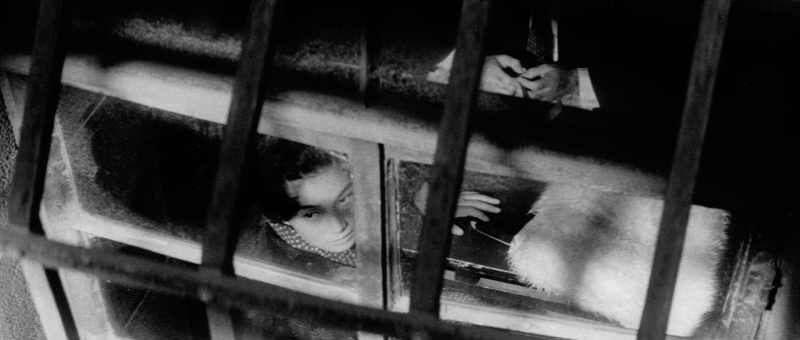
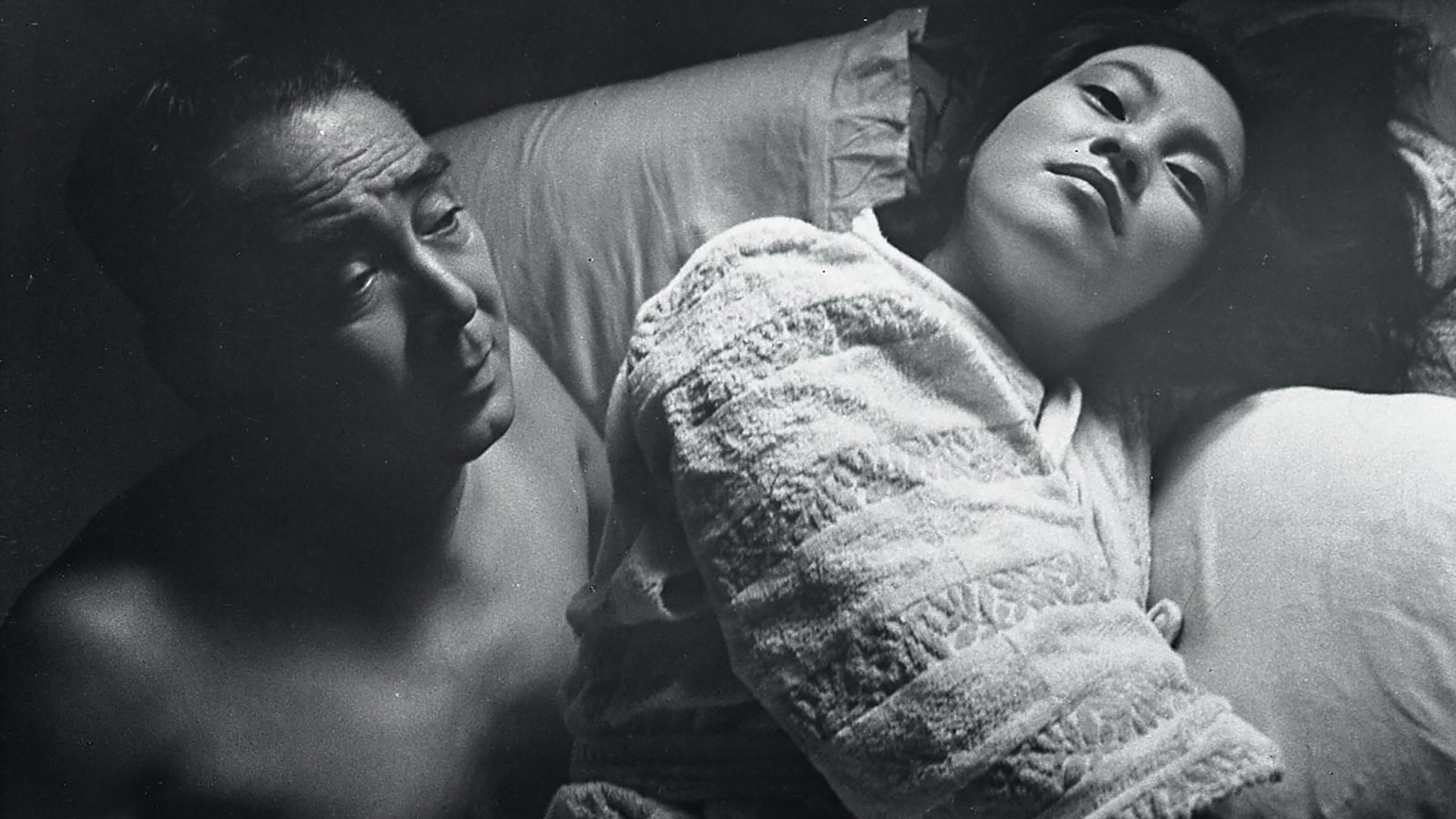
The Insect Woman (にっぽん昆虫記, Shohei Imamura, 1963)

“What other way is there?” a young woman says to her mother, little understanding that what she so casually tells her quietly crushes her mother’s view of herself as if her long years of suffering had all been for nothing while exposing her justification that everything she had done was to save her daughter from her own fate as not strictly true. The opening scenes of Shohei Imamura’s The Insect Woman (にっぽん昆虫記, Nippon Konchuki) follow a bug stubbornly traversing rough terrain, slipping, pushing onward, overcoming obstacles, yet not really getting anywhere.

The bug’s journey is echoed in Tome’s (Sachiko Hidari) return to the village at the end of the film, now an ageing woman struggling with mountain roads after long years spent in the city and finally snapping her geta leaving her barefoot on rocky ground. Like that of the bug, Tome’s life seems to be a flat circle in which history repeats itself inexorably. The film opens in 1918 as Tome is born out of wedlock to a promiscuous woman who has entered a common law union with a man who appears to have learning difficulties. Chuji (Kazuo Kitamura) may or may not be her biological father, but has an attachment to Tome. As a child, she had asked him whether they are “married” seeing as they sleep together, and he had said that they were. There is definitely more than humouring a little girl’s silly question in his reply, while he flies into jealous rages when there is talk of marrying off the older Tome to the local landlord’s son. 

Just as her mother had, Tome also has a child out of wedlock, though the father can only be Shuzo, the man her family intended her to marry in part in settlement of a longstanding debt. Tome’s early life is defined by the lingering feudalism of the rural society in which her family are serfs beholden to the whims of the landlord. The older women in the village call her away from her factory job which she says she is doing for the war effort to help on the landlord’s farm. Though she is assured she is only required to do farm work, she is raped by Shuzo who urges her to submit to him and serve her country in another way by letting him have his way with her as he will soon be going off to die for the emperor. Tome then becomes his woman, but not actually his legal wife while this justification wears a little thin when it is revealed that Shuzo has another woman and child already and thus will likely not marry her. When she becomes pregnant and Chuji beats Shuzo up, Tome is sent back to her family to have the baby. It turns out to be a girl and the older women have a brief conversation about whether to let it die as female babies are worthless and resources are scarce. This seems to run contrary to rural wisdom seen in other films such as Imamura’s later The Ballad of Narayama in which, grim as it is, male children are often exposed as girls at least can be sold, though possibly not any longer in the new democratic society.

Nevertheless, Tome insists on keeping her baby though feels out of place among her family and returns to the factory where he she has an affair with the married foreman who gets her into trade unionism and then complains that she’s too militant about the labour movement when he gets promoted to assistant manager. Tome bristles at his hypocrisy, but later abandons her ideals herself and becomes an exploiter of women after moving to the city. After visiting a shady cult to overcome her sense of guilt after a child she was looking after who reminded her of her own faraway daughter died in accident, Tome meets a devotee who complains that all of the contemporary society’s ills are caused by a lack of religious rigour, yet is actually running a brothel staffed by “amateur” sex workers to which she forcibly recruits Tome by locking her in a room with a customer. 

Just as Tome schemes by dobbing her new boss in to the police so she can start up her own business using the women as call girls posing as one half of a regular couple to avoid police detection, so she is later betrayed by her own prodigy. Tome’s travel from her rural hometown to Tokyo mimics the nation’s transition from an agrarian to an urban society mired in post-war corruption as seen in the cynical and exploitive conditions at the brothel in which the madam takes almost all the money for herself, deducting large amounts for things like kimonos and room and board, while the “amateur” sex workers prepare blood vials to convince the customers they are virgins. Tome always states that her goal is to earn enough money so that she, Chuji, and her daughter Nobuko who have been shunned by the family, could live together but though she becomes quite wealthy and sends large amounts of money home she makes no real attempt to bring them with her or to go back to the village. 

A grown-up Nobuko (Jitsuko Yoshimura) later comes to her and asks for money because some of the local youngsters are trying to start a collective farm in the wake of land reforms that redistributed landlords’ lands and ended serfdom. Tome is distressed to know that Nobuko has dropped out of school though Tome has been sending her money for the fees, realising that Nobuko will not escape the village through education nor through marrying a nice professional husband and moving to the city. In fact, Nobuko follows in the footsteps of her mother and grandmother by conceiving a child of uncertain lineage out of wedlock after being coaxed into a sexual relationship with her mother’s former lover, Karasawa (Seizaburo Kawazu), a once-prominent businessman who has fallen on hard times. He agrees to lend her the money for the farm on the condition that she make herself sexually available to him twice a week. He eventually asks her to stay and run a shop he owns instead. Nobuko agrees, but actually runs off with the money for the farm and returns to her boyfriend Yoshiji. Like Chuji, he also questions the paternity of her child, but seems to have accepted the fact it may not be his while agreeing to raise it. Tome, meanwhile, returns to the village on Karasawa’s behalf planning to tell Yoshiji about Nobuko’s life in the city in an attempt to force her to return to him.

In blowing Karasawa off and taking the money to invest in the farm, Nobuko may have broken the cycle in another way in shaking off male authority and rejecting the consumerism of the urban society, though her farm is also envisioned as a money-making business that will make them rich rather than purely self-sufficient. Another passenger on the train Tome is travelling on remarks that the rice tastes better because they have had good harvests, bearing out Nobuko’s optimism for the future. Yet in other ways, Tome is merely a passive everywoman largely oblivious to the history happening all around her. She misses the emperor’s speech announcing the end of the war while sick from malnutrition and canoodling with her lover. A former union organiser she ironically gets caught up in the Matsukawa train derailment that was blamed on the Communist Party and Japan National Railway Union which the authorities desperately wanted to crush. As an older woman, she runs into the 1960 Anpo protests, but is irritated because they disrupt her cab journey costing her time and money. She may have been corrupted by the urban, amoral capitalism of the post-war society, but is neither good nor bad, just herself and someone doing what they can to survive. 

Imamura had said that he wanted to challenge the image of suffering womanhood seen in golden age cinema. Self-sacrificing heroines such as those in Naruse’s Floating Clouds or Mizoguchi’s Life of Oharu don’t really exist, he explained. His heroines were strong and outlived men, just like Tome who tries to carve out a kind of independence for herself, but eventually finds it taken from her by other women trying to do the same. Imamura had been prevented from making another film for three years after going over budget on Pigs and Battleships, but returns with a bold new stylistic experiment using freeze fames and ironic composition to depict the “messiness” of Tome’s life in all of its moral ambiguities, victories, and defeats.

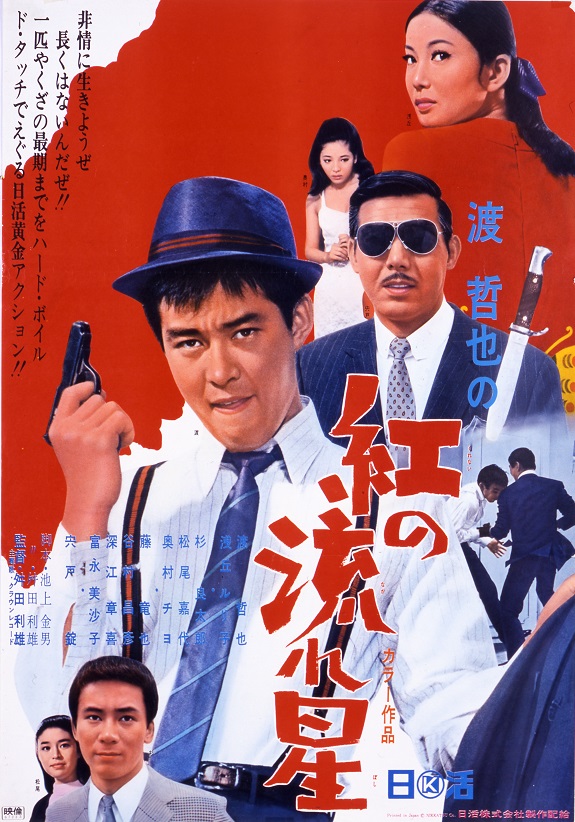
Velvet Hustler (紅の流れ星, Toshio Masuda, 1967)

Perhaps overlooked in comparison with his better known contemporaries, Toshio Masuda was a bankable talent at Nikkatsu directing some of the studio’s biggest box office hits largely thanks to his long association with tentpole star Yujiro Ishihara. Nine years on from their collaborative debut Rusty Knife, however, times had perhaps begun to change. Featuring vibrant colour production design by Tokyo Drifter’s Takeo Kimura, a frequent Seijun Suzuki collaborator, 1967’s Velvet Hustler (紅の流れ星, Kurenai no Nagareboshi, AKA Like a Shooting Star) is a reworking of Masuda’s own Red Pier, itself inspired by Julien Duvivier’s 1937 French thriller Pepé le Moko, with Tetsuya Watari in the role originally filled by Ishihara. Apparently drawing inspiration from Godard’s Breathless, Velvet Hustler is a thoroughly post-modern retake, a parodic tale of gangster ennui and post-war emptiness in which rising economic prosperity has brought with it only despair. 

When we first meet petty gangster Goro (Tetsuya Watari), he’s coolly standing by, leaning on a fencepost like a bored gunslinger as he waits for the perfect getaway vehicle. Jumping into a fancy red convertible which it seems has already been stolen by the young man who parked it in this packed car park, the wires handily hanging striped and exposed, Goro barrels along the highway and and performs an infinitely efficient drive-by shooting on a rival gang boss. According to the man who hired him, Goro was only supposed to cause serious injury, not death, but as he points out if the guy insists on dying that’s hardly his problem. Taking his paycheque, Goro agrees to lie low in Kobe for the next six months after which his boss will come and get him. A year later, however, and he’s still there doing not much of anything, hanging out with the local kids and acting as a procurer dragging sailors on shore leave into gang-run clubs where Americans get into fights with Vietnamese émigrés. So desperate for escape are they that Goro’s underling even suggests they go to war, later thinking better of it when he remembers seeing horrific photos from the front.  

In a convenient but unsatisfying relationship with bar hostess Yukari (Kayo Matsuo), Goro explains that it’s not that he doesn’t like her, but he’s bored, “bored with fooling around with women”, but also of the business of living. The sun comes up, the sun goes down, and then it comes up again, every day all the same. His life has become completely meaningless and he has no idea what to do about it. He longs to go back to Tokyo, but is trapped in this strange Kobe limbo land, an end of the line sea port in which there is ironically no sense of escape. He doesn’t know it yet, but there’s a killer (Jo Shishido) on his trail, a killer who eventually reminds Goro that even if he kills him first another man will come. The bullets you fire are aimed squarely at yourself, Goro’s destiny is already set. There is only one way out of Kobe and it doesn’t lead back to Tokyo. 

Meanwhile, another possibility presents itself in the beautiful Keiko (Ruriko Asaoka), a temporary visitor from the capital looking for her missing fiancé presumed to have done a bunk with her father’s money. Keiko is a distinctly cool yet self-assured figure, generating an instant connection with the affable gangster at once reassured by a sympathetic mama-san that Goro is good but also warned that he’s still a yakuza and as such no good for a smart young woman like her. Keiko thinks that Tokyo is pretentious and boring, confused by Goro’s insistence on getting back there but like him perhaps in waiting. “I love you to death” she later ironically confesses while simultaneously insisting that men and women are different. There is no escape for her. Goro is tired of running but refuses to be handcuffed, choosing perhaps the only path to freedom presented to him. 

A nihilistic tale of gangster ennui in which life itself no longer has value, Velvet Hustler is a curiously cheerful affair despite its essential melancholy, Goro and Keiko sparring in a romantic war of attrition while he almost flirts with the dogged detective (Tatsuya Fuji) determined to bring him down. The kitschy production design gives way to Antonioni-esque shots of a strangely empty city while an ethereal sequence of dissolves eventually leaves the pair alone on the dance floor as if to imply their single moment of romance is but a brief dream of emotional escape. The trappings of post-war success are everywhere from Keiko’s elegant outfits to the cute red sports car and the weird club where Goro dad dances in front of his minions, not so much older than them but clearly out of place in this distinctly unhip seaside bar, but finally all there is is a dead end and an infinite emptiness the embrace of which is, perhaps, the only viable path to freedom. 


Cruel Gun Story (拳銃残酷物語, Takumi Furukawa, 1964)

cruel-gun-story-poster.jpgIn the history of Japanese noir, the name Haruhiko Oyabu looms large. Oyabu’s gritty, pulp infused tales of tough guy heroes found their clearest expression in the hardline ‘70s with Toru Murakawa’s unique brand of macho action as seen in Resurrection of the Golden Wolf or The Beast Must Die, but a decade earlier they were also finding fertile ground in Nikkatsu’s harder B-movie noir. Based on a novel by Oyabu, Cruel Gun Story (拳銃残酷物語, Kenju Zankoku Monogatari) seems to owe more than a little to Kubrick’s The Killing in its crime never pays tale of honest crooks undercut by their unscrupulous comrades but the central message is that the gun is a cruel master and those living under its control will pay a heavy price.

Togawa (Jo Shishido) has just been (unexpectedly) given early release from a prison sentence incurred when he took revenge on the truck driver who knocked down his little sister (Chieko Matsubara) and confined her to a wheelchair for the rest of her life. Middle rank gangster Ito – formerly a crooked lawyer with a pencil mustache a supercilious air, has a job for him the gang thinks only he can do. The payout is 120 million yen – not to be sniffed at, but Togawa has reasons to be suspicious. He takes some convincing but finally relents when he finds out an old and trusted friend, Shirai (Yuji Kodaka), has already agreed. The gang have another three guys lined up but Togawa rules the third one out when he tests him and confirms he’s an untrustworthy blabbermouth. The other two are a former boxer with mild brain damage whose girlfriend has just left him, and an unscrupulous but clever chancer named Teramoto (Kojiro Kusanagi).

Following the general pattern, Furukawa walks us through the heist as it’s supposed to go if everything goes to plan complete with a 3D diagram and plastic toy cars but, of course, not everything goes to plan. The job is to steal the ticket money from the Japan Derby (much like the race course robbery in The Killing). The gang will set up fake road signs and station a “policeman” to divert the armoured car onto a small country lane where they will kill the police motorcycle escort, get rid of the guards, and load the truck onto a bigger lorry that they will then take to a disused US airbase they’ll use as their lair.

Disused American airbase could easily apply to the entirety of the surrounding area. Jets fly ominously overhead while the world Togawa and his guys inhabit is one of noirish jazz bars filled with foreigners, grimy boxing clubs, signs in English and the relics of destruction everywhere. This is a place for those who’ve already fallen through the cracks, even the gangsters are only really small fry – not yakuza but hoodlums ripped straight from the Edward G. Robinson playbook. This giant heist is the most audacious in living memory, pulling it off would be the finest achievement any of them would ever make, taking them out of their dead end environments and catapulting them into the criminal high life.

Togawa knows there’s something not right about this – he almost turns it down because he wants to be around to take care of his sister, but he also wants the money to pay for an operation he hopes will restore her mobility to assuage his guilt over having sent her out on the fateful day she was injured. Rie now lives in the care of kindly nuns and is a goodhearted, religious woman hoping for her big brother’s reformation. Togawa and his sister are also victims of war having lost their parents during the evacuation from Manchuria and have been essentially on their own ever since. Rie has become a living symbol of Togawa’s failures – his inability to protect her, to keep them both safe and together, and to free them of the ruined post-war landscape within which they both remain trapped. Rie pins her hopes on God, but Togawa says to hell with that – where has He been so far?

Having pinned his hopes on the gun, Togawa intends this to be the heist to end all heists. After this, he’ll be free to give his sister the life she deserves away from crime and the rundown town strewn with mementos of a distant, dethroned occupying power. The gun, however, is a divisive weapon and engenders nothing but mistrust among men. Resentful of Togawa’s solid friendships, the other guys turn on him as do his shady employers sending Togawa even further along the dark path to moral ruination than he already was. All that’s waiting for Togawa is a hollow victory and the intense disappointment of those whose faith in him was ultimately misplaced.